S2R For
Success
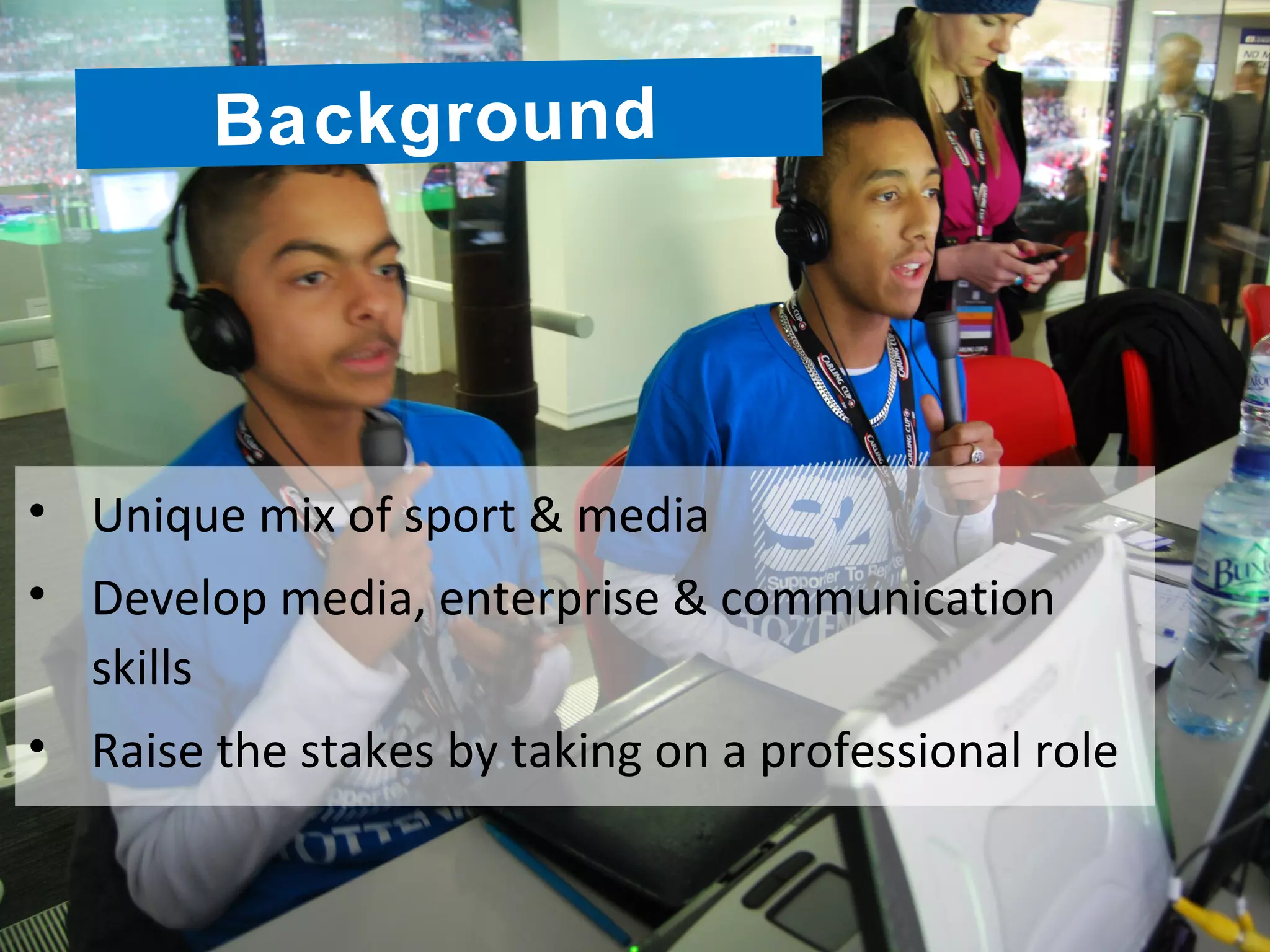
• Unique mix of sport & media
• Develop media, enterprise & communication
skills
• Raise the stakes by taking on a professional role
Background
S2R FS
Approach
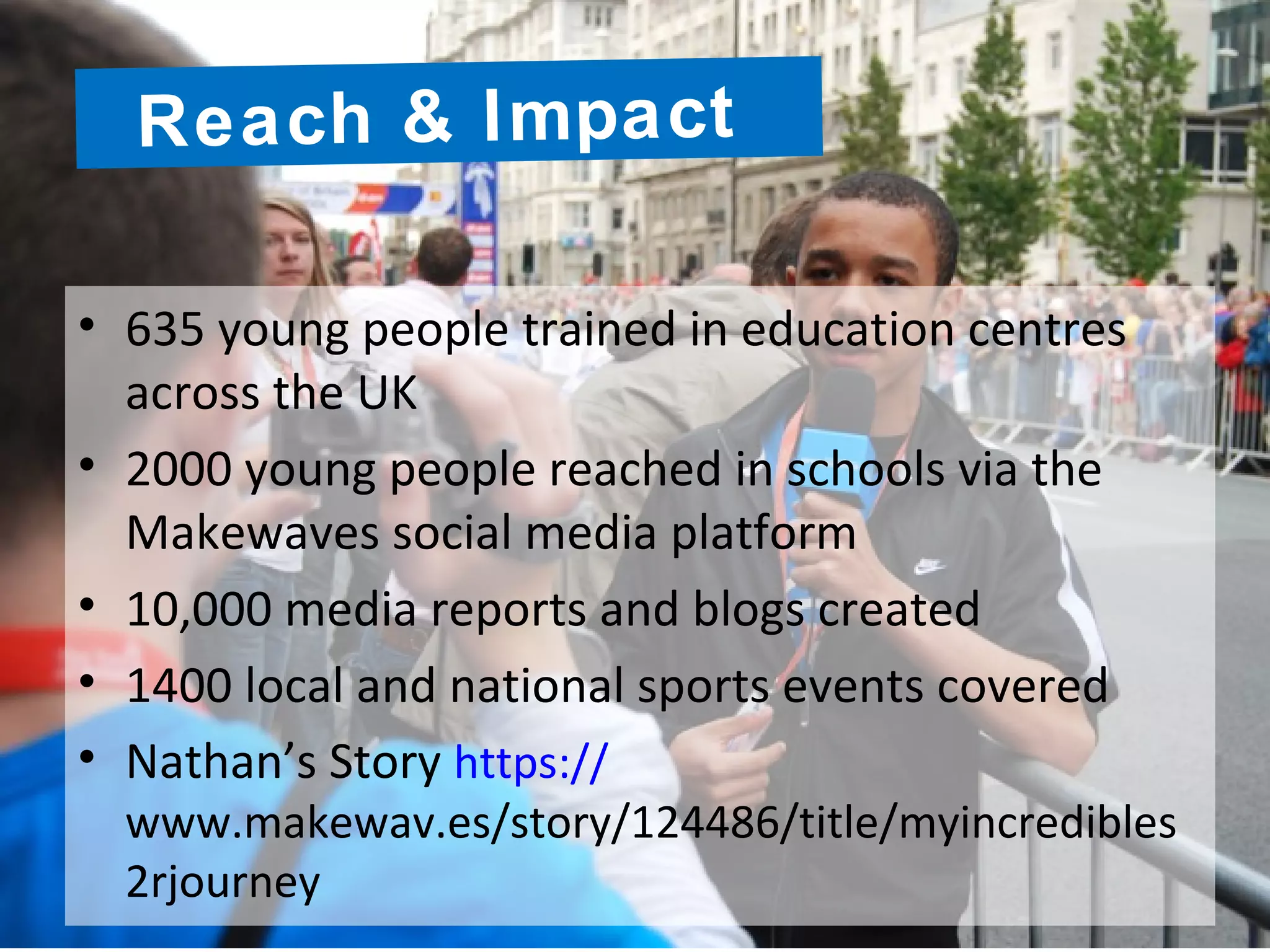
• 635 young people trained in education centres
across the UK
• 2000 young people reached in schools via the
Makewaves social media platform
• 10,000 media reports and blogs created
• 1400 local and national sports events covered
• Nathan’s Story https://
www.makewav.es/story/124486/title/myincredibles
2rjourney
Reach & Impact
S2R For Success
Programme
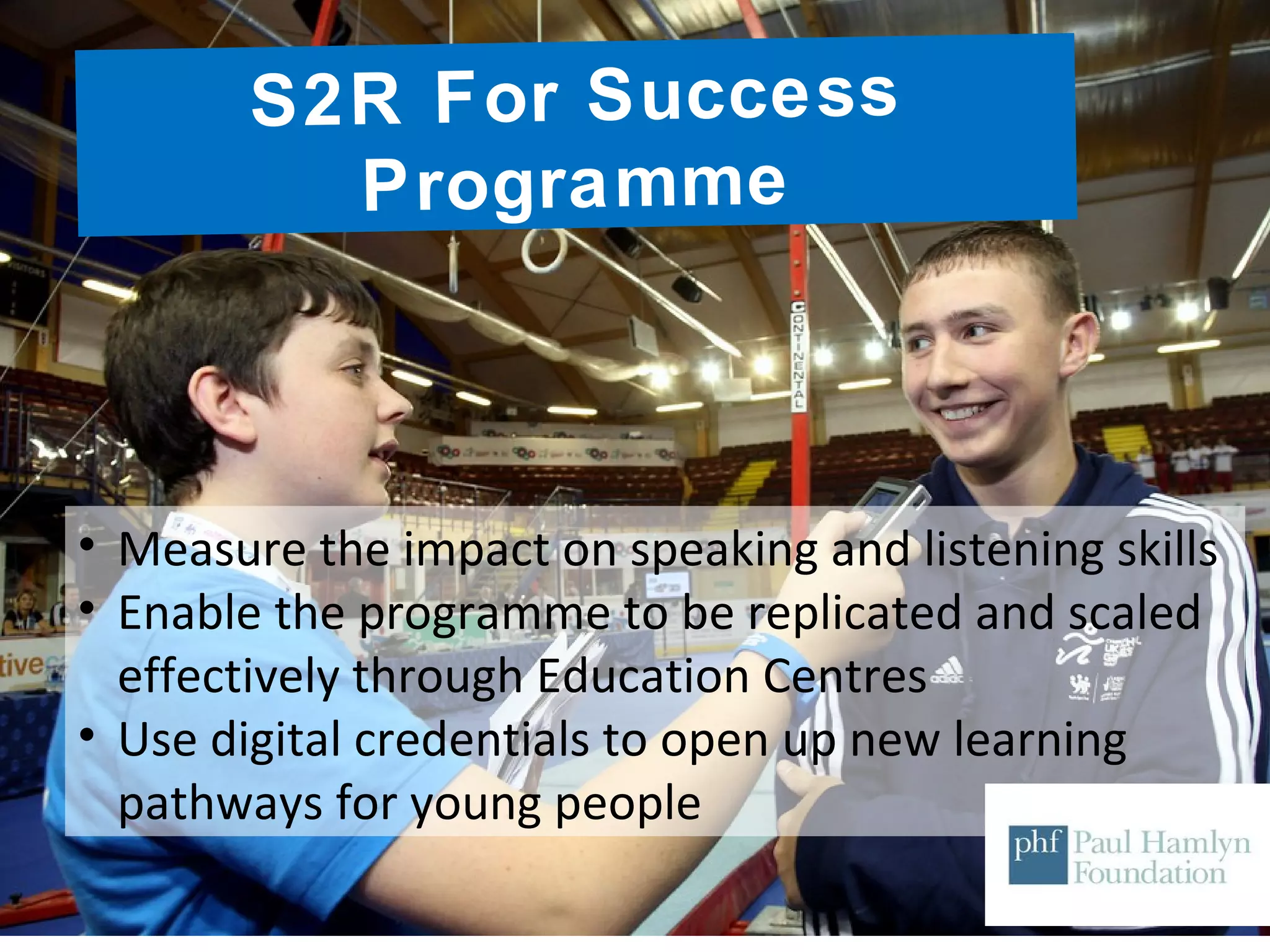
• Measure the impact on speaking and listening skills
• Enable the programme to be replicated and scaled
effectively through Education Centres
• Use digital credentials to open up new learning
pathways for young people
“S2R For Success is a programme
where 11-16 year olds enhance their
speaking and listening skills through
becoming sports reporters.”
S2R For Success
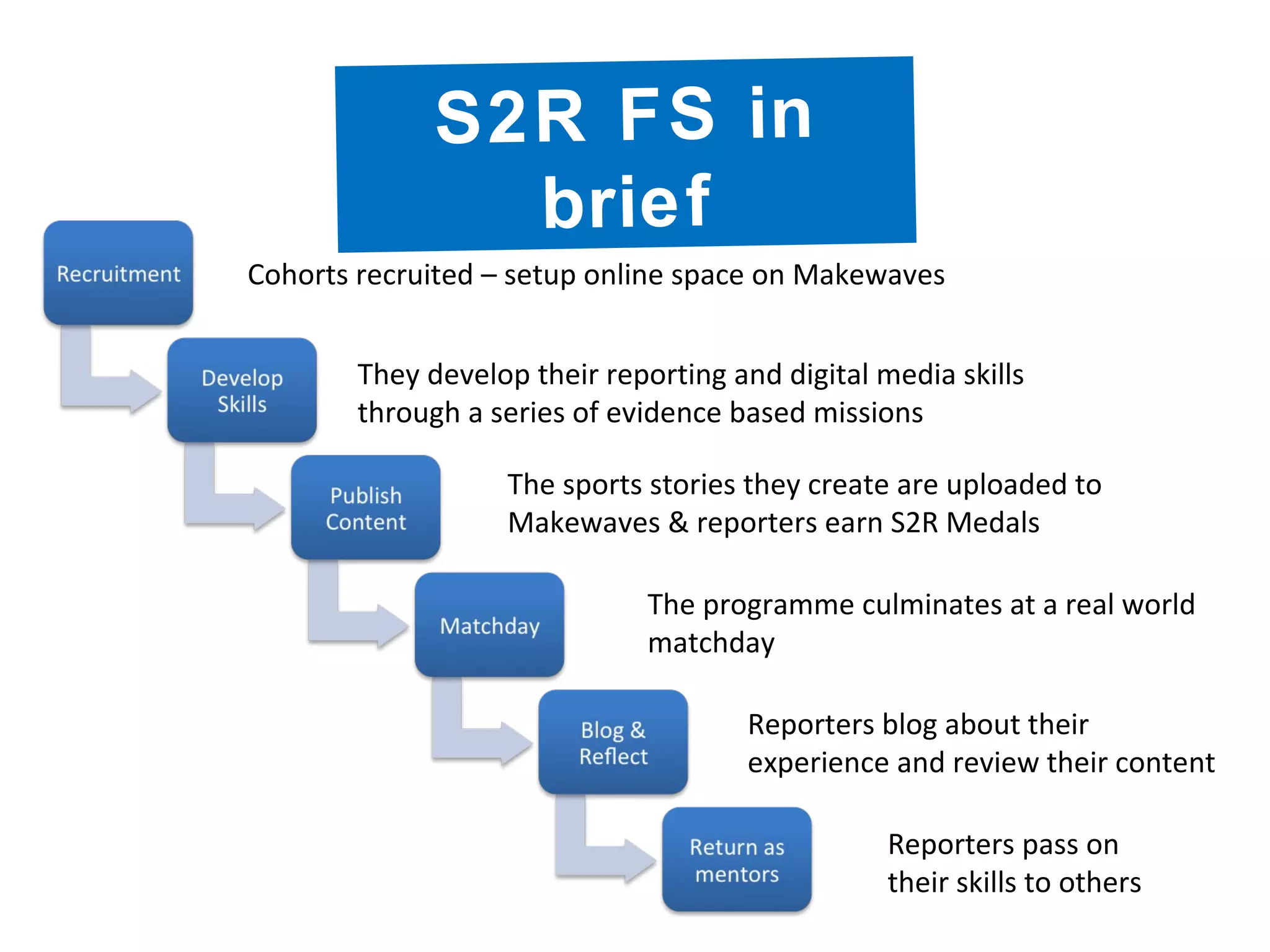
S2R FS in
brief
Cohorts recruited – setup online space on Makewaves
They develop their reporting and digital media skills
through a series of evidence based missions
The sports stories they create are uploaded to
Makewaves & reporters earn S2R Medals
The programme culminates at a real world
matchday
Reporters blog about their
experience and review their content
Reporters pass on
their skills to others
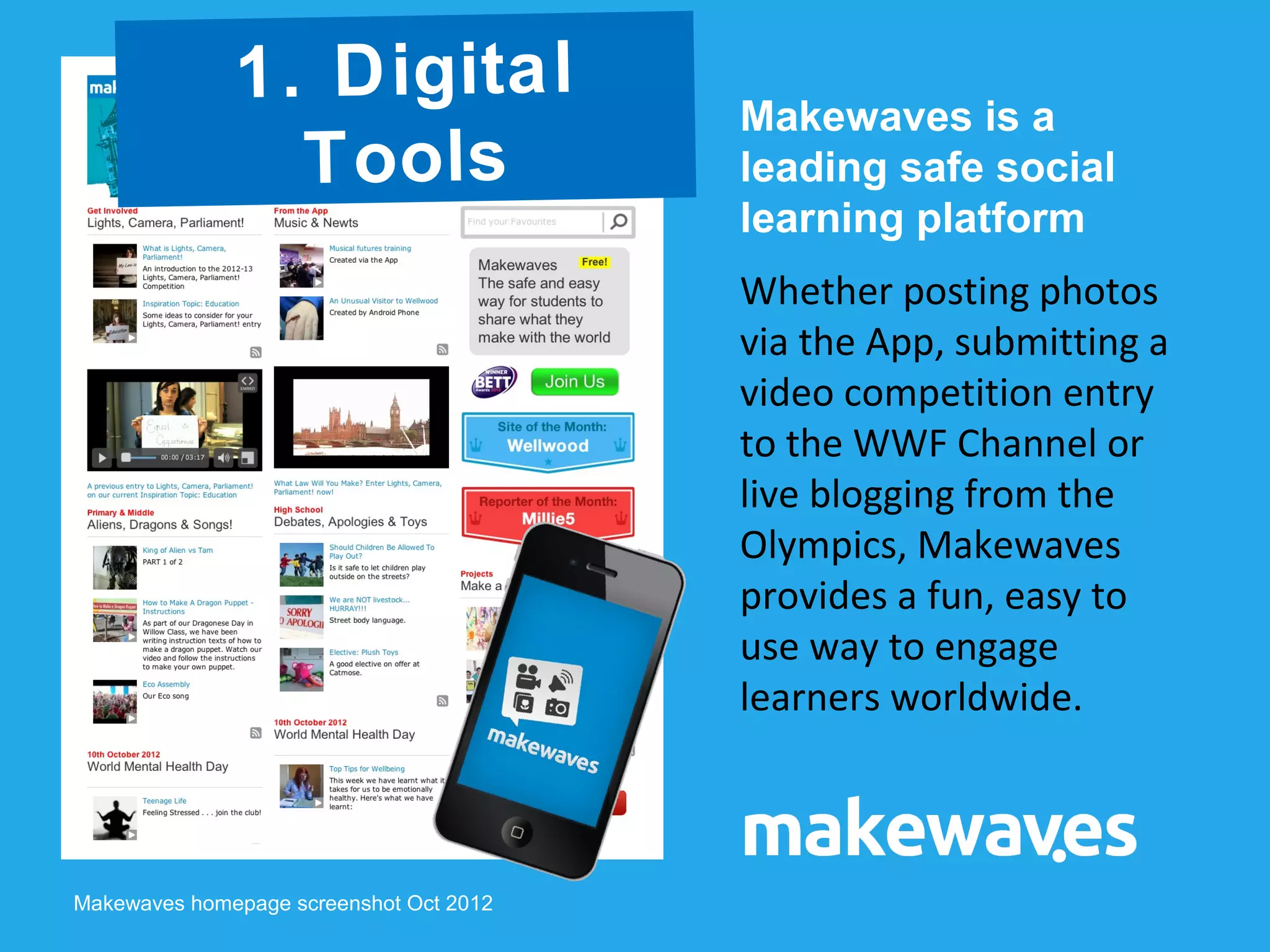
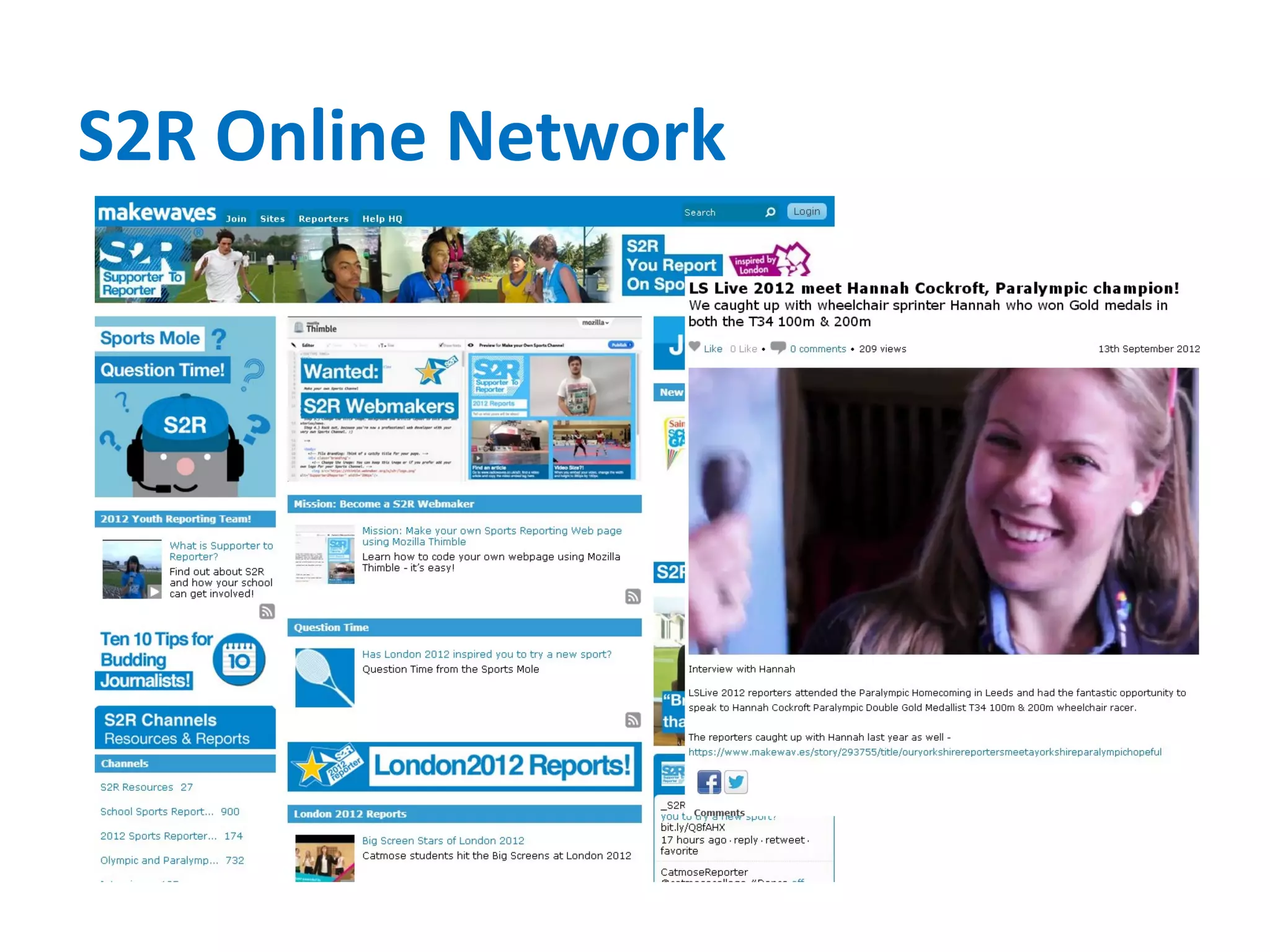
Makewaves is a
leading safe social
learning platform
Whether posting photos
via the App, submitting a
video competition entry
to the WWF Channel or
live blogging from the
Olympics, Makewaves
provides a fun, easy to
use way to engage
learners worldwide.
Makewaves homepage screenshot Oct 2012
1. Digital
Tools
S2R Online Network
2. Training & Support
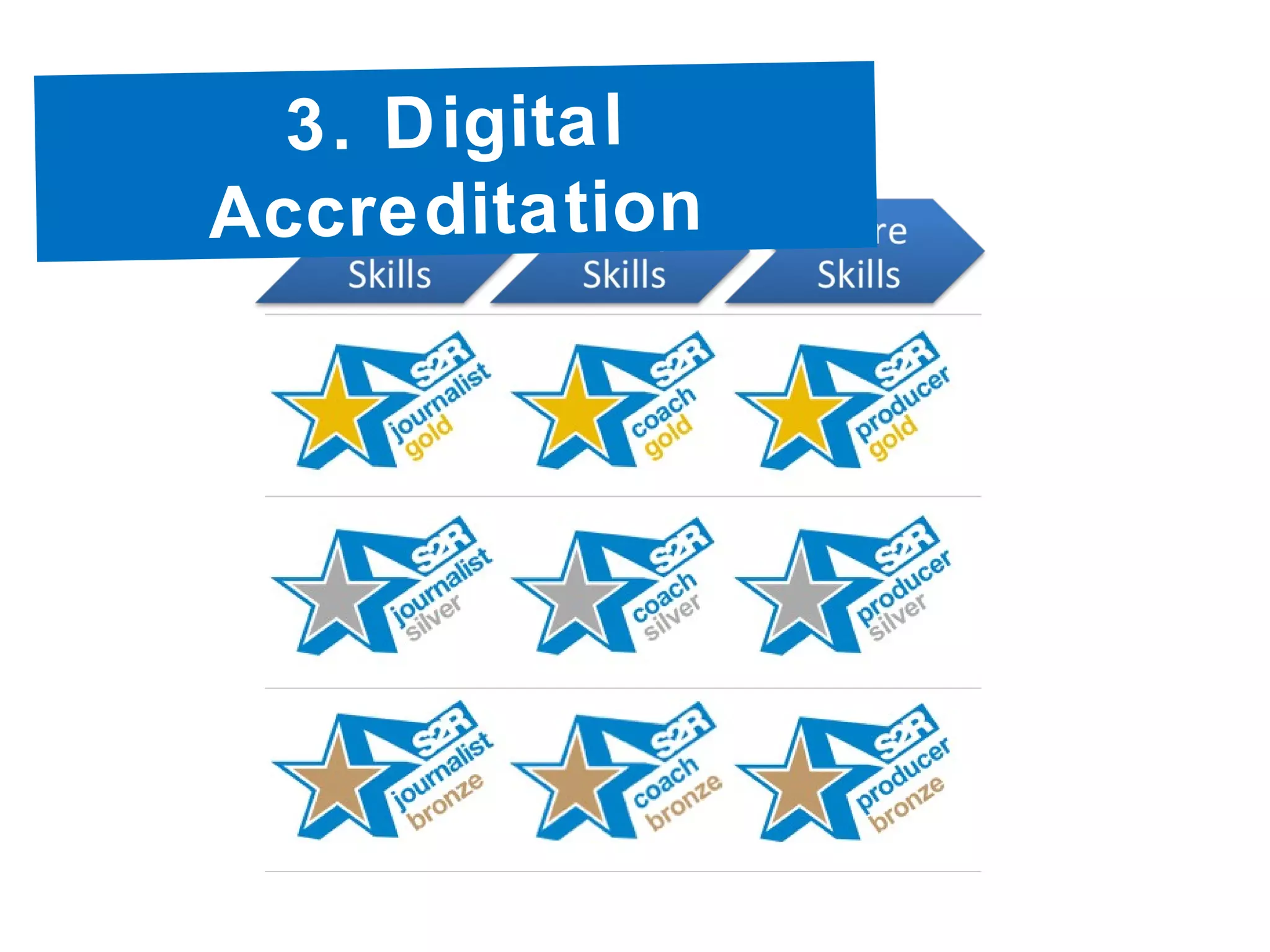
3. Digital
Accreditation
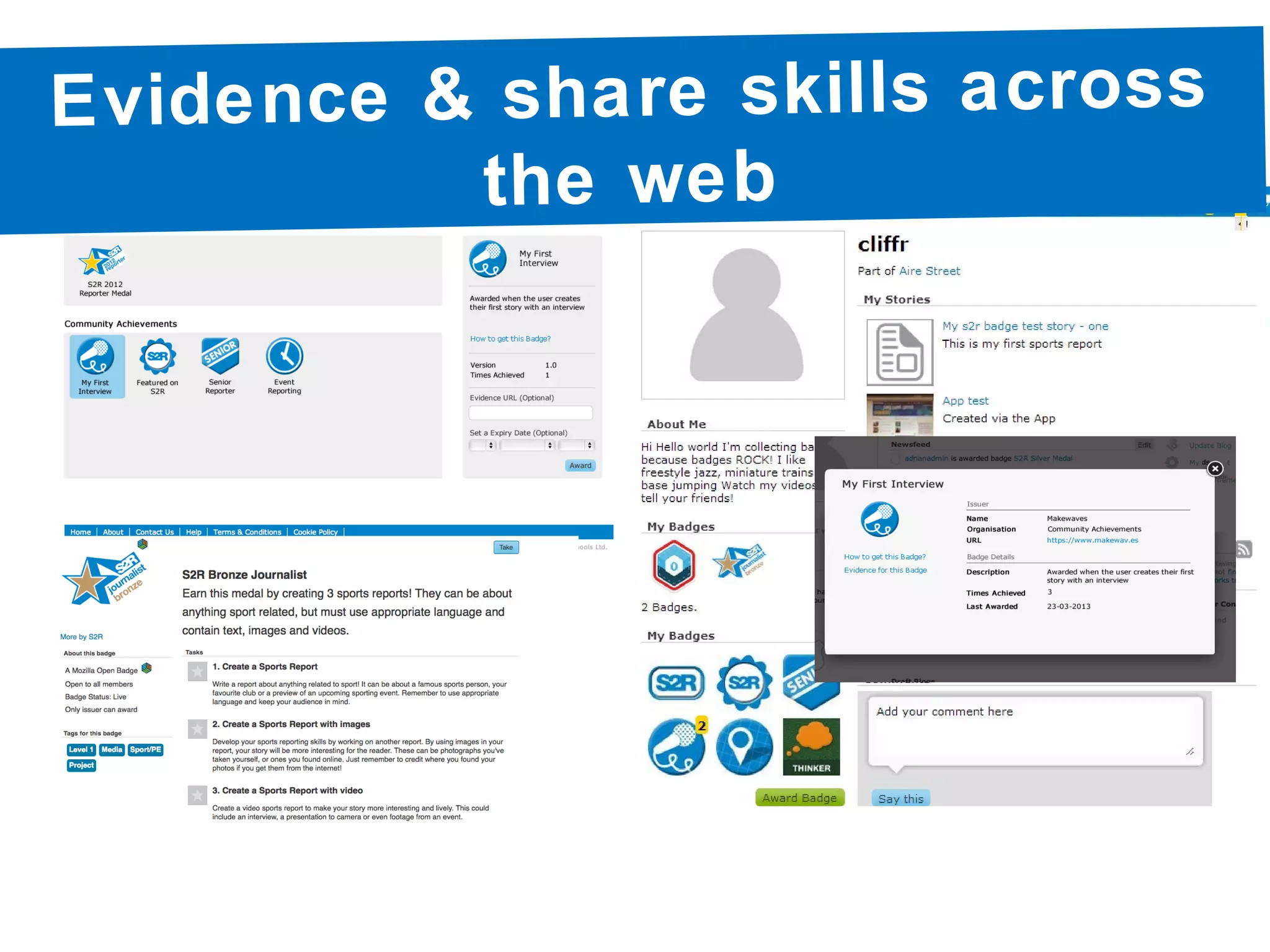
Evidence & share skills across
the web
What are badges?
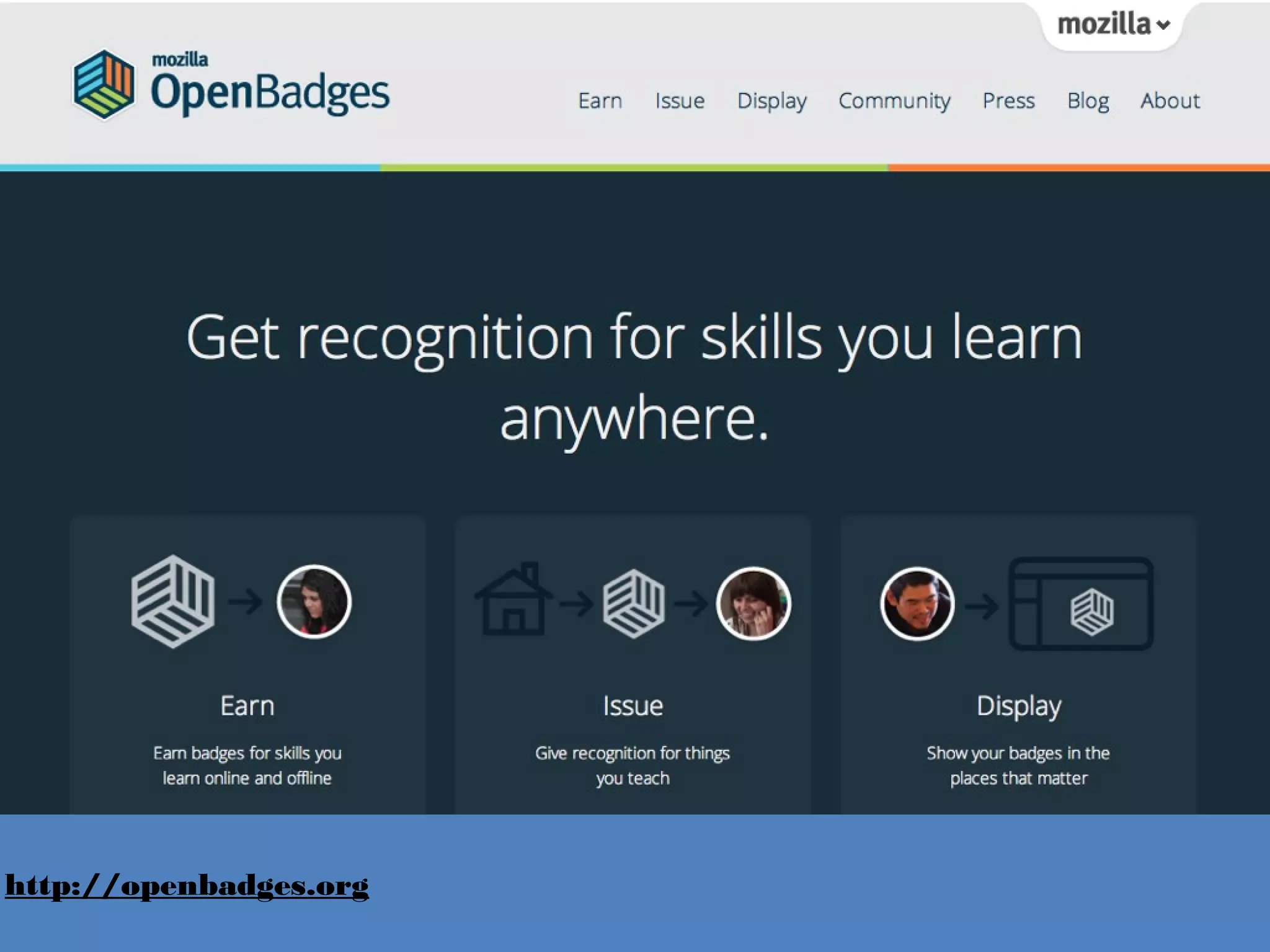
http://openbadges.org
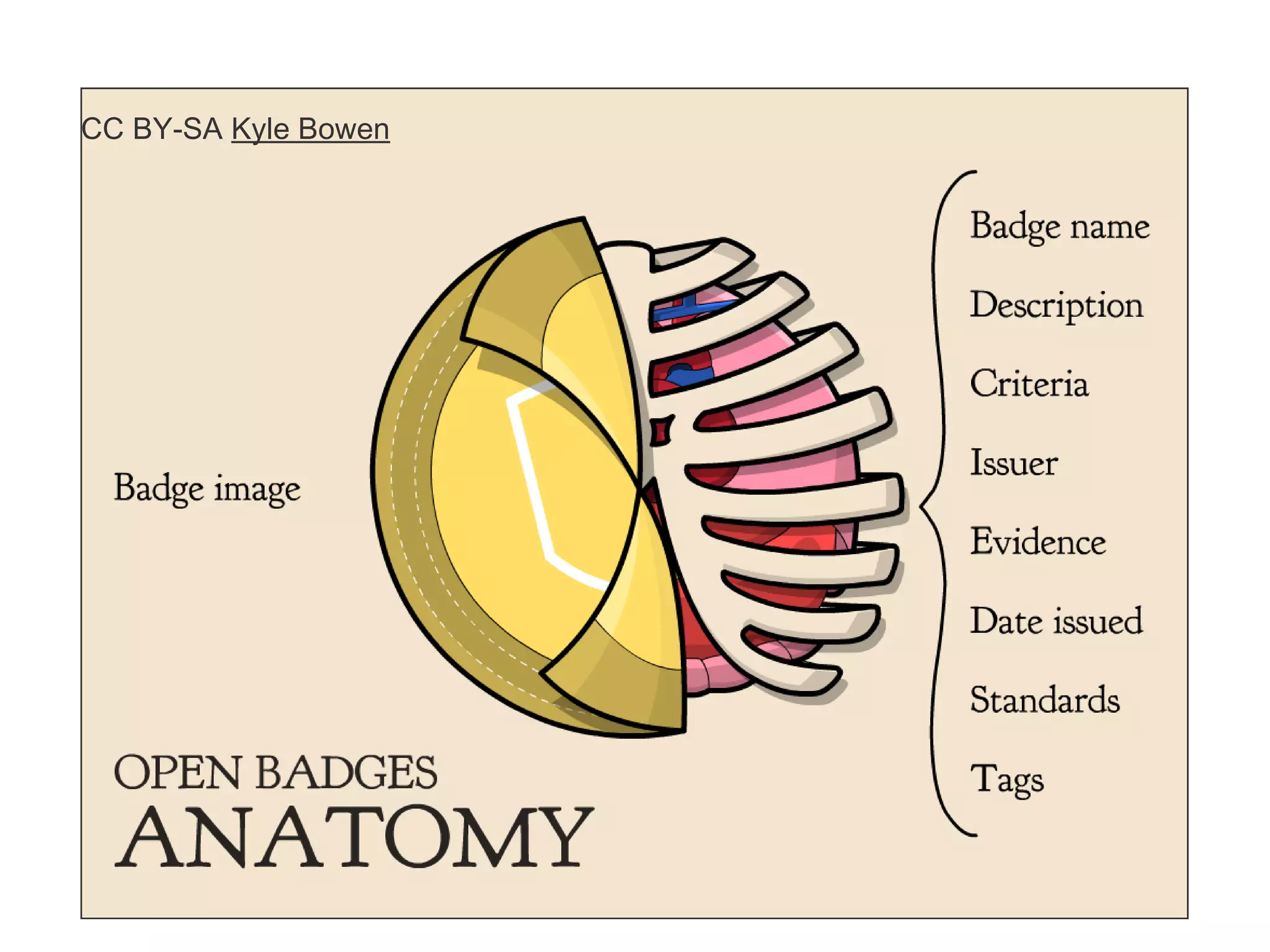
CC BY-SA Kyle Bowen
4. Measuring Impact
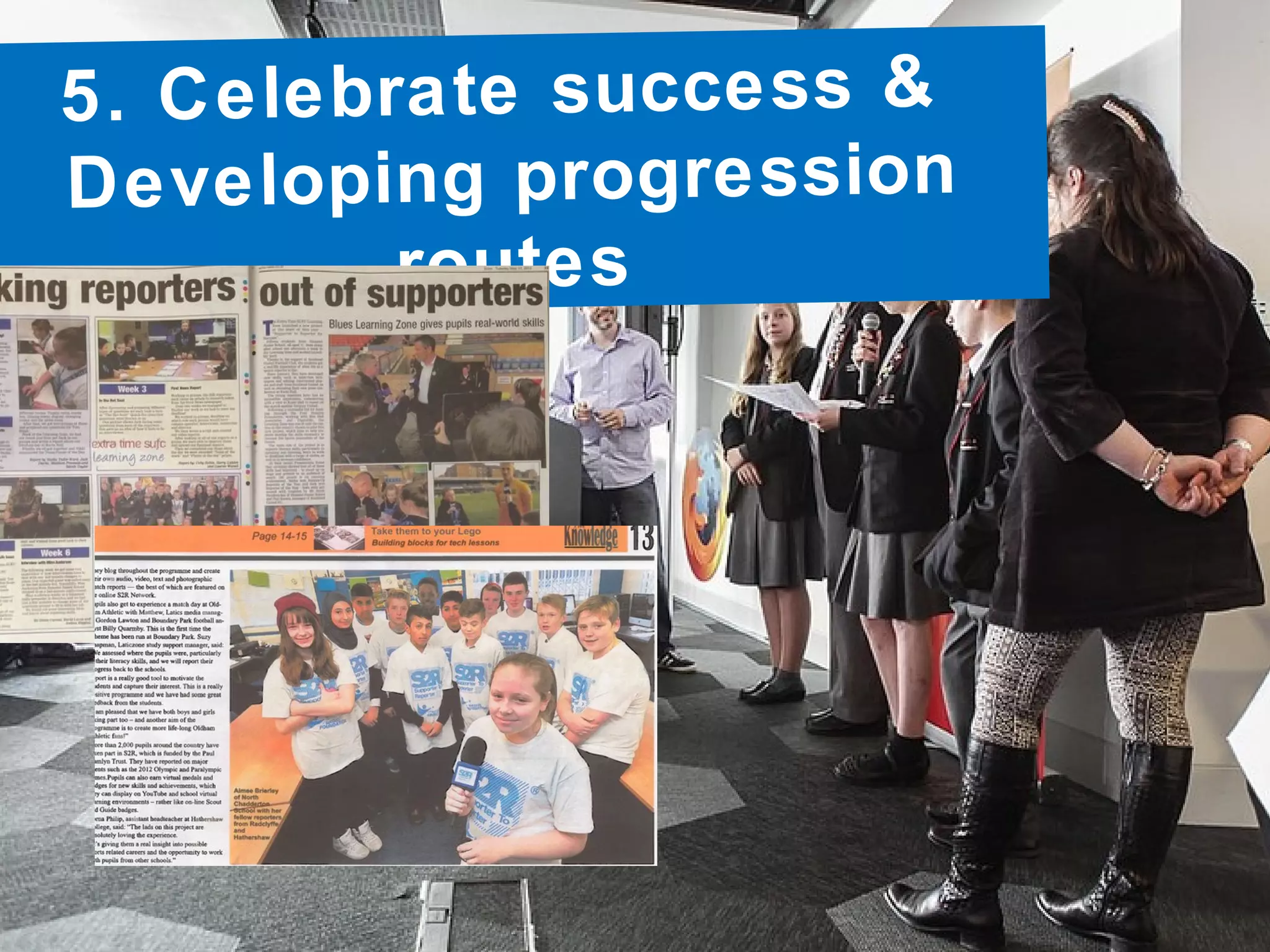
5. Celebrate success &
Developing progression
routes
6. Mentors
Case
Studies
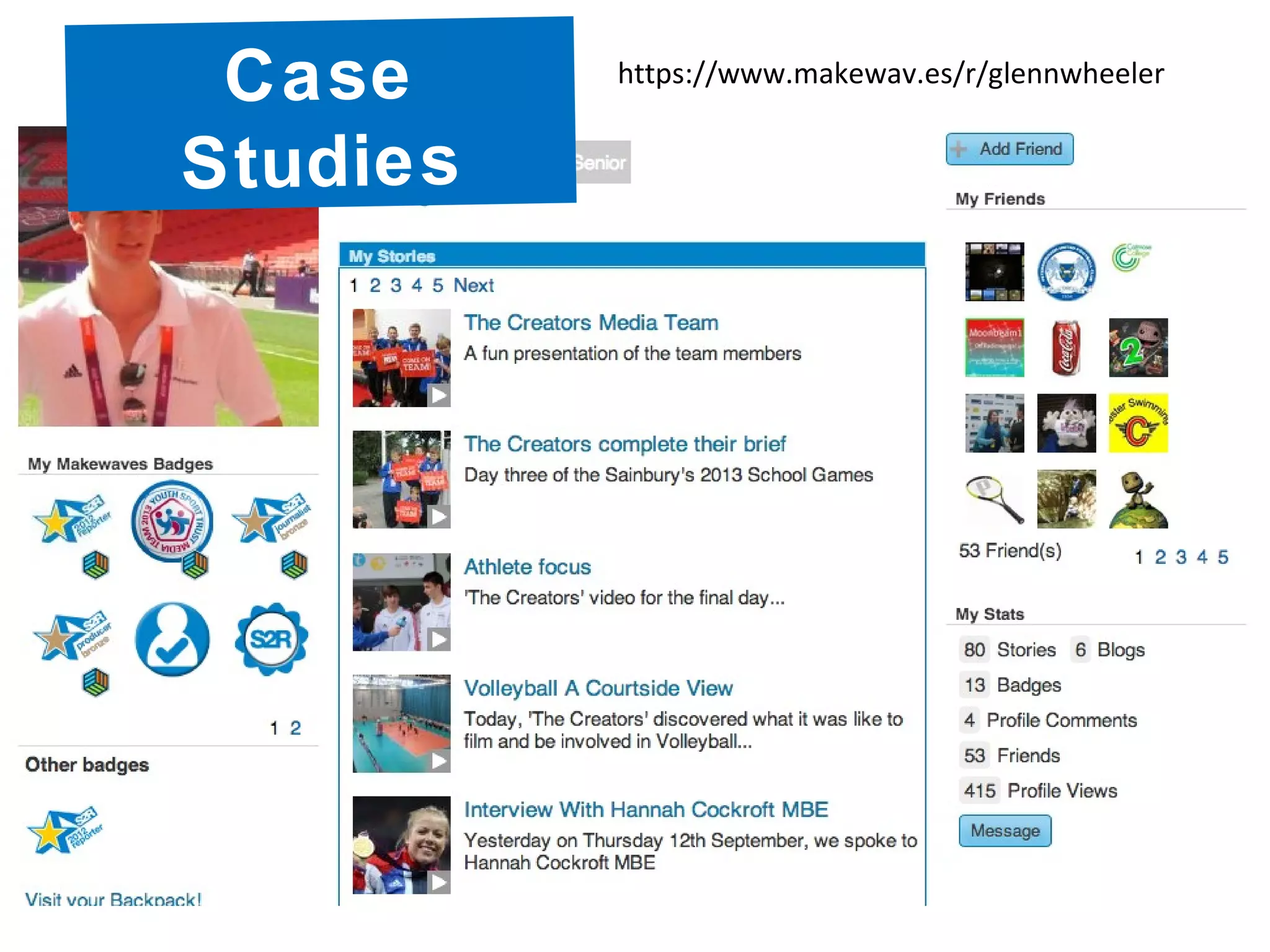
https://www.makewav.es/r/glennwheeler
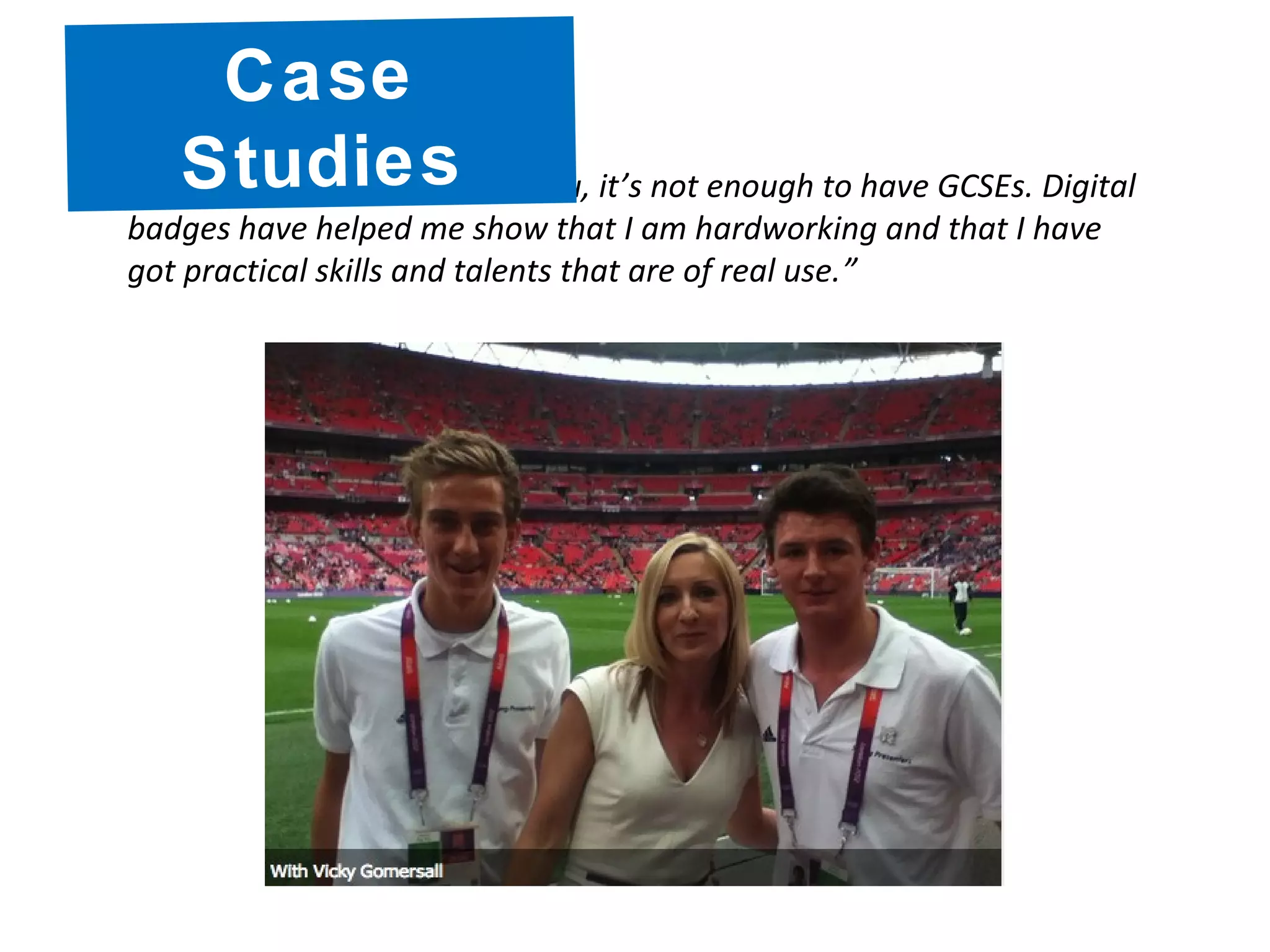
“To get employers to notice you, it’s not enough to have GCSEs. Digital
badges have helped me show that I am hardworking and that I have
got practical skills and talents that are of real use.”
Case
Studies
Questions?
Your S2R
Mission
Create a 1-2 minute video about one of the Education
Centres you have visited.
You must:
•Plan your video using a storyboard
•Work as a team to meet your deadline
•Include an interview
•Make your report interesting for the viewer!
Use the Makewaves app to publish your report online
Your S2R
MissionTips:
•Open your report with an energetic, informative
introduction that shows off your presenting skills
•Use open questions to gather interesting information
from interviewees
•Think about how your report looks – what
background and camera angles will help tell your
story?
•Don’t leave your viewers hanging – finish off your
report with a clear, summary ‘outro’
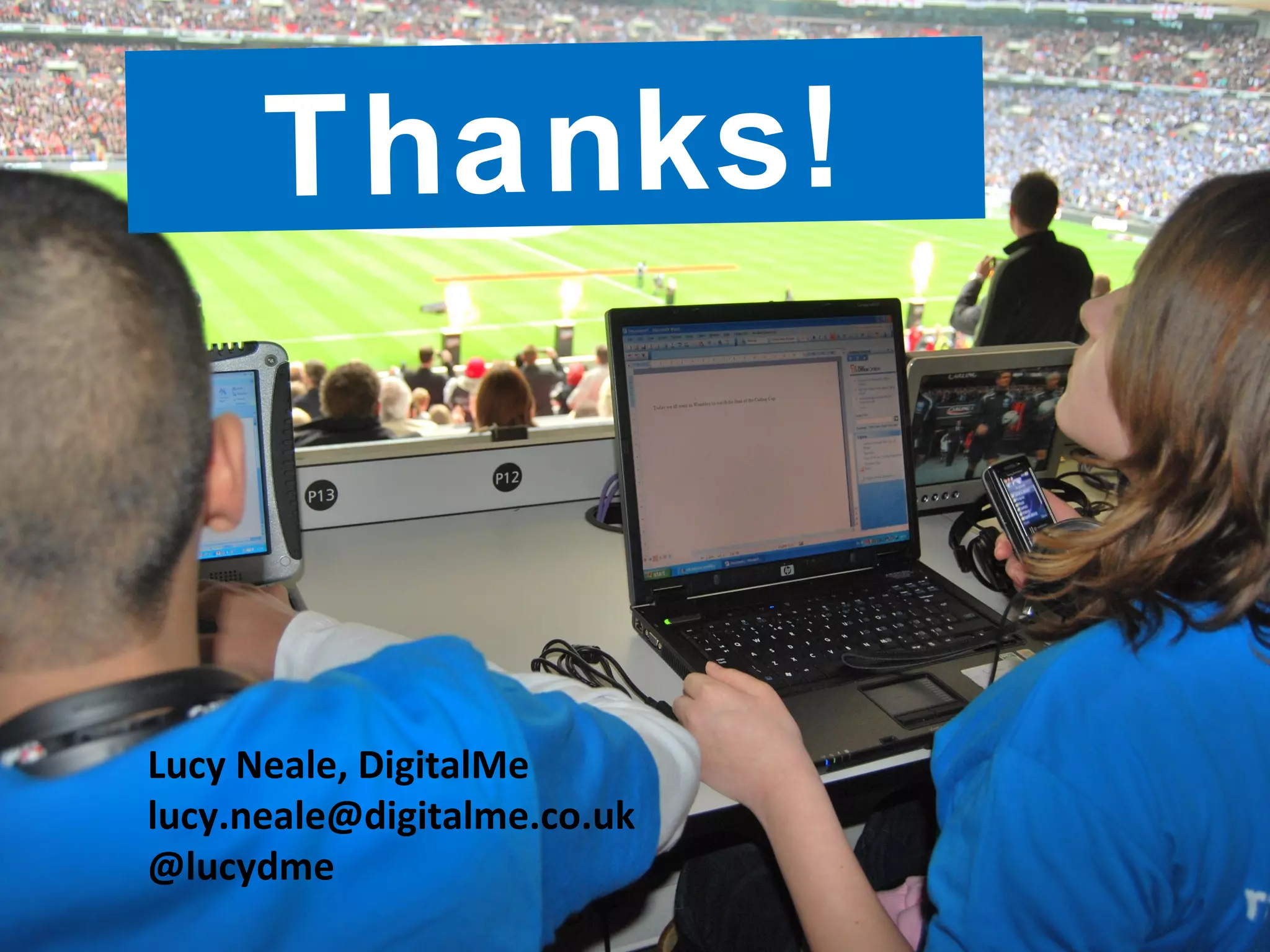
Thanks!
Lucy Neale, DigitalMe
lucy.neale@digitalme.co.uk
@lucydme

S2R For Success Netherlands presentation

  • 1.
  • 2.
    • Unique mixof sport & media • Develop media, enterprise & communication skills • Raise the stakes by taking on a professional role Background
  • 3.
  • 4.
    • 635 youngpeople trained in education centres across the UK • 2000 young people reached in schools via the Makewaves social media platform • 10,000 media reports and blogs created • 1400 local and national sports events covered • Nathan’s Story https:// www.makewav.es/story/124486/title/myincredibles 2rjourney Reach & Impact
  • 5.
    S2R For Success Programme •Measure the impact on speaking and listening skills • Enable the programme to be replicated and scaled effectively through Education Centres • Use digital credentials to open up new learning pathways for young people
  • 6.
    “S2R For Successis a programme where 11-16 year olds enhance their speaking and listening skills through becoming sports reporters.” S2R For Success
  • 7.
    S2R FS in brief Cohortsrecruited – setup online space on Makewaves They develop their reporting and digital media skills through a series of evidence based missions The sports stories they create are uploaded to Makewaves & reporters earn S2R Medals The programme culminates at a real world matchday Reporters blog about their experience and review their content Reporters pass on their skills to others
  • 8.
    Makewaves is a leadingsafe social learning platform Whether posting photos via the App, submitting a video competition entry to the WWF Channel or live blogging from the Olympics, Makewaves provides a fun, easy to use way to engage learners worldwide. Makewaves homepage screenshot Oct 2012 1. Digital Tools
  • 9.
  • 10.
  • 11.
  • 12.
    Evidence & shareskills across the web
  • 13.
  • 14.
  • 15.
  • 17.
  • 18.
    5. Celebrate success& Developing progression routes
  • 19.
  • 20.
  • 21.
    “To get employersto notice you, it’s not enough to have GCSEs. Digital badges have helped me show that I am hardworking and that I have got practical skills and talents that are of real use.” Case Studies
  • 22.
  • 23.
    Your S2R Mission Create a1-2 minute video about one of the Education Centres you have visited. You must: •Plan your video using a storyboard •Work as a team to meet your deadline •Include an interview •Make your report interesting for the viewer! Use the Makewaves app to publish your report online
  • 24.
    Your S2R MissionTips: •Open yourreport with an energetic, informative introduction that shows off your presenting skills •Use open questions to gather interesting information from interviewees •Think about how your report looks – what background and camera angles will help tell your story? •Don’t leave your viewers hanging – finish off your report with a clear, summary ‘outro’
  • 25.

Editor's Notes

  • #2 1. Hi – really pleased to be here today. Tell you a bit about S2R and our new programme of work in partnership with For Success Share an overview of the programme, some examples and case studies of it in action – then get you working together to have a go! 2 Who DigitalMe are – non profit based in Leeds, delivering digital learning projects that develop employability skills in young people – place them in a role and develop skills, character, resilience to enable them to transition more smoothly into training or work. Work with schools, charities and employers to deliver this work and we have just started using a new digital credentialing technology called open badges to create a new skills currency for young people – tell you more later 3 We run a number of programmes but Supporter to Reporter is long standing flagship project. Originally funded by Football Foundation in 2008, piloted at Lancashire Cricket Club, became a national programmes delivered via 9 regional PFS centres.
  • #3 1. What is S2R? Project that increases skills and confidence by turning young people into sports reporters. S2R’s origins were in the aim higher project – a national scheme aimed to increase skills & confidence and raise aspirations of young people who were capable of continuing into higher education but didn’t have a family background of University education. 2. 3 key principles at its heart. Use mix of sport and media to motivate young people to learn (particularly entice boys – but ended up 50/50)v` Use a project based learning approach to develop a range of skills: communication, teamworking, leaderships – PROCESS go through a training programe to learn how to create media reports, respond to briefs, set their own briefs and conduct interviews, publish online and promote their work to an audience online via a safe social network Raise the stakes by putting young people in a professional environment – culminating in a match day where they worked together to meet deadlines 3. Since 2008 developed programme based on these key objectives Worked in education centres across UK – supported the training and role out of programme Intensive model, delivered by media experts or through intensive training of centre staff.
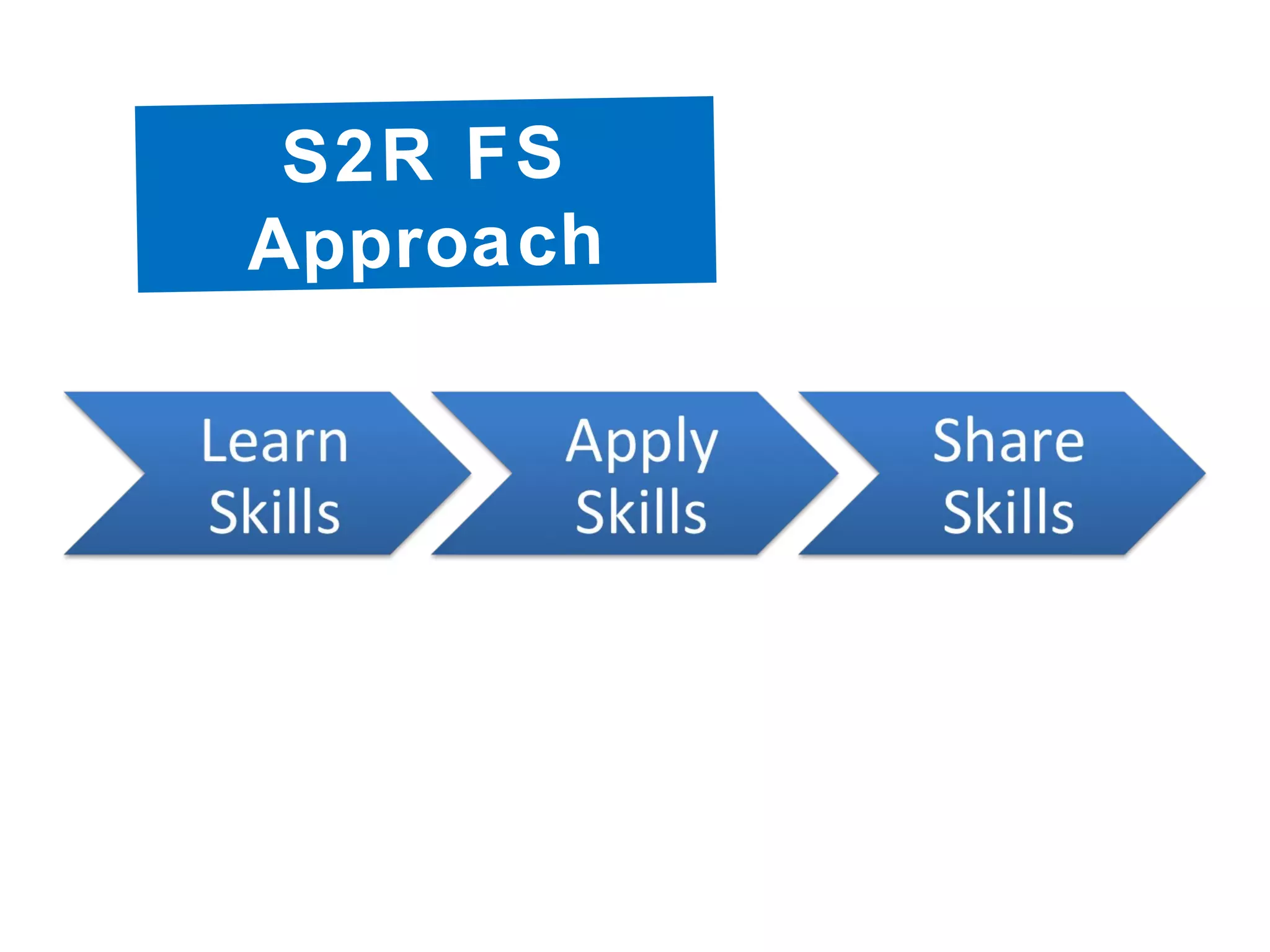
  • #4 1 We know this approach to project based learning is the most effective at developing skills & competencies 2 Move freom left to right – deepens learning. deep learning has taken place – ensures behaviours are developed 3 Passing on skills shows leadership – ongoing commitment, enables scale and opens up progresssion routes
  • #5 Very successful programe – huge reach and impact, Young people report improved self – confidence, self esteem, raised aspirations and presentation/communication skills Many local and national events covered and some young people were able to unlock prestigious opportunities to report at Premier League games, Wembley & Olympics https://www.makewav.es/story/124486/title/myincredibles2rjourney 2. BUT – expensive, heavily facilitated & time intensive, centres received 5 days direct training and support each to deliver – coupled with a time when pfs centres closed, funding disappeared SO needed to find a new model One that could: Scale more easily Be easily replicated without our direct support BUT not lose the essence of the project More effectively capture the skills and achievements young people earn to demonstrate value to schools and parents 3. Things we needed: Evidence base for programme Way of accrediting programme to add value for teachers, students & parents Way of delivering the project digitally to enable scale
  • #6 1. 2012 Presented with the opportunity to work in partnership with for success – fantastic opportunity to work together to refine the model by working closley with education centres. For Successes deep knowledge and understanding of how centres run which means they can provide real insight into how we need to structire the programme moving forwards to ensure it has credibikity and impact. Objectives of partnership: Working with 12 centres in UK to roll out this approach and refine scalable model, working with local stakeholders – FS uniquely placed to provide packages of support at centre level to enable the successful piloting of the scheme Formally evaluate the impact on speaking and listening skills, writing skills & ICT Introduce a new digital credentialling technology (open Badges) to capture achievements and develop new progression routes for young people after the programme
  • #7 Develops lots of skills but primarily about speaking and listening – making young people more confident communicators. Focussing on key transition points 12 education centres in UK – supporting those centres to roll programme out to schools locally.
  • #8 Revised programme centres are being supported to deliver in brief: 1. Centre staff are centrally trained and then supported to recruit a cohort of young people 2. They deliver skills workshops over 20 hours with a focus on improving speaking and listening skills through presenting themselves and information to camera and online. Young people respond to a number of challenges including interviewing a member of the club, working in a team to meet deadlines, problem solve and think creatively. 3. Present their work to an audience online and gather digital credentials 4. Match day challenge 5. Refelct on journey and some young people return as mentors to support the next cohort Receive resousrces, training and digital tools to enable the delivery of this
  • #9 So – key things needed for the project to work. 1. Digital tools: Makewaves – safe space to publish content, connect with other young people Used by over 5000 schools and educational groups worldwide Safe moderated community – all members and content are approved Young people get own portfolio pages to show their work – can present content safely to an audience
  • #10 Community within MW - Online channel, access tutorials and support, share reports and connect with experts and other reporters. Access national opportunities and activities. Young people create media stories
  • #11 Centres receive a package of training and support from FS – critical friend visits
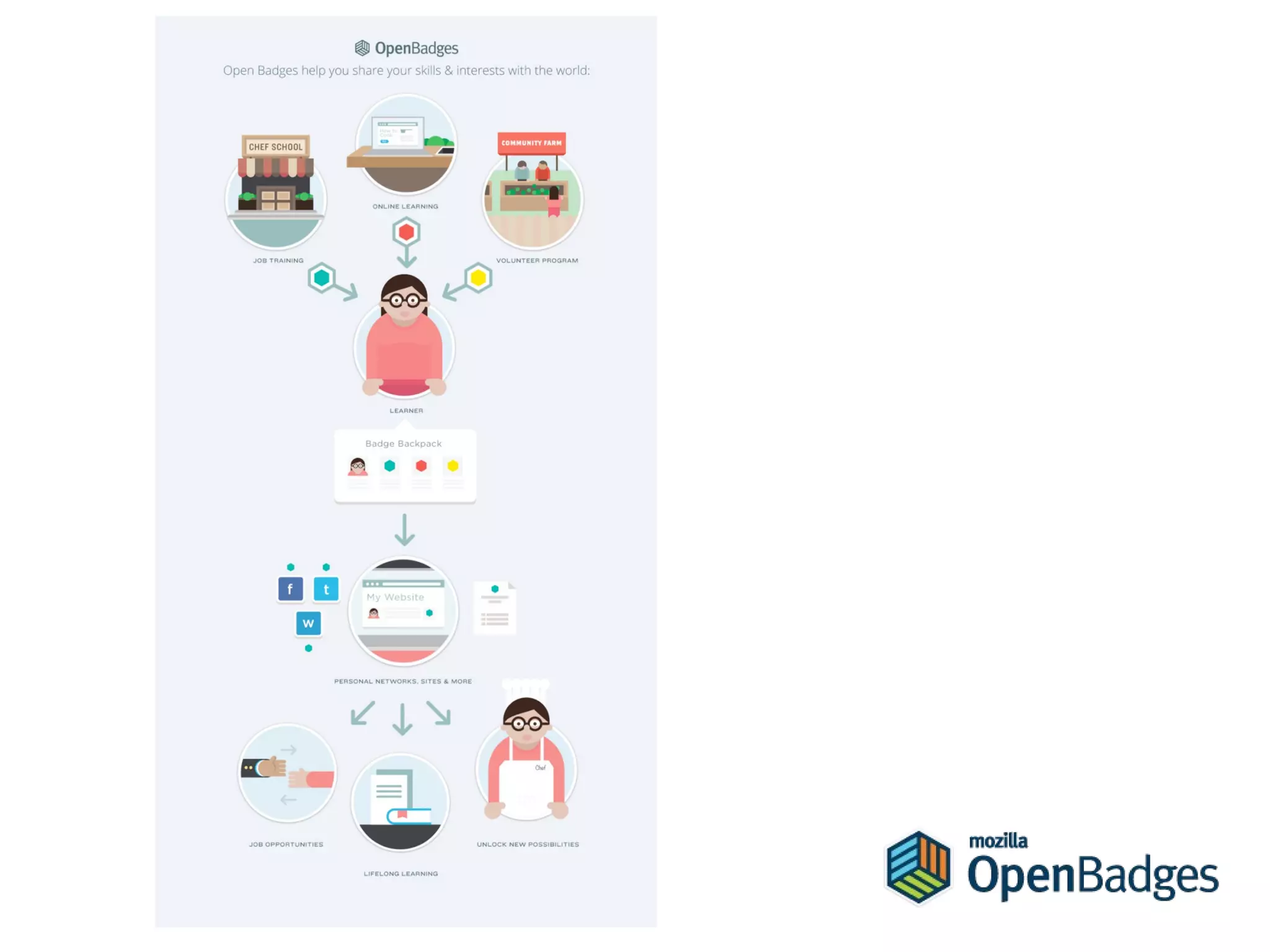
  • #12 Open badges are used to scaffold the learning journey – to motivate young people to engage and progress, but also to ensure they have something that they can take away from the project Different levels at each stage – about measuring knowledge as well as effort, commitment and distance travelled. Flexible accreditation so all young people can access and personalise
  • #13 This is what badges look like – can be shared with schools/employers and link to evidence. Really exvitings
  • #14 Those of you that may not have heard of badges – I’ll give you a quick overview here… All familiar with offline badges Useful – familiar with idea of recognition but also limiting
  • #15 Develop by Mozilla Foundation – global non-profit. Mozilla is a global, nonprofit organization dedicated to making the Web better. We believe that the Web is a shared public resource to be cared for, not a commodity to be sold. Creates open source tools to enable people to learn how to create the web, not just consume it. Good ethos around privacy and data – open badges are about enabling learners to own their own data Designed specifically for skills recognition Specifically to create new learning pathways. Open in two ways: Anyone can create them (brings up issues of value) Open data – user owns their data and can display where they choose to So how does this work?
  • #16 An Open Badge is a metadata-infused credential.Metadata is data about data. So in the same way that the index of a book has information about what's contained the book, so a badge has information inside it.
  • #18 Evaluation important – FS providing the pedagogy and structure to enable the approach to be effectively monitored and impact measured
  • #19 1. Development of progression routes through celebrating success etc 2. Good links with club and community (media, employers, schools) are crucial to ensure the programme is embedded and has longevity for the participants 3. Opportunties for progression opened up locally & nationally
  • #20 In order to enable scale, important mentors return Aim is to enable young people to pass on their skills, both on and offline. Currently exploring the best models to enable this to happen.
  • #21 “G” a young male participant in the Colchester West S2R programme built up an impressive ‘backpack’ of 13 Open Badges reflecting the various journalistic skills he gained through the project. Displaying his badges on the S2R site, he also used them as part of his online CV to secure a position as a ‘youth media presenter’ at the 2013 Olympic games. “To get employers to notice you, it’s not enough to have GCSEs. Digital badges have helped me show that I am hardworking and that I have got practical skills and talents that are of real use.” https://www.makewav.es/r/glennwheeler CLICK!
  • #24 Have a look around the s2r site – we are going to create a vide story In groups plan & storyboard Train on ipod Use MW app to upload
  • #25 Have a look around the s2r site – we are going to create a vide story In groups plan & storyboard Train on ipod Use MW app to upload