Safflower
SAFFLOWER PRODUCTION PRACTICES IN
PAKISTAN
Introduction
Safflower was introduced as oilseed crop in Pakistan in 1960. It is mainly cultivated in Sindh and
Baluchistan Provinces. During 1997-98, total area under this crop was 1594 ha with production of 1129
tones. Safflower research work was started in 1976 at National Agricultural Research Centre, Islamabad.
Being drought tolerant crop it is recommended for planting in rainfed areas. In Sindh it is cultivated on
residual moisture after rice. Safflower seed contains 26-37 % oil. Its oil is most popular for its high quality.
Improved Production Technology
1. Land Selection and Preparation
Light clay to heavy clay land with good drainage system is most appropriate for this crop. To get more
production, at least one to two ploughings are sufficient. For deep ploughing mold boald (MB) plough can
be used. After this cultivator and planker are used to make the land even and pulverized.
2. Sowing Time
a. Canal irrigated area October 20, to November 30
b. Barani area October 15, to November 15
3. Sowing Method
Like other Oilseed crops, it must be sown in lines. In barani areas, line to line distance should be 60
centimeter (2 feet) and in irrigated areas, 45 centimeter (1.5 feet). In proper moisture conditions, sowing
may be done with hand or wheat drill.
4. Seed Rate
In barani areas the recommended seed rate varies from 6 to 7 kg and in irrigated areas 8 to 9 kg. If the
crop is cultivated by broad cost method then use 20 % more seed (9-11 kg/ha).
5. Thinning
When the plants become 10 centimeter high, thinning may be done with hands. After thinning plant to
plant distance should be 10 to 15 centimeter so that the required plant population may be maintained in
the field. Plant population should be 167000 (60 cm x 10 cm) and 111,000 (60 cm x 15 cm) per hectare.
6. Hoeing
In the beginning, growth of safflower is slow so that the field should be clean from weeds to have good
plant establishment. In case of line sowing Rotary hoe may be used once or twice before flower initiation.
7. Recommended Varieties
In Pakistan, the commercial varieties of safflower are Gilla, US-10, S-208 (spiny) Thori-78 and Pawari-95
(spineless). These varieties are also recommended for dry areas of Frontier Provence. Oilseeds
Research Programme of PARC evaluated a large number of varieties in National Uniform Yield Trials
during last 3-4 years and results show that the BI-9740 and BI-4059 are best in yield in Potohar Region.
8. Fertilization
Area Dose per acre Time of Application
DAP Urea
a. Canal irrigated One bag One bag at sowing and bed preparation
b. Barani One bag One bag at seed bed preparation
9. Irrigation
Due to its deep root zone, safflower crop can get moisture from the lower surface. During season 2-3
irrigation are sufficient. First irrigation should be given 1-1/2 to 2 months after germination; second
irrigation at flowering time and last irrigation should be given at the seed development time.
10. Diseases of Safflower
1. Alternaria and Remularia Leaf Blight
In humid season, due to these both diseases brown and blackish spots appear on leaves. In swear attack
of disease the spots become closer to each other resulting in the whole plant damage.
i). Bacterial Blight
This disease spreads due to high moisture in the air. Use of healthy seeds is very essential to minimize
the attack of the disease.
ii). Rust
In the middle and northern areas of Pakistan, attack of rust is low in early days. In late sowing crop the
attack is swear. To overcome this disease, crop rotation may be helpful. Seed should be treated with
Thrim @ 3g/kg of seed before planting.
iii). Root Rot and Wilt Diseases
This disease is swear in canal irrigated areas. In particular, when the temperature is highly and more
irrigation is given to the crop. To overcome this disease, safflower should not be cultivated at one place.
Field should be leveled so that water should not stand in the field to avoid root rot.
11. Insect Control by Spray
Insect Control Area
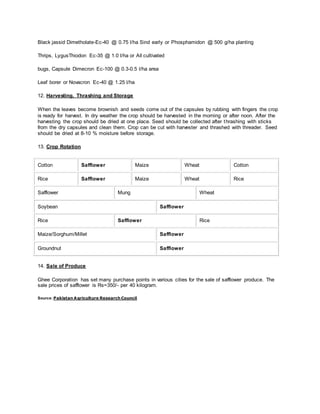
Black jassid Dimetholate-Ec-40 @ 0.75 l/ha Sind early or Phosphamidon @ 500 g/ha planting
Thrips, LygusThiodon Ec-35 @ 1.0 l/ha or All cultivated
bugs, Capsule Dimecron Ec-100 @ 0.3-0.5 l/ha area
Leaf borer or Novacron Ec-40 @ 1.25 l/ha
12. Harvesting, Thrashing and Storage
When the leaves become brownish and seeds come out of the capsules by rubbing with fingers the crop
is ready for harvest. In dry weather the crop should be harvested in the morning or after noon. After the
harvesting the crop should be dried at one place. Seed should be collected after thrashing with sticks
from the dry capsules and clean them. Crop can be cut with harvester and thrashed with threader. Seed
should be dried at 8-10 % moisture before storage.
13. Crop Rotation
Cotton Safflower Maize Wheat Cotton
Rice Safflower Maize Wheat Rice
Safflower Mung Wheat
Soybean Safflower
Rice Safflower Rice
Maize/Sorghum/Millet Safflower
Groundnut Safflower
14. Sale of Produce
Ghee Corporation has set many purchase points in various cities for the sale of safflower produce. The
sale prices of safflower is Rs=350/- per 40 kilogram.
Source: Pakistan Agriculture Research Council

S afflower

  • 1.
    Safflower SAFFLOWER PRODUCTION PRACTICESIN PAKISTAN Introduction Safflower was introduced as oilseed crop in Pakistan in 1960. It is mainly cultivated in Sindh and Baluchistan Provinces. During 1997-98, total area under this crop was 1594 ha with production of 1129 tones. Safflower research work was started in 1976 at National Agricultural Research Centre, Islamabad. Being drought tolerant crop it is recommended for planting in rainfed areas. In Sindh it is cultivated on residual moisture after rice. Safflower seed contains 26-37 % oil. Its oil is most popular for its high quality. Improved Production Technology 1. Land Selection and Preparation Light clay to heavy clay land with good drainage system is most appropriate for this crop. To get more production, at least one to two ploughings are sufficient. For deep ploughing mold boald (MB) plough can be used. After this cultivator and planker are used to make the land even and pulverized. 2. Sowing Time a. Canal irrigated area October 20, to November 30 b. Barani area October 15, to November 15 3. Sowing Method Like other Oilseed crops, it must be sown in lines. In barani areas, line to line distance should be 60 centimeter (2 feet) and in irrigated areas, 45 centimeter (1.5 feet). In proper moisture conditions, sowing may be done with hand or wheat drill. 4. Seed Rate In barani areas the recommended seed rate varies from 6 to 7 kg and in irrigated areas 8 to 9 kg. If the crop is cultivated by broad cost method then use 20 % more seed (9-11 kg/ha). 5. Thinning When the plants become 10 centimeter high, thinning may be done with hands. After thinning plant to plant distance should be 10 to 15 centimeter so that the required plant population may be maintained in the field. Plant population should be 167000 (60 cm x 10 cm) and 111,000 (60 cm x 15 cm) per hectare. 6. Hoeing In the beginning, growth of safflower is slow so that the field should be clean from weeds to have good plant establishment. In case of line sowing Rotary hoe may be used once or twice before flower initiation.
  • 2.
    7. Recommended Varieties InPakistan, the commercial varieties of safflower are Gilla, US-10, S-208 (spiny) Thori-78 and Pawari-95 (spineless). These varieties are also recommended for dry areas of Frontier Provence. Oilseeds Research Programme of PARC evaluated a large number of varieties in National Uniform Yield Trials during last 3-4 years and results show that the BI-9740 and BI-4059 are best in yield in Potohar Region. 8. Fertilization Area Dose per acre Time of Application DAP Urea a. Canal irrigated One bag One bag at sowing and bed preparation b. Barani One bag One bag at seed bed preparation 9. Irrigation Due to its deep root zone, safflower crop can get moisture from the lower surface. During season 2-3 irrigation are sufficient. First irrigation should be given 1-1/2 to 2 months after germination; second irrigation at flowering time and last irrigation should be given at the seed development time. 10. Diseases of Safflower 1. Alternaria and Remularia Leaf Blight In humid season, due to these both diseases brown and blackish spots appear on leaves. In swear attack of disease the spots become closer to each other resulting in the whole plant damage. i). Bacterial Blight This disease spreads due to high moisture in the air. Use of healthy seeds is very essential to minimize the attack of the disease. ii). Rust In the middle and northern areas of Pakistan, attack of rust is low in early days. In late sowing crop the attack is swear. To overcome this disease, crop rotation may be helpful. Seed should be treated with Thrim @ 3g/kg of seed before planting. iii). Root Rot and Wilt Diseases This disease is swear in canal irrigated areas. In particular, when the temperature is highly and more irrigation is given to the crop. To overcome this disease, safflower should not be cultivated at one place. Field should be leveled so that water should not stand in the field to avoid root rot. 11. Insect Control by Spray Insect Control Area
  • 3.
    Black jassid Dimetholate-Ec-40@ 0.75 l/ha Sind early or Phosphamidon @ 500 g/ha planting Thrips, LygusThiodon Ec-35 @ 1.0 l/ha or All cultivated bugs, Capsule Dimecron Ec-100 @ 0.3-0.5 l/ha area Leaf borer or Novacron Ec-40 @ 1.25 l/ha 12. Harvesting, Thrashing and Storage When the leaves become brownish and seeds come out of the capsules by rubbing with fingers the crop is ready for harvest. In dry weather the crop should be harvested in the morning or after noon. After the harvesting the crop should be dried at one place. Seed should be collected after thrashing with sticks from the dry capsules and clean them. Crop can be cut with harvester and thrashed with threader. Seed should be dried at 8-10 % moisture before storage. 13. Crop Rotation Cotton Safflower Maize Wheat Cotton Rice Safflower Maize Wheat Rice Safflower Mung Wheat Soybean Safflower Rice Safflower Rice Maize/Sorghum/Millet Safflower Groundnut Safflower 14. Sale of Produce Ghee Corporation has set many purchase points in various cities for the sale of safflower produce. The sale prices of safflower is Rs=350/- per 40 kilogram. Source: Pakistan Agriculture Research Council