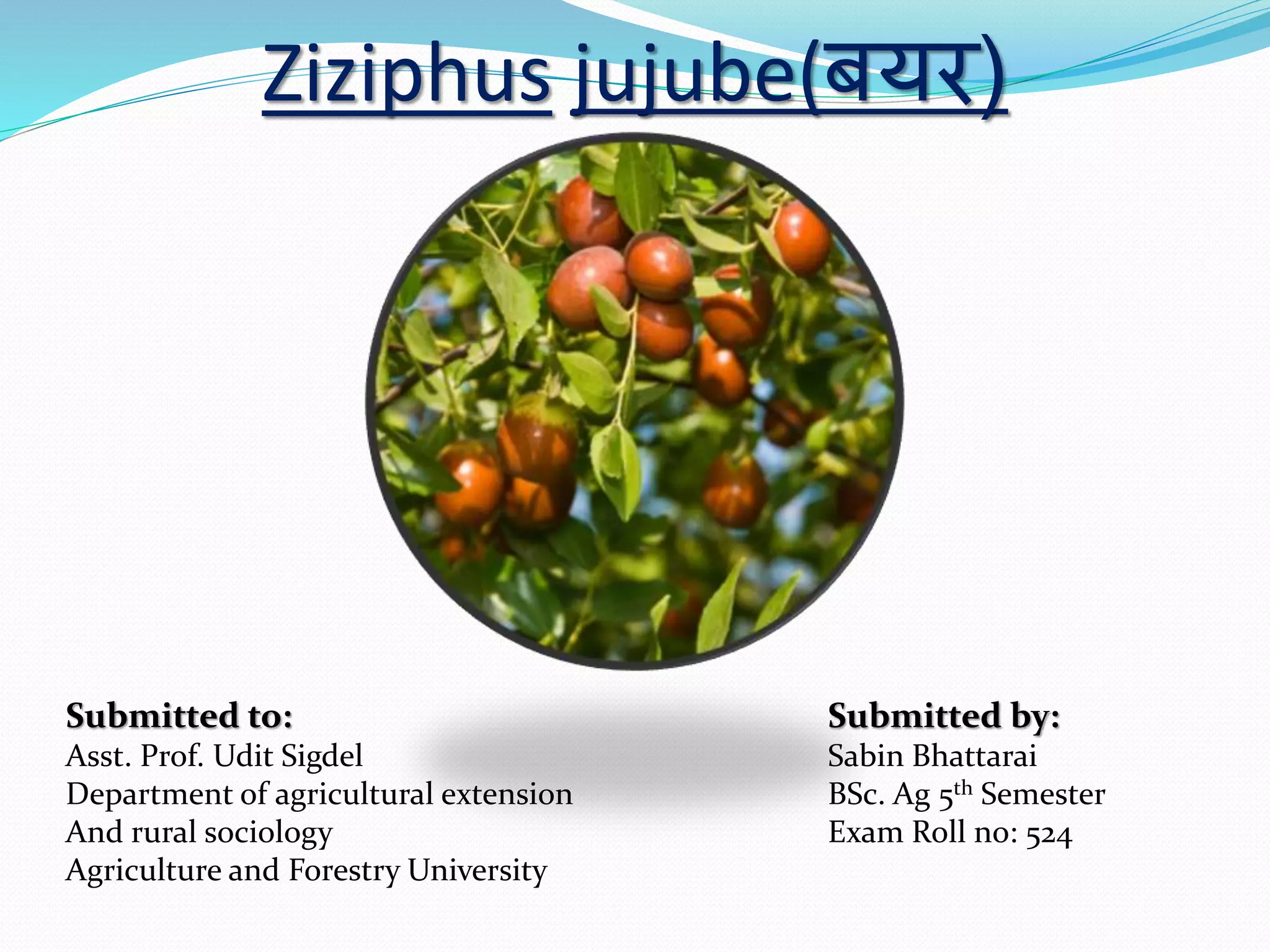
Ziziphus jujube(बयर)
Submitted to: Submitted by:
Asst. Prof. Udit Sigdel Sabin Bhattarai
Department of agricultural extension BSc. Ag 5th Semester
And rural sociology Exam Roll no: 524
Agriculture and Forestry University
Jujube
INTRODUCTION
 Jujube (Ziziphus jujuba Mill.) is one of the most
important fruit crops.
 The jujube is a medium-sized tree, growing 7–10
metres high. The tree has shiny deciduous foliage
and produces a fruit that is known as a drupe.
 The fruit varies in size depending on the cultivar, and
it has a thin, dark red skin surrounding a sweet,
white flesh.
 The jujube is a rich source of vitamin C and B-
complex.
Climate and soils
 The jujube grows best in climates with a long, hot, dry
summer after adequate rain early in the season and cool
temperatures during its dormancy.
 The jujube has a lower water requirement and higher salt
tolerance than most fruit crops.
 The tree adapts to drought conditions and not only
survives but also produces reasonable yields under
severe drought.
 Chilling requirement 775 to 1737 hours at less than
7.2°C.
 200–1000mm annual rainfall.
 Prefers sandy loams or lighter soils with pH 4.5–8.4.
Varieties
 There is enormous variation among cultivars
which can be classified into five groups based on
the use of the fruit: fresh; dried; candied;
multipurpose and ornamental.
 GA866, Suimen, Thornless, Lang, Silverhill,
Sherwood, Redlands, Admiral Wilkes and.
Orchard set up
 Conventional jujube orchards spacings of 4–5m x 5–6m.
 Intensive orchards are planted at 2–3m x 3–4m, 1m x 2m.
In super-intensive plantings 0.5–0.7m x 1m.
 Prior to planting, pits of 0.6–1m cubed are dug at
appropriate distances.
 The pits are filled with original soil mixed with manure,
superphosphate and trace elements.
 Windbreaks are advised if the site is susceptible to
strong prevailing winds.
 Netting is recommended to protect jujube orchards from
birds, rabbits and kangaroos.
Nutrient Management
 before budburst (September)
 early flowering (October/November)
 rapid growth stage of young fruit (December)
 immediately after fruit harvest (April/May).
Irrigation
 Although jujube trees can survive with very little water,
irrigation is an important factor to produce a good yield
of quality jujubes.
 The trees require approximately 3–8 megalitres per
hectare (ML/ha) over the growing season.
Training and pruning
 Training is carried out during the first three to five years
of growth.
 Central leader, open center or modified leader systems.
 Pruning can be done in both the dormant and growing
seasons.
 Dormant pruning is done mainly to remove shoots that
are incapable of producing fruit of suitable size and
quality such as weak, diseased, pest-damaged and
crowded shoots.
 Summer pruning includes removing useless or crowded
sprouted buds and new shoots and damaged and
diseased shoots.
Propagation
 Jujube was propagated primarily by root suckers,
graft or bud onto seedling rootstocks.
 Tissue culture has successfully been used for
propagation but commercial production by this
technique is still under development
Pests and diseases
 The fungal pathogen Phoma glomerata which causes
jujube fruit shrink disease has recently been found in
jujubes in WA. No other significant diseases have been
found in jujubes in Western Australia to date.
 Pests include rabbits, kangaroos and birds but these can
be controlled by fencing or netting the orchard. The
jujube is susceptible to Mediterranean fruit fly (Med fly)
so a baiting program may be required. Three main
control strategies are recommended:
a. cover spraying
b. bait or spot spraying
c. lure and kill devices.
Bird control
 Parrots are the most damaging pest to small and/or
relatively isolated orchards. The rainbow lorikeet has
also become a serious pest in some growing areas where
it can pose an even greater threat to crops than the
twenty-eight and red cap parrots.
 Bird control methods include:
 Exclusion netting: Although expensive (approximately
$30 000/ha) this method will also alleviate the effects of
extreme weather events such as hail storms and hot
temperatures (sunburn). When assessing the advantage
of netting as a means of bird control, the percentage of
crop loss as well as the time spent controlling birds by
other methods must be taken into account.
 Bird scaring devices: Birds generally become
accustomed to scaring devices and noise
generators in the orchard and their effectiveness is
quickly lost. Varying degrees of control can be
obtained by swapping from one device to another
and altering their location in the orchard.
 Culling: Unless many hours are spent each week
keeping pressure on birds by shooting, they will
continuously invade the orchard and ruin a large
percentage of your crop.
Flowering
 Jujube blooms in early summer and fruit ripens in late
summer/autumn but flowering time can vary at different
locations and depends on cultivar and climate. Flowering of
jujubes generally occurs over an eight week period in
summer. The trees flower from November to December, with
fruit starting to ripen at the end of February.
 most cultivars are self-fertile, pollination can be enhanced
through the introduction of bees. Pollen is sticky and
therefore wind pollination ineffective. Pollen viability is low
in most cultivars. Jujube trees typically have abundant
flowering but low fruit set. Heavy fruit drop occurs after fruit
set, caused by lack of fertilization or degeneration of the
ovule. Soil moisture stress, low relative humidity, lack of
sunlight and strong winds during fruit maturity can also lead
to fruit drop.
Measures to improve fruit set
include:
 Trunk girdling during flowering
 Heading back current year shoots
 Keeping bees in the orchard during the flower
season
 Two to three sprays of 10–20ppm gibberellic acid
(GA3) or 0.2% borate during flowering.
 The pre-harvest fruit drop can be prevented via a
spray of 10–20ppm NAA four weeks before harvest.
Fruit development
 The time for fruit maturation varies among
cultivars from 60 to 145 days. Fruit development is
slightly longer in warmer climates and shorter in
cooler climates. In York, fruits start to form in early
December, a month after flowering.
 The varieties GA866, Li, Thornless, Tarjan, Shanxi-
li, Redlands, Sherwood and Si-hong begin to fruit
in early December while for Lang, Don Polenski,
Silverhill and Admiral Wilkes fruiting begins in
late December.
Harvesting
 Fruit matures from February to April. Immature
fruits have green skin and will not ripen if picked.
Fruit picked later will continue to ripen after
harvest. The fruit can be left on the tree to be
picked when dried.
Fruit maturation of Chinese jujube can be divided
into three phases:
 White mature: The fruit is near full size and
shape; the skin of the fruit is thin and changes
from green to greenish white color.
 Crisp mature: The fruit is half to fully red; the
skin becomes thicker, harder and easily separated
from the flesh which becomes crisp, juicy and
sweet and contains more sugar and acid.
 Fully mature: Sugar content of the flesh increases
rapidly and water content begins to decrease. The
flesh near the stone and fruit stalk becomes yellow
and soft. The skin changes to a dark red and fruit
becomes wrinkled.
Postharvest treatment
 After harvesting, fruits should be graded according
to the degree of ripening and fruit size, then stored
under low temperature, dried, or processed.
Dehydrated jujube fruits can be obtained by
drying under the sun for about three weeks or in a
cabinet drier at 60°C for 36–48 hours until the
moisture content reduced to less than 25%. The
dried fruit can be consumed as such or further
processed into juice, wine, powder and so on
Storage practices
Pests and diseases
 Jujube fruit is very perishable and highly susceptible to
postharvest decay. Blue mould caused by Penicillin
expansum is one of the most serious postharvest diseases
of jujube in China.
Storage and processing
Fresh jujube fruit cannot be stored for a long period
under ambient conditions due to its perishable nature.
Its shelf life is usually only two to three days without any
treatment. Semi-red fresh fruits can be kept crispy for
over 100 days if packed in 0.04–0.07mm vented
polyethylene bags and stored at -1 to 1°C, with relative
humidity and CO2concentration kept within 90–95%
and 5% respectively.

Ziziphus jujube

  • 1.
    Ziziphus jujube(बयर) Submitted to:Submitted by: Asst. Prof. Udit Sigdel Sabin Bhattarai Department of agricultural extension BSc. Ag 5th Semester And rural sociology Exam Roll no: 524 Agriculture and Forestry University
  • 2.
    Jujube INTRODUCTION  Jujube (Ziziphusjujuba Mill.) is one of the most important fruit crops.  The jujube is a medium-sized tree, growing 7–10 metres high. The tree has shiny deciduous foliage and produces a fruit that is known as a drupe.  The fruit varies in size depending on the cultivar, and it has a thin, dark red skin surrounding a sweet, white flesh.  The jujube is a rich source of vitamin C and B- complex.
  • 3.
    Climate and soils The jujube grows best in climates with a long, hot, dry summer after adequate rain early in the season and cool temperatures during its dormancy.  The jujube has a lower water requirement and higher salt tolerance than most fruit crops.  The tree adapts to drought conditions and not only survives but also produces reasonable yields under severe drought.  Chilling requirement 775 to 1737 hours at less than 7.2°C.  200–1000mm annual rainfall.  Prefers sandy loams or lighter soils with pH 4.5–8.4.
  • 4.
    Varieties  There isenormous variation among cultivars which can be classified into five groups based on the use of the fruit: fresh; dried; candied; multipurpose and ornamental.  GA866, Suimen, Thornless, Lang, Silverhill, Sherwood, Redlands, Admiral Wilkes and.
  • 5.
    Orchard set up Conventional jujube orchards spacings of 4–5m x 5–6m.  Intensive orchards are planted at 2–3m x 3–4m, 1m x 2m. In super-intensive plantings 0.5–0.7m x 1m.  Prior to planting, pits of 0.6–1m cubed are dug at appropriate distances.  The pits are filled with original soil mixed with manure, superphosphate and trace elements.  Windbreaks are advised if the site is susceptible to strong prevailing winds.  Netting is recommended to protect jujube orchards from birds, rabbits and kangaroos.
  • 6.
    Nutrient Management  beforebudburst (September)  early flowering (October/November)  rapid growth stage of young fruit (December)  immediately after fruit harvest (April/May).
  • 7.
    Irrigation  Although jujubetrees can survive with very little water, irrigation is an important factor to produce a good yield of quality jujubes.  The trees require approximately 3–8 megalitres per hectare (ML/ha) over the growing season.
  • 8.
    Training and pruning Training is carried out during the first three to five years of growth.  Central leader, open center or modified leader systems.  Pruning can be done in both the dormant and growing seasons.  Dormant pruning is done mainly to remove shoots that are incapable of producing fruit of suitable size and quality such as weak, diseased, pest-damaged and crowded shoots.  Summer pruning includes removing useless or crowded sprouted buds and new shoots and damaged and diseased shoots.
  • 9.
    Propagation  Jujube waspropagated primarily by root suckers, graft or bud onto seedling rootstocks.  Tissue culture has successfully been used for propagation but commercial production by this technique is still under development
  • 10.
    Pests and diseases The fungal pathogen Phoma glomerata which causes jujube fruit shrink disease has recently been found in jujubes in WA. No other significant diseases have been found in jujubes in Western Australia to date.  Pests include rabbits, kangaroos and birds but these can be controlled by fencing or netting the orchard. The jujube is susceptible to Mediterranean fruit fly (Med fly) so a baiting program may be required. Three main control strategies are recommended: a. cover spraying b. bait or spot spraying c. lure and kill devices.
  • 11.
    Bird control  Parrotsare the most damaging pest to small and/or relatively isolated orchards. The rainbow lorikeet has also become a serious pest in some growing areas where it can pose an even greater threat to crops than the twenty-eight and red cap parrots.  Bird control methods include:  Exclusion netting: Although expensive (approximately $30 000/ha) this method will also alleviate the effects of extreme weather events such as hail storms and hot temperatures (sunburn). When assessing the advantage of netting as a means of bird control, the percentage of crop loss as well as the time spent controlling birds by other methods must be taken into account.
  • 12.
     Bird scaringdevices: Birds generally become accustomed to scaring devices and noise generators in the orchard and their effectiveness is quickly lost. Varying degrees of control can be obtained by swapping from one device to another and altering their location in the orchard.  Culling: Unless many hours are spent each week keeping pressure on birds by shooting, they will continuously invade the orchard and ruin a large percentage of your crop.
  • 13.
    Flowering  Jujube bloomsin early summer and fruit ripens in late summer/autumn but flowering time can vary at different locations and depends on cultivar and climate. Flowering of jujubes generally occurs over an eight week period in summer. The trees flower from November to December, with fruit starting to ripen at the end of February.  most cultivars are self-fertile, pollination can be enhanced through the introduction of bees. Pollen is sticky and therefore wind pollination ineffective. Pollen viability is low in most cultivars. Jujube trees typically have abundant flowering but low fruit set. Heavy fruit drop occurs after fruit set, caused by lack of fertilization or degeneration of the ovule. Soil moisture stress, low relative humidity, lack of sunlight and strong winds during fruit maturity can also lead to fruit drop.
  • 14.
    Measures to improvefruit set include:  Trunk girdling during flowering  Heading back current year shoots  Keeping bees in the orchard during the flower season  Two to three sprays of 10–20ppm gibberellic acid (GA3) or 0.2% borate during flowering.  The pre-harvest fruit drop can be prevented via a spray of 10–20ppm NAA four weeks before harvest.
  • 15.
    Fruit development  Thetime for fruit maturation varies among cultivars from 60 to 145 days. Fruit development is slightly longer in warmer climates and shorter in cooler climates. In York, fruits start to form in early December, a month after flowering.  The varieties GA866, Li, Thornless, Tarjan, Shanxi- li, Redlands, Sherwood and Si-hong begin to fruit in early December while for Lang, Don Polenski, Silverhill and Admiral Wilkes fruiting begins in late December.
  • 16.
    Harvesting  Fruit maturesfrom February to April. Immature fruits have green skin and will not ripen if picked. Fruit picked later will continue to ripen after harvest. The fruit can be left on the tree to be picked when dried. Fruit maturation of Chinese jujube can be divided into three phases:  White mature: The fruit is near full size and shape; the skin of the fruit is thin and changes from green to greenish white color.
  • 17.
     Crisp mature:The fruit is half to fully red; the skin becomes thicker, harder and easily separated from the flesh which becomes crisp, juicy and sweet and contains more sugar and acid.  Fully mature: Sugar content of the flesh increases rapidly and water content begins to decrease. The flesh near the stone and fruit stalk becomes yellow and soft. The skin changes to a dark red and fruit becomes wrinkled.
  • 18.
    Postharvest treatment  Afterharvesting, fruits should be graded according to the degree of ripening and fruit size, then stored under low temperature, dried, or processed. Dehydrated jujube fruits can be obtained by drying under the sun for about three weeks or in a cabinet drier at 60°C for 36–48 hours until the moisture content reduced to less than 25%. The dried fruit can be consumed as such or further processed into juice, wine, powder and so on
  • 19.
    Storage practices Pests anddiseases  Jujube fruit is very perishable and highly susceptible to postharvest decay. Blue mould caused by Penicillin expansum is one of the most serious postharvest diseases of jujube in China. Storage and processing Fresh jujube fruit cannot be stored for a long period under ambient conditions due to its perishable nature. Its shelf life is usually only two to three days without any treatment. Semi-red fresh fruits can be kept crispy for over 100 days if packed in 0.04–0.07mm vented polyethylene bags and stored at -1 to 1°C, with relative humidity and CO2concentration kept within 90–95% and 5% respectively.