NAME : FIDHA
CLASS : 9
SUBJECT : SOCIAL SCIENCE
TOPIC : NATURAL DISASTER PROJECT
DATE STARTED : 1ST MAY
DATE ENDED : 15TH MAY
ACKNOWLEDGEMENT
I fidha of class 9 wish to express my gratitude to my social teacher for her
guidance And assistance throughout this project work. I wish to acknowledge
my parents for their great support and providing me with all the materials. I
thank almighty god for all the blessings and graces and for making this
project successful.
INDEX
Introduction
What is flood and causes of flood
Vulnerability atlas
How flood should be prevented
What is roof
Flat roof, advantages and disadvantages
Pitched roof, advantages and disadvantages
Shell roof, advantages and disadvantages
Conclusion and bibliography
INTRODUCTION
disaster accident or negligence which
results in substantial loss of life or
human suffering or damage to, and
destruction of, property, or damage
to, or degradation of, environment,
and is of such a nature or magnitude
as to be beyond the coping capacity
of the community of the affected
area. There are two types of disaster
WHAT IS FLOOD?
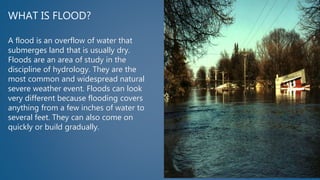
A flood is an overflow of water that
submerges land that is usually dry.
Floods are an area of study in the
discipline of hydrology. They are the
most common and widespread natural
severe weather event. Floods can look
very different because flooding covers
anything from a few inches of water to
several feet. They can also come on
quickly or build gradually.
CAUSES OF FLOOD
Heavy Rains
Rivers or Streams Overflows
Lakes and Coastal Flooding
Dam Breakage
Clogged Drainages
VULNERABILITY ATLAS –
FLOOD
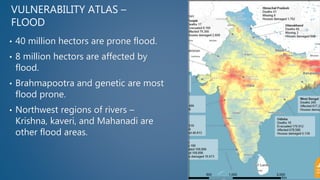
• 40 million hectors are prone flood.
• 8 million hectors are affected by
flood.
• Brahmapootra and genetic are most
flood prone.
• Northwest regions of rivers –
Krishna, kaveri, and Mahanadi are
other flood areas.
HOW FLOOD
SHOULD BE
PREVENTED?
Introduce better flood warning systems
Modify homes and businesses to help them withstand floods
Construct buildings above flood levels
Tackle climate change
Increase spending on flood defenses
Protect wetlands and introduce plant trees strategically
Restore rivers to their natural courses
Introduce water storage areas
Improve soil conditions
Put up more flood barriers
Take action
THE FUNCTION OF FLOODPLAIN
floodplains are a natural feature of rivers. They are the
mostly flat land adjacent to the river and form due to the
actions of the river. Rivers erode their own banks and
redeposit the eroded material downstream. Material is
added to the floodplain during floods, a process called
overbank deposition. The material that underlies floodplains
is a mixture of thick layers of sand and thin layers of mud.
During high water events, some of the water is absorbed by
the floodplain, helping to keep the river from overflowing.
The absorbed water can then be returned to the stream
during times of low water. If high water event is large
enough, water will overflow the channel of the river and flow
onto and spread over the floodplain, which slows the flow of
the water. Reduced water flow can help prevent severe
erosion and flooding downstream.
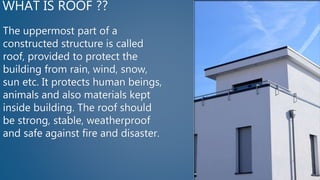
WHAT IS ROOF ??
The uppermost part of a
constructed structure is called
roof, provided to protect the
building from rain, wind, snow,
sun etc. It protects human beings,
animals and also materials kept
inside building. The roof should
be strong, stable, weatherproof
and safe against fire and disaster.
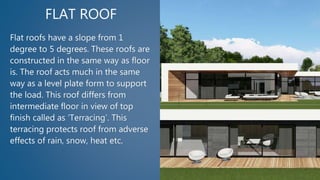
FLAT ROOF
Flat roofs have a slope from 1
degree to 5 degrees. These roofs are
constructed in the same way as floor
is. The roof acts much in the same
way as a level plate form to support
the load. This roof differs from
intermediate floor in view of top
finish called as ‘Terracing’. This
terracing protects roof from adverse
effects of rain, snow, heat etc.
FLAT ROOF
Advantages
 it can be used for living purposes.
 It is comparatively safer than other types of
roofs.
 Its construction and maintenance is
simpler and more economical.
 It provides better light, ventilation and
architectural appearance.
 the construction of upper floor can be
taken up when desired in minimum time.
 It is economical than Pitched roof for
normal residential and official buildings
because false ceiling is required for
thermal comfort.
Disadvantage
 It cannot be used for industrial sheds without
using intermediate columns. These roofs are not
suitable where rainfall or snowfall is heavy.
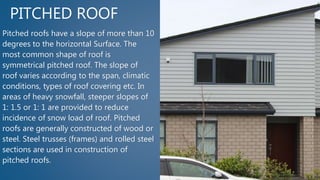
PITCHED ROOF
Pitched roofs have a slope of more than 10
degrees to the horizontal Surface. The
most common shape of roof is
symmetrical pitched roof. The slope of
roof varies according to the span, climatic
conditions, types of roof covering etc. In
areas of heavy snowfall, steeper slopes of
1: 1.5 or 1: 1 are provided to reduce
incidence of snow load of roof. Pitched
roofs are generally constructed of wood or
steel. Steel trusses (frames) and rolled steel
sections are used in construction of
pitched roofs.
PITCHED ROOF
advantages
 More area is covered without any
intermediate columns etc.
 There is no leakage problem in
this type of roof.
 It gives architectural view to add
beauty nearby area.
 The area covered under this roof
is used for conferences and big
gathering
disadvantages
It cannot be used to construct
upper floor.
It has problems of natural light
and ventilation.
It is costly for construction.
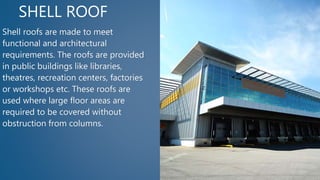
SHELL ROOF
Shell roofs are made to meet
functional and architectural
requirements. The roofs are provided
in public buildings like libraries,
theatres, recreation centers, factories
or workshops etc. These roofs are
used where large floor areas are
required to be covered without
obstruction from columns.
SHELL ROOF
Advantages
 More area is covered without any
intermediate columns etc.
 There is no leakage problem in this
type of roof.
 It gives architectural view to add
beauty nearby area.
 The area covered under this roof is
used for conferences and big
gathering.
Disadvantages
It cannot be used to construct
upper floor.
It has problems of natural light
and ventilation.
It is costly for construction
CONCLUSION
disaster accident or negligence which results in substantial loss of life or human
suffering or damage. A flood is an overflow of water that submerges land that is
usually dry. floodplains are a natural feature of rivers. The uppermost part of a
constructed structure is called roof, provided to protect the building from rain,
wind, snow, sun etc. Flat roofs have a slope from 1 degree to 5 degrees. Pitched
roofs have a slope of more than 10 degrees to the horizontal Surface. Shell roofs
are made to meet functional and architectural requirements.
BIBILIOGRAPHY
Sources referred to
• Google
• Pdfs and ppts

Natural disaster management project - slide share - reference - grade 9 - grade 10

  • 1.
    NAME : FIDHA CLASS: 9 SUBJECT : SOCIAL SCIENCE TOPIC : NATURAL DISASTER PROJECT DATE STARTED : 1ST MAY DATE ENDED : 15TH MAY
  • 2.
    ACKNOWLEDGEMENT I fidha ofclass 9 wish to express my gratitude to my social teacher for her guidance And assistance throughout this project work. I wish to acknowledge my parents for their great support and providing me with all the materials. I thank almighty god for all the blessings and graces and for making this project successful.
  • 3.
    INDEX Introduction What is floodand causes of flood Vulnerability atlas How flood should be prevented What is roof Flat roof, advantages and disadvantages Pitched roof, advantages and disadvantages Shell roof, advantages and disadvantages Conclusion and bibliography
  • 4.
    INTRODUCTION disaster accident ornegligence which results in substantial loss of life or human suffering or damage to, and destruction of, property, or damage to, or degradation of, environment, and is of such a nature or magnitude as to be beyond the coping capacity of the community of the affected area. There are two types of disaster
  • 5.
    WHAT IS FLOOD? Aflood is an overflow of water that submerges land that is usually dry. Floods are an area of study in the discipline of hydrology. They are the most common and widespread natural severe weather event. Floods can look very different because flooding covers anything from a few inches of water to several feet. They can also come on quickly or build gradually.
  • 6.
    CAUSES OF FLOOD HeavyRains Rivers or Streams Overflows Lakes and Coastal Flooding Dam Breakage Clogged Drainages
  • 7.
    VULNERABILITY ATLAS – FLOOD •40 million hectors are prone flood. • 8 million hectors are affected by flood. • Brahmapootra and genetic are most flood prone. • Northwest regions of rivers – Krishna, kaveri, and Mahanadi are other flood areas.
  • 8.
    HOW FLOOD SHOULD BE PREVENTED? Introducebetter flood warning systems Modify homes and businesses to help them withstand floods Construct buildings above flood levels Tackle climate change Increase spending on flood defenses Protect wetlands and introduce plant trees strategically Restore rivers to their natural courses Introduce water storage areas Improve soil conditions Put up more flood barriers Take action
  • 9.
    THE FUNCTION OFFLOODPLAIN floodplains are a natural feature of rivers. They are the mostly flat land adjacent to the river and form due to the actions of the river. Rivers erode their own banks and redeposit the eroded material downstream. Material is added to the floodplain during floods, a process called overbank deposition. The material that underlies floodplains is a mixture of thick layers of sand and thin layers of mud. During high water events, some of the water is absorbed by the floodplain, helping to keep the river from overflowing. The absorbed water can then be returned to the stream during times of low water. If high water event is large enough, water will overflow the channel of the river and flow onto and spread over the floodplain, which slows the flow of the water. Reduced water flow can help prevent severe erosion and flooding downstream.
  • 10.
    WHAT IS ROOF?? The uppermost part of a constructed structure is called roof, provided to protect the building from rain, wind, snow, sun etc. It protects human beings, animals and also materials kept inside building. The roof should be strong, stable, weatherproof and safe against fire and disaster.
  • 11.
    FLAT ROOF Flat roofshave a slope from 1 degree to 5 degrees. These roofs are constructed in the same way as floor is. The roof acts much in the same way as a level plate form to support the load. This roof differs from intermediate floor in view of top finish called as ‘Terracing’. This terracing protects roof from adverse effects of rain, snow, heat etc.
  • 12.
    FLAT ROOF Advantages  itcan be used for living purposes.  It is comparatively safer than other types of roofs.  Its construction and maintenance is simpler and more economical.  It provides better light, ventilation and architectural appearance.  the construction of upper floor can be taken up when desired in minimum time.  It is economical than Pitched roof for normal residential and official buildings because false ceiling is required for thermal comfort. Disadvantage  It cannot be used for industrial sheds without using intermediate columns. These roofs are not suitable where rainfall or snowfall is heavy.
  • 13.
    PITCHED ROOF Pitched roofshave a slope of more than 10 degrees to the horizontal Surface. The most common shape of roof is symmetrical pitched roof. The slope of roof varies according to the span, climatic conditions, types of roof covering etc. In areas of heavy snowfall, steeper slopes of 1: 1.5 or 1: 1 are provided to reduce incidence of snow load of roof. Pitched roofs are generally constructed of wood or steel. Steel trusses (frames) and rolled steel sections are used in construction of pitched roofs.
  • 14.
    PITCHED ROOF advantages  Morearea is covered without any intermediate columns etc.  There is no leakage problem in this type of roof.  It gives architectural view to add beauty nearby area.  The area covered under this roof is used for conferences and big gathering disadvantages It cannot be used to construct upper floor. It has problems of natural light and ventilation. It is costly for construction.
  • 15.
    SHELL ROOF Shell roofsare made to meet functional and architectural requirements. The roofs are provided in public buildings like libraries, theatres, recreation centers, factories or workshops etc. These roofs are used where large floor areas are required to be covered without obstruction from columns.
  • 16.
    SHELL ROOF Advantages  Morearea is covered without any intermediate columns etc.  There is no leakage problem in this type of roof.  It gives architectural view to add beauty nearby area.  The area covered under this roof is used for conferences and big gathering. Disadvantages It cannot be used to construct upper floor. It has problems of natural light and ventilation. It is costly for construction
  • 17.
    CONCLUSION disaster accident ornegligence which results in substantial loss of life or human suffering or damage. A flood is an overflow of water that submerges land that is usually dry. floodplains are a natural feature of rivers. The uppermost part of a constructed structure is called roof, provided to protect the building from rain, wind, snow, sun etc. Flat roofs have a slope from 1 degree to 5 degrees. Pitched roofs have a slope of more than 10 degrees to the horizontal Surface. Shell roofs are made to meet functional and architectural requirements. BIBILIOGRAPHY Sources referred to • Google • Pdfs and ppts