Diagnosing Alzheimer's before
the Alzheimer's; Novel tools for
        early detection
              Nellie Byun, PhD
           Romina Gentier, MSc
        Rylan Allemang-Grand, BSc
           Elizabeth Steuer, BSc
          Jennifer Goldman, BA
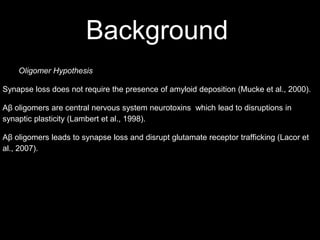
Background
    Oligomer Hypothesis

Synapse loss does not require the presence of amyloid deposition (Mucke et al., 2000).

Aβ oligomers are central nervous system neurotoxins which lead to disruptions in
synaptic plasticity (Lambert et al., 1998).

Aβ oligomers leads to synapse loss and disrupt glutamate receptor trafficking (Lacor et
al., 2007).
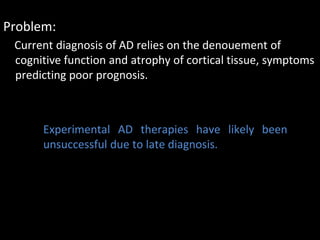
Problem:
 Current diagnosis of AD relies on the denouement of
 cognitive function and atrophy of cortical tissue, symptoms
 predicting poor prognosis.


      Experimental AD therapies have likely been
      unsuccessful due to late diagnosis.
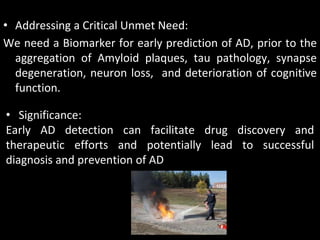
• Addressing a Critical Unmet Need:
We need a Biomarker for early prediction of AD, prior to the
  aggregation of Amyloid plaques, tau pathology, synapse
  degeneration, neuron loss, and deterioration of cognitive
  function.

• Significance:
Early AD detection can facilitate drug discovery and
therapeutic efforts and potentially lead to successful
diagnosis and prevention of AD
Hypothesis
Accumulation of low molecular weight amyloid
fragments are an early predictor of AD and can be
detected by PET imaging.
AIMS:
1. Development and characterization of a novel
   PET radioligand for detection of Ab oligomers

1. Determining the relationship of Ab oligomers
   in brain with other AD pathology

1. Algorithm for identifying at-risk individuals,
   human toxicity screen and PET trials
AIM 1:Development and characterization of a novel PET
radioligand for detection of ADDLs in MgGill-TG thy1-APP
rats
 Strategy: Multiple antibodies (Abs) have already been developed
   against Ab oligomers. In the cancer field, antibodies have been
   successfully (i.e., FDA approved) utilized as imaging agents, so the
   technology and expertise should be used in neuroscience.
 Methods: Screening and validation
 - Purchase Abs against oligomers (Nu-1, Nu-2, Nu-3, Nu-4) [See
   Alzforum antibody list]
 - Radiochemistry to label Abs with 18F and purify.
 - Perform microPET scans in anesthetized MgGill-TG thy1-APP and
   control rats; tail vein injection of 18F-Ab (0.75 and 1.5 mCi); n=
   10/group
 - Perform Nanotech Assay (Mirkin) following PET scan to quantify Ab
   and determine sensitivity of PET ligands
AIM 2:
Determining the spatial and temporal relationship of Ab
oligomer binding in brain with AD pathology

•   MgGill-TG thy1-APP rats housed in non-stressful
    environments
•   Behavior- Object Recognition, Morris Water Maze
•   Immunochemistry and quantification of Abeta
    aggregates, Tau pathology, synapse density, activated
    microglia, cell density, neurite morphology, number of
    neurons
•   Electrophysiology: miniEPSCs, LTP/LTD measurements
    (synapse density and plasticity measurements)
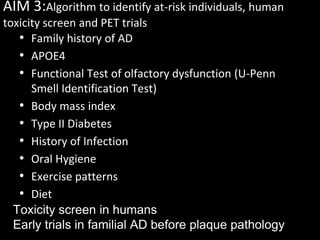
AIM 3:Algorithm to identify at-risk individuals, human
toxicity screen and PET trials
   • Family history of AD
   • APOE4
   • Functional Test of olfactory dysfunction (U-Penn
      Smell Identification Test)
   • Body mass index
   • Type II Diabetes
   • History of Infection
   • Oral Hygiene
   • Exercise patterns
   • Diet
  Toxicity screen in humans
  Early trials in familial AD before plaque pathology
Cost and Resource Use
Funding request: $500,000/year for 3 years
Y1: Radiotracer development
Core costs
-Animals and housing: $30,000 [$2/day/Cage]
-PET Radiochemistry: $16,000 [$100/animal ($600/synthesis
  for n=6 animals)]
-microPET scanning: $40,000 [$240/animal ($120/hour, 2
  hours)]


Supplies/Equipment
-UPSIT (Sold by Sensonics, Inc): $26.95/test
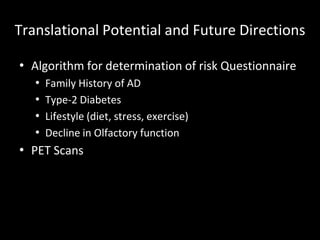
Translational Potential and Future Directions

• Algorithm for determination of risk Questionnaire
   • Family History of AD
   • Type-2 Diabetes
   • Lifestyle (diet, stress, exercise)
   • Decline in Olfactory function
• PET Scans
References
    Mucke, L., Masliah, E., Yu, G.Q., Mallory, M., Rockenstein, E.M., Tatsuno, G., et al.
(2000). High-level neuronal expression of A-beta (1-42) in wild-type human
amyloid protein precursor transgenic mice: synaptotoxicity without plaque
formation. Journal of Neuroscience, 1;20(11), 4050-4058.


     Lambert, M. P., Barlow, A. K., Chromy, B. A., Edwards, C., Freed, R., Liosatos, M.,
et al. (1998). Diffusible, nonfibrillar ligands derived from Abeta1-42 are potent
central nervous system neurotoxins. Proceedings of the National Academy of
Sciences of the United States of America, 95, 6448–6453.


     Lacor, P. N., Buniel, M. C., Furlow, P. W., Clemente, A. S., Velasco, P. T., Wood,
M., et al. (2007). Abeta oligomer-induced aberrations in synapse composition,
shape, and density provide a molecular basis for loss of connectivity in
Alzheimer’s disease. Journal of Neuroscience, 27, 796–807.
Thank You!
• EURON, AHAF, ISAO

• Drs. Harry Steinbusch, Claudio Cuello, Mark
  Mattson, William Klein, Bart Rutten, Paul
  Coleman, Cindy Lemere, Frank LaFerla, Jochen
  Walter, Jorg Bernard Schultz, Ilse
  Dewachter, Carol Colton, Michael
  Sofroniew, Jin-Moo Lee, Joana Palha,

Rylan

  • 1.
    Diagnosing Alzheimer's before theAlzheimer's; Novel tools for early detection Nellie Byun, PhD Romina Gentier, MSc Rylan Allemang-Grand, BSc Elizabeth Steuer, BSc Jennifer Goldman, BA
  • 2.
    Background Oligomer Hypothesis Synapse loss does not require the presence of amyloid deposition (Mucke et al., 2000). Aβ oligomers are central nervous system neurotoxins which lead to disruptions in synaptic plasticity (Lambert et al., 1998). Aβ oligomers leads to synapse loss and disrupt glutamate receptor trafficking (Lacor et al., 2007).
  • 3.
    Problem: Current diagnosisof AD relies on the denouement of cognitive function and atrophy of cortical tissue, symptoms predicting poor prognosis. Experimental AD therapies have likely been unsuccessful due to late diagnosis.
  • 4.
    • Addressing aCritical Unmet Need: We need a Biomarker for early prediction of AD, prior to the aggregation of Amyloid plaques, tau pathology, synapse degeneration, neuron loss, and deterioration of cognitive function. • Significance: Early AD detection can facilitate drug discovery and therapeutic efforts and potentially lead to successful diagnosis and prevention of AD
  • 5.
    Hypothesis Accumulation of lowmolecular weight amyloid fragments are an early predictor of AD and can be detected by PET imaging.
  • 6.
    AIMS: 1. Development andcharacterization of a novel PET radioligand for detection of Ab oligomers 1. Determining the relationship of Ab oligomers in brain with other AD pathology 1. Algorithm for identifying at-risk individuals, human toxicity screen and PET trials
  • 7.
    AIM 1:Development andcharacterization of a novel PET radioligand for detection of ADDLs in MgGill-TG thy1-APP rats Strategy: Multiple antibodies (Abs) have already been developed against Ab oligomers. In the cancer field, antibodies have been successfully (i.e., FDA approved) utilized as imaging agents, so the technology and expertise should be used in neuroscience. Methods: Screening and validation - Purchase Abs against oligomers (Nu-1, Nu-2, Nu-3, Nu-4) [See Alzforum antibody list] - Radiochemistry to label Abs with 18F and purify. - Perform microPET scans in anesthetized MgGill-TG thy1-APP and control rats; tail vein injection of 18F-Ab (0.75 and 1.5 mCi); n= 10/group - Perform Nanotech Assay (Mirkin) following PET scan to quantify Ab and determine sensitivity of PET ligands
  • 8.
    AIM 2: Determining thespatial and temporal relationship of Ab oligomer binding in brain with AD pathology • MgGill-TG thy1-APP rats housed in non-stressful environments • Behavior- Object Recognition, Morris Water Maze • Immunochemistry and quantification of Abeta aggregates, Tau pathology, synapse density, activated microglia, cell density, neurite morphology, number of neurons • Electrophysiology: miniEPSCs, LTP/LTD measurements (synapse density and plasticity measurements)
  • 9.
    AIM 3:Algorithm toidentify at-risk individuals, human toxicity screen and PET trials • Family history of AD • APOE4 • Functional Test of olfactory dysfunction (U-Penn Smell Identification Test) • Body mass index • Type II Diabetes • History of Infection • Oral Hygiene • Exercise patterns • Diet Toxicity screen in humans Early trials in familial AD before plaque pathology
  • 10.
    Cost and ResourceUse Funding request: $500,000/year for 3 years Y1: Radiotracer development Core costs -Animals and housing: $30,000 [$2/day/Cage] -PET Radiochemistry: $16,000 [$100/animal ($600/synthesis for n=6 animals)] -microPET scanning: $40,000 [$240/animal ($120/hour, 2 hours)] Supplies/Equipment -UPSIT (Sold by Sensonics, Inc): $26.95/test
  • 11.
    Translational Potential andFuture Directions • Algorithm for determination of risk Questionnaire • Family History of AD • Type-2 Diabetes • Lifestyle (diet, stress, exercise) • Decline in Olfactory function • PET Scans
  • 12.
    References Mucke, L., Masliah, E., Yu, G.Q., Mallory, M., Rockenstein, E.M., Tatsuno, G., et al. (2000). High-level neuronal expression of A-beta (1-42) in wild-type human amyloid protein precursor transgenic mice: synaptotoxicity without plaque formation. Journal of Neuroscience, 1;20(11), 4050-4058. Lambert, M. P., Barlow, A. K., Chromy, B. A., Edwards, C., Freed, R., Liosatos, M., et al. (1998). Diffusible, nonfibrillar ligands derived from Abeta1-42 are potent central nervous system neurotoxins. Proceedings of the National Academy of Sciences of the United States of America, 95, 6448–6453. Lacor, P. N., Buniel, M. C., Furlow, P. W., Clemente, A. S., Velasco, P. T., Wood, M., et al. (2007). Abeta oligomer-induced aberrations in synapse composition, shape, and density provide a molecular basis for loss of connectivity in Alzheimer’s disease. Journal of Neuroscience, 27, 796–807.
  • 13.
    Thank You! • EURON,AHAF, ISAO • Drs. Harry Steinbusch, Claudio Cuello, Mark Mattson, William Klein, Bart Rutten, Paul Coleman, Cindy Lemere, Frank LaFerla, Jochen Walter, Jorg Bernard Schultz, Ilse Dewachter, Carol Colton, Michael Sofroniew, Jin-Moo Lee, Joana Palha,