• Characteristics:
 Proteinaceous infectious agent that lacks a specific nucleic acid genome
 A protein-based element of inheritance
• Basic requirements:
 A self-propagating state of a protein (the prion) that is biologically accessible, but rarely
accumulates spontaneously.
 Replication by acting on the non-prion state of the protein
 Capacity to spread to naïve hosts and find new substrate pools for replication.
• Examples
 Yeast/fungal prions
 Mammalian TSE prions
Prions
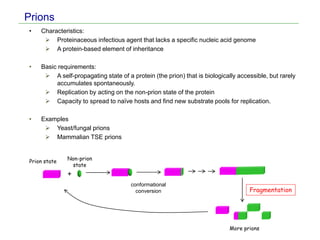
Fragmentation
More prions
Prion state
Non-prion
state
+
conformational
conversion
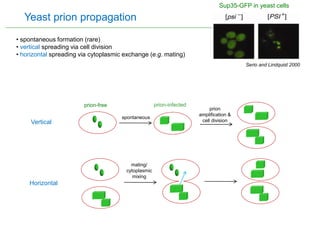
Yeast prion propagation
• spontaneous formation (rare)
• vertical spreading via cell division
• horizontal spreading via cytoplasmic exchange (e.g. mating)
Sup35-GFP in yeast cells
Serio and Lindquist 2000
prion-free prion-infected
spontaneous
mating/
cytoplasmic
mixing
prion
amplification &
cell divisionVertical
Horizontal
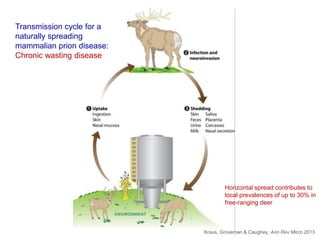
Transmission cycle for a
naturally spreading
mammalian prion disease:
Chronic wasting disease
Kraus, Groveman & Caughey, Ann Rev Micro 2013
Horizontal spread contributes to
local prevalences of up to 30% in
free-ranging deer
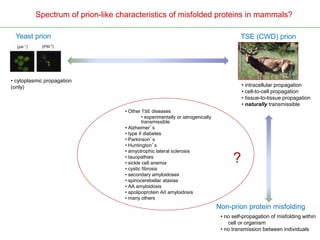
Spectrum of prion-like characteristics of misfolded proteins in mammals?
Non-prion protein misfolding
• cytoplasmic propagation
(only) • intracellular propagation
• cell-to-cell propagation
• tissue-to-tissue propagation
• naturally transmissible
• no self-propagation of misfolding within
cell or organism
• no transmission between individuals
Yeast prion TSE (CWD) prion
• Other TSE diseases
• experimentally or iatrogenically
transmissible
• Alzheimer’s
• type II diabetes
• Parkinson’s
• Huntington’s
• amyotrophic lateral sclerosis
• tauopathies
• sickle cell anemia
• cystic fibrosis
• secondary amyloidoses
• spinocerebellar ataxias
• AA amyloidosis
• apolipoprotein AII amyloidosis
• many others
?

Byron Caughey

  • 1.
    • Characteristics:  Proteinaceousinfectious agent that lacks a specific nucleic acid genome  A protein-based element of inheritance • Basic requirements:  A self-propagating state of a protein (the prion) that is biologically accessible, but rarely accumulates spontaneously.  Replication by acting on the non-prion state of the protein  Capacity to spread to naïve hosts and find new substrate pools for replication. • Examples  Yeast/fungal prions  Mammalian TSE prions Prions Fragmentation More prions Prion state Non-prion state + conformational conversion
  • 2.
    Yeast prion propagation •spontaneous formation (rare) • vertical spreading via cell division • horizontal spreading via cytoplasmic exchange (e.g. mating) Sup35-GFP in yeast cells Serio and Lindquist 2000 prion-free prion-infected spontaneous mating/ cytoplasmic mixing prion amplification & cell divisionVertical Horizontal
  • 3.
    Transmission cycle fora naturally spreading mammalian prion disease: Chronic wasting disease Kraus, Groveman & Caughey, Ann Rev Micro 2013 Horizontal spread contributes to local prevalences of up to 30% in free-ranging deer
  • 4.
    Spectrum of prion-likecharacteristics of misfolded proteins in mammals? Non-prion protein misfolding • cytoplasmic propagation (only) • intracellular propagation • cell-to-cell propagation • tissue-to-tissue propagation • naturally transmissible • no self-propagation of misfolding within cell or organism • no transmission between individuals Yeast prion TSE (CWD) prion • Other TSE diseases • experimentally or iatrogenically transmissible • Alzheimer’s • type II diabetes • Parkinson’s • Huntington’s • amyotrophic lateral sclerosis • tauopathies • sickle cell anemia • cystic fibrosis • secondary amyloidoses • spinocerebellar ataxias • AA amyloidosis • apolipoprotein AII amyloidosis • many others ?

Editor's Notes