Success at GCSE Evening
While you wait:
Discuss what you could do as a family
to ensure success at GCSE
Success at GCSE Evening
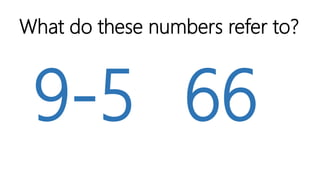
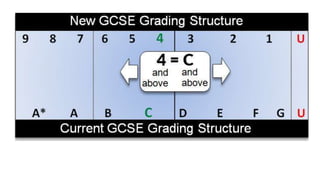
9-5 66
What do these numbers refer to?
The Challenge
9-1 GCSEs
• Deliberately made more challenging
• Terminal examinations, not modular
• No coursework or controlled assessment for academic subjects
• Larger emphasis on examination in practical subjects
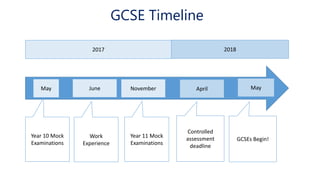
May November April May
2017 2018
Year 10 Mock
Examinations
Year 11 Mock
Examinations
Controlled
assessment
deadline
June
Work
Experience
GCSEs Begin!
GCSE Timeline
How we can succeed…
Attendance
Sleep and food
A survey of GCSE students in England found that 29% of the young
people stay up until after 1 a.m. and half said they went to school
without eating breakfast.
Devices and Blue Light
Communication with School
Understand the Courses
Success at GCSE
Mathematics
To learn, you must
want to be taught.
Why is Maths important?
•Many courses and jobs require GCSE Maths
•It improves your problem solving skills
•It gives you the skills to manage your personal
finances
•Research shows that people who are good at
Maths, on average, earn more
Pencil, protractor and calculator –
weapons of Maths destruction.
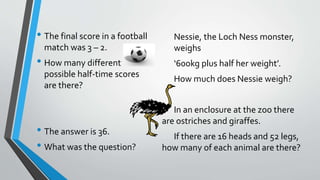
• The final score in a football
match was 3 – 2.
• How many different
possible half-time scores
are there?
• The answer is 36.
• What was the question?
Nessie, the Loch Ness monster,
weighs
‘600kg plus half her weight’.
How much does Nessie weigh?
In an enclosure at the zoo there
are ostriches and giraffes.
If there are 16 heads and 52 legs,
how many of each animal are there?
Course Overview
•The GCSE course started inYear 9.
•It takes 3 years.
•The exams are in May or June 2018.
•AQA Mathematics – 3 exams at the end of the course.
•There is no coursework.
5 out of 4 people have difficulty with fractions
Course Content
• Number 4 operations Surds
Negative numbers Standard form
Factors, multiples, primes Indices
Fractions Rational Numbers
Decimals Limits of Accuracy
Percentages
Ratio and Proportion
BIDMAS
0.3333… = 1/3 0.6666… = 2/3
0.9999… = 3/3 = 1
Course Content
• Algebra Substitution Quadratic equations
Equations Algebraic Fractions
Graphs Transforming Graphs
Sequences Iteration
Brackets Pre-Calculus
Rearranging Formulae
Trial and Improvement
Simple quadratics
Decimals Have a Point
Course Content
• Shape and Space 2D shapes Trigonometry
3D shapes Vectors
Area &Volume Circle Geometry
Pythagoras Similar Shapes
Transformations Spheres and Pyramids
Angles
Measures
Constructions
Simple trigonometry
Why is the number 6 scared? Because 7 8 9.
Course Content
• Statistics and Averages Histogram
Probability Charts Cumulative Frequency
Scatter Graph Box Plot
Probability Tree Diagrams
Surveys Conditional Probability
If you think dogs can’t count, try putting 3 biscuits in your pocket
and only giving Fido 2 of them.
Expectations
Behaviour for learning Complete homework
Do your best Complete practice papers
Show your working Keep your book neat and accurate
Attendance Be prepared for each lesson
If there is a 50 – 50 chance that something will go wrong,
then 9 times out 10 it will.
Equipment
Calculator – have your own to become familiar with it
Pen & Pencil Sharpener
Ruler Protractor
Rubber Compasses
It is not how many times you fall that is important,
it is how many times you get back up again.
Homework
•Set twice per week
•Year 10 consolidation tasks, learning, puzzles
•Year 11 revision and practice papers
•Should take between 30 – 40 minutes
Failure is the opportunity to begin again,
more intelligently.
The Maths Exam AQA Mathematics (8300)
Higher
Old
Grade
A* A* A B B/C C
New
Grade
9 8 7 6 5 4
Foundation
Old
Grade
B/C C D E F/G
New
Grade
5 4 3 2 1
The Maths Exam
•AQA Mathematics (8300)
•The higher the number, the higher the grade.
•Set 1 and Set 2 follow the Higher course.
•Set 3, Set 4 and Set 5 follow the Foundation course.
Maths, the only place where you can buy 80 watermelons
without anyone thinking you’re weird.
The Papers
• Foundation Higher
•Paper 1 non-calculator 80 marks 1h 30m 1h 30m
•Paper 2 calculator 80 marks 1h 30m 1h 30m
•Paper 3 calculator 80 marks 1h 30m 1h 30m
•Any topic can appear on any paper
Parallel lines have so much in common, it’s a
shame they’ll never meet.
What do the students do?
• Individual work and Paired work
• Basic skills and applied skills
• Familiar and unfamiliar situations
• Multi-stage problems
• Regular assessments to track progress
• Targets set to enhance progress
• Complete practice papers (Year 11)
Maths is like true love, a simple idea but it can get complicated.
What can parents do?
• Provide an appropriate place to work free from distraction
• Be supportive and encouraging
• Ask your child to explain what they have been doing
• Get a revision guide
• Check that homework and practice papers are completed
• Do not say ‘well I was never any good at maths’.
• If you are positive then your child will be positive.
• If you have a concern contact the school.
The will to succeed is not nearly so important as
the will to prepare to succeed.
Websites
•Mymaths
•Mr Barton maths
•bbc bitesize
•Khan Academy
•AQA for past papers
The only way to learn Maths is to do Maths.
GCSE English
Two GCSEs with separate grades awarded:
English Language
English Literature
Spoken Language
Course Structure
Language Literature
Paper 1 (1hr 45)
•Exploration in creative
reading and writing.
Paper 2 (1hr 45)
 Writers’ viewpoints and
perspectives.
Paper 1 (1hr 45)
•Shakespeare
•19th Century Literature Text
Paper 2 (2hr 15)
•Modern Text/Play
•Relationship Poetry
•Unseen poetry.
What does the GCSE look like?
• All exam
• There are no tiers for the papers (Foundation or
Higher)
• Closed text exams
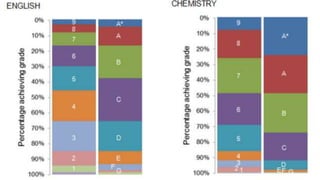
• Grades will now be awarded in 9-1, with 9 being the
highest (A*-G)
How can you help?
Five ways parents can help and support
students in GCSE English.
1. Encourage reading- e.g. a range of fiction (various
centuries)/ newspapers/ autobiographies.
2. Encourage proof reading i.e. checking for errors
(spelling/punctuation/ change of tense) and finding
opportunities for improvement.
3. Get to know the exams. aqa.org.uk
4. Read set texts (a handout is available), talking about
the texts is invaluable.
5. Encourage organisation of work/resources
And some practical ideas…
• Ask your son/daughter to write you a letter arguing for
something they believe in/want to do/ think should change.
• Read a novel/article/play/essay/auto-biography text together
and discuss what you liked about it, how it made you both feel,
etc.
• Give your son/daughter a list of five words to learn how to
spell and to use.
BBC bitesize GCSE
http://www.bbc.co.uk/education/subjects/zr9d7ty
AQA:
http://www.aqa.org.uk/
Learning
Quiz
1.
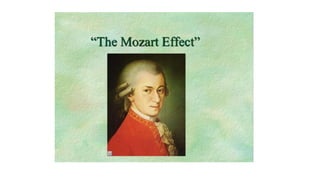
Will listening to
classical music whilst
studying help you
learn?
2.
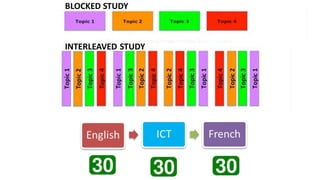
Is it better to spend 90 minutes revising
one subject?
OR
30 minutes revising three different
subjects?
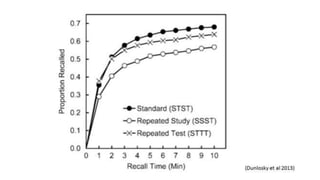
3.
Which of these approaches do you think
would lead to biggest learning gains?
1. Study- test - study - test
2. Study - study - study - test
3. Study - test - test - test
In lessons…
• Make good decisions
• Put your hand up
• Focus
• Persevere
• Be curious
• Smile
At home…
Success at GCSE Evening
As a result of this evening:
Discuss what you could do as a family
to ensure success at GCSE

Ryedale School GCSE Information Evening

  • 1.
    Success at GCSEEvening While you wait: Discuss what you could do as a family to ensure success at GCSE
  • 2.
  • 3.
    9-5 66 What dothese numbers refer to?
  • 5.
  • 6.
    9-1 GCSEs • Deliberatelymade more challenging • Terminal examinations, not modular • No coursework or controlled assessment for academic subjects • Larger emphasis on examination in practical subjects
  • 8.
    May November AprilMay 2017 2018 Year 10 Mock Examinations Year 11 Mock Examinations Controlled assessment deadline June Work Experience GCSEs Begin! GCSE Timeline
  • 10.
    How we cansucceed…
  • 11.
  • 13.
    Sleep and food Asurvey of GCSE students in England found that 29% of the young people stay up until after 1 a.m. and half said they went to school without eating breakfast.
  • 14.
  • 15.
  • 16.
  • 17.
    Success at GCSE Mathematics Tolearn, you must want to be taught.
  • 18.
    Why is Mathsimportant? •Many courses and jobs require GCSE Maths •It improves your problem solving skills •It gives you the skills to manage your personal finances •Research shows that people who are good at Maths, on average, earn more Pencil, protractor and calculator – weapons of Maths destruction.
  • 19.
    • The finalscore in a football match was 3 – 2. • How many different possible half-time scores are there? • The answer is 36. • What was the question? Nessie, the Loch Ness monster, weighs ‘600kg plus half her weight’. How much does Nessie weigh? In an enclosure at the zoo there are ostriches and giraffes. If there are 16 heads and 52 legs, how many of each animal are there?
  • 20.
    Course Overview •The GCSEcourse started inYear 9. •It takes 3 years. •The exams are in May or June 2018. •AQA Mathematics – 3 exams at the end of the course. •There is no coursework. 5 out of 4 people have difficulty with fractions
  • 21.
    Course Content • Number4 operations Surds Negative numbers Standard form Factors, multiples, primes Indices Fractions Rational Numbers Decimals Limits of Accuracy Percentages Ratio and Proportion BIDMAS 0.3333… = 1/3 0.6666… = 2/3 0.9999… = 3/3 = 1
  • 22.
    Course Content • AlgebraSubstitution Quadratic equations Equations Algebraic Fractions Graphs Transforming Graphs Sequences Iteration Brackets Pre-Calculus Rearranging Formulae Trial and Improvement Simple quadratics Decimals Have a Point
  • 23.
    Course Content • Shapeand Space 2D shapes Trigonometry 3D shapes Vectors Area &Volume Circle Geometry Pythagoras Similar Shapes Transformations Spheres and Pyramids Angles Measures Constructions Simple trigonometry Why is the number 6 scared? Because 7 8 9.
  • 24.
    Course Content • Statisticsand Averages Histogram Probability Charts Cumulative Frequency Scatter Graph Box Plot Probability Tree Diagrams Surveys Conditional Probability If you think dogs can’t count, try putting 3 biscuits in your pocket and only giving Fido 2 of them.
  • 25.
    Expectations Behaviour for learningComplete homework Do your best Complete practice papers Show your working Keep your book neat and accurate Attendance Be prepared for each lesson If there is a 50 – 50 chance that something will go wrong, then 9 times out 10 it will.
  • 26.
    Equipment Calculator – haveyour own to become familiar with it Pen & Pencil Sharpener Ruler Protractor Rubber Compasses It is not how many times you fall that is important, it is how many times you get back up again.
  • 27.
    Homework •Set twice perweek •Year 10 consolidation tasks, learning, puzzles •Year 11 revision and practice papers •Should take between 30 – 40 minutes Failure is the opportunity to begin again, more intelligently.
  • 28.
    The Maths ExamAQA Mathematics (8300) Higher Old Grade A* A* A B B/C C New Grade 9 8 7 6 5 4 Foundation Old Grade B/C C D E F/G New Grade 5 4 3 2 1
  • 29.
    The Maths Exam •AQAMathematics (8300) •The higher the number, the higher the grade. •Set 1 and Set 2 follow the Higher course. •Set 3, Set 4 and Set 5 follow the Foundation course. Maths, the only place where you can buy 80 watermelons without anyone thinking you’re weird.
  • 30.
    The Papers • FoundationHigher •Paper 1 non-calculator 80 marks 1h 30m 1h 30m •Paper 2 calculator 80 marks 1h 30m 1h 30m •Paper 3 calculator 80 marks 1h 30m 1h 30m •Any topic can appear on any paper Parallel lines have so much in common, it’s a shame they’ll never meet.
  • 31.
    What do thestudents do? • Individual work and Paired work • Basic skills and applied skills • Familiar and unfamiliar situations • Multi-stage problems • Regular assessments to track progress • Targets set to enhance progress • Complete practice papers (Year 11) Maths is like true love, a simple idea but it can get complicated.
  • 32.
    What can parentsdo? • Provide an appropriate place to work free from distraction • Be supportive and encouraging • Ask your child to explain what they have been doing • Get a revision guide • Check that homework and practice papers are completed • Do not say ‘well I was never any good at maths’. • If you are positive then your child will be positive. • If you have a concern contact the school. The will to succeed is not nearly so important as the will to prepare to succeed.
  • 33.
    Websites •Mymaths •Mr Barton maths •bbcbitesize •Khan Academy •AQA for past papers The only way to learn Maths is to do Maths.
  • 34.
    GCSE English Two GCSEswith separate grades awarded: English Language English Literature Spoken Language
  • 35.
    Course Structure Language Literature Paper1 (1hr 45) •Exploration in creative reading and writing. Paper 2 (1hr 45)  Writers’ viewpoints and perspectives. Paper 1 (1hr 45) •Shakespeare •19th Century Literature Text Paper 2 (2hr 15) •Modern Text/Play •Relationship Poetry •Unseen poetry.
  • 36.
    What does theGCSE look like? • All exam • There are no tiers for the papers (Foundation or Higher) • Closed text exams • Grades will now be awarded in 9-1, with 9 being the highest (A*-G)
  • 37.
  • 38.
    Five ways parentscan help and support students in GCSE English. 1. Encourage reading- e.g. a range of fiction (various centuries)/ newspapers/ autobiographies. 2. Encourage proof reading i.e. checking for errors (spelling/punctuation/ change of tense) and finding opportunities for improvement. 3. Get to know the exams. aqa.org.uk 4. Read set texts (a handout is available), talking about the texts is invaluable. 5. Encourage organisation of work/resources
  • 39.
    And some practicalideas… • Ask your son/daughter to write you a letter arguing for something they believe in/want to do/ think should change. • Read a novel/article/play/essay/auto-biography text together and discuss what you liked about it, how it made you both feel, etc. • Give your son/daughter a list of five words to learn how to spell and to use. BBC bitesize GCSE http://www.bbc.co.uk/education/subjects/zr9d7ty AQA: http://www.aqa.org.uk/
  • 40.
  • 41.
    1. Will listening to classicalmusic whilst studying help you learn?
  • 43.
    2. Is it betterto spend 90 minutes revising one subject? OR 30 minutes revising three different subjects?
  • 45.
    3. Which of theseapproaches do you think would lead to biggest learning gains? 1. Study- test - study - test 2. Study - study - study - test 3. Study - test - test - test
  • 47.
    In lessons… • Makegood decisions • Put your hand up • Focus • Persevere • Be curious • Smile
  • 48.
  • 49.
    Success at GCSEEvening As a result of this evening: Discuss what you could do as a family to ensure success at GCSE

Editor's Notes

  • #35 English GCSE spans over two years and students will achieve two GCSEs, English Language and English Literature. They will also achieve a separate award for Spoken Language, this will be taught and assessed as part of the course, and will be focused on developing confidence in students and nurturing their ability to speak formally for an audience. Further education establishments (sixth forms, colleges, apprenticeships) will be looking for at minimum pass grade of a C in English, it is a key subject for students, to ensure they can move on to the next step – there is lots of support for students, in the form of lessons, homework (there will be two set homework tasks a week in English, they will be between 30-40 minutes in length, homework can range from written essays, planning work, annotating texts, researching), feedback and KS4 study club run on a Tuesday and Thursday after school.
  • #36 Paper 1 will involve study of one literature text from either C19th, C20th or C21st, from this students will then be required to write creatively a narrative or description. In Paper 2, however, students will be required to study two texts, one non-fiction and one literary non-fiction (a genre of writing that uses literary styles and techniques to create factually accurate narratives). Students will then be required to make comparisons between the two texts (from different centuries), this will then lead in to a written piece where students will present their own view. Both exams have a high focus on writing, spelling, punctuation and grammar. There will also be two literature exams, the first exam focuses on Shakespeare and the C19th Literature (either ACC or PP). This exam will be a closed text exam and students will not have their text with them. Therefore it is vital that students develop a deep and working knowledge with these texts during the two year course. It will be important for students to read and re-read these texts independently. The second exam focuses on the modern text (either AIC or HB) and poetry. There will be also be a comparative question on the poems they study over the two years and finally two questions on unseen poems, poems they have previously not studied, therefore they are showing their skills at reading and understanding in a new context.
  • #37 Therefore it is vital that students are organised over the two years, resources need to be kept neatly, if students are away they need to catch up on missed work, there will also be a GCSE English Study Club run on Tuesdays and Thursdays, where homework, class work or personal choice work can be completed with an English specialist near by to help! The questions are broad to allow access for all students, we have also selected texts which will be accessible and provide appropriate challenge for students. The new grading system will come into being in 2016 – students achieving the highest result will be awarded a 9.
  • #39 The wider range, the better, particularly the more experience students have of different centuries, the more they know about life in C19th/C20th England or the world, the better. It will equip them with extra knowledge, something original in the exam! Proof-reading is vital – technical aspects of writing are being assessed more and students need to be encouraged to check – to avoid silly mistakes and less marks! The specifications are online – if you want anymore information Discussion of the texts is so important and the more variety of opinions, the better. Seems silly, but with a two year course, they need to know where to look for the resources they need.