



WELCOME
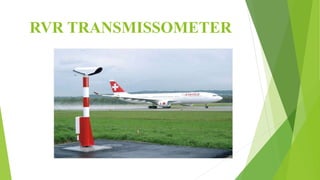
RVR TRANSMISSOMETER
INTRODUCTION
RVR
 “The visual range over which the pilot can see the runway surface
markings .”
 Assessment of visibility based on extinction coefficient of atmosphere,
runway light intensity etc.
 The purpose of RVR is to provide information to pilots , ATS.
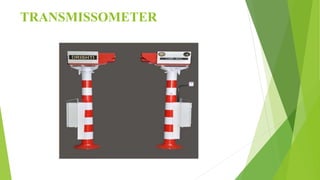
TRANSMISSOMETER
 Instrument that automatically measures and reports RVR.
 It assess extinction coefficient and provides a reliable method of assessing
the atmospheric condition.
 Has a transmitter and a receiver.
NEED OF RVR CHECKING
IN AVIATION
 Majority of the accidents in the aviation sector are linked to
visibility haze.
 Visibility is restricted by the effect of light being disturbed by
atmospheric particles.
 Weather phenomena can reduce the visibility.
 Infinite visibility never occurs in the atmosphere.
 In aviation sector visibility haze is a main issue.
MOST COMMON WEATHER PHENOMENA
AND THEIR CHARACTERISTICS
CONVENTIONAL METHODS -
TRANSMISSOMETER
A)HUMAN OBSERVER TECHNIQUE
 An observer counts the number of runway lights or markers.
 This number is converted to runway visual range, making due
allowance for the differences in light intensity, background, etc.
 Human assessments are not accurate.
Disadvantages
 Accuracy and consistency are lower than instrumented RVR systems
 Change in weather conditions cannot be updated.
 Fluctuations of RVR cannot be indicated.
 Time consuming.
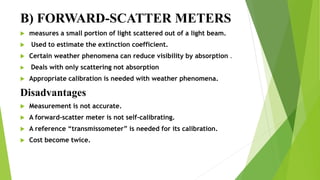
B) FORWARD-SCATTER METERS
 measures a small portion of light scattered out of a light beam.
 Used to estimate the extinction coefficient.
 Certain weather phenomena can reduce visibility by absorption .
 Deals with only scattering not absorption
 Appropriate calibration is needed with weather phenomena.
Disadvantages
 Measurement is not accurate.
 A forward-scatter meter is not self-calibrating.
 A reference “transmissometer” is needed for its calibration.
 Cost become twice.
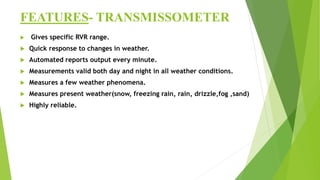
FEATURES- TRANSMISSOMETER
 Gives specific RVR range.
 Quick response to changes in weather.
 Automated reports output every minute.
 Measurements valid both day and night in all weather conditions.
 Measures a few weather phenomena.
 Measures present weather(snow, freezing rain, rain, drizzle,fog ,sand)
 Highly reliable.
TRANSMISSOMETER
STRUCTURE- TRANSMISSOMETER
BLOCK DIAGRAM -
TRANSMISSOMETER
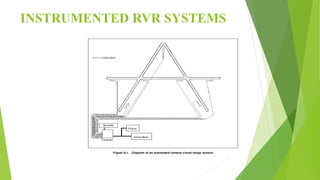
INSTRUMENTED RVR SYSTEMS
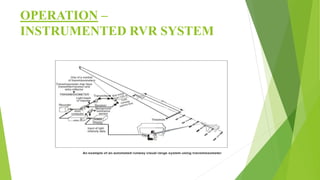
OPERATION –
INSTRUMENTED RVR SYSTEM
ADVANTAGES
 self-calibrating.
 Both absorption and scattering effects are correctly measured.
 The accuracy of the measurement does not depend upon the
weather phenomena.
DISADVANTAGES
 Covering the complete RVR range from 50 to 2 000 m with a single
instrument is technically difficult.
 Sensitive to errors caused by window contamination.
 Can not be recalibrated under low visibility conditions
FUTURE SCOPE
 Size can be reduced
 A single instrument which covers the entire range of RVR can be
implemented.
CONCLUSION
 Rate of accidents in aviation is reduced by this technology.
 Hope INDIA also will acquire this technology in all airports.
THANKS
Q&A

RVR Transmissometer

  • 1.
  • 2.
  • 3.
    INTRODUCTION RVR  “The visualrange over which the pilot can see the runway surface markings .”  Assessment of visibility based on extinction coefficient of atmosphere, runway light intensity etc.  The purpose of RVR is to provide information to pilots , ATS. TRANSMISSOMETER  Instrument that automatically measures and reports RVR.  It assess extinction coefficient and provides a reliable method of assessing the atmospheric condition.  Has a transmitter and a receiver.
  • 4.
    NEED OF RVRCHECKING IN AVIATION  Majority of the accidents in the aviation sector are linked to visibility haze.  Visibility is restricted by the effect of light being disturbed by atmospheric particles.  Weather phenomena can reduce the visibility.  Infinite visibility never occurs in the atmosphere.  In aviation sector visibility haze is a main issue.
  • 5.
    MOST COMMON WEATHERPHENOMENA AND THEIR CHARACTERISTICS
  • 6.
    CONVENTIONAL METHODS - TRANSMISSOMETER A)HUMANOBSERVER TECHNIQUE  An observer counts the number of runway lights or markers.  This number is converted to runway visual range, making due allowance for the differences in light intensity, background, etc.  Human assessments are not accurate. Disadvantages  Accuracy and consistency are lower than instrumented RVR systems  Change in weather conditions cannot be updated.  Fluctuations of RVR cannot be indicated.  Time consuming.
  • 7.
    B) FORWARD-SCATTER METERS measures a small portion of light scattered out of a light beam.  Used to estimate the extinction coefficient.  Certain weather phenomena can reduce visibility by absorption .  Deals with only scattering not absorption  Appropriate calibration is needed with weather phenomena. Disadvantages  Measurement is not accurate.  A forward-scatter meter is not self-calibrating.  A reference “transmissometer” is needed for its calibration.  Cost become twice.
  • 8.
    FEATURES- TRANSMISSOMETER  Givesspecific RVR range.  Quick response to changes in weather.  Automated reports output every minute.  Measurements valid both day and night in all weather conditions.  Measures a few weather phenomena.  Measures present weather(snow, freezing rain, rain, drizzle,fog ,sand)  Highly reliable.
  • 9.
  • 10.
  • 11.
  • 12.
  • 13.
  • 14.
    ADVANTAGES  self-calibrating.  Bothabsorption and scattering effects are correctly measured.  The accuracy of the measurement does not depend upon the weather phenomena. DISADVANTAGES  Covering the complete RVR range from 50 to 2 000 m with a single instrument is technically difficult.  Sensitive to errors caused by window contamination.  Can not be recalibrated under low visibility conditions
  • 15.
    FUTURE SCOPE  Sizecan be reduced  A single instrument which covers the entire range of RVR can be implemented.
  • 16.
    CONCLUSION  Rate ofaccidents in aviation is reduced by this technology.  Hope INDIA also will acquire this technology in all airports.
  • 17.
  • 18.