Rural Finance Study
Project: Rural finance Mission: New business development , finance Category: Research Agency: RC&M Client: Mulitple
IndexIntroductionRural Finance – An UnderstandingFinance Presence in Rural IndiaThe ChallengesEnabling Measures Banking Strategy -  Long Term ImpactCase StudiesGoing Forward – Next StepsAnnexure I
IntroductionIn India, over 65% of the population resides in villages. And approx, 70% of the villagers do not have bank accounts.But Finance is not completely absent. Just the sources of supply are informal like moneylendersMoneylenders are said to control one third of all rural loans, and wield considerable strength, given their personal acquaintance with the local population and omnipresent distribution network.
Rural Finance – An Understanding
Rural finance- An understandingA number of banks and finance companies have begun to specialize in offering credit to farmers.Finance in this sector has the added benefit of supporting further work in regional areas. As banks and financial services continue to extend their services into rural India they are generating employment in the vicinity.
Rural finance- An understandingRural finance is a line of credit specifically intended for the requirements of the agricultural industry. Ranging from mortgage assistance to land development and farming equipment, these credit plans are a significant aspect of rural and semi-urban support.In a country like India, farming finance is a service of utmost importance and closely related to the continued progress of the country, as agriculture continues to play a central role.
Finance Presence in Rural India
Financial aids for the poor clusters in rural areas today are in the following forms:Nationalized Banks
Private Banks
Credit Societies
Co-operative Banks
 Informal loans (Money Lenders)Finance Presence in Rural IndiaNationalized Banks – Regional Rural Banks (RRB/ Gramin)Rural banking in India started since the establishment of banking sector in India. Rural Banks in those days mainly focused upon the agro sector. Regional rural banks in India penetrated every corner of the country and extended a helping hand in the growth process of the country.
Till date in rural banking in India, there are 14,475 rural banks in the country of which 2126 (91%) are located in remote rural areas. Finance Presence in Rural IndiaNationalized Banks – Regional Rural Banks (RRB/ Gramin)SBISBI, has a breathtaking rural branch network of 6,600 with 972 specialized branches. These	branches have been set up in different parts of the country with the sole purpose of developing agriculture through credit deployment.
SBI has developed rural agricultural business units, education programmes for local farmers and “kisan” cards. SBI has gradually evolved to become the leader in agricultural finance with a portfolio of Rs. 18,000 crore in  loans to around 50 lakh farmers. Finance Presence in Rural IndiaNationalized Banks – Regional Rural Banks (RRB/ Gramin)SBIOne of their recent  endeavors is the tie-up with National Agricultural Cooperative Marketing Federation (NAFED) to  finance farmers for cultivation of various crops like soyabean, paddy, jute and potato.
SBI has 30 Regional Rural Banks in India known as RRBs. The rural banks of SBI is spread in 13 states extending from Kashmir to Karnataka and Himachal Pradesh to North East. The total number of SBIs Regional Rural Banks in India branches is 2349 (16%).Finance Presence in Rural IndiaNationalized Banks – Regional Rural Banks (RRB/ Gramin)CanaraCanara has launched aggressive grass-root  level plans, in a bid to achieve 100% financial inclusion in 1,400 villages all over India, which could bring 7 lakh families into their net.
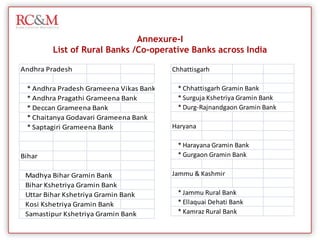
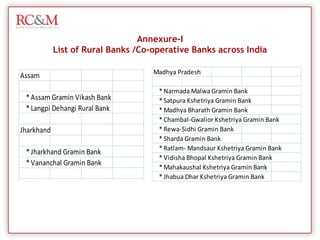
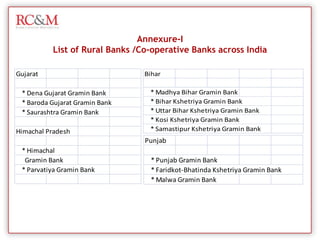
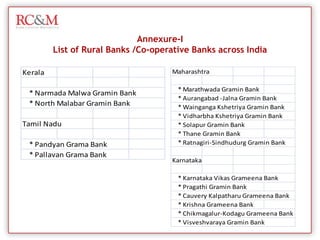
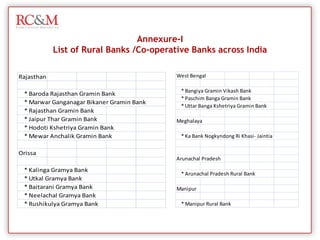
Under  this programme, every adult member of a rural household in the selected villages would be encouraged to open a 'No Frills' account with minimum entry-level formalities.List of all RRB Banks across India – see Annexure I, at the end of the presentation
Finance Presence in Rural IndiaPrivate banks- CommercialICICIICICI Bank, the country’s second largest bank, has adopted the franchise model of operation in rural markets.
A one man office (known as “kendra”) in the village forms an interface between the villager and the Bank’s products and facilities. Crop loans, housing loans, automobile loans, farm equipment, seed  financing and insurance policies are all on offer.
The number of borrowers has risen from 130 in 2000 to over 42,000 today, and the rural loan book has crossed Rs. 16,000 crore. And the bank’s default rate in the rural retail sector is 1  –  2 % as compared to 2 – 3% in the rural wholesale sector and 5% for the banking  sector as a whole.Finance Presence in Rural IndiaPrivate banks- CommercialICICI ICICI  is looking at tying up with micro-finance institutions and local self-help groups (or creating them if already do not exist).
 ICICI has gone further in tying up with large corporate majors having significant presence rural India and providing loans/banking services to their distributors/traders and also it is working in tandem with postal department.Finance Presence in Rural IndiaPrivate banks- CommercialForeign BanksForeign Banks like Citibank, HSBC and Standard Chartered are now looking “villageward”. Citi is reported to be in the hunt for several rural branch licenses. There is a new focus on the SME segment as well.
More or less, all the banks are using an agent-based model , as the typical branch-based model does not work here due to cost economics.
Many banks have solutions for Mobile-based services to reach rural consumers directly into their hand. Finance Presence in Rural IndiaCooperative  Banks Credit CooperativesRural Credit Cooperatives have existed in India for a long time. A shortage of supply of rural credit was prevalent in India. To meet the demand for short and long term rural credit the Co-operative Credit Structure (CCS) was set up. While short term credit is supplied by the State Cooperative Banks (SCB), District Central Cooperative Banks (DCCB) and Primary Agricultural Credit Societies (PACS), long term credit is supplied by the Primary Cooperative Agriculture and Rural Development Banks (PCARDB)
Finance Presence in Rural IndiaCooperative  Banks Credit CooperativesThe Co-operative Credit Structure (CCS) of India was set up to serve the needs of both short term and long term rural credit in India. Short term credit is supplied in rural India by three institutions – State Cooperative Banks (SCB)
District Central Cooperative Banks (DCCB)
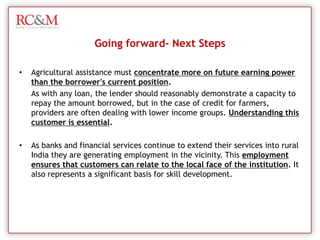
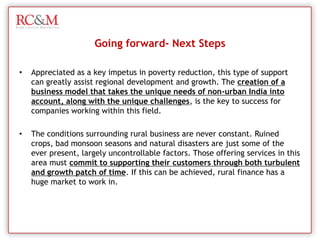
Primary Agricultural Credit Societies (PACS) Long term credit is supplied by the Primary Cooperative Agriculture and
Rural Development Banks (PCARDB).Finance Presence in Rural IndiaCredit Societies - Small Scale Finance OrganizationsThere are two types of financial organizations that 	provide small‐scale entrepreneur support.  Microfinance  institutions (MFI)
Small Organizations/NGOs/SHGFinance Presence in Rural IndiaCredit Societies - Small Scale Finance OrganizationsMicrofinance institutionsMFI  Their amounts are often  too  small to  be   used  for the  intended (productive)  purposes,  such  as Upgrading an existing venture, as well as for their  lack of non-financial support. 
However, some MFI’s, notably BASIX, a  livelihood finance provider, and SKS, are using  financing models that go beyond  the  traditional microfinance  funds  to support  small‐scale  entrepreneurs  as  an  alternative investment opportunity in rural areas.Finance Presence in Rural IndiaCredit Societies - Small Scale Finance OrganizationsMicrofinance institutionsThese MFI’s provide larger grants coupled with non‐financial support for rural ventures that promise increased employment opportunities for the poor. Already  established  in  rural  areas, MFI’s  have an  advantage  in  local  networks  and  understanding about the risks of a potential investment
Finance Presence in Rural IndiaCredit Societies - Small Scale Finance OrganizationsSmall Organisations- NGOs/SHOsThere are other organizations involved in financing rural  entrepreneurs or infrastructure in villages, often with a specific remit such as environmental sustainability. 
Financial organization such as S3IDF work together with   local NGOs/SHGs to provide basic infrastructure services in rural areas and train local entrepreneurs to  take charge of the projects or services. 
Finance is the primary service, but these organizationsprovide additional services to link the technology with    finance and suppliers Case Study – ICommunity Banks/SocietiesBanking for specific communities : Community based banks are success stories in India. Rickshaw Bank is started in 2004 and the central idea is the issue of an asset-based loan to the rickshaw puller for which installments are repayable on a daily repayment plan with one-year duration. Full and timely repayment leads to ownership of the rickshaw being handed over to the puller. This concept is in contradiction to the existing practice in which an equivalent amount of a daily rental fee is paid to rent the vehicle, possibly for the lifetime of activity, with no scope for ownership.Usha Bank is started by a sex worker and it is with the purpose of providing economic security to Sex workers. Although sex workers earn in cash, they have little control over their assets. Most of their income is used to pay off power brokers within the industry, bribe local cops and provide sustenance to their families. This makes them vulnerable to extortion by moneylenders. Perpetually in debt, it is not uncommon for prostitutes to pay annual interest rates as high as 1500 percent.
Case Study – II : Example of SHG (aiding villagers’ Finance)Karunya, a woman’s self help group Can be found at the vegetable market in Santhivila, a village on the outskirts of Thiruvananthapuram. They are a group of 16 young women who have changed the local economy. They are members of Karunya, a women's self-help group registered with Kudumbasree, the state Government's Poverty Eradication Project. None of them had a job till they formed Karunya in 2007The local gram panchayat gave the group Rs 1 lakh and space at the local vegetable market. With the seed money, they took a bank loan to start a unit making paper boards, cloth bags, office files, pens, pencils etc. Today, Karunya is one of the most popular brands in these products. There are an incredible 37 lakh poor women who are members of Kudumbasree, making it Asia's largest women's self-help and micro-credit movement.
More financial products making wayOther financial products making their way into villages includeIFFCO-Tokio’s weather insurance product,
BarishBimaYojana for farmers in Rajasthan
ICICI Lombard’s medical insurance scheme ‘Sanjeevini’  for farmers in Punjab
Commodity futures and weather derivatives. The challenges
ChallengesSome of the major challenges which intermediaries (Local Financial Institutions) face today in India are:The supply dilemma: The exclusion of large numbers of the rural population from the formal banking sector may be for several reasons from the supply side: Persons are un-bankable in the evaluation/perception of bankersThe loan amount is too small to invite attention of the bankersThe person is bankable on a credit appraisal approach but supporting the  accounts and expanding branch network is not feasible and viable
ChallengesThe supply dilemma:High transaction costs particularly in dealing with a large number of small accounts
Lack of collateral security Inability to evaluate and monitor cash flow cycles and repayment capacities due to information asymmetry, lack of data base and absence of credit history of people with small means
Human resources related constraints both in terms of inadequacy of manpower and lack of proper orientation/expertise
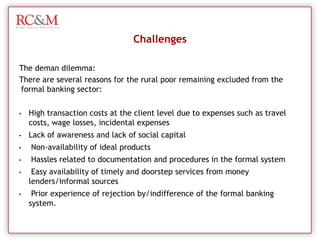
Adverse security situation prevailing in some parts of slums and other such localities ChallengesThe deman dilemma:There are several reasons for the rural poor remaining excluded from the formal banking sector:High transaction costs at the client level due to expenses such as travel costs, wage losses, incidental expenses
Lack of awareness and lack of social capital
 Non-availability of ideal products
 Hassles related to documentation and procedures in the formal system
 Easy availability of timely and doorstep services from money lenders/informal sources
 Prior experience of rejection by/indifference of the formal banking system.Enabling measures
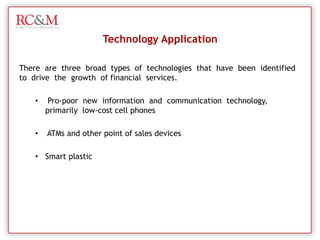
Technology ApplicationThere  are  three  broad  types  of  technologies  that  have  been  identified  to  drive  the  growth  of financial  services. Pro-poor  new  information  and  communication  technology, primarily  low-cost cell phones
 ATMs and other point of sales devices
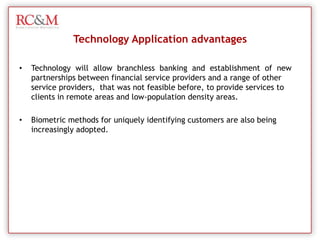
Smart plastic Technology Application advantagesTechnology  will  allow  branchless  banking  and  establishment  of  new  partnerships between financial service providers and a range of other service providers,  that was not feasible before, to provide services to clients in remote areas and low-population density areas. Biometric methods for uniquely identifying customers are also being increasingly adopted.
Casestudy- Technology adoptedBanks  in  India  have  initiated  pilot  projects  utilizing  smart  cards/mobile  technology  to  increase their outreach. Banks  are  also  increasingly  adopting  technological  solutions  for  delivery  of  credit  at affordable price and  to a wider section of  the population. SBI
Corporation BankCasestudy III- Technology adoptedState Bank of  India  initiated a project called  the  SBI  Tiny  Card  Accounts  [SBITCAs] recently  in  Aizwal.  The  SBITCAs  are  based  through  new  generation mobile  phones  based  on  near-field  communication  [NFC]  technology, enhanced with  fingerprint  recognition  software and attached  to  receipt printer. The Card tremendously increased the customer base for the bank. This card allows:Activation of  transfer of  funds  for  the purpose of micro-savings Cash deposits  and withdrawal,
Casestudy III- Technology adoptedThe card allows:Micro-credit, money  transfer  [account-to-account within  the  system], Micro-insurance Cashless payments  to  merchants  SHG  Savings-cum-credit  accounts  and  attendance  systems Disbursements of Government benefits like the national rural employment guarantee scheme, for equated  monthly  installments Utility  payments,  coupons,  vouchers,  tickets,  automatic  fare collection systems, etc.
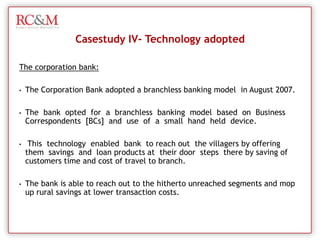
Casestudy IV- Technology adoptedThe corporation bank:The Corporation Bank adopted a branchless banking model  in August 2007. The  bank  opted  for  a  branchless  banking  model  based  on  Business Correspondents  [BCs]  and  use  of  a  small  hand  held  device.  This  technology  enabled  bank  to reach out  the villagers by offering  them  savings  and  loan products at  their door  steps  there by saving of customers time and cost of travel to branch. The bank is able to reach out to the hitherto unreached segments and mop up rural savings at lower transaction costs.

Rural Finance Study | Finance Presence in Rural India By RC&M India

  • 1.
  • 2.
    Project: Rural financeMission: New business development , finance Category: Research Agency: RC&M Client: Mulitple
  • 3.
    IndexIntroductionRural Finance –An UnderstandingFinance Presence in Rural IndiaThe ChallengesEnabling Measures Banking Strategy - Long Term ImpactCase StudiesGoing Forward – Next StepsAnnexure I
  • 4.
    IntroductionIn India, over65% of the population resides in villages. And approx, 70% of the villagers do not have bank accounts.But Finance is not completely absent. Just the sources of supply are informal like moneylendersMoneylenders are said to control one third of all rural loans, and wield considerable strength, given their personal acquaintance with the local population and omnipresent distribution network.
  • 5.
    Rural Finance –An Understanding
  • 6.
    Rural finance- AnunderstandingA number of banks and finance companies have begun to specialize in offering credit to farmers.Finance in this sector has the added benefit of supporting further work in regional areas. As banks and financial services continue to extend their services into rural India they are generating employment in the vicinity.
  • 7.
    Rural finance- AnunderstandingRural finance is a line of credit specifically intended for the requirements of the agricultural industry. Ranging from mortgage assistance to land development and farming equipment, these credit plans are a significant aspect of rural and semi-urban support.In a country like India, farming finance is a service of utmost importance and closely related to the continued progress of the country, as agriculture continues to play a central role.
  • 8.
  • 9.
    Financial aids forthe poor clusters in rural areas today are in the following forms:Nationalized Banks
  • 10.
  • 11.
  • 12.
  • 13.
    Informal loans(Money Lenders)Finance Presence in Rural IndiaNationalized Banks – Regional Rural Banks (RRB/ Gramin)Rural banking in India started since the establishment of banking sector in India. Rural Banks in those days mainly focused upon the agro sector. Regional rural banks in India penetrated every corner of the country and extended a helping hand in the growth process of the country.
  • 14.
    Till date inrural banking in India, there are 14,475 rural banks in the country of which 2126 (91%) are located in remote rural areas. Finance Presence in Rural IndiaNationalized Banks – Regional Rural Banks (RRB/ Gramin)SBISBI, has a breathtaking rural branch network of 6,600 with 972 specialized branches. These branches have been set up in different parts of the country with the sole purpose of developing agriculture through credit deployment.
  • 15.
    SBI has developedrural agricultural business units, education programmes for local farmers and “kisan” cards. SBI has gradually evolved to become the leader in agricultural finance with a portfolio of Rs. 18,000 crore in loans to around 50 lakh farmers. Finance Presence in Rural IndiaNationalized Banks – Regional Rural Banks (RRB/ Gramin)SBIOne of their recent endeavors is the tie-up with National Agricultural Cooperative Marketing Federation (NAFED) to finance farmers for cultivation of various crops like soyabean, paddy, jute and potato.
  • 16.
    SBI has 30Regional Rural Banks in India known as RRBs. The rural banks of SBI is spread in 13 states extending from Kashmir to Karnataka and Himachal Pradesh to North East. The total number of SBIs Regional Rural Banks in India branches is 2349 (16%).Finance Presence in Rural IndiaNationalized Banks – Regional Rural Banks (RRB/ Gramin)CanaraCanara has launched aggressive grass-root level plans, in a bid to achieve 100% financial inclusion in 1,400 villages all over India, which could bring 7 lakh families into their net.
  • 17.
    Under thisprogramme, every adult member of a rural household in the selected villages would be encouraged to open a 'No Frills' account with minimum entry-level formalities.List of all RRB Banks across India – see Annexure I, at the end of the presentation
  • 18.
    Finance Presence inRural IndiaPrivate banks- CommercialICICIICICI Bank, the country’s second largest bank, has adopted the franchise model of operation in rural markets.
  • 19.
    A one manoffice (known as “kendra”) in the village forms an interface between the villager and the Bank’s products and facilities. Crop loans, housing loans, automobile loans, farm equipment, seed financing and insurance policies are all on offer.
  • 20.
    The number ofborrowers has risen from 130 in 2000 to over 42,000 today, and the rural loan book has crossed Rs. 16,000 crore. And the bank’s default rate in the rural retail sector is 1 – 2 % as compared to 2 – 3% in the rural wholesale sector and 5% for the banking sector as a whole.Finance Presence in Rural IndiaPrivate banks- CommercialICICI ICICI is looking at tying up with micro-finance institutions and local self-help groups (or creating them if already do not exist).
  • 21.
    ICICI hasgone further in tying up with large corporate majors having significant presence rural India and providing loans/banking services to their distributors/traders and also it is working in tandem with postal department.Finance Presence in Rural IndiaPrivate banks- CommercialForeign BanksForeign Banks like Citibank, HSBC and Standard Chartered are now looking “villageward”. Citi is reported to be in the hunt for several rural branch licenses. There is a new focus on the SME segment as well.
  • 22.
    More or less,all the banks are using an agent-based model , as the typical branch-based model does not work here due to cost economics.
  • 23.
    Many banks havesolutions for Mobile-based services to reach rural consumers directly into their hand. Finance Presence in Rural IndiaCooperative Banks Credit CooperativesRural Credit Cooperatives have existed in India for a long time. A shortage of supply of rural credit was prevalent in India. To meet the demand for short and long term rural credit the Co-operative Credit Structure (CCS) was set up. While short term credit is supplied by the State Cooperative Banks (SCB), District Central Cooperative Banks (DCCB) and Primary Agricultural Credit Societies (PACS), long term credit is supplied by the Primary Cooperative Agriculture and Rural Development Banks (PCARDB)
  • 24.
    Finance Presence inRural IndiaCooperative Banks Credit CooperativesThe Co-operative Credit Structure (CCS) of India was set up to serve the needs of both short term and long term rural credit in India. Short term credit is supplied in rural India by three institutions – State Cooperative Banks (SCB)
  • 25.
  • 26.
    Primary Agricultural CreditSocieties (PACS) Long term credit is supplied by the Primary Cooperative Agriculture and
  • 27.
    Rural Development Banks(PCARDB).Finance Presence in Rural IndiaCredit Societies - Small Scale Finance OrganizationsThere are two types of financial organizations that  provide small‐scale entrepreneur support.  Microfinance  institutions (MFI)
  • 28.
    Small Organizations/NGOs/SHGFinance Presencein Rural IndiaCredit Societies - Small Scale Finance OrganizationsMicrofinance institutionsMFI Their amounts are often  too  small to  be  used  for the  intended (productive)  purposes,  such  as Upgrading an existing venture, as well as for their  lack of non-financial support. 
  • 29.
    However, some MFI’s, notably BASIX, a  livelihood finance provider, and SKS, are using  financing models that go beyond the  traditional microfinance  funds  to support  small‐scale  entrepreneurs  as  an  alternative investment opportunity in rural areas.Finance Presence in Rural IndiaCredit Societies - Small Scale Finance OrganizationsMicrofinance institutionsThese MFI’s provide larger grants coupled with non‐financial support for rural ventures that promise increased employment opportunities for the poor. Already  established  in  rural  areas, MFI’s  have an  advantage  in  local  networks  and  understanding about the risks of a potential investment
  • 30.
    Finance Presence inRural IndiaCredit Societies - Small Scale Finance OrganizationsSmall Organisations- NGOs/SHOsThere are other organizations involved in financing rural  entrepreneurs or infrastructure in villages, often with a specific remit such as environmental sustainability. 
  • 31.
  • 32.
    Finance is the primary service, but these organizationsprovide additional services to link the technology with finance and suppliers Case Study – ICommunity Banks/SocietiesBanking for specific communities : Community based banks are success stories in India. Rickshaw Bank is started in 2004 and the central idea is the issue of an asset-based loan to the rickshaw puller for which installments are repayable on a daily repayment plan with one-year duration. Full and timely repayment leads to ownership of the rickshaw being handed over to the puller. This concept is in contradiction to the existing practice in which an equivalent amount of a daily rental fee is paid to rent the vehicle, possibly for the lifetime of activity, with no scope for ownership.Usha Bank is started by a sex worker and it is with the purpose of providing economic security to Sex workers. Although sex workers earn in cash, they have little control over their assets. Most of their income is used to pay off power brokers within the industry, bribe local cops and provide sustenance to their families. This makes them vulnerable to extortion by moneylenders. Perpetually in debt, it is not uncommon for prostitutes to pay annual interest rates as high as 1500 percent.
  • 33.
    Case Study –II : Example of SHG (aiding villagers’ Finance)Karunya, a woman’s self help group Can be found at the vegetable market in Santhivila, a village on the outskirts of Thiruvananthapuram. They are a group of 16 young women who have changed the local economy. They are members of Karunya, a women's self-help group registered with Kudumbasree, the state Government's Poverty Eradication Project. None of them had a job till they formed Karunya in 2007The local gram panchayat gave the group Rs 1 lakh and space at the local vegetable market. With the seed money, they took a bank loan to start a unit making paper boards, cloth bags, office files, pens, pencils etc. Today, Karunya is one of the most popular brands in these products. There are an incredible 37 lakh poor women who are members of Kudumbasree, making it Asia's largest women's self-help and micro-credit movement.
  • 34.
    More financial productsmaking wayOther financial products making their way into villages includeIFFCO-Tokio’s weather insurance product,
  • 35.
  • 36.
    ICICI Lombard’s medicalinsurance scheme ‘Sanjeevini’ for farmers in Punjab
  • 37.
    Commodity futures andweather derivatives. The challenges
  • 38.
    ChallengesSome of themajor challenges which intermediaries (Local Financial Institutions) face today in India are:The supply dilemma: The exclusion of large numbers of the rural population from the formal banking sector may be for several reasons from the supply side: Persons are un-bankable in the evaluation/perception of bankersThe loan amount is too small to invite attention of the bankersThe person is bankable on a credit appraisal approach but supporting the accounts and expanding branch network is not feasible and viable
  • 39.
    ChallengesThe supply dilemma:Hightransaction costs particularly in dealing with a large number of small accounts
  • 40.
    Lack of collateralsecurity Inability to evaluate and monitor cash flow cycles and repayment capacities due to information asymmetry, lack of data base and absence of credit history of people with small means
  • 41.
    Human resources relatedconstraints both in terms of inadequacy of manpower and lack of proper orientation/expertise
  • 42.
    Adverse security situationprevailing in some parts of slums and other such localities ChallengesThe deman dilemma:There are several reasons for the rural poor remaining excluded from the formal banking sector:High transaction costs at the client level due to expenses such as travel costs, wage losses, incidental expenses
  • 43.
    Lack of awarenessand lack of social capital
  • 44.
    Non-availability ofideal products
  • 45.
    Hassles relatedto documentation and procedures in the formal system
  • 46.
    Easy availabilityof timely and doorstep services from money lenders/informal sources
  • 47.
    Prior experienceof rejection by/indifference of the formal banking system.Enabling measures
  • 48.
    Technology ApplicationThere are three broad types of technologies that have been identified to drive the growth of financial services. Pro-poor new information and communication technology, primarily low-cost cell phones
  • 49.
    ATMs andother point of sales devices
  • 50.
    Smart plastic TechnologyApplication advantagesTechnology will allow branchless banking and establishment of new partnerships between financial service providers and a range of other service providers, that was not feasible before, to provide services to clients in remote areas and low-population density areas. Biometric methods for uniquely identifying customers are also being increasingly adopted.
  • 51.
    Casestudy- Technology adoptedBanks in India have initiated pilot projects utilizing smart cards/mobile technology to increase their outreach. Banks are also increasingly adopting technological solutions for delivery of credit at affordable price and to a wider section of the population. SBI
  • 52.
    Corporation BankCasestudy III-Technology adoptedState Bank of India initiated a project called the SBI Tiny Card Accounts [SBITCAs] recently in Aizwal. The SBITCAs are based through new generation mobile phones based on near-field communication [NFC] technology, enhanced with fingerprint recognition software and attached to receipt printer. The Card tremendously increased the customer base for the bank. This card allows:Activation of transfer of funds for the purpose of micro-savings Cash deposits and withdrawal,
  • 53.
    Casestudy III- TechnologyadoptedThe card allows:Micro-credit, money transfer [account-to-account within the system], Micro-insurance Cashless payments to merchants SHG Savings-cum-credit accounts and attendance systems Disbursements of Government benefits like the national rural employment guarantee scheme, for equated monthly installments Utility payments, coupons, vouchers, tickets, automatic fare collection systems, etc.
  • 54.
    Casestudy IV- TechnologyadoptedThe corporation bank:The Corporation Bank adopted a branchless banking model in August 2007. The bank opted for a branchless banking model based on Business Correspondents [BCs] and use of a small hand held device. This technology enabled bank to reach out the villagers by offering them savings and loan products at their door steps there by saving of customers time and cost of travel to branch. The bank is able to reach out to the hitherto unreached segments and mop up rural savings at lower transaction costs.