Scope of Education in Rural India Scope of Education in Rural India
Index  Change & Evolution  in Education Scenario in Rural India in last 5 years TG Aspirations , Perception & Growth Education Market - Scope of Evolution Industrial Scenario Example  Digitized Way of Teaching Challenges Agency Role in meeting the Challenges
Change & Evolution  in the Education Scenario  in Rural India in last 5 years
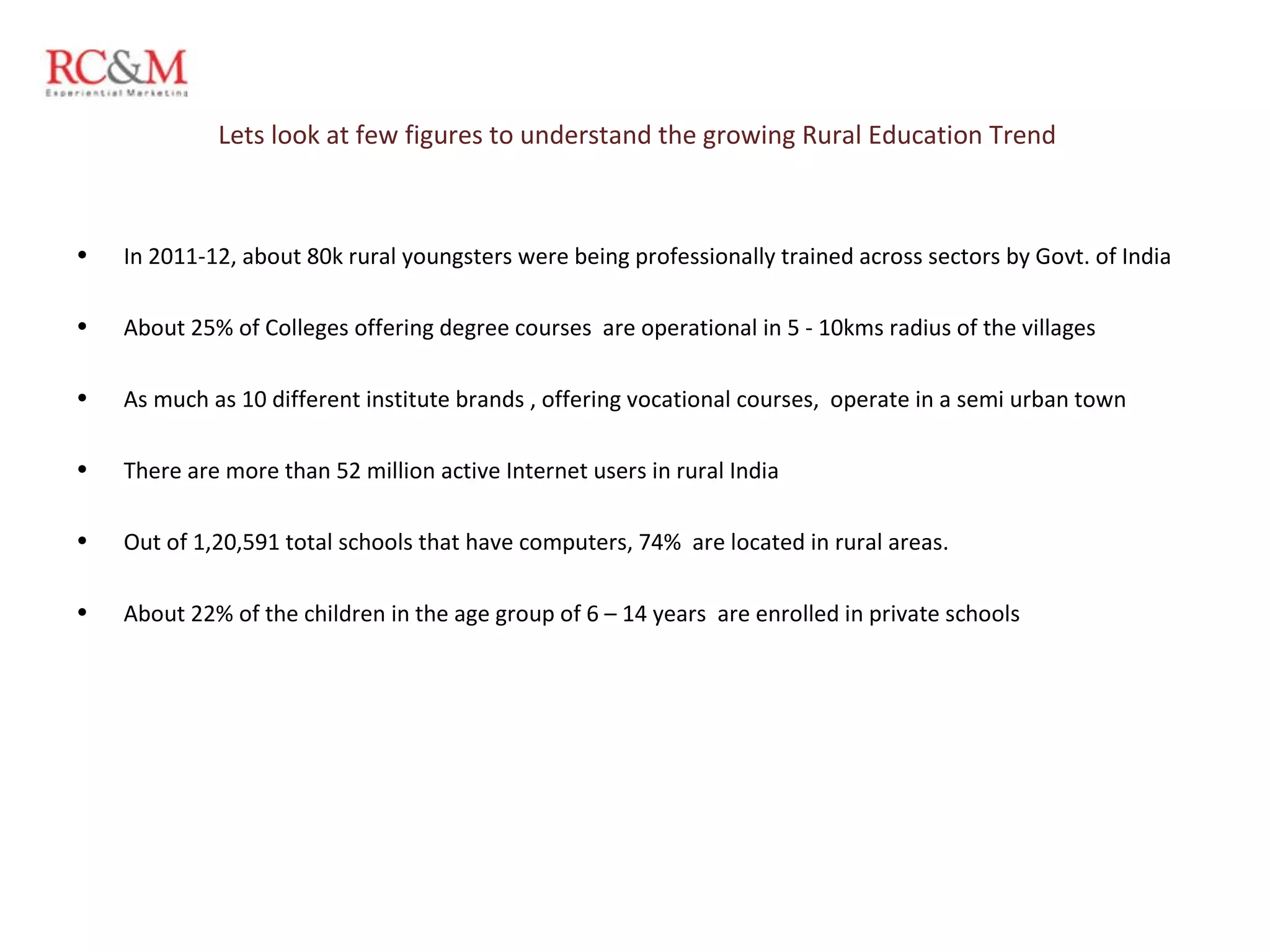
Lets look at few figures to understand the growing Rural Education Trend  In 2011-12, about 80k rural youngsters were being professionally trained across sectors by Govt. of India About 25% of Colleges offering degree courses  are operational in 5 - 10kms radius of the villages As much as 10 different institute brands , offering vocational courses,  operate in a semi urban town There are more than 52 million active Internet users in rural India Out of 1,20,591 total schools that have computers, 74%  are located in rural areas. About 22% of the children in the age group of 6 – 14 years  are enrolled in private schools
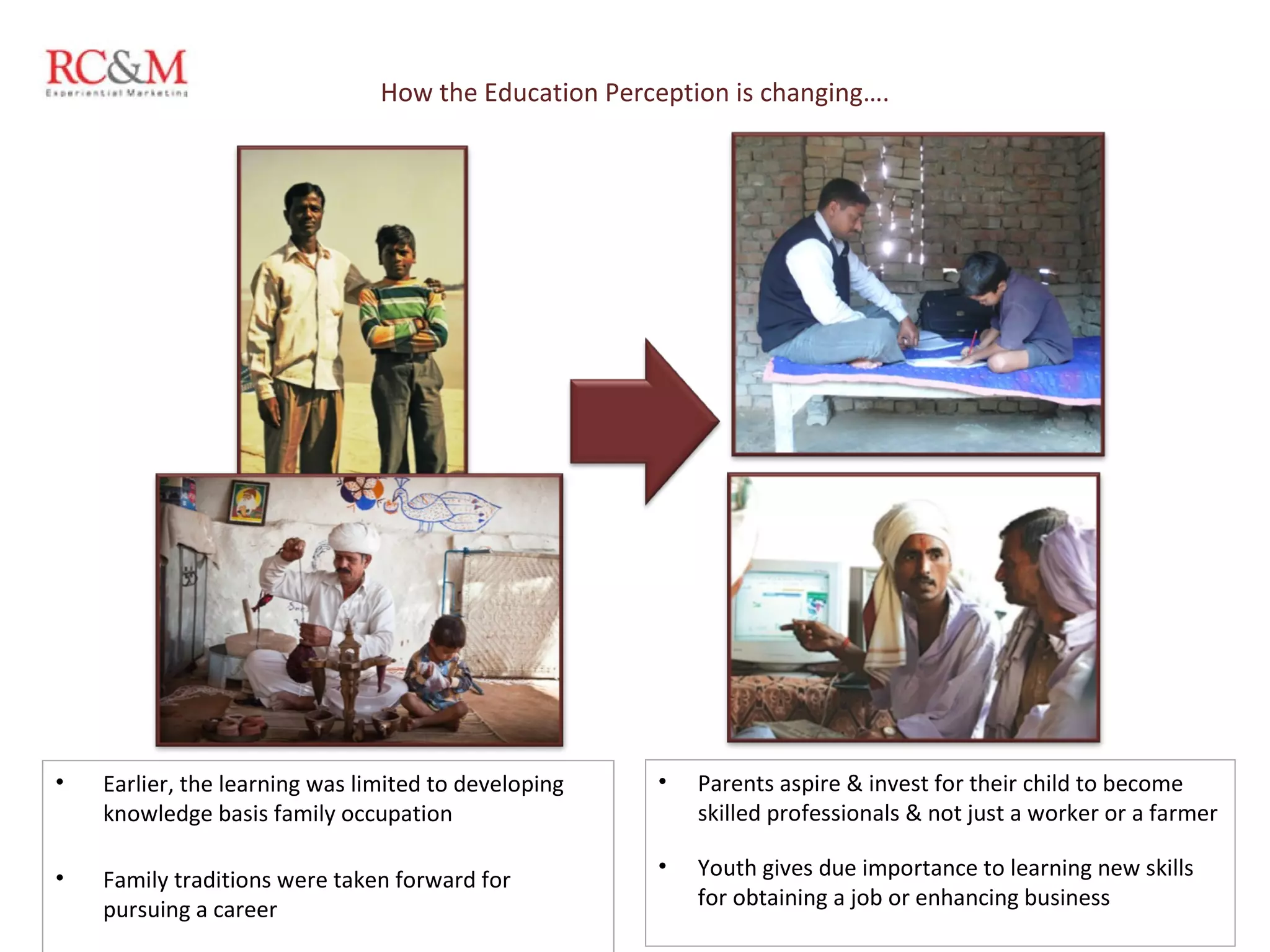
How the Education Perception is changing…. Earlier, the learning was limited to developing knowledge basis family occupation  Family traditions were taken forward for pursuing a career Parents aspire & invest for their child to become skilled professionals & not just a worker or a farmer Youth gives due importance to learning new skills for obtaining a job or enhancing business
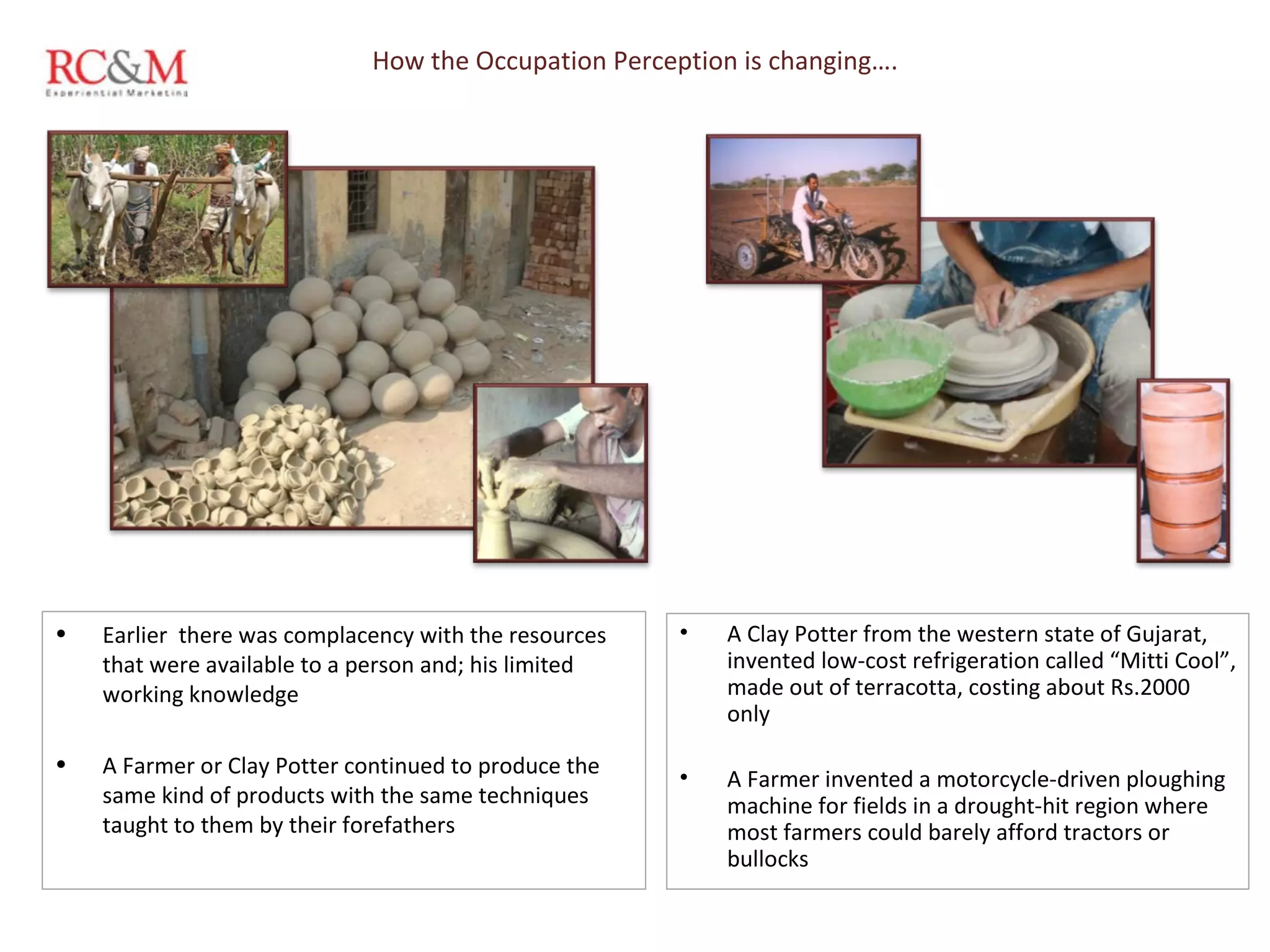
How the Occupation Perception is changing…. A Clay Potter from the western state of Gujarat, invented low-cost refrigeration called “Mitti Cool”, made out of terracotta, costing about Rs.2000 only A Farmer invented a motorcycle-driven ploughing machine for fields in a drought-hit region where most farmers could barely afford tractors or bullocks Earlier  there was complacency with the resources that were available to a person and; his limited working knowledge  A Farmer or Clay Potter continued to produce the same kind of products with the same techniques  taught to them by their forefathers
TG Aspirations, Perception &   Growth
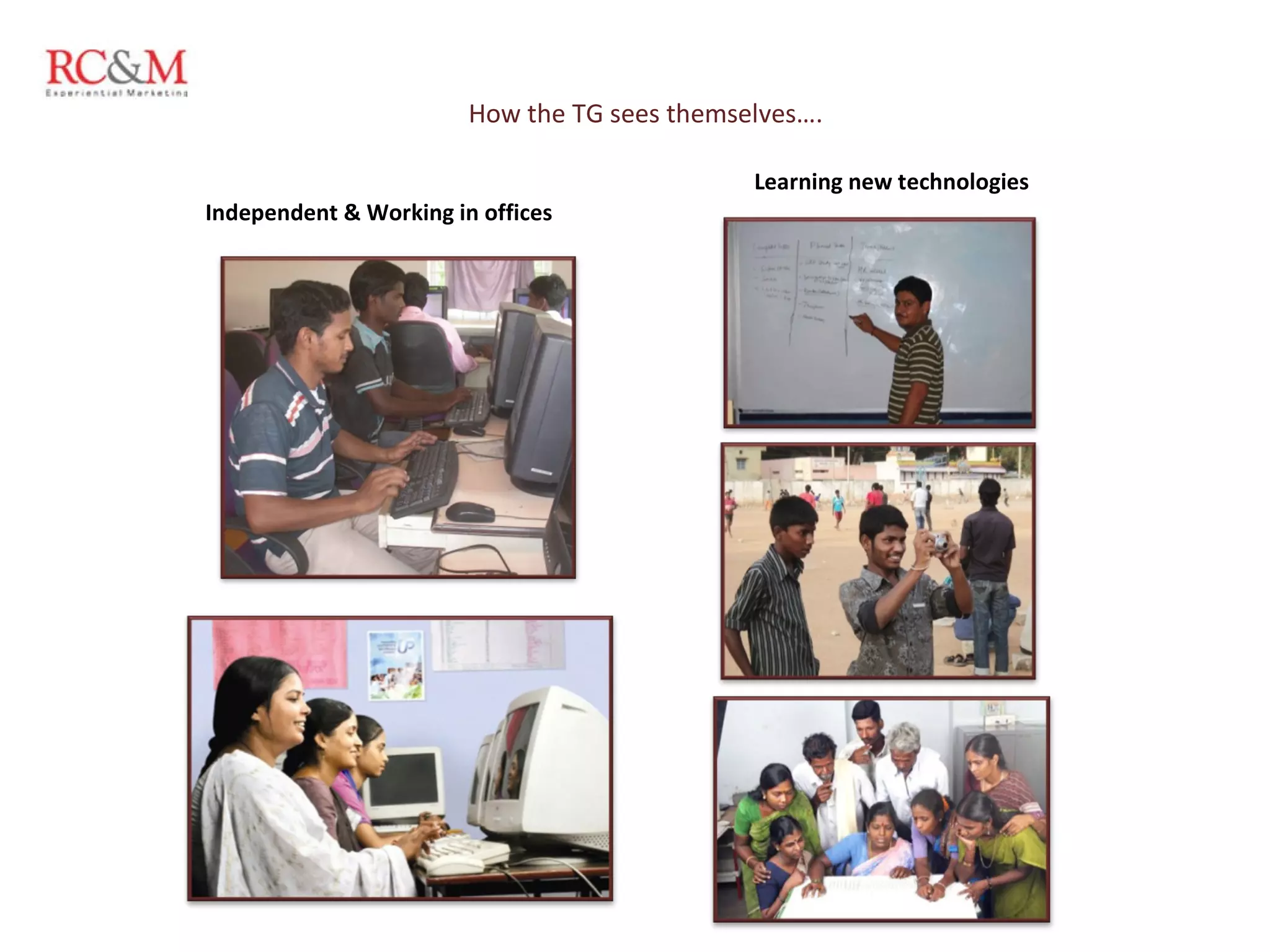
How the TG sees themselves…. Learning new technologies Independent & Working in offices
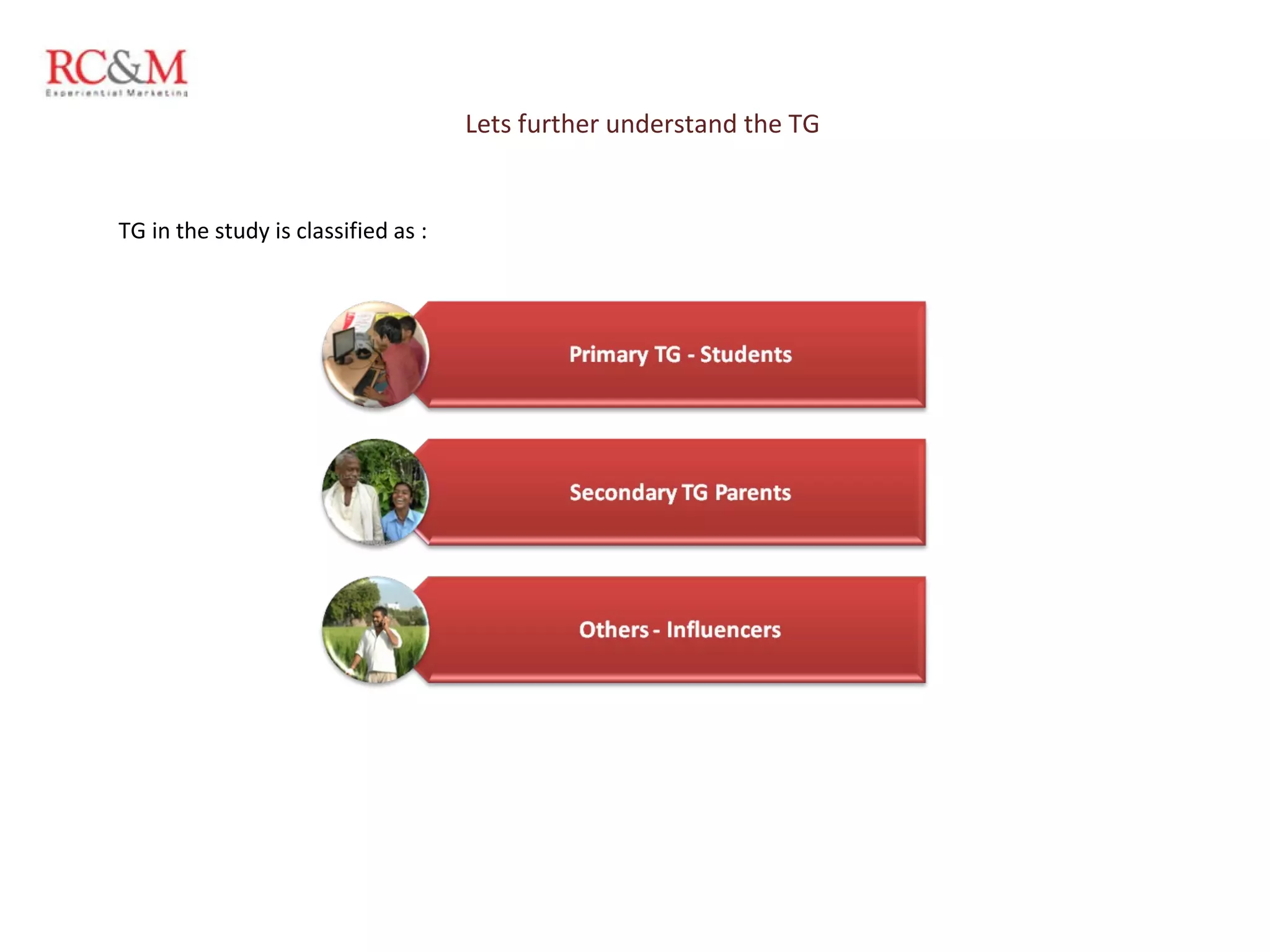
TG in the study is classified as : 25-11-11 Lets further understand the TG
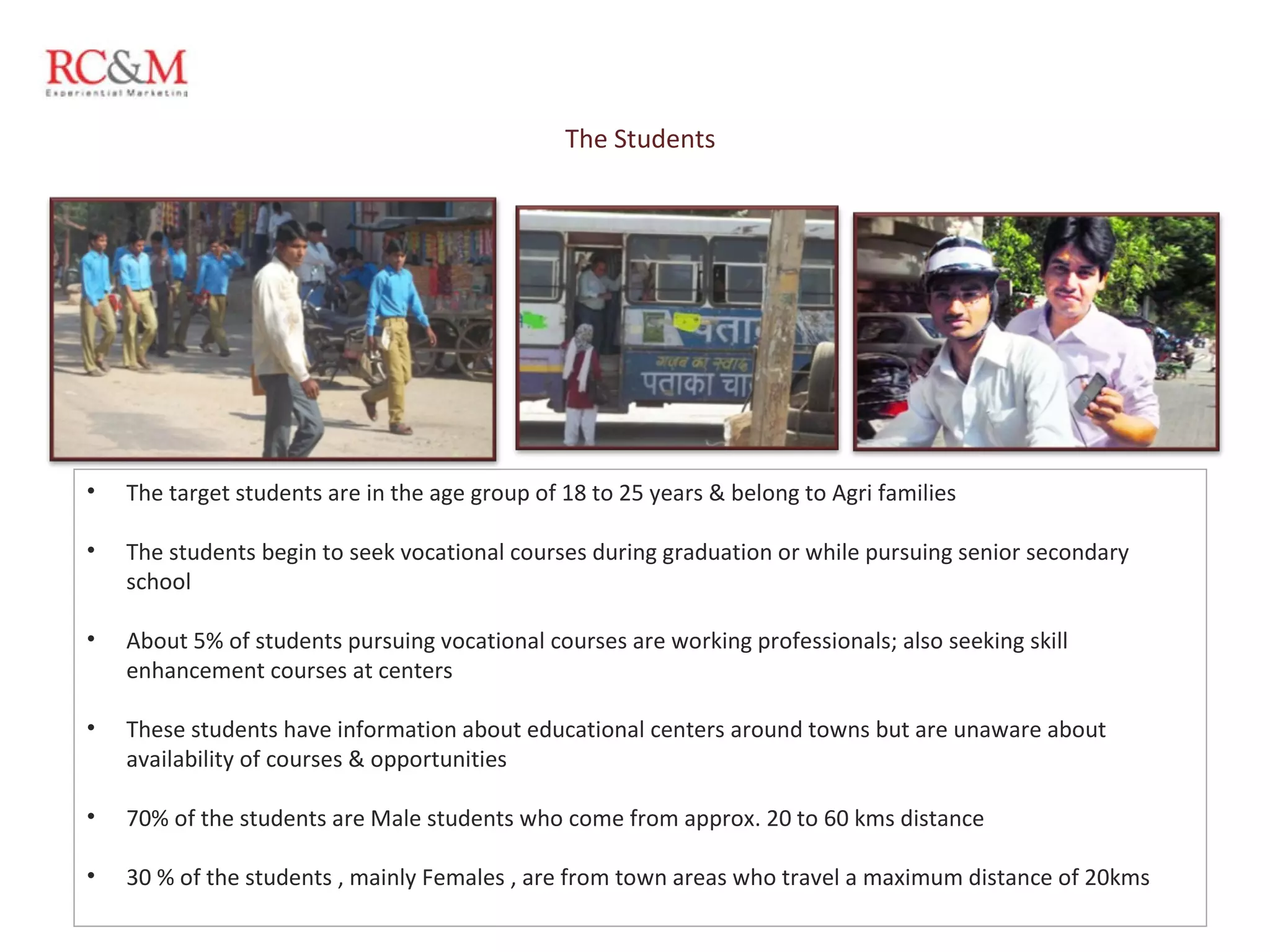
The Students The target students are in the age group of 18 to 25 years & belong to Agri families  The students begin to seek vocational courses during graduation or while pursuing senior secondary school About 5% of students pursuing vocational courses are working professionals; also seeking skill enhancement courses at centers These students have information about educational centers around towns but are unaware about availability of courses & opportunities 70% of the students are Male students who come from approx. 20 to 60 kms distance 30 % of the students , mainly Females , are from town areas who travel a maximum distance of 20kms
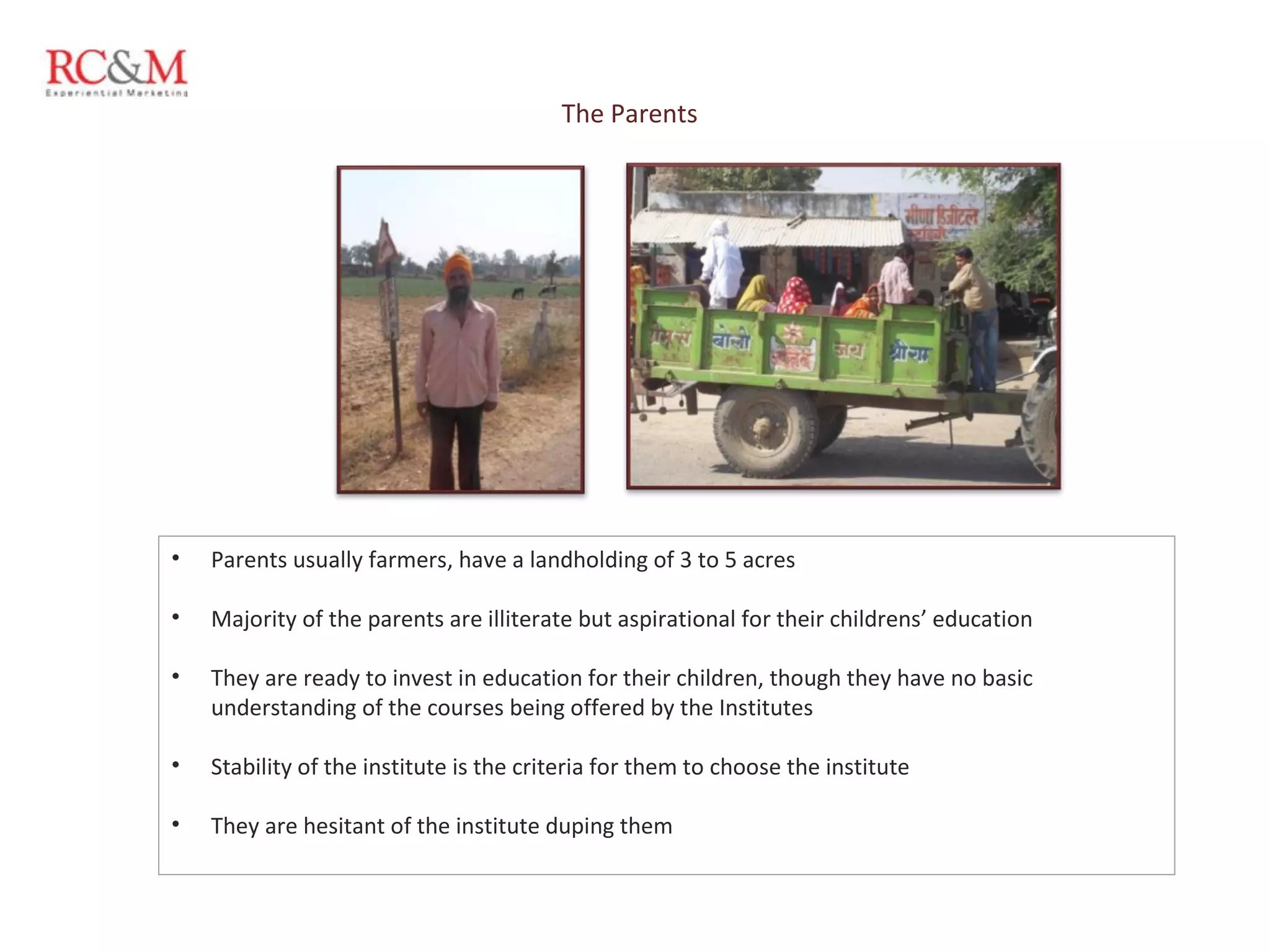
The Parents Parents usually farmers, have a landholding of 3 to 5 acres Majority of the parents are illiterate but aspirational for their childrens’ education They are ready to invest in education for their children, though they have no basic understanding of the courses being offered by the Institutes Stability of the institute is the criteria for them to choose the institute They are hesitant of the institute duping them
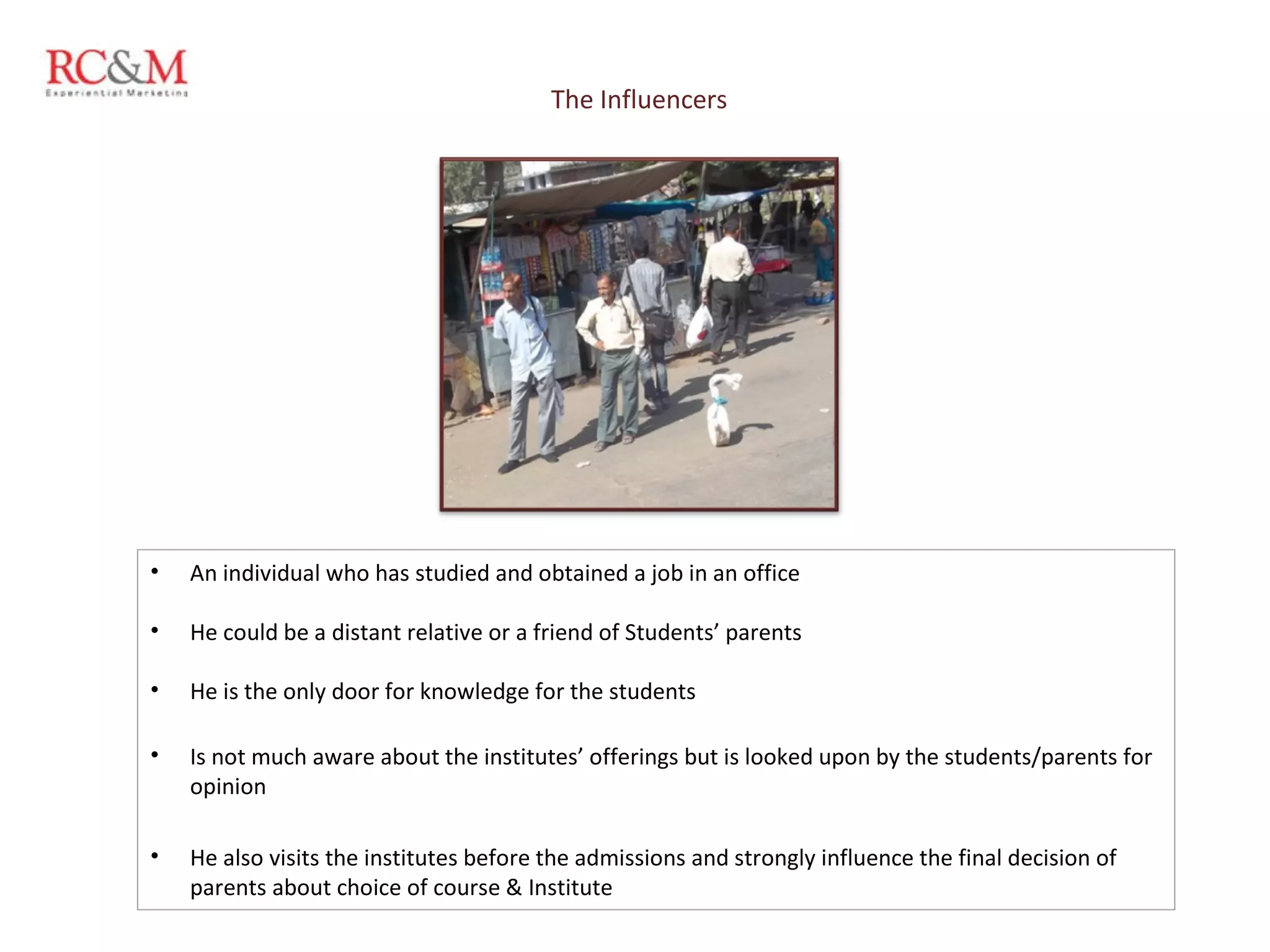
The Influencers An individual who has studied and obtained a job in an office He could be a distant relative or a friend of Students’ parents He is the only door for knowledge for the students Is not much aware about the institutes’ offerings but is looked upon by the students/parents for opinion He also visits the institutes before the admissions and strongly influence the final decision of parents about choice of course & Institute
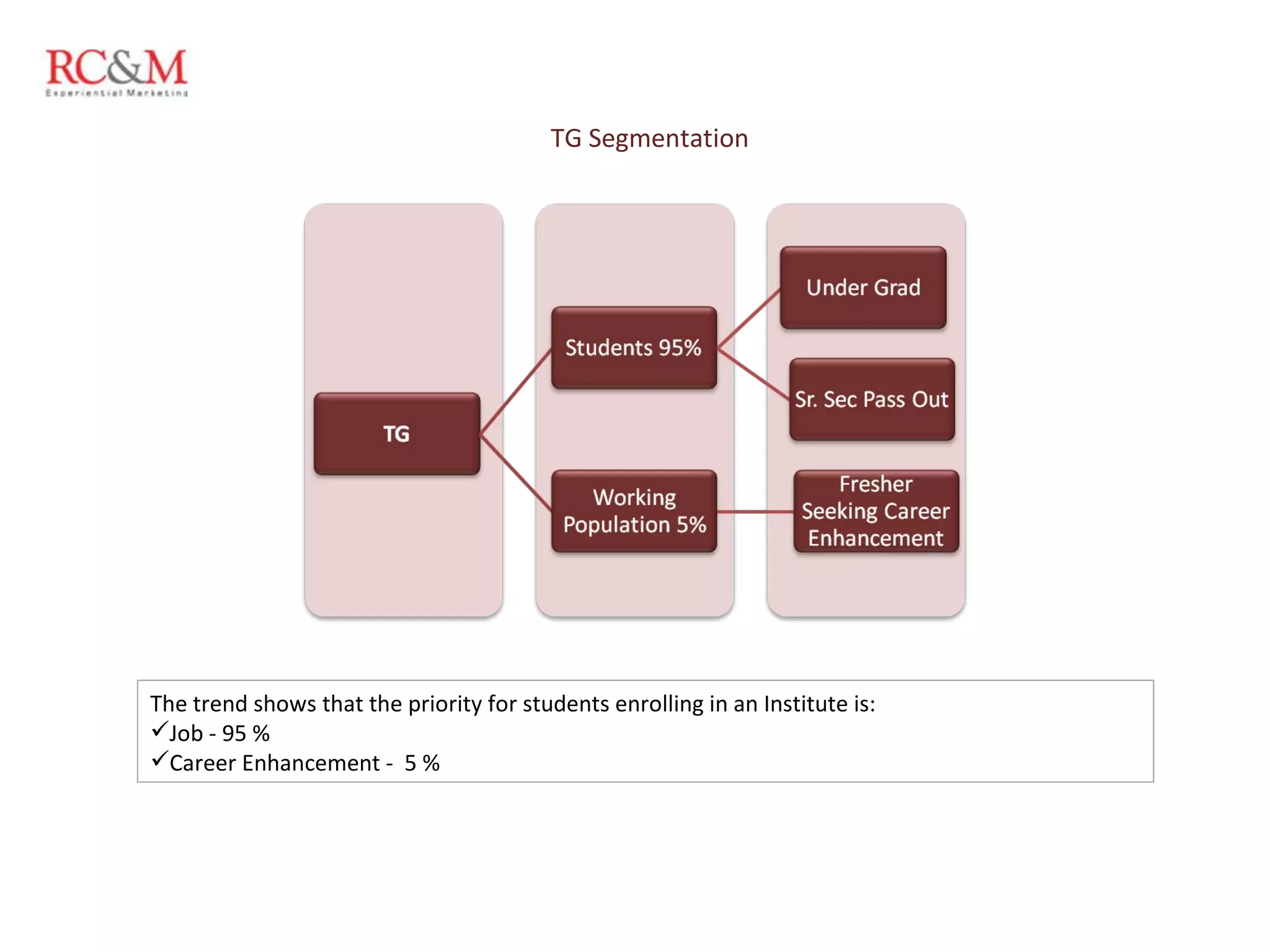
TG Segmentation The trend shows that the priority for students enrolling in an Institute is: Job - 95 % Career Enhancement -  5 %
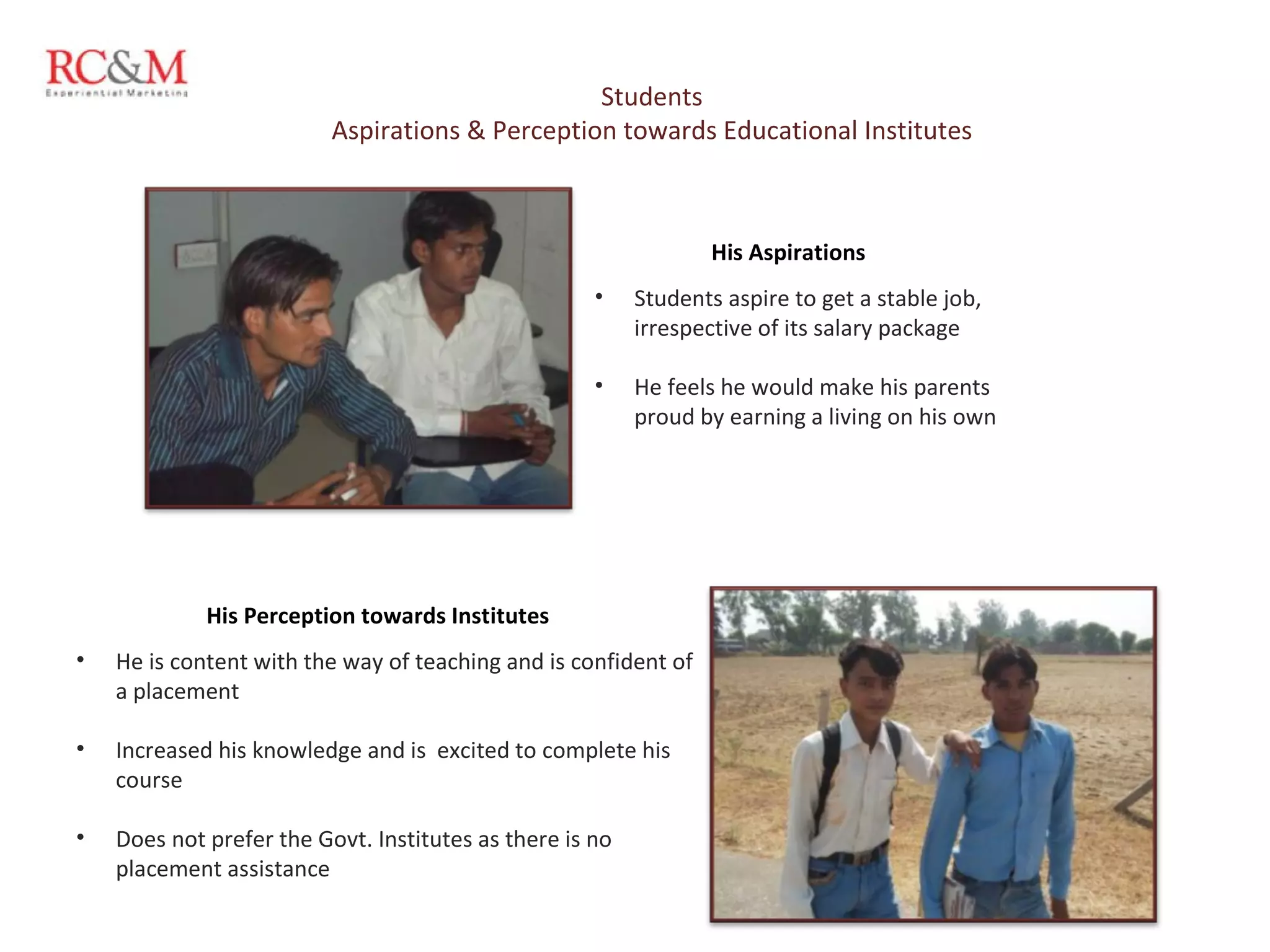
Students Aspirations & Perception towards Educational Institutes Students aspire to get a stable job, irrespective of its salary package He feels he would make his parents proud by earning a living on his own His Aspirations He is content with the way of teaching and is confident of a placement Increased his knowledge and is  excited to complete his course Does not prefer the Govt. Institutes as there is no placement assistance  His Perception towards Institutes
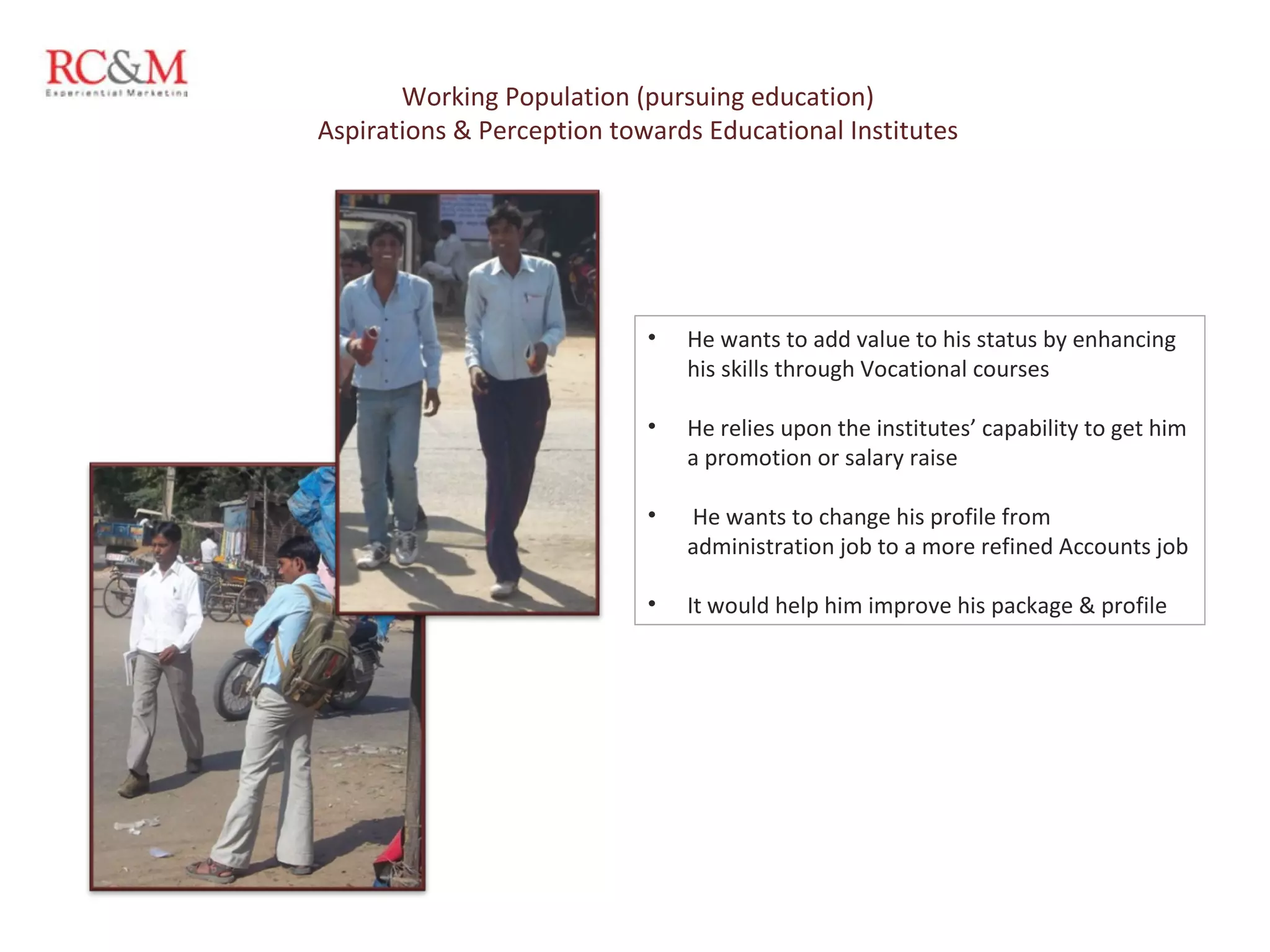
He wants to add value to his status by enhancing his skills through Vocational courses He relies upon the institutes’ capability to get him a promotion or salary raise He wants to change his profile from administration job to a more refined Accounts job  It would help him improve his package & profile Working Population (pursuing education) Aspirations & Perception towards Educational Institutes
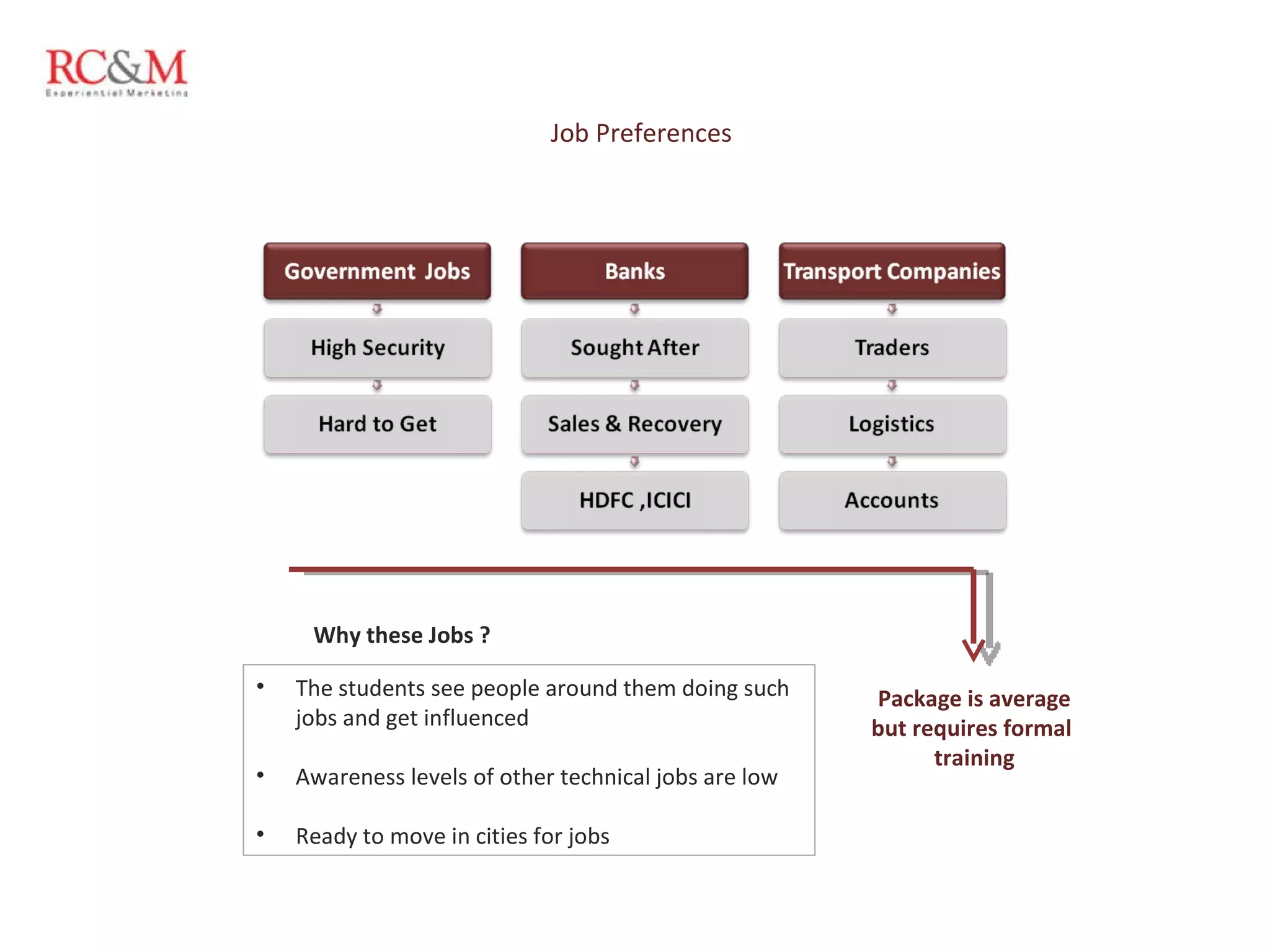
Job Preferences Why these Jobs ? The students see people around them doing such jobs and get influenced Awareness levels of other technical jobs are low Ready to move in cities for jobs Package is average but requires formal  training
Education Market  Scope of Evolution
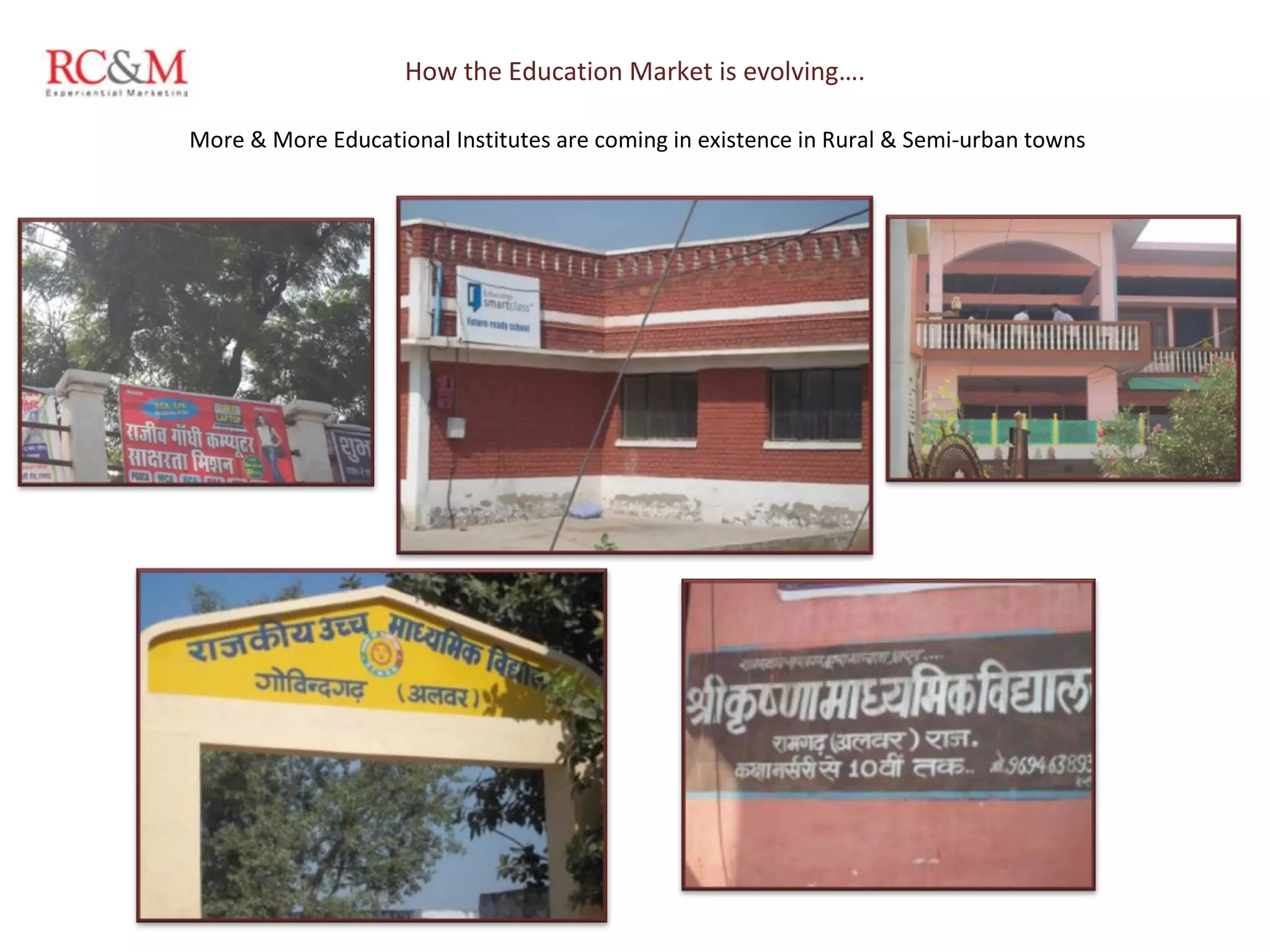
How the Education Market is evolving…. More & More Educational Institutes are coming in existence in Rural & Semi-urban towns
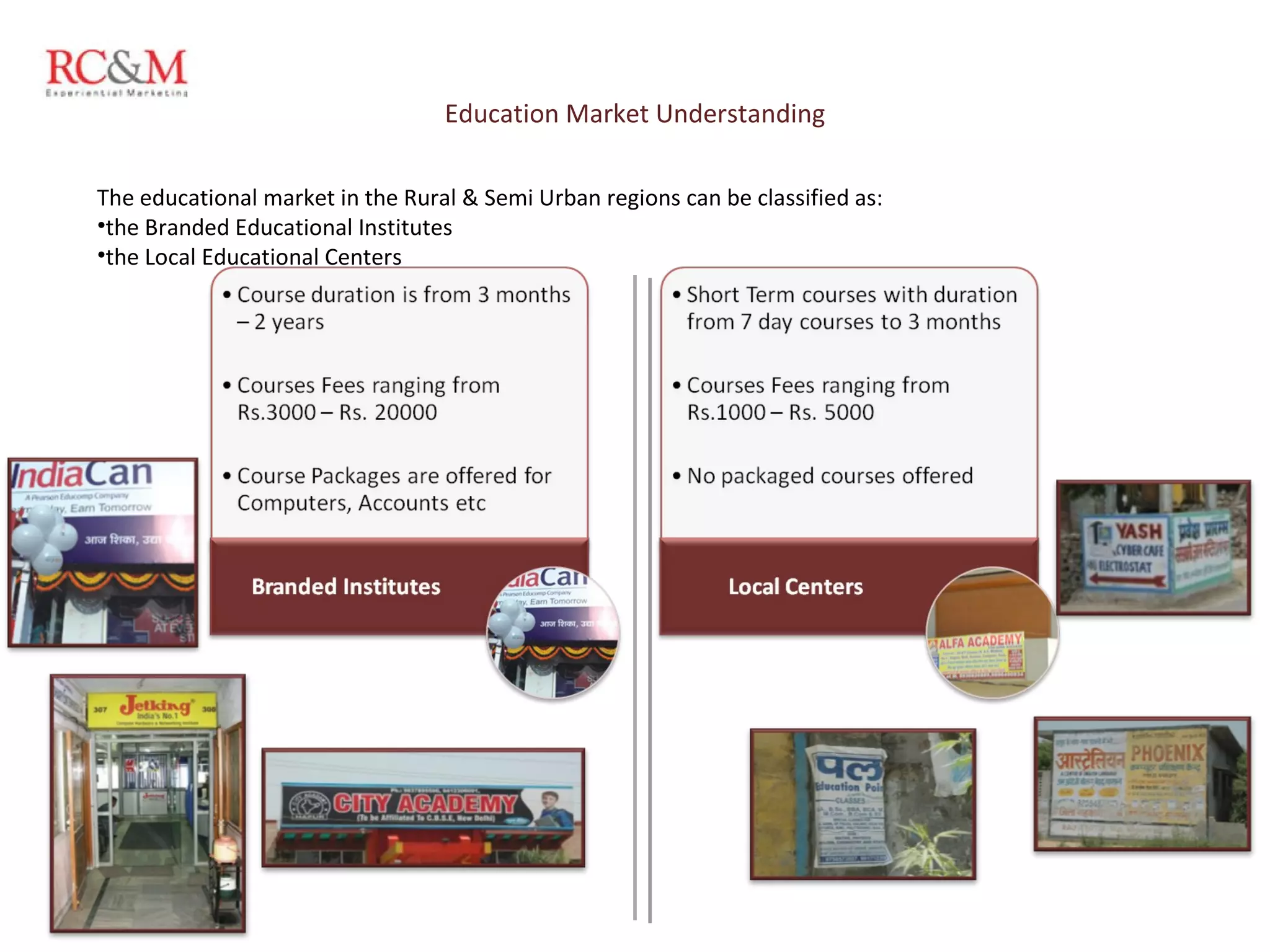
The educational market in the Rural & Semi Urban regions can be classified as: the Branded Educational Institutes the Local Educational Centers  Education Market Understanding
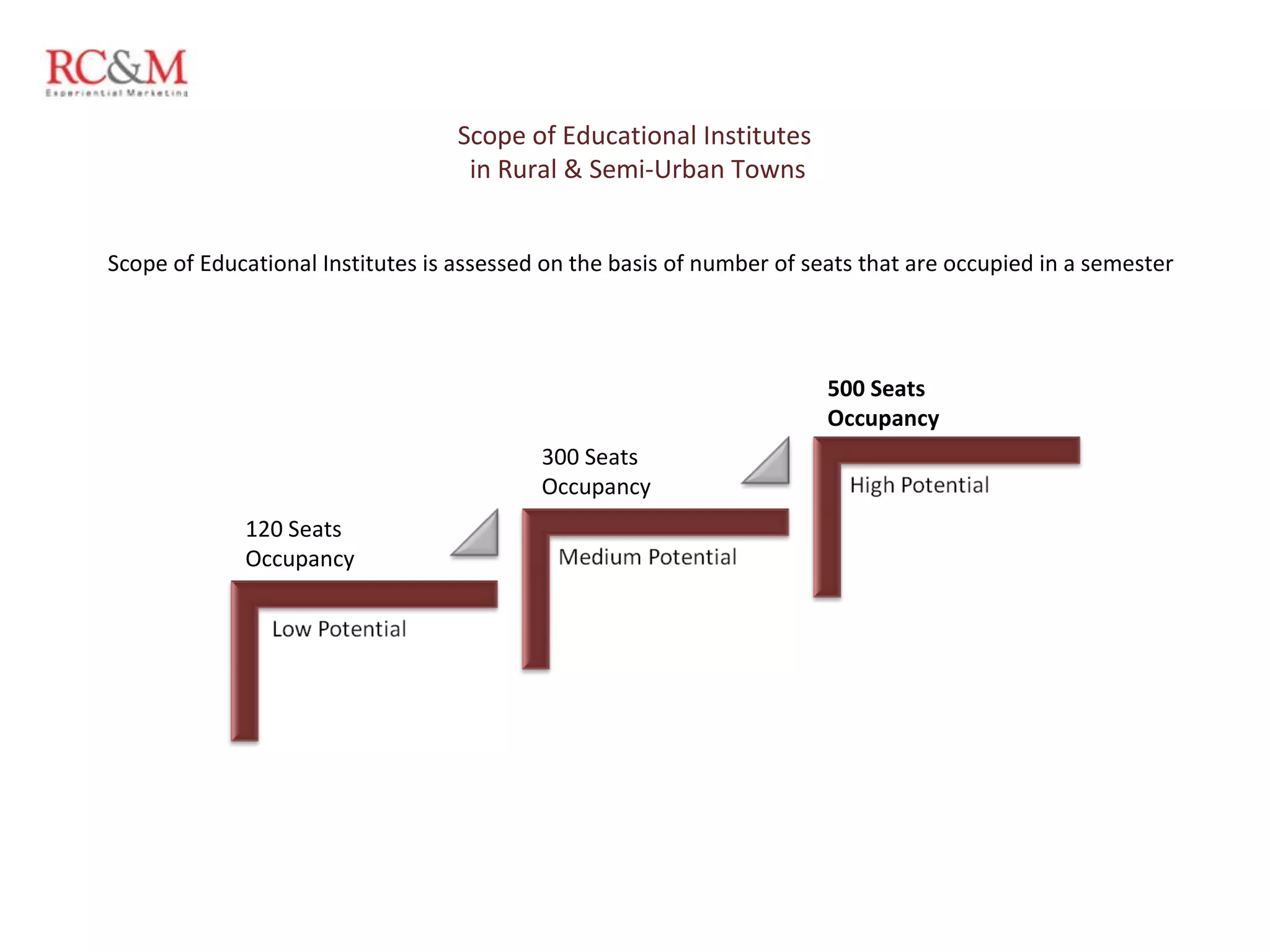
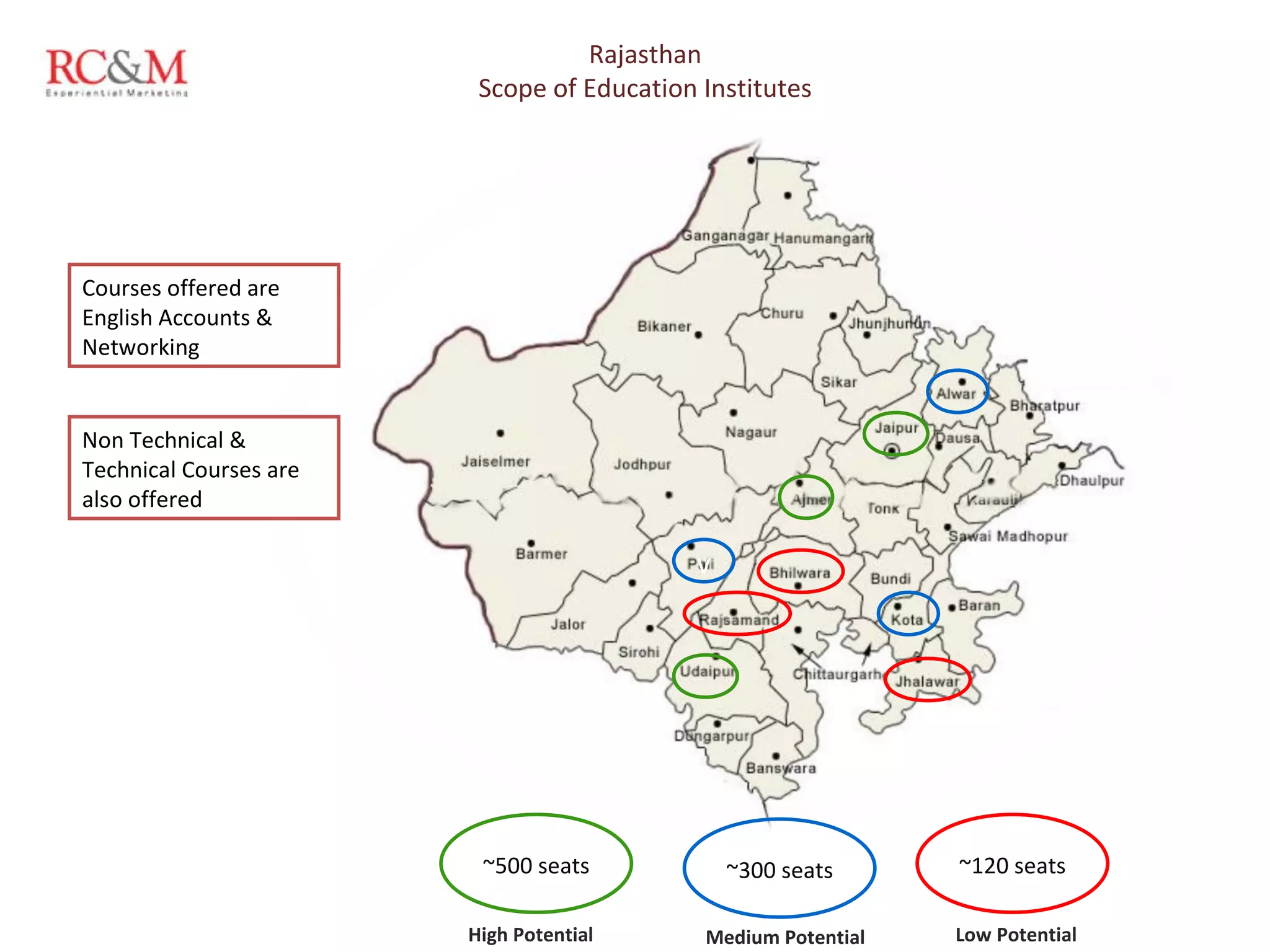
Scope of Educational Institutes  in Rural & Semi-Urban Towns Scope of Educational Institutes is assessed on the basis of number of seats that are occupied in a semester 120 Seats Occupancy 300 Seats Occupancy 500 Seats Occupancy
Lets see an example for Industry Scenario …..
v Rajasthan  Scope of Education Institutes  ~500 seats ~300 seats ~120 seats Non Technical & Technical Courses are also offered  Courses offered are English Accounts & Networking High Potential Medium Potential Low Potential
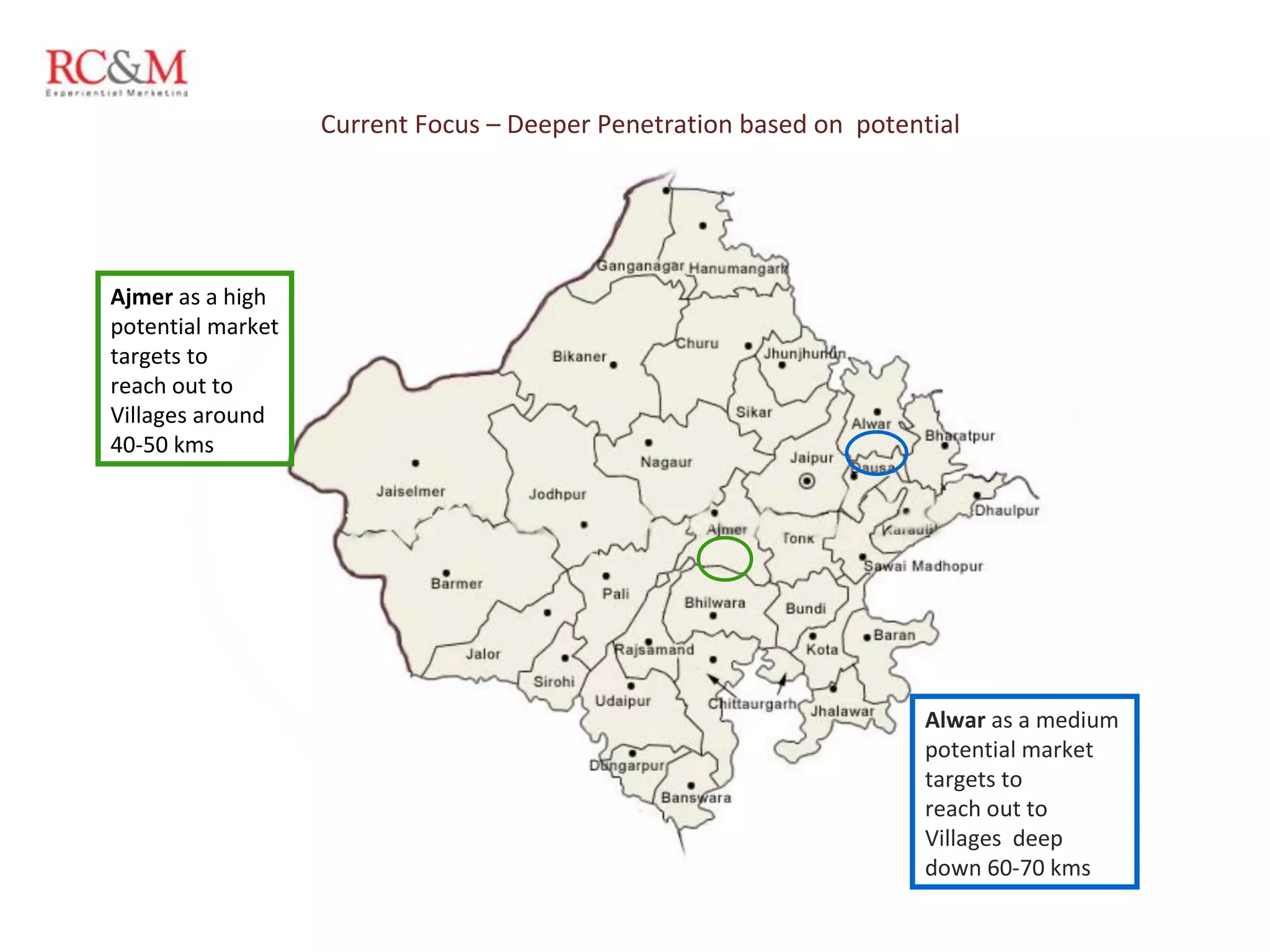
Current Focus – Deeper Penetration based on  potential Alwar  as a medium  potential market targets to  reach out to  Villages  deep down 60-70 kms Ajmer  as a high  potential market targets to  reach out to  Villages around  40-50 kms
Institutes Scan - Alwar Branded Institutes Indiacan  is one of the institutes in  Rajasthan which has the maximum number of its owned centres Institutes like  Jetking, SCL , NIFA , ICA  etc have franchisees, but no company owned centers Most popular courses at these Institutes are English Speaking , Hardware Networking & Financial Accountancy courses English Speaking courses usually have duration of 3 months – 6 months IT courses & Financial courses have a duration from 6 months – 2years Job Placement Guarantee is given to the students Local Centers Local Institutes like  Rajiv Gandhi Computer Institute, Gurukul, Alfa Academy  are some local institutes present Local Institutes offer single Application courses like Tally, MS-Excel, Call Center Training, Basic English Language Training etc which are short duration i.e. from 7 days – 3 months There is no job placement guarantee with these institutes  25-11-11
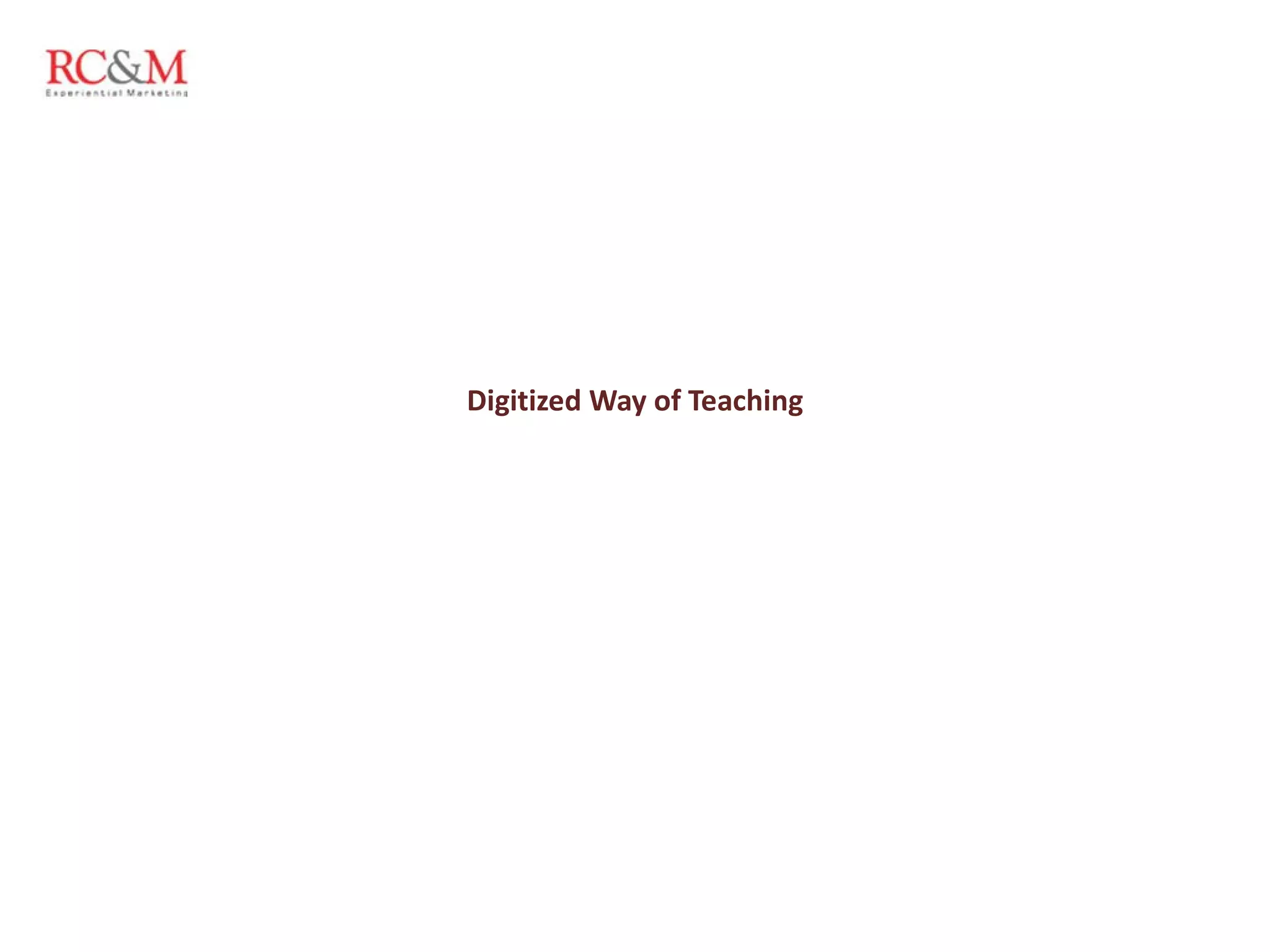
Alwar as a Market Limited hangout joints for the students in and around the villages.  Eating joints are near Bus Stands and at small market place in the village. Sarpanch holds a high value in the village and is one of the major  opinion leaders Job availability is very limited  Local educational institutes lack basic infrastructure though less expensive
Digitized Way of Teaching
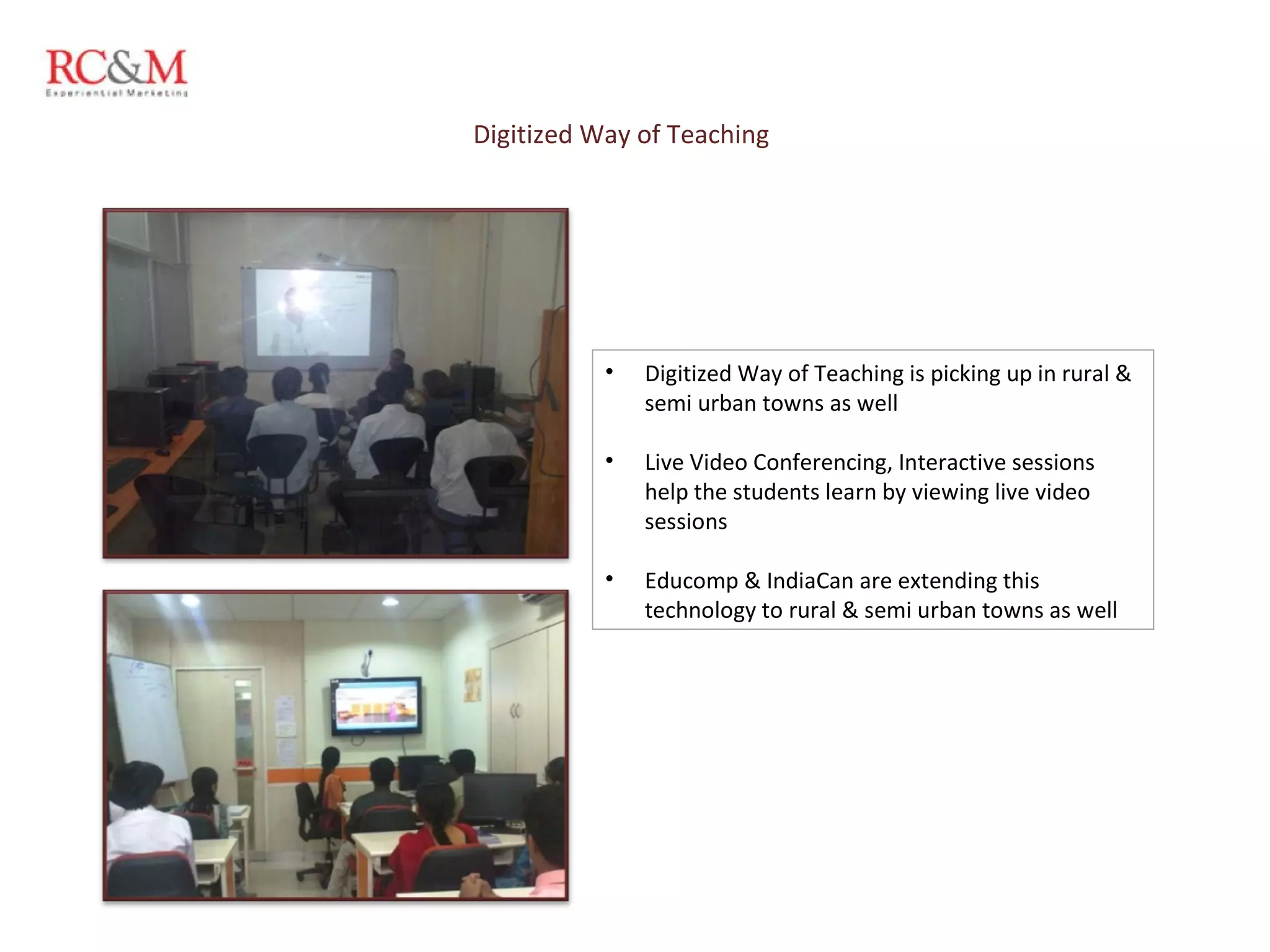
Digitized Way of Teaching  Digitized Way of Teaching is picking up in rural & semi urban towns as well  Live Video Conferencing, Interactive sessions help the students learn by viewing live video sessions Educomp & IndiaCan are extending this technology to rural & semi urban towns as well
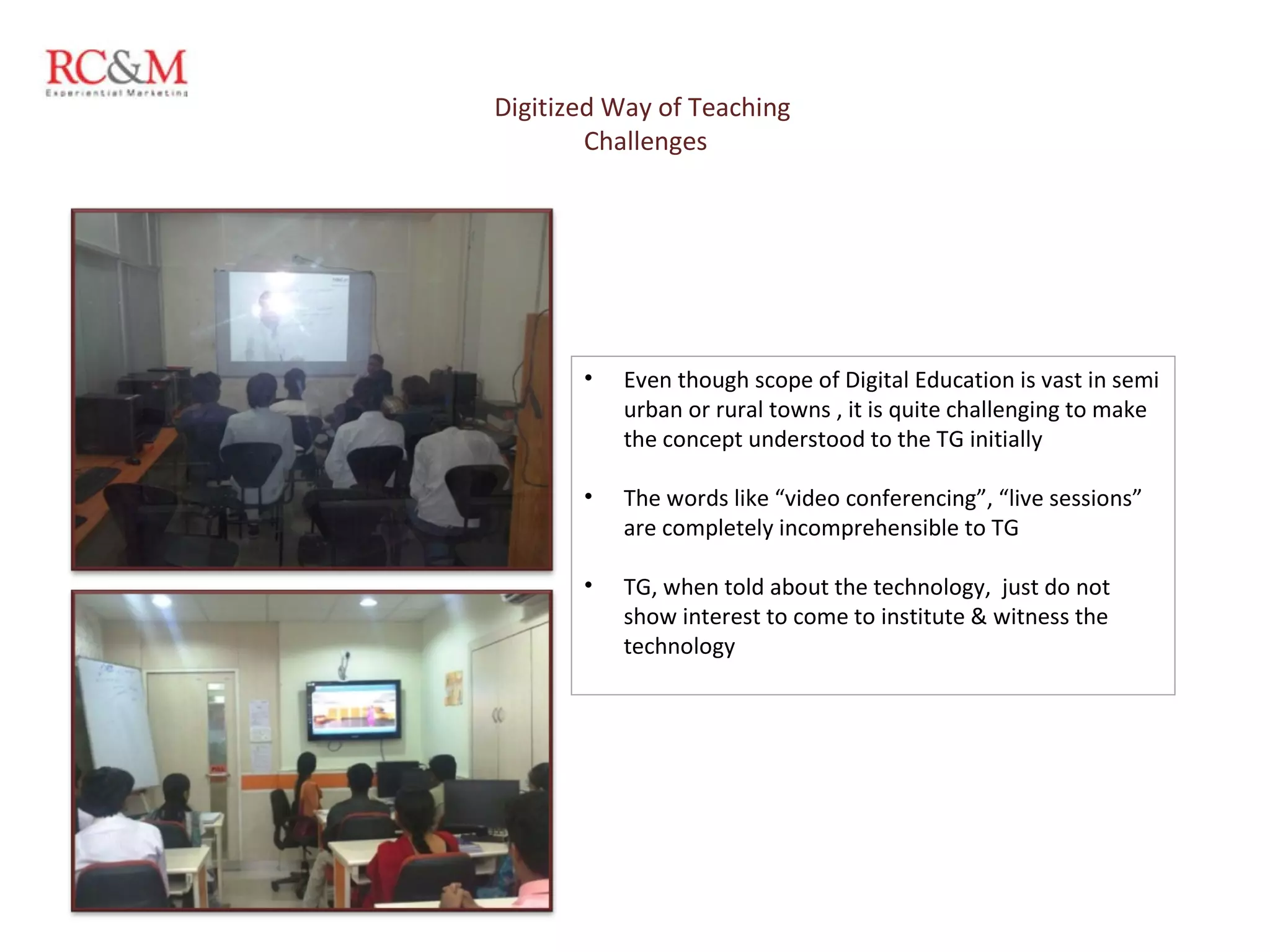
Digitized Way of Teaching  Challenges Even though scope of Digital Education is vast in semi urban or rural towns , it is quite challenging to make the concept understood to the TG initially  The words like “video conferencing”, “live sessions” are completely incomprehensible to TG TG, when told about the technology,  just do not show interest to come to institute & witness the technology
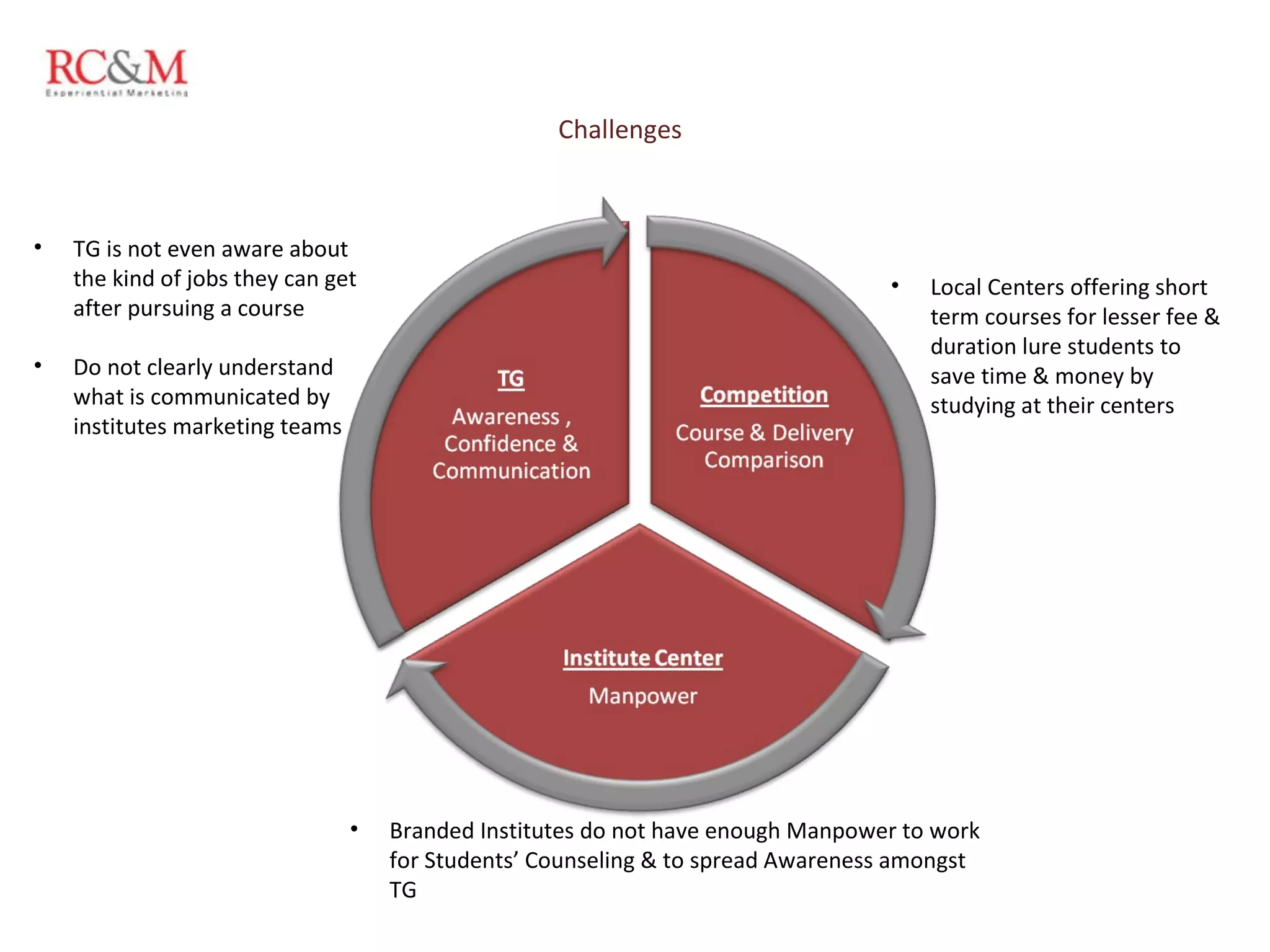
Challenges TG is not even aware about the kind of jobs they can get after pursuing a course Do not clearly understand what is communicated by institutes marketing teams  Local Centers offering short term courses for lesser fee & duration lure students to save time & money by studying at their centers Branded Institutes do not have enough Manpower to work for Students’ Counseling & to spread Awareness amongst TG
Agency Role in meeting the Challenges Confused TG needs proper Guidance & Expert Counseling  Since TG does not have a proper source that can provide them with sound career counseling, they do not get the best out of the institute also.  Some students after joining IMS course realized they wanted to do Tally because no company nearby is hiring students who have done IMS   Needs Financial Assurance Farmers want to spend on their children’s secure future but sometimes just with a margin less of money, they are not able to make their children enroll for the courses Even TG with good income is not willing to give away the complete amount as they do not have trust on the institute because they have not heard about it.   Relevant communication is the utmost requirement No one in such areas understand Digital education Due to institutes’ limitations in remote areas they have not been able to show case the videos to the rural people about how classes are done
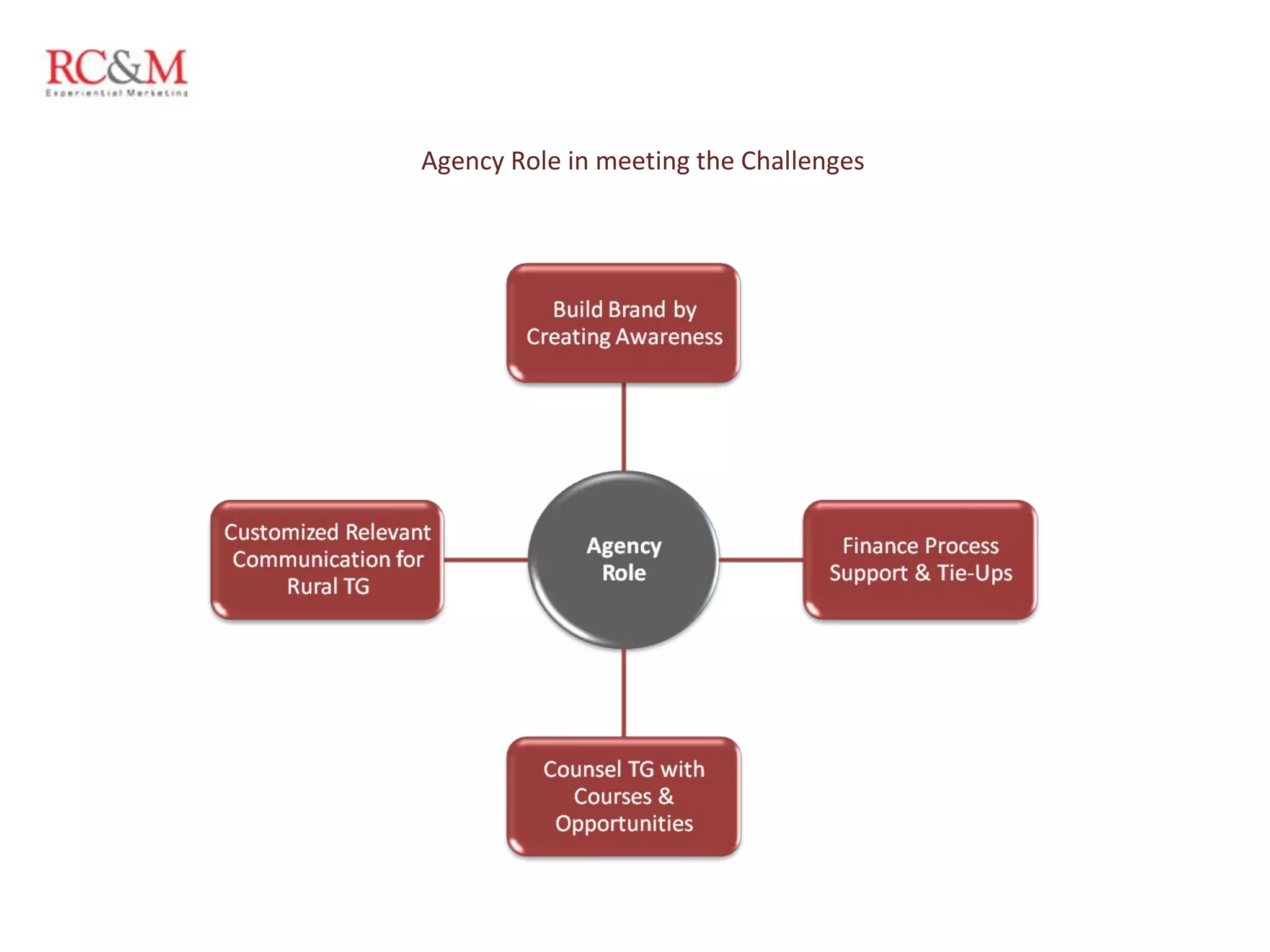
Agency Role in meeting the Challenges
Thank You

Scope of Education in Rural India PPT | Future of Education in Rural Areas | RC&M India Experiential Rural Marketing Firm

  • 1.
    Scope of Educationin Rural India Scope of Education in Rural India
  • 2.
    Index Change& Evolution in Education Scenario in Rural India in last 5 years TG Aspirations , Perception & Growth Education Market - Scope of Evolution Industrial Scenario Example Digitized Way of Teaching Challenges Agency Role in meeting the Challenges
  • 3.
    Change & Evolution in the Education Scenario in Rural India in last 5 years
  • 4.
    Lets look atfew figures to understand the growing Rural Education Trend In 2011-12, about 80k rural youngsters were being professionally trained across sectors by Govt. of India About 25% of Colleges offering degree courses are operational in 5 - 10kms radius of the villages As much as 10 different institute brands , offering vocational courses, operate in a semi urban town There are more than 52 million active Internet users in rural India Out of 1,20,591 total schools that have computers, 74% are located in rural areas. About 22% of the children in the age group of 6 – 14 years are enrolled in private schools
  • 5.
    How the EducationPerception is changing…. Earlier, the learning was limited to developing knowledge basis family occupation Family traditions were taken forward for pursuing a career Parents aspire & invest for their child to become skilled professionals & not just a worker or a farmer Youth gives due importance to learning new skills for obtaining a job or enhancing business
  • 6.
    How the OccupationPerception is changing…. A Clay Potter from the western state of Gujarat, invented low-cost refrigeration called “Mitti Cool”, made out of terracotta, costing about Rs.2000 only A Farmer invented a motorcycle-driven ploughing machine for fields in a drought-hit region where most farmers could barely afford tractors or bullocks Earlier there was complacency with the resources that were available to a person and; his limited working knowledge A Farmer or Clay Potter continued to produce the same kind of products with the same techniques taught to them by their forefathers
  • 7.
  • 8.
    How the TGsees themselves…. Learning new technologies Independent & Working in offices
  • 9.
    TG in thestudy is classified as : 25-11-11 Lets further understand the TG
  • 10.
    The Students Thetarget students are in the age group of 18 to 25 years & belong to Agri families The students begin to seek vocational courses during graduation or while pursuing senior secondary school About 5% of students pursuing vocational courses are working professionals; also seeking skill enhancement courses at centers These students have information about educational centers around towns but are unaware about availability of courses & opportunities 70% of the students are Male students who come from approx. 20 to 60 kms distance 30 % of the students , mainly Females , are from town areas who travel a maximum distance of 20kms
  • 11.
    The Parents Parentsusually farmers, have a landholding of 3 to 5 acres Majority of the parents are illiterate but aspirational for their childrens’ education They are ready to invest in education for their children, though they have no basic understanding of the courses being offered by the Institutes Stability of the institute is the criteria for them to choose the institute They are hesitant of the institute duping them
  • 12.
    The Influencers Anindividual who has studied and obtained a job in an office He could be a distant relative or a friend of Students’ parents He is the only door for knowledge for the students Is not much aware about the institutes’ offerings but is looked upon by the students/parents for opinion He also visits the institutes before the admissions and strongly influence the final decision of parents about choice of course & Institute
  • 13.
    TG Segmentation Thetrend shows that the priority for students enrolling in an Institute is: Job - 95 % Career Enhancement - 5 %
  • 14.
    Students Aspirations &Perception towards Educational Institutes Students aspire to get a stable job, irrespective of its salary package He feels he would make his parents proud by earning a living on his own His Aspirations He is content with the way of teaching and is confident of a placement Increased his knowledge and is excited to complete his course Does not prefer the Govt. Institutes as there is no placement assistance His Perception towards Institutes
  • 15.
    He wants toadd value to his status by enhancing his skills through Vocational courses He relies upon the institutes’ capability to get him a promotion or salary raise He wants to change his profile from administration job to a more refined Accounts job It would help him improve his package & profile Working Population (pursuing education) Aspirations & Perception towards Educational Institutes
  • 16.
    Job Preferences Whythese Jobs ? The students see people around them doing such jobs and get influenced Awareness levels of other technical jobs are low Ready to move in cities for jobs Package is average but requires formal training
  • 17.
    Education Market Scope of Evolution
  • 18.
    How the EducationMarket is evolving…. More & More Educational Institutes are coming in existence in Rural & Semi-urban towns
  • 19.
    The educational marketin the Rural & Semi Urban regions can be classified as: the Branded Educational Institutes the Local Educational Centers Education Market Understanding
  • 20.
    Scope of EducationalInstitutes in Rural & Semi-Urban Towns Scope of Educational Institutes is assessed on the basis of number of seats that are occupied in a semester 120 Seats Occupancy 300 Seats Occupancy 500 Seats Occupancy
  • 21.
    Lets see anexample for Industry Scenario …..
  • 22.
    v Rajasthan Scope of Education Institutes ~500 seats ~300 seats ~120 seats Non Technical & Technical Courses are also offered Courses offered are English Accounts & Networking High Potential Medium Potential Low Potential
  • 23.
    Current Focus –Deeper Penetration based on potential Alwar as a medium potential market targets to reach out to Villages deep down 60-70 kms Ajmer as a high potential market targets to reach out to Villages around 40-50 kms
  • 24.
    Institutes Scan -Alwar Branded Institutes Indiacan is one of the institutes in Rajasthan which has the maximum number of its owned centres Institutes like Jetking, SCL , NIFA , ICA etc have franchisees, but no company owned centers Most popular courses at these Institutes are English Speaking , Hardware Networking & Financial Accountancy courses English Speaking courses usually have duration of 3 months – 6 months IT courses & Financial courses have a duration from 6 months – 2years Job Placement Guarantee is given to the students Local Centers Local Institutes like Rajiv Gandhi Computer Institute, Gurukul, Alfa Academy are some local institutes present Local Institutes offer single Application courses like Tally, MS-Excel, Call Center Training, Basic English Language Training etc which are short duration i.e. from 7 days – 3 months There is no job placement guarantee with these institutes 25-11-11
  • 25.
    Alwar as aMarket Limited hangout joints for the students in and around the villages. Eating joints are near Bus Stands and at small market place in the village. Sarpanch holds a high value in the village and is one of the major opinion leaders Job availability is very limited Local educational institutes lack basic infrastructure though less expensive
  • 26.
  • 27.
    Digitized Way ofTeaching Digitized Way of Teaching is picking up in rural & semi urban towns as well Live Video Conferencing, Interactive sessions help the students learn by viewing live video sessions Educomp & IndiaCan are extending this technology to rural & semi urban towns as well
  • 28.
    Digitized Way ofTeaching Challenges Even though scope of Digital Education is vast in semi urban or rural towns , it is quite challenging to make the concept understood to the TG initially The words like “video conferencing”, “live sessions” are completely incomprehensible to TG TG, when told about the technology, just do not show interest to come to institute & witness the technology
  • 29.
    Challenges TG isnot even aware about the kind of jobs they can get after pursuing a course Do not clearly understand what is communicated by institutes marketing teams Local Centers offering short term courses for lesser fee & duration lure students to save time & money by studying at their centers Branded Institutes do not have enough Manpower to work for Students’ Counseling & to spread Awareness amongst TG
  • 30.
    Agency Role inmeeting the Challenges Confused TG needs proper Guidance & Expert Counseling Since TG does not have a proper source that can provide them with sound career counseling, they do not get the best out of the institute also. Some students after joining IMS course realized they wanted to do Tally because no company nearby is hiring students who have done IMS   Needs Financial Assurance Farmers want to spend on their children’s secure future but sometimes just with a margin less of money, they are not able to make their children enroll for the courses Even TG with good income is not willing to give away the complete amount as they do not have trust on the institute because they have not heard about it.   Relevant communication is the utmost requirement No one in such areas understand Digital education Due to institutes’ limitations in remote areas they have not been able to show case the videos to the rural people about how classes are done
  • 31.
    Agency Role inmeeting the Challenges
  • 32.