Chapter 3
Agricultural Credit
Syllabus
3.1 Role of Commercial Banks in Agricultural Sector
3.2 Role of National Bank for Agriculture and Rural Development (NABARD)
3.3 Role of Cooperative Institutions
3.4 Role of Regional Rural Banks (RRBs)
3.5 Introduction to Microfinance and concept of Self -Help Group
A commercial bank is a financial institution which performs the
functions of accepting deposits from the general public and giving
loans for investment with the aim of earning profit.
Meaning of Commercial
Banks
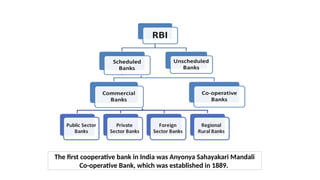
The first cooperative bank in India was Anyonya Sahayakari Mandali
Co-operative Bank, which was established in 1889.
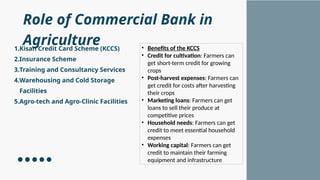
Role of Commercial Bank in
Agriculture
1.Kisan Credit Card Scheme (KCCS)
2.Insurance Scheme
3.Training and Consultancy Services
4.Warehousing and Cold Storage
Facilities
5.Agro-tech and Agro-Clinic Facilities
• Benefits of the KCCS
• Credit for cultivation: Farmers can
get short-term credit for growing
crops
• Post-harvest expenses: Farmers can
get credit for costs after harvesting
their crops
• Marketing loans: Farmers can get
loans to sell their produce at
competitive prices
• Household needs: Farmers can get
credit to meet essential household
expenses
• Working capital: Farmers can get
credit to maintain their farming
equipment and infrastructure
Role of National Bank for Agriculture
and Rural Development (NABARD)
Meaning of NABARD
NABARD stands for National Bank for Agriculture and Rural
Development and is an apex regulatory body in the Indian rural
banking system It is a development bank that aims to provide and
regulate credit in rural areas.
Objectives of NABARD
1. To serve as an apex refinancing agency for the institutions providing investment credit and
production credit to rural areas
2 To support programmes and projects of Government of India
3. To ensure credit to weaker section.
4. To coordinate rural financing activities.
5. To monitor and evaluate various projects
6. To initiate measures towards institutional building.
7. To promote research in banking, agriculture and rural development
Functions of NABARD
1.Monitors and evaluates projects
2. Provides long-term loans to State Governments
3. Extends credit to financial institutions
4. Maintains a Research and Development fund
5. Issues and sells bonds and debentures:
6. Acts as a coordinating agency
7. Inspects cooperative banks and regional rural banks
8.Monitors and controls RRBs and Central Cooperative Banks
9.Promotes the healthy functioning of credit institutions
10. Provides training and conducts research
Role of NABARD
1. Funds rural development
2. Plans for rural areas
3. Promotes rural growth.
4. Coordinates rural credit.
5. Evaluates and inspects banks
6. Supports research
7. Assists other institutions
8. Offers training
9. Strengthens credit delivery
10. Supports Self-Help Groups (SHGs)
NABARD’s Activities
1) Production Credit
2) Investment Credit
3) Rural Infrastructure Development Fund (RIDF)
Role of Cooperative Institutions
According to Calvert
Co-operation is a specialised form of economic organization in which people voluntarily associate
together on a basis of equality for the promotion of their common economic interests .
Characteristics of Cooperation
1) Open Membership
2) Democratic Management
3) Voluntary Association
4) Unity
5) State Control
6) source of Finance
7) Service Motive /Limited Interest on Capital
8) Separate Legal Entity
State Cooperative Bank
State Cooperative Banks (SCBs) are apex institutions at the state level in India's
cooperative banking system. Their primary function is to coordinate the
activities of Primary Agricultural Credit Societies (PACS) and connect them with
the money market, Reserve Bank of India, and other cooperative banks. SCBs
are open to membership from Central Cooperative Banks (CCBs), District Central
Cooperative Banks (DCCBs), and other societies. They are governed by a General
Body, with day-to-day operations managed by a Board of Directors. SCBs raise
funds through share capital, reserve funds, deposits, and borrowings from
institutions like NABARD and SBI.
.
Function of SCBs
1.T o act as bankers' bank to DCCBs and to supervise, control and guide them.
2. To co-ordinate the various development agencies and help the government in drawing plans for co-operative
development and their implementation.
3. To mobilise financial resources needed by the PACS and depioy them properly among the various sectors of
the cooperative movement.
4. To formulate and execute uniform credit policies for co-operative movement.
5. To perform banking funtions such as issuing cheques, drafts, letters of credit.
6.To grant a specified amount to a third party specified therein, collecting and discounting bills, etc.
District Central Cooperative Bank
(DCCB)
DCCBs are cooperative banks in India that operate at the district level. They
provide banking services to rural areas, linking PACS with SCBs. DCCBs raise
funds through various sources and use them to finance agricultural activities by
lending to PACS.
Function of DCCBs
1. To meet the credit requirements of member societies.
2 To perform banking business and to act as balancing centres for the PACS by diverting
the surplus funas or some societies to those which face shortage of funds.
3. To guide and supervise the PACS.
4. To undertake non-credit activities
Primary Agricultural Credit Society
(PACS)
PACS are the basic units and smallest cooperative credit institutions in India,
operating at the grassroots level (village level). Established in 1904, their primary
objective is to provide cheap credit to farmers and free them from the clutches of
moneylenders. PACS also play a role in distributing agricultural inputs like
fertilizers and act as distributors for the Public Distribution System (PDS).
Functions of PACS
1.To promote economic interests of the members in accordance with the co-operative
principles.
2. To provide short and medium term loans
3. To promote savings habit among members.
4. To supply agricultural inputs like fertilizers, seeds, insecticides and implements.
5. To provide marketing facilities for the sale of agricultural produces.
6. To supply domestic products requirements such as sugar, kerosene, etc.
Regional Rural Bank
(RRB)
• Importance Of Regional Rural Bank
1. RRB helps in reducing rural and urban gap by mobilising financial resources and services to rural regions.
2. Regional Rural Banks pave the way for inclusion of the marginal population like small farmers, Below
Poverty Line (BPL) farmers and workers, small entrepreneurs, artisans, women, etc.
3. Regiona Rural Banks astist rural businesses and help to improve the role of entrepreneurship. It provides
them short term loans, insurance facilities, etc.,
4. Providing assistance like loans, advances, insurance to agriculturists for farming inputs, equipment
processing, marketing activities.
5. RRBs help in the growth of cooperative societies, agricultural societies, etc.
Role of Regional Rural Bank for Rural
Development
1. Identify financial needs in rural areas
2. Bring banking services to rural areas
3.Enhance banking and finance in backward and unbanked areas
4. Mobilize rural savings for productive activities
5.Provide credit to weaker sections of society
6.Provide finance to cooperative societies
7.Provide finance to weaker sections of societies (small farmers, rural laborers, etc.)
8.Improve banking facilities in semi-urban and rural areas.
9. Generate employment opportunities in rural areas.
Functions of RRB
1.Granting loans and advances
2. Accepting Deposits
3.Wages Disbursement
4.Loan Extension
Micro
Finance
Definitio
n
According to NABARD, Micro finance refers to the, "provision of thrift, credit and other
financial services and products of very small amount to poor in rural, semi urban or
urban areas enabling them to raise their income levels and improve standards"
• Need of Micro finance in
India
1.High poverty rate
2.Limited access to formal credit
3.High credit demand
4.Low credit distribution
• Importance of Micro
finance
1.Improving quality of life
2.Mobilizing resources
3.creating opportunities
4.Traning rural poor
• Role of Micro Finance in Reducing
Poverty
1.Saving Facilities
2.Credit Facility
3.Payment/Money Transfer Services
4.Insurance Services
• Limitation of Micro
Finance
1. Micro-Finance still is a credit based industry that provide compulsory saving
services.
2. MFI have move from "development" "financial focus".
3. MFI are seriously undercapitalized.
Self Help Group
Meaning
:
A self-help group (commonly abbreviated SHG) is a financial intermediary committee usually
composed of 15 to 20 local women between the ages of 18 and 40.
Definition
:
"Self Help Groups are non-professional organisations formed by people for solving their socio-
economic problems."
• Objectives of SHG
1.To inculcate the savings and banking habit among members
2 To secure them from financial uncertainties.
3 To enable availing of loan for productive purposes.
4 To gain economic prosperity through loan/credit.
5 To sensitize women of target area for the need of SHG and its relevance in their upliftment.
6. To create group feeling among women.
7 To enhance the confidence and capabilities of women.
• Features of SHG
1. A simple and effective method for the poor to hc'p each other.
2. A voluntary group of rural poor who face similar situations and problems.
3. Encourages small savings among members.
4. Usually having 15 to 20 members.
5. Provide a forum for members to solve their problems collectively.
• Initiatives of SHG
1.Sensitization of staff: Working in rural and semi-urban branches.
2. Training programs: Conducted at 54 Learning Centers and SBIRD, Hyderabad.
3.Close liaison with NGOs.
4.14 million poor families: Access microfinance through 8,81,154 SHGs.
5.Lending to NGOs/Federations of SHGs/MFIs.
6.Financial Literacy Centers (FLCs): Conduct camps, seminars, and workshops to create financial awareness.
7. Scheme for Promotion of Women SHGs: Implemented through anchor NGOs in 150 backward/LWE-affected
districts.
8.Cash credit facility: Provided to SHGs to facilitate flexibility in operation. SHG members can save a variable
amount over and above the minimum savings fixed by the group. This forms part of the savings corpus for the
purpose of arriving at a loan limit to SHGs.
Thank
You!

Agricultural Credit , BBA IB notes , TY BBA

  • 1.
  • 2.
    Syllabus 3.1 Role ofCommercial Banks in Agricultural Sector 3.2 Role of National Bank for Agriculture and Rural Development (NABARD) 3.3 Role of Cooperative Institutions 3.4 Role of Regional Rural Banks (RRBs) 3.5 Introduction to Microfinance and concept of Self -Help Group

  • 3.
    A commercial bankis a financial institution which performs the functions of accepting deposits from the general public and giving loans for investment with the aim of earning profit. Meaning of Commercial Banks
  • 4.
    The first cooperativebank in India was Anyonya Sahayakari Mandali Co-operative Bank, which was established in 1889.
  • 5.
    Role of CommercialBank in Agriculture 1.Kisan Credit Card Scheme (KCCS) 2.Insurance Scheme 3.Training and Consultancy Services 4.Warehousing and Cold Storage Facilities 5.Agro-tech and Agro-Clinic Facilities • Benefits of the KCCS • Credit for cultivation: Farmers can get short-term credit for growing crops • Post-harvest expenses: Farmers can get credit for costs after harvesting their crops • Marketing loans: Farmers can get loans to sell their produce at competitive prices • Household needs: Farmers can get credit to meet essential household expenses • Working capital: Farmers can get credit to maintain their farming equipment and infrastructure
  • 6.
    Role of NationalBank for Agriculture and Rural Development (NABARD) Meaning of NABARD NABARD stands for National Bank for Agriculture and Rural Development and is an apex regulatory body in the Indian rural banking system It is a development bank that aims to provide and regulate credit in rural areas.
  • 7.
    Objectives of NABARD 1.To serve as an apex refinancing agency for the institutions providing investment credit and production credit to rural areas 2 To support programmes and projects of Government of India 3. To ensure credit to weaker section. 4. To coordinate rural financing activities. 5. To monitor and evaluate various projects 6. To initiate measures towards institutional building. 7. To promote research in banking, agriculture and rural development
  • 8.
    Functions of NABARD 1.Monitorsand evaluates projects 2. Provides long-term loans to State Governments 3. Extends credit to financial institutions 4. Maintains a Research and Development fund 5. Issues and sells bonds and debentures: 6. Acts as a coordinating agency 7. Inspects cooperative banks and regional rural banks 8.Monitors and controls RRBs and Central Cooperative Banks 9.Promotes the healthy functioning of credit institutions 10. Provides training and conducts research
  • 9.
    Role of NABARD 1.Funds rural development 2. Plans for rural areas 3. Promotes rural growth. 4. Coordinates rural credit. 5. Evaluates and inspects banks 6. Supports research 7. Assists other institutions 8. Offers training 9. Strengthens credit delivery 10. Supports Self-Help Groups (SHGs)
  • 10.
    NABARD’s Activities 1) ProductionCredit 2) Investment Credit 3) Rural Infrastructure Development Fund (RIDF)
  • 11.
    Role of CooperativeInstitutions According to Calvert Co-operation is a specialised form of economic organization in which people voluntarily associate together on a basis of equality for the promotion of their common economic interests .
  • 12.
    Characteristics of Cooperation 1)Open Membership 2) Democratic Management 3) Voluntary Association 4) Unity 5) State Control 6) source of Finance 7) Service Motive /Limited Interest on Capital 8) Separate Legal Entity
  • 13.
    State Cooperative Bank StateCooperative Banks (SCBs) are apex institutions at the state level in India's cooperative banking system. Their primary function is to coordinate the activities of Primary Agricultural Credit Societies (PACS) and connect them with the money market, Reserve Bank of India, and other cooperative banks. SCBs are open to membership from Central Cooperative Banks (CCBs), District Central Cooperative Banks (DCCBs), and other societies. They are governed by a General Body, with day-to-day operations managed by a Board of Directors. SCBs raise funds through share capital, reserve funds, deposits, and borrowings from institutions like NABARD and SBI. .
  • 14.
    Function of SCBs 1.To act as bankers' bank to DCCBs and to supervise, control and guide them. 2. To co-ordinate the various development agencies and help the government in drawing plans for co-operative development and their implementation. 3. To mobilise financial resources needed by the PACS and depioy them properly among the various sectors of the cooperative movement. 4. To formulate and execute uniform credit policies for co-operative movement. 5. To perform banking funtions such as issuing cheques, drafts, letters of credit. 6.To grant a specified amount to a third party specified therein, collecting and discounting bills, etc.
  • 15.
    District Central CooperativeBank (DCCB) DCCBs are cooperative banks in India that operate at the district level. They provide banking services to rural areas, linking PACS with SCBs. DCCBs raise funds through various sources and use them to finance agricultural activities by lending to PACS.
  • 16.
    Function of DCCBs 1.To meet the credit requirements of member societies. 2 To perform banking business and to act as balancing centres for the PACS by diverting the surplus funas or some societies to those which face shortage of funds. 3. To guide and supervise the PACS. 4. To undertake non-credit activities
  • 17.
    Primary Agricultural CreditSociety (PACS) PACS are the basic units and smallest cooperative credit institutions in India, operating at the grassroots level (village level). Established in 1904, their primary objective is to provide cheap credit to farmers and free them from the clutches of moneylenders. PACS also play a role in distributing agricultural inputs like fertilizers and act as distributors for the Public Distribution System (PDS).
  • 18.
    Functions of PACS 1.Topromote economic interests of the members in accordance with the co-operative principles. 2. To provide short and medium term loans 3. To promote savings habit among members. 4. To supply agricultural inputs like fertilizers, seeds, insecticides and implements. 5. To provide marketing facilities for the sale of agricultural produces. 6. To supply domestic products requirements such as sugar, kerosene, etc.
  • 19.
    Regional Rural Bank (RRB) •Importance Of Regional Rural Bank 1. RRB helps in reducing rural and urban gap by mobilising financial resources and services to rural regions. 2. Regional Rural Banks pave the way for inclusion of the marginal population like small farmers, Below Poverty Line (BPL) farmers and workers, small entrepreneurs, artisans, women, etc. 3. Regiona Rural Banks astist rural businesses and help to improve the role of entrepreneurship. It provides them short term loans, insurance facilities, etc., 4. Providing assistance like loans, advances, insurance to agriculturists for farming inputs, equipment processing, marketing activities. 5. RRBs help in the growth of cooperative societies, agricultural societies, etc.
  • 20.
    Role of RegionalRural Bank for Rural Development 1. Identify financial needs in rural areas 2. Bring banking services to rural areas 3.Enhance banking and finance in backward and unbanked areas 4. Mobilize rural savings for productive activities 5.Provide credit to weaker sections of society 6.Provide finance to cooperative societies 7.Provide finance to weaker sections of societies (small farmers, rural laborers, etc.) 8.Improve banking facilities in semi-urban and rural areas. 9. Generate employment opportunities in rural areas.
  • 21.
    Functions of RRB 1.Grantingloans and advances 2. Accepting Deposits 3.Wages Disbursement 4.Loan Extension
  • 22.
    Micro Finance Definitio n According to NABARD,Micro finance refers to the, "provision of thrift, credit and other financial services and products of very small amount to poor in rural, semi urban or urban areas enabling them to raise their income levels and improve standards"
  • 23.
    • Need ofMicro finance in India 1.High poverty rate 2.Limited access to formal credit 3.High credit demand 4.Low credit distribution • Importance of Micro finance 1.Improving quality of life 2.Mobilizing resources 3.creating opportunities 4.Traning rural poor
  • 24.
    • Role ofMicro Finance in Reducing Poverty 1.Saving Facilities 2.Credit Facility 3.Payment/Money Transfer Services 4.Insurance Services • Limitation of Micro Finance 1. Micro-Finance still is a credit based industry that provide compulsory saving services. 2. MFI have move from "development" "financial focus". 3. MFI are seriously undercapitalized.
  • 25.
    Self Help Group Meaning : Aself-help group (commonly abbreviated SHG) is a financial intermediary committee usually composed of 15 to 20 local women between the ages of 18 and 40. Definition : "Self Help Groups are non-professional organisations formed by people for solving their socio- economic problems."
  • 26.
    • Objectives ofSHG 1.To inculcate the savings and banking habit among members 2 To secure them from financial uncertainties. 3 To enable availing of loan for productive purposes. 4 To gain economic prosperity through loan/credit. 5 To sensitize women of target area for the need of SHG and its relevance in their upliftment. 6. To create group feeling among women. 7 To enhance the confidence and capabilities of women. • Features of SHG 1. A simple and effective method for the poor to hc'p each other. 2. A voluntary group of rural poor who face similar situations and problems. 3. Encourages small savings among members. 4. Usually having 15 to 20 members. 5. Provide a forum for members to solve their problems collectively.
  • 27.
    • Initiatives ofSHG 1.Sensitization of staff: Working in rural and semi-urban branches. 2. Training programs: Conducted at 54 Learning Centers and SBIRD, Hyderabad. 3.Close liaison with NGOs. 4.14 million poor families: Access microfinance through 8,81,154 SHGs. 5.Lending to NGOs/Federations of SHGs/MFIs. 6.Financial Literacy Centers (FLCs): Conduct camps, seminars, and workshops to create financial awareness. 7. Scheme for Promotion of Women SHGs: Implemented through anchor NGOs in 150 backward/LWE-affected districts. 8.Cash credit facility: Provided to SHGs to facilitate flexibility in operation. SHG members can save a variable amount over and above the minimum savings fixed by the group. This forms part of the savings corpus for the purpose of arriving at a loan limit to SHGs.
  • 28.