DevOps
What is it?
Do we want it all?
How are we doing?
What is DevOps? (according to Wikipedia)
• software DEVelopment and information technology OPerationS
• “A set practices that emphasize the collaboration and communication
of both software developers and information technology professionals
while automating the process of software delivery and infrastructure
changes”
• “Establishing a culture and environment where building, testing, and
releasing software can happen rapidly, frequently, and more reliably”
• Generally agreed to have started around 2008-2009 (devopsdays.org)
What is DevOps? (my personal definition)
• The art and science of identifying and automating the routine parts of managing
information, software, and technology for rapid, reliable deployment
• A framework/toolset that helps technologists focus on the interesting parts of our
work and lets non-technologists focus on their core jobs
• By this metric, DevOps in some form has been around as long as there has been
systems administration
• “Fighting fires” is not interesting in a good way
• Unplanned incidents consume resources uncontrollably (wildfire)
• Planned, proactive fire management is better
• Forestry to manage the forest, plus understanding how fires could start and
when controlled burns are needed, is best
What motivated me to think about DevOps?
• The Phoenix Project: a novel about IT, DevOps, and helping your business
win by Gene Kim, Kevin Behr, George Spafford
(http://itrevolution.com/books/phoenix-project-devops-book/ )
• Our protagonist inherits an IT infrastructure which is badly broken
• Catastrophe -> heroic recovery -> maybe learning (repeat)
• Incremental improvements to understanding, infrastructure
• Ticketing system to make work visible (with actual tickets: KanBan!)
• Identify and ameliorate bottlenecks (Brent)
• Prioritize IT work by understanding business needs, IT infrastructure
• Develop knowledge of and skill in workplace politics
Real life DevOps example: npm
• https://speakerdeck.com/ceejbot/devops-at-npm-scaling-the-registry
• CJ Silverio, CTO at npm, describes how they scaled up infrastructure
to create a usable global Node.js registry
• Moved from best guess predictive scaling to reactive monitoring
and scaling to proactive improvements based on reliable metrics
• Infrastructure was exciting for several months while trying to meet
increasing demand
• Sometimes learned what needs to be monitored by having it break
• “The goal is to be boring”
Real life DevOps example: Etsy
• https://codeascraft.com/2012/05/22/blameless-postmortems/
• John Allspaw, CTO at Etsy, writes about their culture where failure
is expected and used to learn how to make improvements
• Human error is inevitable
• Equip ourselves to better deal with problems that may arise
• Give people the authority to make things better
• Just Culture requires understanding personal reactions to failure
Does Arts need DevOps?
(audience participation time)
• Why are we here?
• Do we develop technology solutions to help Arts work effectively?
• Are we solely/primarily a support organization?
• Should we be?
• Should central IT be where DevOps happens?
• How effectively do we work across units?
What DevOps Isn’t (busting a few myths, 1/n)
• A replacement for Agile
• The Agile Manifesto http://agilemanifesto.org/principles.html (created in
2001) is about building and maintaining software responsively
• In a sense, DevOps is an extension of work flow practices used in
Agile/Extreme/Lean/Scrum methods to technology management
• Agile is not a prerequisite for DevOps
• Flexible IT service delivery can support Agile software development
• Our job isn’t over when code is fully tested and in production
• Do we use Agile/Lean software development or project
management?
What DevOps Isn’t (2/n)
• A replacement for ITIL
• ITIL is a set of best practices
• ITIL and ITSM describe capabilities needed to support DevOps
• Service design is relevant
• Problem management is relevant to DevOps, too
• Many processes codified in ITIL can be automated
• This includes change, configuration, release processes
• As with Agile, DevOps can enable ITIL implementation
• Do we use ITIL? Has this changed in the past year?
What DevOps Isn’t (3/n)
• NoOps (entirely eliminating IT Operations)
• Many IT operations tasks become self service under DevOps
• Pushes some operations functionality to groups that don’t
have an operations focus, e.g. development
• Operations still has responsibility to maintain and develop
the environment that makes everyone’s job less frustrating
• Are there areas of our work where we use NoOps? Do we
consume any NoOps services? Would we like to?
What DevOps Isn’t (4/n)
• Linked primarily to Open Source
• Principles are universal
• You don’t need a LAMP stack: independent of underlying technology
• Some DevOps requirements are common in Open Source environments
• automated testing
• configuration management
• version control
• How much of our work relies on vendor solutions? Open
source? Home grown software?
What DevOps Isn’t (5/n)
• Infrastructure as code (nothing but automation)
• Many patterns require automation
• We also need mutual trust, shared goals
• Understanding how technology enables the business and how
people (technologists and non-techs) get things done
• The business of higher education has a lot of moving parts
• How much of our work involves knowing academic,
administrative work flows?
What DevOps Isn’t (6/6)
• For tech startups and behemoths/unicorns
• Google, Amazon, Twitter, LinkedIn, Esty, Facebook started with
traditional IT Operations practices
• DevOps practices are widespread across industries
• Financial services (Bank of America, Paychex, World Bank)
• Retailers (REI, Macy’s, GameStop)
• Higher education (UBC, Kansas State)
• US and UK government agencies
• Does DevOps make sense for Arts Computing? For UW?
What DevOps is: core concepts
The three ways
The four types of work
Monitoring and visibility
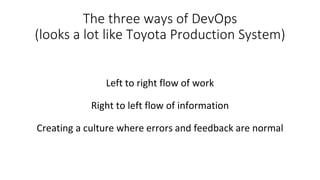
The three ways of DevOps
(looks a lot like Toyota Production System)
Left to right flow of work
Right to left flow of information
Creating a culture where errors and feedback are normal
Left to right flow of work
• Work in progress always moves forward
• Development -> IT Operations -> end user
• Small batch sizes and intervals
• Do not pass defects downstream
• Constantly optimize for global goals
• Continuous build, integration, deployment
• Create environments on demand
• Limit work in process
• Build safe systems
• Build infrastructure that is resilient to change in requirements, environment, demand
Right to left flow of information
• Constant, fast feedback at all stages
• Amplify information
• Identify exceptions
• Speed up exception detection and recovery
• Prevent problems from recurring
• Stop everything when something goes wrong
• Improvement of work takes precedence over the work itself
• Fast, automated testing
• Shared goals among business, development, operations
• Pervasive, visible production telemetry
Creating a resilient culture
• Foster continual experimentation
• Reward taking risks
• Learn from both failure and success
• Improve relentlessly
• Innovation demands a high level of trust
• Understand: repetition and practice are needed for mastery
• Develop reliable skills and habits
• How can we help each other be comfortable taking risks?
The four types of work that IT does
• Business projects (why we get paid)
• The work of the organization, often software development/projects
• This includes some client support of various kinds as well
• IT projects (how we make it easier to do what we get paid for)
• Infrastructure creation/maintenance
• Internally generated improvement work
• Changes (planned updates because we don’t exist in a bubble)
• Feature development, service delivery, patches
• Unplanned work (forest fires)
• Incidents, problems
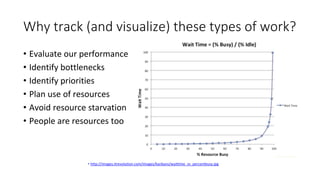
Why track (and visualize) these types of work?
• Evaluate our performance
• Identify bottlenecks
• Identify priorities
• Plan use of resources
• Avoid resource starvation
• People are resources too
• http://images.itrevolution.com/images/kanbans/waittime_vs_percentbusy.jpg
How are we doing?
• Following the three ways (workflow, flow of feedback, flow of trust)
• How much of each of four types of work we do (Arts, IT, change, fires)
• Can we measure this more effectively?
• Identifying and fixing bottlenecks
• Automating what we can
• Figuring out what can be automated
• Understanding the business that makes our work necessary
• Tell me about the Faculty of Arts; how does it work?
Where do we go from here? (homework)
• Automate something you do by hand
• Help a client automate something
• Look at what you see in monitoring results
• Fix it so it’s actionable or response is automated
• Find out what your supported departments and programs are
doing/planning and how we can help them
• Prepare to take a two week vacation without checking email
• Check in with team on your progress in 2-6 months (set deadline)
Thanks!
Questions?
Comments?

DevOps

  • 1.
    DevOps What is it? Dowe want it all? How are we doing?
  • 2.
    What is DevOps?(according to Wikipedia) • software DEVelopment and information technology OPerationS • “A set practices that emphasize the collaboration and communication of both software developers and information technology professionals while automating the process of software delivery and infrastructure changes” • “Establishing a culture and environment where building, testing, and releasing software can happen rapidly, frequently, and more reliably” • Generally agreed to have started around 2008-2009 (devopsdays.org)
  • 3.
    What is DevOps?(my personal definition) • The art and science of identifying and automating the routine parts of managing information, software, and technology for rapid, reliable deployment • A framework/toolset that helps technologists focus on the interesting parts of our work and lets non-technologists focus on their core jobs • By this metric, DevOps in some form has been around as long as there has been systems administration • “Fighting fires” is not interesting in a good way • Unplanned incidents consume resources uncontrollably (wildfire) • Planned, proactive fire management is better • Forestry to manage the forest, plus understanding how fires could start and when controlled burns are needed, is best
  • 4.
    What motivated meto think about DevOps? • The Phoenix Project: a novel about IT, DevOps, and helping your business win by Gene Kim, Kevin Behr, George Spafford (http://itrevolution.com/books/phoenix-project-devops-book/ ) • Our protagonist inherits an IT infrastructure which is badly broken • Catastrophe -> heroic recovery -> maybe learning (repeat) • Incremental improvements to understanding, infrastructure • Ticketing system to make work visible (with actual tickets: KanBan!) • Identify and ameliorate bottlenecks (Brent) • Prioritize IT work by understanding business needs, IT infrastructure • Develop knowledge of and skill in workplace politics
  • 5.
    Real life DevOpsexample: npm • https://speakerdeck.com/ceejbot/devops-at-npm-scaling-the-registry • CJ Silverio, CTO at npm, describes how they scaled up infrastructure to create a usable global Node.js registry • Moved from best guess predictive scaling to reactive monitoring and scaling to proactive improvements based on reliable metrics • Infrastructure was exciting for several months while trying to meet increasing demand • Sometimes learned what needs to be monitored by having it break • “The goal is to be boring”
  • 6.
    Real life DevOpsexample: Etsy • https://codeascraft.com/2012/05/22/blameless-postmortems/ • John Allspaw, CTO at Etsy, writes about their culture where failure is expected and used to learn how to make improvements • Human error is inevitable • Equip ourselves to better deal with problems that may arise • Give people the authority to make things better • Just Culture requires understanding personal reactions to failure
  • 7.
    Does Arts needDevOps? (audience participation time) • Why are we here? • Do we develop technology solutions to help Arts work effectively? • Are we solely/primarily a support organization? • Should we be? • Should central IT be where DevOps happens? • How effectively do we work across units?
  • 8.
    What DevOps Isn’t(busting a few myths, 1/n) • A replacement for Agile • The Agile Manifesto http://agilemanifesto.org/principles.html (created in 2001) is about building and maintaining software responsively • In a sense, DevOps is an extension of work flow practices used in Agile/Extreme/Lean/Scrum methods to technology management • Agile is not a prerequisite for DevOps • Flexible IT service delivery can support Agile software development • Our job isn’t over when code is fully tested and in production • Do we use Agile/Lean software development or project management?
  • 9.
    What DevOps Isn’t(2/n) • A replacement for ITIL • ITIL is a set of best practices • ITIL and ITSM describe capabilities needed to support DevOps • Service design is relevant • Problem management is relevant to DevOps, too • Many processes codified in ITIL can be automated • This includes change, configuration, release processes • As with Agile, DevOps can enable ITIL implementation • Do we use ITIL? Has this changed in the past year?
  • 10.
    What DevOps Isn’t(3/n) • NoOps (entirely eliminating IT Operations) • Many IT operations tasks become self service under DevOps • Pushes some operations functionality to groups that don’t have an operations focus, e.g. development • Operations still has responsibility to maintain and develop the environment that makes everyone’s job less frustrating • Are there areas of our work where we use NoOps? Do we consume any NoOps services? Would we like to?
  • 11.
    What DevOps Isn’t(4/n) • Linked primarily to Open Source • Principles are universal • You don’t need a LAMP stack: independent of underlying technology • Some DevOps requirements are common in Open Source environments • automated testing • configuration management • version control • How much of our work relies on vendor solutions? Open source? Home grown software?
  • 12.
    What DevOps Isn’t(5/n) • Infrastructure as code (nothing but automation) • Many patterns require automation • We also need mutual trust, shared goals • Understanding how technology enables the business and how people (technologists and non-techs) get things done • The business of higher education has a lot of moving parts • How much of our work involves knowing academic, administrative work flows?
  • 13.
    What DevOps Isn’t(6/6) • For tech startups and behemoths/unicorns • Google, Amazon, Twitter, LinkedIn, Esty, Facebook started with traditional IT Operations practices • DevOps practices are widespread across industries • Financial services (Bank of America, Paychex, World Bank) • Retailers (REI, Macy’s, GameStop) • Higher education (UBC, Kansas State) • US and UK government agencies • Does DevOps make sense for Arts Computing? For UW?
  • 14.
    What DevOps is:core concepts The three ways The four types of work Monitoring and visibility
  • 15.
    The three waysof DevOps (looks a lot like Toyota Production System) Left to right flow of work Right to left flow of information Creating a culture where errors and feedback are normal
  • 16.
    Left to rightflow of work • Work in progress always moves forward • Development -> IT Operations -> end user • Small batch sizes and intervals • Do not pass defects downstream • Constantly optimize for global goals • Continuous build, integration, deployment • Create environments on demand • Limit work in process • Build safe systems • Build infrastructure that is resilient to change in requirements, environment, demand
  • 17.
    Right to leftflow of information • Constant, fast feedback at all stages • Amplify information • Identify exceptions • Speed up exception detection and recovery • Prevent problems from recurring • Stop everything when something goes wrong • Improvement of work takes precedence over the work itself • Fast, automated testing • Shared goals among business, development, operations • Pervasive, visible production telemetry
  • 18.
    Creating a resilientculture • Foster continual experimentation • Reward taking risks • Learn from both failure and success • Improve relentlessly • Innovation demands a high level of trust • Understand: repetition and practice are needed for mastery • Develop reliable skills and habits • How can we help each other be comfortable taking risks?
  • 19.
    The four typesof work that IT does • Business projects (why we get paid) • The work of the organization, often software development/projects • This includes some client support of various kinds as well • IT projects (how we make it easier to do what we get paid for) • Infrastructure creation/maintenance • Internally generated improvement work • Changes (planned updates because we don’t exist in a bubble) • Feature development, service delivery, patches • Unplanned work (forest fires) • Incidents, problems
  • 20.
    Why track (andvisualize) these types of work? • Evaluate our performance • Identify bottlenecks • Identify priorities • Plan use of resources • Avoid resource starvation • People are resources too • http://images.itrevolution.com/images/kanbans/waittime_vs_percentbusy.jpg
  • 21.
    How are wedoing? • Following the three ways (workflow, flow of feedback, flow of trust) • How much of each of four types of work we do (Arts, IT, change, fires) • Can we measure this more effectively? • Identifying and fixing bottlenecks • Automating what we can • Figuring out what can be automated • Understanding the business that makes our work necessary • Tell me about the Faculty of Arts; how does it work?
  • 22.
    Where do wego from here? (homework) • Automate something you do by hand • Help a client automate something • Look at what you see in monitoring results • Fix it so it’s actionable or response is automated • Find out what your supported departments and programs are doing/planning and how we can help them • Prepare to take a two week vacation without checking email • Check in with team on your progress in 2-6 months (set deadline)
  • 23.