Water released through Dam by Gate Opening….
Rule Level & Gate Operation
Video by:
Manish Khandelwal
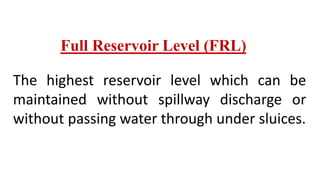
Full Reservoir Level (FRL)
The highest reservoir level which can be
maintained without spillway discharge or
without passing water through under sluices.
Highest Flood Level (HFL)
The level likely to be attained during floods
in a reservoir at the dam face while
negotiating the adopted design flood.
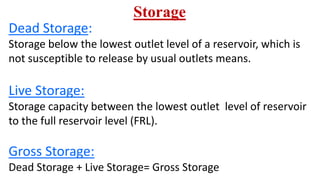
Storage
Dead Storage:
Storage below the lowest outlet level of a reservoir, which is
not susceptible to release by usual outlets means.
Live Storage:
Storage capacity between the lowest outlet level of reservoir
to the full reservoir level (FRL).
Gross Storage:
Dead Storage + Live Storage= Gross Storage
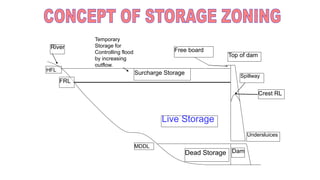
Crest RL
MDDL
Surcharge Storage
HFL
Dead Storage
Live Storage
Top of dam
Spillway
Undersluices
Dam
River Free board
FRL
Temporary
Storage for
Controlling flood
by increasing
outflow.
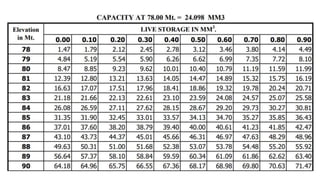
Area-Elevation & Capacity-Elevation Curve
These curves are graphical representation
which readily show the reservoir water
surface area at different elevations and the
capacity or volume of the water contained in
the reservoir at different elevations.
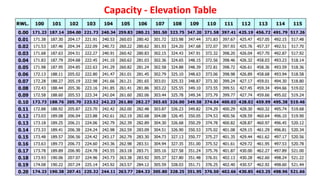
Capacity - Elevation Table
Flood Routing
Flood routing is a process of determining
theoretically the outflow pattern from
reservoir, for any given inflow pattern,
storage capacity and tail water condition.
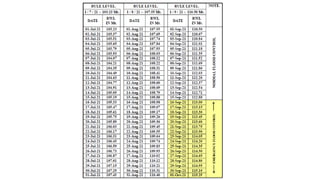
Rule Level
A Rule level is a pre-defined level on a
specified date to be maintained in the
reservoir to fill the reservoir in stages during
on-going monsoon season considering flood
control aspect & dam water uses (i.e.
irrigation, power generation, industrial,
drinking supply etc.)
Role of Rule Level
The role of rule level is significant in reservoir due to
following reasons:
• On specified date, it provides information about flood
space available in the reservoir.
• The available flood space helps in flood regulation and
moderation during high flood.
• By regulated release, it helps to prevent downstream
flooding. It also helps to prevent panic gate operation
during high flood.
Basis for Rule Level
• Inflow Data
• Water Requirements for Irrigation, Water
Supply, Power generation
• Past Experiences of observed storm
• Down Stream Hazard
• Safe carrying capacity of D/S Channel
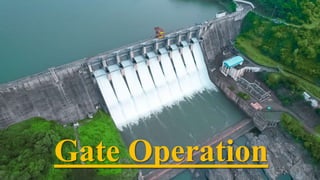
Gate Operation
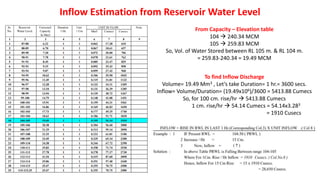
Inflow Estimation from Reservoir Water Level
From Capacity – Elevation table
104  240.34 MCM
105  259.83 MCM
So, Vol. of Water Stored between RL 105 m. & RL 104 m.
= 259.83-240.34 = 19.49 MCM
To find Inflow Discharge
Volume= 19.49 Mm3 , Let’s take Duration= 1 hr.= 3600 secs.
Inflow= Volume/Duration= (19.49x10⁶)/3600 = 5413.88 Cumecs
So, for 100 cm. rise/hr  5413.88 Cumecs
1 cm. rise/hr  54.14 Cumecs = 54.14x3.283
= 1910 Cusecs
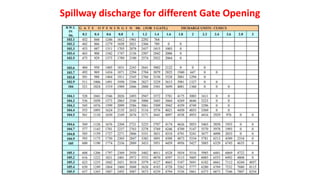
Spillway discharge for different Gate Opening
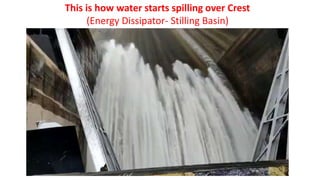
This is how water starts spilling over Crest
(Energy Dissipator- Stilling Basin)
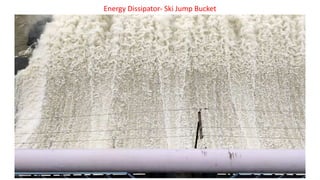
Energy Dissipator- Ski Jump Bucket
Thank You!!
Ask your questions in comment section
 Subscribe the channel for more videos
manishh_29
manishkhandelwal76

Rule Level & Gate Operation in a Dam.pptx

  • 2.
    Water released throughDam by Gate Opening….
  • 3.
    Rule Level &Gate Operation Video by: Manish Khandelwal
  • 4.
    Full Reservoir Level(FRL) The highest reservoir level which can be maintained without spillway discharge or without passing water through under sluices.
  • 5.
    Highest Flood Level(HFL) The level likely to be attained during floods in a reservoir at the dam face while negotiating the adopted design flood.
  • 6.
    Storage Dead Storage: Storage belowthe lowest outlet level of a reservoir, which is not susceptible to release by usual outlets means. Live Storage: Storage capacity between the lowest outlet level of reservoir to the full reservoir level (FRL). Gross Storage: Dead Storage + Live Storage= Gross Storage
  • 7.
    Crest RL MDDL Surcharge Storage HFL DeadStorage Live Storage Top of dam Spillway Undersluices Dam River Free board FRL Temporary Storage for Controlling flood by increasing outflow.
  • 9.
    Area-Elevation & Capacity-ElevationCurve These curves are graphical representation which readily show the reservoir water surface area at different elevations and the capacity or volume of the water contained in the reservoir at different elevations.
  • 10.
  • 11.
    Flood Routing Flood routingis a process of determining theoretically the outflow pattern from reservoir, for any given inflow pattern, storage capacity and tail water condition.
  • 12.
    Rule Level A Rulelevel is a pre-defined level on a specified date to be maintained in the reservoir to fill the reservoir in stages during on-going monsoon season considering flood control aspect & dam water uses (i.e. irrigation, power generation, industrial, drinking supply etc.)
  • 14.
    Role of RuleLevel The role of rule level is significant in reservoir due to following reasons: • On specified date, it provides information about flood space available in the reservoir. • The available flood space helps in flood regulation and moderation during high flood. • By regulated release, it helps to prevent downstream flooding. It also helps to prevent panic gate operation during high flood.
  • 15.
    Basis for RuleLevel • Inflow Data • Water Requirements for Irrigation, Water Supply, Power generation • Past Experiences of observed storm • Down Stream Hazard • Safe carrying capacity of D/S Channel
  • 16.
  • 17.
    Inflow Estimation fromReservoir Water Level From Capacity – Elevation table 104  240.34 MCM 105  259.83 MCM So, Vol. of Water Stored between RL 105 m. & RL 104 m. = 259.83-240.34 = 19.49 MCM To find Inflow Discharge Volume= 19.49 Mm3 , Let’s take Duration= 1 hr.= 3600 secs. Inflow= Volume/Duration= (19.49x10⁶)/3600 = 5413.88 Cumecs So, for 100 cm. rise/hr  5413.88 Cumecs 1 cm. rise/hr  54.14 Cumecs = 54.14x3.283 = 1910 Cusecs
  • 18.
    Spillway discharge fordifferent Gate Opening
  • 19.
    This is howwater starts spilling over Crest (Energy Dissipator- Stilling Basin)
  • 20.
  • 21.
    Thank You!! Ask yourquestions in comment section  Subscribe the channel for more videos manishh_29 manishkhandelwal76