5. Reservoir
Prepared by: Birhanu W. 1
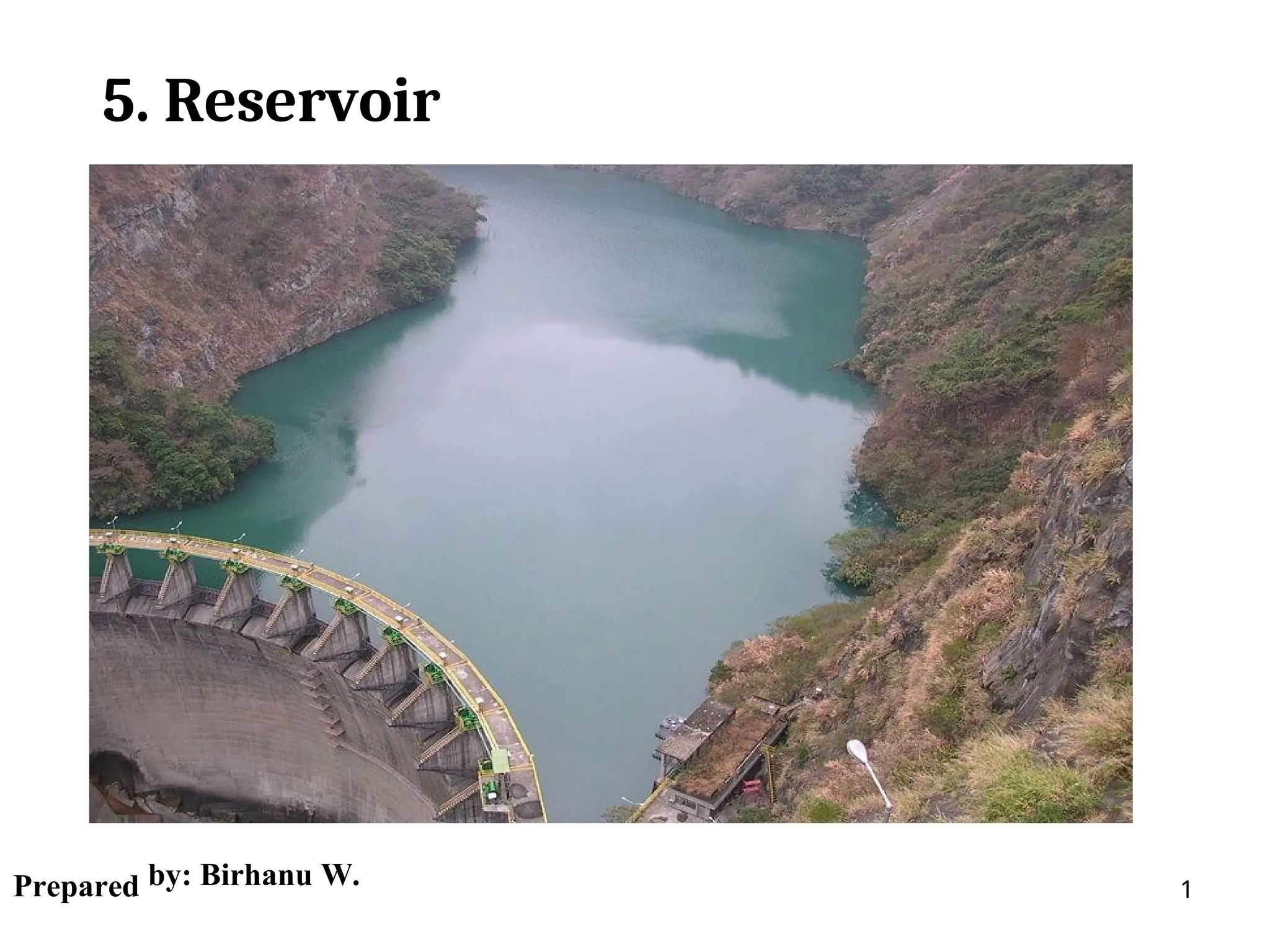
Reservoir: During high flows, water flowing in a river has to be stored so
that a uniform supply of water can be assured, for water resources
utilisation like irrigation, water supply, power generation, etc. during
periods of low flows of the river.
Its determination is performed using historical inflow records in the stream
at
the proposed dam site.
 Type of Reservoir
Storage or conservation reservoir
 Can retain excess supplies during period of peak flows and can
release gradually during low flows
Flood control reservoir
 to minimize the flood peaks at the areas to be protected
downstream. Multipurpose reservoir
5.1 Reservoir
 designed to protect the downstream areas from floods and to conserve
water
for water supply, irrigation, industrial needs, hydroelectric purposes etc
Distribution reservoir 2
 Is a small storage reservoir constructed within a city water supply system
3
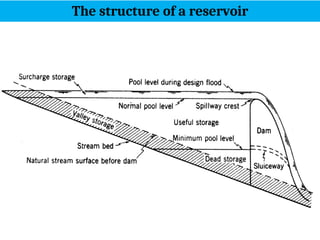
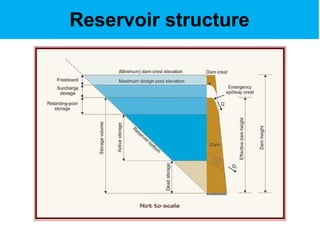
5.1.1 Storage Zone of Reservoir
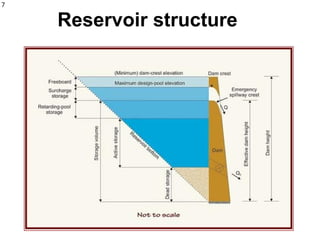
• Normal pool level: It is the maximum
elevation, to which the reservoir water
surface will rise during normal operating
condition.
• Minimum pool level: The lowest water
surface elevation, which has to be kept under
normal operating condition in a reservoir
• Surcharge storage: This is the storage between
full reservoir level and maximum water level.
4
• Dead storage (low water level): It is the
minimum reservoir level below which, water is
not allowed to be drawn for conservation
purposes.
5
Storage Zone of Reservoir
• Live storage: It is also known as the useful or
conservation storage of a reservoir and it is the
difference between the storages at full reservoir
level and dead storage level
• Bank storage: It is the storage of water in the
permeable reservoir banks.
• Full reservoir level (FRL): It is the level of spillway crest (for un
gated spillway) or the top of spillway gate (for gated
spillway) to which the reservoir is usually filled.
• Maximum water level (MWL): It is the new elevation to
6
which, water in the reservoir rises when design flood
impinges at full reservoir level.
7
Reservoir structure
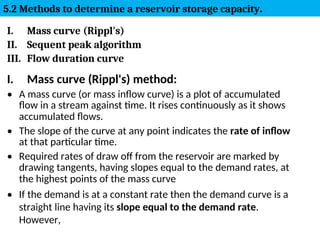
I. Mass curve (Rippl's)
II. Sequent peak algorithm
III. Flow duration curve
I. Mass curve (Rippl's) method:
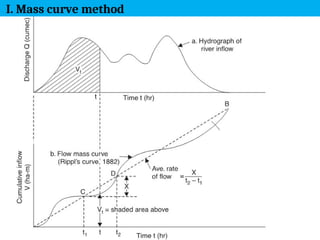
• A mass curve (or mass inflow curve) is a plot of accumulated
flow in a stream against time. It rises continuously as it shows
accumulated flows.
• The slope of the curve at any point indicates the rate of inflow
at that particular time.
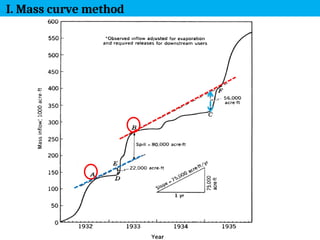
• Required rates of draw off from the reservoir are marked by
drawing tangents, having slopes equal to the demand rates, at
the highest points of the mass curve
• If the demand is at a constant rate then the demand curve is a
straight line having its slope equal to the demand rate.
However,
5.2 Methods to determine a reservoir storage capacity.
if
the demand is not constant then the demand will be curved 6
indicating a variable rate of demand.
7
I. Mass curve method
8
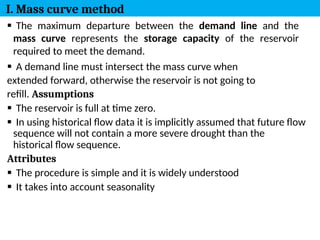
 The maximum departure between the demand line and the
mass curve represents the storage capacity of the reservoir
required to meet the demand.
 A demand line must intersect the mass curve when
extended forward, otherwise the reservoir is not going to
refill. Assumptions
 The reservoir is full at time zero.
 In using historical flow data it is implicitly assumed that future flow
sequence will not contain a more severe drought than the
historical flow sequence.
Attributes
 The procedure is simple and it is widely understood
 It takes into account seasonality
I. Mass curve method
9
I. Mass curve method
10
Mass curve procedure
• The reservoir capacity required for a specified yield or
demand may be determined by using mass curve and demand
curve using the following steps
1. A mass curve is prepared from the flow hydrograph for a
number of consecutive years selected from the available
stream flow record such that it includes the most critical or the
driest period.
2. Corresponding to the given rate of demand, a demand
11
curve is prepared.
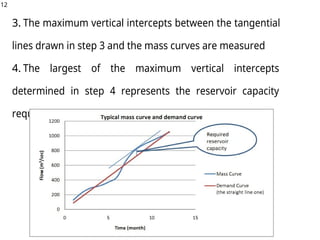
3. Lines are drawn parallel to the demand curve and tangential to the
high points of the mass curve
12
3. The maximum vertical intercepts between the tangential
lines drawn in step 3 and the mass curves are measured
4. The largest of the maximum vertical intercepts
determined in step 4 represents the reservoir capacity
required to satisfy the given demand.
IX. The required capacity is C = max (Hk – Tk) 13
𝒊=
𝟏
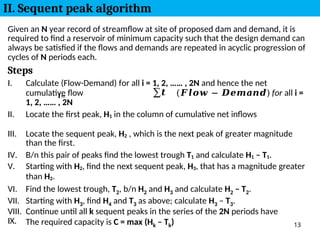
Given an N year record of streamflow at site of proposed dam and demand, it is
required to find a reservoir of minimum capacity such that the design demand can
always be satisfied if the flows and demands are repeated in acyclic progression of
cycles of N periods each.
Steps
I. Calculate (Flow-Demand) for all i = 1, 2, …… , 2N and hence the net
cumulative flow ∑𝒕 (𝑭𝒍𝒐𝒘 − 𝑫𝒆𝒎𝒂𝒏𝒅) for all i =
1, 2, …… , 2N
II. Locate the first peak, H1 in the column of cumulative net inflows
III. Locate the sequent peak, H2 , which is the next peak of greater magnitude
than the first.
IV. B/n this pair of peaks find the lowest trough T1 and calculate H1 – T1.
V. Starting with H2, find the next sequent peak, H3, that has a magnitude greater
than H2.
VI. Find the lowest trough, T2, b/n H2 and H3 and calculate H2 – T2.
VII. Starting with H3, find H4 and T3 as above; calculate H3 – T3.
VIII. Continue until all k sequent peaks in the series of the 2N periods have
II. Sequent peak algorithm
IX. The required capacity is C = max (Hk – Tk) 14
been found.
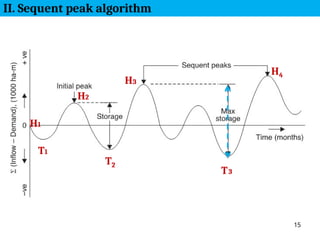
15
H4
3
H2
H1
T1
T2
3
II. Sequent peak algorithm
H
T
16
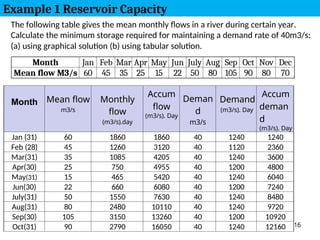
The following table gives the mean monthly flows in a river during certain year.
Calculate the minimum storage required for maintaining a demand rate of 40m3/s:
(a) using graphical solution (b) using tabular solution.
Month Jan Feb Mar Apr May Jun July Aug Sep Oct Nov Dec
Mean flow M3/s 60 45 35 25 15 22 50 80 105 90 80 70
Month Mean flow
m3/s
Monthly
flow
(m3/s).day
Accum
flow
(m3/s). Day
Deman
d
m3/s
Demand
(m3/s). Day
Accum
deman
d
(m3/s). Day
Jan (31) 60 1860 1860 40 1240 1240
Feb (28) 45 1260 3120 40 1120 2360
Mar(31) 35 1085 4205 40 1240 3600
Apr(30) 25 750 4955 40 1200 4800
May(31) 15 465 5420 40 1240 6040
Jun(30) 22 660 6080 40 1200 7240
July(31) 50 1550 7630 40 1240 8480
Aug(31) 80 2480 10110 40 1240 9720
Sep(30) 105 3150 13260 40 1200 10920
Oct(31) 90 2790 16050 40 1240 12160
Example 1 Reservoir Capacity
17
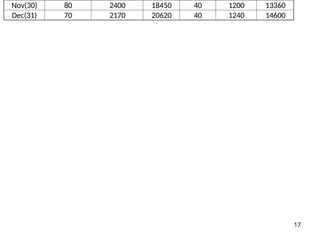
Nov(30) 80 2400 18450 40 1200 13360
Dec(31) 70 2170 20620 40 1240 14600
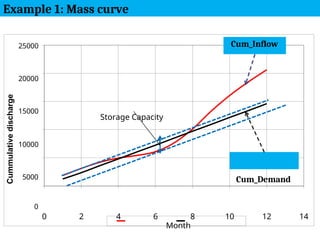
25000
20000
15000
Storage Capacity
10000
5000 Cum_Demand
0
0 2 4 6 8 10 12 14
Month
Example 1: Mass curve
Cum_Inflow
Cummulative
discharge
Mass curve Demand curve 15
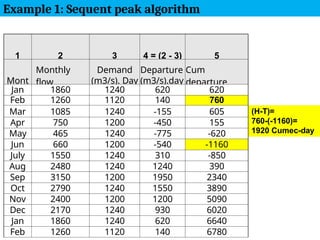
1 2 3 4 = (2 - 3) 5
Mont
Monthly
flow
Demand
(m3/s). Day
Departure
(m3/s).day
Cum
departure
Jan 1860 1240 620 620
Feb 1260 1120 140 760
Mar 1085 1240 -155 605 (H-T)=
760-(-1160)=
1920 Cumec-day
Apr 750 1200 -450 155
May 465 1240 -775 -620
Jun 660 1200 -540 -1160
July 1550 1240 310 -850
Aug 2480 1240 1240 390
Sep 3150 1200 1950 2340
Oct 2790 1240 1550 3890
Nov 2400 1200 1200 5090
Dec 2170 1240 930 6020
Jan 1860 1240 620 6640
Feb 1260 1120 140 6780
Example 1: Sequent peak algorithm
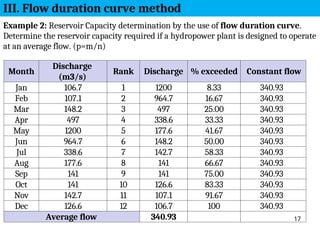
Example 2: Reservoir Capacity determination by the use of flow duration curve.
Determine the reservoir capacity required if a hydropower plant is designed to operate
at an average flow. (p=m/n)
Month
Discharge
(m3/s)
Rank Discharge % exceeded Constant flow
Jan 106.7 1 1200 8.33 340.93
Feb 107.1 2 964.7 16.67 340.93
Mar 148.2 3 497 25.00 340.93
Apr 497 4 338.6 33.33 340.93
May 1200 5 177.6 41.67 340.93
Jun 964.7 6 148.2 50.00 340.93
Jul 338.6 7 142.7 58.33 340.93
Aug 177.6 8 141 66.67 340.93
Sep 141 9 141 75.00 340.93
Oct 141 10 126.6 83.33 340.93
Nov 142.7 11 107.1 91.67 340.93
Dec 126.6 12 106.7 100 340.93
Average flow 340.93 17
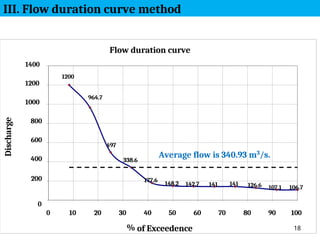
III. Flow duration curve method
1400
1200
1000
1200
964.7
Flow duration curve
800
600
400
497
338.6
Average flow is 340.93 m3
/s.
200 177.6
148.2 142.7 141 141 126.6 107.1 106.7
0
0 10 20 30 40 50 60 70 80 90 100
% of Exceedence 18
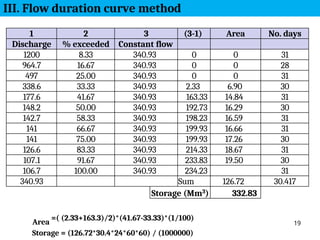
III. Flow duration curve method
Discharge
1 2 3 (3-1) Area No. days
Discharge % exceeded Constant flow
1200 8.33 340.93 0 0 31
964.7 16.67 340.93 0 0 28
497 25.00 340.93 0 0 31
338.6 33.33 340.93 2.33 6.90 30
177.6 41.67 340.93 163.33 14.84 31
148.2 50.00 340.93 192.73 16.29 30
142.7 58.33 340.93 198.23 16.59 31
141 66.67 340.93 199.93 16.66 31
141 75.00 340.93 199.93 17.26 30
126.6 83.33 340.93 214.33 18.67 31
107.1 91.67 340.93 233.83 19.50 30
106.7 100.00 340.93 234.23 31
340.93 Sum 126.72 30.417
Storage (Mm3) 332.83
Area
=( (2.33+163.3)/2)*(41.67-33.33)*(1/100)
19
Storage = (126.72*30.4*24*60*60) / (1000000)
III. Flow duration curve method
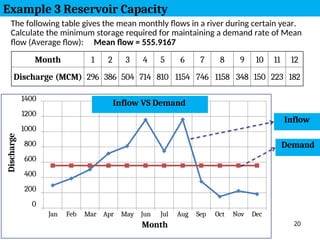
The following table gives the mean monthly flows in a river during certain year.
Calculate the minimum storage required for maintaining a demand rate of Mean
flow (Average flow): Mean flow = 555.9167
Month 1 2 3 4 5 6 7 8 9 10 11 12
Discharge (MCM) 296 386 504 714 810 1154 746 1158 348 150 223 182
1400
1200
1000
800
600
400
200
0
Jan Feb Mar Apr May Jun Jul Aug Sep Oct Nov Dec
Month
Inflow
Demand
20
Inflow VS Demand
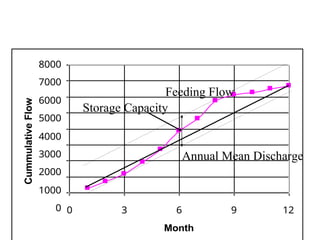
Example 3 Reservoir Capacity
Discharge
8000
7000
6000
5000
4000
3000
2000
1000
0
Feeding Flow
Storage Capacity
Annual Mean Discharge
0 3 6 9 12
Month
Cummulative
Flow
Rate
21
Example 3: Mass curve
22
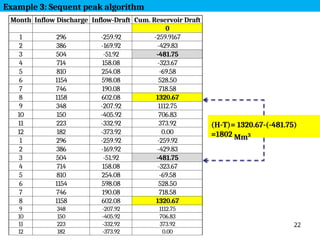
Month Inflow Discharge Inflow-Draft Cum. Reservoir Draft
0
1 296 -259.92 -259.9167
2 386 -169.92 -429.83
3 504 -51.92 -481.75
4 714 158.08 -323.67
5 810 254.08 -69.58
6 1154 598.08 528.50
7 746 190.08 718.58
8 1158 602.08 1320.67
9 348 -207.92 1112.75
10 150 -405.92 706.83
11 223 -332.92 373.92
12 182 -373.92 0.00
1 296 -259.92 -259.92
2 386 -169.92 -429.83
3 504 -51.92 -481.75
4 714 158.08 -323.67
5 810 254.08 -69.58
6 1154 598.08 528.50
7 746 190.08 718.58
8 1158 602.08 1320.67
9 348 -207.92 1112.75
10 150 -405.92 706.83
11 223 -332.92 373.92
12 182 -373.92 0.00
Example 3: Sequent peak algorithm
(H-T)= 1320.67-(-481.75)
=1802 Mm3
23
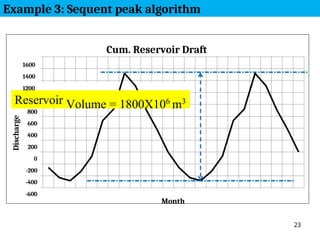
1000
Reservoir Volume = 1800X106
m3
1600
1400
1200
Cum. Reservoir Draft
800
600
400
200
0
-200
-400
-600
Month
Example 3: Sequent peak algorithm
Discharge
24
• A river entering a water reservoir will loose its capacity to
transport sediments. b/c water velocity decreases, together
with the shear stress on the bed. The sediments will therefore
deposit in the reservoir and decrease its volume.
• In the design of dam, it is important to assess the magnitude
of sediment deposition in the reservoir. The problem can be
divided In two parts:
1. How much sediments enter the reservoir
2. What is the trap efficiency of the reservoir
• In a detailed study, the sediment size distributions also have
to be determined for question 1.
5.3. Reservoirs and sediments
25
• Question 2 may also involve determining the location of the
deposits and the concentration and grain size distribution of the
sediments entering the water intakes.
26
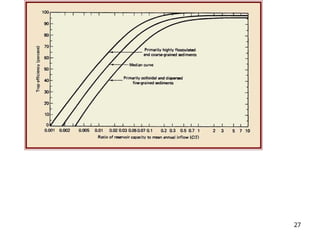
Trap efficiency
27
28
The structure of a reservoir
29
Reservoir structure
30
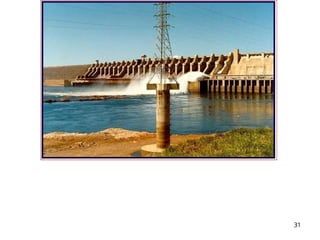
Spillway
31
32
In general, there are two approaches to the
sedimentation problem:
I. The reservoir is constructed so large that it will take a very
long time to fill. The economical value of the project will
thereby be maintained.
II. The reservoir is designed relatively small and the dam gates are
constructed relatively large, so that it is possible to remove the
sediments regularly by flushing. The gates are opened,
lowering the water level in the reservoir, which increases the
water velocity.
• The flushing has to be done while the water discharge in
to the reservoir is relatively high.
Reservoirs and sediments
33
• A long and narrow reservoir will therefore be more
effectively flushed than a short and wide geometry. For the
later, the sediment deposits may remain on the sides.
• The land use, slope and size of the catchment are important factors
for
determination of sediment load.
• Sediment moves in the streams as suspended load (fine particles)
and as bed load. Sediment concentrations are measured using
standard sampling techniques, and water discharges are
recorded simultaneously.
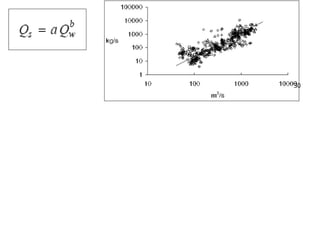
• The measurements are taken at varying water discharges. The
values of water discharge and sediment concentrations are
plotted on a graph, and a rating curve is made. This is often on
the form:
5.4. Sediment Load Prediction
30
31
• The useful life of a reservoir gets reduced due to sediment
deposition
causing a decrease in its storage capacity.
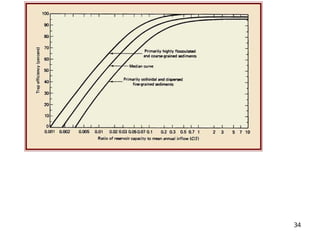
• The Percent of the inflowing sediment which is retained in a
reservoir is called the trap efficiency and it is a function of the
ratio of reservoir capacity to total annual sediment inflow
• The total sediment transport may be estimated by adding 10-22%
to the suspended sediment transport to allow for the bed load
contribution.
The rate at which the capacity of a reservoir is reduced by sediment
deposition depends on
1. The rate of sediment inflow i.e sediment load
5.5 Reduction in reservoir capacity
32
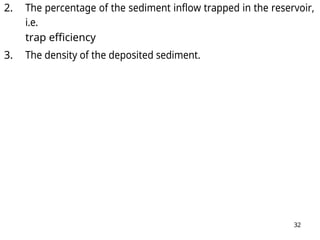
2. The percentage of the sediment inflow trapped in the reservoir,
i.e.
trap efficiency
3. The density of the deposited sediment.
33
Trap efficiency
34
33
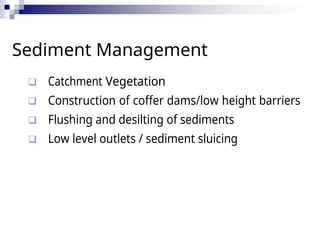
Sediment Management
 Catchment Vegetation
 Construction of coffer dams/low height barriers
 Flushing and desilting of sediments
 Low level outlets / sediment sluicing
Catchment vegetation
34
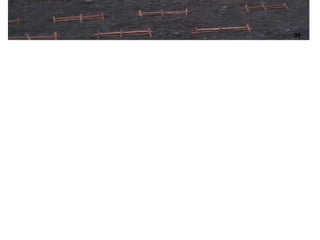
Wooden barriers
35
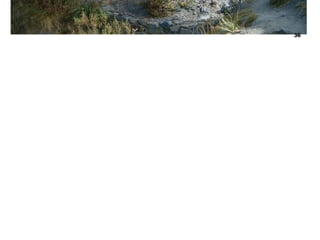
Wooden barriers
36
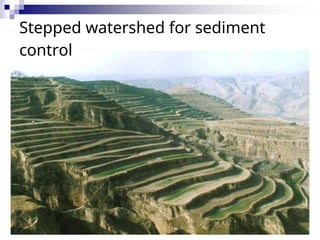
Stepped watershed for sediment
control
37
Flushing of sediments from reservoir
38
Sediment sluicing
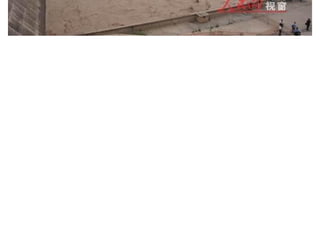
39
Sediment sluicing
40
41
Thank You !!!

waste water pollution controlloling Chapter-5.docx

  • 1.
  • 2.
    Reservoir: During highflows, water flowing in a river has to be stored so that a uniform supply of water can be assured, for water resources utilisation like irrigation, water supply, power generation, etc. during periods of low flows of the river. Its determination is performed using historical inflow records in the stream at the proposed dam site.  Type of Reservoir Storage or conservation reservoir  Can retain excess supplies during period of peak flows and can release gradually during low flows Flood control reservoir  to minimize the flood peaks at the areas to be protected downstream. Multipurpose reservoir 5.1 Reservoir
  • 3.
     designed toprotect the downstream areas from floods and to conserve water for water supply, irrigation, industrial needs, hydroelectric purposes etc Distribution reservoir 2  Is a small storage reservoir constructed within a city water supply system
  • 4.
    3 5.1.1 Storage Zoneof Reservoir • Normal pool level: It is the maximum elevation, to which the reservoir water surface will rise during normal operating condition. • Minimum pool level: The lowest water surface elevation, which has to be kept under normal operating condition in a reservoir • Surcharge storage: This is the storage between full reservoir level and maximum water level.
  • 5.
    4 • Dead storage(low water level): It is the minimum reservoir level below which, water is not allowed to be drawn for conservation purposes.
  • 6.
    5 Storage Zone ofReservoir • Live storage: It is also known as the useful or conservation storage of a reservoir and it is the difference between the storages at full reservoir level and dead storage level • Bank storage: It is the storage of water in the permeable reservoir banks. • Full reservoir level (FRL): It is the level of spillway crest (for un gated spillway) or the top of spillway gate (for gated spillway) to which the reservoir is usually filled. • Maximum water level (MWL): It is the new elevation to
  • 7.
    6 which, water inthe reservoir rises when design flood impinges at full reservoir level.
  • 8.
  • 9.
    I. Mass curve(Rippl's) II. Sequent peak algorithm III. Flow duration curve I. Mass curve (Rippl's) method: • A mass curve (or mass inflow curve) is a plot of accumulated flow in a stream against time. It rises continuously as it shows accumulated flows. • The slope of the curve at any point indicates the rate of inflow at that particular time. • Required rates of draw off from the reservoir are marked by drawing tangents, having slopes equal to the demand rates, at the highest points of the mass curve • If the demand is at a constant rate then the demand curve is a straight line having its slope equal to the demand rate. However, 5.2 Methods to determine a reservoir storage capacity.
  • 10.
    if the demand isnot constant then the demand will be curved 6 indicating a variable rate of demand.
  • 11.
  • 12.
    8  The maximumdeparture between the demand line and the mass curve represents the storage capacity of the reservoir required to meet the demand.  A demand line must intersect the mass curve when extended forward, otherwise the reservoir is not going to refill. Assumptions  The reservoir is full at time zero.  In using historical flow data it is implicitly assumed that future flow sequence will not contain a more severe drought than the historical flow sequence. Attributes  The procedure is simple and it is widely understood  It takes into account seasonality I. Mass curve method
  • 13.
  • 14.
    10 Mass curve procedure •The reservoir capacity required for a specified yield or demand may be determined by using mass curve and demand curve using the following steps 1. A mass curve is prepared from the flow hydrograph for a number of consecutive years selected from the available stream flow record such that it includes the most critical or the driest period. 2. Corresponding to the given rate of demand, a demand
  • 15.
    11 curve is prepared. 3.Lines are drawn parallel to the demand curve and tangential to the high points of the mass curve
  • 16.
    12 3. The maximumvertical intercepts between the tangential lines drawn in step 3 and the mass curves are measured 4. The largest of the maximum vertical intercepts determined in step 4 represents the reservoir capacity required to satisfy the given demand.
  • 17.
    IX. The requiredcapacity is C = max (Hk – Tk) 13 𝒊= 𝟏 Given an N year record of streamflow at site of proposed dam and demand, it is required to find a reservoir of minimum capacity such that the design demand can always be satisfied if the flows and demands are repeated in acyclic progression of cycles of N periods each. Steps I. Calculate (Flow-Demand) for all i = 1, 2, …… , 2N and hence the net cumulative flow ∑𝒕 (𝑭𝒍𝒐𝒘 − 𝑫𝒆𝒎𝒂𝒏𝒅) for all i = 1, 2, …… , 2N II. Locate the first peak, H1 in the column of cumulative net inflows III. Locate the sequent peak, H2 , which is the next peak of greater magnitude than the first. IV. B/n this pair of peaks find the lowest trough T1 and calculate H1 – T1. V. Starting with H2, find the next sequent peak, H3, that has a magnitude greater than H2. VI. Find the lowest trough, T2, b/n H2 and H3 and calculate H2 – T2. VII. Starting with H3, find H4 and T3 as above; calculate H3 – T3. VIII. Continue until all k sequent peaks in the series of the 2N periods have II. Sequent peak algorithm
  • 18.
    IX. The requiredcapacity is C = max (Hk – Tk) 14 been found.
  • 19.
  • 20.
    16 The following tablegives the mean monthly flows in a river during certain year. Calculate the minimum storage required for maintaining a demand rate of 40m3/s: (a) using graphical solution (b) using tabular solution. Month Jan Feb Mar Apr May Jun July Aug Sep Oct Nov Dec Mean flow M3/s 60 45 35 25 15 22 50 80 105 90 80 70 Month Mean flow m3/s Monthly flow (m3/s).day Accum flow (m3/s). Day Deman d m3/s Demand (m3/s). Day Accum deman d (m3/s). Day Jan (31) 60 1860 1860 40 1240 1240 Feb (28) 45 1260 3120 40 1120 2360 Mar(31) 35 1085 4205 40 1240 3600 Apr(30) 25 750 4955 40 1200 4800 May(31) 15 465 5420 40 1240 6040 Jun(30) 22 660 6080 40 1200 7240 July(31) 50 1550 7630 40 1240 8480 Aug(31) 80 2480 10110 40 1240 9720 Sep(30) 105 3150 13260 40 1200 10920 Oct(31) 90 2790 16050 40 1240 12160 Example 1 Reservoir Capacity
  • 21.
    17 Nov(30) 80 240018450 40 1200 13360 Dec(31) 70 2170 20620 40 1240 14600
  • 22.
    25000 20000 15000 Storage Capacity 10000 5000 Cum_Demand 0 02 4 6 8 10 12 14 Month Example 1: Mass curve Cum_Inflow Cummulative discharge
  • 23.
  • 24.
    1 2 34 = (2 - 3) 5 Mont Monthly flow Demand (m3/s). Day Departure (m3/s).day Cum departure Jan 1860 1240 620 620 Feb 1260 1120 140 760 Mar 1085 1240 -155 605 (H-T)= 760-(-1160)= 1920 Cumec-day Apr 750 1200 -450 155 May 465 1240 -775 -620 Jun 660 1200 -540 -1160 July 1550 1240 310 -850 Aug 2480 1240 1240 390 Sep 3150 1200 1950 2340 Oct 2790 1240 1550 3890 Nov 2400 1200 1200 5090 Dec 2170 1240 930 6020 Jan 1860 1240 620 6640 Feb 1260 1120 140 6780 Example 1: Sequent peak algorithm
  • 25.
    Example 2: ReservoirCapacity determination by the use of flow duration curve. Determine the reservoir capacity required if a hydropower plant is designed to operate at an average flow. (p=m/n) Month Discharge (m3/s) Rank Discharge % exceeded Constant flow Jan 106.7 1 1200 8.33 340.93 Feb 107.1 2 964.7 16.67 340.93 Mar 148.2 3 497 25.00 340.93 Apr 497 4 338.6 33.33 340.93 May 1200 5 177.6 41.67 340.93 Jun 964.7 6 148.2 50.00 340.93 Jul 338.6 7 142.7 58.33 340.93 Aug 177.6 8 141 66.67 340.93 Sep 141 9 141 75.00 340.93 Oct 141 10 126.6 83.33 340.93 Nov 142.7 11 107.1 91.67 340.93 Dec 126.6 12 106.7 100 340.93 Average flow 340.93 17 III. Flow duration curve method
  • 26.
    1400 1200 1000 1200 964.7 Flow duration curve 800 600 400 497 338.6 Averageflow is 340.93 m3 /s. 200 177.6 148.2 142.7 141 141 126.6 107.1 106.7 0 0 10 20 30 40 50 60 70 80 90 100 % of Exceedence 18 III. Flow duration curve method Discharge
  • 27.
    1 2 3(3-1) Area No. days Discharge % exceeded Constant flow 1200 8.33 340.93 0 0 31 964.7 16.67 340.93 0 0 28 497 25.00 340.93 0 0 31 338.6 33.33 340.93 2.33 6.90 30 177.6 41.67 340.93 163.33 14.84 31 148.2 50.00 340.93 192.73 16.29 30 142.7 58.33 340.93 198.23 16.59 31 141 66.67 340.93 199.93 16.66 31 141 75.00 340.93 199.93 17.26 30 126.6 83.33 340.93 214.33 18.67 31 107.1 91.67 340.93 233.83 19.50 30 106.7 100.00 340.93 234.23 31 340.93 Sum 126.72 30.417 Storage (Mm3) 332.83 Area =( (2.33+163.3)/2)*(41.67-33.33)*(1/100) 19 Storage = (126.72*30.4*24*60*60) / (1000000) III. Flow duration curve method
  • 28.
    The following tablegives the mean monthly flows in a river during certain year. Calculate the minimum storage required for maintaining a demand rate of Mean flow (Average flow): Mean flow = 555.9167 Month 1 2 3 4 5 6 7 8 9 10 11 12 Discharge (MCM) 296 386 504 714 810 1154 746 1158 348 150 223 182 1400 1200 1000 800 600 400 200 0 Jan Feb Mar Apr May Jun Jul Aug Sep Oct Nov Dec Month Inflow Demand 20 Inflow VS Demand Example 3 Reservoir Capacity Discharge
  • 29.
    8000 7000 6000 5000 4000 3000 2000 1000 0 Feeding Flow Storage Capacity AnnualMean Discharge 0 3 6 9 12 Month Cummulative Flow Rate
  • 30.
  • 31.
    22 Month Inflow DischargeInflow-Draft Cum. Reservoir Draft 0 1 296 -259.92 -259.9167 2 386 -169.92 -429.83 3 504 -51.92 -481.75 4 714 158.08 -323.67 5 810 254.08 -69.58 6 1154 598.08 528.50 7 746 190.08 718.58 8 1158 602.08 1320.67 9 348 -207.92 1112.75 10 150 -405.92 706.83 11 223 -332.92 373.92 12 182 -373.92 0.00 1 296 -259.92 -259.92 2 386 -169.92 -429.83 3 504 -51.92 -481.75 4 714 158.08 -323.67 5 810 254.08 -69.58 6 1154 598.08 528.50 7 746 190.08 718.58 8 1158 602.08 1320.67 9 348 -207.92 1112.75 10 150 -405.92 706.83 11 223 -332.92 373.92 12 182 -373.92 0.00 Example 3: Sequent peak algorithm (H-T)= 1320.67-(-481.75) =1802 Mm3
  • 32.
    23 1000 Reservoir Volume =1800X106 m3 1600 1400 1200 Cum. Reservoir Draft 800 600 400 200 0 -200 -400 -600 Month Example 3: Sequent peak algorithm Discharge
  • 33.
    24 • A riverentering a water reservoir will loose its capacity to transport sediments. b/c water velocity decreases, together with the shear stress on the bed. The sediments will therefore deposit in the reservoir and decrease its volume. • In the design of dam, it is important to assess the magnitude of sediment deposition in the reservoir. The problem can be divided In two parts: 1. How much sediments enter the reservoir 2. What is the trap efficiency of the reservoir • In a detailed study, the sediment size distributions also have to be determined for question 1. 5.3. Reservoirs and sediments
  • 34.
    25 • Question 2may also involve determining the location of the deposits and the concentration and grain size distribution of the sediments entering the water intakes.
  • 35.
  • 36.
  • 37.
  • 38.
  • 39.
  • 40.
  • 41.
    32 In general, thereare two approaches to the sedimentation problem: I. The reservoir is constructed so large that it will take a very long time to fill. The economical value of the project will thereby be maintained. II. The reservoir is designed relatively small and the dam gates are constructed relatively large, so that it is possible to remove the sediments regularly by flushing. The gates are opened, lowering the water level in the reservoir, which increases the water velocity. • The flushing has to be done while the water discharge in to the reservoir is relatively high. Reservoirs and sediments
  • 42.
    33 • A longand narrow reservoir will therefore be more effectively flushed than a short and wide geometry. For the later, the sediment deposits may remain on the sides.
  • 43.
    • The landuse, slope and size of the catchment are important factors for determination of sediment load. • Sediment moves in the streams as suspended load (fine particles) and as bed load. Sediment concentrations are measured using standard sampling techniques, and water discharges are recorded simultaneously. • The measurements are taken at varying water discharges. The values of water discharge and sediment concentrations are plotted on a graph, and a rating curve is made. This is often on the form: 5.4. Sediment Load Prediction
  • 44.
  • 45.
    31 • The usefullife of a reservoir gets reduced due to sediment deposition causing a decrease in its storage capacity. • The Percent of the inflowing sediment which is retained in a reservoir is called the trap efficiency and it is a function of the ratio of reservoir capacity to total annual sediment inflow • The total sediment transport may be estimated by adding 10-22% to the suspended sediment transport to allow for the bed load contribution. The rate at which the capacity of a reservoir is reduced by sediment deposition depends on 1. The rate of sediment inflow i.e sediment load 5.5 Reduction in reservoir capacity
  • 46.
    32 2. The percentageof the sediment inflow trapped in the reservoir, i.e. trap efficiency 3. The density of the deposited sediment.
  • 47.
  • 48.
  • 49.
    33 Sediment Management  CatchmentVegetation  Construction of coffer dams/low height barriers  Flushing and desilting of sediments  Low level outlets / sediment sluicing
  • 50.
  • 51.
  • 52.
  • 53.
  • 54.
  • 55.
  • 56.
    Stepped watershed forsediment control
  • 57.
  • 58.
    Flushing of sedimentsfrom reservoir
  • 59.
  • 60.
  • 61.
  • 62.
  • 63.
  • 64.