Notes on Civil Procedure by Lawrence Villamar 
Source: “Revised Rules of Procedure Annotated” (Estopia, 2013) 
RULE 65 
CERTIORARI, PROHIBITION, AND MANDAMUS 
A. CERTIORARI 
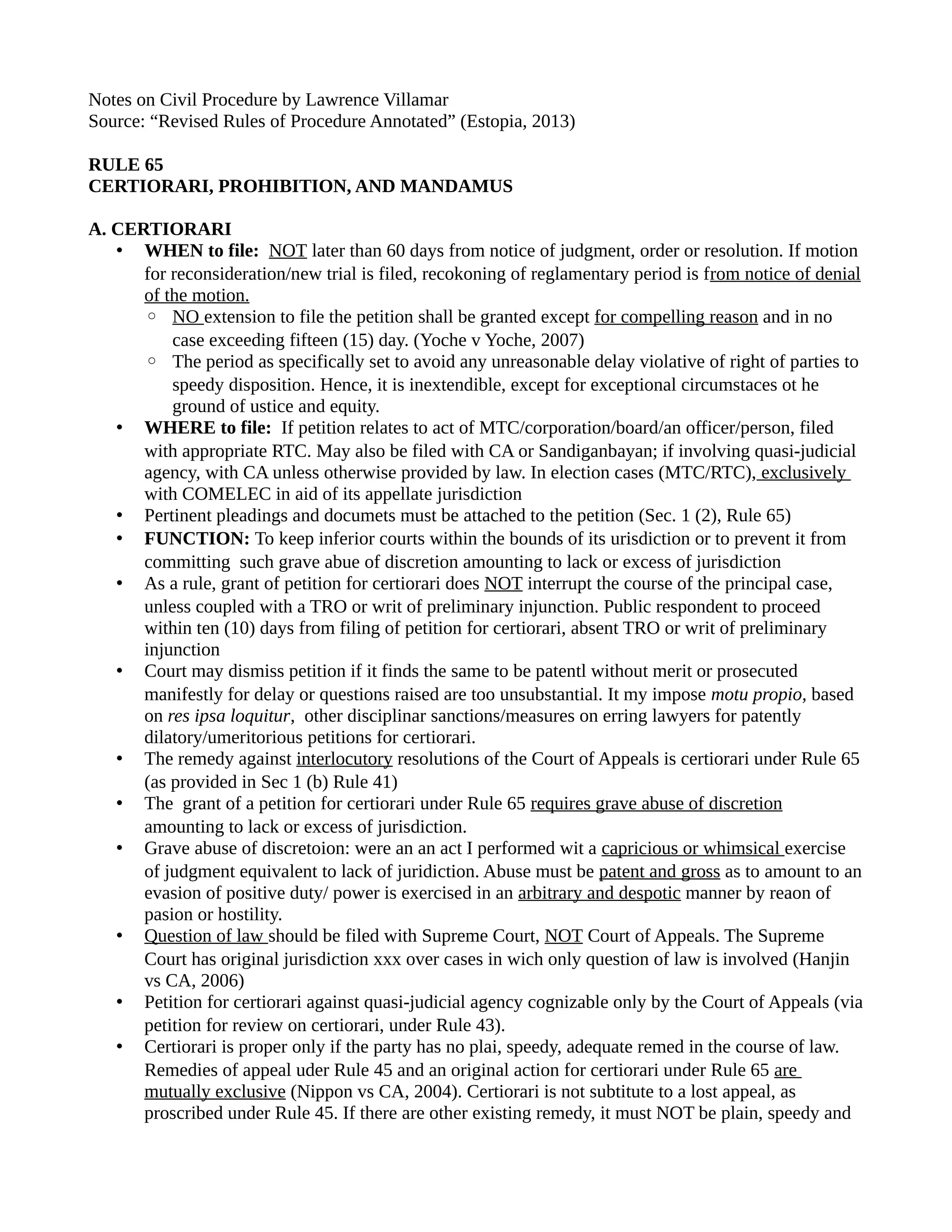
• WHEN to file: NOT later than 60 days from notice of judgment, order or resolution. If motion 
for reconsideration/new trial is filed, recokoning of reglamentary period is from notice of denial 
of the motion. 
◦ NO extension to file the petition shall be granted except for compelling reason and in no 
case exceeding fifteen (15) day. (Yoche v Yoche, 2007) 
◦ The period as specifically set to avoid any unreasonable delay violative of right of parties to 
speedy disposition. Hence, it is inextendible, except for exceptional circumstaces ot he 
ground of ustice and equity. 
• WHERE to file: If petition relates to act of MTC/corporation/board/an officer/person, filed 
with appropriate RTC. May also be filed with CA or Sandiganbayan; if involving quasi-judicial 
agency, with CA unless otherwise provided by law. In election cases (MTC/RTC), exclusively 
with COMELEC in aid of its appellate jurisdiction 
• Pertinent pleadings and documets must be attached to the petition (Sec. 1 (2), Rule 65) 
• FUNCTION: To keep inferior courts within the bounds of its urisdiction or to prevent it from 
committing such grave abue of discretion amounting to lack or excess of jurisdiction 
• As a rule, grant of petition for certiorari does NOT interrupt the course of the principal case, 
unless coupled with a TRO or writ of preliminary injunction. Public respondent to proceed 
within ten (10) days from filing of petition for certiorari, absent TRO or writ of preliminary 
injunction 
• Court may dismiss petition if it finds the same to be patentl without merit or prosecuted 
manifestly for delay or questions raised are too unsubstantial. It my impose motu propio, based 
on res ipsa loquitur, other disciplinar sanctions/measures on erring lawyers for patently 
dilatory/umeritorious petitions for certiorari. 
• The remedy against interlocutory resolutions of the Court of Appeals is certiorari under Rule 65 
(as provided in Sec 1 (b) Rule 41) 
• The grant of a petition for certiorari under Rule 65 requires grave abuse of discretion 
amounting to lack or excess of jurisdiction. 
• Grave abuse of discretoion: were an an act I performed wit a capricious or whimsical exercise 
of judgment equivalent to lack of juridiction. Abuse must be patent and gross as to amount to an 
evasion of positive duty/ power is exercised in an arbitrary and despotic manner by reaon of 
pasion or hostility. 
• Question of law should be filed with Supreme Court, NOT Court of Appeals. The Supreme 
Court has original jurisdiction xxx over cases in wich only question of law is involved (Hanjin 
vs CA, 2006) 
• Petition for certiorari against quasi-judicial agency cognizable only by the Court of Appeals (via 
petition for review on certiorari, under Rule 43). 
• Certiorari is proper only if the party has no plai, speedy, adequate remed in the course of law. 
Remedies of appeal uder Rule 45 and an original action for certiorari under Rule 65 are 
mutually exclusive (Nippon vs CA, 2004). Certiorari is not subtitute to a lost appeal, as 
proscribed under Rule 45. If there are other existing remedy, it must NOT be plain, speedy and
Notes on Civil Procedure by Lawrence Villamar 
Source: “Revised Rules of Procedure Annotated” (Estopia, 2013) 
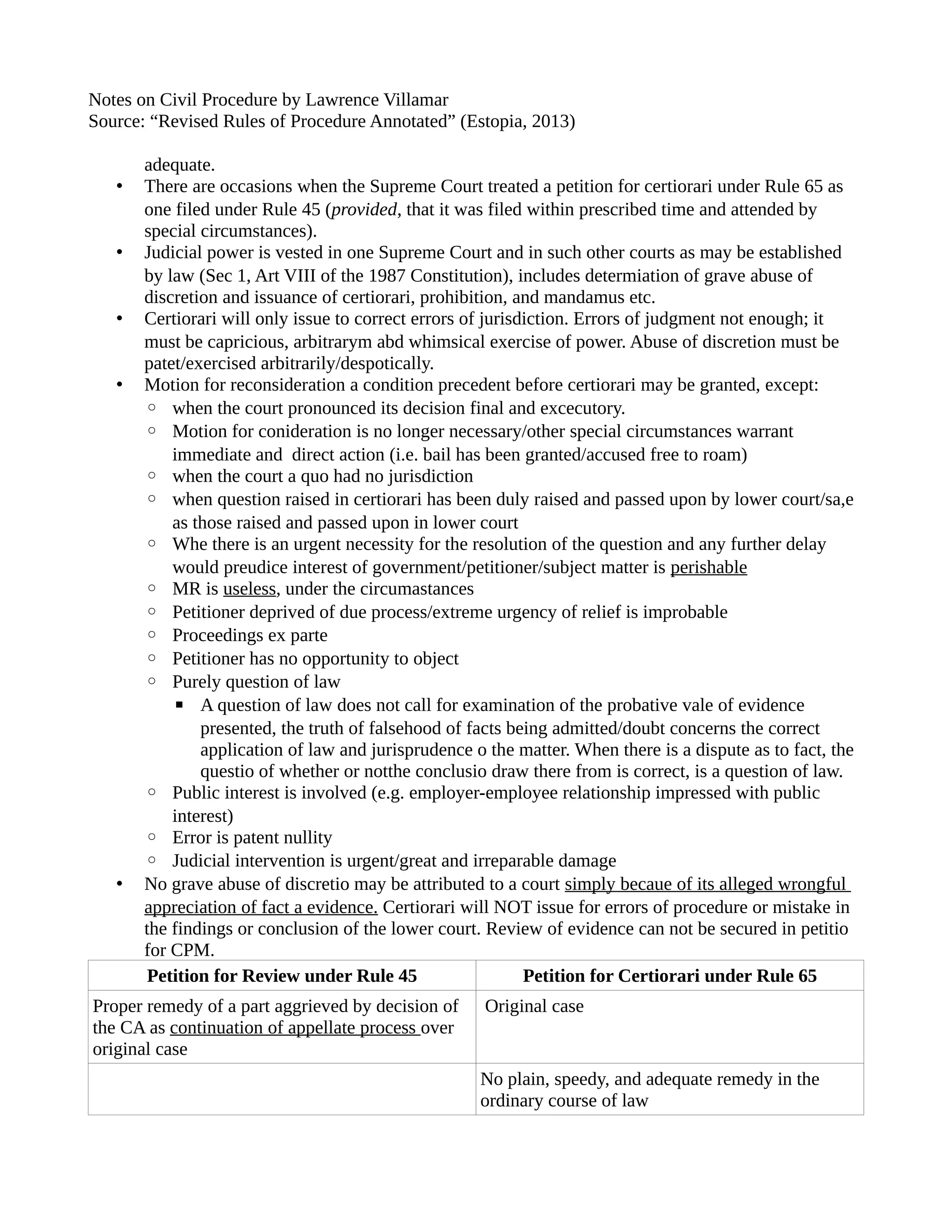
adequate. 
• There are occasions when the Supreme Court treated a petition for certiorari under Rule 65 as 
one filed under Rule 45 (provided, that it was filed within prescribed time and attended by 
special circumstances). 
• Judicial power is vested in one Supreme Court and in such other courts as may be established 
by law (Sec 1, Art VIII of the 1987 Constitution), includes determiation of grave abuse of 
discretion and issuance of certiorari, prohibition, and mandamus etc. 
• Certiorari will only issue to correct errors of jurisdiction. Errors of judgment not enough; it 
must be capricious, arbitrarym abd whimsical exercise of power. Abuse of discretion must be 
patet/exercised arbitrarily/despotically. 
• Motion for reconsideration a condition precedent before certiorari may be granted, except: 
◦ when the court pronounced its decision final and excecutory. 
◦ Motion for conideration is no longer necessary/other special circumstances warrant 
immediate and direct action (i.e. bail has been granted/accused free to roam) 
◦ when the court a quo had no jurisdiction 
◦ when question raised in certiorari has been duly raised and passed upon by lower court/sa,e 
as those raised and passed upon in lower court 
◦ Whe there is an urgent necessity for the resolution of the question and any further delay 
would preudice interest of government/petitioner/subject matter is perishable 
◦ MR is useless, under the circumastances 
◦ Petitioner deprived of due process/extreme urgency of relief is improbable 
◦ Proceedings ex parte 
◦ Petitioner has no opportunity to object 
◦ Purely question of law 
▪ A question of law does not call for examination of the probative vale of evidence 
presented, the truth of falsehood of facts being admitted/doubt concerns the correct 
application of law and jurisprudence o the matter. When there is a dispute as to fact, the 
questio of whether or notthe conclusio draw there from is correct, is a question of law. 
◦ Public interest is involved (e.g. employer-employee relationship impressed with public 
interest) 
◦ Error is patent nullity 
◦ Judicial intervention is urgent/great and irreparable damage 
• No grave abuse of discretio may be attributed to a court simply becaue of its alleged wrongful 
appreciation of fact a evidence. Certiorari will NOT issue for errors of procedure or mistake in 
the findings or conclusion of the lower court. Review of evidence can not be secured in petitio 
for CPM. 
Petition for Review under Rule 45 Petition for Certiorari under Rule 65 
Proper remedy of a part aggrieved by decision of 
the CA as continuation of appellate process over 
original case 
Original case 
No plain, speedy, and adequate remedy in the 
ordinary course of law
Notes on Civil Procedure by Lawrence Villamar 
Source: “Revised Rules of Procedure Annotated” (Estopia, 2013) 
Promptly relieves petitioner from inurious effects 
of judgments/acts of lower court/agency1 
• Interlocutory orders, if found to be with grave abuse of discretion amounting to lack or excess 
of jurisdiction, may be remedied with special civil action of certiorari under Rule 65. 
• The doctrine of hierarchy of courts is not n iro0n-clad dictum and it may be relaxed whe 
exceptional and compelling circumstance so warrant the exercise of the [Supreme Court's] 
primary jurisdiction. Technical rules on substitution of parties should not be nrrowly construed 
as to prevent the court from deciding the case on its merit. 
B. PROHIBITION 
• Requisites: 
◦ tribunal/corporation/board/an officer/person unlawfully neglects the performance of an act 
which the law specfically enjoins as duty/ unlawfully excludes another from the use or 
enjoyment of a right or office 
◦ No other plain, speedy and adequate remedy 
◦ verified petition in the proper courts alleging facts with certainty/praying judgments be 
rendered commanding the resposndent to desist from further proceedings in the action or 
matter specified therein/incidental relief 
• Grounds for petition 
◦ without or in excess of its or his jurisdiction 
◦ with grave abuse of discretion amounting to lack or excess of jurisdiction 
◦ no appeal/ any other plain, speedy and adequate remedy in the ordinary course of law 
• Certified true copy of the judgment must accompany the petition as well as copies of pertinent 
pleadings and documents, and sworn certificate of non-forum shopping (Sec 3 Rule 46) 
C. MANDAMUS 
• A mandamus will not prosper to compel a discretionary act 
◦ EXCEPTION: Instances of(1) gross abuse of discretion , manifest injustice or palpable 
excess of authority, equivalent to denia of settled right and (2) no other plain, speedy, 
adequate remedy 
• Commission with ministerial duty subject to mandamus 
◦ A purely ministerial act is one which an officer or tribunal performs in a given state of facts 
in a prescribed manner in obedience ot the mandate of legal authority WITHOUT regard to 
or the exercise of his own judgment upon propriety or impropriety of the act done. 
◦ Mandamus is the preoper remedy to compel a corporation to grant monthly salary and 
holiday pay 
◦ Mandamus is NOT the proper to compel a school to enroll a student for academic 
deficiencies because this involves the exercise by the school of discretion under academic 
freedom 
1 The grant of petition for certiorari does not stop the assailed principal proceedings, unless ith TRO or writ of prelimary 
injunction.
Notes on Civil Procedure by Lawrence Villamar 
Source: “Revised Rules of Procedure Annotated” (Estopia, 2013) 
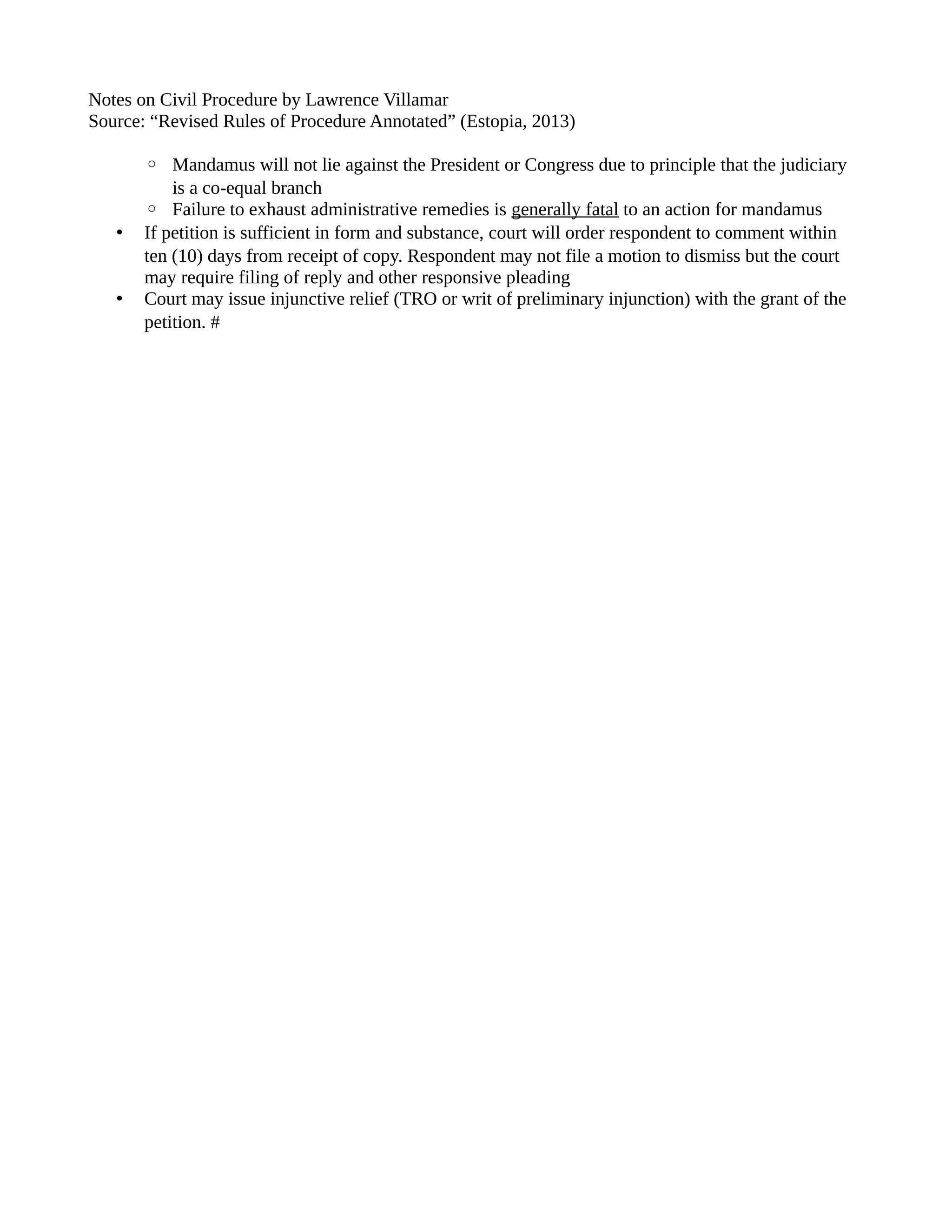
◦ Mandamus will not lie against the President or Congress due to principle that the judiciary 
is a co-equal branch 
◦ Failure to exhaust administrative remedies is generally fatal to an action for mandamus 
• If petition is sufficient in form and substance, court will order respondent to comment within 
ten (10) days from receipt of copy. Respondent may not file a motion to dismiss but the court 
may require filing of reply and other responsive pleading 
• Court may issue injunctive relief (TRO or writ of preliminary injunction) with the grant of the 
petition. #

Rules on Civil Procedure Rule 65 Certiorari

  • 1.
    Notes on CivilProcedure by Lawrence Villamar Source: “Revised Rules of Procedure Annotated” (Estopia, 2013) RULE 65 CERTIORARI, PROHIBITION, AND MANDAMUS A. CERTIORARI • WHEN to file: NOT later than 60 days from notice of judgment, order or resolution. If motion for reconsideration/new trial is filed, recokoning of reglamentary period is from notice of denial of the motion. ◦ NO extension to file the petition shall be granted except for compelling reason and in no case exceeding fifteen (15) day. (Yoche v Yoche, 2007) ◦ The period as specifically set to avoid any unreasonable delay violative of right of parties to speedy disposition. Hence, it is inextendible, except for exceptional circumstaces ot he ground of ustice and equity. • WHERE to file: If petition relates to act of MTC/corporation/board/an officer/person, filed with appropriate RTC. May also be filed with CA or Sandiganbayan; if involving quasi-judicial agency, with CA unless otherwise provided by law. In election cases (MTC/RTC), exclusively with COMELEC in aid of its appellate jurisdiction • Pertinent pleadings and documets must be attached to the petition (Sec. 1 (2), Rule 65) • FUNCTION: To keep inferior courts within the bounds of its urisdiction or to prevent it from committing such grave abue of discretion amounting to lack or excess of jurisdiction • As a rule, grant of petition for certiorari does NOT interrupt the course of the principal case, unless coupled with a TRO or writ of preliminary injunction. Public respondent to proceed within ten (10) days from filing of petition for certiorari, absent TRO or writ of preliminary injunction • Court may dismiss petition if it finds the same to be patentl without merit or prosecuted manifestly for delay or questions raised are too unsubstantial. It my impose motu propio, based on res ipsa loquitur, other disciplinar sanctions/measures on erring lawyers for patently dilatory/umeritorious petitions for certiorari. • The remedy against interlocutory resolutions of the Court of Appeals is certiorari under Rule 65 (as provided in Sec 1 (b) Rule 41) • The grant of a petition for certiorari under Rule 65 requires grave abuse of discretion amounting to lack or excess of jurisdiction. • Grave abuse of discretoion: were an an act I performed wit a capricious or whimsical exercise of judgment equivalent to lack of juridiction. Abuse must be patent and gross as to amount to an evasion of positive duty/ power is exercised in an arbitrary and despotic manner by reaon of pasion or hostility. • Question of law should be filed with Supreme Court, NOT Court of Appeals. The Supreme Court has original jurisdiction xxx over cases in wich only question of law is involved (Hanjin vs CA, 2006) • Petition for certiorari against quasi-judicial agency cognizable only by the Court of Appeals (via petition for review on certiorari, under Rule 43). • Certiorari is proper only if the party has no plai, speedy, adequate remed in the course of law. Remedies of appeal uder Rule 45 and an original action for certiorari under Rule 65 are mutually exclusive (Nippon vs CA, 2004). Certiorari is not subtitute to a lost appeal, as proscribed under Rule 45. If there are other existing remedy, it must NOT be plain, speedy and
  • 2.
    Notes on CivilProcedure by Lawrence Villamar Source: “Revised Rules of Procedure Annotated” (Estopia, 2013) adequate. • There are occasions when the Supreme Court treated a petition for certiorari under Rule 65 as one filed under Rule 45 (provided, that it was filed within prescribed time and attended by special circumstances). • Judicial power is vested in one Supreme Court and in such other courts as may be established by law (Sec 1, Art VIII of the 1987 Constitution), includes determiation of grave abuse of discretion and issuance of certiorari, prohibition, and mandamus etc. • Certiorari will only issue to correct errors of jurisdiction. Errors of judgment not enough; it must be capricious, arbitrarym abd whimsical exercise of power. Abuse of discretion must be patet/exercised arbitrarily/despotically. • Motion for reconsideration a condition precedent before certiorari may be granted, except: ◦ when the court pronounced its decision final and excecutory. ◦ Motion for conideration is no longer necessary/other special circumstances warrant immediate and direct action (i.e. bail has been granted/accused free to roam) ◦ when the court a quo had no jurisdiction ◦ when question raised in certiorari has been duly raised and passed upon by lower court/sa,e as those raised and passed upon in lower court ◦ Whe there is an urgent necessity for the resolution of the question and any further delay would preudice interest of government/petitioner/subject matter is perishable ◦ MR is useless, under the circumastances ◦ Petitioner deprived of due process/extreme urgency of relief is improbable ◦ Proceedings ex parte ◦ Petitioner has no opportunity to object ◦ Purely question of law ▪ A question of law does not call for examination of the probative vale of evidence presented, the truth of falsehood of facts being admitted/doubt concerns the correct application of law and jurisprudence o the matter. When there is a dispute as to fact, the questio of whether or notthe conclusio draw there from is correct, is a question of law. ◦ Public interest is involved (e.g. employer-employee relationship impressed with public interest) ◦ Error is patent nullity ◦ Judicial intervention is urgent/great and irreparable damage • No grave abuse of discretio may be attributed to a court simply becaue of its alleged wrongful appreciation of fact a evidence. Certiorari will NOT issue for errors of procedure or mistake in the findings or conclusion of the lower court. Review of evidence can not be secured in petitio for CPM. Petition for Review under Rule 45 Petition for Certiorari under Rule 65 Proper remedy of a part aggrieved by decision of the CA as continuation of appellate process over original case Original case No plain, speedy, and adequate remedy in the ordinary course of law
  • 3.
    Notes on CivilProcedure by Lawrence Villamar Source: “Revised Rules of Procedure Annotated” (Estopia, 2013) Promptly relieves petitioner from inurious effects of judgments/acts of lower court/agency1 • Interlocutory orders, if found to be with grave abuse of discretion amounting to lack or excess of jurisdiction, may be remedied with special civil action of certiorari under Rule 65. • The doctrine of hierarchy of courts is not n iro0n-clad dictum and it may be relaxed whe exceptional and compelling circumstance so warrant the exercise of the [Supreme Court's] primary jurisdiction. Technical rules on substitution of parties should not be nrrowly construed as to prevent the court from deciding the case on its merit. B. PROHIBITION • Requisites: ◦ tribunal/corporation/board/an officer/person unlawfully neglects the performance of an act which the law specfically enjoins as duty/ unlawfully excludes another from the use or enjoyment of a right or office ◦ No other plain, speedy and adequate remedy ◦ verified petition in the proper courts alleging facts with certainty/praying judgments be rendered commanding the resposndent to desist from further proceedings in the action or matter specified therein/incidental relief • Grounds for petition ◦ without or in excess of its or his jurisdiction ◦ with grave abuse of discretion amounting to lack or excess of jurisdiction ◦ no appeal/ any other plain, speedy and adequate remedy in the ordinary course of law • Certified true copy of the judgment must accompany the petition as well as copies of pertinent pleadings and documents, and sworn certificate of non-forum shopping (Sec 3 Rule 46) C. MANDAMUS • A mandamus will not prosper to compel a discretionary act ◦ EXCEPTION: Instances of(1) gross abuse of discretion , manifest injustice or palpable excess of authority, equivalent to denia of settled right and (2) no other plain, speedy, adequate remedy • Commission with ministerial duty subject to mandamus ◦ A purely ministerial act is one which an officer or tribunal performs in a given state of facts in a prescribed manner in obedience ot the mandate of legal authority WITHOUT regard to or the exercise of his own judgment upon propriety or impropriety of the act done. ◦ Mandamus is the preoper remedy to compel a corporation to grant monthly salary and holiday pay ◦ Mandamus is NOT the proper to compel a school to enroll a student for academic deficiencies because this involves the exercise by the school of discretion under academic freedom 1 The grant of petition for certiorari does not stop the assailed principal proceedings, unless ith TRO or writ of prelimary injunction.
  • 4.
    Notes on CivilProcedure by Lawrence Villamar Source: “Revised Rules of Procedure Annotated” (Estopia, 2013) ◦ Mandamus will not lie against the President or Congress due to principle that the judiciary is a co-equal branch ◦ Failure to exhaust administrative remedies is generally fatal to an action for mandamus • If petition is sufficient in form and substance, court will order respondent to comment within ten (10) days from receipt of copy. Respondent may not file a motion to dismiss but the court may require filing of reply and other responsive pleading • Court may issue injunctive relief (TRO or writ of preliminary injunction) with the grant of the petition. #