
Discussion on Basics of Writ Petitions.
Writ
Petitions

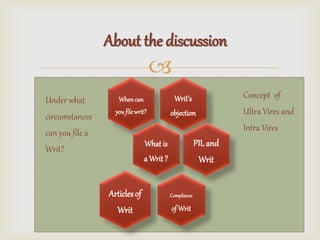
Writ’s
objection
Concept of
Ultra Vires and
Intra Vires
Whencan
you file writ?
What is
a Writ ?
PIL and
Writ
Compliance
of Writ
Under what
circumstances
can you file a
Writ?
Articlesof
Writ
About the discussion

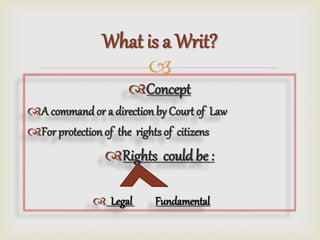
What is a Writ?
Concept
A command or a direction by Court of Law
For protection of the rights of citizens
Rights could be :
 Legal Fundamental

 In the case of State of Rajasthan v Union of India, the Supreme Court stated
that “Legal rights in the strict sense are correlatives of legal duties and legal
rights are defined as the interests which the law protects by imposing duties
on other persons. But the legal right in the strict sense means right is the
immunity from the legal power of another. Immunity is no subjection at all”.
Eg: Every person has a right to live in a clean environment, and
hence no person should contaminate the same.
What are Legal rights?

 Fundamental rights are those rights which are essential for intellectual,
moral and spiritual development of individuals.
 As these rights are fundamental or essential for existence and all-round
development of individuals, hence, it's called as 'Fundamental' rights.
 These Fundamental rights are divided into seven categories which are
covered from Article 12 till Article 35 of the Indian Constitution.
What are Fundamental Rights?

 Legal rights are protected by the ordinary law
 Legal rights can be taken away by the legislature by changing that law
 Fundamental rights are protected and guaranteed by the Constitution.
Reasonable restrictions mayhoweverbe imposed bythe Legislature.
 If a legal right of a person is violated, such person can move to the concerned
authority/court as provided for in the relevant statute.
 When a fundamental right is violated the Constitution provides that the
affected person may move to the Supreme Court or the High Court.
Difference between Legal and Fundamental
rights

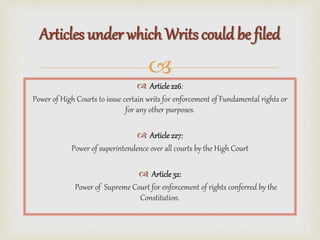
 Article 226:
Power of High Courts to issue certain writs for enforcement of Fundamental rights or
for any other purposes.
 Article 227:
Power of superintendence over all courts by the High Court
 Article 32:
Power of Supreme Court for enforcement of rights conferred by the
Constitution.
Articles under which Writs could be filed

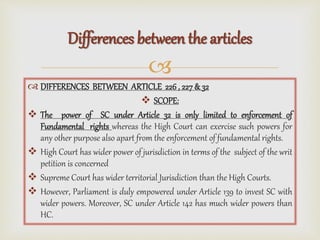
 DIFFERENCES BETWEEN ARTICLE 226 , 227& 32
 SCOPE:
 The power of SC under Article 32 is only limited to enforcement of
Fundamental rights whereas the High Court can exercise such powers for
any other purpose also apart from the enforcement of fundamental rights.
 High Court has wider power of jurisdiction in terms of the subject of the writ
petition is concerned
 Supreme Court has wider territorial Jurisdiction than the High Courts.
 However, Parliament is duly empowered under Article 139 to invest SC with
wider powers. Moreover, SC under Article 142 has much wider powers than
HC.
Differences between the articles

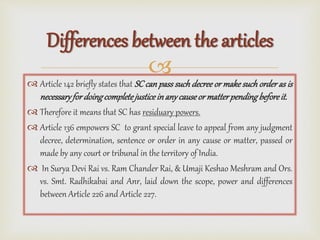
 Article 142 briefly states that SC can pass such decree or make such order as is
necessaryfor doingcompletejusticeinanycauseor matterpendingbeforeit.
 Therefore it means that SC has residuary powers.
 Article 136 empowers SC to grant special leave to appeal from any judgment
decree, determination, sentence or order in any cause or matter, passed or
made by any court or tribunal in the territory of India.
 In Surya Devi Rai vs. Ram Chander Rai, & Umaji Keshao Meshram and Ors.
vs. Smt. Radhikabai and Anr, laid down the scope, power and differences
between Article 226 and Article 227.
Differences between the articles

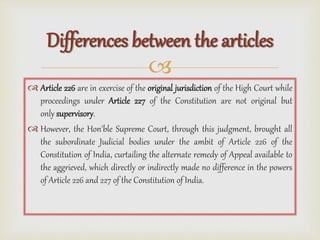
 Article 226 are in exercise of the original jurisdiction of the High Court while
proceedings under Article 227 of the Constitution are not original but
only supervisory.
 However, the Hon'ble Supreme Court, through this judgment, brought all
the subordinate Judicial bodies under the ambit of Article 226 of the
Constitution of India, curtailing the alternate remedy of Appeal available to
the aggrieved, which directly or indirectly made no difference in the powers
of Article 226 and 227 of the Constitution of India.
Differences between the articles

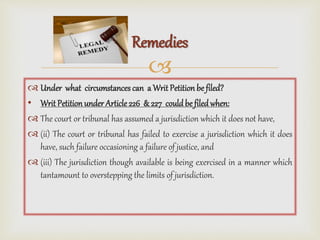
 Under what circumstances can a Writ Petition be filed?
• Writ Petitionunder Article 226 & 227 couldbe filedwhen:
 The court or tribunal has assumed a jurisdiction which it does not have,
 (ii) The court or tribunal has failed to exercise a jurisdiction which it does
have, such failure occasioning a failure of justice, and
 (iii) The jurisdiction though available is being exercised in a manner which
tantamount to overstepping the limits of jurisdiction.
Remedies

 Under what circumstancescan a writ be filedunder Article 32?
 Article 32 of the Indian Constitution gives the right to individuals to move to
the Supreme Court to seek justice when they feel that their right has been
‘unduly deprived’.
 The nature of Writ Jurisdiction provided under this Article is discretionary.
There are five important factors for guiding this discretion.
 A) Locus Standi b) Alternative Relief c) Res Judicata d) Questions of the
Fact e) Laches
Remedies

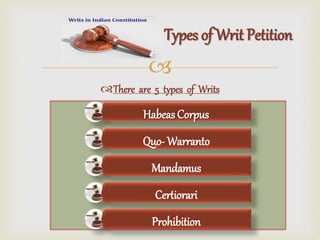
There are 5 types of Writs
Types of Writ Petition
Habeas Corpus
Quo- Warranto
Mandamus
Certiorari
Prohibition

 Writs are written in Latin Language
HabesCorpus means:
You must have the body
By this writ the court directs the person or authority who has detained
another person to bring the body of the prisoner before the court so as to
enable the court to decide the validity , jurisdiction or justification for such
detention.
Under Art. 22, a person arrested is required to be produced before a
magistrate within 24 hours of his arrest , and failure to do so would entitle the
arrested person to be released .
Characteristics of Writs

 Quo Warrantomeans:
 what is your authority
 used to judicially control executive action in the matter of making
appointments to public offices under relevant statutory provisions.
 protect a citizen from the holder of a public office to which he has no right .
 the necessary ingredients to be satisfied by the court before issuing a writ is
that the office in question must be public, created by the constitution or a
law and the person holding the office is not legally qualified to hold the office
in clear infringements of provisions of the constitution or the law .
Characteristics of Writs

 Mandamus means:
 Mandamus is a command issued by a court to an authority directing it to
perform a public duty imposed upon it by law .
 For example, when a body omits to decide a matter which it is bound to
decide, it can be commanded to decide the same.
 In Bombay municipality v. Advance Builders, the court directed the
municipality to implement a planning scheme which was prepared by it and
approved by the Government under the relevant statute but on which no
action was taken for a considerable time.
Characteristics of Writs

 . Certiorari :
 Designed to prevent the excess of power by public authorities
 Certiorari under Art. 226 is issued for correcting gross error of jurisdiction i.e.
when a subordinate court is found to have acted (1) without jurisdiction or by
assuming jurisdiction where there exists none , or
 (2) in excess of its jurisdiction by over stepping or crossing the limits of
jurisdiction or
 (3) acting in flagrant disregard of law or rules of procedure or acting in
violation of principles of natural justice where there is no procedure specified
and thereby occasioning failure of justice.
 (4) Petition can be filed after the decree or judgment has been passed.
Characteristics of Writs

 Prohibition:
 A writ of prohibition is normally issued when inferior court or tribunal
 (a) proceeds to act without jurisdiction or in excess of jurisdiction
 (b) proceeds to act in violation of rules of natural justice or
 (c) proceeds to act under a law which is itself ultra vires or unconstitutional
or
 (d) proceeds to act in contravention of fundamental rights.
 (e) Petition has to be filed before the decree or judgment is passed.
Characteristics of Writs

 The Latin phrase intra vires means "inside the powers," and it's often used to
contrast something that's ultravires, "outside the powers.“
 The doctrine of ultra vires envisages that an authority can exercise only so
much power as is conferred on it by law.
 An action of the authority is intra vires when it falls within the limits of the
power conferred on it but ultra vires if it goes outside this limit.
Doctrine of Intra Vires, Ultra Vires with
Article 13, 245 and 246

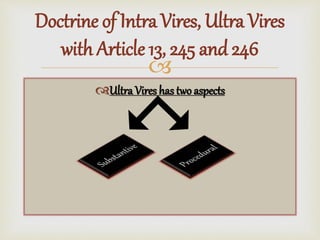
Ultra Vires has two aspects
Doctrine of Intra Vires, Ultra Vires
with Article 13, 245 and 246

 Constitution has overriding effect over all the other laws.
 If enabling or parent act is void and subordinate or delegated legislation made
under the act will also be declared to be unconstitutional and therefore void.
 Article 13(1) (2) and (3) provides that all laws in force in the territory of India in so
far as they are inconsistent with the provisions of Part III (fundamental rights) shall,
to the extent of the contravention, be void.
 No law made by Parliament shall be deemed to be invalid on the ground that it
would have extra territorial operation. However, the law made by the state
legislature may be challenged on the ground of extra territorial operation.
Grounds on which Delegated Legislation may be
challenged!

 Article 246 makes provisions in respect of the distribution of powers between
the powers between the Parliament and the State legislatures.
 From article 246 and the seventh schedule, it becomes clear that the subjects
have been divided into three categories –
 Union list,
 State list and
 Concurrent list.
The Seventh Schedule & Doctrine of
Delegated Legislation

 In S.T.O. v. Abraham the Act empowered the Government to carry out the purposes of the
Act the Government made rule so as to fix the last date for filing the declaration forms by
dealers for getting the benefit of concessional rates on inter-State sales.
 This rule was held to be ultra vires the Enabling Act on the ground that the Act empowered
the Government for making rules for prescribing the particulars to be mentioned in the
forms and it was not given power to prescribe a time-limit for filling the form.
 Thus, to draw conclusion it can be said that if the subordinate or delegated legislation goes
beyond the scope of authority concerned on the delegate or it is in conflict with the Parent or
Enabling Act, it is called substantive ultra vires. The validity of the subordinate or delegated
legislation may be challenged before the Courts on this ground.
When it is made in excess of the power
conferred by the Enabling or Parent Act:

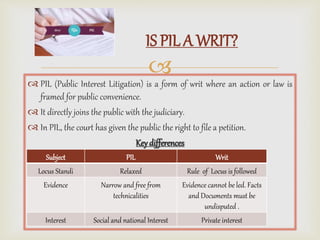
 PIL (Public Interest Litigation) is a form of writ where an action or law is
framed for public convenience.
 It directly joins the public with the judiciary.
 In PIL, the court has given the public the right to file a petition.
Key differences
IS PIL A WRIT?
Subject PIL Writ
Locus Standi Relaxed Rule of Locus is followed
Evidence Narrow and free from
technicalities
Evidence cannot be led. Facts
and Documents must be
undisputed .
Interest Social and national Interest Private interest

 http://www.legalserviceindia.com/legal/article-68-types-of-writs-in-
indian-constitution.html
 https://blog.ipleaders.in/writs/
 https://blog.ipleaders.in/writs-under-the-constitution/
 https://www.youtube.com/watch?v=iWFJGwZcm7k
Research Bibliography
Writ petitions revised

Writ petitions revised

  • 1.
     Discussion on Basicsof Writ Petitions. Writ Petitions
  • 2.
     Writ’s objection Concept of Ultra Viresand Intra Vires Whencan you file writ? What is a Writ ? PIL and Writ Compliance of Writ Under what circumstances can you file a Writ? Articlesof Writ About the discussion
  • 3.
     What is aWrit? Concept A command or a direction by Court of Law For protection of the rights of citizens Rights could be :  Legal Fundamental
  • 4.
      In thecase of State of Rajasthan v Union of India, the Supreme Court stated that “Legal rights in the strict sense are correlatives of legal duties and legal rights are defined as the interests which the law protects by imposing duties on other persons. But the legal right in the strict sense means right is the immunity from the legal power of another. Immunity is no subjection at all”. Eg: Every person has a right to live in a clean environment, and hence no person should contaminate the same. What are Legal rights?
  • 5.
      Fundamental rightsare those rights which are essential for intellectual, moral and spiritual development of individuals.  As these rights are fundamental or essential for existence and all-round development of individuals, hence, it's called as 'Fundamental' rights.  These Fundamental rights are divided into seven categories which are covered from Article 12 till Article 35 of the Indian Constitution. What are Fundamental Rights?
  • 6.
      Legal rightsare protected by the ordinary law  Legal rights can be taken away by the legislature by changing that law  Fundamental rights are protected and guaranteed by the Constitution. Reasonable restrictions mayhoweverbe imposed bythe Legislature.  If a legal right of a person is violated, such person can move to the concerned authority/court as provided for in the relevant statute.  When a fundamental right is violated the Constitution provides that the affected person may move to the Supreme Court or the High Court. Difference between Legal and Fundamental rights
  • 7.
      Article 226: Powerof High Courts to issue certain writs for enforcement of Fundamental rights or for any other purposes.  Article 227: Power of superintendence over all courts by the High Court  Article 32: Power of Supreme Court for enforcement of rights conferred by the Constitution. Articles under which Writs could be filed
  • 8.
      DIFFERENCES BETWEENARTICLE 226 , 227& 32  SCOPE:  The power of SC under Article 32 is only limited to enforcement of Fundamental rights whereas the High Court can exercise such powers for any other purpose also apart from the enforcement of fundamental rights.  High Court has wider power of jurisdiction in terms of the subject of the writ petition is concerned  Supreme Court has wider territorial Jurisdiction than the High Courts.  However, Parliament is duly empowered under Article 139 to invest SC with wider powers. Moreover, SC under Article 142 has much wider powers than HC. Differences between the articles
  • 9.
      Article 142briefly states that SC can pass such decree or make such order as is necessaryfor doingcompletejusticeinanycauseor matterpendingbeforeit.  Therefore it means that SC has residuary powers.  Article 136 empowers SC to grant special leave to appeal from any judgment decree, determination, sentence or order in any cause or matter, passed or made by any court or tribunal in the territory of India.  In Surya Devi Rai vs. Ram Chander Rai, & Umaji Keshao Meshram and Ors. vs. Smt. Radhikabai and Anr, laid down the scope, power and differences between Article 226 and Article 227. Differences between the articles
  • 10.
      Article 226are in exercise of the original jurisdiction of the High Court while proceedings under Article 227 of the Constitution are not original but only supervisory.  However, the Hon'ble Supreme Court, through this judgment, brought all the subordinate Judicial bodies under the ambit of Article 226 of the Constitution of India, curtailing the alternate remedy of Appeal available to the aggrieved, which directly or indirectly made no difference in the powers of Article 226 and 227 of the Constitution of India. Differences between the articles
  • 11.
      Under whatcircumstances can a Writ Petition be filed? • Writ Petitionunder Article 226 & 227 couldbe filedwhen:  The court or tribunal has assumed a jurisdiction which it does not have,  (ii) The court or tribunal has failed to exercise a jurisdiction which it does have, such failure occasioning a failure of justice, and  (iii) The jurisdiction though available is being exercised in a manner which tantamount to overstepping the limits of jurisdiction. Remedies
  • 12.
      Under whatcircumstancescan a writ be filedunder Article 32?  Article 32 of the Indian Constitution gives the right to individuals to move to the Supreme Court to seek justice when they feel that their right has been ‘unduly deprived’.  The nature of Writ Jurisdiction provided under this Article is discretionary. There are five important factors for guiding this discretion.  A) Locus Standi b) Alternative Relief c) Res Judicata d) Questions of the Fact e) Laches Remedies
  • 13.
     There are 5types of Writs Types of Writ Petition Habeas Corpus Quo- Warranto Mandamus Certiorari Prohibition
  • 14.
      Writs arewritten in Latin Language HabesCorpus means: You must have the body By this writ the court directs the person or authority who has detained another person to bring the body of the prisoner before the court so as to enable the court to decide the validity , jurisdiction or justification for such detention. Under Art. 22, a person arrested is required to be produced before a magistrate within 24 hours of his arrest , and failure to do so would entitle the arrested person to be released . Characteristics of Writs
  • 15.
      Quo Warrantomeans: what is your authority  used to judicially control executive action in the matter of making appointments to public offices under relevant statutory provisions.  protect a citizen from the holder of a public office to which he has no right .  the necessary ingredients to be satisfied by the court before issuing a writ is that the office in question must be public, created by the constitution or a law and the person holding the office is not legally qualified to hold the office in clear infringements of provisions of the constitution or the law . Characteristics of Writs
  • 16.
      Mandamus means: Mandamus is a command issued by a court to an authority directing it to perform a public duty imposed upon it by law .  For example, when a body omits to decide a matter which it is bound to decide, it can be commanded to decide the same.  In Bombay municipality v. Advance Builders, the court directed the municipality to implement a planning scheme which was prepared by it and approved by the Government under the relevant statute but on which no action was taken for a considerable time. Characteristics of Writs
  • 17.
      . Certiorari:  Designed to prevent the excess of power by public authorities  Certiorari under Art. 226 is issued for correcting gross error of jurisdiction i.e. when a subordinate court is found to have acted (1) without jurisdiction or by assuming jurisdiction where there exists none , or  (2) in excess of its jurisdiction by over stepping or crossing the limits of jurisdiction or  (3) acting in flagrant disregard of law or rules of procedure or acting in violation of principles of natural justice where there is no procedure specified and thereby occasioning failure of justice.  (4) Petition can be filed after the decree or judgment has been passed. Characteristics of Writs
  • 18.
      Prohibition:  Awrit of prohibition is normally issued when inferior court or tribunal  (a) proceeds to act without jurisdiction or in excess of jurisdiction  (b) proceeds to act in violation of rules of natural justice or  (c) proceeds to act under a law which is itself ultra vires or unconstitutional or  (d) proceeds to act in contravention of fundamental rights.  (e) Petition has to be filed before the decree or judgment is passed. Characteristics of Writs
  • 19.
      The Latinphrase intra vires means "inside the powers," and it's often used to contrast something that's ultravires, "outside the powers.“  The doctrine of ultra vires envisages that an authority can exercise only so much power as is conferred on it by law.  An action of the authority is intra vires when it falls within the limits of the power conferred on it but ultra vires if it goes outside this limit. Doctrine of Intra Vires, Ultra Vires with Article 13, 245 and 246
  • 20.
     Ultra Vires hastwo aspects Doctrine of Intra Vires, Ultra Vires with Article 13, 245 and 246
  • 21.
      Constitution hasoverriding effect over all the other laws.  If enabling or parent act is void and subordinate or delegated legislation made under the act will also be declared to be unconstitutional and therefore void.  Article 13(1) (2) and (3) provides that all laws in force in the territory of India in so far as they are inconsistent with the provisions of Part III (fundamental rights) shall, to the extent of the contravention, be void.  No law made by Parliament shall be deemed to be invalid on the ground that it would have extra territorial operation. However, the law made by the state legislature may be challenged on the ground of extra territorial operation. Grounds on which Delegated Legislation may be challenged!
  • 22.
      Article 246makes provisions in respect of the distribution of powers between the powers between the Parliament and the State legislatures.  From article 246 and the seventh schedule, it becomes clear that the subjects have been divided into three categories –  Union list,  State list and  Concurrent list. The Seventh Schedule & Doctrine of Delegated Legislation
  • 23.
      In S.T.O.v. Abraham the Act empowered the Government to carry out the purposes of the Act the Government made rule so as to fix the last date for filing the declaration forms by dealers for getting the benefit of concessional rates on inter-State sales.  This rule was held to be ultra vires the Enabling Act on the ground that the Act empowered the Government for making rules for prescribing the particulars to be mentioned in the forms and it was not given power to prescribe a time-limit for filling the form.  Thus, to draw conclusion it can be said that if the subordinate or delegated legislation goes beyond the scope of authority concerned on the delegate or it is in conflict with the Parent or Enabling Act, it is called substantive ultra vires. The validity of the subordinate or delegated legislation may be challenged before the Courts on this ground. When it is made in excess of the power conferred by the Enabling or Parent Act:
  • 24.
      PIL (PublicInterest Litigation) is a form of writ where an action or law is framed for public convenience.  It directly joins the public with the judiciary.  In PIL, the court has given the public the right to file a petition. Key differences IS PIL A WRIT? Subject PIL Writ Locus Standi Relaxed Rule of Locus is followed Evidence Narrow and free from technicalities Evidence cannot be led. Facts and Documents must be undisputed . Interest Social and national Interest Private interest
  • 25.
      http://www.legalserviceindia.com/legal/article-68-types-of-writs-in- indian-constitution.html  https://blog.ipleaders.in/writs/ https://blog.ipleaders.in/writs-under-the-constitution/  https://www.youtube.com/watch?v=iWFJGwZcm7k Research Bibliography