Trespass to Immovable
Property
Under the Guidance
of
Shri. Srinivas C. P.
Asst. Prof.
Presented By - Jagannath R. Ramapur
Trespass
It is a breach of primary duty fixed by law other
than contract for which remedy is unliquidated
damages.
Tort
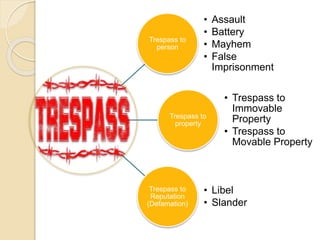
Trespass to
person
• Assault
• Battery
• Mayhem
• False
Imprisonment
Trespass to
property
• Trespass to
Immovable
Property
• Trespass to
Movable Property
Trespass to
Reputation
(Defamation)
• Libel
• Slander
(I) Trespass
to
land
(A) Essential to constitute to trespass
 Trespass by unlawful entry
 Trespass by remaining on land
 Trespass by placing things on land or
by doing an act affecting the sole of
possession of the plaintiff land
 In each case without justification.
1. Trespass by unlawful entry.
 It is the most common mode of
trespass.
 For this slightest entry of the defendant
is sufficient.
 Eg. Complete entry, sitting on wall.
2. Trespass by remaining on land.
 Sometime a person has permission to
entre for certain time.
 But if he remains on the land after his
right to entry ceased;
 Causes trespass.
3. Trespass by placing things on
land or by doing an act affecting
the sole possession
 It is trespass caused not by actual
entry; but by placing or crossing
some physical things on another’s
property.
 Eg. Driving nail into plaintiff’s wall,
throwing stone or rubbish over his
property.
Essential elements for trespass
 “entry” is essential.
 entry by an unauthorized person.
 intentional entry or entry by mistake.
 aerial or underground trespass.
 If a person enters lawfully, remains
there after his right is ceased - liable
 constructive trespass.
What plaintiff has to prove?
In an action of trespass, plaintiff must prove
following things.
1. Plaintiff - in actual possession - land at - time
of trespass. Where - mere user of the land
- not sufficient. Lawful or unlawful possession
- immaterial.
2. direct interference with - possession of his
land- no need to show actual loss or
damage.
(B) Aerial Trespass
 The column of air space above the surface ad
infinitum.
 The owner of everything up to the sky and
down to the centre of the earth.
 the owner’s right to air and space above his
land is restricted to such height as it necessary
for the ordinary use and enjoyment of his land
 Kelson v. Imperial Tobacco Co. Ltd. –
Advertising sign – plaintiff –single-storey shop.-
defendant – nuisance – court held – Trespass to
airspace.
 Every continuance of a trespass is a
fresh trespass.
 An action may be brought in respect
of it.
(C) Continuing Trespass
(D) Trespass by joint-owners
 Joint-tenants or tenants-in-common can
only sue one another in trespass
 For acts done by one inconsistent with
the rights of the other.
 Ex. Destruction of a building, carrying
away of soil etc.
(E) Trespass by animals
 Trespass by a man’s cattle is dealt
with similar to trespass committed by
himself.
 The owner of the animal is
responsible for the trespass and
consequential damage.
 Ellis v. Leftus Iron Co. – Injury by
horse- defendant’s horse- injured –
plaintiff – biting and kicking her
through an iron fence - belong – liable
- no negligence.
Following remedies are available to the plaintiff.
 Plaintiff can file suit against defendant for
injunction restraining him from doing and
repeating the act of trespass.
 Plaintiff can file suit against defendant
claiming damages. Other remedies like
declaration of right, possession, expulsion
may be claimed along with injunction and
damages. Forcibly eject him.
 Distress damage feasant – remedy –
damage done by cattle or other things –
seize them –without legal process.
(F) Remedies to plaintiff
(G) Defenses
Defenses available to defendant
In an action for trespass, defendant has
following defenses.
 Prescription- Defendant may plead that he was
justified by his right by way of prescription.
 Leave and license – It is also considered as
consent. This defense can be used for those
acts which will be lawful with consent. Where
plaintiff has consented for the entry of
defendant; he cannot complain.
 Authority of law - if the entry of the defendant is
warranted by lawful authority, he not
answerable.
 Act of necessity – if the act done by the
defendant is under necessity, if may not be
liable.
 Self defense – if defendant does
trespass for safety of himself, property,
goods or animals; he may not be liable.
Re entry on land – if defendant has been
dispossessed from his land then if tries
for re entry over such land; he is not
liable for trespass.
Abatement of nuisance - if defendant is
doing for abatement of nuisance; in
peaceful manner and without danger to
life and limb; he is not liable for trespass.
(G) Defenses
 Some time a person enters over
another’s property with some authority or
consent. By later, he does some thing or
abuses or goes beyond such permission
to him, he will be liable for trespass only.
But if a person enters the land of another
under the authority of some law but then
abuses his authority by doing some
wrongful act , then he will be treated as
trespasser ab initio i.e. he will be treated
as trespasser from the beginning
(II) Trespass ab initio
 entered the plaintiff’s inn wine and
bread there. refused to pay for wine
and bread when so asked.
Suit by plff for trespass ab initio.
Held - non payment was an omission to
do - non feasance
Six carpenter’s case (vaux v.
Newman)
Six carpenter’s case (vaux v.
Newman)
In this case, court laid down three
points
 If a man abuses his authority given to
him by law, he become a trespasser
ab initio.
In an action of trespass, if the
authority be pleaded then subsequent
abuse may be replied.
A mere non feasance does not
amount to such an abuse as renders a
It is applicable only where the entry is
authorized under any law.
It is applicable only in cases of mis
feasance and not for non feasance.
It is not applicable where entry can be
justified on other ground.
It is less applicable in the present
time.
Limitation to trespass ab initio
Thank you

Trespass to land

  • 1.
    Trespass to Immovable Property Underthe Guidance of Shri. Srinivas C. P. Asst. Prof. Presented By - Jagannath R. Ramapur
  • 2.
    Trespass It is abreach of primary duty fixed by law other than contract for which remedy is unliquidated damages. Tort
  • 3.
    Trespass to person • Assault •Battery • Mayhem • False Imprisonment Trespass to property • Trespass to Immovable Property • Trespass to Movable Property Trespass to Reputation (Defamation) • Libel • Slander
  • 4.
  • 5.
    (A) Essential toconstitute to trespass  Trespass by unlawful entry  Trespass by remaining on land  Trespass by placing things on land or by doing an act affecting the sole of possession of the plaintiff land  In each case without justification.
  • 6.
    1. Trespass byunlawful entry.  It is the most common mode of trespass.  For this slightest entry of the defendant is sufficient.  Eg. Complete entry, sitting on wall.
  • 7.
    2. Trespass byremaining on land.  Sometime a person has permission to entre for certain time.  But if he remains on the land after his right to entry ceased;  Causes trespass.
  • 8.
    3. Trespass byplacing things on land or by doing an act affecting the sole possession  It is trespass caused not by actual entry; but by placing or crossing some physical things on another’s property.  Eg. Driving nail into plaintiff’s wall, throwing stone or rubbish over his property.
  • 9.
    Essential elements fortrespass  “entry” is essential.  entry by an unauthorized person.  intentional entry or entry by mistake.  aerial or underground trespass.  If a person enters lawfully, remains there after his right is ceased - liable  constructive trespass.
  • 10.
    What plaintiff hasto prove? In an action of trespass, plaintiff must prove following things. 1. Plaintiff - in actual possession - land at - time of trespass. Where - mere user of the land - not sufficient. Lawful or unlawful possession - immaterial. 2. direct interference with - possession of his land- no need to show actual loss or damage.
  • 11.
    (B) Aerial Trespass The column of air space above the surface ad infinitum.  The owner of everything up to the sky and down to the centre of the earth.  the owner’s right to air and space above his land is restricted to such height as it necessary for the ordinary use and enjoyment of his land  Kelson v. Imperial Tobacco Co. Ltd. – Advertising sign – plaintiff –single-storey shop.- defendant – nuisance – court held – Trespass to airspace.
  • 12.
     Every continuanceof a trespass is a fresh trespass.  An action may be brought in respect of it. (C) Continuing Trespass (D) Trespass by joint-owners  Joint-tenants or tenants-in-common can only sue one another in trespass  For acts done by one inconsistent with the rights of the other.  Ex. Destruction of a building, carrying away of soil etc.
  • 13.
    (E) Trespass byanimals  Trespass by a man’s cattle is dealt with similar to trespass committed by himself.  The owner of the animal is responsible for the trespass and consequential damage.  Ellis v. Leftus Iron Co. – Injury by horse- defendant’s horse- injured – plaintiff – biting and kicking her through an iron fence - belong – liable - no negligence.
  • 14.
    Following remedies areavailable to the plaintiff.  Plaintiff can file suit against defendant for injunction restraining him from doing and repeating the act of trespass.  Plaintiff can file suit against defendant claiming damages. Other remedies like declaration of right, possession, expulsion may be claimed along with injunction and damages. Forcibly eject him.  Distress damage feasant – remedy – damage done by cattle or other things – seize them –without legal process. (F) Remedies to plaintiff
  • 15.
    (G) Defenses Defenses availableto defendant In an action for trespass, defendant has following defenses.  Prescription- Defendant may plead that he was justified by his right by way of prescription.  Leave and license – It is also considered as consent. This defense can be used for those acts which will be lawful with consent. Where plaintiff has consented for the entry of defendant; he cannot complain.  Authority of law - if the entry of the defendant is warranted by lawful authority, he not answerable.  Act of necessity – if the act done by the defendant is under necessity, if may not be liable.
  • 16.
     Self defense– if defendant does trespass for safety of himself, property, goods or animals; he may not be liable. Re entry on land – if defendant has been dispossessed from his land then if tries for re entry over such land; he is not liable for trespass. Abatement of nuisance - if defendant is doing for abatement of nuisance; in peaceful manner and without danger to life and limb; he is not liable for trespass. (G) Defenses
  • 17.
     Some timea person enters over another’s property with some authority or consent. By later, he does some thing or abuses or goes beyond such permission to him, he will be liable for trespass only. But if a person enters the land of another under the authority of some law but then abuses his authority by doing some wrongful act , then he will be treated as trespasser ab initio i.e. he will be treated as trespasser from the beginning (II) Trespass ab initio
  • 19.
     entered theplaintiff’s inn wine and bread there. refused to pay for wine and bread when so asked. Suit by plff for trespass ab initio. Held - non payment was an omission to do - non feasance Six carpenter’s case (vaux v. Newman)
  • 20.
    Six carpenter’s case(vaux v. Newman) In this case, court laid down three points  If a man abuses his authority given to him by law, he become a trespasser ab initio. In an action of trespass, if the authority be pleaded then subsequent abuse may be replied. A mere non feasance does not amount to such an abuse as renders a
  • 21.
    It is applicableonly where the entry is authorized under any law. It is applicable only in cases of mis feasance and not for non feasance. It is not applicable where entry can be justified on other ground. It is less applicable in the present time. Limitation to trespass ab initio
  • 22.