Downloaded 534 times
![Object of specific relief:
The main object of specific relief is to discourage people from taking law
into their own hands. It provides summary and speedy remedy through a
medium of civil court,
Features of specific relief:
(i) Specific relief is granted under the principles of equity.
(ii) Its basic purpose is to give a very thing to a person who is entitled for it.
(iii) The defaulting party is compelled to do or to omit the very act which he
has undertaken to do or to omit.
Part II of the Specific Relict, Chapter I of Recovering
Possession of Property:
a) Possession of Immovable Property
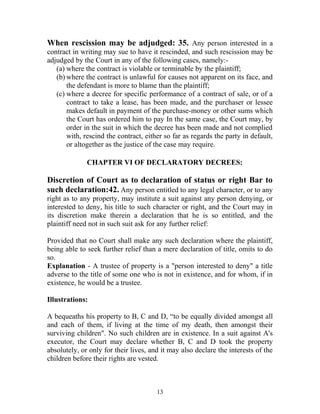
Recovery of specific immoveable property: 8. A person entitled to
the possession of specific immoveable property may recover it in the manner
prescribed by the Code of Civil Procedure
CHAPTER II OF THE SPECIFIC PERFORMANCE OF
CONTRACTS
(a) Contracts which may be specifically enforce
Cases in which specific performance enforceable:12. Except as
otherwise provided in this Chapter, the specific performance of any contract
may in the discretion of the Court be enforced
(a) when the act agreed to be done is in the performance, wholly or
partly, of a trust;
(b)when there] exists no standard for ascertaining the actual damage
caused by non-performance of the act agreed to be done;
3](https://image.slidesharecdn.com/southeastuniversity-130917122539-phpapp01/85/Specific-Releif-Act-1877-3-320.jpg)
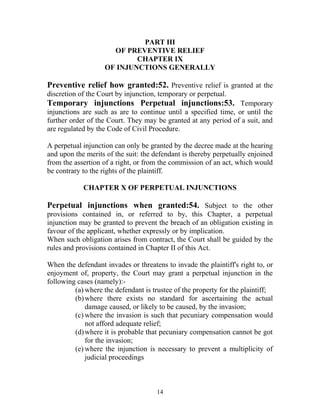
![Explanation - For the purpose of this section a trademark is property.
Illustration:
A lets certain lands to B and B contracts not to dig sand or gravel there out.
A may sue for an injunction to restrain B from digging in violation of his
contract.
Mandatory injunctions:55. When, to prevent the breach of an
obligation, it is necessary to compel the performance of certain acts which
the Court is capable of enforcing, the Court may in its discretion grant an
injunction to prevent the breach complained of, and also to compel
performance of the requisite acts.
Illustration:
A threaten to publish statement concerning B which would be punishable
under Chapter XXI of the Penal Code]. The Court may grant an injunction to
restrain the publication, even though it may be shown not to be injurious to
B's property.
Injunction when refused: 56. An injunction cannot be granted-
(a) to stay a judicial proceeding pending at the institution of the
suit in which the injunction is sought, unless such restraint is
necessary to prevent a multiplicity of proceedings;
(b)to stay proceedings in a Court not subordinate to that from
which the injunction is sought;
(c) to restraint persons from applying to any legislative body;
(d)to interfere with the public duties of any department of the
Government, or with the sovereign acts of Foreign
Government;
(e) to stay proceedings in any criminal matter;
(f) to prevent the breach of a contract the performance of which
would not be specifically enforced;
(g)to prevent, on the ground of nuisance, an act of which it is not
reasonably clear that it will be a nuisance;
(h)to prevent a continuing breach in which the applicant has
acquiesced;
(i) when equally efficacious relief can certainly be obtained by any
other usual mode of proceeding except in case of breach of
trust;
(j) when the conduct of the applicant on his agents has been such
as to disentitle him to the assistance of the Court;
15](https://image.slidesharecdn.com/southeastuniversity-130917122539-phpapp01/85/Specific-Releif-Act-1877-15-320.jpg)

This document provides an overview of specific relief under Indian law. It discusses key concepts like specific performance of contracts and recovery of possession of property. Specific relief refers to a form of judicial remedy where a party is compelled by a civil court to do or refrain from doing a certain act. The Specific Relief Act of 1877 governs specific relief in India and is based on principles of equity. It allows for specific performance of contracts for sale of immovable property, partial performance of contracts where part of the obligation cannot be fulfilled, and rights of purchasers against vendors with imperfect title. Certain types of contracts cannot be specifically enforced, such as those requiring continuous performance over 3 years or those with uncertain terms.


