NOTES IN CIVIL PROCEDURE 
SOURCE: ESTOPIA 2013 
By: Panky Obbania 
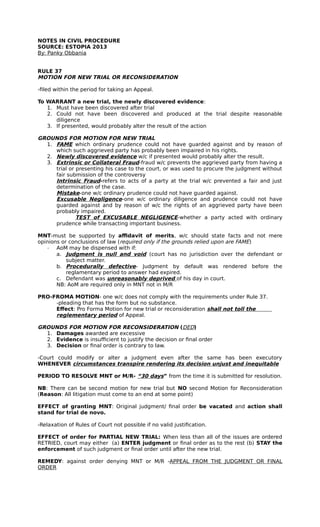
RULE 37 
MOTION FOR NEW TRIAL OR RECONSIDERATION 
-filed within the period for taking an Appeal. 
To WARRANT a new trial, the newly discovered evidence: 
1. Must have been discovered after trial 
2. Could not have been discovered and produced at the trial despite reasonable 
diligence 
3. If presented, would probably alter the result of the action 
GROUNDS FOR MOTION FOR NEW TRIAL 
1. FAME which ordinary prudence could not have guarded against and by reason of 
which such aggrieved party has probably been impaired in his rights. 
2. Newly discovered evidence w/c if presented would probably alter the result. 
3. Extrinsic or Collateral Fraud-fraud w/c prevents the aggrieved party from having a 
trial or presenting his case to the court, or was used to procure the judgment without 
fair submission of the controversy 
Intrinsic Fraud-refers to acts of a party at the trial w/c prevented a fair and just 
determination of the case. 
Mistake-one w/c ordinary prudence could not have guarded against. 
Excusable Negligence-one w/c ordinary diligence and prudence could not have 
guarded against and by reason of w/c the rights of an aggrieved party have been 
probably impaired. 
TEST of EXCUSABLE NEGLIGENCE-whether a party acted with ordinary 
prudence while transacting important business. 
MNT-must be supported by affidavit of merits, w/c should state facts and not mere 
opinions or conclusions of law (required only if the grounds relied upon are FAME) 
­AoM 
may be dispensed with if: 
a. Judgment is null and void (court has no jurisdiction over the defendant or 
subject matter. 
b. Procedurally defective- Judgment by default was rendered before the 
reglamentary period to answer had expired. 
c. Defendant was unreasonably deprived of his day in court. 
NB: AoM are required only in MNT not in M/R 
PRO-FROMA MOTION- one w/c does not comply with the requirements under Rule 37. 
-pleading that has the form but no substance. 
Effect: Pro Forma Motion for new trial or reconsideration shall not toll the 
reglementary period of Appeal. 
GROUNDS FOR MOTION FOR RECONSIDERATION (DED) 
1. Damages awarded are excessive 
2. Evidence is insufficient to justify the decision or final order 
3. Decision or final order is contrary to law. 
-Court could modify or alter a judgment even after the same has been executory 
WHENEVER circumstances transpire rendering its decision unjust and inequitable 
PERIOD TO RESOLVE MNT or M/R- “30 days” from the time it is submitted for resolution. 
NB: There can be second motion for new trial but NO second Motion for Reconsideration 
(Reason: All litigation must come to an end at some point) 
EFFECT of granting MNT: Original judgment/ final order be vacated and action shall 
stand for trial de novo. 
-Relaxation of Rules of Court not possible if no valid justification. 
EFFECT of order for PARTIAL NEW TRIAL: When less than all of the issues are ordered 
RETRIED, court may either (a) ENTER judgment or final order as to the rest (b) STAY the 
enforcement of such judgment or final order until after the new trial. 
REMEDY: against order denying MNT or M/R -APPEAL FROM THE JUDGMENT OR FINAL 
ORDER
NOTES IN CIVIL PROCEDURE 
SOURCE: ESTOPIA 2013 
By: Panky Obbania 
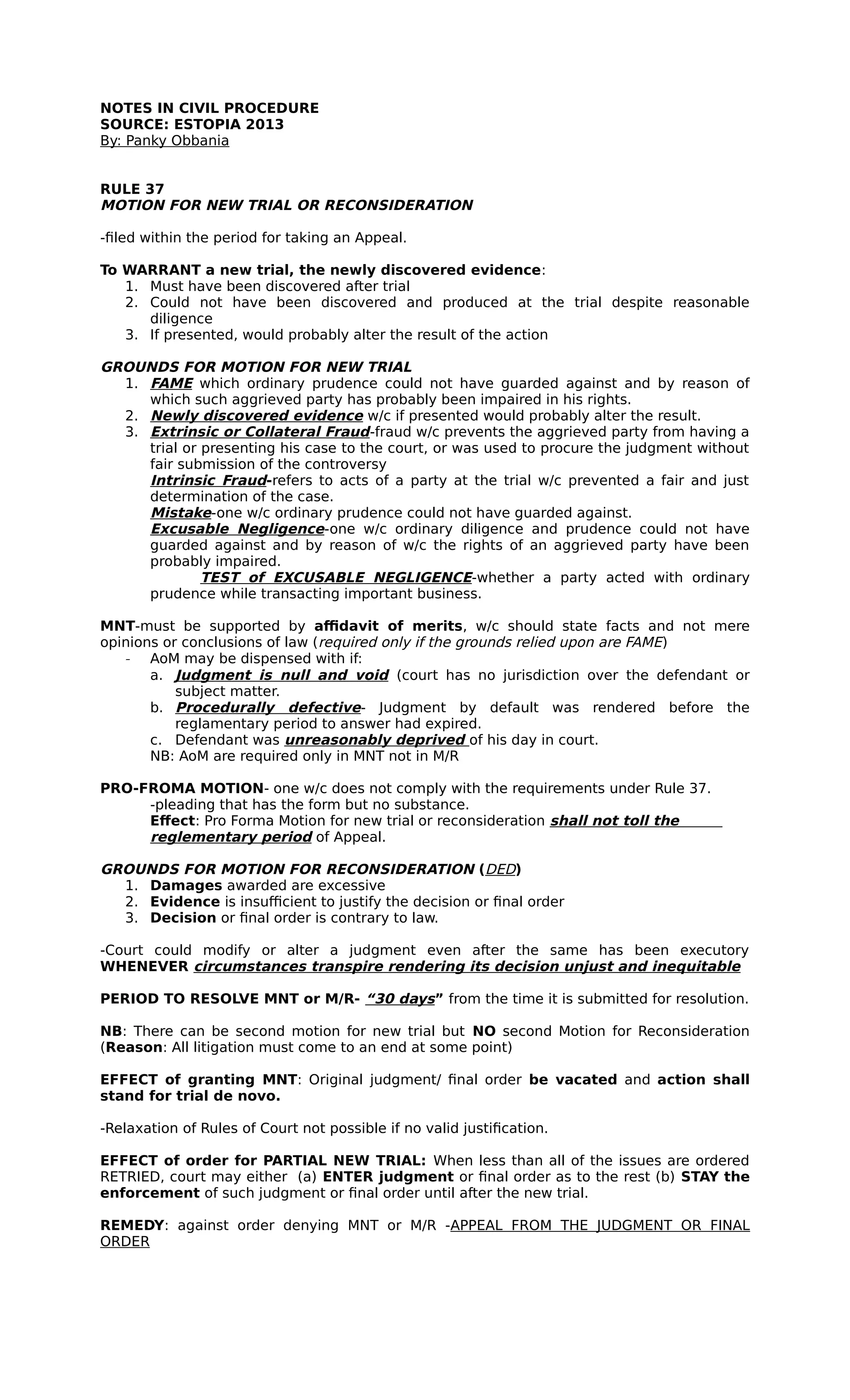
RULE 38 
RELIEF FROM JUDGMENTS ORDERS, OR OTHER PROCEEDINGS 
Petition for Relief- is a legal remedy whereby a party seeks to set aside a judgment 
rendered against him by court whenever he was unjustly deprived of a hearing or was 
prevented from taking an Appeal in either case because of FAME. 
- In effect, it is a second opportunity for an aggrieved party to ask for new trial. (Sayman 
vs. CA) 
PRFJ- Applicable to all kinds of Special Proceedings 
­Intestate 
Settlement, Guardianship Proceedings, Land Registration 
When and How Filed: - a verified petition for relief must be filed w/in 60 days after 
petitioner learns of the judgment, final order, or “other proceeding” (includes an order or 
writ of execution, order dismissing an appeal) to be set aside and not more than 6 
months after such judgment or final order has been entered or such proceeding has been 
taken. 
-must be accompanied with affidavit of merit alleging the grounds below. 
GROUNDS: 
1. FAME (Heavy workload not a ground for excusable negligence (LBP vs. Eli GC 
Natividad, et al.) 
2. Existence of a good and substantial cause of action or defense. 
-ABSENCE of AoM is a fatal defect and warrants the denial of the petition. 
Two periods for the filing of a petition for relief are not extendible and never 
interrupted 
1. 60 day period- reckoned from time party acquired knowledge of O/J/P 
2. 6-month period-computed from date of entry of order or judgment in the book of 
entries NOT from the date of order of default or the rendition of finality of judgment. 
REMEDY: Denial of Petition for Relief from Judgment (PRFJ) or an order disallowing or 
dismissing an appeal may only be challenged through Special Civil Action of Certiorari 
under Rule 65. (Cross Reference-Rule 41, Sec. 1 par b interlocutory, and last par of 
same rule) 
Interlocutory: Petition for Relief from the order of Default, Order denying an M/R of the 
default order. (Not Appealable) 
-BUT an order seeking to set aside the order of default is final and therefore appealable 
COURT ISSUES ODER TO FILE AN ANSWER-If PRFJ is sufficient in form and in substance, 
adverse parties file their answer within 15 days from the receipt thereof. (Order +copy of 
petition+AOM) 
-FAILURE to file an answer does not constitute DEFAULT, even w/out an answer, the court 
will still have to hear the petition and determine its merits. 
2 HEARINGS IN A PETITION FOR RELIEF 
1. Hearing to determine whether J/O/P should be set aside 
2. In the affirmative, hearing on the merits of the case.
NOTES IN CIVIL PROCEDURE 
SOURCE: ESTOPIA 2013 
By: Panky Obbania 
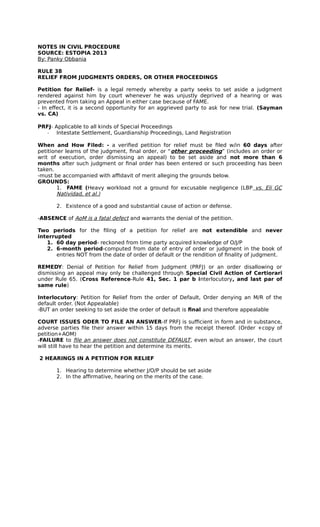
RULE 41-APPEAL FROM THE REGIONAL TRIAL COURT 
SUBJECT OF APPEAL 
-Appeal may be taken from a judgment or final order that completely disposes of the 
case. 
- cases not appealable-CODAL (refer to Rule 41, sec. 1 a-h) Remedy: Rule 65 of the 
ROC 
MODES OF APPEAL 
a. Ordinary Appeal-Appeal to C/A decided by the RTC in the exercise of its Original 
jurisdiction be taken by filing a notice of appeal (15 days from notice of final 
judgment or order or resolution, or from the date of its last publication if publication 
is required by law for its effectively ) w/ the court w/c rendered the judgment or final 
order. Notice of Appeal need NOT be approved by the court w/c rendered the 
decision. 
­In 
ordinary appeal, record on appeal is not required except in 
1. Special Proceedings 
2. Other cases of multiple or separate appeals (e.g. Expropriation) 
RECORD ON APPEAL-appellant shall file a notice of appeal and record on appeal 
w/in 30 days from the notice of judgment or final order. FAILURE of the R/A to show 
date of filing not a ground to dismiss if appellate court had no way of checking. 
­Amended 
R/A is deemed to have been filed on the presentation of the original, w/c 
was done w/in the reglementary period. If Amended R/A was submitted after the 
30-day reglementary period, it did not render the perfection thereof ultimately. 
(Rodriguez vs. CA) 
b. Petition for Review- Appeal to C/A cases decided by the RTC in the exercise of its 
appellate jurisdiction. 
c. Appeal by Certiorari- Appeal to SC under rule 45 in all cases where only questions 
of law are involved/raised. 
QUESTION OF FACTS VS. QUESTION OF LAWS 
Question is the correctness or falsity of an 
alleged fact. 
Question is what law is applicable in a given 
set of facts.(Cheesman vs. IAC) 
NB-Partial Summary judgment is interlocutory order NOT a final judgment (Guevarra vs. CA) 
Right to Appeal –NOT a natural right or a part of due process. It is merely a STATUTORY 
PRIVILEGE, failure to comply with the requirements is fatal. 
­FAILURE 
to pay appellate court docket fees (in full) and other lawful fees on time is a 
ground to dismiss the appeal.(M.A. Santander Construction, Inc. vs. Villanueva). 
­FAILURE 
to perfect an appeal w/in the prescribed period is JURISDICTIONAL, hence 
renders the judgment final and executory. 
MOTION TO DISMISS AN APPEAL BARRED BY LACHES- on the ground that the record on 
appeal does not contain data showing that the appeal was perfected on time where the 
movant allowed 6 years after the filing of the brief elapse w/out moving for the dismissal of 
the case. 
-It is the duty of the trial court to determine whether the appeal has been perfected on time. 
Appellate court has the duty to examine record on appeal if the printed record does not 
show date of filing. 
-Clerical error can’t prevail over what actually appears on the records 
-Trial courts approval of the record on appeal serves to cure whatever defect or omission 
committed therein ( Compagne des Messageries vs. CA) 
- Unsigned record on appeal may be given force and effect where no impairment of the 
rights of the other party can be shown. The same could be required to be signed (Toribio, 
et al. vs. Montejo, et al.) 
-Appeals TARDILY FILED may be allowed by the Court under the policy of liberality. 
Technical objections may be disregarded to get the substantive issues raised. It is the 
Court’s inherent power to suspend the application of procedural rules when warranted in 
relation to the dictum the “all controversies should be resolved on their merits ”. 
(Ombudsman vs. Pendatun G. Laja, et al. )
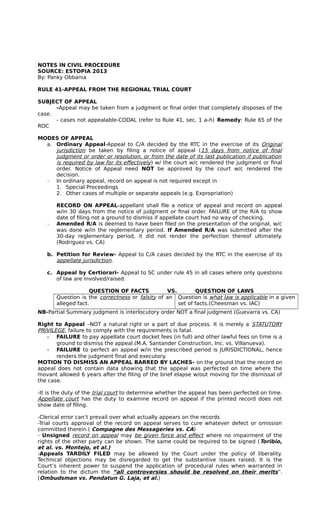
-Execution shall issue as a matter of right upon the period to appeal. 
-The perfection of the appeal by one party does not operate to deprive the trial court of 
jurisdiction. Such jurisdiction is lost only upon the expiration of the period to appeal by the 
other party. 
-After the perfection of the appeal but before transmittal of the record on appeal, TC retains 
jurisdiction to set its order approving the R/A with a view to further inquiring whether said 
R/A is complete or contains error or not. (Cabungcal vs. Fernandez) 
EFFECT OF PERFECTION OF AN APPEAL 
­Stays 
judgment or final order. Judgment or order appealed from cannot be final and 
executory until the appeal has been finally resolved. (Rule 42, Sec 8 (b) 
­TSN 
of the proceedings must be certified by the stenographer concerned. In appeals 
from RTC to CA whether by R/A or by the original record, stenographers transcribed 
their notes and submit the transcripts to COC of the Trial court, who must submit the 
TSN to the COC of CA w/in 30 days from the perfection of appeal.( Francisco vs. 
Bosa) 
TRANSMITTAL- of the record should be the sole responsibility of the COC 
­COC 
of trial court shall transmit to the appellate court 
1. the original record or the approved record on appeal w/in 30 days from the 
perfection of appeal 
2. together with proof of payment of the appellate court docket and other lawful fees 
3. CTC of the minutes of the proceedings 
4. order of approval 
5. certificate of correctness 
6. original documentary evidence 
7. original 3 copies of the transcripts. 
MOTION TO DISMISS THE APPEAL(Sec. 13, Rule 41)-may be filed with the appellate 
court (Rule 50 sec. 1 (b)

Rule 37 38-41

  • 1.
    NOTES IN CIVILPROCEDURE SOURCE: ESTOPIA 2013 By: Panky Obbania RULE 37 MOTION FOR NEW TRIAL OR RECONSIDERATION -filed within the period for taking an Appeal. To WARRANT a new trial, the newly discovered evidence: 1. Must have been discovered after trial 2. Could not have been discovered and produced at the trial despite reasonable diligence 3. If presented, would probably alter the result of the action GROUNDS FOR MOTION FOR NEW TRIAL 1. FAME which ordinary prudence could not have guarded against and by reason of which such aggrieved party has probably been impaired in his rights. 2. Newly discovered evidence w/c if presented would probably alter the result. 3. Extrinsic or Collateral Fraud-fraud w/c prevents the aggrieved party from having a trial or presenting his case to the court, or was used to procure the judgment without fair submission of the controversy Intrinsic Fraud-refers to acts of a party at the trial w/c prevented a fair and just determination of the case. Mistake-one w/c ordinary prudence could not have guarded against. Excusable Negligence-one w/c ordinary diligence and prudence could not have guarded against and by reason of w/c the rights of an aggrieved party have been probably impaired. TEST of EXCUSABLE NEGLIGENCE-whether a party acted with ordinary prudence while transacting important business. MNT-must be supported by affidavit of merits, w/c should state facts and not mere opinions or conclusions of law (required only if the grounds relied upon are FAME) ­AoM may be dispensed with if: a. Judgment is null and void (court has no jurisdiction over the defendant or subject matter. b. Procedurally defective- Judgment by default was rendered before the reglamentary period to answer had expired. c. Defendant was unreasonably deprived of his day in court. NB: AoM are required only in MNT not in M/R PRO-FROMA MOTION- one w/c does not comply with the requirements under Rule 37. -pleading that has the form but no substance. Effect: Pro Forma Motion for new trial or reconsideration shall not toll the reglementary period of Appeal. GROUNDS FOR MOTION FOR RECONSIDERATION (DED) 1. Damages awarded are excessive 2. Evidence is insufficient to justify the decision or final order 3. Decision or final order is contrary to law. -Court could modify or alter a judgment even after the same has been executory WHENEVER circumstances transpire rendering its decision unjust and inequitable PERIOD TO RESOLVE MNT or M/R- “30 days” from the time it is submitted for resolution. NB: There can be second motion for new trial but NO second Motion for Reconsideration (Reason: All litigation must come to an end at some point) EFFECT of granting MNT: Original judgment/ final order be vacated and action shall stand for trial de novo. -Relaxation of Rules of Court not possible if no valid justification. EFFECT of order for PARTIAL NEW TRIAL: When less than all of the issues are ordered RETRIED, court may either (a) ENTER judgment or final order as to the rest (b) STAY the enforcement of such judgment or final order until after the new trial. REMEDY: against order denying MNT or M/R -APPEAL FROM THE JUDGMENT OR FINAL ORDER
  • 2.
    NOTES IN CIVILPROCEDURE SOURCE: ESTOPIA 2013 By: Panky Obbania RULE 38 RELIEF FROM JUDGMENTS ORDERS, OR OTHER PROCEEDINGS Petition for Relief- is a legal remedy whereby a party seeks to set aside a judgment rendered against him by court whenever he was unjustly deprived of a hearing or was prevented from taking an Appeal in either case because of FAME. - In effect, it is a second opportunity for an aggrieved party to ask for new trial. (Sayman vs. CA) PRFJ- Applicable to all kinds of Special Proceedings ­Intestate Settlement, Guardianship Proceedings, Land Registration When and How Filed: - a verified petition for relief must be filed w/in 60 days after petitioner learns of the judgment, final order, or “other proceeding” (includes an order or writ of execution, order dismissing an appeal) to be set aside and not more than 6 months after such judgment or final order has been entered or such proceeding has been taken. -must be accompanied with affidavit of merit alleging the grounds below. GROUNDS: 1. FAME (Heavy workload not a ground for excusable negligence (LBP vs. Eli GC Natividad, et al.) 2. Existence of a good and substantial cause of action or defense. -ABSENCE of AoM is a fatal defect and warrants the denial of the petition. Two periods for the filing of a petition for relief are not extendible and never interrupted 1. 60 day period- reckoned from time party acquired knowledge of O/J/P 2. 6-month period-computed from date of entry of order or judgment in the book of entries NOT from the date of order of default or the rendition of finality of judgment. REMEDY: Denial of Petition for Relief from Judgment (PRFJ) or an order disallowing or dismissing an appeal may only be challenged through Special Civil Action of Certiorari under Rule 65. (Cross Reference-Rule 41, Sec. 1 par b interlocutory, and last par of same rule) Interlocutory: Petition for Relief from the order of Default, Order denying an M/R of the default order. (Not Appealable) -BUT an order seeking to set aside the order of default is final and therefore appealable COURT ISSUES ODER TO FILE AN ANSWER-If PRFJ is sufficient in form and in substance, adverse parties file their answer within 15 days from the receipt thereof. (Order +copy of petition+AOM) -FAILURE to file an answer does not constitute DEFAULT, even w/out an answer, the court will still have to hear the petition and determine its merits. 2 HEARINGS IN A PETITION FOR RELIEF 1. Hearing to determine whether J/O/P should be set aside 2. In the affirmative, hearing on the merits of the case.
  • 3.
    NOTES IN CIVILPROCEDURE SOURCE: ESTOPIA 2013 By: Panky Obbania RULE 41-APPEAL FROM THE REGIONAL TRIAL COURT SUBJECT OF APPEAL -Appeal may be taken from a judgment or final order that completely disposes of the case. - cases not appealable-CODAL (refer to Rule 41, sec. 1 a-h) Remedy: Rule 65 of the ROC MODES OF APPEAL a. Ordinary Appeal-Appeal to C/A decided by the RTC in the exercise of its Original jurisdiction be taken by filing a notice of appeal (15 days from notice of final judgment or order or resolution, or from the date of its last publication if publication is required by law for its effectively ) w/ the court w/c rendered the judgment or final order. Notice of Appeal need NOT be approved by the court w/c rendered the decision. ­In ordinary appeal, record on appeal is not required except in 1. Special Proceedings 2. Other cases of multiple or separate appeals (e.g. Expropriation) RECORD ON APPEAL-appellant shall file a notice of appeal and record on appeal w/in 30 days from the notice of judgment or final order. FAILURE of the R/A to show date of filing not a ground to dismiss if appellate court had no way of checking. ­Amended R/A is deemed to have been filed on the presentation of the original, w/c was done w/in the reglementary period. If Amended R/A was submitted after the 30-day reglementary period, it did not render the perfection thereof ultimately. (Rodriguez vs. CA) b. Petition for Review- Appeal to C/A cases decided by the RTC in the exercise of its appellate jurisdiction. c. Appeal by Certiorari- Appeal to SC under rule 45 in all cases where only questions of law are involved/raised. QUESTION OF FACTS VS. QUESTION OF LAWS Question is the correctness or falsity of an alleged fact. Question is what law is applicable in a given set of facts.(Cheesman vs. IAC) NB-Partial Summary judgment is interlocutory order NOT a final judgment (Guevarra vs. CA) Right to Appeal –NOT a natural right or a part of due process. It is merely a STATUTORY PRIVILEGE, failure to comply with the requirements is fatal. ­FAILURE to pay appellate court docket fees (in full) and other lawful fees on time is a ground to dismiss the appeal.(M.A. Santander Construction, Inc. vs. Villanueva). ­FAILURE to perfect an appeal w/in the prescribed period is JURISDICTIONAL, hence renders the judgment final and executory. MOTION TO DISMISS AN APPEAL BARRED BY LACHES- on the ground that the record on appeal does not contain data showing that the appeal was perfected on time where the movant allowed 6 years after the filing of the brief elapse w/out moving for the dismissal of the case. -It is the duty of the trial court to determine whether the appeal has been perfected on time. Appellate court has the duty to examine record on appeal if the printed record does not show date of filing. -Clerical error can’t prevail over what actually appears on the records -Trial courts approval of the record on appeal serves to cure whatever defect or omission committed therein ( Compagne des Messageries vs. CA) - Unsigned record on appeal may be given force and effect where no impairment of the rights of the other party can be shown. The same could be required to be signed (Toribio, et al. vs. Montejo, et al.) -Appeals TARDILY FILED may be allowed by the Court under the policy of liberality. Technical objections may be disregarded to get the substantive issues raised. It is the Court’s inherent power to suspend the application of procedural rules when warranted in relation to the dictum the “all controversies should be resolved on their merits ”. (Ombudsman vs. Pendatun G. Laja, et al. )
  • 4.
    -Execution shall issueas a matter of right upon the period to appeal. -The perfection of the appeal by one party does not operate to deprive the trial court of jurisdiction. Such jurisdiction is lost only upon the expiration of the period to appeal by the other party. -After the perfection of the appeal but before transmittal of the record on appeal, TC retains jurisdiction to set its order approving the R/A with a view to further inquiring whether said R/A is complete or contains error or not. (Cabungcal vs. Fernandez) EFFECT OF PERFECTION OF AN APPEAL ­Stays judgment or final order. Judgment or order appealed from cannot be final and executory until the appeal has been finally resolved. (Rule 42, Sec 8 (b) ­TSN of the proceedings must be certified by the stenographer concerned. In appeals from RTC to CA whether by R/A or by the original record, stenographers transcribed their notes and submit the transcripts to COC of the Trial court, who must submit the TSN to the COC of CA w/in 30 days from the perfection of appeal.( Francisco vs. Bosa) TRANSMITTAL- of the record should be the sole responsibility of the COC ­COC of trial court shall transmit to the appellate court 1. the original record or the approved record on appeal w/in 30 days from the perfection of appeal 2. together with proof of payment of the appellate court docket and other lawful fees 3. CTC of the minutes of the proceedings 4. order of approval 5. certificate of correctness 6. original documentary evidence 7. original 3 copies of the transcripts. MOTION TO DISMISS THE APPEAL(Sec. 13, Rule 41)-may be filed with the appellate court (Rule 50 sec. 1 (b)