Meaning & concept of Immovable Property
(TRANSFER OF PROPERTY ACT, 1882)
Submitted to-
Ms. Ritu Gautam
(Assistant Professor)
Submitted by-
Tejinder Singh
LL.B 5th semester
Definition of Immovable Property
 The TPA Act has not defined this term. It only
says that, “immovable property” does not includes
standing timber, growing crops or grass.
 However section 3(25) of the general clause act,
1897 defines the term “immovable property” as-
immovable property shall include land, benefit to
arise out of land, and things attached to land or
permanently fastened to anything attached to the
Earth.
Babulal v Bhavani 1912
 It was held in this case that the definition of
immovable property given in the general clause
act is applicable to the transfer of property Act.
Land include following
elements-
 Determinate portion of Earth’s surface.
 Column of space above surface.
 All objects either on or under the surface of land
in their natural state. Ex. Minerals
 All objects placed by human with intention of
permanent annexation.
Benefits arrising out of land
 All the benefits arising out of land are also
considered as immovable property because such
benefits cannot be served from the land and are
incidents of it.
 Right to collect-lac , leaves etc. from trees,
revenue from agricultural land, right to take out
minerals, to collect fish ponds, debt secured by
mortgage of immovable property, rent from
tenanted property all are benefits arising out of
land.
Case laws under benefits arising
out of land
 Anand Behera v. state of Orissa, (1955)
Right to profits a prendre are benefits arising out of
land and are immovable property. For example, a
right to enter upon land and to carry away fish from
pond is a right to profits a prendre and is, therefore,
immovable property.
 ShantaBai v. State of Bombay, (1959)
Right to enter on the lands in order to cut down
trees and carry away wood.
Things attached to the earth
 Section 3 of TPA Act says that ‘attached to the
earth’ means-
a) Rooted in the earth, as in case of trees and
shurbs.
b) Imbedded in the earth, as in case of wall or
buildings
c) Attached to earth for permanent beneficial
enjoyment.
V.P.Fakrudheen Haji vs State Bank
Of India, 2008
 In view of the definition of the term "attached to
earth" in S.3 read with S.8 of the Transfer of
Property Act, even if the title deed or the schedule
of property attached thereto does not mention
that the house in the property which is the subject
of transfer is also transferred, the transferee
would get title to the house situated in the
property, unless the house is specifically excluded
from the transfer."
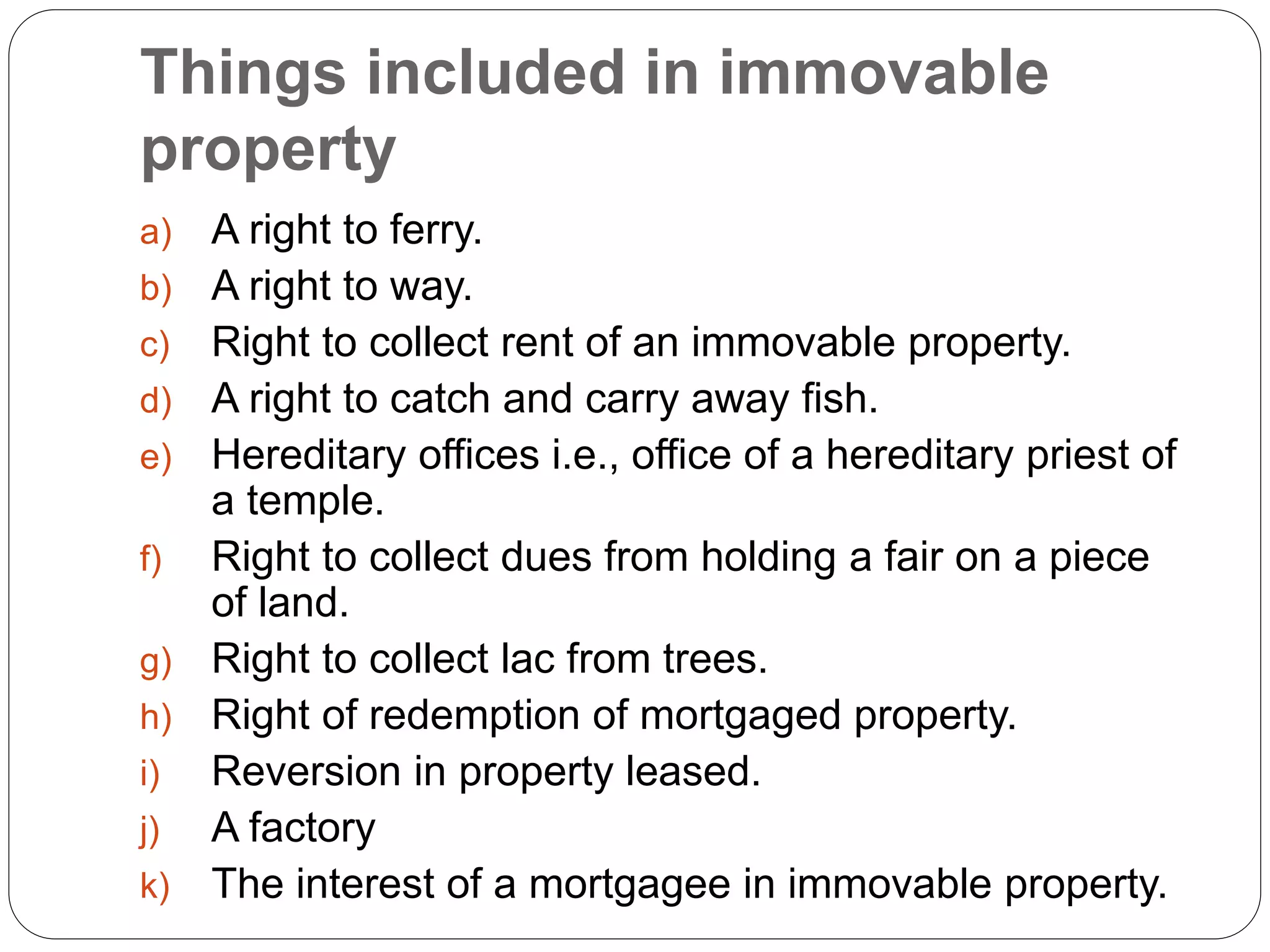
Things included in immovable
property
a) A right to ferry.
b) A right to way.
c) Right to collect rent of an immovable property.
d) A right to catch and carry away fish.
e) Hereditary offices i.e., office of a hereditary priest of
a temple.
f) Right to collect dues from holding a fair on a piece
of land.
g) Right to collect lac from trees.
h) Right of redemption of mortgaged property.
i) Reversion in property leased.
j) A factory
k) The interest of a mortgagee in immovable property.

MEANING & CONCEPT OF immovable property

  • 1.
    Meaning & conceptof Immovable Property (TRANSFER OF PROPERTY ACT, 1882) Submitted to- Ms. Ritu Gautam (Assistant Professor) Submitted by- Tejinder Singh LL.B 5th semester
  • 2.
    Definition of ImmovableProperty  The TPA Act has not defined this term. It only says that, “immovable property” does not includes standing timber, growing crops or grass.  However section 3(25) of the general clause act, 1897 defines the term “immovable property” as- immovable property shall include land, benefit to arise out of land, and things attached to land or permanently fastened to anything attached to the Earth.
  • 3.
    Babulal v Bhavani1912  It was held in this case that the definition of immovable property given in the general clause act is applicable to the transfer of property Act.
  • 4.
    Land include following elements- Determinate portion of Earth’s surface.  Column of space above surface.  All objects either on or under the surface of land in their natural state. Ex. Minerals  All objects placed by human with intention of permanent annexation.
  • 5.
    Benefits arrising outof land  All the benefits arising out of land are also considered as immovable property because such benefits cannot be served from the land and are incidents of it.  Right to collect-lac , leaves etc. from trees, revenue from agricultural land, right to take out minerals, to collect fish ponds, debt secured by mortgage of immovable property, rent from tenanted property all are benefits arising out of land.
  • 6.
    Case laws underbenefits arising out of land  Anand Behera v. state of Orissa, (1955) Right to profits a prendre are benefits arising out of land and are immovable property. For example, a right to enter upon land and to carry away fish from pond is a right to profits a prendre and is, therefore, immovable property.  ShantaBai v. State of Bombay, (1959) Right to enter on the lands in order to cut down trees and carry away wood.
  • 7.
    Things attached tothe earth  Section 3 of TPA Act says that ‘attached to the earth’ means- a) Rooted in the earth, as in case of trees and shurbs. b) Imbedded in the earth, as in case of wall or buildings c) Attached to earth for permanent beneficial enjoyment.
  • 8.
    V.P.Fakrudheen Haji vsState Bank Of India, 2008  In view of the definition of the term "attached to earth" in S.3 read with S.8 of the Transfer of Property Act, even if the title deed or the schedule of property attached thereto does not mention that the house in the property which is the subject of transfer is also transferred, the transferee would get title to the house situated in the property, unless the house is specifically excluded from the transfer."
  • 9.
    Things included inimmovable property a) A right to ferry. b) A right to way. c) Right to collect rent of an immovable property. d) A right to catch and carry away fish. e) Hereditary offices i.e., office of a hereditary priest of a temple. f) Right to collect dues from holding a fair on a piece of land. g) Right to collect lac from trees. h) Right of redemption of mortgaged property. i) Reversion in property leased. j) A factory k) The interest of a mortgagee in immovable property.