Rubik Cubes For Geeks
     http://bit.ly/rubikcube

   Barcamp Singapore 4
      21th Nov 2009
     Benson & Hong
Overview

 Origin
 Structure
 Notations
 Techniques
 Speed Cubing
 Competition
Once Upon A Time...

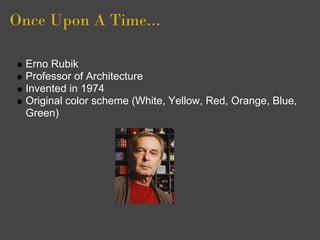
  Erno Rubik
  Professor of Architecture
  Invented in 1974
  Original color scheme (White, Yellow, Red, Orange, Blue,
  Green)
Structure

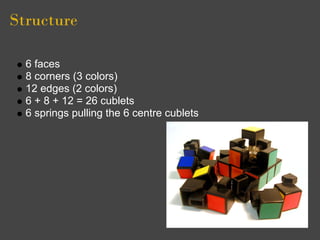
  6 faces
  8 corners (3 colors)
  12 edges (2 colors)
  6 + 8 + 12 = 26 cublets
  6 springs pulling the 6 centre cublets
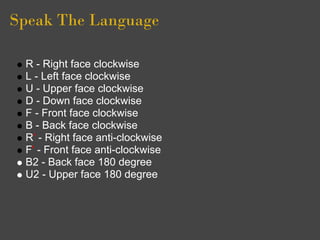
Speak The Language

 R - Right face clockwise
 L - Left face clockwise
 U - Upper face clockwise
 D - Down face clockwise
 F - Front face clockwise
 B - Back face clockwise
 R' - Right face anti-clockwise
 F' - Front face anti-clockwise
 B2 - Back face 180 degree
 U2 - Upper face 180 degree
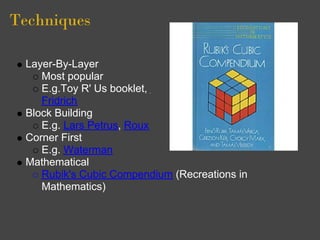
Techniques

 Layer-By-Layer
    Most popular
    E.g.Toy R' Us booklet,
    Fridrich
 Block Building
    E.g. Lars Petrus, Roux
 Corner First
    E.g. Waterman
 Mathematical
    Rubik's Cubic Compendium (Recreations in
    Mathematics)
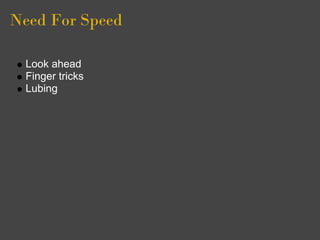
Need For Speed

 Look ahead
 Finger tricks
 Lubing
Lube Your Cube

 Bad
    Methylene Chloride
    Acetone
    WD-40 (good sticker remover )
 Good
    Silicon spray
Competition

 World Cube Association (http://www.worldcubeassociation.
 org)
 Rules and Regulations
 Judges, scramblers, score takers
 Speed cubing, single hand, blindfold, feet cubing, ...
 "Competitors must bring and use their own puzzles.
 Competitors may borrow puzzles from other competitors..."
 Max. 15s inspection
DEMO
Fridrich Method

1. Bottom Cross
2. F2L (First 2 Layers) = 4 x (corner + edge)
3. OLL (Orientation of Last Layer) + PLL (Permutation of Last
   Layer)

  Characteristics
    Popular!
    Need memorization
    Many variations for last layer
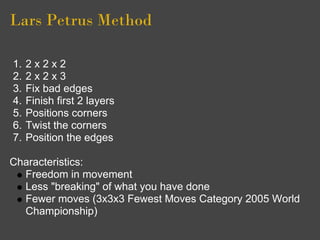
Lars Petrus Method

1.   2x2x2
2.   2x2x3
3.   Fix bad edges
4.   Finish first 2 layers
5.   Positions corners
6.   Twist the corners
7.   Position the edges

Characteristics:
  Freedom in movement
  Less "breaking" of what you have done
  Fewer moves (3x3x3 Fewest Moves Category 2005 World
  Championship)

Rubikcubesforgeeks

  • 1.
    Rubik Cubes ForGeeks http://bit.ly/rubikcube Barcamp Singapore 4 21th Nov 2009 Benson & Hong
  • 2.
    Overview Origin Structure Notations Techniques Speed Cubing Competition
  • 3.
    Once Upon ATime... Erno Rubik Professor of Architecture Invented in 1974 Original color scheme (White, Yellow, Red, Orange, Blue, Green)
  • 4.
    Structure 6faces 8 corners (3 colors) 12 edges (2 colors) 6 + 8 + 12 = 26 cublets 6 springs pulling the 6 centre cublets
  • 5.
    Speak The Language R - Right face clockwise L - Left face clockwise U - Upper face clockwise D - Down face clockwise F - Front face clockwise B - Back face clockwise R' - Right face anti-clockwise F' - Front face anti-clockwise B2 - Back face 180 degree U2 - Upper face 180 degree
  • 6.
    Techniques Layer-By-Layer Most popular E.g.Toy R' Us booklet, Fridrich Block Building E.g. Lars Petrus, Roux Corner First E.g. Waterman Mathematical Rubik's Cubic Compendium (Recreations in Mathematics)
  • 7.
    Need For Speed Look ahead Finger tricks Lubing
  • 8.
    Lube Your Cube Bad Methylene Chloride Acetone WD-40 (good sticker remover ) Good Silicon spray
  • 9.
    Competition World CubeAssociation (http://www.worldcubeassociation. org) Rules and Regulations Judges, scramblers, score takers Speed cubing, single hand, blindfold, feet cubing, ... "Competitors must bring and use their own puzzles. Competitors may borrow puzzles from other competitors..." Max. 15s inspection
  • 10.
  • 11.
    Fridrich Method 1. BottomCross 2. F2L (First 2 Layers) = 4 x (corner + edge) 3. OLL (Orientation of Last Layer) + PLL (Permutation of Last Layer) Characteristics Popular! Need memorization Many variations for last layer
  • 12.
    Lars Petrus Method 1. 2x2x2 2. 2x2x3 3. Fix bad edges 4. Finish first 2 layers 5. Positions corners 6. Twist the corners 7. Position the edges Characteristics: Freedom in movement Less "breaking" of what you have done Fewer moves (3x3x3 Fewest Moves Category 2005 World Championship)