
An Introduction to the Real-time
Transport Protocol (RTP)
Ye Xia
WebTP Meeting
12/12/00
Transport Functions
• Application Support
– Reliability control: loss recover, in-sequence delivery,
etc.
• Network Control
– Congestion control, rate allocation, etc
• The distinction between the two is not sharp.
– Rate allocation and scheduling can be viewed as part of
either one above.
• This dual view arises when we contemplate
traditional transports: TCP and UDP
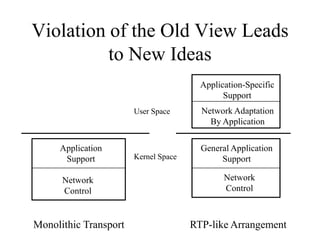
Violation of the Old View Leads
to New Ideas
Application
Support
Network
Control
Application-Specific
Support
Network
Control
Monolithic Transport
General Application
Support
User Space
Kernel Space
RTP-like Arrangement
Network Adaptation
By Application
Fine-grained Application Support
• In monolithic transport, application support
function needs to be general. Why?
– Transport sits in the kernel. Hard to modify.
– API needs to be stable.
– The philosophy of some transport designers: transport
should have sufficient generality.
• How to accommodate specific application’s
needs?
– Build complex logic into the (monolithic) transport. But
should not be overly ambitious.
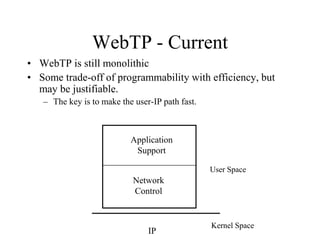
WebTP - Current
• WebTP is still monolithic
• Some trade-off of programmability with efficiency, but
may be justifiable.
– The key is to make the user-IP path fast.
Application
Support
Network
Control
User Space
Kernel Space
IP
Overview of RTP
• Provides end-to-end delivery services for real-time
traffic: interactive audio and video
– Payload identification, sequence numbering,
timestamping and delivery monitoring
• Runs on top of UDP, and less often, TCP.
– RTP does not guarantee delivery or prevent out-of-
order delivery.
• Primarily designed to support multiparty
multimedia conferences, typically assumes IP
multicast.
Overview – Cont.
• The protocol has two parts.
– RTP: carry real-time data
– RTP control protocol (RTCP): monitor the quality of
service and to convey information about the
participants.
• Principles of application level framing and
integrated layer processing.
– Is malleable to provide application specific info.
– Is typically integrated into the application processing.
– Protocol is deliberately not complete. It only contains
the common functions.
– A complete specification for an application also
includes a profile and a payload format document.
Example- Multicast audio
conference
• Need a multicast address and a pair of ports: one
for data and one for (RTCP) control.
• RTP header contains type of audio encoding (such
as PCM). Senders can change encoding during the
conference.
• RTP header contains timing information. Audio
data can be played out as they are produced by the
source.
• Senders and receivers multicast reports through
RTCP. Packet loss ratio, delay jitter, and other
status info can be monitored.
Example – Audio and Video
Conference
• Audio and video are transmitted using
separate RTP sessions. (with different UDP
ports and/or multicast addresses.)
• Each participant of both sessions can be
identified by the same name in RTCP
packets.
• The decoupling of the two sessions allows
some participants to join only one session.
Example – Mixers and
Translators
• Mixers: a RTP-level entity that receives streams of RTP
data packets from one or more sources and combines them
into a single stream.
• A translator forwards RTP packets from different sources
separately.
• Mixer is like a new RTP-level source to the receivers.
• Translator is more transparent. Receivers can identify
individual sources even though packets pass through the
same translator and carry the translator’s network source
address.
• Mixer can re-synchronize the incoming stream and
generates its own timing info.
Translators and Mixers
• The real distinction between mixers and translators: SSRC
identifier is not changed at a translator, but is changed at a
mixer.
• They both use a different transport address (network
address + port) at the output side.
• Multiple data packets can be combined into one.
• Uses of translators and mixers: go-through firewalls;
transcoding for low-bandwidth links; adding or removing
encryption; emulating multicast address with one or more
unicast addresses.
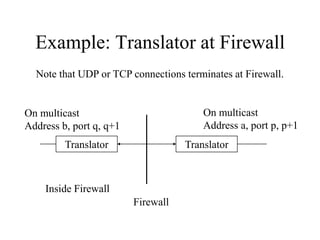
Example: Translator at Firewall
Translator
Firewall
Translator
On multicast
Address a, port p, p+1
On multicast
Address b, port q, q+1
Inside Firewall
Note that UDP or TCP connections terminates at Firewall.
Some RTP Definitions
• Transport address: network address + port
• RTP session: communications on a pair of transport
addresses (data + control)
• Synchronization source (SSRC): the source of a stream of
RTP packets
– Identified by 32-bit SSRC identifier.
– All packets from the same SSRC form a single timing and
sequencing space. Receivers group packets by SSRC for playback.
– Not dependent on network address.
– Examples: all packets from a camera; from a mixer; for layered
encoding transmitted on separate RTP sessions a single SSRC is
used for all layers.
– A participant need not use the same SSRC for all RTP sessions in a
multimedia session.
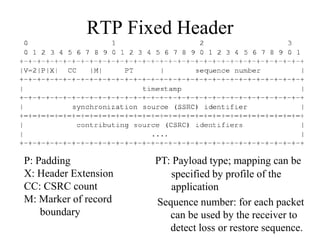
RTP Fixed Header
P: Padding
X: Header Extension
CC: CSRC count
M: Marker of record
boundary
PT: Payload type; mapping can be
specified by profile of the
application
Sequence number: for each packet
can be used by the receiver to
detect loss or restore sequence.
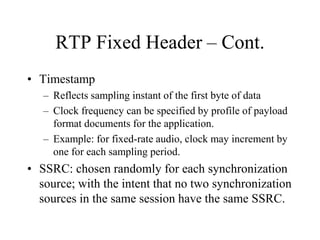
RTP Fixed Header – Cont.
• Timestamp
– Reflects sampling instant of the first byte of data
– Clock frequency can be specified by profile of payload
format documents for the application.
– Example: for fixed-rate audio, clock may increment by
one for each sampling period.
• SSRC: chosen randomly for each synchronization
source; with the intent that no two synchronization
sources in the same session have the same SSRC.
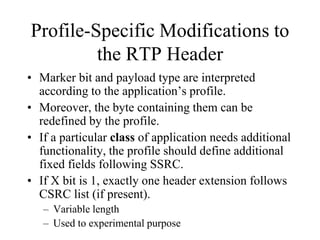
Profile-Specific Modifications to
the RTP Header
• Marker bit and payload type are interpreted
according to the application’s profile.
• Moreover, the byte containing them can be
redefined by the profile.
• If a particular class of application needs additional
functionality, the profile should define additional
fixed fields following SSRC.
• If X bit is 1, exactly one header extension follows
CSRC list (if present).
– Variable length
– Used to experimental purpose
RTCP
• Primary function is to provide feedback on the quality
of data distribution.
– Through sender and receiver reports;
– For adaptive encoding (adaptive to network congestion);
– Can be used to diagnose faults
• RTCP carries a persistent transport-level identifier for
an RTP source, called canonical name, CNAME.
– Receivers use CNAME to keep track of each participant
– And to synchronize related media streams (with the help of
NTP)
• Passes participant’s identification for display.
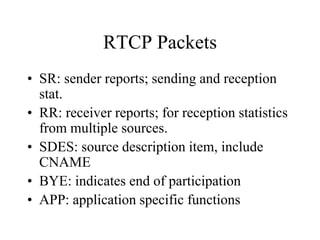
RTCP Packets
• SR: sender reports; sending and reception
stat.
• RR: receiver reports; for reception statistics
from multiple sources.
• SDES: source description item, include
CNAME
• BYE: indicates end of participation
• APP: application specific functions
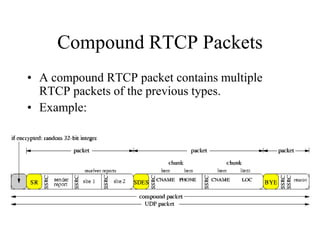
Compound RTCP Packets
• A compound RTCP packet contains multiple
RTCP packets of the previous types.
• Example:
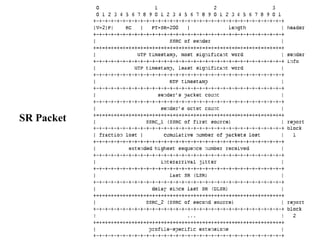
SR Packet
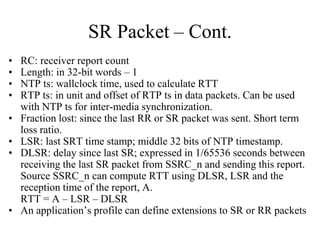
SR Packet – Cont.
• RC: receiver report count
• Length: in 32-bit words – 1
• NTP ts: wallclock time, used to calculate RTT
• RTP ts: in unit and offset of RTP ts in data packets. Can be used
with NTP ts for inter-media synchronization.
• Fraction lost: since the last RR or SR packet was sent. Short term
loss ratio.
• LSR: last SRT time stamp; middle 32 bits of NTP timestamp.
• DLSR: delay since last SR; expressed in 1/65536 seconds between
receiving the last SR packet from SSRC_n and sending this report.
Source SSRC_n can compute RTT using DLSR, LSR and the
reception time of the report, A.
RTT = A – LSR – DLSR
• An application’s profile can define extensions to SR or RR packets
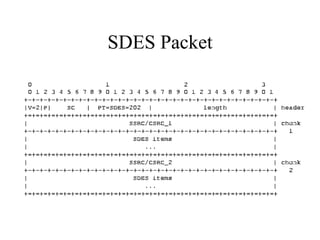
SDES Packet
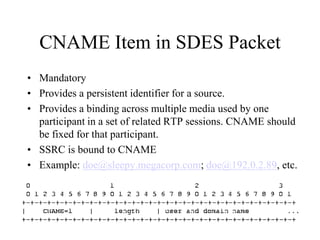
CNAME Item in SDES Packet
• Mandatory
• Provides a persistent identifier for a source.
• Provides a binding across multiple media used by one
participant in a set of related RTP sessions. CNAME should
be fixed for that participant.
• SSRC is bound to CNAME
• Example: doe@sleepy.megacorp.com; doe@192.0.2.89, etc.
Other Items in SDES Packet
• NAME: user name
• EMAIL:
• PHONE:
• LOC: location
• TOOL: application or tool name
• NOTE: notice/status
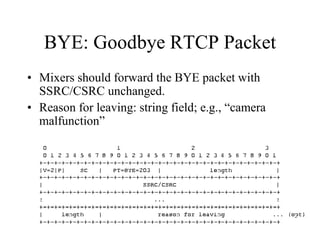
BYE: Goodbye RTCP Packet
• Mixers should forward the BYE packet with
SSRC/CSRC unchanged.
• Reason for leaving: string field; e.g., “camera
malfunction”
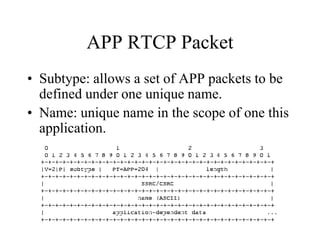
APP RTCP Packet
• Subtype: allows a set of APP packets to be
defined under one unique name.
• Name: unique name in the scope of one this
application.
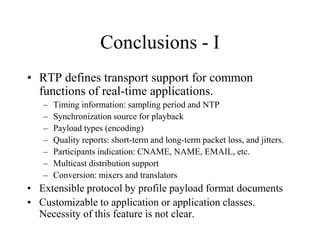
Conclusions - I
• RTP defines transport support for common
functions of real-time applications.
– Timing information: sampling period and NTP
– Synchronization source for playback
– Payload types (encoding)
– Quality reports: short-term and long-term packet loss, and jitters.
– Participants indication: CNAME, NAME, EMAIL, etc.
– Multicast distribution support
– Conversion: mixers and translators
• Extensible protocol by profile payload format documents
• Customizable to application or application classes.
Necessity of this feature is not clear.
Conclusion – II
• Separation of control and data stream
(analogous to out-band signaling)
– Data header overhead is small.
– Can accomplish complex control features.
– Complexity of the protocol/algorithm is not so
bad, because there is little hard guarantee (It
relies on TCP or application for hard
guarantees).
Conclusions – III
• Congestion control is not defined in baseline
document, but may be defined by application’s
profile.
– Leads to application-specific congestion control or
adaptation
• RTP can be considered user-space transport
entities, but does not run as stand-alone process.
• Mixers and translators are stand-alone processes.
They terminate TCP or UDP connections.
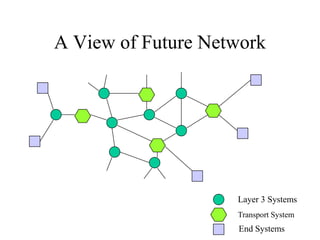
A View of Future Network
Layer 3 Systems
Transport System
End Systems
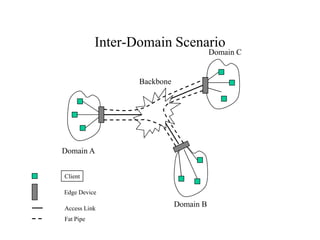
Inter-Domain Scenario
Backbone
Domain A
Client
Domain C
Domain B
Edge Device
Access Link
Fat Pipe
RTP Algorithms - I
• RTCP packets generation: need to limit the control
traffic
– Control traffic takes 5% of data traffic bandwidth (not
defined)
– ¼ of the RTCP bandwidth is used by senders
– Interval between RTCP packets scales linearly with the
number of members in the group.
– Each compound RTCP packet must include a report
packet and a SDES packet for timely feedback.
RTP Algorithms - II
• SSRCs are chosen randomly and locally and can
collide.
• Loops introduced by mixers and translators
– A translator may incorrectly forward a packet to the
same multicast group from which it has received the
packet.
– Parallel translators.
• Collision avoidance of SSRC and loop detection
are entangled.
Example of A Profile Document
• RTP data header:
– use one marker bit
– No additional fixed fields
– No RTP header extensions are defined.
• RTCP
– No additional RTCP packet types.
– No SR/RR extensions are defined
– SDES use: CNAME is sent every reporting interval,
other items should be sent only every fifth reporting
interval.
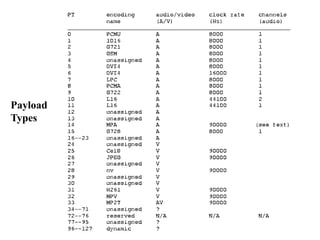
RFC1890: RTP Profile for Audio and Video Conferences with Minimal Control.
Payload
Types

Rtp

  • 1.
    An Introduction tothe Real-time Transport Protocol (RTP) Ye Xia WebTP Meeting 12/12/00
  • 2.
    Transport Functions • ApplicationSupport – Reliability control: loss recover, in-sequence delivery, etc. • Network Control – Congestion control, rate allocation, etc • The distinction between the two is not sharp. – Rate allocation and scheduling can be viewed as part of either one above. • This dual view arises when we contemplate traditional transports: TCP and UDP
  • 3.
    Violation of theOld View Leads to New Ideas Application Support Network Control Application-Specific Support Network Control Monolithic Transport General Application Support User Space Kernel Space RTP-like Arrangement Network Adaptation By Application
  • 4.
    Fine-grained Application Support •In monolithic transport, application support function needs to be general. Why? – Transport sits in the kernel. Hard to modify. – API needs to be stable. – The philosophy of some transport designers: transport should have sufficient generality. • How to accommodate specific application’s needs? – Build complex logic into the (monolithic) transport. But should not be overly ambitious.
  • 5.
    WebTP - Current •WebTP is still monolithic • Some trade-off of programmability with efficiency, but may be justifiable. – The key is to make the user-IP path fast. Application Support Network Control User Space Kernel Space IP
  • 6.
    Overview of RTP •Provides end-to-end delivery services for real-time traffic: interactive audio and video – Payload identification, sequence numbering, timestamping and delivery monitoring • Runs on top of UDP, and less often, TCP. – RTP does not guarantee delivery or prevent out-of- order delivery. • Primarily designed to support multiparty multimedia conferences, typically assumes IP multicast.
  • 7.
    Overview – Cont. •The protocol has two parts. – RTP: carry real-time data – RTP control protocol (RTCP): monitor the quality of service and to convey information about the participants. • Principles of application level framing and integrated layer processing. – Is malleable to provide application specific info. – Is typically integrated into the application processing. – Protocol is deliberately not complete. It only contains the common functions. – A complete specification for an application also includes a profile and a payload format document.
  • 8.
    Example- Multicast audio conference •Need a multicast address and a pair of ports: one for data and one for (RTCP) control. • RTP header contains type of audio encoding (such as PCM). Senders can change encoding during the conference. • RTP header contains timing information. Audio data can be played out as they are produced by the source. • Senders and receivers multicast reports through RTCP. Packet loss ratio, delay jitter, and other status info can be monitored.
  • 9.
    Example – Audioand Video Conference • Audio and video are transmitted using separate RTP sessions. (with different UDP ports and/or multicast addresses.) • Each participant of both sessions can be identified by the same name in RTCP packets. • The decoupling of the two sessions allows some participants to join only one session.
  • 10.
    Example – Mixersand Translators • Mixers: a RTP-level entity that receives streams of RTP data packets from one or more sources and combines them into a single stream. • A translator forwards RTP packets from different sources separately. • Mixer is like a new RTP-level source to the receivers. • Translator is more transparent. Receivers can identify individual sources even though packets pass through the same translator and carry the translator’s network source address. • Mixer can re-synchronize the incoming stream and generates its own timing info.
  • 11.
    Translators and Mixers •The real distinction between mixers and translators: SSRC identifier is not changed at a translator, but is changed at a mixer. • They both use a different transport address (network address + port) at the output side. • Multiple data packets can be combined into one. • Uses of translators and mixers: go-through firewalls; transcoding for low-bandwidth links; adding or removing encryption; emulating multicast address with one or more unicast addresses.
  • 12.
    Example: Translator atFirewall Translator Firewall Translator On multicast Address a, port p, p+1 On multicast Address b, port q, q+1 Inside Firewall Note that UDP or TCP connections terminates at Firewall.
  • 13.
    Some RTP Definitions •Transport address: network address + port • RTP session: communications on a pair of transport addresses (data + control) • Synchronization source (SSRC): the source of a stream of RTP packets – Identified by 32-bit SSRC identifier. – All packets from the same SSRC form a single timing and sequencing space. Receivers group packets by SSRC for playback. – Not dependent on network address. – Examples: all packets from a camera; from a mixer; for layered encoding transmitted on separate RTP sessions a single SSRC is used for all layers. – A participant need not use the same SSRC for all RTP sessions in a multimedia session.
  • 14.
    RTP Fixed Header P:Padding X: Header Extension CC: CSRC count M: Marker of record boundary PT: Payload type; mapping can be specified by profile of the application Sequence number: for each packet can be used by the receiver to detect loss or restore sequence.
  • 15.
    RTP Fixed Header– Cont. • Timestamp – Reflects sampling instant of the first byte of data – Clock frequency can be specified by profile of payload format documents for the application. – Example: for fixed-rate audio, clock may increment by one for each sampling period. • SSRC: chosen randomly for each synchronization source; with the intent that no two synchronization sources in the same session have the same SSRC.
  • 16.
    Profile-Specific Modifications to theRTP Header • Marker bit and payload type are interpreted according to the application’s profile. • Moreover, the byte containing them can be redefined by the profile. • If a particular class of application needs additional functionality, the profile should define additional fixed fields following SSRC. • If X bit is 1, exactly one header extension follows CSRC list (if present). – Variable length – Used to experimental purpose
  • 17.
    RTCP • Primary functionis to provide feedback on the quality of data distribution. – Through sender and receiver reports; – For adaptive encoding (adaptive to network congestion); – Can be used to diagnose faults • RTCP carries a persistent transport-level identifier for an RTP source, called canonical name, CNAME. – Receivers use CNAME to keep track of each participant – And to synchronize related media streams (with the help of NTP) • Passes participant’s identification for display.
  • 18.
    RTCP Packets • SR:sender reports; sending and reception stat. • RR: receiver reports; for reception statistics from multiple sources. • SDES: source description item, include CNAME • BYE: indicates end of participation • APP: application specific functions
  • 19.
    Compound RTCP Packets •A compound RTCP packet contains multiple RTCP packets of the previous types. • Example:
  • 20.
  • 21.
    SR Packet –Cont. • RC: receiver report count • Length: in 32-bit words – 1 • NTP ts: wallclock time, used to calculate RTT • RTP ts: in unit and offset of RTP ts in data packets. Can be used with NTP ts for inter-media synchronization. • Fraction lost: since the last RR or SR packet was sent. Short term loss ratio. • LSR: last SRT time stamp; middle 32 bits of NTP timestamp. • DLSR: delay since last SR; expressed in 1/65536 seconds between receiving the last SR packet from SSRC_n and sending this report. Source SSRC_n can compute RTT using DLSR, LSR and the reception time of the report, A. RTT = A – LSR – DLSR • An application’s profile can define extensions to SR or RR packets
  • 22.
  • 23.
    CNAME Item inSDES Packet • Mandatory • Provides a persistent identifier for a source. • Provides a binding across multiple media used by one participant in a set of related RTP sessions. CNAME should be fixed for that participant. • SSRC is bound to CNAME • Example: doe@sleepy.megacorp.com; doe@192.0.2.89, etc.
  • 24.
    Other Items inSDES Packet • NAME: user name • EMAIL: • PHONE: • LOC: location • TOOL: application or tool name • NOTE: notice/status
  • 25.
    BYE: Goodbye RTCPPacket • Mixers should forward the BYE packet with SSRC/CSRC unchanged. • Reason for leaving: string field; e.g., “camera malfunction”
  • 26.
    APP RTCP Packet •Subtype: allows a set of APP packets to be defined under one unique name. • Name: unique name in the scope of one this application.
  • 27.
    Conclusions - I •RTP defines transport support for common functions of real-time applications. – Timing information: sampling period and NTP – Synchronization source for playback – Payload types (encoding) – Quality reports: short-term and long-term packet loss, and jitters. – Participants indication: CNAME, NAME, EMAIL, etc. – Multicast distribution support – Conversion: mixers and translators • Extensible protocol by profile payload format documents • Customizable to application or application classes. Necessity of this feature is not clear.
  • 28.
    Conclusion – II •Separation of control and data stream (analogous to out-band signaling) – Data header overhead is small. – Can accomplish complex control features. – Complexity of the protocol/algorithm is not so bad, because there is little hard guarantee (It relies on TCP or application for hard guarantees).
  • 29.
    Conclusions – III •Congestion control is not defined in baseline document, but may be defined by application’s profile. – Leads to application-specific congestion control or adaptation • RTP can be considered user-space transport entities, but does not run as stand-alone process. • Mixers and translators are stand-alone processes. They terminate TCP or UDP connections.
  • 30.
    A View ofFuture Network Layer 3 Systems Transport System End Systems
  • 31.
    Inter-Domain Scenario Backbone Domain A Client DomainC Domain B Edge Device Access Link Fat Pipe
  • 32.
    RTP Algorithms -I • RTCP packets generation: need to limit the control traffic – Control traffic takes 5% of data traffic bandwidth (not defined) – ¼ of the RTCP bandwidth is used by senders – Interval between RTCP packets scales linearly with the number of members in the group. – Each compound RTCP packet must include a report packet and a SDES packet for timely feedback.
  • 33.
    RTP Algorithms -II • SSRCs are chosen randomly and locally and can collide. • Loops introduced by mixers and translators – A translator may incorrectly forward a packet to the same multicast group from which it has received the packet. – Parallel translators. • Collision avoidance of SSRC and loop detection are entangled.
  • 34.
    Example of AProfile Document • RTP data header: – use one marker bit – No additional fixed fields – No RTP header extensions are defined. • RTCP – No additional RTCP packet types. – No SR/RR extensions are defined – SDES use: CNAME is sent every reporting interval, other items should be sent only every fifth reporting interval. RFC1890: RTP Profile for Audio and Video Conferences with Minimal Control.
  • 35.