A D V A N C E D F O U N D A T I O N S A N D M E T H O D S O F E N G L I S H
L A N G U A G E L I T E R A C Y D E V E L O P M E N T A N D
C O N T E N T I N S T R U C T I O N ( O N L I N E )
U C L A E X T E N S I O N
M O D U L E 1 - - L E C T U R E 1
Data-Based Learning Goals and
Student Work Analysis
Data-Based Learning
 The use of data-based learning goals is not something
new, but rather has been expanded a great deal because
of new technology.
 Today ,we can see easily where students need work
because of the breakdown of standardized tests reports.
 Data-based learning goals drive effective
instructional decisions and high quality teaching.
 Designing and sharing specific learning targets to
enhance student achievement requires and continually
hones teachers’ decision-making expertise.
Data-Based Learning
 LAUSD has two sites about using data-based
instruction that you should bookmark now.
1. http://data.lausd.net
2. http://data.lausd.net/resources
Data Collection
 Collecting data and giving it to administrators or
boards of education who look at it and say that we, as
teachers, are not doing our jobs, is not helpful.
 Integrating data into faculty meetings should not be
limited to discussions of standardized scores.
 Instead, creating a sense of confidence that the
data will be used fairly and appropriately is
the duty of the administration.
Data Collection: Disaggregation
 This can be done by disaggregation, which means
looking at how specific subgroups perform.
 Typically, formal student achievement data come
“aggregated,” reported for the population as a
whole—the whole state, school, grade level, or class.
 Disaggregating can bring to light critical problems
and issues that might otherwise remain invisible.
Data Collection: Triangulation
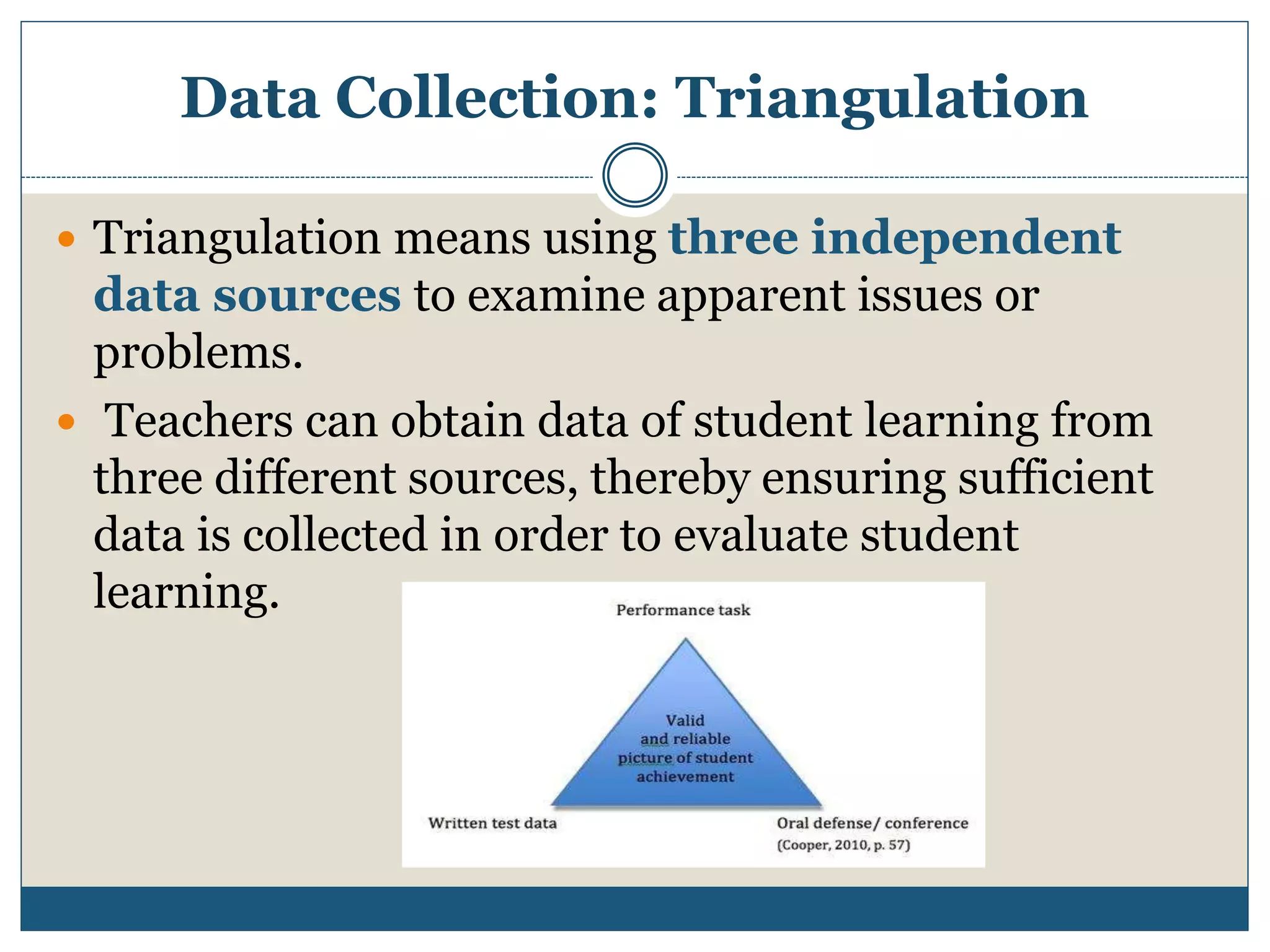
 Triangulation means using three independent
data sources to examine apparent issues or
problems.
 Teachers can obtain data of student learning from
three different sources, thereby ensuring sufficient
data is collected in order to evaluate student
learning.
Data Collection: Triangulation (cont.)
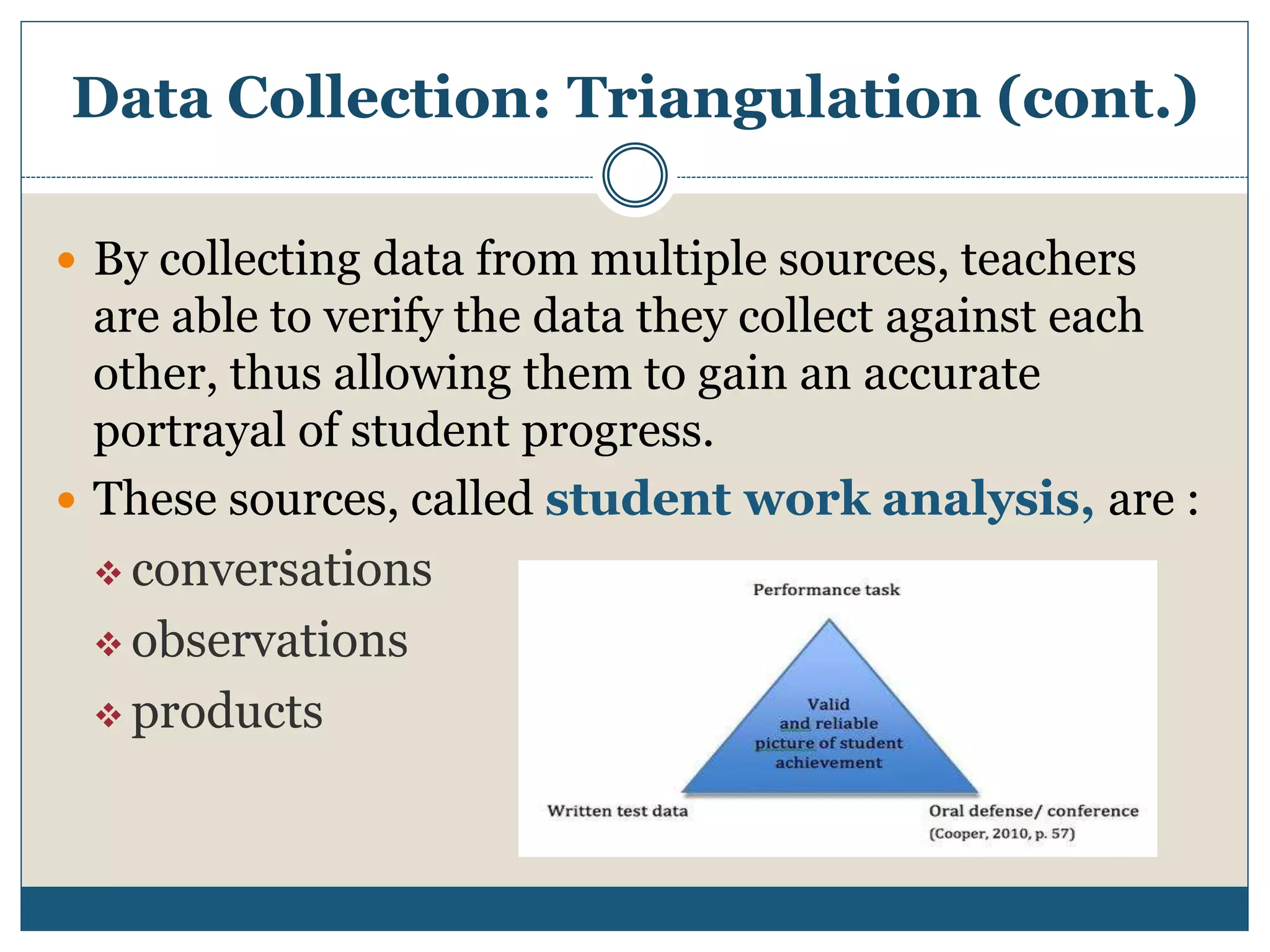
 By collecting data from multiple sources, teachers
are able to verify the data they collect against each
other, thus allowing them to gain an accurate
portrayal of student progress.
 These sources, called student work analysis, are :
 conversations
 observations
 products
Student Work Analysis
 Teachers have always examined student work as part
of their grading process.
 With the new focus on accountability and standards,
more structured and collaborative
examination of student work is needed.
 Student work analysis protocol (in the next slide),
was developed to help teachers understand what
students know and still need to learn.
Student Work Analysis Protocol
 The protocol focuses teachers on three critical areas:
1. Identification of characteristics of proficiency
on an objective using a specific
assignment/assessment;
2. A team of teachers who work through the
process of reaching consensus on what the team
believes constitutes a proficient response on a
selected text and question;
3. Diagnosis of student strengths and needs on the
performance.
Student Work Analysis Protocol
 This team examines three student papers to
determine if the response is proficient and to identify
what the student knows and still needs to learn.
 The next instructional steps are based on the
diagnosis, including:
 What questions the teacher might want to ask the student to
better understand his/her thinking,
 What feedback the teacher might give, and
 What re-teaching might need to take place for the whole or
part of the class.
Shift from Scoring to Diagnosing
 This process requires teachers to shift their mindset from
scoring (a summative examination) to diagnosing
(a formative examination) student performance.
 In many cases, teachers have spent a great deal of time
sorting student responses (either by letter grades or by
rubric scores) and virtually no time diagnosing what
students know and still need to learn.
 It is only the diagnostic information that will help
teachers understand what they need to do next
instructionally with their students.
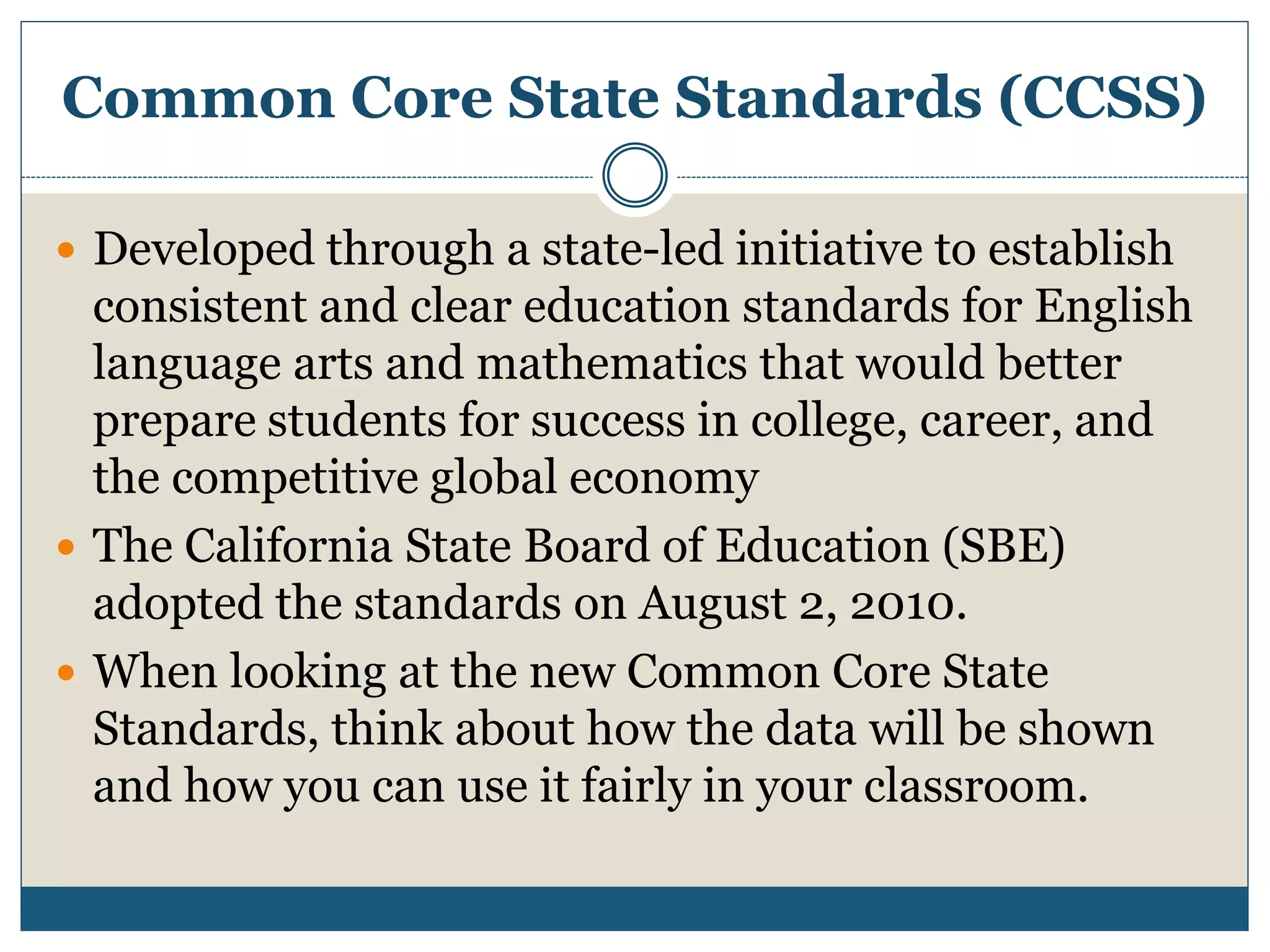
Common Core State Standards (CCSS)
 Developed through a state-led initiative to establish
consistent and clear education standards for English
language arts and mathematics that would better
prepare students for success in college, career, and
the competitive global economy
 The California State Board of Education (SBE)
adopted the standards on August 2, 2010.
 When looking at the new Common Core State
Standards, think about how the data will be shown
and how you can use it fairly in your classroom.
Common Core State Standards (CCSS)
 For more information on the Common Core
State Standards, please visit the CDE website
at: http://www.cde.ca.gov/ci/cc/
 CDE is in the process of developing
implementation plans to assist schools and
districts in the transition to the new standards.
Common Core State Standards (CCSS)
 This school year (2014-2015), we will transition to one
of two recently funded assessment consortia, the
SMARTER Balanced Assessment Consortium.
 Both will be tightly aligned to the Common Core State
Standards with the goal of determining the degree to
which students are college and/or career ready.
 As we move forward with the implementation of
assessment processes being promoted by these two
systems, we find ourselves migrating to new item types
and test formats.
 The move to large-scale use of technology-based
assessments has arrived.
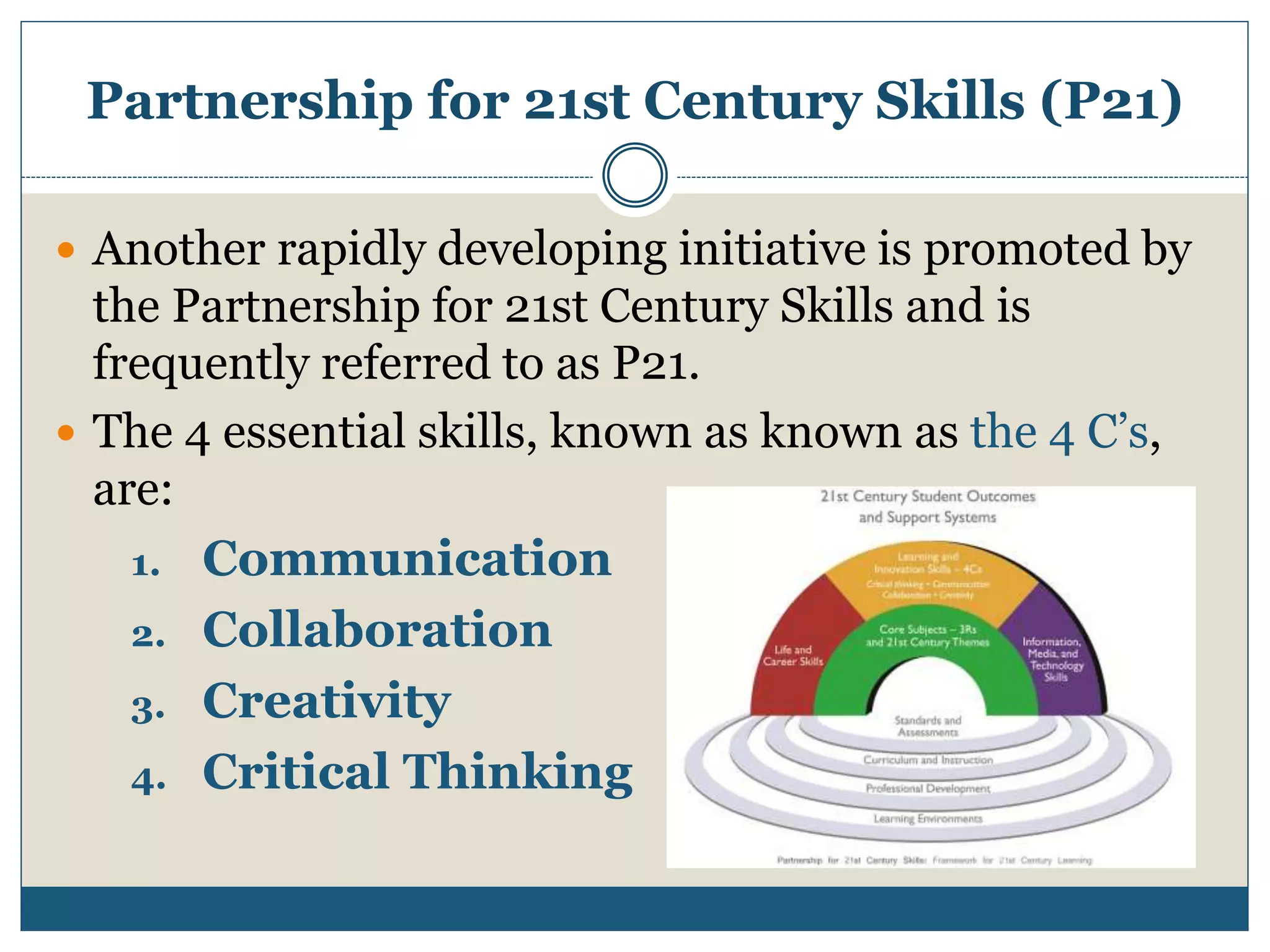
Partnership for 21st Century Skills (P21)
 Another rapidly developing initiative is promoted by
the Partnership for 21st Century Skills and is
frequently referred to as P21.
 The 4 essential skills, known as known as the 4 C’s,
are:
1. Communication
2. Collaboration
3. Creativity
4. Critical Thinking
Assessment Characteristics in the P21
 Supports a balance of assessments, including
high-quality standardized testing along with effective
formative and summative classroom assessment
emphasizes useful feedback on student performance
that is embedded into everyday learning.
 Requires a balance of technology-enhanced,
formative and summative assessments that
measure student mastery of 21st century skills.
Assessment Characteristics in the P21
 Enables development of portfolios of student work
that demonstrate mastery of 21st century skills to
educators and prospective employers.
 Enables a balanced portfolio of measures to
assess the educational system’s effectiveness in
reaching high levels of student competency in 21st
century skills.
 The implications for teaching and learning are large.
 You may want to reflect upon how the ultimate
impact of the four C’s will impact how we teach and
how we assess our students.
Final Notes
 There are several types of assessments that serve
different purposes.
 Although the method and modes of assessment are
subject to change, the uses of assessment data
remain relatively constant:
1. To gauge the achievement level of our students
2. To provide us with feedback on the effectiveness of our
teaching
3. Through the use of formative data we are able to
pinpoint key skills and concepts that may need to be re-
taught

Advanced Foundations and Methods in EL (Lecture 1)

  • 1.
    A D VA N C E D F O U N D A T I O N S A N D M E T H O D S O F E N G L I S H L A N G U A G E L I T E R A C Y D E V E L O P M E N T A N D C O N T E N T I N S T R U C T I O N ( O N L I N E ) U C L A E X T E N S I O N M O D U L E 1 - - L E C T U R E 1 Data-Based Learning Goals and Student Work Analysis
  • 2.
    Data-Based Learning  Theuse of data-based learning goals is not something new, but rather has been expanded a great deal because of new technology.  Today ,we can see easily where students need work because of the breakdown of standardized tests reports.  Data-based learning goals drive effective instructional decisions and high quality teaching.  Designing and sharing specific learning targets to enhance student achievement requires and continually hones teachers’ decision-making expertise.
  • 3.
    Data-Based Learning  LAUSDhas two sites about using data-based instruction that you should bookmark now. 1. http://data.lausd.net 2. http://data.lausd.net/resources
  • 4.
    Data Collection  Collectingdata and giving it to administrators or boards of education who look at it and say that we, as teachers, are not doing our jobs, is not helpful.  Integrating data into faculty meetings should not be limited to discussions of standardized scores.  Instead, creating a sense of confidence that the data will be used fairly and appropriately is the duty of the administration.
  • 5.
    Data Collection: Disaggregation This can be done by disaggregation, which means looking at how specific subgroups perform.  Typically, formal student achievement data come “aggregated,” reported for the population as a whole—the whole state, school, grade level, or class.  Disaggregating can bring to light critical problems and issues that might otherwise remain invisible.
  • 6.
    Data Collection: Triangulation Triangulation means using three independent data sources to examine apparent issues or problems.  Teachers can obtain data of student learning from three different sources, thereby ensuring sufficient data is collected in order to evaluate student learning.
  • 7.
    Data Collection: Triangulation(cont.)  By collecting data from multiple sources, teachers are able to verify the data they collect against each other, thus allowing them to gain an accurate portrayal of student progress.  These sources, called student work analysis, are :  conversations  observations  products
  • 8.
    Student Work Analysis Teachers have always examined student work as part of their grading process.  With the new focus on accountability and standards, more structured and collaborative examination of student work is needed.  Student work analysis protocol (in the next slide), was developed to help teachers understand what students know and still need to learn.
  • 9.
    Student Work AnalysisProtocol  The protocol focuses teachers on three critical areas: 1. Identification of characteristics of proficiency on an objective using a specific assignment/assessment; 2. A team of teachers who work through the process of reaching consensus on what the team believes constitutes a proficient response on a selected text and question; 3. Diagnosis of student strengths and needs on the performance.
  • 10.
    Student Work AnalysisProtocol  This team examines three student papers to determine if the response is proficient and to identify what the student knows and still needs to learn.  The next instructional steps are based on the diagnosis, including:  What questions the teacher might want to ask the student to better understand his/her thinking,  What feedback the teacher might give, and  What re-teaching might need to take place for the whole or part of the class.
  • 11.
    Shift from Scoringto Diagnosing  This process requires teachers to shift their mindset from scoring (a summative examination) to diagnosing (a formative examination) student performance.  In many cases, teachers have spent a great deal of time sorting student responses (either by letter grades or by rubric scores) and virtually no time diagnosing what students know and still need to learn.  It is only the diagnostic information that will help teachers understand what they need to do next instructionally with their students.
  • 12.
    Common Core StateStandards (CCSS)  Developed through a state-led initiative to establish consistent and clear education standards for English language arts and mathematics that would better prepare students for success in college, career, and the competitive global economy  The California State Board of Education (SBE) adopted the standards on August 2, 2010.  When looking at the new Common Core State Standards, think about how the data will be shown and how you can use it fairly in your classroom.
  • 13.
    Common Core StateStandards (CCSS)  For more information on the Common Core State Standards, please visit the CDE website at: http://www.cde.ca.gov/ci/cc/  CDE is in the process of developing implementation plans to assist schools and districts in the transition to the new standards.
  • 14.
    Common Core StateStandards (CCSS)  This school year (2014-2015), we will transition to one of two recently funded assessment consortia, the SMARTER Balanced Assessment Consortium.  Both will be tightly aligned to the Common Core State Standards with the goal of determining the degree to which students are college and/or career ready.  As we move forward with the implementation of assessment processes being promoted by these two systems, we find ourselves migrating to new item types and test formats.  The move to large-scale use of technology-based assessments has arrived.
  • 15.
    Partnership for 21stCentury Skills (P21)  Another rapidly developing initiative is promoted by the Partnership for 21st Century Skills and is frequently referred to as P21.  The 4 essential skills, known as known as the 4 C’s, are: 1. Communication 2. Collaboration 3. Creativity 4. Critical Thinking
  • 16.
    Assessment Characteristics inthe P21  Supports a balance of assessments, including high-quality standardized testing along with effective formative and summative classroom assessment emphasizes useful feedback on student performance that is embedded into everyday learning.  Requires a balance of technology-enhanced, formative and summative assessments that measure student mastery of 21st century skills.
  • 17.
    Assessment Characteristics inthe P21  Enables development of portfolios of student work that demonstrate mastery of 21st century skills to educators and prospective employers.  Enables a balanced portfolio of measures to assess the educational system’s effectiveness in reaching high levels of student competency in 21st century skills.  The implications for teaching and learning are large.  You may want to reflect upon how the ultimate impact of the four C’s will impact how we teach and how we assess our students.
  • 18.
    Final Notes  Thereare several types of assessments that serve different purposes.  Although the method and modes of assessment are subject to change, the uses of assessment data remain relatively constant: 1. To gauge the achievement level of our students 2. To provide us with feedback on the effectiveness of our teaching 3. Through the use of formative data we are able to pinpoint key skills and concepts that may need to be re- taught