The Better Care Fund
Refreshing the High Impact
Change Model for Managing
Transfers for Care
Fiona Russell, Local Government Association
fiona.russell@local.gov.uk; 07799 466328
26 November 2020 www.local.gov.uk
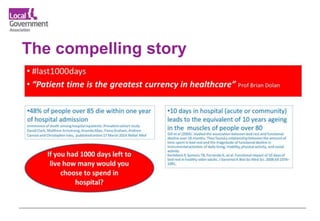
The compelling story
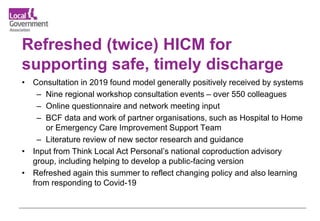
Refreshed (twice) HICM for
supporting safe, timely discharge
• Consultation in 2019 found model generally positively received by systems
– Nine regional workshop consultation events – over 550 colleagues
– Online questionnaire and network meeting input
– BCF data and work of partner organisations, such as Hospital to Home
or Emergency Care Improvement Support Team
– Literature review of new sector research and guidance
• Input from Think Local Act Personal’s national coproduction advisory
group, including helping to develop a public-facing version
• Refreshed again this summer to reflect changing policy and also learning
from responding to Covid-19
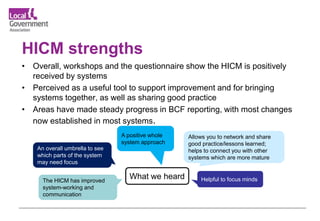
HICM strengths
• Overall, workshops and the questionnaire show the HICM is positively
received by systems
• Perceived as a useful tool to support improvement and for bringing
systems together, as well as sharing good practice
• Areas have made steady progress in BCF reporting, with most changes
now established in most systems.
What we heard
The HICM has improved
system-working and
communication
Helpful to focus minds
A positive whole
system approach
An overall umbrella to see
which parts of the system
may need focus
Allows you to network and share
good practice/lessons learned;
helps to connect you with other
systems which are more mature
Key areas for improvement
• Greater clarity and guidance around the HICM, while ensuring it better
allows for local variance and flexibility
• A strengthening of focus on the person, and greater emphasis on the key
Home First policy
• Extend scope to wider partners, housing issues, and admission avoidance
• Recognition of underpinning behaviours and enablers, such as the
importance of strong system leadership and positive working cultures
• Workshop participants found change 5 the most difficult, and change 7 the
most confusing. BCF/questionnaire found changes 5, 6 and 7 the hardest
• As a result, we have added:
– I and We statements
– More case studies and supporting material
– A new change on housing and related services
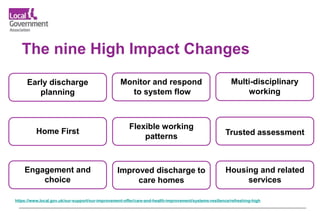
The nine High Impact Changes
Early discharge
planning
Monitor and respond
to system flow
Multi-disciplinary
working
Home First
Flexible working
patterns Trusted assessment
Engagement and
choice
Improved discharge to
care homes
Housing and related
services
https://www.local.gov.uk/our-support/our-improvement-offer/care-and-health-improvement/systems-resilience/refreshing-high
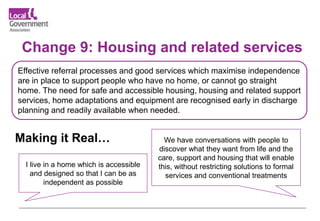
Change 9: Housing and related services
Effective referral processes and good services which maximise independence
are in place to support people who have no home, or cannot go straight
home. The need for safe and accessible housing, housing and related support
services, home adaptations and equipment are recognised early in discharge
planning and readily available when needed.
We have conversations with people to
discover what they want from life and the
care, support and housing that will enable
this, without restricting solutions to formal
services and conventional treatments
I live in a home which is accessible
and designed so that I can be as
independent as possible
Making it Real…
Change 9: Housing and related services
Key points
• Early discharge planning includes a person’s housing situation or needs
• Include housing/housing service provider(s) as real or virtual member(s) of
your discharge planning team.
• Fix it now
• Inform your workforce – educate them about options, beyond aids and
adaptations
• Homelessness should not be a reason for delaying discharge
• Consider the role of the voluntary, community and social enterprise sector
in support people to get home, and access support in their community
• Short-term accommodation, such as step-down, can be appropriate where
a person is ready to go home but their home is not ready
• Use data to understand demand for, and capacity of housing services
Home First and Discharge to Assess
• Hospital discharge policy embeds many aspects of HICM
• Instead of counting delayed discharges, focus is on reconfiguring care
model, services and pathways to support policy
• Work with commissioners and system leads to demonstrate your role in
supporting policy – what ‘service offer’ can you develop?
• Support to develop the HICM as a whole model, or to assess, progress or
implement individual changes
• Delivered in partnership with Better Care Fund Team and NHS
Emergency Care Improvement Support Team
• Peer reviews, bespoke support, briefings, good practice tools, webinars
• https://www.local.gov.uk/our-support/our-improvement-offer/care-and-
health-improvement/integration-and-better-care-fund/support-offer
A new tool on reducing
preventable admissions to
health or care settings
www.local.gov.uk
What does the tool cover?
• What are preventable admissions?
• Those where there was scope for earlier, or different, action to prevent
an individual’s health deteriorating to the extent where hospital or
long-term bed-based care is required
• The good practice tool:
• Is founded on principle that most people want to be at home and
independent for as long
as possible, with support where necessary
• Includes practical examples, covering equally health and care
interventions – including housing and wider public services
• Is a self-assessment for improvement, not performance management,
and is applicable on any footprint
• Jointly developed by the LGA, with NHSEI and wide range of partners
What does the tool cover?
• Two goals:
• Five high impact actions across one or both goals:
1. Population health management approach to identifying
those most at risk
2. Target and tailor interventions and support for those most at risk
3. Practise effective multi-disciplinary working
4. Encourage and empower individuals to self-manage
5. Provide a coordinated and rapid response to crisis in
the community
Stop crisis becoming
an admission
Prevent crisis

LGA - High Impact Change Model

  • 1.
    The Better CareFund Refreshing the High Impact Change Model for Managing Transfers for Care Fiona Russell, Local Government Association fiona.russell@local.gov.uk; 07799 466328 26 November 2020 www.local.gov.uk
  • 2.
  • 3.
    Refreshed (twice) HICMfor supporting safe, timely discharge • Consultation in 2019 found model generally positively received by systems – Nine regional workshop consultation events – over 550 colleagues – Online questionnaire and network meeting input – BCF data and work of partner organisations, such as Hospital to Home or Emergency Care Improvement Support Team – Literature review of new sector research and guidance • Input from Think Local Act Personal’s national coproduction advisory group, including helping to develop a public-facing version • Refreshed again this summer to reflect changing policy and also learning from responding to Covid-19
  • 4.
    HICM strengths • Overall,workshops and the questionnaire show the HICM is positively received by systems • Perceived as a useful tool to support improvement and for bringing systems together, as well as sharing good practice • Areas have made steady progress in BCF reporting, with most changes now established in most systems. What we heard The HICM has improved system-working and communication Helpful to focus minds A positive whole system approach An overall umbrella to see which parts of the system may need focus Allows you to network and share good practice/lessons learned; helps to connect you with other systems which are more mature
  • 5.
    Key areas forimprovement • Greater clarity and guidance around the HICM, while ensuring it better allows for local variance and flexibility • A strengthening of focus on the person, and greater emphasis on the key Home First policy • Extend scope to wider partners, housing issues, and admission avoidance • Recognition of underpinning behaviours and enablers, such as the importance of strong system leadership and positive working cultures • Workshop participants found change 5 the most difficult, and change 7 the most confusing. BCF/questionnaire found changes 5, 6 and 7 the hardest • As a result, we have added: – I and We statements – More case studies and supporting material – A new change on housing and related services
  • 6.
    The nine HighImpact Changes Early discharge planning Monitor and respond to system flow Multi-disciplinary working Home First Flexible working patterns Trusted assessment Engagement and choice Improved discharge to care homes Housing and related services https://www.local.gov.uk/our-support/our-improvement-offer/care-and-health-improvement/systems-resilience/refreshing-high
  • 7.
    Change 9: Housingand related services Effective referral processes and good services which maximise independence are in place to support people who have no home, or cannot go straight home. The need for safe and accessible housing, housing and related support services, home adaptations and equipment are recognised early in discharge planning and readily available when needed. We have conversations with people to discover what they want from life and the care, support and housing that will enable this, without restricting solutions to formal services and conventional treatments I live in a home which is accessible and designed so that I can be as independent as possible Making it Real…
  • 8.
    Change 9: Housingand related services Key points • Early discharge planning includes a person’s housing situation or needs • Include housing/housing service provider(s) as real or virtual member(s) of your discharge planning team. • Fix it now • Inform your workforce – educate them about options, beyond aids and adaptations • Homelessness should not be a reason for delaying discharge • Consider the role of the voluntary, community and social enterprise sector in support people to get home, and access support in their community • Short-term accommodation, such as step-down, can be appropriate where a person is ready to go home but their home is not ready • Use data to understand demand for, and capacity of housing services
  • 9.
    Home First andDischarge to Assess • Hospital discharge policy embeds many aspects of HICM • Instead of counting delayed discharges, focus is on reconfiguring care model, services and pathways to support policy • Work with commissioners and system leads to demonstrate your role in supporting policy – what ‘service offer’ can you develop? • Support to develop the HICM as a whole model, or to assess, progress or implement individual changes • Delivered in partnership with Better Care Fund Team and NHS Emergency Care Improvement Support Team • Peer reviews, bespoke support, briefings, good practice tools, webinars • https://www.local.gov.uk/our-support/our-improvement-offer/care-and- health-improvement/integration-and-better-care-fund/support-offer
  • 10.
    A new toolon reducing preventable admissions to health or care settings www.local.gov.uk
  • 11.
    What does thetool cover? • What are preventable admissions? • Those where there was scope for earlier, or different, action to prevent an individual’s health deteriorating to the extent where hospital or long-term bed-based care is required • The good practice tool: • Is founded on principle that most people want to be at home and independent for as long as possible, with support where necessary • Includes practical examples, covering equally health and care interventions – including housing and wider public services • Is a self-assessment for improvement, not performance management, and is applicable on any footprint • Jointly developed by the LGA, with NHSEI and wide range of partners
  • 12.
    What does thetool cover? • Two goals: • Five high impact actions across one or both goals: 1. Population health management approach to identifying those most at risk 2. Target and tailor interventions and support for those most at risk 3. Practise effective multi-disciplinary working 4. Encourage and empower individuals to self-manage 5. Provide a coordinated and rapid response to crisis in the community Stop crisis becoming an admission Prevent crisis