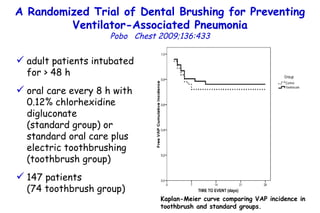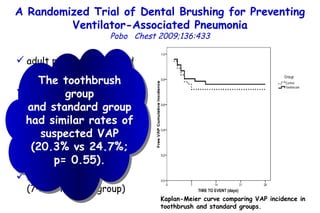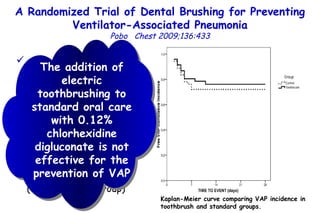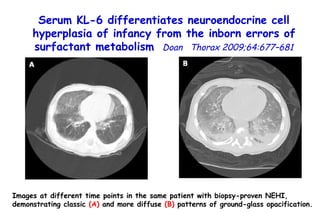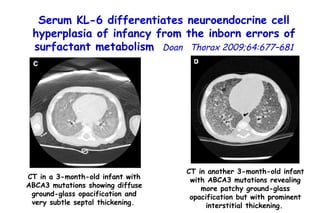





WHAT YOU SHOULD HAVE READ BUT….2010 pulmonology University of Verona, Italy Attilio Boner
Bronchiolitis
Bronchiolitis Risk factors
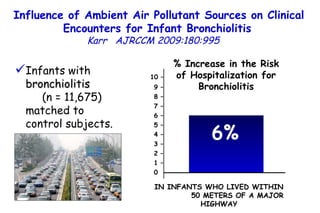
Influence of Ambient Air Pollutant Sources on Clinical Encounters for Infant Bronchiolitis   Karr   AJRCCM 2009:180:995  Infants with  bronchiolitis   (n = 11,675) matched to control subjects.  IN INFANTS WHO LIVED WITHIN  50 METERS OF A MAJOR HIGHWAY  % Increase in the Risk of Hospitalization for Bronchiolitis 6% 10 – 9 – 8 – 7 – 6 – 5 – 4 – 3 – 2 – 1 – 0
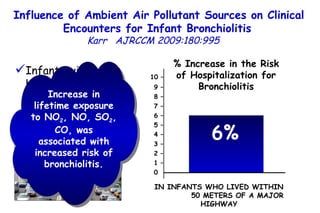
Influence of Ambient Air Pollutant Sources on Clinical Encounters for Infant Bronchiolitis   Karr   AJRCCM 2009:180:995  Infants with  bronchiolitis   (n = 11,675) matched to control subjects.  IN INFANTS WHO LIVED WITHIN  50 METERS OF A MAJOR HIGHWAY  % Increase in the Risk of Hospitalization for Bronchiolitis 6% 10 – 9 – 8 – 7 – 6 – 5 – 4 – 3 – 2 – 1 – 0 Increase in lifetime exposure to NO 2 , NO, SO 2 , CO, was associated with increased risk of bronchiolitis.
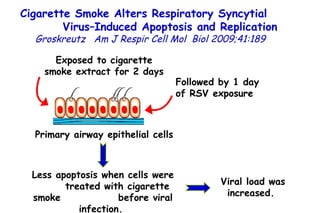
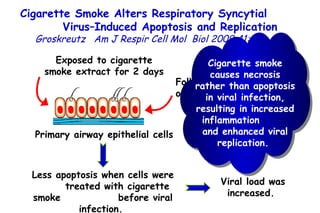
Cigarette Smoke Alters Respiratory Syncytial  Virus–Induced Apoptosis and Replication Groskreutz   Am J Respir Cell Mol  Biol 2009;41:189  Exposed to cigarette smoke extract for 2 days  Primary airway epithelial cells  Followed by 1 day  of RSV exposure  Less apoptosis when cells were  treated with cigarette smoke  before viral infection.  Viral load was increased.
Cigarette Smoke Alters Respiratory Syncytial  Virus–Induced Apoptosis and Replication Groskreutz   Am J Respir Cell Mol  Biol 2009;41:189  Exposed to cigarette smoke extract for 2 days  Primary airway epithelial cells  Followed by 1 day  of RSV exposure  Less apoptosis when cells were  treated with cigarette smoke  before viral infection.  Viral load was increased.  Cigarette smoke causes necrosis rather than apoptosis in viral infection, resulting in increased inflammation  and enhanced viral replication.
Cytokine responses in cord blood predict the severity of later respiratory syncytial virus infection Juntti  JACI 2009;124:52  Background: It has been claimed that an early respiratory syncytial virus (RSV) infection can induce asthma and recurrent wheezing. Objective: We addressed the question of whether infants contracting an early RSV infection differ from healthy children in their cytokine production at birth.
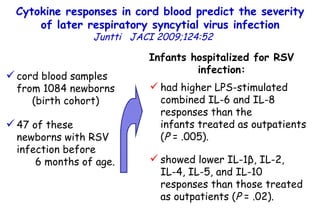
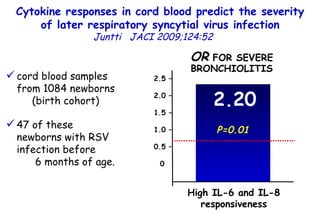
Cytokine responses in cord blood predict the severity of later respiratory syncytial virus infection Juntti  JACI 2009;124:52  cord blood samples from 1084 newborns  (birth cohort)  47 of these newborns with RSV infection before  6 months of age.  had higher LPS-stimulated combined IL-6 and IL-8 responses than the  infants treated as outpatients ( P  = .005).  showed lower IL-1β, IL-2,  IL-4, IL-5, and IL-10 responses than those treated as outpatients ( P  = .02). Infants hospitalized for RSV infection:
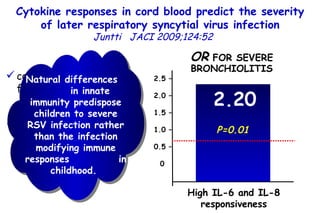
Cytokine responses in cord blood predict the severity of later respiratory syncytial virus infection Juntti  JACI 2009;124:52  2.20 High IL-6 and IL-8 responsiveness OR  FOR SEVERE BRONCHIOLITIS 2.5 – 2.0 – 1.5 – 1.0 – 0.5 – 0 P=0.01 cord blood samples from 1084 newborns  (birth cohort)  47 of these newborns with RSV infection before  6 months of age.
Cytokine responses in cord blood predict the severity of later respiratory syncytial virus infection Juntti  JACI 2009;124:52  2.20 High IL-6 and IL-8 responsiveness OR  FOR SEVERE BRONCHIOLITIS 2.5 – 2.0 – 1.5 – 1.0 – 0.5 – 0 P=0.01 cord blood samples from 1084 newborns  (birth cohort)  47 of these newborns with RSV infection before  6 months of age.  Natural differences  in innate immunity predispose children to severe RSV infection rather than the infection modifying immune responses  in childhood.
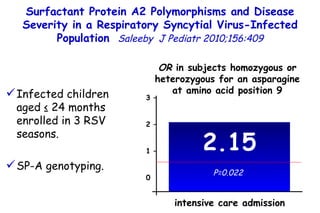
Surfactant protein A  (SP-A) is now recognized as a pattern recognition receptor functioning as a  component of the innate immune system .  The human SP-A gene locus consists of 2 functional genes, SP-A1 and SP-A2.  Both SP-A loci are polymorphic, with several single-nucleotide polymorphisms (SNPs) Surfactant Protein A2 Polymorphisms and Disease Severity in a Respiratory Syncytial Virus-Infected Population   Saleeby  J Pediatr 2010;156:409
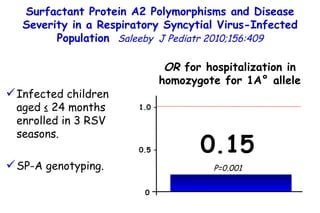
0.15 1.0 – 0.5 – 0 Infected children aged ≤ 24 months enrolled in 3 RSV seasons. SP-A genotyping. OR  for hospitalization in homozygote for 1A° allele Surfactant Protein A2 Polymorphisms and Disease Severity in a Respiratory Syncytial Virus-Infected Population   Saleeby  J Pediatr 2010;156:409 P=0.001
2.15 Infected children aged ≤ 24 months enrolled in 3 RSV seasons. SP-A genotyping. OR  in subjects  homozygous or heterozygous for an asparagine at amino acid position 9 Surfactant Protein A2 Polymorphisms and Disease Severity in a Respiratory Syncytial Virus-Infected Population   Saleeby  J Pediatr 2010;156:409 P=0.022 3 – 2 – 1 – 0 intensive care admission
Does Low Birth Weight Confer a Lifelong  Respiratory Disadvantage?  Greenough  Am J Respir Crit Care Med 2009;180:107  Almost 20 years ago Barker reported that airway function was diminished in adults born with lower birth weight and speculated that prenatal nutrition might program fetal lung growth.  Subsequently, evidence has shown that low birth weight is associated with excess respiratory morbidity in adults, regardless of whether the low birth weight was the result of in utero growth retardation or premature birth.
Low Birth Weight and Respiratory Disease in Adulthood A Population-based Case-Control Study  Walter  Am J Respir Crit Care Med 2009;180:176  Rationale :  The proportion of low and very low birth weight births is increasing. Infants and children with  a history of low and very low birth weight have an increased risk of respiratory illnesses, but it is unknown if clinically significant disease persists into adulthood.  Objectives :  To determine if a history of low birth weight is associated with hospitalization for respiratory illness in adulthood.
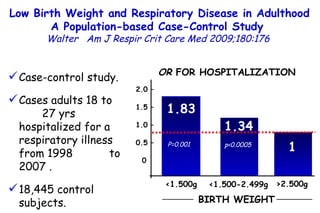
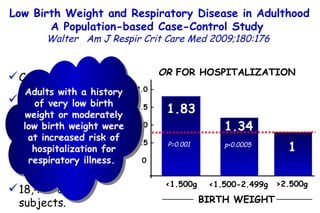
Low Birth Weight and Respiratory Disease in Adulthood A Population-based Case-Control Study  Walter  Am J Respir Crit Care Med 2009;180:176  Case-control study.  Cases adults 18 to  27 yrs hospitalized for a respiratory illness from 1998  to 2007 . 18,445 control subjects.  <1.500g OR  FOR HOSPITALIZATION <1.500-2.499g >2.500g 1.83 1.34 1 p<0.0005 P=0.001 2.0 – 1.5 – 1.0 – 0.5 – 0 BIRTH WEIGHT
Low Birth Weight and Respiratory Disease in Adulthood A Population-based Case-Control Study  Walter  Am J Respir Crit Care Med 2009;180:176  Case-control study.  Cases adults 18 to  27 yrs hospitalized for a respiratory illness from 1998  to 2007 . 18,445 control subjects.  <1.500g OR  FOR HOSPITALIZATION <1.500-2.499g >2.500g 1.83 1.34 1 p<0.0005 P=0.001 2.0 – 1.5 – 1.0 – 0.5 – 0 BIRTH WEIGHT Adults with a history of very low birth weight or moderately low birth weight were at increased risk of hospitalization for respiratory illness.
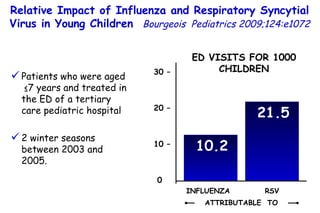
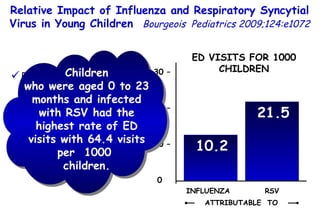
Relative Impact of Influenza and Respiratory Syncytial Virus in Young Children  Bourgeois  Pediatrics 2009;124:e1072 Patients who were aged  ≤7 years and treated in the ED of a tertiary care pediatric hospital 2 winter seasons between 2003 and 2005. ED VISITS FOR 1000 CHILDREN 10.2 30 – 20 – 10 – 0 21.5 INFLUENZA RSV ATTRIBUTABLE  TO
Relative Impact of Influenza and Respiratory Syncytial Virus in Young Children  Bourgeois  Pediatrics 2009;124:e1072 Patients who were aged  ≤7 years and treated in the ED of a tertiary care pediatric hospital 2 winter seasons between 2003 and 2005. ED VISITS FOR 1000 CHILDREN 10.2 30 – 20 – 10 – 0 21.5 INFLUENZA RSV ATTRIBUTABLE  TO Children who were aged 0 to 23 months and infected with RSV had the highest rate of ED visits with 64.4 visits per  1000  children.
Bronchiolitis Assesment
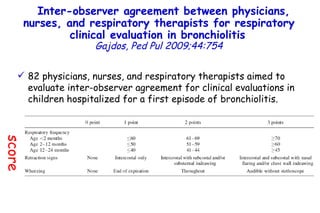
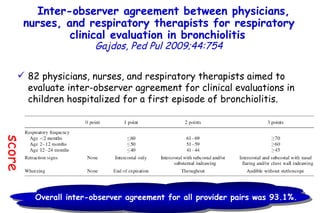
Inter-observer agreement between physicians, nurses, and respiratory therapists for respiratory clinical evaluation in bronchiolitis   Gajdos, Ped Pul 2009;44:754 5/60 85% 51/60 82 physicians, nurses, and respiratory therapists aimed to evaluate inter-observer agreement for clinical evaluations in children hospitalized for a first episode of bronchiolitis.  score
Inter-observer agreement between physicians, nurses, and respiratory therapists for respiratory clinical evaluation in bronchiolitis   Gajdos, Ped Pul 2009;44:754 5/60 85% 51/60 82 physicians, nurses, and respiratory therapists aimed to evaluate inter-observer agreement for clinical evaluations in children hospitalized for a first episode of bronchiolitis.  score Overall inter-observer agreement for all provider pairs was 93.1%.
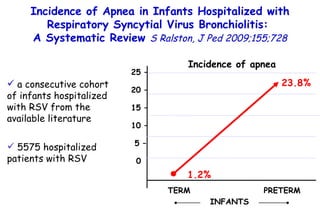
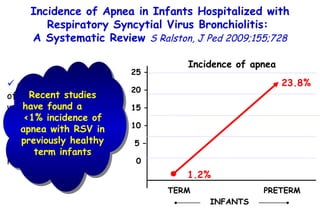
a consecutive cohort of infants hospitalized with RSV  from the available literature 5575 hospitalized patients with RSV Incidence of apnea 25 – 20 – 15 – 10 – 5 – 0 TERM Incidence of Apnea in Infants Hospitalized with Respiratory Syncytial Virus Bronchiolitis:  A Systematic Review  S Ralston,  J Ped 2009;155;728 PRETERM 1.2% 23.8% INFANTS
a consecutive cohort of infants hospitalized with RSV  from the available literature 5575 hospitalized patients with RSV Incidence of apnea 25 – 20 – 15 – 10 – 5 – 0 TERM Incidence of Apnea in Infants Hospitalized with Respiratory Syncytial Virus Bronchiolitis:  A Systematic Review  S Ralston,  J Ped 2009;155;728 PRETERM 1.2% 23.8% INFANTS Recent studies have found a  <1% incidence of apnea with RSV in previously healthy term infants
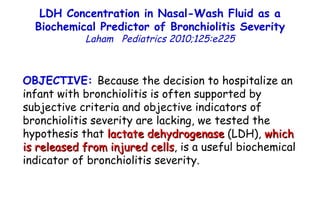
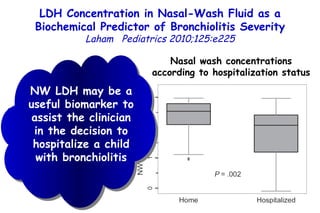
LDH Concentration in Nasal-Wash Fluid as a Biochemical Predictor of Bronchiolitis Severity Laham  Pediatrics 2010;125:e225 OBJECTIVE:  Because the decision to hospitalize an infant with bronchiolitis is often supported by subjective criteria and objective indicators of bronchiolitis severity are lacking, we tested the hypothesis that  lactate dehydrogenase  (LDH),  which  is released from injured cells , is a useful biochemical indicator of bronchiolitis severity.
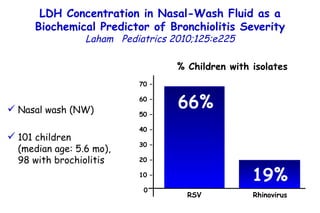
LDH Concentration in Nasal-Wash Fluid as a Biochemical Predictor of Bronchiolitis Severity Laham  Pediatrics 2010;125:e225 % Children with isolates 66% 70 – 60 – 50 – 40 – 30 – 20 – 10 – 0 19% RSV Rhinovirus Nasal wash (NW) 101 children  (median age: 5.6 mo),  98 with brochiolitis
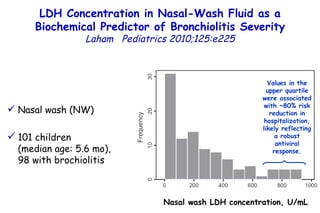
LDH Concentration in Nasal-Wash Fluid as a Biochemical Predictor of Bronchiolitis Severity Laham  Pediatrics 2010;125:e225 Nasal wash LDH concentration, U/mL Values in the upper  quartile were associated with ~80% risk reduction in hospitalization, likely reflecting a robust antiviral response. Nasal wash (NW) 101 children  (median age: 5.6 mo),  98 with brochiolitis
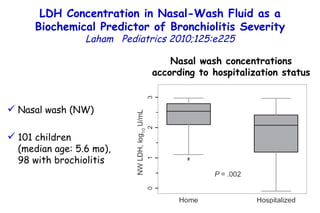
LDH Concentration in Nasal-Wash Fluid as a Biochemical Predictor of Bronchiolitis Severity Laham  Pediatrics 2010;125:e225 Nasal wash concentrations according to hospitalization  status Nasal wash (NW) 101 children  (median age: 5.6 mo),  98 with brochiolitis
LDH Concentration in Nasal-Wash Fluid as a Biochemical Predictor of Bronchiolitis Severity Laham  Pediatrics 2010;125:e225 Nasal wash (NW) 101 children  (median age: 5.6 months), 98 with brochiolitis  Nasal wash concentrations according to hospitalization  status NW LDH may be a useful biomarker to assist the clinician in the decision to hospitalize a child with bronchiolitis
BronchiolitisTreatment
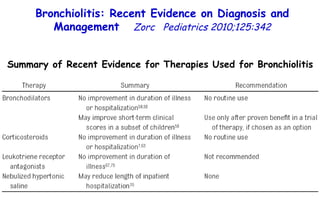
Bronchiolitis: Recent Evidence on Diagnosis and Management  Zorc  Pediatrics 2010;125:342 Summary of Recent Evidence for Therapies Used for Bronchiolitis
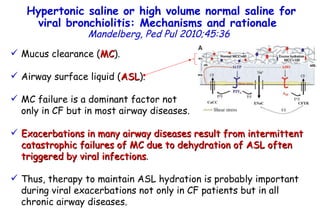
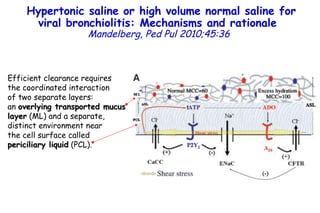
Hypertonic saline or high volume normal saline for viral bronchiolitis: Mechanisms and rationale   Mandelberg,   Ped Pul 2010;45:36 Mucus clearance ( MC ). Airway surface liquid ( ASL ). MC failure is a dominant factor not  only in CF but in most airway diseases. Exacerbations in many airway diseases result from intermittent catastrophic failures of MC due to dehydration of ASL often triggered by viral infections . Thus, therapy to maintain ASL hydration is probably important during viral exacerbations not only in CF patients but in all chronic airway diseases.
Hypertonic saline or high volume normal saline for viral bronchiolitis: Mechanisms and rationale   Mandelberg,   Ped Pul 2010;45:36 Efficient clearance requires the coordinated interaction of two separate layers: an  overlying transported mucus layer  (ML) and a separate, distinct environment near the cell surface called  periciliary liquid  (PCL).
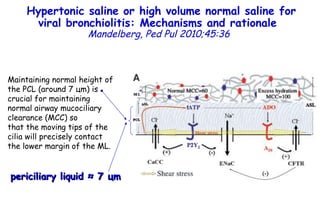
Hypertonic saline or high volume normal saline for viral bronchiolitis: Mechanisms and rationale   Mandelberg,   Ped Pul 2010;45:36 Maintaining normal height of the PCL (around 7  ц m) is crucial for maintaining normal airway mucociliary clearance (MCC) so that the moving tips of the cilia will precisely contact the lower margin of the ML. periciliary liquid ≈ 7  ц m
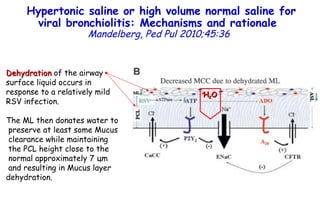
Hypertonic saline or high volume normal saline for viral bronchiolitis: Mechanisms and rationale   Mandelberg,   Ped Pul 2010;45:36 Dehydration  of the airway  surface liquid occurs in  response to a relatively mild RSV infection. The ML then donates water to preserve at least some Mucus  clearance while maintaining the PCL height close to the  normal approximately 7  ц m and resulting in Mucus layer  dehydration. H 2 O
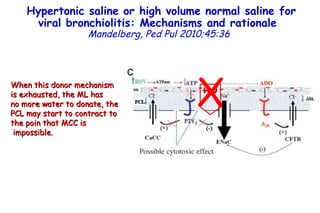
When this donor mechanism is exhausted, the ML has no more water to donate, the PCL may start to contract to the poin that MCC is  impossible. Hypertonic saline or high volume normal saline for viral bronchiolitis: Mechanisms and rationale   Mandelberg,   Ped Pul 2010;45:36 H 2 O X
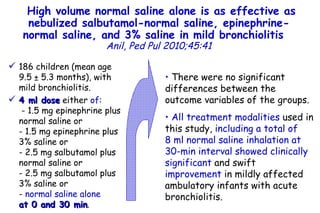
High volume normal saline alone is as effective as nebulized salbutamol-normal saline, epinephrine-normal saline, and 3% saline in mild bronchiolitis   Anil,   Ped Pul 2010;45:41 186 children (mean age 9.5 ± 5.3 months), with mild bronchiolitis.  4 ml dose  either  of :  - 1.5 mg epinephrine plus normal saline or  - 1.5 mg epinephrine plus 3% saline or  - 2.5 mg salbutamol plus normal saline or  - 2.5 mg salbutamol plus 3% saline or  -  normal saline alone   at 0 and 30 min .  There were no significant differences between the outcome variables of the groups. All treatment modalities  used in this study,  including a total of 8 ml normal saline inhalation at 30-min interval showed clinically significant  and swift  improvement  in mildly affected ambulatory infants with acute bronchiolitis.
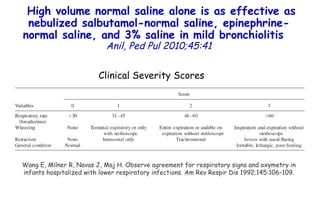
High volume normal saline alone is as effective as nebulized salbutamol-normal saline, epinephrine-normal saline, and 3% saline in mild bronchiolitis   Anil,   Ped Pul 2010;45:41 Clinical Severity Scores Wang E, Milner R, Navas J, Maj H. Observe agreement for respiratory signs and oxymetry in infants hospitalized with lower respiratory infections. Am Rev Respir Dis 1992;145:106–109.
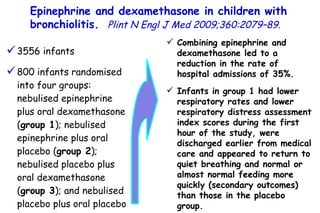
3556 infants 800 infants randomised into four groups: nebulised epinephrine plus oral dexamethasone ( group 1 ); nebulised epinephrine plus oral placebo ( group 2 ); nebulised placebo plus oral dexamethasone ( group 3 ); and nebulised placebo plus oral placebo ( group 4 ). Combining epinephrine and dexamethasone led to a reduction in the rate of hospital admissions of 35%. Infants in group 1 had lower respiratory rates and lower respiratory distress assessment index scores during the first hour of the study, were discharged earlier from medical care and appeared to return to quiet breathing and normal or almost normal feeding more quickly (secondary outcomes) than those in the placebo group. Epinephrine and dexamethasone in children with bronchiolitis.   Plint N Engl J Med 2009;360:2079–89.
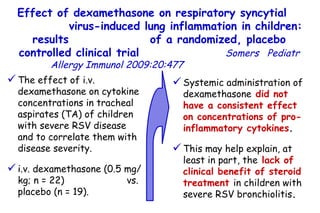
Effect of dexamethasone on respiratory syncytial  virus-induced lung inflammation in children: results  of a randomized, placebo controlled clinical trial   Somers   Pediatr Allergy Immunol 2009:20:477  The effect of i.v. dexamethasone on cytokine concentrations in tracheal aspirates (TA) of children with severe RSV disease and to correlate them with disease severity.  i.v. dexamethasone (0.5 mg/kg; n = 22)  vs. placebo (n = 19).  Systemic administration of dexamethasone   did not have a consistent effect on concentrations of pro-inflammatory cytokines .  This may help explain, at least in part, the   lack of clinical benefit   of steroid treatment   in children with severe RSV bronchiolitis .
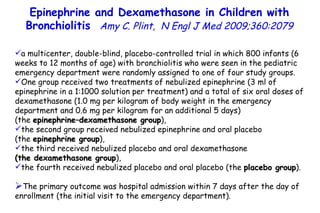
Epinephrine and Dexamethasone in Children with Bronchiolitis  Amy C. Plint,  N Engl J Med 2009;360:2079 a multicenter, double-blind, placebo-controlled trial in which 800 infants (6 weeks to 12 months of age) with bronchiolitis who were seen in the pediatric emergency department were randomly assigned to one of four study groups.  One group received two treatments of nebulized epinephrine (3 ml of epinephrine in a 1:1000 solution per treatment) and a total of six oral doses of dexamethasone (1.0 mg per kilogram of body weight in the emergency department and 0.6 mg per kilogram for an additional 5 days)  (the  epinephrine–dexamethasone group ),  the second group received nebulized epinephrine and oral placebo  (the  epinephrine group ),  the third received nebulized placebo and oral dexamethasone  (the dexamethasone group ), the fourth received nebulized placebo and oral placebo (the  placebo group ).  The primary outcome was hospital admission within 7 days after the day of enrollment (the initial visit to the emergency department).
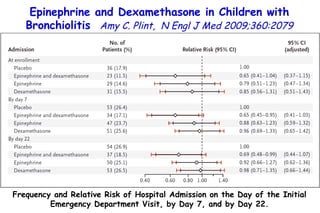
Epinephrine and Dexamethasone in Children with Bronchiolitis  Amy C. Plint,  N Engl J Med 2009;360:2079 Frequency and Relative Risk of Hospital Admission on the Day of the Initial Emergency Department Visit, by Day 7, and by Day 22.
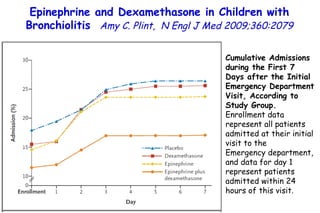
Epinephrine and Dexamethasone in Children with Bronchiolitis  Amy C. Plint,  N Engl J Med 2009;360:2079 Cumulative Admissions during the First 7 Days after the Initial Emergency Department Visit, According to Study Group. Enrollment data represent all patients admitted at their initial visit to the Emergency department, and data for day 1 represent patients admitted within 24 hours of this visit.
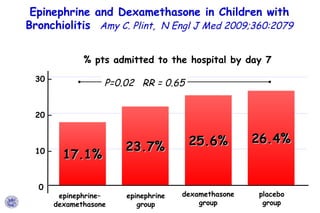
% pts admitted to the hospital by day 7 30 – 20 – 10 – 0 P=0.02  RR = 0.65 26.4% 25.6% 23.7% 17.1% epinephrine–dexamethasone epinephrine group dexamethasone group placebo group Epinephrine and Dexamethasone in Children with Bronchiolitis  Amy C. Plint,  N Engl J Med 2009;360:2079
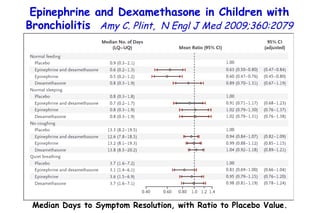
Epinephrine and Dexamethasone in Children with Bronchiolitis  Amy C. Plint,  N Engl J Med 2009;360:2079 Median Days to Symptom Resolution, with Ratio to Placebo Value.
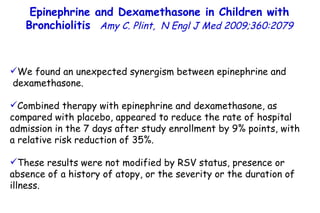
Epinephrine and Dexamethasone in Children with Bronchiolitis  Amy C. Plint,  N Engl J Med 2009;360:2079 We found an unexpected synergism between epinephrine and dexamethasone.  Combined therapy with epinephrine and dexamethasone, as compared with placebo, appeared to reduce the rate of hospital admission in the 7 days after study enrollment by 9% points, with a relative risk reduction of 35%. These results were not modified by RSV status, presence or absence of a history of atopy, or the severity or the duration of illness.
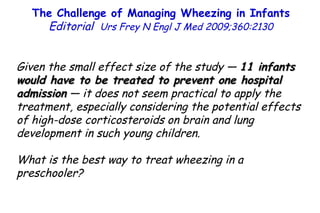
Given the small effect size of the study —  11 infants would have to be treated to prevent one hospital admission  — it does not seem practical to apply the treatment, especially considering the potential effects of high-dose corticosteroids on brain and lung development in such young children. What is the best way to treat wheezing in a preschooler?  The Challenge of Managing Wheezing in Infants  Editorial  Urs Frey N Engl J Med 2009;360:2130
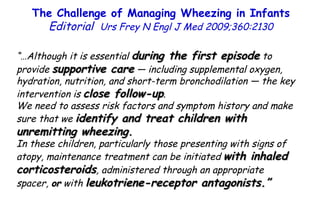
“… Although it is essential  during the first episode  to provide  supportive care  — including supplemental oxygen, hydration, nutrition, and short-term bronchodilation — the key intervention is  close follow-up .  We need to assess risk factors and symptom history and make sure that we  identify and treat children with unremitting wheezing.  In these children, particularly those presenting with signs of atopy, maintenance treatment can be initiated  with inhaled corticosteroids , administered through an appropriate spacer,  or  with  leukotriene-receptor antagonists.” The Challenge of Managing Wheezing in Infants  Editorial  Urs Frey N Engl J Med 2009;360:2130
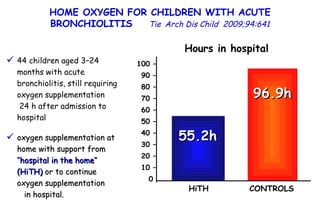
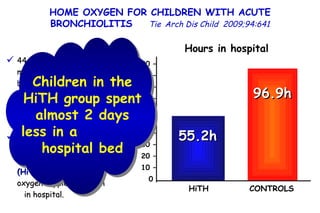
44 children aged 3–24 months with acute bronchiolitis, still requiring oxygen supplementation  24 h after admission to hospital oxygen supplementation at home with support from  ‘‘hospital in the home’’ (HiTH)  or to continue oxygen supplementation  in hospital. HOME OXYGEN FOR CHILDREN WITH ACUTE BRONCHIOLITIS  Tie   Arch Dis Child  2009;94:641 Hours in hospital   100 – 90 – 80 – 70 – 60 – 50 – 40 – 30 – 20 – 10 – 0  55.2h HiTH 96.9h CONTROLS
44 children aged 3–24 months with acute bronchiolitis, still requiring oxygen supplementation  24 h after admission to hospital oxygen supplementation at home with support from  ‘‘hospital in the home’’ (HiTH)  or to continue oxygen supplementation  in hospital. HOME OXYGEN FOR CHILDREN WITH ACUTE BRONCHIOLITIS  Tie   Arch Dis Child  2009;94:641 Hours in hospital   100 – 90 – 80 – 70 – 60 – 50 – 40 – 30 – 20 – 10 – 0  55.2h HiTH 96.9h CONTROLS Children in the HiTH group spent almost 2 days less in a  hospital bed
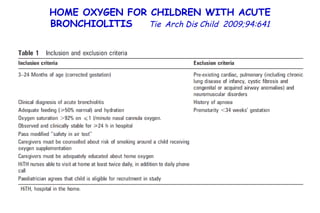
HOME OXYGEN FOR CHILDREN WITH ACUTE BRONCHIOLITIS  Tie   Arch Dis Child  2009;94:641
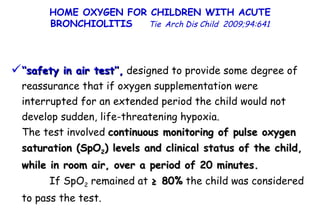
HOME OXYGEN FOR CHILDREN WITH ACUTE BRONCHIOLITIS  Tie   Arch Dis Child  2009;94:641 ‘‘ safety in air test’’,  designed to provide some degree of reassurance that if oxygen supplementation were interrupted for an extended period the child would not develop sudden, life-threatening hypoxia.  The test involved  continuous monitoring of pulse oxygen saturation (SpO 2 ) levels and clinical status of the child, while in room air, over a period of 20 minutes.   If SpO 2  remained at  ≥ 80%  the child was considered to pass the test.
Bronchiolitis Long-term consequences
Exploring the Association between Severe Respiratory Syncytial Virus Infection and Asthma.  A Registry-based Twin Study  Thomsen   Am J Respir Crit Care Med  2009;179:1091  All twins born in Denmark between 1994 and 2000 (8,280 pairs). Information on asthma obtained from hospital discharge registries  and parent-completed questionnaires.  RSV hospitalization and asthma were positively associated ( r =0.43),  and genetic determinants for  the two disorders overlapped completely.
Exploring the Association between Severe Respiratory Syncytial Virus Infection and Asthma.  A Registry-based Twin Study  Thomsen   Am J Respir Crit Care Med  2009;179:1091   All twins born in Denmark between 1994 and 2000 (8,280 pairs). Information on asthma obtained from hospital discharge registries  and parent-completed questionnaires.  A model in which asthma &quot;causes&quot; RSV hospitalization fitted the data significantly better than a model  in which RSV hospitalization &quot;causes&quot; asthma ( P  <0.001).
Exploring the Association between Severe Respiratory Syncytial Virus Infection and Asthma.  A Registry-based Twin Study  Thomsen   Am J Respir Crit Care Med  2009;179:1091   All twins born in Denmark between 1994 and 2000 (8,280 pairs). Information on asthma obtained from hospital discharge registries  and parent-completed questionnaires.  A model in which asthma &quot;causes&quot; RSV hospitalization fitted the data significantly better than a model  in which RSV hospitalization &quot;causes&quot; asthma ( P  <0.001).   RSV infection that is severe enough to warrant hospitalization does not cause asthma but is an indicator of the genetic predisposition to asthma.
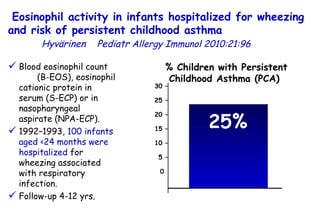
Eosinophil activity in infants hospitalized for wheezing and risk of persistent childhood asthma  Hyvärinen  Pediatr  Allergy Immunol 2010:21:96  % Children with Persistent Childhood Asthma (PCA)  25%  30 – 25 – 20 – 15 – 10 – 0 5 – 0 Blood eosinophil count  (B-EOS), eosinophil cationic protein in serum (S-ECP) or in nasopharyngeal  aspirate (NPA-ECP). 1992–1993,  100 infants aged <24 months were hospitalized  for wheezing associated with respiratory infection. Follow-up 4-12 yrs.
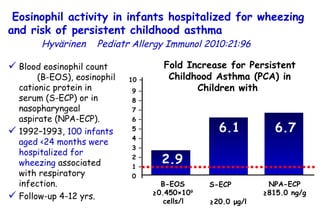
Eosinophil activity in infants hospitalized for wheezing and risk of persistent childhood asthma  Hyvärinen  Pediatr  Allergy Immunol 2010:21:96  Blood eosinophil count  (B-EOS), eosinophil cationic protein in serum (S-ECP) or in nasopharyngeal  aspirate (NPA-ECP). 1992–1993,  100 infants aged <24 months were hospitalized for wheezing  associated with respiratory infection. Follow-up 4-12 yrs.  Fold Increase for Persistent Childhood Asthma (PCA) in Children with  B-EOS  ≥ 0.450×10 9   cells/l   2.9 6.1 6.7 S-ECP  ≥20.0 μg/l  NPA-ECP ≥815.0 ng/g  10 – 9 – 8 – 7 – 6 – 5 – 4 – 3 – 2 – 1 – 0
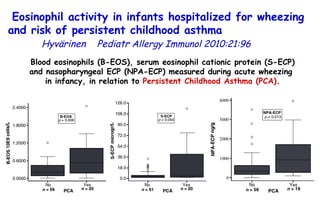
Eosinophil activity in infants hospitalized for wheezing and risk of persistent childhood asthma  Hyvärinen  Pediatr  Allergy Immunol 2010:21:96  Blood eosinophils (B-EOS), serum eosinophil cationic protein (S-ECP) and nasopharyngeal ECP (NPA-ECP) measured during acute wheezing  in infancy, in relation to  Persistent Childhood Asthma (PCA) .
Recurrent wheezing after respiratory syncytial virus or non-respiratory syncytial virus bronchiolitis in infancy: a 3-year follow-up.  Valkonen   Allergy 2009:64:1359  Background:  Recent studies have suggested that  rhinovirus -associated early wheezing is a greater risk factor for development of recurrent wheezing in children than is early wheezing associated with  respiratory syncytial virus  (RSV).  We determined the development of recurrent wheezing in young children within 3 years after hospitalization for RSV or non-RSV bronchiolitis.
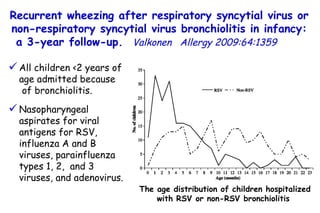
Recurrent wheezing after respiratory syncytial virus or non-respiratory syncytial virus bronchiolitis in infancy: a 3-year follow-up.  Valkonen   Allergy 2009:64:1359  All children <2 years of age admitted because  of bronchiolitis. Nasopharyngeal aspirates for viral antigens for RSV, influenza A and B viruses, parainfluenza types 1, 2,  and 3 viruses, and adenovirus.  The age distribution of children hospitalized with RSV or non-RSV bronchiolitis
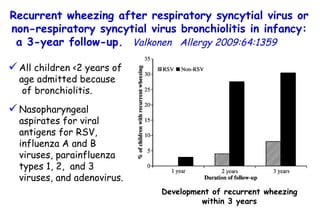
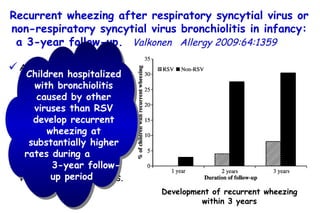
Recurrent wheezing after respiratory syncytial virus or non-respiratory syncytial virus bronchiolitis in infancy: a 3-year follow-up.  Valkonen   Allergy 2009:64:1359  All children <2 years of age admitted because  of bronchiolitis. Nasopharyngeal aspirates for viral antigens for RSV, influenza A and B viruses, parainfluenza types 1, 2,  and 3 viruses, and adenovirus.  Development of recurrent wheezing within 3 years
Recurrent wheezing after respiratory syncytial virus or non-respiratory syncytial virus bronchiolitis in infancy: a 3-year follow-up.  Valkonen   Allergy 2009:64:1359  All children <2 years of age admitted because  of bronchiolitis. Nasopharyngeal aspirates for viral antigens for RSV, influenza A and B viruses, parainfluenza types 1, 2,  and 3 viruses, and adenovirus.  Children hospitalized with bronchiolitis caused by other viruses than RSV develop recurrent wheezing at substantially higher rates during a  3-year follow-up period  Development of recurrent wheezing within 3 years
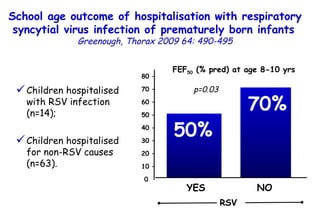
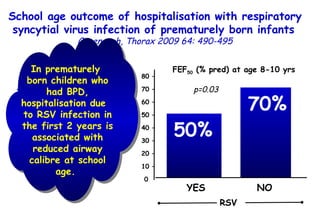
50% 70% YES NO School age outcome of hospitalisation with respiratory syncytial virus infection of prematurely born infants   Greenough, Thorax 2009 64: 490-495 Children  hospitalised with RSV infection (n=14); Children hospitalised for non-RSV causes (n=63). FEF 50  (% pred) at age 8-10 yrs 80 – 70 – 60 – 50 – 40 – 30 – 20 – 10 – 0 p=0.03 RSV
School age outcome of hospitalisation with respiratory syncytial virus infection of prematurely born infants   Greenough, Thorax 2009 64: 490-495 50% 70% YES NO Children  hospitalised with RSV infection (n=14); Children hospitalised for non-RSV causes (n=63). FEF 50  (% pred) at age 8-10 yrs 80 – 70 – 60 – 50 – 40 – 30 – 20 – 10 – 0 p=0.03 RSV In prematurely  born children who had BPD, hospitalisation due  to RSV infection in the first 2 years is associated with reduced airway calibre at school age.
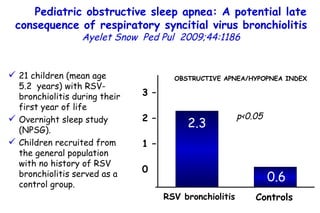
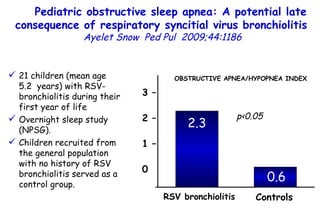
Pediatric obstructive sleep apnea: A potential late consequence of respiratory syncitial virus bronchiolitis   Ayelet Snow   Ped Pul  2009;44:1186 21 children (mean age 5.2  years) with RSV- bronchiolitis during their first year of life  Overnight sleep study (NPSG). Children recruited from the general population with no history of RSV bronchiolitis served as a control group.  3 – 2 – 1 – 0 2.3 0.6 RSV bronchiolitis Controls OBSTRUCTIVE APNEA/HYPOPNEA INDEX   p <0.05
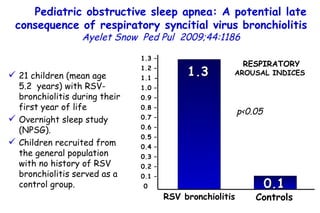
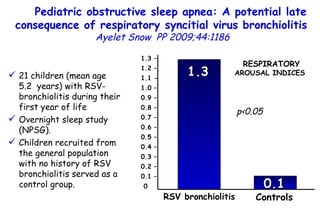
Pediatric obstructive sleep apnea: A potential late consequence of respiratory syncitial virus bronchiolitis   Ayelet Snow   PP   2009;44:1186 1.3 RSV bronchiolitis Controls p <0.05 1.3 – 1.2 – 1.1 -  1.0 – 0.9 – 0.8 – 0.7 – 0.6 – 0.5 – 0.4 – 0.3 – 0.2 – 0.1 – 0 0.1 RESPIRATORY  AROUSAL INDICES  21 children (mean age 5.2  years) with RSV- bronchiolitis during their first year of life  Overnight sleep study (NPSG). Children recruited from the general population with no history of RSV bronchiolitis served as a control group.
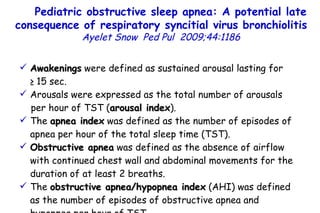
Pediatric obstructive sleep apnea: A potential late consequence of respiratory syncitial virus bronchiolitis   Ayelet Snow   PP   2009;44:1186 Awakenings were defined as sustained arousal lasting for  ≥ 15 sec. Arousals were expressed as the total number of arousals per hour of TST (arousal index). The apnea index was defined as the number of episodes of apnea per hour of the total sleep time (TST). Obstructive apnea was defined as the absence of airflow with continued chest wall and abdominal movements for the duration of at least 2 breaths. The obstructive apnea/hypopnea index (AHI) was defined as the number of episodes of obstructive apnea and hypopnea per hour of TST.          TO P        ABSTRACT        ME THODS        RE SULTS        DI SCUSSION        Su pport  statement        St atement  of interest        AC KNOWLEDGEMENTS        RE FERENCES         TO P        ABSTRACT        ME THODS        RE SULTS        DI SCUSSION        Su pport  statement        St atement  of interest        AC KNOWLEDGEMENTS        RE FERENCES
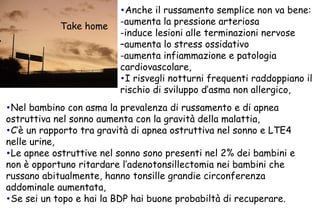
Esiste uno score clinico che può essere utilizzato anche dal personale paramedico, Attenti all’apnea soprattutto nel prematuro, È chiaro perché funziona l’ipertonica ma anche la soluzione fisiologica, Alcuni bambini possono continuare l’ossigeno-terapia a domicilio ma con una buona organizzazione dei servizi, L’eosinofilia e l’eziologia da rinovirus sono predittivi di possibile problema persistente.
cough
The online Cough Clinic: developing guideline-based diagnosis and advice .  Dettmar   ERJ 2009:34:819  8,546 adults with chronic cough completed  the  Cough Clinic diagnostic questionnaire.  Response to 16 specific questions.
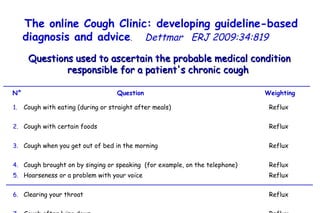
Cough with eating (during or straight after meals) Reflux  Cough with certain foods Reflux  Cough when you get out of bed in the morning Reflux   Cough brought on by singing or speaking  (for example, on the telephone) Reflux  Hoarseness or a problem with your voice Reflux  Clearing your throat Reflux  Cough after lying down Reflux  Heartburn, chest pain, indigestion or stomach acid coming up Reflux  Questions used to ascertain the probable medical condition responsible for a patient's chronic cough  N°   Question     Weighting The online Cough Clinic: developing guideline-based diagnosis and advice .  Dettmar   ERJ 2009:34:819
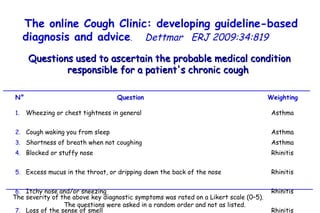
Wheezing or chest tightness in general Asthma  Cough waking you from sleep  Asthma Shortness of breath when not coughing Asthma  Blocked or stuffy nose Rhinitis  Excess mucus in the throat, or dripping down the back of the nose  Rhinitis  Itchy nose and/or sneezing Rhinitis  Loss of the sense of smell Rhinitis  A feeling that mucus is running down the back of your throat Rhinitis N°   Question     Weighting The severity of the above key diagnostic symptoms was rated on a Likert scale (0–5).  The questions were asked in a random order and not as listed.  The online Cough Clinic: developing guideline-based diagnosis and advice .  Dettmar   ERJ 2009:34:819  Questions used to ascertain the probable medical condition responsible for a patient's chronic cough
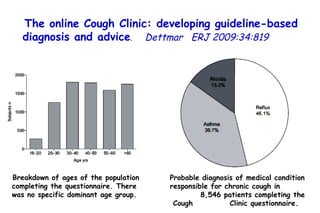
Breakdown of ages of the population completing the questionnaire. There  was no specific dominant age group.  Probable diagnosis of medical condition responsible for chronic cough in  8,546 patients completing the Cough  Clinic questionnaire.  The online Cough Clinic: developing guideline-based diagnosis and advice .  Dettmar   ERJ 2009:34:819
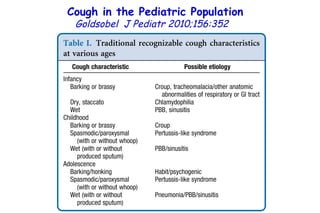
Cough in the Pediatric Population  Goldsobel  J Pediatr 2010;156:352
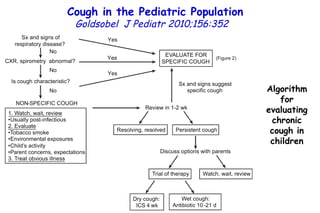
Cough in the Pediatric Population  Goldsobel  J Pediatr 2010;156:352   Algorithm for evaluating chronic cough in children
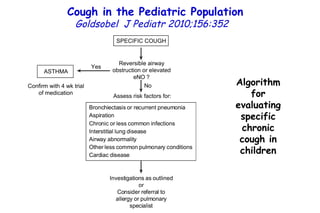
Cough in the Pediatric Population  Goldsobel  J Pediatr 2010;156:352   Algorithm for evaluating specific chronic cough in children
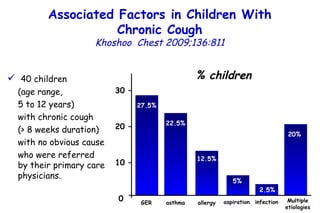
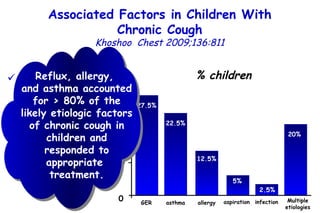
40 children  (age range,  5 to 12 years)  with chronic cough  (> 8 weeks duration)  with no obvious cause  who were referred by their primary care physicians. % children 27.5% asthma 20% Multiple etiologies Associated Factors in Children With Chronic Cough Khoshoo  Chest 2009;136:811 5% aspiration 30 – 20 – 10 – 0 2.5% 22.5% 12.5% allergy GER infection
40 children  (age range,  5 to 12 years)  with chronic cough  (> 8 weeks duration)  with no obvious cause  who were referred by their primary care physicians. % children 27.5% asthma 20% Multiple etiologies Associated Factors in Children With Chronic Cough Khoshoo  Chest 2009;136:811 5% aspiration 30 – 20 – 10 – 0 2.5% 22.5% 12.5% allergy GER infection Reflux, allergy,  and asthma accounted for > 80% of the likely etiologic factors of chronic cough in children and responded to appropriate  treatment.
Background:  Chronic cough is common, and medical treatment can be ineffective. Mindfulness  is a psychological intervention that aims to teach moment-to-moment non-judgemental awareness of thoughts, feelings and sensations   and has proven effective in the management of several chronic disease states including chronic pain, depression, fibromyalgia and psoriasis. Mindfulness training  is classically led by experts and practised in group sessions over an 8- to 10-week period with regular homework activities to encourage integration of the coping strategies into everyday life. The effect of mindfulness meditation on cough  reflex sensitivity   Young  Thorax 2009; 64: 993-998
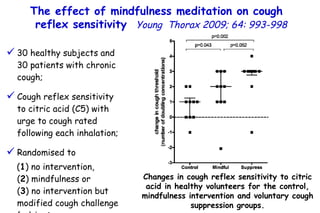
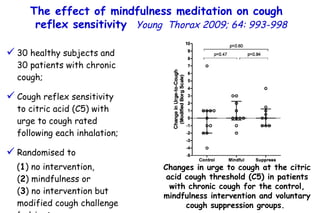
30 healthy subjects and 30 patients with chronic cough; Cough reflex sensitivity to citric acid (C5) with urge to cough rated following each inhalation; Randomised to  ( 1 ) no intervention,  ( 2 ) mindfulness or  ( 3 ) no intervention but modified cough challenge (subjects suppress coughing). Changes in cough reflex sensitivity to citric acid in healthy volunteers for the control, mindfulness intervention and voluntary cough suppression groups. The effect of mindfulness meditation on cough  reflex sensitivity   Young  Thorax 2009; 64: 993-998
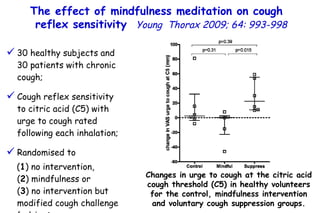
30 healthy subjects and 30 patients with chronic cough; Cough reflex sensitivity to citric acid (C5) with urge to cough rated following each inhalation; Randomised to  ( 1 ) no intervention,  ( 2 ) mindfulness or  ( 3 ) no intervention but modified cough challenge (subjects suppress coughing). Changes in urge to cough at the citric acid cough threshold (C5) in healthy volunteers for the control, mindfulness intervention and voluntary cough suppression groups. The effect of mindfulness meditation on cough  reflex sensitivity   Young  Thorax 2009; 64: 993-998
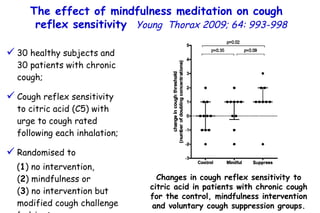
30 healthy subjects and 30 patients with chronic cough; Cough reflex sensitivity to citric acid (C5) with urge to cough rated following each inhalation; Randomised to  ( 1 ) no intervention,  ( 2 ) mindfulness or  ( 3 ) no intervention but modified cough challenge (subjects suppress coughing). Changes in cough reflex sensitivity to citric acid in patients with chronic cough for the control, mindfulness intervention and voluntary cough suppression groups. The effect of mindfulness meditation on cough  reflex sensitivity   Young  Thorax 2009; 64: 993-998
30 healthy subjects and 30 patients with chronic cough; Cough reflex sensitivity to citric acid (C5) with urge to cough rated following each inhalation; Randomised to  ( 1 ) no intervention,  ( 2 ) mindfulness or  ( 3 ) no intervention but modified cough challenge (subjects suppress coughing). Changes in urge to cough at the citric acid cough threshold (C5) in patients with chronic cough for the control, mindfulness intervention and voluntary cough suppression groups.  The effect of mindfulness meditation on cough  reflex sensitivity   Young  Thorax 2009; 64: 993-998
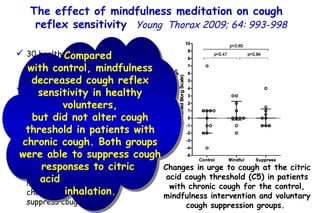
Changes in urge to cough at the citric acid cough threshold (C5) in patients with chronic cough for the control, mindfulness intervention and voluntary cough suppression groups.  30 healthy subjects and 30 patients with chronic cough; Cough reflex sensitivity to citric acid (C5) with urge to cough rated following each inhalation; Randomised to  (1) no intervention,  (2) mindfulness or  (3) no intervention but modified cough challenge (subjects suppress coughing). Compared  with control, mindfulness decreased cough reflex sensitivity in healthy volunteers, but did not alter cough threshold in patients with chronic cough. Both groups were able to suppress cough responses to citric  acid  inhalation . The effect of mindfulness meditation on cough  reflex sensitivity   Young  Thorax 2009; 64: 993-998
Pnumonia
Pnumonia Risk factors
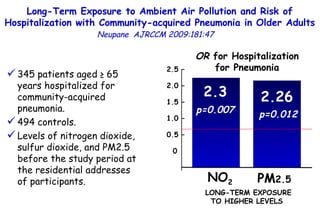
Long-Term Exposure to Ambient Air Pollution and Risk of Hospitalization with Community-acquired Pneumonia in Older Adults   Neupane   AJRCCM 2009:181:47   NO 2 2.3 2.26 2.5 – 2.0 – 1.5 – 1.0 – 0.5 – 0 PM 2.5 345 patients aged ≥ 65 years hospitalized for community-acquired pneumonia.  494 controls. Levels of nitrogen dioxide, sulfur dioxide, and PM2.5 before the study period at the residential addresses of participants.  p=0.012 LONG-TERM EXPOSURE TO HIGHER LEVELS  OR  for Hospitalization for Pneumonia 2.3 p=0.007
Serum 25 hydroxyvitamin D [25(OH)D] levels. Young children with bronchiolitis (n = 55) or pneumonia (n = 50). (ALRI) Subjects without respiratory symptoms (n = 92).  Vitamin D deficiency in young children with severe acute lower respiratory infection   McNally, Ped Pul 2009;44:981
Vitamin D deficiency in young children with severe acute lower respiratory infection   McNally, Ped Pul 2009;44:981 Serum 25 hydroxyvitamin D [25(OH)D] levels. Young children with bronchiolitis (n = 55) or pneumonia (n = 50). (ALRI) Subjects without respiratory symptoms (n = 92).  The mean vitamin D level for the entire ALRI group was not significantly different from the control group (81 ± 40 vs. 83 ± 30 nmol/L, respectively).
Vitamin D deficiency in young children with severe acute lower respiratory infection   McNally, Ped Pul 2009;44:981 Serum 25 hydroxyvitamin D [25(OH)D] levels. Young children with bronchiolitis (n = 55) or pneumonia (n = 50). (ALRI) Subjects without respiratory symptoms (n = 92).  87 49 P=0.001
Vitamin D deficiency in young children with severe acute lower respiratory infection   McNally, Ped Pul 2009;44:981 Serum 25 hydroxyvitamin D [25(OH)D] levels. Young children with bronchiolitis (n = 55) or pneumonia (n = 50). (ALRI) Subjects without respiratory symptoms (n = 92).  The mean vitamin D level for the ALRI subjects admitted to the pediatric intensive care unit (49 ± 24 nmol/L) was significantly lower (p=0.001) than that observed for both control (83 ± 30 nmol/L) and ALRI subjects admitted to the general pediatrics ward (87 ± 39 nmol/L).  P=0.001 87 49
Vitamin D deficiency in young children with severe acute lower respiratory infection   McNally, Ped Pul 2009;44:981 Serum 25 hydroxyvitamin D [25(OH)D] levels. Young children with bronchiolitis (n = 55) or pneumonia (n = 50). (ALRI) Subjects without respiratory symptoms (n = 92).  P=0.001 Vitamin D deficiency (<50 nmol/L) remained associated with ALRI requiring admission to pediatric intensive care unit after the inclusion of prematurity into a multivariate logistic regression model. 87 49
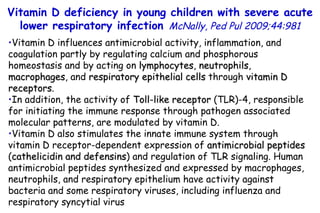
Vitamin D influences antimicrobial activity, inflammation, and coagulation partly by regulating calcium and phosphorous homeostasis and by acting on  lymphocytes ,  neutrophils ,  macrophages , and  respiratory epithelial cells  through  vitamin D receptors .  In addition, the activity of  Toll-like receptor  (TLR)-4, responsible for initiating the immune response through pathogen associated molecular patterns, are modulated by vitamin D. Vitamin D also stimulates the innate immune system through vitamin D receptor-dependent expression of  antimicrobial peptides  ( cathelicidin and defensins ) and regulation of TLR signaling. Human antimicrobial peptides synthesized and expressed by macrophages, neutrophils, and respiratory epithelium have activity against bacteria and some respiratory viruses, including influenza and respiratory syncytial virus Vitamin D deficiency in young children with severe acute lower respiratory infection   McNally, Ped Pul 2009;44:981
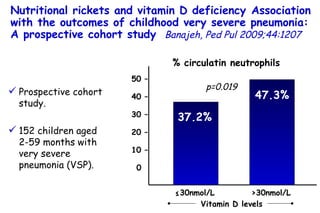
Nutritional rickets and vitamin D deficiency Association with the outcomes of childhood very severe pneumonia: A prospective cohort study   Banajeh, Ped Pul 2009;44:1207 19.9 35.2 Prospective cohort study. 152 children aged  2-59 months with very severe pneumonia (VSP).  50 – 40 – 30 – 20 – 10 – 0 37.2% 47.3% p=0.019 % circulatin neutrophils ≤ 30nmol/L >30nmol/L Vitamin D levels
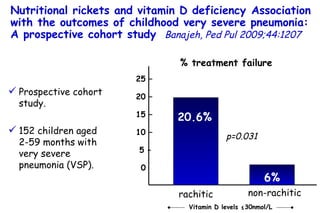
Nutritional rickets and vitamin D deficiency Association with the outcomes of childhood very severe pneumonia: A prospective cohort study   Banajeh, Ped Pul 2009;44:1207 19.9 35.2 Prospective cohort study. 152 children aged  2-59 months with very severe pneumonia (VSP).  25 – 20 – 15 – 10 – 5 – 0 20.6% 6% p=0.031 % treatment failure Vitamin D levels ≤30nmol/L rachitic non-rachitic
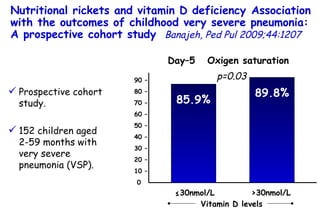
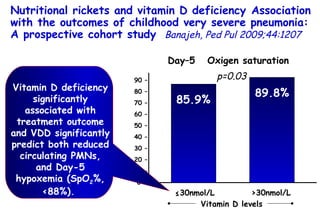
19.9 35.2 Prospective cohort study. 152 children aged  2-59 months with very severe pneumonia (VSP).  85.9% 89.8% Day–5  Oxigen saturation ≤ 30nmol/L >30nmol/L 90 – 80 – 70 – 60 – 50 – 40 – 30 – 20 – 10 – 0 p=0.03 Vitamin D levels Nutritional rickets and vitamin D deficiency Association with the outcomes of childhood very severe pneumonia: A prospective cohort study   Banajeh, Ped Pul 2009;44:1207
19.9 35.2 Prospective cohort study. 152 children aged  2-59 months with very severe pneumonia (VSP).  85.9% 89.8% Day–5  Oxigen saturation ≤ 30nmol/L >30nmol/L 90 – 80 – 70 – 60 – 50 – 40 – 30 – 20 – 10 – 0 p=0.03 Vitamin D levels Nutritional rickets and vitamin D deficiency Association with the outcomes of childhood very severe pneumonia: A prospective cohort study   Banajeh, Ped Pul 2009;44:1207 Vitamin D deficiency significantly associated with treatment outcome and VDD significantly predict both reduced circulating PMNs, and Day-5 hypoxemia (SpO 2 %, <88%).
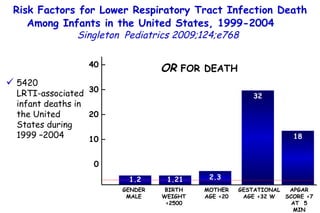
5420  LRTI-associated infant deaths in the United States during 1999 –2004 Risk Factors for Lower Respiratory Tract Infection Death Among Infants in the United States, 1999-2004   Singleton  Pediatrics 2009;124;e768   40 – 30 – 20 – 10 – 0 1.2 1.21 2.3 32 18 GENDER MALE BIRTH WEIGHT <2500 MOTHER AGE <20 GESTATIONAL AGE <32 W APGAR SCORE <7 AT  5 MIN OR  FOR DEATH
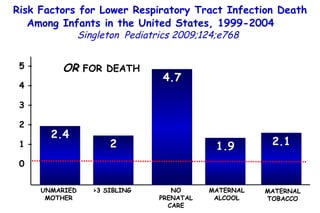
2.4 UNMARIED MOTHER >3 SIBLING NO PRENATAL CARE MATERNAL ALCOOL MATERNAL TOBACCO OR  FOR DEATH 5 – 4 – 3 – 2 – 1 – 0 2 4.7 1.9 2.1 Risk Factors for Lower Respiratory Tract Infection Death Among Infants in the United States, 1999-2004   Singleton  Pediatrics 2009;124;e768
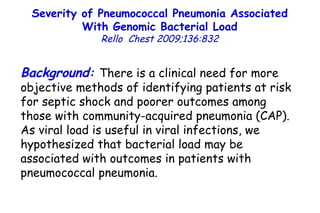
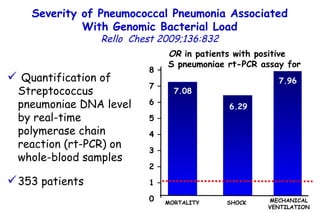
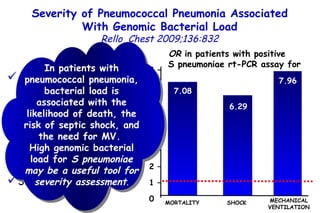
Severity of Pneumococcal Pneumonia Associated With Genomic Bacterial Load Rello  Chest 2009;136:832 Background :   There is a clinical need for more objective methods of identifying patients at risk for septic shock and poorer outcomes among those with community-acquired pneumonia (CAP). As viral load is useful in viral infections, we hypothesized that bacterial load may be associated with outcomes in patients with pneumococcal pneumonia.
8 – 7 – 6 – 5 – 4 – 3 – 2 – 1 – 0 Quantification of Streptococcus pneumoniae DNA level by real-time polymerase chain reaction (rt-PCR) on whole-blood samples 353 patients OR  in patients with positive  S pneumoniae rt-PCR assay for 7.08 MORTALITY 7.96 MECHANICAL VENTILATION Severity of Pneumococcal Pneumonia Associated With Genomic Bacterial Load Rello  Chest 2009;136:832 6.29 SHOCK
8 – 7 – 6 – 5 – 4 – 3 – 2 – 1 – 0 Quantification of Streptococcus pneumoniae DNA level by real-time polymerase chain reaction (rt-PCR) on whole-blood samples 353 patients OR  in patients with positive  S pneumoniae rt-PCR assay for 7.08 MORTALITY 7.96 MECHANICAL VENTILATION Severity of Pneumococcal Pneumonia Associated With Genomic Bacterial Load Rello  Chest 2009;136:832 6.29 SHOCK In patients with pneumococcal pneumonia, bacterial load is associated with the likelihood of death, the risk of septic shock, and the need for MV.  High genomic bacterial load for  S pneumoniae may be a useful tool for severity assessment .
Pnumonia Etiology  atypical bacteria
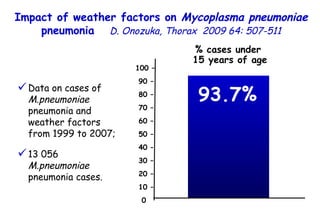
93.7% Impact of weather factors on  Mycoplasma pneumoniae  pneumonia   D. Onozuka, Thorax  2009 64: 507-511 Data on cases of  M . pneumoniae  pneumonia and weather factors from 1999 to 2007; 13 056  M.pneumoniae  pneumonia cases. % cases under  15 years of age 100 – 90 – 80 – 70 – 60 – 50 – 40 – 30 – 20 – 10 – 0
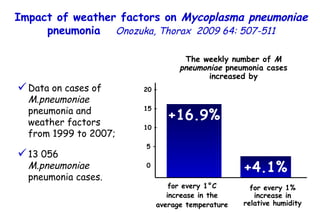
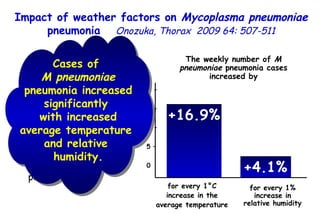
+16.9% +4.1% for every 1°C increase in the average temperature for every 1% increase in relative humidity The weekly number of  M   pneumoniae  pneumonia cases increased by 20 – 15 – 10 – 5 – 0 Impact of weather factors on  Mycoplasma pneumoniae  pneumonia   Onozuka, Thorax  2009 64: 507-511 Data on cases of  M . pneumoniae  pneumonia and weather factors from 1999 to 2007; 13 056  M.pneumoniae  pneumonia cases.
+16.9% +4.1% for every 1°C increase in the average temperature for every 1% increase in relative humidity The weekly number of  M   pneumoniae  pneumonia cases increased by 20 – 15 – 10 – 5 – 0 Impact of weather factors on  Mycoplasma pneumoniae  pneumonia   Onozuka, Thorax  2009 64: 507-511 Data on cases of  M . pneumoniae  pneumonia and weather factors from 1999 to 2007; 13 056  M.pneumoniae  pneumonia cases. Cases of  M pneumoniae  pneumonia increased significantly  with increased average temperature  and relative  humidity.
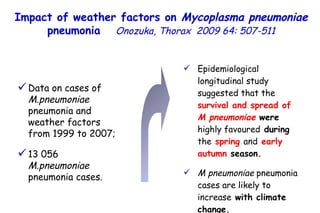
Epidemiological longitudinal study suggested that the   survival and spread of  M   pneumoniae  were  highly favoured  during  the   spring   and   early autumn  season. M   pneumoniae  pneumonia cases are likely to increase  with climate change. Data on cases of  M . pneumoniae  pneumonia and weather factors from 1999 to 2007; 13 056  M.pneumoniae  pneumonia cases. Impact of weather factors on  Mycoplasma pneumoniae  pneumonia   Onozuka, Thorax  2009 64: 507-511
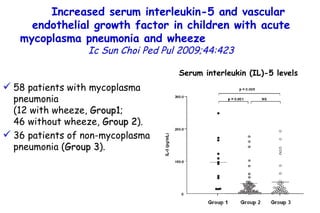
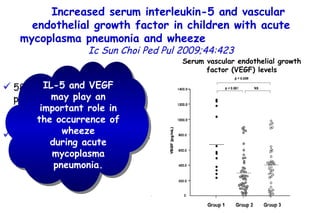
Increased serum interleukin-5 and vascular endothelial growth factor in children with acute mycoplasma pneumonia   and wheeze   Ic Sun Choi   Ped Pul 2009;44:423 58 patients with mycoplasma pneumonia  (12 with wheeze,  Group1 ;  46 without wheeze,  Group 2 ). 36 patients of non-mycoplasma pneumonia ( Group 3 ).  Serum interleukin (IL)-5 levels         TO P        ABSTRACT        ME THODS        RE SULTS        DI SCUSSION        Su pport  statement        St atement  of interest        AC KNOWLEDGEMENTS        RE FERENCES         TO P        ABSTRACT        ME THODS        RE SULTS        DI SCUSSION        Su pport  statement        St atement  of interest        AC KNOWLEDGEMENTS        RE FERENCES
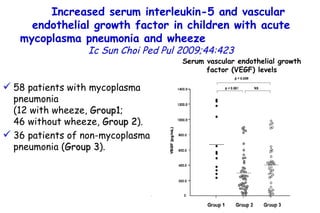
58 patients with mycoplasma pneumonia  (12 with wheeze,  Group1 ;  46 without wheeze,  Group 2 ). 36 patients of non-mycoplasma pneumonia ( Group 3 ).  Increased serum interleukin-5 and vascular endothelial growth factor in children with acute mycoplasma pneumonia   and wheeze   Ic Sun Choi   Ped Pul 2009;44:423 Serum vascular endothelial growth factor (VEGF) levels         TO P        ABSTRACT        ME THODS        RE SULTS        DI SCUSSION        Su pport  statement        St atement  of interest        AC KNOWLEDGEMENTS        RE FERENCES         TO P        ABSTRACT        ME THODS        RE SULTS        DI SCUSSION        Su pport  statement        St atement  of interest        AC KNOWLEDGEMENTS        RE FERENCES
58 patients with mycoplasma pneumonia  (12 with wheeze,  Group1 ;  46 without wheeze,  Group 2 ). 36 patients of non-mycoplasma pneumonia ( Group 3 ).  Increased serum interleukin-5 and vascular endothelial growth factor in children with acute mycoplasma pneumonia   and wheeze   Ic Sun Choi   Ped Pul 2009;44:423 Serum vascular endothelial growth factor (VEGF) levels IL-5 and VEGF may play an important role in the occurrence of wheeze during acute mycoplasma pneumonia.         TO P        ABSTRACT        ME THODS        RE SULTS        DI SCUSSION        Su pport  statement        St atement  of interest        AC KNOWLEDGEMENTS        RE FERENCES         TO P        ABSTRACT        ME THODS        RE SULTS        DI SCUSSION        Su pport  statement        St atement  of interest        AC KNOWLEDGEMENTS        RE FERENCES
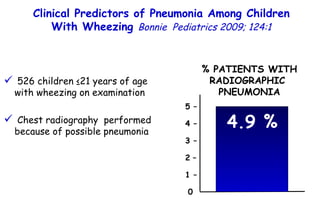
Clinical Predictors of Pneumonia Among Children With Wheezing  Bonnie  Pediatrics 2009; 124:1 526 children ≤21 years of age with wheezing on examination Chest radiography  performed because of possible pneumonia % PATIENTS WITH RADIOGRAPHIC  PNEUMONIA 4.9 % 5 – 4 – 3 – 2   – 1 – 0
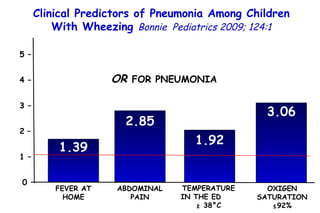
Clinical Predictors of Pneumonia Among Children With Wheezing  Bonnie  Pediatrics 2009; 124:1 OR  FOR PNEUMONIA 1.39 OXIGEN SATURATION ≤92% FEVER AT HOME ABDOMINAL PAIN 5 – 4 – 3 – 2   – 1 – 0 3.06 1.92 2.85 TEMPERATURE IN THE ED  ≥ 38°C
Pnumonia assesment
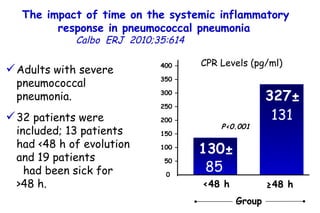
130 ± <48 h 400 – 350 – 300 – 250 – 200 – 150 – 100 – 0 50 – 0  327 ± Adults with severe pneumococcal pneumonia. 32 patients were included; 13 patients had <48 h of evolution and 19 patients  had been sick for >48 h.  The impact of time on the systemic inflammatory response in pneumococcal pneumonia   Calbo   ERJ  2010;35:614  CPR Levels (pg/ml) ≥ 48 h P<0.001 85 131 Group
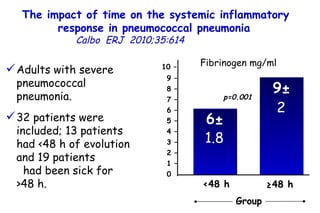
6 ± <48 h 9 ± Adults with severe pneumococcal pneumonia. 32 patients were included; 13 patients had <48 h of evolution and 19 patients  had been sick for >48 h.  The impact of time on the systemic inflammatory response in pneumococcal pneumonia   Calbo   ERJ  2010;35:614  Fibrinogen mg/ml ≥ 48 h p=0.001 1.8 2 10 – 9 – 8 – 7 – 6 – 5 – 4 – 3 – 2 – 1 – 0 Group
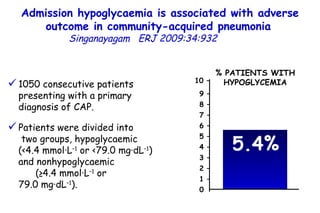
Admission hypoglycaemia is associated with adverse outcome in community-acquired pneumonia   Singanayagam   ERJ 2009:34:932  1050 consecutive patients presenting with a primary diagnosis of CAP. Patients were divided into  two groups, hypoglycaemic (<4.4 mmol·L –1  or <79.0 mg·dL –1 ) and nonhypoglycaemic  (≥4.4 mmol·L –1  or  79.0 mg·dL –1 ).  5.4% 10 – 9 – 8 – 7 – 6 – 5 – 4 – 3 – 2 – 1 – 0 % PATIENTS WITH HYPOGLYCEMIA
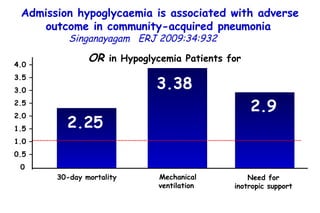
Admission hypoglycaemia is associated with adverse outcome in community-acquired pneumonia   Singanayagam   ERJ 2009:34:932  5.4% OR  in Hypoglycemia Patients for 30-day mortality Need for  inotropic support  Mechanical ventilation  2.25 3.38 2.9 4.0 – 3.5 – 3.0 – 2.5 – 2.0 – 1.5 – 1.0 – 0.5 – 0
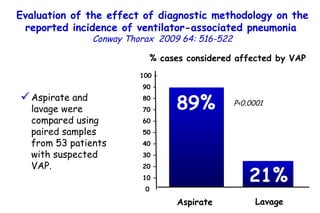
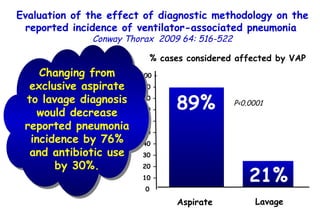
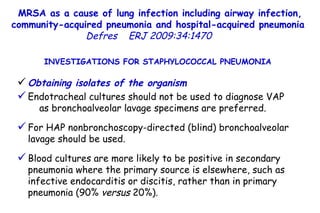
89% 21% Aspirate Lavage Evaluation of the effect of diagnostic methodology on the reported incidence of ventilator-associated pneumonia   Conway Thorax  2009 64: 516-522 Aspirate and lavage were compared using paired samples from 53 patients with suspected VAP. 100 – 90 – 80 – 70 – 60 – 50 – 40 – 30 – 20 – 10 – 0 % cases considered affected by VAP P<0.0001
89% 21% Aspirate Lavage Evaluation of the effect of diagnostic methodology on the reported incidence of ventilator-associated pneumonia   Conway Thorax  2009 64: 516-522 Aspirate and lavage were compared using paired samples from 53 patients with suspected VAP. 100 – 90 – 80 – 70 – 60 – 50 – 40 – 30 – 20 – 10 – 0 % cases considered affected by VAP P<0.0001 Changing from exclusive aspirate to lavage diagnosis would decrease reported pneumonia incidence by 76% and antibiotic use by 30%.
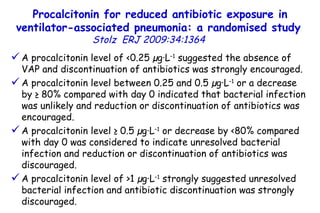
Procalcitonin for reduced antibiotic exposure in ventilator-associated pneumonia: a randomised study   Stolz  ERJ 2009:34:1364  A procalcitonin level of <0.25 µg·L –1  suggested the absence of VAP and discontinuation of antibiotics was strongly encouraged.  A procalcitonin level between 0.25 and 0.5 µg·L –1  or a decrease by ≥ 80% compared with day 0 indicated that bacterial infection was unlikely and reduction or discontinuation of antibiotics was encouraged.  A procalcitonin level ≥ 0.5 µg·L –1  or decrease by <80% compared with day 0 was considered to indicate unresolved bacterial infection and reduction or discontinuation of antibiotics was discouraged.  A procalcitonin level of >1 µg·L –1  strongly suggested unresolved bacterial infection and antibiotic discontinuation was strongly discouraged.
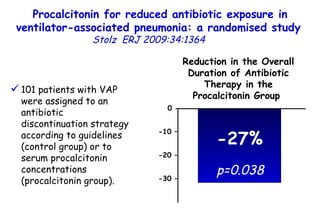
Procalcitonin for reduced antibiotic exposure in ventilator-associated pneumonia: a randomised study   Stolz  ERJ 2009:34:1364  101 patients with VAP were assigned to an antibiotic discontinuation strategy according to guidelines (control group) or to serum procalcitonin concentrations (procalcitonin group).  Reduction in the Overall Duration of Antibiotic Therapy in the Procalcitonin Group  0  -10 – -20 – -30 – -27% p=0.038
Pnumonia treatment
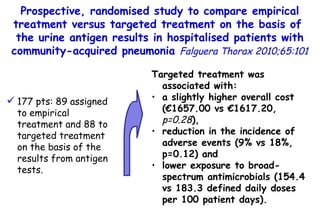
Targeted treatment was associated with: a slightly higher overall cost (€1657.00 vs €1617.20,  p=0.28 ),  reduction in the incidence of adverse events (9% vs 18%, p=0.12) and  lower exposure to broad-spectrum antimicrobials (154.4 vs 183.3 defined daily doses per 100 patient  days). 177 pts: 89 assigned to empirical treatment and 88 to targeted treatment on the basis of the results from antigen tests. Prospective, randomised study to compare empirical treatment versus targeted treatment on the basis of  the urine antigen results in hospitalised patients  with community-acquired pneumonia  Falguera Thorax 2010;65:101
Prospective, randomised study to compare empirical treatment versus targeted treatment on the basis of  the urine antigen results in hospitalised patients  with community-acquired pneumonia  Falguera Thorax 2010;65:101 Targeted treatment was associated with: a slightly higher overall cost (€1657.00 vs €1617.20,  p=0.28 ),  reduction in the incidence of adverse events (9% vs 18%, p=0.12) and  lower exposure to broad-spectrum antimicrobials (154.4 vs 183.3 defined daily doses per 100 patient  days). 177 pts: 89 assigned to empirical treatment and 88 to targeted treatment on the basis of the results from antigen tests. No statistically significant differences in other  outcome parameters were observed.
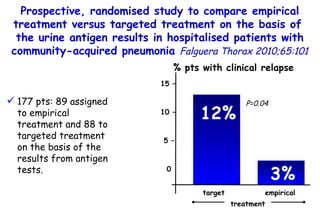
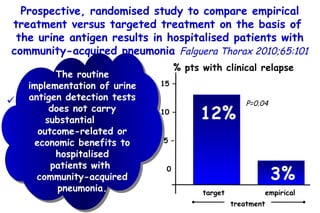
% pts with clinical relapse 12% 15 – 10 – 5 – 0 3% P=0.04 target empirical treatment 177 pts: 89 assigned to empirical treatment and 88 to targeted treatment on the basis of the results from antigen tests. Prospective, randomised study to compare empirical treatment versus targeted treatment on the basis of  the urine antigen results in hospitalised patients  with community-acquired pneumonia  Falguera Thorax 2010;65:101
Prospective, randomised study to compare empirical treatment versus targeted treatment on the basis of  the urine antigen results in hospitalised patients  with community-acquired pneumonia  Falguera Thorax 2010;65:101 % pts with clinical relapse 12% 15 – 10 – 5 – 0 3% P=0.04 target empirical treatment 177 pts: 89 assigned to empirical treatment and 88 to targeted treatment on the basis of the results from antigen tests. The routine implementation of urine antigen detection tests does not carry substantial  outcome-related or economic benefits to hospitalised patients with  community-acquired pneumonia.
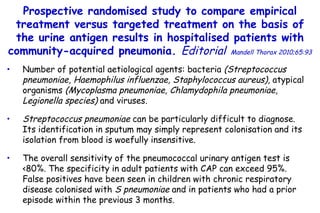
Prospective randomised study to compare empirical treatment  versus targeted treatment on the basis of the urine antigen results  in hospitalised patients with community-acquired pneumonia.  Editorial   Mandell Thorax 2010;65:93 Number of potential aetiological agents: bacteria  (Streptococcus pneumoniae, Haemophilus influenzae, Staphylococcus aureus),  atypical organisms  (Mycoplasma pneumoniae, Chlamydophila pneumoniae, Legionella species)  and viruses. Streptococcus pneumoniae  can be particularly difficult to diagnose.  Its identification in sputum may simply represent colonisation and its isolation from blood is woefully insensitive. The overall sensitivity of  the pneumococcal urinary antigen test is  <80%. The  specificity in adult patients with CAP can exceed 95%.  False positives have been seen in children with chronic respiratory disease colonised with  S pneumoniae  and in patients who had a prior episode within  the previous 3 months.
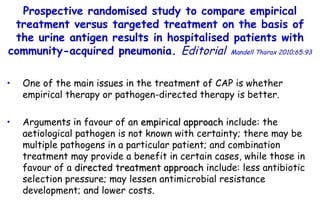
One of the main issues in the treatment of CAP is whether empirical therapy or  pathogen-directed therapy is better. Arguments in favour of an  empirical approach  include: the aetiological pathogen is not known with certainty; there may be multiple pathogens in  a particular patient; and combination  treatment may provide a benefit in certain cases, while those in favour of a  directed treatment approach  include: less antibiotic selection pressure; may lessen  antimicrobial resistance development; and lower costs. Prospective randomised study to compare empirical treatment  versus targeted treatment on the basis of the urine antigen results  in hospitalised patients with community-acquired pneumonia.  Editorial   Mandell Thorax 2010;65:93
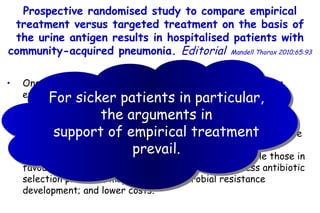
One of the main issues in the treatment of CAP is whether empirical therapy or  pathogen-directed therapy is better. Arguments in favour of an  empirical approach  include: the aetiological pathogen is not known with certainty; there may be multiple pathogens in  a particular patient; and combination  treatment may provide a benefit in certain cases, while those in favour of a  directed treatment approach  include: less antibiotic selection pressure; may lessen  antimicrobial resistance development; and lower costs. Prospective randomised study to compare empirical treatment  versus targeted treatment on the basis of the urine antigen results  in hospitalised patients with community-acquired pneumonia.  Editorial   Mandell Thorax 2010;65:93 For sicker  patients in particular, the arguments in support of empirical treatment prevail.
One of the main issues in the treatment of CAP is whether empirical therapy or  pathogen-directed therapy is better. Arguments in favour of an  empirical approach  include: the aetiological pathogen is not known with certainty; there may be multiple pathogens in  a particular patient; and combination  treatment may provide a benefit in certain cases, while those in favour of a  directed treatment approach  include: less antibiotic selection pressure; may lessen  antimicrobial resistance development; and lower costs. Prospective randomised study to compare empirical treatment  versus targeted treatment on the basis of the urine antigen results  in hospitalised patients with community-acquired pneumonia.  Editorial   Mandell Thorax 2010;65:93 For  pneumococcal bacteraemia  combination treatment, particularly  with a  β -lactam and a macrolide, results in  better outcomes.
Antibiotic Resistance in Community-Acquired Pneumonia Caused by  Streptococcus Pneumoniae, Methicillin- Resistant S taphylococcus aureus, and Acinetobacter baumannii   Ho CHEST 2009; 136:1119 In Europe,  penicillin nonsusceptibility  rates in France are 58%, but only 11% in Austria and 6% in Germany In Spain, the  macrolide resistance  rate is reported to range from 28 to 64% Drug resistence S. Pneumoniae (DRSP)
Antibiotic Resistance in Community-Acquired Pneumonia Caused by  Streptococcus Pneumoniae, Methicillin- Resistant S taphylococcus aureus, and Acinetobacter baumannii   Ho CHEST 2009; 136:1119 In Europe, penicillin nonsusceptibility rates in France are 58%, but only 11% in Austria and 6% in Germany In Spain, the macrolide resistance rate is reported to range from 28 to 64% Drug resistence S. Pneumoniae (DRSP) Penicillin-intermediate or  penicillin-resistant pneumococci are more likely than susceptible isolates to have resistance to macrolides
Currently, the newer fluoroquinolones remain active against  >98% of the pneumococci, Nonetheless, significant fluoroquinolone resistance rates ( >5%) have been found by local studies in Italy, The use of the heptavalent pneumococcal conjugate vaccine  (PCV-7, targeting serotypes 4, 6B, 9V, 14, 18C, 19F, and 23F) in the year 2000 for children was followed by a drastic reduction in the incidence of pneumococcal infections among both children and adults. Because PCV-7 serotypes are often penicillin and multidrug resistant. Antibiotic Resistance in Community-Acquired Pneumonia Caused by  Streptococcus Pneumoniae, Methicillin- Resistant S taphylococcus aureus, and Acinetobacter baumannii   Ho CHEST 2009; 136:1119 Drug resistence S. Pneumoniae (DRSP)
At the current level of penicillin resistance, the clinical  outcome of pneumococcal pneumonia is not adversely affected when  appropriate  β -lactam agents  ( eg, penicillin,  ampicillin, amoxicillin, cefotaxime, and ceftriaxone)  and doses  are used. Maintaining a serum concentration above the minimum inhibitory concentration (MIC) for  40% of the dosing intervals for  β -lactam antibiotics are predictive of favorable outcomes. Antibiotic Resistance in Community-Acquired Pneumonia Caused by  Streptococcus Pneumoniae, Methicillin- Resistant S taphylococcus aureus, and Acinetobacter baumannii   Ho CHEST 2009; 136:1119 Clinical relevance of antibiotic resistance of S. Pneumoniae
There is no evidence of bacteriologic  failure for pneumococcal pneumonia with  cefotaxime  or  ceftriaxone . In contrast, patients who were treated with  cefuroxime  and were infected with pneumococci with  in vitro nonsusceptibility to cefuroxime experienced  significantly higher mortality rates. Pharmacokinetics-pharmacodynamics principles indicate that some oral cephalosporins, including  cephalothin ,  cefaclor ,  cefixime , and  ceftibuten , are likely to be ineffective for the treatment of penicillinresistant  S pneumoniae. Antibiotic Resistance in Community-Acquired Pneumonia Caused by  Streptococcus Pneumoniae, Methicillin- Resistant S taphylococcus aureus, and Acinetobacter baumannii   Ho CHEST 2009; 136:1119 Clinical relevance of antibiotic resistance of S. Pneumoniae
Unlike penicillin resistance, the existing data suggest that resistance to  macrolides  and  fluoroquinolones  could lead to treatment failures. The older fluoroquinolones, including  ciprofloxacin  and  ofloxacin  and  levofloxacin , which are poorly active against pneumococci, should not be used for the treatment of suspected or confirmed pneumococcal infection in the respiratory tract. No treatment failure of  S pneumoniae infections  has been reported to occur with  moxifloxacin  and  gatifloxacin . Antibiotic Resistance in Community-Acquired Pneumonia Caused by  Streptococcus Pneumoniae, Methicillin- Resistant S taphylococcus aureus, and Acinetobacter baumannii   Ho CHEST 2009; 136:1119 Clinical relevance of antibiotic resistance of S. Pneumoniae
When a patient with mild CAP caused by  S pneumoniae  is initially treated with an antibiotic to which the organism is resistant, there is evidence of an increased risk of progression to serious disease. Failures associated with the macrolides are increasing. When  S pneumoniae is  established or strongly suspected as the causative pathogen, the preferred antimicrobial agents are penicillin G or amoxicillin. Some investigators have advocated combination therapy with both a penicillin and a macrolide for critically ill patients with pneumococcal bacteremia, but the necessity of this beyond the initial 2 days and in patients with CAP of mild-to-moderate severity remains controversial.  Treatment of S. Pneumoniae Antibiotic Resistance in Community-Acquired Pneumonia Caused by  Streptococcus Pneumoniae, Methicillin- Resistant S taphylococcus aureus, and Acinetobacter baumannii   Ho CHEST 2009; 136:1119
Patients with CA-MRSA infection most commonly present with skin and soft-tissue infections. Occasionally CA-MRSA can manifest as a severe disease such as necrotizing fasciitis, endocarditis, sepsis syndrome, and necrotizing pneumonia are more common in winter, and occur in association with influenza and parainfluenza virus. Community-acquired methicillin-resistant  S aureus  (CA-MRSA) Antibiotic Resistance in Community-Acquired Pneumonia Caused by  Streptococcus Pneumoniae, Methicillin- Resistant S taphylococcus aureus, and Acinetobacter baumannii   Ho CHEST 2009; 136:1119
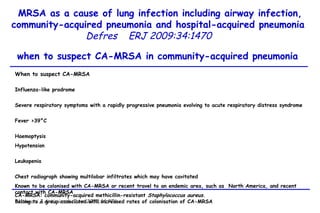
In 1999,  S aureus carrying PVL was associated  with a highly fatal form of pneumonia that is characterized by extensive lung necrosis. Typical features of necrotizing pneumonia caused by  PVL-positive  S aureus  include high fever ( > 39°C), rapid breathing (respiratory rate,  > 40 breaths/min), hemoptysis, leukopenia, extensive pulmonary involvement, and rapid progression to ARDS. Unique Features of Panton-Valentine leukocidin  PVL-Positive S aureus Pneumonia Antibiotic Resistance in Community-Acquired Pneumonia Caused by  Streptococcus Pneumoniae, Methicillin- Resistant S taphylococcus aureus, and Acinetobacter baumannii   Ho CHEST 2009; 136:1119
In 1999,  S aureus carrying PVL was associated  with a highly fatal form of pneumonia that is characterized by extensive lung necrosis. Typical features of necrotizing pneumonia caused by  PVL-positive  S aureus  include high fever ( > 39°C), rapid breathing (respiratory rate,  > 40 breaths/min), hemoptysis, leukopenia, extensive pulmonary involvement, and rapid progression to ARDS. Unique Features of Panton-Valentine leukocidin  PVL-Positive S aureus Pneumonia Antibiotic Resistance in Community-Acquired Pneumonia Caused by  Streptococcus Pneumoniae, Methicillin- Resistant S taphylococcus aureus, and Acinetobacter baumannii   Ho CHEST 2009; 136:1119 Patients with the disease tend to be children and young adults with no underlying illness
In 1999,  S aureus carrying PVL was associated  with a highly fatal form of pneumonia that is characterized by extensive lung necrosis. Typical features of necrotizing pneumonia caused by  PVL-positive  S aureus  include high fever ( > 39°C), rapid breathing (respiratory rate,  > 40 breaths/min), hemoptysis, leukopenia, extensive pulmonary involvement, and rapid progression to ARDS. Unique Features of Panton-Valentine leukocidin  PVL-Positive S aureus Pneumonia Antibiotic Resistance in Community-Acquired Pneumonia Caused by  Streptococcus Pneumoniae, Methicillin- Resistant S taphylococcus aureus, and Acinetobacter baumannii   Ho CHEST 2009; 136:1119 Predictors of mortality included airway bleeding, erythroderma, and leukopenia
Because CA-MRSA is a rare cause of CAP in most communities, the routine incorporation of agents with anti-MRSA activity into empirical therapy cannot be justified. However, a high index of suspicion for CA-MRSA pneumonia is required during the  influenza  season, especially in those young, healthy persons with rapidly progressive cavitary infiltrates and in those with a history of MRSA infection or close contact with an MRSA-infected person. Treatment of CA-MRSA Pneumonia Antibiotic Resistance in Community-Acquired Pneumonia Caused by  Streptococcus Pneumoniae, Methicillin- Resistant S taphylococcus aureus, and Acinetobacter baumannii   Ho CHEST 2009; 136:1119
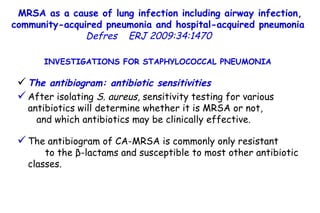
In general, CA-MRSA is usually susceptible  in vitro to  vancomycin,  linezolid,  trimethoprim-sulfamethoxazole ,  rifampin, and tigecycline. CA-MRSA is sometimes susceptible to clindamycin, but the D-test has to be done to determine the presence of  in vitro inducible resistance. From 2003 to 2004, all of the CA-MRSA isolates were uniformly  resistant to macrolides , and one-half of them were not susceptible to treatment with fluoroquinolones. Treatment of CA-MRSA Pneumonia Antibiotic Resistance in Community-Acquired Pneumonia Caused by  Streptococcus Pneumoniae, Methicillin- Resistant S taphylococcus aureus, and Acinetobacter baumannii   Ho CHEST 2009; 136:1119
In general, CA-MRSA is usually susceptible  in vitro to vancomycin, linezolid, trimethoprim-sulfamethoxazole,  rifampin, and tigecycline. CA-MRSA is sometimes susceptible to clindamycin, but the D-test has to be done to determine the presence of  in vitro inducible resistance. From 2003 to 2004, all of the CA-MRSA isolates were uniformly resistant to macrolides, and one-half of them were not susceptible to treatment with fluoroquinolones. Treatment of CA-MRSA Pneumonia Antibiotic Resistance in Community-Acquired Pneumonia Caused by  Streptococcus Pneumoniae, Methicillin- Resistant S taphylococcus aureus, and Acinetobacter baumannii   Ho CHEST 2009; 136:1119 The 2007 Infectious Diseases Society  of America/American Thoracic Society guidelines recommended the addition of vancomycin or linezolid for empirical treatment of CAP if CA-MRSA is a consideration
In general, CA-MRSA is usually susceptible  in vitro to vancomycin, linezolid, trimethoprim-sulfamethoxazole,  rifampin, and tigecycline. CA-MRSA is sometimes susceptible to clindamycin, but the D-test has to be done to determine the presence of  in vitro inducible resistance. From 2003 to 2004, all of the CA-MRSA isolates were uniformly resistant to macrolides, and one-half of them were not susceptible to treatment with fluoroquinolones. Treatment of CA-MRSA Pneumonia Antibiotic Resistance in Community-Acquired Pneumonia Caused by  Streptococcus Pneumoniae, Methicillin- Resistant S taphylococcus aureus, and Acinetobacter baumannii   Ho CHEST 2009; 136:1119 Linezolid (10 mg/Kg 8-12 h in chidren) may be a better choice due to its good pharmacokinetic profile in the lung
In the 2009 British Thoracic Society guidelines for CAP, combination therapy with linezolid, clindamycin, and rifampicin is recommended when necrotizing pneumonia caused by PVL-positive  S aureus is strongly suspected. For patients with  influenza and CA-MRSA coinfection, combined therapy with an antibiotic and an antiviral agent  should be considered. In a mouse model of postinfluenza pneumococcal pneumonia, it was found that ampicillin alone did not improve mortality. When the mice were treated with both oseltamivir and ampicillin, all deaths were prevented. Antibiotic Resistance in Community-Acquired Pneumonia Caused by  Streptococcus Pneumoniae, Methicillin- Resistant S taphylococcus aureus, and Acinetobacter baumannii   Ho CHEST 2009; 136:1119 Treatment of CA-MRSA Pneumonia
A baumannii is an  aerobic Gram-negative coccobacillus that is ubiquitous in soil and fresh water, and it is a well-known and common cause of hospital-acquired  A baumannii  pneumonia (HAP-AB). In contrast, CAP-AB has been reported sporadically in Asian-Pacific countries, especially during the warmer and more humid seasons. CAP-AB tends to affect older people. Reported risk factors are cigarette smoking and COPD, alcoholism, diabetes mellitus, organ failures, and malignancies. Antibiotic Resistance in Community-Acquired Pneumonia Caused by  Streptococcus Pneumoniae, Methicillin- Resistant S taphylococcus aureus, and Acinetobacter baumannii   Ho CHEST 2009; 136:1119 Community-Acquired A BAUMANNII Pneumonia
A baumannii strains isolated in patients with  CAP-AB are generally resistant to treatment with ampicillin, cefotaxime, chloramphenicol, aztreonam, and cefoperazone. A baumannii strains were sensitive to  aminoglycosides ,  antipseudomonal penicillins, imipenem, fluoroquinolones and ceftazidime. Antibiotic Resistance in Community-Acquired Pneumonia Caused by  Streptococcus Pneumoniae, Methicillin- Resistant S taphylococcus aureus, and Acinetobacter baumannii   Ho CHEST 2009; 136:1119 Community-Acquired A BAUMANNII Pneumonia
MRSA as a cause of community-acquired pneumonia   Nakou   ERJ 2009:34:1013  S. aureus  has led to a multidrug-resistant pathogen, meticillin-resistant  S. aureus  (MRSA) after the introduction of methicillin into clinical practice in the 1960s.  MRSA  is resistant to β-lactam antibiotics, including penicillin and cephalosporins. Resistance is mediated by penicillin binding protein 2a, a penicillin binding protein encoded by the mecA gene that permits growth in the presence of methicillin.
MRSA as a cause of community-acquired pneumonia   Nakou   ERJ 2009:34:1013  MRSA was only a nosocomial pathogen. In the mid 1990s, MRSA began to be detected in the community,  i.e.  community-acquired MRSA (CA-MRSA). It is the leading cause of identifiable skin and soft tissue infections seen in USA emergency rooms.  CA-MRSA may be associated with the presence of Panton Valentine leukocidin (PVL), a staphylococcal membrane toxin that targets leucocytes. PVL isolates have been linked to severe infections and necrotising pneumonia.
MRSA as a cause of community-acquired pneumonia   Nakou   ERJ 2009:34:1013  Compared with nosocomial MRSA, CA-MRSA isolates are commonly sensitive to antibiotics such as clindamycin, fluoroquinolones, trimethoprim–sulfamethoxazole, tetracyclines and rifampicin. There is evidence of increasing prevalence of asymptomatic colonisation among children and  adults in the community, which is typically resistant to β-lactam and macrolide antimicrobial agents and contains genes for PVL toxin.
MRSA as a cause of community-acquired pneumonia   Nakou   ERJ 2009:34:1013  Compared with nosocomial MRSA, CA-MRSA isolates are commonly sensitive to antibiotics such as clindamycin, fluoroquinolones, trimethoprim–sulfamethoxazole, tetracyclines and rifampicin. There is evidence of increasing prevalence of asymptomatic colonisation among children and  adults in the community, which is typically resistant to β-lactam and macrolide antimicrobial agents and contains genes for PVL toxin.  Guidelines recommend vancomycin or linezolid.
MRSA as a cause of community-acquired pneumonia   Nakou   ERJ 2009:34:1013  Post-influenza staphylococcal pneumonia has been reported during influenza pandemics.  There is evidence of mechanisms indicating influenza interaction with  S. aureus : an influenza-induced increase in  S. aureus -specific adhesion throughout the respiratory tract and  S. aureus -specific proteases, which may increase  influenza viral replication. MRSA should remain in the differential diagnosis of severe CAP occurring during the influenza season, especially in those with cavitary infiltrates and in those with a history of MRSA infection.
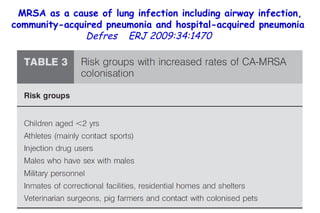
What is MRSA?   Pantosti  ERJ 2009:34:1190  Typically, CA-MRSA strains cause skin and soft tissue infections, including furuncles, abscesses,  impetigo and cellulitis.  Infections are often recurrent and outbreaks have been reported. Rarely, CA-MRSA are associated with severe infections with high mortality, such as sepsis and Waterhouse-Friderichsen syndrome, necrotising fasciitis and necrotising pneumonia. Necrotising pneumonia occurs in young patients, is often preceded by influenza virus infection or an influenza-like illness, is characterised by multiple cavitating lung infiltrates and mortality can exceed 50%.
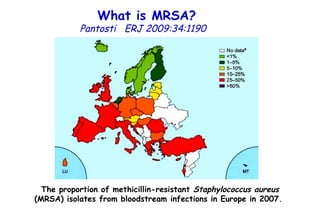
What is MRSA?   Pantosti  ERJ 2009:34:1190  The proportion of methicillin-resistant  Staphylococcus aureus  (MRSA) isolates from bloodstream infections in Europe in 2007.
MRSA as a cause of lung infection including airway infection, community-acquired pneumonia and hospital-acquired pneumonia  Defres   ERJ 2009:34:1470  Staphylococci are Gram-positive spherical bacteria that occur in microscopic clusters resembling grapes.  Staphylococcus aureus  mainly colonises the nasal passages, but it may be found regularly in most other anatomical sites.  Carrier rates in adults vary from 20–50% with people being persistent carriers, intermittent carriers or noncarriers.  A large study found that 24% of people persistently carry  S. aureus  and 57% are intermittent carriers whilst 20% were never colonised.
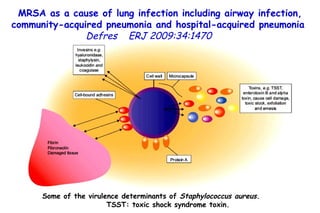
MRSA as a cause of lung infection including airway infection, community-acquired pneumonia and hospital-acquired pneumonia  Defres   ERJ 2009:34:1470  Some of the virulence determinants of  Staphylococcus aureus .  TSST: toxic shock syndrome toxin.
MRSA as a cause of lung infection including airway infection, community-acquired pneumonia and hospital-acquired pneumonia  Defres   ERJ 2009:34:1470  S. aureus  virulence factors include the following.  Surface proteins, for example protein A, that promote adherence and hence colonisation of host tissues. Different  S. aureus  strains may have different groups of these proteins predisposing them to different kinds of infections.  Invasions that promote bacterial spread in tissues (leukocidin, kinases and hyaluronidase).  Membrane damaging toxins that lyse eukaryotic cell membranes (haemolysins, leukotoxin and leukocidin).  Exotoxins that damage host tissues or otherwise provoke symptoms of disease (SAE-G, TSST-1, exfoliatin toxin and Panton–Valentine leukocidin (PVL)).  Inherent and acquired resistance to antimicrobial therapeutic agents.
MRSA as a cause of lung infection including airway infection, community-acquired pneumonia and hospital-acquired pneumonia  Defres   ERJ 2009:34:1470  Initially, MRSA was exclusively associated with acquisition from hospitals and other healthcare settings. However, in the late 1990s true CA-MRSA was identified as the cause of severe and fatal infections occurring in clusters of previously healthy children in North America, who had no identifiable associations with healthcare settings. Cases of  CA-MRSA causing skin and soft tissue infections  and necrotising pneumonia have since been widely reported in otherwise healthy individuals.
MRSA as a cause of lung infection including airway infection, community-acquired pneumonia and hospital-acquired pneumonia  Defres   ERJ 2009:34:1470  Hospital-acquired pneumonia (HAP) or nosocomial pneumonia is usually defined as pneumonia developing ≥ 48 h after admission to hospital that was not incubating at the time of admission. Ventilator-associated pneumonia (VAP) is usually defined as pneumonia developing ≥ 48 h after implementation of endotracheal intubation and/or mechanical ventilation and which was not present prior to intubation.  VAP can be divided into early and late onset. Early-onset disease occurs within  4–5 days of admission and tends to be caused by antibiotic-susceptible community-type pathogens, whereas late-onset disease tends to be caused by antibiotic-resistant pathogens.
MRSA as a cause of lung infection including airway infection, community-acquired pneumonia and hospital-acquired pneumonia  Defres   ERJ 2009:34:1470  Hospital-acquired pneumonia (HAP) or nosocomial pneumonia is usually defined as pneumonia developing ≥ 48 h after admission to hospital that was not incubating at the time of admission. Ventilator-associated pneumonia (VAP) is usually defined as pneumonia developing ≥ 48 h after implementation of endotracheal intubation and/or mechanical ventilation and which was not present prior to intubation.  VAP can be divided into early and late onset. Early-onset disease occurs within  4–5 days of admission and tends to be caused by antibiotic-susceptible community-type pathogens, whereas late-onset disease tends to be caused by antibiotic-resistant pathogens.  However, some studies have found an increasing frequency of early-onset  HAP caused by pathogens more commonly associated with nosocomial disease.
MRSA as a cause of lung infection including airway infection, community-acquired pneumonia and hospital-acquired pneumonia  Defres   ERJ 2009:34:1470  Healthcare-associated pneumonia HCAP, has been defined as pneumonia occurring in any patient who had: been admitted to  an acute care hospital for ≥2 days within 90 days of the infection; been a resident in a nursing home or long-term care facility (LTCF); attended a hospital or haemodialysis clinic; or received recent intravenous antibiotic therapy, chemotherapy  or wound care within the 30 days prior to the current infection.
MRSA as a cause of lung infection including airway infection, community-acquired pneumonia and hospital-acquired pneumonia  Defres   ERJ 2009:34:1470  In the European setting,  S. aureus  remains an unusual primary cause of community-acquired pneumonia (CAP), although it is an important cause of pneumonia and death following influenza.
MRSA as a cause of lung infection including airway infection, community-acquired pneumonia and hospital-acquired pneumonia  Defres   ERJ 2009:34:1470  HAP and VAP Until recently  S. aureus  accounted for  ≈ 1–5% of CAP cases and  ≈10–15% of HAP cases, but over the past 10–20 yrs there has been important changes in the epidemiology of  Staphylococcal pneumonia . First, there has been a dramatic increase in the proportion of  S. aureus  infections due to MRSA, which is now responsible for >50% of all  S. aureus  infections in some intensive care units (ICUs).
MRSA as a cause of lung infection including airway infection, community-acquired pneumonia and hospital-acquired pneumonia  Defres   ERJ 2009:34:1470  HAP and VAP HAP requires the entry of microbial pathogens into the lower respiratory tract followed by colonisation which, if the body's defences are overwhelmed, leads to overt infection.  Factors such as the severity of the patient's underlying disease, prior surgery, exposure to antibiotics, other medications, and exposure to invasive respiratory devices and equipment are important in the pathogenesis of HAP and VAP.
MRSA as a cause of lung infection including airway infection, community-acquired pneumonia and hospital-acquired pneumonia  Defres   ERJ 2009:34:1470  HAP and VAP HAP requires the entry of microbial pathogens into the lower respiratory tract followed by colonisation which, if the body's defences are overwhelmed, leads to overt infection.  Factors such as the severity of the patient's underlying disease, prior surgery, exposure to antibiotics, other medications, and exposure to invasive respiratory devices and equipment are important in the pathogenesis of HAP and VAP.  Early-onset disease, defined as within 4 days of hospitalisation, has a better prognosis and is more likely to be caused by antibiotic-sensitive bacteria.
MRSA as a cause of lung infection including airway infection, community-acquired pneumonia and hospital-acquired pneumonia  Defres   ERJ 2009:34:1470  HAP and VAP A prospective study comparing VAP outcome by causative pathogen demonstrated that, in patients who received appropriate initial antimicrobial therapy, cases due to MRSA still had a significantly slower clinical resolution than those due to other pathogens. Resolution of fever and hypoxia within 72 h occurred in only 30% of MRSA VAP cases, compared to 93.3% of methicilin-sensitive  S. aureus  (MSSA) VAP cases, 100% due to  H. influenzae  and 73% due to  Pseudomonas aeruginosa  .  Vidaur L. Eur Respir Rev 2007;16:31–32
MRSA as a cause of lung infection including airway infection, community-acquired pneumonia and hospital-acquired pneumonia  Defres   ERJ 2009:34:1470  A new form of CAP There has been an emergence of CA-MRSA CAP being reported on both sides of the Atlantic. Although CA-MRSA is primarily a cause of skin and soft tissue infections, it can also cause severe necrotising pneumonia. Characteristics of CA-MRSA CAP often frequently occur in young previously healthy adults, up to 75% of cases, with a preceding flu-like illness. Sufferers rapidly develop severe respiratory symptoms, often including haemoptysis, hypotension and a high fever. Characteristically, leukopenia occurs and C-reactive protein is elevated (>350 g·L –1 ). CXR findings of multilobar cavitating alveolar infiltration are also consistent with CA-MRSA.
MRSA as a cause of lung infection including airway infection, community-acquired pneumonia and hospital-acquired pneumonia  Defres   ERJ 2009:34:1470  when to suspect CA-MRSA in community-acquired pneumonia  When to suspect CA-MRSA Influenza-like prodrome  Severe respiratory symptoms with a rapidly progressive pneumonia evolving to acute respiratory distress syndrome  Fever >39°C  Haemoptysis  Hypotension  Leukopenia  Chest radiograph showing multilobar infiltrates which may have cavitated  Known to be colonised with CA-MRSA or recent travel to an endemic area, such as  North America, and recent contact with CA-MRSA  Belong to a group associated with increased rates of colonisation of CA-MRSA  Previous history or family history of recurrent furuncles or skin abscesses (two or more in past 6 months) CA-MRSA: community-acquired methicillin-resistant  Staphylococcus aureus .  Nathwani J Antimicrob Chem 2008;61:976
MRSA as a cause of lung infection including airway infection, community-acquired pneumonia and hospital-acquired pneumonia  Defres   ERJ 2009:34:1470
MRSA as a cause of lung infection including airway infection, community-acquired pneumonia and hospital-acquired pneumonia  Defres   ERJ 2009:34:1470  INVESTIGATIONS FOR STAPHYLOCOCCAL PNEUMONIA  Obtaining isolates of the organism Endotracheal cultures should not be used to diagnose VAP  as bronchoalveolar lavage specimens are preferred.  For HAP nonbronchoscopy-directed (blind) bronchoalveolar lavage should be used. Blood cultures are more likely to be positive in secondary pneumonia where the primary source is elsewhere, such as infective endocarditis or discitis, rather than in primary pneumonia (90%  versus  20%).
MRSA as a cause of lung infection including airway infection, community-acquired pneumonia and hospital-acquired pneumonia  Defres   ERJ 2009:34:1470  INVESTIGATIONS FOR STAPHYLOCOCCAL PNEUMONIA  The antibiogram: antibiotic sensitivities After isolating  S. aureus , sensitivity testing for various antibiotics will determine whether it is MRSA or not,  and which antibiotics may be clinically effective.  The antibiogram of CA-MRSA is commonly only resistant  to the β-lactams and susceptible to most other antibiotic classes.
MRSA as a cause of lung infection including airway infection, community-acquired pneumonia and hospital-acquired pneumonia  Defres   ERJ 2009:34:1470  INVESTIGATIONS FOR STAPHYLOCOCCAL PNEUMONIA  Molecular techniques Novel laboratory techniques, including microarrays to detect PVL and possibly other staphylococcal toxins or superantigens, may aid in the diagnosis of CA-MRSA pneumonia. These microarrays can reveal if the isolates are harbouring the genes for several toxins including PVL and leukocidin, which have been linked with pulmonary disease and have been associated with CA-MRSA isolates. Also under investigation and development are molecular-based rapid tests to detect PVL,  mec A and SCC mec  type IV.
MRSA as a cause of lung infection including airway infection, community-acquired pneumonia and hospital-acquired pneumonia  Defres   ERJ 2009:34:1470  INVESTIGATIONS FOR STAPHYLOCOCCAL PNEUMONIA  Radiological investigations No radiological features are highly specific for  Staphylococcal pneumonia.  Early in the disease progression of CAP with  S. aureus  there may be minimal infiltrates but they rapidly progress, even within hours. Infiltrates are more likely to cavitate, which may be seen on serial CXR and best confirmed by a computed tomography scan. Pleural effusions, pneumatoceles and pneumothoraces are also common findings.
MRSA as a cause of lung infection including airway infection, community-acquired pneumonia and hospital-acquired pneumonia  Defres   ERJ 2009:34:1470  INVESTIGATIONS FOR STAPHYLOCOCCAL PNEUMONIA  Radiological investigations No radiological features are highly specific for  Staphylococcal pneumonia.  Early in the disease progression of CAP with  S. aureus  there may be minimal infiltrates but they rapidly progress, even within hours. Infiltrates are more likely to cavitate, which may be seen on serial CXR and best confirmed by a computed tomography scan. Pleural effusions, pneumatoceles and pneumothoraces are also common findings.  Clinically however, there may be a suspicion of MRSA as the causative organism in VAP  as patients tend to have more severe disease and respond more slowly to appropriate antimicrobial therapy.
MRSA as a cause of lung infection including airway infection, community-acquired pneumonia and hospital-acquired pneumonia  Defres   ERJ 2009:34:1470  Necrotising pneumonia on  A ) a chest radiograph and  B ) a computed tomography (CT) scan obtained on day 3. The CT scan shows multiple bilateral nodular and cavity lesions.
MRSA as a cause of lung infection including airway infection, community-acquired pneumonia and hospital-acquired pneumonia  Defres   ERJ 2009:34:1470  The frequency of pneumonia caused by HA-MRSA and CA-MRSA is increasing.  HA-MRSA traditionally occurs in the hospital setting. A new form of MRSA, more virulent and frequently more toxin producing (including PVL toxin), is emerging from the community.  It is primarily affecting young healthy individuals and has a high mortality rate.  Vancomycin has been disappointing in treating MRSA pneumonia and although linezolid may be a better choice. Combination therapy with clindamycin and immunoglobulin may be helpful in cases of CA-MRSA where there is PVL production causing haemorrhagic and necrotising pneumonia.  CONCLUSIONS
Effect of Linezolid Compared With  Glycopeptides (Vancomycin, Teicoplanin) in Methicillin-Resistant  Staphylococcus aureus Severe  Pneumonia in Piglets   Luna Chest 2009;135:1564 Infected with MRSA Severe pneumonia Lung pathology score  was  lower in those receiving LZD vs those receiving glycopeptides (Vancomycin, Teicoplanin) (p=0.049) Survival at 72 h was higher in the LZD.
The survival time up to 72 hours analyzed for the different groups Pathology score according to the different AMT received by the piglets. AMT= antimicrobial therapy MV= mechanical ventilation Effect of Linezolid Compared With  Glycopeptides (Vancomycin, Teicoplanin) in Methicillin-Resistant  Staphylococcus aureus Severe  Pneumonia in Piglets   Luna Chest 2009;135:1564
Macrolide resistance in  Streptococcus pyogenes :  A marker of an overuse of macrolides   Matti Korppi, Ped Pulmonol 2009;44:1246 There is no need to treat pharyngitis by macrolides, since nearly all streptococcal strains are sensitive to penicillin and cephalosporins. Thus, macrolide resistance in  S. pyogenes  is not a therapeutic problem, not even in penicillin-allergic patients who can be treated, for example, by cephalosporins.  Merely,  macrolide resistance in  S. pyogenes  is a marker of an overuse of macrolides in the population , and  the true problem is the development of macrolid resistance in  S. pneumoniae .
Thus,  macrolides cannot be used any more as an only drug in the treatment of community-acquired pneumonia (CAP) in children , even though  Mycoplasma pneumoniae  or  Chlamydia pneumoniae  is suspected . M.pneumoniae  and  C. pneumoniae  together cause over half of the CAP cases in over 5 years old and even more in over 10 years old children. However,  S. pneumoniae  should be covered also in these cases, since  a third of atypical bacterial CAP cases are mixed infections with pneumococcus .  Korppi M., Respirology 2004;9:109. Macrolide resistance in  Streptococcus pyogenes :  A marker of an overuse of macrolides   Matti Korppi, Ped Pulmonol 2009;44:1246
A Randomized Trial of Dental Brushing  for Preventing Ventilator-Associated Pneumonia Pobo  Chest 2009;136:433 adult patients intubated for > 48 h oral care every 8 h with 0.12% chlorhexidine digluconate  (standard group) or standard oral care plus electric toothbrushing (toothbrush group) 147 patients  (74 toothbrush group) Kaplan-Meier curve comparing VAP incidence in toothbrush and standard groups.
A Randomized Trial of Dental Brushing  for Preventing Ventilator-Associated Pneumonia Pobo  Chest 2009;136:433 adult patients intubated for > 48 h oral care every 8 h with 0.12% chlorhexidine digluconate (standard group) or standard oral care plus electric toothbrushing (toothbrush group) 147 patients  (74 toothbrush group) Kaplan-Meier curve comparing VAP incidence in toothbrush and standard groups. The toothbrush group and standard group had similar rates of suspected VAP (20.3% vs 24.7%; p= 0.55).
A Randomized Trial of Dental Brushing  for Preventing Ventilator-Associated Pneumonia Pobo  Chest 2009;136:433 adult patients intubated for > 48 h oral care every 8 h with 0.12% chlorhexidine digluconate (standard group) or standard oral care plus electric toothbrushing (toothbrush group) 147 patients  (74 toothbrush group) Kaplan-Meier curve comparing VAP incidence in toothbrush and standard groups. The addition of electric toothbrushing to standard oral care with 0.12% chlorhexidine digluconate is not effective for the prevention of VAP
Nonresolving pneumonia and rash in an adult: pulmonary involvements in Kawasaki's disease   Ugi  ERJ  2010;35:452  Slowly resolving or nonresolving pneumonia is a challenge for physicians.  The most common clinical error when approaching these patients is to subsequently treat the patient with different antibiotics over an extended period of time, without questioning the cause of treatment failure.  Mostly, slowly resolving pneumonias are due to host defence or infectious causes.  Nonresolving pneumonias are usually of noninfectious origin  and, in the majority of cases, require invasive diagnostic techniques to be confirmed.
Nonresolving pneumonia and rash in an adult: pulmonary involvements in Kawasaki's disease   Ugi  ERJ  2010;35:452  A 19-yr-old male developed dyspnoea, dry cough and bilateral reticulo-nodular infiltrates on chest radiograph.  On admission he was still febrile (38.5°C), had generalised oedema and required 6 L·min –1  oxygen to achieve a saturation of 96%. On physical examination crackles were noted on lung auscultation, along with bi-basal dullness to percussion of the thorax.
Nonresolving pneumonia and rash in an adult: pulmonary involvements in Kawasaki's disease   Ugi  ERJ  2010;35:452  Additionally, bilateral conjunctival injections, cervical and axillary lymphadenopathy and markedly reddened pharynx were observed.  Computed tomography scan revealed massive bilateral pleural effusions with bilaterally disseminated patchy infiltrates and ground-glass alterations, modest pericardial effusion and enlarged axillary and mediastinal lymph-nodes.
Nonresolving pneumonia and rash in an adult: pulmonary involvements in Kawasaki's disease   Ugi  ERJ  2010;35:452  Additionally, bilateral conjunctival injections, cervical and axillary lymphadenopathy and markedly reddened pharynx were observed.  Computed tomography scan revealed massive bilateral pleural effusions with bilaterally disseminated patchy infiltrates and ground-glass alterations, modest pericardial effusion and enlarged axillary and mediastinal lymph-nodes.  Based on the assumption of progressive, therapy was piperacillin/tazobactam and clarithromycin.
Nonresolving pneumonia and rash in an adult: pulmonary involvements in Kawasaki's disease   Ugi  ERJ  2010;35:452  Maculo-squamous exanthema was progressive and  he developed palmo-plantar desquamations.  He remained febrile and serological markers of infections continued to be elevated.  All serological and rheumatological analyses, as  well as microbiology and virology were negative.
Nonresolving pneumonia and rash in an adult: pulmonary involvements in Kawasaki's disease   Ugi  ERJ  2010;35:452  Maculo-squamous exanthema was progressive and  he developed palmo-plantar desquamations.  He remained febrile and serological markers of infections continued to be elevated.  All serological and rheumatological analyses, as  well as microbiology and virology were negative.  The next diagnostic step would  have been bronchoscopy including bronchoalveolar lavage.
Nonresolving pneumonia and rash in an adult: pulmonary involvements in Kawasaki's disease   Ugi  ERJ  2010;35:452  As no infectious aetiology could be established and the patient  fulfilled the major criteria for the diagnosis of Kawasaki's disease , antibiotic treatment was withdrawn and high-dose intravenous immunoglobulins at a dose of 2.0 g per kg bodyweight and acetylsalicylic acid were administered.  The patient remained febrile for >30 h after administration  of the first dose of  i.v.  immunoglobulins; thus, a second dose was given, according to the American Heart Association's statement on the management of Kawasaki's disease.  Thereafter, the patient was finally afebrile.
PLEURITE  EMPIEMA epidemiologia e diagnosi
Pediatric parapneumonic pleural effusion:Epidemiology, clinical characteristics, and microbiological diagnosis   Hernández-Bou   Ped Pul 2009;44:1192 Prospective study of patients  <18 years admitted for pneumonic pleural effusion (PPE) between  September 2003 and December 2006. 40 – 30 – 20 – 10 – 0 CASES PER 100,000  19.9 35.2 2004 2006         TO P        ABSTRACT        ME THODS        RE SULTS        DI SCUSSION        Su pport  statement        St atement  of interest        AC KNOWLEDGEMENTS        RE FERENCES         TO P        ABSTRACT        ME THODS        RE SULTS        DI SCUSSION        Su pport  statement        St atement  of interest        AC KNOWLEDGEMENTS        RE FERENCES
Pediatric parapneumonic pleural effusion:Epidemiology, clinical characteristics, and microbiological diagnosis   Hernández-Bou   Ped Pul 2009;44:1192 Prospective study of patients  <18 years admitted for pneumonic pleural effusion (PPE) between  September 2003 and December 2006. 40 – 30 – 20 – 10 – 0 CASES PER 100,000  19.9 35.2 2004 2006 S. pneumoniae  was the main causal agent. Non-vaccine serotypes (NVS) predominated (81.5%), and  serotype 1 was responsible for  38.5% of cases.          TO P        ABSTRACT        ME THODS        RE SULTS        DI SCUSSION        Su pport  statement        St atement  of interest        AC KNOWLEDGEMENTS        RE FERENCES         TO P        ABSTRACT        ME THODS        RE SULTS        DI SCUSSION        Su pport  statement        St atement  of interest        AC KNOWLEDGEMENTS        RE FERENCES
Streptococcus pneumoniae continues to be the principal etiological agent of PPE in the pediatric population.  S. pneumoniae is divided into 91 serotypes, only a few of which are responsiblefor most cases of invasive pneumococcaldisease (IPD). Pneumococcal conjugate heptavalent vaccine (PCV-7) contains (4, 6B, 9V, 14, 18C, 19F, and 23F). Pediatric parapneumonic pleural effusion:Epidemiology, clinical characteristics, and microbiological diagnosis   Hernández-Bou   Ped Pul 2009;44:1192 Serotypes 1 and 19 A are the most frequent causes of PPE         TO P        ABSTRACT        ME THODS        RE SULTS        DI SCUSSION        Su pport  statement        St atement  of interest        AC KNOWLEDGEMENTS        RE FERENCES         TO P        ABSTRACT        ME THODS        RE SULTS        DI SCUSSION        Su pport  statement        St atement  of interest        AC KNOWLEDGEMENTS        RE FERENCES
Empyema Hospitalizations Increased in US Children Despite Pneumococcal Conjugate Vaccine Li  Pediatrics 2010;125:26 Hospitalizations of children ≤ 18 years associated with empyema in 1997,  2000, 2003,  and 2006 % increase in empyema-associated hospitalization rate from 1997 to 2006 70% 70 – 60 – 50 – 40 – 30 – 20 – 10 – 0
Empyema Hospitalizations Increased in US Children Despite Pneumococcal Conjugate Vaccine Li  Pediatrics 2010;125:26 Hospitalizations of children ≤ 18 years associated with empyema in 1997,  2000, 2003,  and 2006 % increase in empyema-associated hospitalization rate from 1997 to 2006 70% 70 – 60 – 50 – 40 – 30 – 20 – 10 – 0 The rate of invasive pneumococcal disease (pneumonia, sepsis, or meningitis caused by  Streptococcus pneumoniae)  decreased 50%, and t he rate of bacterial pneumonia decreased 13%.
Because Parapneumonic effusion (PPEs) <10 mm in thickness on the lateral decubitus radiograph usually resolve with antibiotics, both the British Thoracic Society and the American College of Chest Physicians guidelines suggest that  only PPEs with pleural fluid thickness (PFT) >10 mm on the lateral decubitus radiograph, ultrasound or CT scan should be sampled . What size parapneumonic effusions should be sampled?   Skouras Thorax 2010;65:91
We examined the association between pleural fluid thickness  ( PFT) and the development of pleural complications in all patients with pneumonia admitted Hospital during a 55-month period and had a chest radiograph and CT scan within 24 h with a pleural effusion and infiltrate. PFT on the CT scan was assessed by measuring the maximal distance between the outside of the lung and the inside of the chest wall in millimetres. A pleural  complication  was said to occur when the patient underwent  tube thoracostomy ,  thoracoscopy  or  thoracotomy . What size parapneumonic effusions should be sampled?   Skouras Thorax 2010;65:91
We examined the association between pleural fluid thickness  ( PFT) and the development of pleural complications in all patients with pneumonia admitted Hospital during a 55-month period and had a chest radiograph and CT scan within 24 h with a pleural effusion and infiltrate. PFT on the CT scan was assessed by measuring the maximal distance between the outside of the lung and the inside of the chest wall in millimetres. A pleural  complication  was said to occur when the patient underwent  tube thoracostomy ,  thoracoscopy  or  thoracotomy . What size parapneumonic effusions should be sampled?   Skouras Thorax 2010;65:91 Our hypothesis was that parapneumonic effusions <20 mm in thickness on the CT scan have a very low incidence of pleural complications.
5.6% incidence of pleural complications ( thoracoscopy  or  thoracotomy ) <20mm ≥ 20mm 59% 63 patients Parapneumonic effusions thickness (mm) 70 – 60 - 50 - 40 - 30 – 20 – 10 – 0  PPEs What size parapneumonic effusions should be sampled?   Skouras Thorax 2010;65:91
Conclusions:  a PFT of <20 mm on the CT scan identifies the PPEs that will most probably not require operational intervention  and whose sampling will probably not alter their management.  However, we do not believe that a chest CT scan should be used routinely in the evaluation of patients with pneumonia, as chest ultrasound presents a comparable performance in the diagnosis of pleural effusions. P=0.055 What size parapneumonic effusions should be sampled?   Skouras Thorax 2010;65:91
Ultrasound in Peripheral Pulmonary Air-Fluid Lesions Color Doppler Imaging as an Aid in Differentiating Empyema and Abscess  Chen Chest 2009;135:1426 patients who had had peripheral  air-fluid lesions due to  empyema or lung abscess color Doppler ultrasound and grayscale  ultrasound examinations The four sonographic characteristics observed and analyzed: The wall characteristics of the lesions (wall width, luminal margin, outer margin, and chest wall angle) Split pleura sign Internal echogenicity (suspended microbubble sign, complex-septated effusions, and passive atelectasis) identification of color Doppler ultrasound vessel signals in pericavitary lesions  (consolidation or atelectasis)
patients who had had peripheral  air-fluid lesions due to  empyema or lung abscess color Doppler ultrasound and grayscale  ultrasound examinations Ultrasound in Peripheral Pulmonary Air-Fluid Lesions Color Doppler Imaging as an Aid in Differentiating Empyema and Abscess  Chen Chest 2009;135:1426 The four sonographic characteristics observed and analyzed: The wall characteristics of the lesions (wall width, luminal margin, outer margin, and chest wall angle) Split pleura sign Internal echogenicity (suspended microbubble sign, complex-septated effusions, and passive atelectasis) identification of color Doppler ultrasound vessel signals in pericavitary lesions  (consolidation or atelectasis) The identification of color Doppler ultrasound vessel signals in pericavitary consolidation was the most useful and specific for identifying lung abscesses.
patients who had had peripheral  air-fluid lesions due to  empyema or lung abscess color Doppler ultrasound and grayscale  ultrasound examinations Ultrasound in Peripheral Pulmonary Air-Fluid Lesions Color Doppler Imaging as an Aid in Differentiating Empyema and Abscess  Chen Chest 2009;135:1426 The four sonographic characteristics observed and analyzed: The wall characteristics of the lesions (wall width, luminal margin, outer margin, and chest wall angle) Split pleura sign Internal echogenicity (suspended microbubble sign, complex-septated effusions, and passive atelectasis) identification of color Doppler ultrasound vessel signals in pericavitary lesions  (consolidation or atelectasis) Color Doppler ultrasound is a powerful tool for differentiating the peripheral air-fluid abscess from empyema, with high specificity and without any risk.
a-An empyema   in the right upper lobe.  Ultrasound examination of the chest revealed a hypoechoic lesion with complex-septated effusions (arrow), passive atelectasis (arrowhead), width uniformity, and smooth luminal and outer margins. Color Doppler ultrasound could not identify vessel signals in pericavitary atelectasis. b-An abscess   in the  right lower lobe.  Ultrasound examination of the chest revealed a hypoechoic lesion with typical pulmonary consolidation (characterized by tree-shaped air bronchogram with ramifications) arrowhead, irregular wall width, and irregular luminal and outer margins. Color Doppler ultrasound could identify  vessel signals in pericavitary consolidation (arrow). Ultrasound in Peripheral Pulmonary Air-Fluid Lesions Color Doppler Imaging as an Aid in Differentiating Empyema and Abscess  Chen Chest 2009;135:1426
a:  radiograph  shows an air-fluid level (arrow) in the left lower lobe.  b:  grayscale ultrasound examination reveals a hypoechoic lesion with suspended microbubble sign (arrowhead), irregular wall width, and irregular luminal and outer margins (arrow). The sonographic characteristics favored lung abscess.  c:  color Doppler ultrasound, however, could not identify vessel signals in pericavitary lesion (arrow). EMPYEMA Ultrasound in Peripheral Pulmonary Air-Fluid Lesions Color Doppler Imaging as an Aid in Differentiating Empyema and Abscess  Chen Chest 2009;135:1426
d : radiograph shows an air-fluid level (arrow) in the right lower lobe.  e:  grayscale ultrasound examination reveals a hypoechoic lesion with suspended microbubble signs (arrowhead), irregular wall width, and irregular luminal and outer margins (arrow). The sonographic characteristics favored lung abscess.  f:  color Doppler ultrasound also could identify vessel signals in pericavitary consolidation (arrow). ABSCESS Ultrasound in Peripheral Pulmonary Air-Fluid Lesions Color Doppler Imaging as an Aid in Differentiating Empyema and Abscess  Chen Chest 2009;135:1426
a:  chest radiograph shows an air-fluid level (arrow) in the right lower lobe.  b: CT scan image shows a  cavitary lesion with an air-fluid level (arrowhead) and split pleura sign (arrow).  c: grayscale ultrasound examination reveals a band-like shape with smooth margin and straight air-bronchograms (arrowhead) not like typical pulmonary consolidation characterized by irregular, serrated, and somewhat blurred margin and a marked tree-shaped air bronchogram with ramifications. The band-like shape does not surround the air-fluid lesion continuously (arrow), which is a typical (continued) presentation of passive atelectasis.  d: the vessels in passive  atelectasis, like the air bronchogram, are relatively straight. Ultrasound in Peripheral Pulmonary Air-Fluid Lesions Color Doppler Imaging as an Aid in Differentiating Empyema and Abscess  Chen Chest 2009;135:1426 EMPYEMA
e:  radiograph shows an air-fluid level (arrow) in the left lower lobe.  f:  CT scan image shows a cavitary lesion with an air-fluid level (arrowhead), mimicking split pleura sign (arrow).  g:  grayscale ultrasound examination of the chest reveals a hypoechoic lesion with suspended microbubble sign (arrowhead), which is surrounded by whole-lung parenchyma (arrow).  h:  color Doppler ultrasound can identify vessel signals in pericavitary consolidation in a lung abscess. The vessels in pulmonary consolidation are  abundant, branching, and twisted. Ultrasound in Peripheral Pulmonary Air-Fluid Lesions Color Doppler Imaging as an Aid in Differentiating Empyema and Abscess  Chen Chest 2009;135:1426 ABSCESS
The Dynamic Air Bronchogram  A Lung Ultrasound Sign of Alveolar Consolidation  Ruling Out Atelectasis Lichtenstein Chest 2009;135:1421 52 patients with proven pneumonia 16 patients with proven resorptive atelectasis The air bronchogram dynamic was analyzed within the ultrasound area of consolidation. The air bronchograms in the pneumonia group yielded the dynamic air bronchogram in 32 patients and a static air bronchogram in 20. In the atelectasis group, air bronchograms yielded a dynamic air bronchogram in 1 out of 16 patients.
52 patients with proven pneumonia 16 patients with proven resorptive atelectasis The air bronchogram dynamic was analyzed within the ultrasound area of consolidation. The air bronchograms in the pneumonia group yielded the dynamic air bronchogram in 32 patients and a static air bronchogram in 20. In the atelectasis group, air bronchograms yielded a dynamic air bronchogram in 1 out of 16 patients. In patients with alveolar consolidation displaying air bronchograms on an ultrasound, the dynamic air bronchogram indicated pneumonia, distinguishing it from resorptive atelectasis. The Dynamic Air Bronchogram  A Lung Ultrasound Sign of Alveolar Consolidation  Ruling Out Atelectasis Lichtenstein Chest 2009;135:1421
The shred sign.  Alveolar consolidation of the lingula. This image shows a mass abutting the pleural line (arrowheads) with a tissue-like pattern. This figure highlights the shredded lower border, limited by the arrows, which is the shred sign. A pleural effusion would have a lower border that is regular and roughly parallel to the pleural line ( ie, the lung line). The Dynamic Air Bronchogram  A Lung Ultrasound Sign of Alveolar Consolidation  Ruling Out Atelectasis Lichtenstein Chest 2009;135:1421
Dynamic air bronchogram  (real time).  Left : tubular bright artifactual structures within a consolidation corresponding to air bronchograms in expiratory time. White arrows indicate consolidated lung tissue. Note punctiform air bronchograms (black arrow).  The arrowhead indicates the diaphragm.  Right : centrifugal progression of the air bronchograms in inspiratory time (arrows). The excursion can be measured at least equal to 1 cm. The Dynamic Air Bronchogram  A Lung Ultrasound Sign of Alveolar Consolidation  Ruling Out Atelectasis Lichtenstein Chest 2009;135:1421 expire inspire
Dynamic air bronchogram   (M-mode). The M-mode analyzes one line of the real-time image in function of time, making dynamic events appear on static images. The centrifugal inspiratory shift of the air bronchograms is objectified (somewhat sinusoidal line). Static air bronchograms would yield horizontal lines, indicating absence of dynamic. Exp expiration;  Insp =inspiration. The Dynamic Air Bronchogram  A Lung Ultrasound Sign of Alveolar Consolidation  Ruling Out Atelectasis Lichtenstein Chest 2009;135:1421
Spontaneous Middle Lobe Torsion Secondary to Pleural Effusion  Raynaud  Chest 2009;136:281 Pulmonary torsion is very rare, and usually occurs following lung resection. We report a case of spontaneous middle lobe torsion in a patient presenting with a right pleural effusion. The condition was treated by lobectomy through a totally thoracoscopic approach.
Spontaneous Middle Lobe Torsion Secondary to Pleural Effusion  Raynaud  Chest 2009;136:281 Chest CT scan demonstrating a condensed and consolidated middle lobe.  A:  a regular, noninjected axial slice.
Spontaneous Middle Lobe Torsion Secondary to Pleural Effusion  Raynaud  Chest 2009;136:281 Chest CT scan demonstrating a condensed and  consolidated middle lobe. B:  a coronal slice after processing with minimal intensity projection.
Spontaneous Middle Lobe Torsion Secondary to Pleural Effusion  Raynaud  Chest 2009;136:281 Chest CT scan demonstrating a condensed and  consolidated middle lobe. B:  a coronal slice after processing with minimal intensity projection. Thoracoscopic close-up view of the middle lobe pedicle showing 360° clockwise torsion as indicated by the arrow. ML =middle lobe;  RLL =right lower lobe; RUL =right upper l obe.
Diagnostic and Prognostic Values of  Pleural Fluid Procalcitonin in Parapneumonic Pleural Effusions Lin  Chest 2009;136:205 82 adult patients with pleural effusions divided into two groups: the parapneumonic pleural effusion (PPPE) group (n =45); and the non-PPPE group (n= 37) Levels of pleural fluid (PF) PCT and serum (S) PCT. PCT in serum
Diagnostic and Prognostic Values of  Pleural Fluid Procalcitonin in Parapneumonic Pleural Effusions Lin  Chest 2009;136:205 82 adult patients with pleural effusions divided into two groups: the parapneumonic pleural effusion (PPPE) group (n =45); and the non-PPPE group (n= 37) Levels of pleural fluid (PF) PCT and serum (S) PCT. PCT in pleural fluid
Diagnostic and Prognostic Values of  Pleural Fluid Procalcitonin in Parapneumonic Pleural Effusions Lin  Chest 2009;136:205 82 adult patients with pleural effusions divided into two groups: the parapneumonic pleural effusion (PPPE) group (n =45); and the non-PPPE group (n= 37) Levels of pleural fluid (PF) PCT and serum (S) PCT. PCT in pleural fluid S-PCT had a better diagnostic performance than PF-PCT
PLEURITE  EMPIEMA terapia
A symptomatic pleural effusion is a common cause of presentation to medical admission units. Traditionally, large-bore Argyle-type  drains were inserted but, over the past  decade, there has been a move to  inserting small-bore 10–12 French gauge  drains using the Seldinger technique.   The reasons for this include a perceived reduction in patient discomfort and invasiveness, and the apparent ease and speed of insertion of the smaller drains. Seldinger chest drain insertion: simpler but not necessarily safer   Maskell  Thorax  2010;65:5-6
Seldinger chest drain insertion: simpler but not necessarily safer   Maskell  Thorax  2010;65:5-6 The Seldinger technique is a  medical  procedure  to obtain safe access to  blood   vessels  and other hollow  organs . It is  named   after  Dr.  Sven-Ivar   Seldinger  (1921-1998), a  Swedish   radiologist . The desired vessel or cavity punctured with a sharp hollow needle called a  trocar , with  ultrasound  guidance if necessary. A round-tipped guidewire is then advanced through the lumen of the trocar, and the trocar is withdrawn. A &quot; sheath &quot; or blunt cannula can now be passed over the guidewire into the cavity or vessel. Alternatively, drainage tubes are passed over the guidewire (as in chest drains or  nephrostomies ).  After passing a sheath of tube, the guidewire is withdrawn.
Surveys on chest drain insertion have shown that, even among experienced respiratory physicians and thoracic surgeons,  overpenetration of the trocar and visceral injuries using Argyle-type chest drains  occur. It has been assumed that the recent change in chest drain insertion to the use of smaller bore chest drains inserted using the Seldinger technique is safer, but there is at present no evidence to support this assumption. Seldinger chest drain insertion: simpler but not necessarily safer   Maskell  Thorax  2010;65:5-6
Complications  of small-bore chest tubes include: Puncture of the intercostal artery. Over-introduction of the dilator into the chest cavity causing organ perforation. Hospital-acquired pleural infection using a non-aseptic technique. Inadequate ‘‘stay’’ suture allowing the chest tube to fall out. Tube blockage, which may be more common than with larger bore Argyle drains. Seldinger chest drain insertion: simpler but not necessarily safer   Maskell  Thorax  2010;65:5-6
The recent National Patient Safety Agency (NPSA) alert reported 12 deaths and  15 cases of serious harm related to chest drain insertion between January 2005 and March 2008. Deaths were secondary to puncture of the heart, lungs and liver. Small-bore chest drain misplaced in left ventricle Seldinger chest drain insertion: simpler but not necessarily safer   Maskell  Thorax  2010;65:5-6
Ultrasound guidance  has been shown to detect  fluid  more accurately than by chest radiography ,  to  decrease the  incidence of failed aspirations  and the incidence  of complications , and to be  significantly  better  than clinical examination  in choosing a site for safe aspiration  or drain insertion. There may be a  temptation with the aid of ultrasound to forget the golden rule  of  drain insertion over the rib , and  to attempt drain insertion into small posteriorly or technically difficult positioned pleural collections  which may lead to an  increase in the incidence of complications . Seldinger chest drain insertion: simpler but not necessarily safer   Maskell  Thorax  2010;65:5-6
< 10 F 36% 36% The Relationship Between Chest Tube Size and Clinical Outcome in Pleural Infection  Rahman   CHEST  2010;137:536  405 patients with pleural infection. Utility of fibrinolytic therapy with chest tubes of differing size. % patients either died or required thoracic surgery 50 – 40 – 30 – 20 – 10 – 0 40% 44% > 20 F 15-20 F 10-15 F TUBE SIZE
< 10 F 36% 36% The Relationship Between Chest Tube Size and Clinical Outcome in Pleural Infection  Rahman   CHEST  2010;137:536  405 patients with pleural infection. Utility of fibrinolytic therapy with chest tubes of differing size. % patients either died or required thoracic surgery 50 – 40 – 30 – 20 – 10 – 0 40% 44% > 20 F 15-20 F 10-15 F Pain scores were substantially higher in patients receiving  larger  tubes. TUBE SIZE
< 10 F 36% 36% The Relationship Between Chest Tube Size and Clinical Outcome in Pleural Infection  Rahman   CHEST  2010;137:536  405 patients with pleural infection. Utility of fibrinolytic therapy with chest tubes of differing size. % patients either died or required thoracic surgery 50 – 40 – 30 – 20 – 10 – 0 40% 44% > 20 F 15-20 F 10-15 F Smaller size tubes may be the initial treatment of choice for pleural infection. TUBE SIZE
Interventional Management of Pleural Infections  Heffner CHEST 2009; 136:1148
Interventional Management of Pleural Infections  Heffner CHEST 2009; 136:1148 Mortality rates are between 7% and 33%, with mortality rates  >50% among elderly patients with comorbidities. Empyema has increased in incidence during the last 2 decades. increase in the empyema incidence rate by 2.8% per year from 1987 to 2004.
Interventional Management of Pleural Infections  Heffner CHEST 2009; 136:1148 Mortality rates are between 7% and 33%, with mortality rates  >50% among elderly patients with comorbidities. Empyema has increased in incidence during the last 2 decades. increase in the empyema incidence rate by 2.8% per year from 1987 to 2004. An aging population, longer survival times for immunocompromised patients and those with comorbid diseases, and changing virulence of pleural pathogens suggest that these incidence trends will  continue.
Interventional Management of Pleural Infections  Heffner CHEST 2009; 136:1148 Modern principles of empyema management promote  early diagnosis  and  prompt pleural drainage. Delays in initiating effective drainage prolong hospital stays, increase the likelihood that more invasive drainage procedures will be required, and increase mortality and morbidity. Unfortunately, studies have demonstrated that physicians commonly delay diagnosis and drainage for patients with pleural infections.
Interventional Management of Pleural Infections  Heffner CHEST 2009; 136:1148 Modern principles of empyema management promote  early diagnosis  and  prompt pleural drainage. Delays in initiating effective drainage prolong hospital stays, increase the likelihood that more invasive drainage procedures will be required, and increase mortality and morbidity. Unfortunately, studies have demonstrated that physicians commonly delay diagnosis and drainage for patients with pleural infections. Every patient who is at risk for pleural infections should undergo an initial evaluation to detect pleural fluid, determine the likelihood that the fluid is infected, and ensure prompt drainage when indicated
Pleural effusions  secondary to pneumonia  are termed  parapneumonic effusions. Most of these effusions remain sterile and resolve with antibiotic therapy  (termed  uncomplicated parapneumonic effusions ) Infections of the pleural space develop in a small subset of patients and require drainage for full recovery  (termed  complicated parapneumonic effusions ). Pathophysiologic Classification and Clinical Staging of Pleural Infections Interventional Management of Pleural Infections  Heffner CHEST 2009; 136:1148
Pleural effusions  secondary to pneumonia  are termed  parapneumonic effusions. Most of these effusions remain sterile and resolve with antibiotic therapy  (termed  uncomplicated parapneumonic effusions ) Infections of the pleural space develop in a small subset of patients and require drainage for full recovery  (termed  complicated parapneumonic effusions ). Pathophysiologic Classification and Clinical Staging of Pleural Infections Interventional Management of Pleural Infections  Heffner CHEST 2009; 136:1148 Without effective drainage, complicated parapneumonic effusions progress to frank intrapleural pus, which defines the presence of an  empyema
Pleural effusions  secondary to pneumonia  are termed  parapneumonic effusions. Most of these effusions remain sterile and resolve with antibiotic therapy  (termed  uncomplicated parapneumonic effusions ) Infections of the pleural space develop in a small subset of patients and require drainage for full recovery  (termed  complicated parapneumonic effusions ). Pathophysiologic Classification and Clinical Staging of Pleural Infections Interventional Management of Pleural Infections  Heffner CHEST 2009; 136:1148 This progression may occur rapidly over a few days and necessitate surgical drainage
Serial chest radiographs and CT scan images demonstrating  rapid progression of infected pleural fluid to an empyema  that required surgical drainage.  A: a chest radiograph obtained at hospital admission demonstrates a right pleural effusion and parenchymal  density at the right lung base. Therapy with antibiotics was begun, but thoracentesis was not performed. The effusion became massive 3 days later ( B) when a noncontrasted CT scan (C) demonstrated multiple locules that contained viscous pus during surgical drainage.  Without contrast, the CT scan could not clearly differentiate in some areas between loculated fluid and lung consolidation. Pathophysiologic Classification and Clinical Staging of Pleural Infections Interventional Management of Pleural Infections  Heffner CHEST 2009; 136:1148 admission 3 days later 3 days later
Progression to empyema occurs in three phases: The  exudative phase  develops when inflammatory fluid enters the pleural space across vascular and visceral pleural membranes that have increased permeability due to pneumonia. Pleural fluid is nonviscous, free-flowing, and readily drained by thoracentesis or chest tube. Unremitting inflammation deposits fibrin that coats the visceral pleura and promotes the formation of locules that impede lung reexpansion during attempts at fluid drainage. Pleural fluid becomes purulent and increasingly viscous. This  fibrinopurulent phase  may respond to therapy with antibiotics and chest tube drainage but often requires  intervention to break down adhesions. If a fibropurulent effusion remains undrained, fibroblasts eventually deposit fibrotic tissue that encases the lung in inelastic peels. At this  organizing phase , resolution of the empyema requires surgical procedures. Pathophysiologic Classification and Clinical Staging of Pleural Infections Interventional Management of Pleural Infections  Heffner CHEST 2009; 136:1148
Progression to empyema occurs in three phases: The  exudative phase  develops when inflammatory fluid enters the pleural space across vascular and visceral pleural membranes that have increased permeability due to pneumonia. Pleural fluid is nonviscous, free-flowing, and readily drained by thoracentesis or chest tube. Unremitting inflammation deposits fibrin that coats the visceral pleura and promotes the formation of locules that impede lung reexpansion during attempts at fluid drainage. Pleural fluid becomes purulent and increasingly viscous. This  fibrinopurulent phase  may respond to therapy with antibiotics and chest tube drainage but often requires  intervention to break down adhesions. If a fibropurulent effusion remains undrained, fibroblasts eventually deposit fibrotic tissue that encases the lung in inelastic peels. At this  organizing phase , resolution of the empyema requires surgical procedures. Pathophysiologic Classification and Clinical Staging of Pleural Infections Interventional Management of Pleural Infections  Heffner CHEST 2009; 136:1148 The three phases of empyema represent a continuum of events with no clear demarcations.
Pathophysiologic Classification and Clinical Staging of Pleural Infections Interventional Management of Pleural Infections  Heffner CHEST 2009; 136:1148
Pathophysiologic Classification and Clinical Staging of Pleural Infections Interventional Management of Pleural Infections  Heffner CHEST 2009; 136:1148 Note: Uncomplicated parapneumonic effusions left undrained should have thoracentesis repeated if the effusion enlarges or the clinical condition deteriorates.
Parapneumonic effusions represent the most common cause of exudative effusions and occur in 20 to 57% of hospitalized patients with pneumonia. Empyemas occur in 1 to 5% of hospitalized patients with parapneumonic effusions. Pathophysiologic Classification and Clinical Staging of Pleural Infections Interventional Management of Pleural Infections  Heffner CHEST 2009; 136:1148
Basic principles of management (ie, rapid detection of infected pleural fluid and prompt, complete drainage when necessary) are important. A multidisciplinary approach that coordinates pulmonary, thoracic surgery, and interventional radiology expertise. Therapeutic Approaches to Pleural Infections Interventional Management of Pleural Infections  Heffner CHEST 2009; 136:1148
When the clinical presentation and pleural fluid analysis do not establish a clear indication for pleural fluid drainage, the ACCP guidelines recommend repeating diagnostic thoracentesis to measure pleural fluid biomarkers again and reassess the need for drainage. Some centers recommend daily therapeutic thoracentesis with or without pleural lavage when infected effusions reaccumulate. This approach may require an average of eight thoracenteses in > 2 to 4 weeks. Therapeutic Approaches to Pleural Infections: serial thoracentesis. Interventional Management of Pleural Infections  Heffner CHEST 2009; 136:1148
When the clinical presentation and pleural fluid analysis do not establish a clear indication for pleural fluid drainage, the ACCP guidelines recommend repeating diagnostic thoracentesis to measure pleural fluid biomarkers again and reassess the need for drainage. Some centers recommend daily therapeutic thoracentesis with or without pleural lavage when infected effusions reaccumulate. This approach may require an average of eight thoracenteses in > 2 to 4 weeks. Therapeutic Approaches to Pleural Infections: serial thoracentesis. Interventional Management of Pleural Infections  Heffner CHEST 2009; 136:1148 Most experts avoid repeating multiple thoracenteses because more effective and minimally invasive drainage procedures using small-bore catheters allow faster recovery and shorter hospital
Interventional Management of Pleural Infections  Heffner CHEST 2009; 136:1148 Therapeutic Approaches to Pleural Infections:  Chest tube drainage . Chest tubes vary in size but can be classified as large-bore  ( 24F to 34F) or small-bore (8F to 24F). Tubes can be guided by fluoroscopy, ultrasonography (US), or CT imaging.  Techniques for the insertion of chest tubes include intercostal incisions (for large-bore tubes) or use of a trocar or Seldinger technique (8F to 28F tubes).
Interventional Management of Pleural Infections  Heffner CHEST 2009; 136:1148 Therapeutic Approaches to Pleural Infections:  Chest tube drainage . Chest tubes vary in size but can be classified as large-bore  ( 24F to 34F) or small-bore (8F to 24F). Tubes can be guided by fluoroscopy, ultrasonography (US), or CT imaging.  Techniques for the insertion of chest tubes include intercostal incisions (for large-bore tubes) or use of a trocar or Seldinger technique (8F to 28F tubes). Complete reexpansion of the lung, as demonstrated by repeat imaging, resolution of clinical and laboratory signs of infection, and avoidance of surgical drainage define successful drainage.
For patients with viscous pleural pus, the surgical tradition recommends the use of large-bore chest tubes (28F to 32F). Clinical studies, however, indicate that small-bore pigtail catheters ( <12F) can successfully drain infected pleural fluid, including loculated empyemas, in 70% to 100% of instances. Six to 20% of patients treated initially with small-bore catheters eventually require surgical drainage. Interventional Management of Pleural Infections  Heffner CHEST 2009; 136:1148 Therapeutic Approaches to Pleural Infections:  Chest tube drainage .
Several factors promote the efficacy of small-bore catheters: 1. monitoring chest tube function and flushing tubes with a saline solution several times a day, 2. malfunctioning tubes are immediately repositioned or replaced, 3. replacing 8F to 12F catheters with larger bore tubes (upsizing) if initial fluid drainage appears to be incomplete. Interventional Management of Pleural Infections  Heffner CHEST 2009; 136:1148 Therapeutic Approaches to Pleural Infections:  Chest tube drainage .
Several factors promote the efficacy of small-bore catheters: 1. monitoring chest tube function and flushing tubes with a saline solution several times a day, 2. malfunctioning tubes are immediately repositioned or replaced, 3. replacing 8F to 12F catheters with larger bore tubes (upsizing) if initial fluid drainage appears to be incomplete. Interventional Management of Pleural Infections  Heffner CHEST 2009; 136:1148 Therapeutic Approaches to Pleural Infections:  Chest tube drainage . Interventional radiologists can insert catheters up to 28F by image-guided trocar or Seldinger techniques
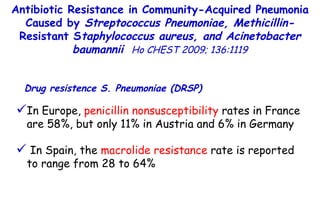
Several factors promote the efficacy of small-bore catheters: 1. monitoring chest tube function and flushing tubes with a saline solution several times a day, 2. malfunctioning tubes are immediately repositioned or replaced, 3. replacing 8F to 12F catheters with larger bore tubes (upsizing) if initial fluid drainage appears to be incomplete. Interventional Management of Pleural Infections  Heffner CHEST 2009; 136:1148 Therapeutic Approaches to Pleural Infections:  Chest tube drainage . Image guidance allows placement of several catheters for multiple noncommunicating pleural fluid collections  including associated extrathoracic  abscesses
( A) shows dense airspace  consolidation in the left lower lobe and  lingula with fluid tracking laterally (arrows). The patient underwent image-guided drainage of thick pus with a small-bore catheter. A sagittal sonographic image ( B, cephalad to the left of the image) shows  no residual fluid. The sonogram ( B) demonstrates the echogenic visceral pleural line peripherally  (arrows). Interventional Management of Pleural Infections  Heffner CHEST 2009; 136:1148 Therapeutic Approaches to Pleural Infections:  Chest tube drainage .
A frontal chest radiograph (A) and a lateral chest radiograph (B) show a lenticularly shaped right posterolateral pleura-based opacity (*) with a small density in the upper major fissure (arrow in B) Interventional Management of Pleural Infections  Heffner CHEST 2009; 136:1148 Therapeutic Approaches to Pleural Infections:  Chest tube drainage .
Both densities were demonstrated by CT scanning to be intrapleural locules. The apparent elevation of the right diaphragm suggests a subpulmonic effusion. A contrast-enhanced CT scan through the lower chest ( C) shows a multiloculated right pleural collection. A CT scan obtained during the placement of a 28F drainage  tube ( D) shows a tube positioned within the dependent region of the fluid collection. The patient recovered without additional  interventions and had minimal residual pleural thickening 19 days later ( E). Interventional Management of Pleural Infections  Heffner CHEST 2009; 136:1148 Therapeutic Approaches to Pleural Infections:  Chest tube drainage .
Pleural imaging (superior to left of image) during sonographically guided tube (T) drainage of an empyema (E) with multiple septations (S).  L =lung. Interventional Management of Pleural Infections  Heffner CHEST 2009; 136:1148 Therapeutic Approaches to Pleural Infections:  Chest tube drainage .
Complications occur in 3% of patients treated with image-guided small-bore catheters. Pigtail catheter dislodgement rates are 8 to 13%. Blind tube insertion has moderate success ( <50%). Failure is attributed to the misplacement of tubes distant from  pleural locules, multiple noncommunicating locules,  tube kinking, or obstruction by secretions. Interventional Management of Pleural Infections  Heffner CHEST 2009; 136:1148 Therapeutic Approaches to Pleural Infections:  Chest tube drainage .
Complications occur in 3% of patients treated with image-guided small-bore catheters Pigtail catheter dislodgement rates are 8 to 13% Blind tube insertion has moderate success ( 50%) Failure is attributed to the misplacement of tubes distant from  pleural locules, multiple noncommunicating locules,  tube kinking, or obstruction by secretions Complications, include hemorrhage, perforation of the diaphragm, lung, or abdominal viscera and tube misplacement into fissures or extrapleural tissue planes Interventional Management of Pleural Infections  Heffner CHEST 2009; 136:1148 Therapeutic Approaches to Pleural Infections:  Chest tube drainage .
Interventional Management of Pleural Infections  Heffner CHEST 2009; 136:1148 Therapeutic Approaches to Pleural Infections:  Fibrinolytic Therapy . When an infected pleural space progresses to the fibrinopurulent phase: 1. Streptokinase, urokinase, and rtPA (intrapleural tissue plasminogen activator), 2. Streptokinase often loses effectiveness due to immune-mediated neutralization.
Interventional Management of Pleural Infections  Heffner CHEST 2009; 136:1148 Therapeutic Approaches to Pleural Infections:  Fibrinolytic Therapy . When an infected pleural space progresses to the fibrinopurulent phase: 1. Streptokinase, urokinase, and rtPA (intrapleural tissue plasminogen activator), 2. Streptokinase often loses effectiveness due to immune-mediated neutralization. Gervais et al, opined that rtPA successfully drained effusions that would otherwise have required surgery Gervais DA, Levis DA, Hahn PF, et al. Adjunctive intrapleural tissue plasminogen activator administered via chest tubes placed with imaging guidance: effectiveness and risk for hemorrhage. Radiology 2008; 246:956
Current evidence does not support routine fibrinolytic therapy for unselected patients with parapneumonic effusions. Subgroups of patients with loculated or septated infected pleural effusions may benefit. As a prudent approach, pending future clinical trials would reserve therapy with fibrinolytic drugs for patients whose pleural effusions fail to drain completely after initial catheter insertion. Chest tubes should be sized appropriately for the fluid viscosity, with timely catheter upsizing performed as needed. Interventional Management of Pleural Infections  Heffner CHEST 2009; 136:1148 Therapeutic Approaches to Pleural Infections:  Fibrinolytic Therapy .
Current evidence does not support routine fibrinolytic therapy for unselected patients with parapneumonic effusions. Subgroups of patients with loculated or septated infected pleural effusions may benefit. As a prudent approach, pending future clinical trials would reserve therapy with fibrinolytic drugs for patients whose pleural effusions fail to drain completely after initial catheter insertion. Chest tubes should be sized appropriately for the fluid viscosity, with timely catheter upsizing performed as needed. Definitive surgical drainage should not be delayed for appropriate operative candidates if fibrinolysis fails to drain the effusion rapidly and completely Interventional Management of Pleural Infections  Heffner CHEST 2009; 136:1148 Therapeutic Approaches to Pleural Infections:  Fibrinolytic Therapy .
Chest CT scan image of a multiloculated empyema ( A) that required percutaneous  placement of a large-bore catheter. After subsequent instillation of rtPA, a contrast-enhanced scan ( B)  at the level of the aortic arch shows the tube in the pleural space posteriorly with minimal residual pleural fluid or thickening (white curved arrows) and regions of edema (black curved arrows) of the extrapleural fat (black straight arrows),  a finding often seen on CT scans of patients with empyema. Interventional Management of Pleural Infections  Heffner CHEST 2009; 136:1148 Therapeutic Approaches to Pleural Infections:  Fibrinolytic Therapy .
The viscosity of pus is largely attributable to its deoxyribose nucleoprotein content. Fibrinolytic drugs have negligible effects on decreasing the viscosity of empyema pus   in contrast to agents that depolymerize DNA, such as human recombinant deoxyribonuclease . Recombinant deoxyribonuclease has been reported to improve drainage in a single patient who did not respond to fibrinolytic  therapy. Interventional Management of Pleural Infections  Heffner CHEST 2009; 136:1148 Therapeutic Approaches to Pleural Infections:  Fibrinolytic Therapy .
The complications of fibrinolysis include chest pain, fever, hemothorax, hematuria, and allergic reactions to streptokinase. With the use of rtPA, systemic hemorrhage has not been reported except in patients receiving concomitant full-dose anticoagulation. Interventional Management of Pleural Infections  Heffner CHEST 2009; 136:1148 Therapeutic Approaches to Pleural Infections:  Fibrinolytic Therapy .
Hemothorax complicating intrapleural instillation of rtPA for a loculated empyema.  An unenhanced CT scan ( A) shows right  anterior, posterolateral, and paraspinal and small left pleural fluid collections with a pigtail catheter entering the right chest wall (arrow) with its tip terminating in the posterolateral fluid collection (not shown in  A). Intrapleural rtPA was instilled into the anterior fluid  collection through a second pigtail catheter. Three days later ( B), the anterior collection drained but posterolateral collection persisted.  After the instillation of additional rtPA, pleural drainage became bloody, and a repeat unenhanced CT scan ( C) demonstrated a large,  anterior fluid collection with high-attenuation material dependently (black arrow) reflecting a loculated hemothorax that displaced the anterior catheter (white arrows). The posterior fluid collection in  C increased slightly compared with B, suggesting posterior accumulation  of blood from the anterior hemorrhage. This series of images demonstrates the difficulty in establishing by CT scan whether different pleural fluid collections intercommunicate Interventional Management of Pleural Infections  Heffner CHEST 2009; 136:1148 Therapeutic Approaches to Pleural Infections:  Fibrinolytic Therapy .
Interventional Management of Pleural Infections  Heffner CHEST 2009; 136:1148 Therapeutic Approaches to Pleural Infections:  Thorascopy . Thoracoscopy provides minimally invasive access to the pleural space for patients with free-flowing or multiloculated effusions to suction viscous pleural fluid, lyse adhesions to promote drainage of locules, and place chest tubes in dependent regions of pleural fluid under direct visualization. Inability of the reinflated lung to expand to the chest wall and diaphragm indicates an unsuccessful thoracoscopy and a need for thoracotomy.
Interventional Management of Pleural Infections  Heffner CHEST 2009; 136:1148 Therapeutic Approaches to Pleural Infections:  Thorascopy . Thoracoscopy provides minimally invasive access to the pleural space for patients with free-flowing or multiloculated effusions to suction viscous pleural fluid, lyse adhesions to promote drainage of locules, and place chest tubes in dependent regions of pleural fluid under direct visualization. Inability of the reinflated lung to expand to the chest wall and diaphragm indicates an unsuccessful thoracoscopy and a need for thoracotomy. Advantages of thoracoscopic pleural drainage compared with thoracotomy include less postoperative pain, lower costs, shorter hospital stays, and better cosmetic results. Available thoracoscopic procedures include medical thoracoscopy and  video-assisted thoracoscopic surgery (VATS)
A thoracic surgeon performs VATS with patients under general anesthesia. Decortication and pleurectomy can be performed. VATS provides wide access to the pleural space in many patients but may be inadequate to reach all fluid collections for advanced empyemas and dense adhesions or widely distributed locules. Interventional Management of Pleural Infections  Heffner CHEST 2009; 136:1148 Therapeutic Approaches to Pleural Infections:  Thorascopy .
A thoracic surgeon performs VATS with patients under general anesthesia. Decortication and pleurectomy can be performed. VATS provides wide access to the pleural space in many patients but may be inadequate to reach all fluid collections for advanced empyemas and dense adhesions or widely distributed locules. Interventional Management of Pleural Infections  Heffner CHEST 2009; 136:1148 Therapeutic Approaches to Pleural Infections:  Thorascopy . The overall success rate, as defined by complete recovery without requiring thoracotomy, is 60 to 100% for fibrinopurulent effusions
A thoracic surgeon performs VATS with patients under general anesthesia. Decortication and pleurectomy can be performed. VATS provides wide access to the pleural space in many patients but may be inadequate to reach all fluid collections for advanced empyemas and dense adhesions or widely distributed locules. Interventional Management of Pleural Infections  Heffner CHEST 2009; 136:1148 Therapeutic Approaches to Pleural Infections:  Thorascopy . Many centers reserve VATS for the treatment of patients with fibrinopurulent effusions, although some surgeons initially treat empyemas in the organizing phase with VATS, with conversion to thoracotomy if necessary.
Interventional Management of Pleural Infections  Heffner CHEST 2009; 136:1148 Therapeutic Approaches to Pleural Infections:  Thorascopy . Epidemiologic noted a lower overall mortality for patients with empyema from 1987 to 2004, during which time progressively more patients underwent surgical drainage (either thoracotomy or thoracoscopy), as opposed to chest tube drainage. Some experts have proposed initial thoracoscopy for all patients with fibrinopurulent or organized empyemas, while others have recommended a trial of image-guided catheter drainage with or without fibrinolytic therapy.
Interventional Management of Pleural Infections  Heffner CHEST 2009; 136:1148 Therapeutic Approaches to Pleural Infections:  Thorascopy . Epidemiologic noted a lower overall mortality for patients with empyema from 1987 to 2004, during which time progressively more patients underwent surgical drainage (either thoracotomy or thoracoscopy), as opposed to chest tube drainage. Some experts have proposed initial thoracoscopy for all patients with fibrinopurulent or organized empyemas, while others have recommended a trial of image-guided catheter drainage with or without fibrinolytic therapy. Regardless of the approach, definitive surgical drainage should not be delayed inappropriately if initial drainage by chest tubes proves unsuccessful.
Interventional Management of Pleural Infections  Heffner CHEST 2009; 136:1148 Therapeutic Approaches to Pleural Infections:  Thorascopy . Epidemiologic noted a lower overall mortality for patients with empyema from 1987 to 2004, during which time progressively more patients underwent surgical drainage (either thoracotomy or thoracoscopy), as opposed to chest tube drainage. Some experts have proposed initial thoracoscopy for all patients with fibrinopurulent or organized empyemas, while others have recommended a trial of image-guided catheter drainage with or without fibrinolytic therapy. Experts variably define the acceptable durations of catheter trials before thoracoscopy as 1 to 7 days. In our experience, the failure to aspirate pleural fluid through an initial image-guided thoracentesis warrants immediate  referral to VATS
Interventional Management of Pleural Infections  Heffner CHEST 2009; 136:1148 Therapeutic Approaches to Pleural Infections:  Thorascopy . A patient with a right-sided empyema underwent VATS because fluid was loculated and could not be sampled by diagnostic thoracentesis. The postoperative chest radiograph ( A ) demonstrated large-bore chest tubes, and left upper lobe fibronodular densities and apical pleural capping consistent with the previously treated tuberculosis of the patient.
Interventional Management of Pleural Infections  Heffner CHEST 2009; 136:1148 Therapeutic Approaches to Pleural Infections:  Thorascopy . A postoperative CT scan ( B ) demonstrated residual fluid, which drained subsequently through the superiorly placed chest tubes (not shown in  B ). The CT scan ( B ) demonstrates the split pleura sign with separation of the contrast enhanced visceral and parietal pleura (black arrows), which suggests intrapleural infection. The CT scan also shows expansion of the extrapleural fat (white arrow).
Interventional Management of Pleural Infections  Heffner CHEST 2009; 136:1148 Therapeutic Approaches to Pleural Infections:  Thoracotomy, Decortication, and Open Drainage . Complete or partial decortication through a full or limited thoracotomy can evacuate intrapleural pus and remove fibrous tissue. Thoracotomy remains the main salvage procedure after unsuccessful thoracoscopy, as defined by the failure of lung expansion to the chest wall.  The mortality rate is 3% to 10%, with a median postsurgery hospital stay of 7 days.
Interventional Management of Pleural Infections  Heffner CHEST 2009; 136:1148 Therapeutic Approaches to Pleural Infections:  Thoracotomy, Decortication, and Open Drainage . Complete or partial decortication through a full or limited thoracotomy can evacuate intrapleural pus and remove fibrous tissue. Thoracotomy remains the main salvage procedure after unsuccessful thoracoscopy, as defined by the failure of lung expansion to the chest wall.  The mortality rate is 3% to 10%, with a median postsurgery hospital stay of 7 days. Patients with organized empyemas who cannot tolerate thoracotomy or have trapped lungs can undergo rib resection with open drainage.
Interventional Management of Pleural Infections  Heffner CHEST 2009; 136:1148 Therapeutic Approaches to Pleural Infections:  Thoracotomy, Decortication, and Open Drainage . Chronic empyemas with bronchopleural fistulas also may require long-term open drainage to prevent persistent pleural suppuration when patients are treated with chest tube drainage alone. Decortication by thoracotomy is also indicated for seriously ill and toxic patients with associated mediastinitis or bronchopleural fistulas who require mediastinal drainage or fistula closure.
Interventional Management of Pleural Infections  Heffner CHEST 2009; 136:1148 Therapeutic Approaches to Pleural Infections:  Thoracotomy, Decortication, and Open Drainage . A patient with a chronic left-sided empyema and bronchopleural fistula due to recurrent pneumonia underwent drainage of pleural pus with a large-bore chest tube. The initial chest CT scan ( A ) also shows middle and right lower lobe airspace opacities and a chronic right effusion that was not infected at the time. There is left visceral pleural thickening (arrows) with a left pneumothorax (ptx) and lobulated parietal pleural thickening. Several months after removal of the chest tube,
Interventional Management of Pleural Infections  Heffner CHEST 2009; 136:1148 Therapeutic Approaches to Pleural Infections:  Thoracotomy, Decortication, and Open Drainage . Another CT scan ( B ) showed a high-density, left-sided pleural fluid with no reexpansion of the left lung and a thick parietal pleura (arrow). The right effusion has increased in size with passive right lower lobe atelectasis, with associated parietal pleural thickening (arrow) due to intrapleural infection. The patient underwent open drainage of the left effusion and placement of a right intrapleural catheter.
Interventional Management of Pleural Infections  Heffner CHEST 2009; 136:1148 Therapeutic Approaches to Pleural Infections:  Thoracotomy, Decortication, and Open Drainage . Some experts recommend proceeding directly to  thoracotomy (or VATS in selected instances) without prior chest tube drainage for toxic patients with virulent multi-drug-resistant pathogens and multiorgan dysfunction.
Interventional Management of Pleural Infections  Heffner CHEST 2009; 136:1148 Conclusions Modern principles of managing pleural space infections emphasize: The importance of the early detection of effusions in patients with pneumonia. The prompt drainage of complicated parapneumonic effusions and empyemas.
19.9 35.2 Two systematic reviews of studies regarding the treatment of empyema in children show that the early use of video-assisted thoracoscopy (VATS) decreases the number of days compared to an initial conservative management (thoracic drainage with or without fibrinolysis). Avansino J, Pediatrics 2005;115:1652 Gates RL, J Pediatr Surg 2004;39:1638 Pediatric parapneumonic pleural effusion:Epidemiology, clinical characteristics, and microbiological diagnosis   Hernández-Bou   Ped Pul 2009;44:1192         TO P        ABSTRACT        ME THODS        RE SULTS        DI SCUSSION        Su pport  statement        St atement  of interest        AC KNOWLEDGEMENTS        RE FERENCES         TO P        ABSTRACT        ME THODS        RE SULTS        DI SCUSSION        Su pport  statement        St atement  of interest        AC KNOWLEDGEMENTS        RE FERENCES
19.9 35.2 Two systematic reviews of studies regarding the treatment of empyema in children show that the early use of video-assisted thoracoscopy (VATS) decreases the number of days compared to an initial conservative management (thoracic drainage with or without fibrinolysis). Avansino J, Pediatrics 2005;115:1652 Gates RL, J Pediatr Surg 2004;39:1638 Pediatric parapneumonic pleural effusion:Epidemiology, clinical characteristics, and microbiological diagnosis   Hernández-Bou   Ped Pul 2009;44:1192 The need for appropriate diagnostic tools, as well as for surgeons with experience in the various techniques used, means that the management of PPE depends in large measure on the material and professional resources available at each hospital.         TO P        ABSTRACT        ME THODS        RE SULTS        DI SCUSSION        Su pport  statement        St atement  of interest        AC KNOWLEDGEMENTS        RE FERENCES         TO P        ABSTRACT        ME THODS        RE SULTS        DI SCUSSION        Su pport  statement        St atement  of interest        AC KNOWLEDGEMENTS        RE FERENCES
19.9 35.2 Two systematic reviews of studies regarding the treatment of empyema in children show that the early use of video-assisted thoracoscopy (VATS) decreases the number of days compared to an initial conservative management (thoracic drainage with or without fibrinolysis). Avansino J, Pediatrics 2005;115:1652 Gates RL, J Pediatr Surg 2004;39:1638 Pediatric parapneumonic pleural effusion:Epidemiology, clinical characteristics, and microbiological diagnosis   Hernández-Bou   Ped Pul 2009;44:1192 That fibrinolytic therapy is an acceptable alternative to VATS, particularly in institutions where a pediatric surgeon is not readily available.         TO P        ABSTRACT        ME THODS        RE SULTS        DI SCUSSION        Su pport  statement        St atement  of interest        AC KNOWLEDGEMENTS        RE FERENCES         TO P        ABSTRACT        ME THODS        RE SULTS        DI SCUSSION        Su pport  statement        St atement  of interest        AC KNOWLEDGEMENTS        RE FERENCES
Il deficit di vitamina D è un fattore di rischio per polmonite più grave, Se aumentano T° ed umidità pensa al micoplasma, specialmente in primavera ed autunno, Nel soggetto con “wheezing” sospetta la polmonite se ha dolore addominale, febbre e SaO 2  ≤92%, La terapia empirica con macrolide e  β -lattanmico va bene. La pleurite parapneumonica è in aumento ed è prevalentemente causata dal pneumococco (sierotipi 1 e 19, non inclusi nel PCV-7), Fino a < 20 mm di spessore di versamento si può aspettare…ma monitoraggio delle condizioni cliniche e con ecografia.
Recurrent Respiratory Infections
bronchiectasis
5/60 Retrospective review of  18 children with primary immunodeficiency.  The diagnosis of primary immunodeficiency was established at median (range) age 3.4 (1-13) years, and bronchiectasis at 9.3  (3.1-13.8) years.  There was no significant difference between baseline and follow-up median  HRCT-chest scores. Bronchiectasis secondary to primary immunodeficiency in children: Longitudinal changes in structure and function.  Haidopoulou, Ped Pul 2009;44:669
5/60 Retrospective review of  18 children with primary immunodeficiency.  The diagnosis of primary immunodeficiency was established at median (range) age 3.4 (1-13) years, and bronchiectasis at 9.3  (3.1-13.8) years.  There was no significant difference between baseline and follow-up median  HRCT-chest scores. Bronchiectasis secondary to primary immunodeficiency in childhood is not always a progressive condition, suggesting a potential to slow or prevent disease progression with appropriate treatment.   Bronchiectasis secondary to primary immunodeficiency in children: Longitudinal changes in structure and function.  Haidopoulou, Ped Pul 2009;44:669
Bronchiectasis secondary to primary immunodeficiency in children: Longitudinal changes in structure and function.  Haidopoulou, Ped Pul 2009;44:669 Improvement in CT appearances. Baseline HRCT-chest scan in a 13-year-old female with CVID. There is mild bronchiectasis with mucus plugging in the right middle lobe (white arrow). There is (chronic) collapse with bronchial dilatation of the left lower lobe. Bhalla score=13. Follow-up HRCT-chest scan performed 26 months after scan in (a). The changes in the right middle lobe have almost completely resolved. There has been reinflation of the left lower lobe but there is residual mild bronchial dilatation (not shown) and mucus plugging (arrow).
Correlation between HRCT-chest scores at baseline and follow-up  (higher scores imply worse features). Correlation between HRCT-chest scores and FEV 1 predicted  (at baseline and follow-up). Bronchiectasis secondary to primary immunodeficiency in children: Longitudinal changes in structure and function.  Haidopoulou, Ped Pul 2009;44:669
In children with bronchiectasis secondary to primary immunodeficiency, structural changes recorded on HRCT chest  may remain stable or improve in some patients. Introduction of aggressive etiology-specific and respiratory  treatment has the potential to halt the progress or lead to  improvemen of bronchiectasis. Bronchiectasis secondary to primary immunodeficiency in children: Longitudinal changes in structure and function.  Haidopoulou, Ped Pul 2009;44:669
COPD
European Community Respiratory Health Survey participants aged 20–45 years randomly selected from general populations. Spirometry in 1991–3 (n=13,359) and 9 years later (n=7,738). Maternal asthma,  paternal asthma,  childhood asthma,  maternal smoking and  childhood respiratory infections Early life origins of chronic obstructive pulmonary disease  Svanes  Thorax 2010;65:14–20 were defined as  ‘‘childhood disadvantage factors’’
% subjects with one or more childhood disadvantage factors 40% 40 – 30 – 20 – 10 – 0 Associated with lower FEV 1 Early life origins of chronic obstructive pulmonary disease  Svanes  Thorax 2010;65:14–20 Maternal asthma,  paternal asthma,  childhood asthma,  maternal smoking  childhood respiratory infections
COPD increased with increasing childhood disadvantage (OR for FEV 1 /FVC ≤ 70%) 1.7 6.3 1 1 7.2 ≥ 3 1.6 ≥ 3 n°FACTORS IN MEN n°FACTORS IN WOMEN 8 – 7 – 6 – 5 – 4 – 3 – 2 – 1 – 0 Early life origins of chronic obstructive pulmonary disease  Svanes  Thorax 2010;65:14–20
Associations of chronic obstructive pulmonary disease (COPD)* with  (A)  individual childhood disadvantage factors and  (B)  with the number of childhood disadvantage factors. COPD defined as FEV 1 /FVC < 0.70 and FEV 1  < 80% predicted Early life origins of chronic obstructive pulmonary disease  Svanes  Thorax 2010;65:14–20
COPD is a  disease of childhood that becomes manifest in  adults . Combining  paediatric risk factors  (such as a personal history of  asthma , a parental history of asthma or  early respiratory infections ) with early exposure to tobacco smoke resulted in a risk that rivalled or exceeded that seen from the traditional COPD risk factor of cigarette smoking. While cigarette smoking remains an undeniable risk factor, it is clear that  not all smokers have the same risk of developing COPD  and its complications . COPD as a disease of children: hype or hope for better understanding?   Mannino  Thorax 2010; 65: 1-2
Some asthma phenotypes in children do look like COPD  in that they seem to be related to ‘‘irritant’’ exposure and show some evidence of impaired lung function. Some recent data support the finding that measures of  lung function  at a mean age of 2 months  track  into young adulthood. Subjects entering  adulthood with poor lung function  are probably at an  increased risk  for developing COPD. COPD as a disease of children: hype or hope for better understanding?   Mannino  Thorax 2010; 65: 1-2
Chronic Bronchitis, COPD, and Lung  Function in Farmers  The Role of Biological Agents  Eduard  Chest 2009;136:716 4,735 Norwegian farmers Personal exposures  to dust, fungal spores, actinomycete spores, endotoxins, bacteria, storage mites,  (1  3)-ß-D-glucans,  fungal antigens, organic dust, inorganic dust, silica, ammonia, and hydrogen sulfide OR  for chronic bronchitis in livestock farmers 1.9 2 – 1 – 0 COMPARED TO CROP FARMERS
4,735 Norwegian farmers Personal exposures  to dust, fungal spores, actinomycete spores, endotoxins, bacteria, storage mites,  (1  3)-ß-D-glucans,  fungal antigens, organic dust, inorganic dust, silica, ammonia, and hydrogen sulfide OR  for COPD in livestock farmers 1.4 2 – 1 – 0 COMPARED TO CROP FARMERS Chronic Bronchitis, COPD, and Lung  Function in Farmers  The Role of Biological Agents  Eduard  Chest 2009;136:716
4,735 Norwegian farmers Personal exposures  to dust, fungal spores, actinomycete spores, endotoxins, bacteria, storage mites,  (1  3)-ß-D-glucans,  fungal antigens, organic dust, inorganic dust, silica, ammonia, and hydrogen sulfide OR  for COPD in livestock farmers 1.4 2 – 1 – 0 COMPARED TO CROP FARMERS FEV 1 (-41 mL) was significantly reduced in livestock farmer Chronic Bronchitis, COPD, and Lung  Function in Farmers  The Role of Biological Agents  Eduard  Chest 2009;136:716
4,735 Norwegian farmers Personal exposures  to dust, fungal spores, actinomycete spores, endotoxins, bacteria, storage mites,  (1  3)-ß-D-glucans,  fungal antigens, organic dust, inorganic dust, silica, ammonia, and hydrogen sulfide OR  for COPD in livestock farmers 1.4 2 – 1 – 0 COMPARED TO CROP FARMERS Livestock farmers have an increased risk of chronic bronchitis, COPD, and reduced FEV 1 .  Ammonia, hydrogen sulfide, inorganic dust, and organic dust may be causally involved. Chronic Bronchitis, COPD, and Lung  Function in Farmers  The Role of Biological Agents  Eduard  Chest 2009;136:716
1412 participants in the long-term Tucson Epidemiological Study of Airway Obstructive Disease who at enrolment  (1972–1973) were 21–80 years old and had FEV 1 /FVC ≥ 70% and no asthma Chronic bronchitis was defined as cough and phlegm production on most days for ≥ 3 months in 2 or more consecutive years.  Airflow limitation was defined as the first follow-up survey with FEV 1 /FVC <70%.  Chronic bronchitis before age 50 years predicts incident airflow limitation and mortality risk   Guerra Thorax 2009;64:894–900
Chronic bronchitis before age 50 years predicts incident airflow limitation and mortality risk   Guerra Thorax 2009;64:894–900 1412 participants in the long-term Tucson Epidemiological Study of Airway Obstructive Disease who at enrolment  (1972–1973) were 21–80 years old and had FEV 1 /FVC ≥ 70% and no asthma Chronic bronchitis was defined as cough and phlegm production on most days for ≥ 3 months in 2 or more consecutive years.  Airflow limitation was defined as the first follow-up survey with FEV 1 /FVC <70%.  Age < 50 years vs ≥ 50 years
Kaplan–Meier survival curves for all-cause mortality. Chronic bronchitis before age 50 years predicts incident airflow limitation and mortality risk   Guerra Thorax 2009;64:894–900 (A)Survival curves for the four groups generated by the combination of smoking status (ever smoked at least 1 pack-year vs never smoked 1 pack-year) and chronic bronchitis (C. Bronchitis) at enrolment. (B) Survival curves for the four groups generated by the combination of age (<50 years vs ≥50 years) and chronic bronchitis at enrolment.
In subjects with chronic bronchitis at enrolment HR for development of airflow limitation (FEV 1 /FVC ≤70%) 2.2 <50 0.9 >50 3 – 2 – 1 – 0 Years old Chronic bronchitis before age 50 years predicts incident airflow limitation and mortality risk   Guerra Thorax 2009;64:894–900
Vitamin D deficiency is highly prevalent in COPD and correlates with variants in the vitamin D-binding gene   Janssens   Thorax 2010;65:215–220 Serum 25-hydroxyvitamin D  (25-OHD) levels. 414 (ex)-smokers  >  50 yrs with COPD. rs7041 and rs4588 variants in the vitamin D-binding gene (GC).
Vitamin D deficiency is highly prevalent in COPD and correlates with variants in the vitamin D-binding gene   Janssens   Thorax 2010;65:215–220 Serum 25-hydroxyvitamin D  (25-OHD) levels. 414 (ex)-smokers  >  50 yrs with COPD. rs7041 and rs4588 variants in the vitamin D-binding gene (GC). In patients with COPD, 25-OHD levels correlated significantly with FEV 1 ( r=0.28,  p<0.0001)
Vitamin D deficiency is highly prevalent in COPD and correlates with variants in the vitamin D-binding gene   Janssens   Thorax 2010;65:215–220 25-OHD levels according to the various GOLD (Global Initiative for Obstructive Lung Disease) stages . Serum 25-hydroxyvitamin D  (25-OHD) levels. 414 (ex)-smokers  >  50 yrs with COPD. rs7041 and rs4588 variants in the vitamin D-binding gene (GC).
Vitamin D deficiency is highly prevalent in COPD and correlates with variants in the vitamin D-binding gene   Janssens   Thorax 2010;65:215–220 % patients having 25-OHD levels - >30 ng/ml (white)   desiderable   - 30-20 ng/ml (grey)   sufficient   - <20 ng/ml (black)   deficient Serum 25-hydroxyvitamin D  (25-OHD) levels. 414 (ex)-smokers  >  50 yrs with COPD. rs7041 and rs4588 variants in the vitamin D-binding gene (GC).
Vitamin D deficiency is highly prevalent in COPD and correlates with variants in the vitamin D-binding gene   Janssens   Thorax 2010;65:215–220 % patients having 25-OHD levels - >30 ng/ml (white)   desiderable   - 30-20 ng/ml (grey)   sufficient   - <20 ng/ml (black)   deficient Serum 25-hydroxyvitamin D  (25-OHD) levels. 414 (ex)-smokers  >  50 yrs with COPD. rs7041 and rs4588 variants in the vitamin D-binding gene (GC). Vitamin D deficiency occurs frequently in COPD and correlates with severity of  COPD.
Vitamin D deficiency is highly prevalent in COPD and correlates with variants in the vitamin D-binding gene   Janssens   Thorax 2010;65:215–220 Univariate analysis of variance comparing mean 25-OHD serum levels according to the different genotypes of the vitamin D-binding gene (GC)
Vitamin D deficiency is highly prevalent in COPD and correlates with variants in the vitamin D-binding gene   Janssens   Thorax 2010;65:215–220 Univariate analysis of variance comparing mean 25-OHD serum levels according to the different genotypes of the vitamin D-binding gene (GC) Notably, 76% and 100% of patients with GOLD stage  3 and 4 homozygous for the rs7041  T allele exhibited 25-OHD levels  <20 ng/ml.
Widespread presence in almost all mammalian cells of key activating and inactivating enzymes of vitamin D and its intracellular receptor, VDR.  3% of the mouse and human genome is regulated via the vitamin D pathway is indicative for a much broader role than initially presumed.  (Uitterlinden AG Gene 2004;338:143–156)   There is growing evidence for the role vitamin D might play in controlling the risk of many chronic illnesses including common cancers, myopathy, autoimmune disease, diabetes and the metabolic syndrome, infections, and cardiovascular disease.  Vitamin D Beyond Bones in Chronic Obstructive Pulmonary Disease: Time to Act Janssens   AJRCCM   2009:179:630
25-OHD is hydroxylated into the active vitamin D metabolite 1,25-(OH) 2 D by 1 α -hydroxylase. 1 α  -Hydroxylase   is also present in cells of several extrarenal tissues such as skin, bone, prostate, and many immune cells.   Although the enzyme found here is identical to the one that is expressed in the kidney, its expression is regulated by immune signals instead of mediators of bone and calcium homeostasis.   Overbergh L. Clin Exp Immunol 2000;120:139–146  van Etten E. J Steroid Biochem Mol Biol 2005;97:93–101  Vitamin D Beyond Bones in Chronic Obstructive Pulmonary Disease: Time to Act Janssens   AJRCCM   2009:179:630
Vitamin D Beyond Bones in Chronic Obstructive Pulmonary Disease: Time to Act Janssens   AJRCCM   2009:179:630  Schematic presentation of calcemic and extracalcemic effects of vitamin D that are potentially important in patients with COPD.
fibrosi cistica
Lung Disease at Diagnosis in Infants with Cystic Fibrosis Detected by Newborn Screening Sly  Am J Respir Crit Care Med 2009;180:146  Rationale :  The promise of  newborn screening  ( NBS ) for cystic fibrosis (CF) has not been fully realized, and the extent of improvement in respiratory outcomes is unclear. We hypothesized that significant lung disease was present at diagnosis.  Objectives :  To determine the extent of lung disease in a geographically defined population of infants with CF diagnosed after detection by NBS.
Lung Disease at Diagnosis in Infants with Cystic Fibrosis Detected by Newborn Screening Sly  Am J Respir Crit Care Med 2009;180:146  57 infants  (median age, 3.6 mo) with CF bronchoalveolar lavage and chest computed tomography (CT).  % CHILDREN WITH LUNG BACTERIAL INFECTION DESPITE NO SYMPTOMS 21.1% 25 – 20 – 15 – 10 – 5 – 0
Lung Disease at Diagnosis in Infants with Cystic Fibrosis Detected by Newborn Screening Sly  Am J Respir Crit Care Med 2009;180:146  % CHILDREN WITH ABNORMAL CT 80.7% 90 – 80 – 70 – 60 – 50 – 40 – 30 – 20 – 10 – 0 57 infants  (median age, 3.6 mo) with CF bronchoalveolar lavage and chest computed tomography (CT).
Lung Disease at Diagnosis in Infants with Cystic Fibrosis Detected by Newborn Screening Sly  Am J Respir Crit Care Med 2009;180:146  Normal scan Representative images from chest  computed tomography scans 57 infants  (median age, 3.6 mo) with CF bronchoalveolar lavage and chest computed tomography (CT).
Lung Disease at Diagnosis in Infants with Cystic Fibrosis Detected by Newborn Screening Sly  Am J Respir Crit Care Med 2009;180:146  Bronchial dilatation (arrow) Representative images from chest  computed tomography scans 57 infants  (median age, 3.6 mo) with CF bronchoalveolar lavage and chest computed tomography (CT).
Lung Disease at Diagnosis in Infants with Cystic Fibrosis Detected by Newborn Screening Sly  Am J Respir Crit Care Med 2009;180:146  Bronchial wall thickening (arrows) Representative images from chest  computed tomography scans 57 infants  (median age, 3.6 mo) with CF bronchoalveolar lavage and chest computed tomography (CT).
Lung Disease at Diagnosis in Infants with Cystic Fibrosis Detected by Newborn Screening Sly  Am J Respir Crit Care Med 2009;180:146  Gas trapping (arrows) Representative images from chest  computed tomography scans 57 infants  (median age, 3.6 mo) with CF bronchoalveolar lavage and chest computed tomography (CT).
Background:  In patients with symptoms suggestive of cystic fibrosis (CF) and intermediate sweat chloride values  (30–60 mmol/l), extensive CFTR gene mutation analysis and nasal potential difference (NPD) measurement are used as additional diagnostic tests and a positive result in either test provides evidence of CFTR dysfunction.  To define the phenotype of such patients and confirm the validity of grouping them, patients with intermediate sweat chloride values in whom either additional CF diagnostic test was abnormal were compared with subjects in whom this was not the case and patients with classic CF. Phenotypic characterisation of patients with intermediate sweat chloride values: towards validation of the European diagnostic algorithm for cystic fibrosis   Goubau Thorax  2009 64: 683-691
Phenotypic characterisation of patients with intermediate sweat chloride values: towards validation of the European diagnostic algorithm for cystic fibrosis   Goubau Thorax  2009 64: 683-691
59 patients with CFTR dysfunction, 46 with an intermediate sweat chloride concentration but no evidence of CFTR dysfunction (CF unlikely), 103 patients with CF and pancreatic sufficiency  (CF-PS), 62 with CF and pancreatic insufficiency (CF-PI). Phenotypic characterisation of patients with intermediate sweat chloride values: towards validation of the European diagnostic algorithm for cystic fibrosis   Goubau Thorax  2009 64: 683-691
Distribution of lung disease severity according to FEV 1   % predicted  normal ≥90% (white), mild 70–89% (pale), moderate 40–69% grey), severe <40% (dark). Phenotypic characterisation of patients with intermediate sweat chloride values: towards validation of the European diagnostic algorithm for cystic fibrosis   Goubau Thorax  2009 64: 683-691
% patients with isolation of  Pseudomonas aeruginosa  (PA) or  Staphylococcal aureus  (SA) from the respiratory tract (dark);  % subjects with chronic  P aeruginosa  colonisation (grey).  Phenotypic characterisation of patients with intermediate sweat chloride values: towards validation of the European diagnostic algorithm for cystic fibrosis   Goubau Thorax  2009 64: 683-691
Oropharyngeal flora in healthy infants: Observations and implications for cystic fibrosis care   David Carlson   Ped Pul   2009;44:497 Oropharyngeal cultures. 104 healthy infants <12 months old to correct interpret the results of CF patients  Well infants in the first 48 hr of life had very few pathogenic organisms found in their oropharyngeal cultures;  1/21 had  S. aureus .  Of the 83 samples from infants over 48 hr of age, we found that 27% (23/83) had  S. aureus. Many infants had polymicrobial cultures ( E. coli ,  E. cloacae ,  H. influenzae , or  M. catarrhalis ) .  3.6% of cultures were positive for non-mucoid Pseudomonas aeruginosa.
Oropharyngeal flora in healthy infants: Observations and implications for cystic fibrosis care   David Carlson   Ped Pul   2009;44:497 Oropharyngeal cultures. 104 healthy infants <12 months old .  Well infants in the first 48 hr of life had very few pathogenic organisms found in their oropharyngeal cultures;  1/21 had  S. aureus .  Of the 83 samples from infants over 48 hr of age, we found that 27% (23/83) had  S. aureus. Many infants had polymicrobial cultures ( E. coli ,  E. cloacae ,  H. influenzae , or  M. catarrhalis ) .  3.6% of cultures were positive for non-mucoid Pseudomonas aeruginosa.  S. aureus  and enteric gram-negative organisms, including non-mucoid  Ps. aeruginosa , can be found in the oropharynx of well children up to 1 year of age.
Oropharyngeal flora in healthy infants: Observations and implications for cystic fibrosis care   David Carlson   Ped Pul   2009;44:497
1)  Pathogens typically associated with pediatric CF disease  such as S. aureus, H. influenzae, St. maltophilia, and  Ps. aeruginosa can be recovered from the oropharynx of non-CF affected infants. 2)  In CF patients worth noting the presence of many of the same organisms in the oropharynx in fairly similar  proportions, but with more gram-negative organisms  recovered from CF patients as they age. Oropharyngeal flora in healthy infants: Observations and implications for cystic fibrosis care   David Carlson   Ped Pul   2009;44:497
Cough-generated aerosols of  Pseudomonas aeruginosa  and other Gram-negative bacteria from patients with cystic fibrosis   Wainwright  Thorax 2009; 64: 926-931  Background:  Pseudomonas aeruginosa  is the most common bacterial pathogen in patients with cystic fibrosis (CF).  Current infection control guidelines aim to prevent transmission via contact and respiratory droplet routes and do not consider the possibility of airborne transmission.  It was hypothesised that subjects with CF produce viable respirable bacterial aerosols with coughing.
P aeruginosa  was isolated in cough aerosols of 25 subjects (89%). In 4 cases the same genotype was isolated from ambient room air. 15 children and  13 adults with CF, 26 chronically infected with  P aeruginosa. Cough aerosols were collected during  5 min of voluntary coughing Cough-generated aerosols of  Pseudomonas aeruginosa  and other Gram-negative bacteria from patients with cystic fibrosis   Wainwright  Thorax 2009; 64: 926-931
15 children and  13 adults with CF, 26 chronically infected with  P aeruginosa. Cough aerosols were collected during  5 min of voluntary coughing Cough-generated aerosols of  Pseudomonas aeruginosa  and other Gram-negative bacteria from patients with cystic fibrosis   Wainwright  Thorax 2009; 64: 926-931  Approximately 70% of viable aerosols collected during voluntary coughing were of particles ≤3.3  μ m aerodynamic diameter. P aeruginosa, Burkholderia cenocepacia, Stenotrophomonas maltophilia and Achromobacter xylosoxidans  were cultivated from respiratory particles in this size range.
15 children and  13 adults with CF, 26 chronically infected with  P aeruginosa. Cough aerosols were collected during  5 min of voluntary coughing Cough-generated aerosols of  Pseudomonas aeruginosa  and other Gram-negative bacteria from patients with cystic fibrosis   Wainwright  Thorax 2009; 64: 926-931  Approximately 70% of viable aerosols collected during voluntary coughing were of particles ≤3.3  μ m aerodynamic diameter. P aeruginosa, Burkholderia cenocepacia, Stenotrophomonas maltophilia and Achromobacter xylosoxidans  were cultivated from respiratory particles in this size range.  During coughing,  patients with CF produce viable aerosols of  P.aeruginosa  and other Gram-negative bacteria of respirable size range, suggesting the potential for airborne  transmission.
Distribution of total corrected voluntary cough aerosols.  B, subject with  Burkholderia cenocepacia ; CFU, colony forming unit; +, positive ambient air samples isolated . Cough-generated aerosols of  Pseudomonas aeruginosa  and other Gram-negative bacteria from patients with cystic fibrosis   Wainwright  Thorax 2009; 64: 926-931
Correlation of baseline forced expiratory volume in 1s (FEV 1 ) with logarithmic total corrected count from cough aerosols during voluntary coughing. CFU, colony forming unit;  +, positive ambient air samples isolated. Particle size distribution of logarithmic corrected total cough aerosol counts in  colony forming units (CFU). Cough-generated aerosols of  Pseudomonas aeruginosa  and other Gram-negative bacteria from patients with cystic fibrosis   Wainwright  Thorax 2009; 64: 926-931
The source of pathogens for patients with cystic fibrosis (CF) is often unknown.  Potential sources include the natural environment the healthcare environment and other patients with CF. Infection control strategies to minimise transmission between patients with CF have been implemented in CF centres around the world.  Patients and their families are also taught to implement infection control practices including hand hygiene and respiratory hygiene which includes containment of respiratory tract secretions and maintaining a distance least 1m from others with CF. Furthering our understanding of pathogen transmission in cystic fibrosis   Saiman  Thorax 2009; 64: 921-922
Episodes of acute worsening of respiratory symptoms, often referred to as &quot;pulmonary exacerbations.&quot;  clinical features of an exacerbation may include increased cough, increased sputum production, shortness of breath, chest pain, loss of appetite,  loss of weight, and lung function decline.  Cystic Fibrosis Pulmonary Guidelines:  Treatment of Pulmonary Exacerbations   Flume   AJRCCM   2009:180:802
Episodes of acute worsening of respiratory symptoms, often referred to as &quot;pulmonary exacerbations.&quot;  clinical features of an exacerbation may include increased cough, increased sputum production, shortness of breath, chest pain, loss of appetite,  loss of weight, and lung function decline.  Cystic Fibrosis Pulmonary Guidelines:  Treatment of Pulmonary Exacerbations   Flume   AJRCCM   2009:180:802 Pulmonary exacerbations have an adverse impact on patients' quality of life and a major impact on the overall cost of care.
RECOMMENDATION GRADE DEFINITIONS AND SUGGESTIONS FOR PRACTICE Grade Definition Suggestions for Practice A The Committee recommends the service.  Offer/provide this service.  There is high certainty that the net benefit  is substantial. B The Committee recommends the service.  Offer/provide this service.  There is high certainty that the net benefit  is moderate or there is moderate certainty that  the net benefit is moderate to substantial. C The Committee recommends against routinely  Offer/provide this service only if  providing the service. There may be  other considerations support  considerations that support providing  offering or providing the service  the service to an individual patient.  to an individual patient.  There is moderate or high certainty that    the net benefit is small. Cystic Fibrosis Pulmonary Guidelines:  Treatment of Pulmonary Exacerbations   Flume   AJRCCM   2009:180:802
RECOMMENDATION GRADE DEFINITIONS AND SUGGESTIONS FOR PRACTICE Grade Definition Suggestions for Practice D The Committee recommends against the service.  Discourage the use of this  There is moderate or high certainty that the  service.   service has no net benefit or that the harm  outweighs the benefits. I The Committee concludes that the current evidence  Read clinical considerations  is insufficient to assess the balance of benefits and  section of the recommendations  harms of the service. Evidence is lacking, of poor  If the service is offered,  quality, or conflicting, and the balance of benefits  patients should understand  and harms cannot be determined. the uncertainty about the  balance of benefits and harms. Cystic Fibrosis Pulmonary Guidelines:  Treatment of Pulmonary Exacerbations   Flume   AJRCCM   2009:180:802
Site of Treatment   Intravenous (IV) antibiotic therapy, is a component of treatment.  There is only one trial demonstrated similar results in most outcome measures  which for home and hospital settings.  If there is any doubt, admission to the hospital is the suggested option.  Cystic Fibrosis Pulmonary Guidelines:  Treatment of Pulmonary Exacerbations   Flume   AJRCCM   2009:180:802
Site of Treatment   Nutritional needs, elevated in most patients with CF, are even greater during an exacerbation.  Patients may demonstrate glucose intolerance during an exacerbation; those patients with CF-related diabetes typically require increased insulin during treatment of an exacerbation.  An additional concern includes patients with renal dysfunction who will need close observation for potential deterioration and drug monitoring.  Cystic Fibrosis Pulmonary Guidelines:  Treatment of Pulmonary Exacerbations   Flume   AJRCCM   2009:180:802
Recommendation: The CF Foundation recommends against delivery of intravenous antibiotics in a nonhospital setting unless resources and support equivalent to the hospital setting can be assured for the treatment of an acute exacerbation of pulmonary disease. (Grade I recommendation.)  Cystic Fibrosis Pulmonary Guidelines:  Treatment of Pulmonary Exacerbations   Flume   AJRCCM   2009:180:802
Continuing Chronic Therapies for Maintenance of Lung Health   Any recommended chronic therapy should be continued during treatment of a pulmonary exacerbation.  Airway clearance therapies should be intensified as part of the treatment of an acute exacerbation (increased time for each treatment as well as an increase in the frequency of treatments).  The use of other chronic therapies, may require consideration, such as the use of high-dose nonsteroidal antiinflammatory agents (e.g., ibuprofen) in the setting of IV aminoglycosides due to a potential increased risk of nephrotoxicity. Cystic Fibrosis Pulmonary Guidelines:  Treatment of Pulmonary Exacerbations   Flume   AJRCCM   2009:180:802
CF Foundation concludes that there is insufficient evidence to recommend for or against continued use of inhaled antibiotics  in patients treated with the same antibiotics intravenously for the treatment of an acute exacerbation of pulmonary disease  (Grade I recommendation.)  CF Foundation recommends continuing chronic therapies  for maintenance of lung health during treatment of an acute exacerbation of pulmonary disease. (Grade B recommendation).  CF Foundation recommends that airway clearance therapy be increased as part of the treatment of an acute exacerbation of pulmonary disease. (Grade B recommendation). Cystic Fibrosis Pulmonary Guidelines:  Treatment of Pulmonary Exacerbations   Flume   AJRCCM   2009:180:802
The standard approach to antibiotic treatment of  P. aeruginosa  in patients with CF has been to use two antipseudomonal drugs to enhance activity and reduce selection of resistant organisms.  The CF Foundation concludes that there is insufficient evidence to recommend the use of a single antibiotic as being equivalent to the use of more than one antibiotic class for treatment of  Pseudomonas  infection during an acute exacerbation of pulmonary disease. (Grade I recommendation.)  Number of Antibiotics Used to Treat Pseudomonas aeruginosa   Cystic Fibrosis Pulmonary Guidelines:  Treatment of Pulmonary Exacerbations   Flume   AJRCCM   2009:180:802
Aminoglycoside has concentration-dependent effects on bacteria (i.e., increased killing as concentrations are increased).  Once-daily dosing would allow for a greater peak concentration that would improve efficacy while reducing the overall exposure to the drug, decreasing the risk of toxicity.  Dose of 10 mg/kg/d tobramycin given every 24 hours. The CF Foundation recommends that once-daily dosing of aminoglycosides is preferable.  Dosing of Antibiotics   Cystic Fibrosis Pulmonary Guidelines:  Treatment of Pulmonary Exacerbations   Flume   AJRCCM   2009:180:802
β-Lactam antibiotics demonstrate time-dependent pharmacodynamic properties-that is, maintaining the concentration at a given multiple above the minimum inhibitory concentration for longer portions of the dosing interval is associated with better antibacterial effect, but increasing the concentration above this multiple does not improve the killing effect.  Dosing of Antibiotics   Cystic Fibrosis Pulmonary Guidelines:  Treatment of Pulmonary Exacerbations   Flume   AJRCCM   2009:180:802
Cystic Fibrosis Pulmonary Guidelines:  Treatment of Pulmonary Exacerbations   Flume   AJRCCM   2009:180:802 Optimal duration of antibiotic therapy is an important question that should be studied further.  Studies of duration of IV antibiotic therapy have been performed for the treatment of ventilator-associated pneumonia (comparing 8–15 d of antibiotic treatment)  and such a strategy might be successful for CF exacerbations as well.  Duration of Antibiotic Treatment
Method:  Spray-dried dry powder mannitol was prepackaged into gelatin capsules (40 mg per capsule) and administered via a breath-activated inhaler device (Osmohaler; Plastiape, Osnago, Italy).  Patients were instructed on inhaler technique, and all manoeuvres during study visits were supervised by the study investigator. Subjects inhaled 400  m g (10 capsules) twice a day.  All children were pre-treated with their usual bronchodilator (400  μ g of Salbutamol or 1  m g of Terbutaline) 15 min prior to inhalation the mannitol. Comparison of inhaled mannitol, daily rhDNase and  a combination of both in children with cystic fibrosis:  a randomised trial   Minasian  Thorax 2010;65:27–31
+6.7% +7.2% +1.9%  ns MANNITOL rhDNase  MANNITOL and rhDNase 8 – 7 – 6 – 5 – 4 – 3 – 2 – 1 – 0 P=0.055 P=0.029 Comparison of inhaled mannitol, daily rhDNase and  a combination of both in children with cystic fibrosis:  a randomised trial   Minasian  Thorax 2010;65:27–31 % change in FEV 1  post treatment 38 children allocated to one of three consecutive 12-week treatment blocks: 1) inhaled mannitol alone,  2) nebulised rhDNase alone  3) mannitol + rhDNase.
discinesia ciliare
Diagnostic Testing of Patients Suspected of Primary Ciliary Dyskinesia.   O'Callaghan  AJRCCM  2010;181:307  Rationale:  Electron microscopy (EM) of ciliated epithelium is widely used to diagnose primary ciliary dyskinesia (PCD). Ciliary beat frequency (CBF) has been used to screen samples to determine whether EM is indicated. Beat pattern analysis has been advocated as  an additional diagnostic test. Neither has been subject  to formal review.  Objectives:  To determine the ability of CBF and beat pattern analysis to predict EM-diagnosed PCD.
Diagnostic Testing of Patients Suspected of Primary Ciliary Dyskinesia.   O'Callaghan  AJRCCM  2010;181:307  CBF calculation and beat pattern analysis and EM on nasal tissue from  371 patients consecutively referred.  With EM as the  &quot;gold standard,&quot; (ROC) curves were constructed.  % Pts with PCD 18.8% 20 – 15 – 10 – 0 5 – 0 70/371
Diagnostic Testing of Patients Suspected of Primary Ciliary Dyskinesia.   O'Callaghan  AJRCCM  2010;181:307  CBF calculation and beat pattern analysis and EM on nasal tissue from  371 patients consecutively referred.  With EM as the  &quot;gold standard,&quot; (ROC) curves were constructed.  Ciliary Beat Frequency <11 Hz Specificity PPV NPV 90 – 80 – 70 – 60 – 50 – 40 – 30 – 20 – 10 – 0 100 – 87.1% 50.0% 95.8% 77.2% Sensitivity
Diagnostic Testing of Patients Suspected of Primary Ciliary Dyskinesia.   O'Callaghan  AJRCCM  2010;181:307  CBF calculation and beat pattern analysis and EM on nasal tissue from  371 patients consecutively referred.  With EM as the  &quot;gold standard,&quot; (ROC) curves were constructed.  Ciliary Beat Frequency <11 Hz Specificity PPV NPV 90 – 80 – 70 – 60 – 50 – 40 – 30 – 20 – 10 – 0 100 – 87.1% 50.0% 95.8% 77.2% Sensitivity The use of CBF alone to screen which biopsies should have EM will result in a significant number of missed diagnoses.
Diagnostic Testing of Patients Suspected of Primary Ciliary Dyskinesia.   O'Callaghan  AJRCCM  2010;181:307  CBF calculation and beat pattern analysis and EM on nasal tissue from  371 patients consecutively referred.  With EM as the  &quot;gold standard,&quot; (ROC) curves were constructed.  ≥  90% o f Ciliated Edges were Dyskinetic   90 – 80 – 70 – 60 – 50 – 40 – 30 – 20 – 10 – 0 100 – 97.1% 84.6% 93.2% 95.3% Specificity PPV NPV Sensitivity
Diagnostic Testing of Patients Suspected of Primary Ciliary Dyskinesia.   O'Callaghan  AJRCCM  2010;181:307  CBF calculation and beat pattern analysis and EM on nasal tissue from  371 patients consecutively referred.  With EM as the  &quot;gold standard,&quot; (ROC) curves were constructed.  ≥  90% o f Ciliated Edges were Dyskinetic   90 – 80 – 70 – 60 – 50 – 40 – 30 – 20 – 10 – 0 100 – 97.1% 84.6% 93.2% 95.3% Specificity PPV NPV Sensitivity Ciliary beat pattern analysis is a more sensitive and specific test for PCD with higher  PPV and NPV.
The diagnosis of primary ciliary dyskinesia (PCD) can be challenging, and it may be particularly difficult to distinguish primary ciliary disease from the secondary changes after infections.  The purpose of the study was to evaluate if nasal epithelial cells, obtained with nasal brushing instead of a biopsy, could be used in a culture system for the diagnosis of PCD in difficult cases. Simplified cell culture method for the diagnosis of atypical primary ciliary dyskinesia.  Pifferi, Boner  Thorax 2009;64:1077–1081
% patients with PCD 22% SCD ? 63% 15% 70 – 60 - 50 - 40 - 30 – 20 – 10 – 0   Ciliary motion analysis (CMA) and transmission electron microscopy (TEM) . 59 subjects with persistent or recurrent pneumonia.   Simplified cell culture method for the diagnosis of atypical primary ciliary dyskinesia.  Pifferi, Boner  Thorax 2009;64:1077–1081
% patients with PCD 22% SCD ? 63% 15% 70 – 60 - 50 - 40 - 30 – 20 – 10 – 0   Ciliary motion analysis (CMA) and transmission electron microscopy (TEM) . 59 subjects with persistent or recurrent pneumonia.   Ciliogenesis in culture allowed the diagnosis of PCD in four of these patients, it was indicative of a secondary defect in two subjects, and it was not helpful in the remaining three patients. Simplified cell culture method for the diagnosis of atypical primary ciliary dyskinesia.  Pifferi, Boner  Thorax 2009;64:1077–1081
Simplified diagnostic algorithm for atypical primary ciliary dyskinesia (*nasal nitric oxide evaluations might be of help in the diagnostic process). Simplified cell culture method for the diagnosis of atypical primary ciliary dyskinesia.  Pifferi, Boner  Thorax 2009;64:1077–1081
TBC epidemiology
TBC diagnosis
Increasing Proportions of Advanced Pulmonary Tuberculosis Reported in the United States:  Are Delays in Diagnosis on the Rise?   Wallace  AJRCCM 2009:180:1016  Pulmonary tuberculosis cases in persons  > 15 years of age reported to the U.S. National Tuberculosis Surveillance System  from 1993 through 2006.   35,584 cases of  advanced pulmonary tuberculosis  (APT).  125,077 cases of  non-APT. Robert Koch (1842-1910)
1993 Proportions of pulmonary TB cases with  advanced pulmonary TB  defined as  as culture-positive pulmonary TB with lung cavitation and AFB smear-positive sputum results   18.5% 26.1% 30 – 25 – 20 – 15 – 10 – 5 – 0 2006 Increasing Proportions of Advanced Pulmonary Tuberculosis Reported in the United States:  Are Delays in Diagnosis on the Rise?   Wallace  AJRCCM 2009:180:1016  Combination of consolidation and cavitation in the right apex consistent with active pulmonary tuberculosis.
1993 Proportions of pulmonary TB cases with advanced pulmonary TB defined as  as culture-positive pulmonary TB with lung cavitation and AFB smear-positive sputum results   18.5% 26.1% 30 – 25 – 20 – 15 – 10 – 5 – 0 2006 The  proportion of   APT  increased greatest among  whites  (65.4%),  employed  (63.3%), and  U.S. born  (59.2%).  Increasing Proportions of Advanced Pulmonary Tuberculosis Reported in the United States:  Are Delays in Diagnosis on the Rise?   Wallace  AJRCCM 2009:180:1016
It seems that  tuberculosis  (TB)  is being forgotten  in  low-TB–burdened countries.  The probability that a physician in the United States or in Western Europe is involved in the management of a TB case  is rather low.  As a result, the  current generation of physicians may not have sufficient experience with TB to suspect it,   let alone to diagnose and treat it. Searching for the Tuberculosis &quot;Needle in the Haystack&quot;:  Do We Need a New Approach to Find Tuberculosis in Countries with a Low Burden of Tuberculosis?   Migliori   AJRCCM   2009:180:916
It seems that  tuberculosis  (TB)  is being forgotten  in  low-TB–burdened countries.  The probability that a physician in the United States or in Western Europe is involved in the management of a TB case  is rather low.  As a result, the  current generation of physicians may not have sufficient experience with TB to suspect it,   let alone to diagnose and treat it. Searching for the Tuberculosis &quot;Needle in the Haystack&quot;:  Do We Need a New Approach to Find Tuberculosis in Countries with a Low Burden of Tuberculosis?   Migliori   AJRCCM   2009:180:916  A number of recent studies in the United States and Europe have suggested that there are delays in the diagnosis of TB.
It seems that  tuberculosis  (TB)  is being forgotten  in  low-TB–burdened countries.  The probability that a physician in the United States or in Western Europe is involved in the management of a TB case  is rather low.  As a result, the  current generation of physicians may not have sufficient experience with TB to suspect it,   let alone to diagnose and treat it. Searching for the Tuberculosis &quot;Needle in the Haystack&quot;:  Do We Need a New Approach to Find Tuberculosis in Countries with a Low Burden of Tuberculosis?   Migliori   AJRCCM   2009:180:916  This has at least two consequences: The development of advanced pulmonary TB with lung cavitation. Increased risk of trasmission.
Searching for the Tuberculosis &quot;Needle in the Haystack&quot;:  Do We Need a New Approach to Find Tuberculosis in Countries with a Low Burden of Tuberculosis?   Migliori   AJRCCM   2009:180:916  The problem is not that TB is difficult to diagnose once it has been considered but that TB is considered late.   Any patient with:  cough of greater than 2-weeks duration  with one additional symptom of:  fever,  night sweats,  weight loss, or  haemoptysis.  is recommended for TB evaluation including: chest radiography and  3 sputum analyses for acid-fast bacilli smear and culture
Searching for the Tuberculosis &quot;Needle in the Haystack&quot;:  Do We Need a New Approach to Find Tuberculosis in Countries with a Low Burden of Tuberculosis?   Migliori   AJRCCM   2009:180:916  The problem is not that TB is difficult to diagnose once it has been considered but that TB is considered late.   Any patient with:  cough of greater than 2-weeks duration  with one additional symptom of:  fever,  night sweats,  weight loss, or  haemoptysis.  is recommended for TB evaluation including: chest radiography and  3 sputum analyses for acid-fast bacilli smear and culture These symptoms undoubtedly occur in persons with TB.
Diagnosing Latent Tuberculosis Infection  Guess Who's Coming to Dinner?  Richeldi  Am J Respir Crit Care Med 2009;180:1  The Mantoux  tuberculin skin test  (TST) developed in the  19 th  century that is still present in clinical medicine“. However TST has at least three  major pitfalls :  Its  specificity is low in vaccinated persons , and its  sensitivity is suboptimal in individuals with reduced cellular immunity . Interpretation of the size of skin induration is complicated by &quot;boosting,&quot; i.e., an increase in size reaction in the absence of a new  Mycobacterium tuberculosis  infection.  Interpretation of the variations of  TST reactions, known as reversions and conversions, is complex, insofar as these changes might be due to reinfection with  M. tuberculosis , loss of specific cell memory, immunological recall, or random variability.
Diagnosing Latent Tuberculosis Infection  Guess Who's Coming to Dinner?  Richeldi  Am J Respir Crit Care Med 2009;180:1  The Mantoux  tuberculin skin test  (TST) developed in the  19 th  century that is still present in clinical medicine“. However TST has at least three  major pitfalls :  Its specificity is low in vaccinated persons, and its sensitivity is suboptimal in individuals with reduced cellular immunity. Interpretation of the size of skin induration is complicated by &quot;boosting,&quot; i.e., an increase in size reaction in the absence of a new  Mycobacterium tuberculosis  infection.  Interpretation of the variations of  TST reactions, known as reversions and conversions, is complex, insofar as these changes might be due to reinfection with  M. tuberculosis , loss of specific cell memory, immunological recall, or random variability.  A new generation of diagnostic tools, the IFN-release assays (IGRA), have many advantages over the TST, such as being  ex vivo  and thus not confounded by boosting.
Every time Mycobacterium tuberculosis is recovered from human specimens by microbiological culture, the diagnosis of active tuberculosis (TB) is definite.  As culture growth of M. tuberculosis may take  2 weeks on average, clinicians need to rely on other methods to achieve rapid diagnosis of active TB and justify the decision to treat the patient .  Interferon- γ  release assays for the diagnosis of active tuberculosis: sensible or silly? Lange   Eur Respir J 2009; 33:1250
The decision to initiate anti-TB treatment can be difficult, especially in children, and is currently based on different criteria including:  medical history and local epidemiology;  chest radiography;  the microscopic detection of acid fast bacilli (AFB); amplification of M. tuberculosis nucleic acids from biological specimens; the detection of mycobacteria-specific immune responses in the tuberculin skin test (TST);  IFN- Υ   release assays (IGRAs).  Interferon- γ  release assays for the diagnosis of active tuberculosis: sensible or silly? Lange   Eur Respir J 2009; 33:1250
The decision to initiate anti-TB treatment can be difficult, especially in children, and is currently based on different criteria including:  medical history and local epidemiology;  chest radiography;  the microscopic detection of acid fast bacilli (AFB); amplification of M. tuberculosis nucleic acids from biological specimens; the detection of mycobacteria-specific immune responses in the tuberculin skin test (TST);  IFN- Υ   release assays (IGRAs).  Interferon- γ  release assays for the diagnosis of active tuberculosis: sensible or silly? Lange   Eur Respir J 2009; 33:1250 IGRAs, commercially available  QuantiFERON-TB-Gold   and  T-SPOT.TB test   are advanced tools for the immunodiagnosis of latent TB infection (LTBI).
In contrast to the mixture of antigens in the purified protein derivate, which is used in the in vivo TST, the IGRA detects effector memory responses to a limited number of specific RD1 peptides by peripheral blood mononuclear cells (PBMC) ex vivo.  The  genes that encode for the RD1 proteins are absent in the bacille Calmette-Guérin (BCG) vaccine strain.  Consequently,  in BCG-vaccinated recent contacts of infectious cases, IGRA responses correlate better to M. tuberculosis exposure than the TST . Interferon- γ  release assays for the diagnosis of active tuberculosis: sensible or silly? Lange   Eur Respir J 2009; 33:1250
A prospective study that evaluated the predictive value of IGRA for the development of active TB in contacts of patients with TB suggested superiority over the TST, although the effect was less pronounced in another study in children. Diel R. AJRCCM 2008;177:1164–1170 .  Bakir M. Ann Intern Med 2008;149:777–787. Interferon- γ  release assays for the diagnosis of active tuberculosis: sensible or silly? Lange   Eur Respir J 2009; 33:1250
The role of IGRA for the diagnosis of active TB is less clear, particularly in children .  In 10–15% of children and  50% of adult cases with active pulmonary TB (those with a positive sputum AFB smear), immunodiagnosis by TST or IGRA is unnecessary and makes little sense.  In this situation, molecular nucleic acid amplification tests (NAAT) can be applied rapidly to identify the bacilli as  M. tuberculosis  (in contrast to nontuberculous mycobacteria) and provide useful information on the presence of rifampicin resistance. Sam IC. Emerg Infect Dis 2006;12:752–759 Interferon- γ  release assays for the diagnosis of active tuberculosis: sensible or silly? Lange   Eur Respir J 2009; 33:1250
The role of IGRA for the diagnosis of active TB is less clear, particularly in children.   In 10–15% of children and  50% of adult cases with active pulmonary TB (those with a positive sputum AFB smear), immunodiagnosis by TST or IGRA is unnecessary and makes little sense.  In this situation, molecular nucleic acid amplification tests (NAAT) can be applied rapidly to identify the bacilli as  M. tuberculosis  (in contrast to nontuberculous mycobacteria) and provide useful information on the presence of rifampicin resistance. Sam IC. Emerg Infect Dis 2006;12:752–759 Interferon- γ  release assays for the diagnosis of active tuberculosis: sensible or silly? Lange   Eur Respir J 2009; 33:1250 Immunodiagnosis may have some utility when AFB-sputum smears, and when available nucleic acid amplification tests (NAAT),  of TB suspects are  negative.
The role of IGRA for the diagnosis of active TB is less clear, particularly in children.   In 10–15% of children and  50% of adult cases with active pulmonary TB (those with a positive sputum AFB smear), immunodiagnosis by TST or IGRA is unnecessary and makes little sense.  In this situation, molecular nucleic acid amplification tests (NAAT) can be applied rapidly to identify the bacilli as  M. tuberculosis  (in contrast to nontuberculous mycobacteria) and provide useful information on the presence of rifampicin resistance. Sam IC. Emerg Infect Dis 2006;12:752–759 Interferon- γ  release assays for the diagnosis of active tuberculosis: sensible or silly? Lange   Eur Respir J 2009; 33:1250 In those with  negative sputum smears,  a common finding in children,  positive IGRA results (when performed on PBMC) and/or TST results are  of limited direct value as  immunodiagnostic tests are  not likely to distinguish active TB from LTBI .
Why is it that IGRA cannot distinguish between active TB and latent TB?   IGRAs have been designed to measure the IFN- Υ  production by peripheral blood cells, predominantly a distinct subgroup of  T-lymphocytes. However, only 2–5% of the lymphocyte pool of the human body circulates in the blood.  The number of effector memory T-cells are very low in the blood. In active TB, the memory T-cells that develop into effector memory T-cells are recruited to the site of infection. Interferon- γ  release assays for the diagnosis of active tuberculosis: sensible or silly? Lange   Eur Respir J 2009; 33:1250
Do igras have a role in the diagnosis of active TB?   As IGRA cannot distinguish between LTBI and active TB, a positive IGRA result may not necessarily indicate active TB (this is almost certainly true in high TB prevalence settings).  An isolated negative IGRA result would not conclusively rule out active disease in an individual suspected to have TB; this also applies to the TST.  Meta-analyses suggest that IGRA have a sensitivity of  70–90% in active TB and sensitivity may be lower in high TB incidence settings . Interferon- γ  release assays for the diagnosis of active tuberculosis: sensible or silly? Lange   Eur Respir J 2009; 33:1250
Do igras have a role in the diagnosis of active TB?   As IGRA cannot distinguish between LTBI and active TB, a positive IGRA result may not necessarily indicate active TB (this is almost certainly true in high TB prevalence settings).  An isolated negative IGRA result would not conclusively rule out active disease in an individual suspected to have TB; this also applies to the TST.  Meta-analyses suggest that IGRA have a sensitivity of  70–90% in active TB and sensitivity may be lower in high TB incidence settings . However, meta-analysis estimates of sensitivity are mainly based on studies in adults.  Interferon- γ  release assays for the diagnosis of active tuberculosis: sensible or silly? Lange   Eur Respir J 2009; 33:1250
Would the situation improve if both TST and IGRA were used in combination?  The negative predictive value for  M. tuberculosis  infection is >95% if both IGRA and TST test results are negative. Therefore,  negative combined test results almost exclude the diagnosis of both LTBI and active TB  in immunocompetent individuals.  Dosanjh DPAnn Intern Med 2008;148:325–336.  Goletti D PLoS ONE 2008;3:e3417 But with any &quot;negative result&quot; it is essential that appropriate controls are in place to detect deleterious handling of the samples that may increase the possibility of false negative results.  Interferon- γ  release assays for the diagnosis of active tuberculosis: sensible or silly? Lange   Eur Respir J 2009; 33:1250
As previously suggested, for the diagnosis of active TB, positive test results of IGRA and TST will be most useful where the pre-test probability of active TB is high and the pre-test probability of latent infection is low. This applies best to persons with clinical manifestations of active TB who lack risk factors of exposure to  M. tuberculosis. Interferon- γ  release assays for the diagnosis of active tuberculosis: sensible or silly? Lange   Eur Respir J 2009; 33:1250 Would the situation improve if both TST and IGRA were used in combination?
What is the current evidence for use of IGRAS in clinical practice?   There may be two situations where IGRAs offer additional clinical value beyond the TST: In those who are  vaccinated with BCG  after infancy or in those receive repeated BCG boosters. IGRAs are superior  to the TST because they are unlikely to be falsely positive. frequencies of positive immune responses to IGRA are higher  in  severely immunosuppressed individuals  than to the TST, but data from longitudinal studies on the incidence of TB in those who were tested are, unfortunately, still missing.  Interferon- γ  release assays for the diagnosis of active tuberculosis: sensible or silly? Lange   Eur Respir J 2009; 33:1250
CONCLUSION None of the immune-based tests (TST, IGRA from peripheral blood or antibody-based serological tests) can replace conventional tests such as smear microscopy, culture and NAAT for the diagnosis of active TB.  In contrast, local immunodiagnosis by BAL-ELISPOT  or fluorescence-activated cell sorter (FACS) analysis is a promising method under evaluation  to distinguish LTBI from active TB in suspects of pulmonary TB with negative AFB-sputum smears and NAAT results.  Jafari C  Eur Respir J  2008;32: Suppl. 52 1s This approach may be most applicable for a rapid decision to initiate anti-TB treatment in settings where bronchoscopy is routinely performed in patients with negative AFB smears and where the technology for ELISPOT and/or FACS analysis exists.  Strassburg A Eur Respir J  2008;31:1132–1135 Interferon- γ  release assays for the diagnosis of active tuberculosis: sensible or silly? Lange   Eur Respir J 2009; 33:1250
Bckground : data are lacking on the performance of interferon- γ  release assays   (IGRAs) in children. Although  IGRAs are recommended for screening   for latent tuberculosis infection  (LTBI),  many clinicians wish   to employ them as a diagnostic test for active tuberculosis   (TB).  The objective of the present study was to compare the   performance of the two commercially available IGRAs and the   tuberculin skin test (TST) side-by-side in children with active   TB and LTBI.  Interferon- γ  release assays do not identify more children with active tuberculosis than the tuberculin skin test  B. Kampmann   E R J 2009; 33:1374         TO P        ABSTRACT        ME THODS        RE SULTS        DI SCUSSION        Su pport  statement        St atement  of interest        AC KNOWLEDGEMENTS        RE FERENCES         TO P        ABSTRACT        ME THODS        RE SULTS        DI SCUSSION        Su pport  statement        St atement  of interest        AC KNOWLEDGEMENTS        RE FERENCES
209 children investigated for active  (n = 91) or latent TB (n = 118).  TST, QuantiFERON-TB Gold In-tube (QFG-IT) and T-SPOT.TB simultaneously used. 100 – 90 – 80 – 70 – 60 – 50 – 40 – 30 – 20 – 10 – 0 83% 80% 58% SENSITIVITY IN CULTURE-CONFIRMED ACTIVE TB TST QFG-IT T-SPOT.TB Interferon- γ  release assays do not identify more children with active tuberculosis than the tuberculin skin test  B. Kampmann   E R J 2009; 33:1374         TO P        ABSTRACT        ME THODS        RE SULTS        DI SCUSSION        Su pport  statement        St atement  of interest        AC KNOWLEDGEMENTS        RE FERENCES         TO P        ABSTRACT        ME THODS        RE SULTS        DI SCUSSION        Su pport  statement        St atement  of interest        AC KNOWLEDGEMENTS        RE FERENCES
209 children investigated for active  (n = 91) or latent TB (n = 118).  TST, QuantiFERON-TB Gold In-tube (QFG-IT) and T-SPOT.TB simultaneously used. 100 – 90 – 80 – 70 – 60 – 50 – 40 – 30 – 20 – 10 – 0 83% 80% 58% SENSITIVITY IN CULTURE-CONFIRMED ACTIVE TB TST QFG-IT T-SPOT.TB Interferon- γ  release assays do not identify more children with active tuberculosis than the tuberculin skin test  B. Kampmann   E R J 2009; 33:1374 IGRAs did not perform significantly better than TST           TO P        ABSTRACT        ME THODS        RE SULTS        DI SCUSSION        Su pport  statement        St atement  of interest        AC KNOWLEDGEMENTS        RE FERENCES         TO P        ABSTRACT        ME THODS        RE SULTS        DI SCUSSION        Su pport  statement        St atement  of interest        AC KNOWLEDGEMENTS        RE FERENCES
209 children investigated for active  (n = 91) or latent TB (n = 118).  TST, QuantiFERON-TB Gold In-tube (QFG-IT) and T-SPOT.TB simultaneously used. 100 – 90 – 80 – 70 – 60 – 50 – 40 – 30 – 20 – 10 – 0 83% 80% 58% SENSITIVITY IN CULTURE-CONFIRMED ACTIVE TB TST QFG-IT T-SPOT.TB Interferon- γ  release assays do not identify more children with active tuberculosis than the tuberculin skin test  B. Kampmann   E R J 2009; 33:1374 The agreement between QFG-IT and T-SPOT.TB in  culture-confirmed TB was poor at 66.7%           TO P        ABSTRACT        ME THODS        RE SULTS        DI SCUSSION        Su pport  statement        St atement  of interest        AC KNOWLEDGEMENTS        RE FERENCES         TO P        ABSTRACT        ME THODS        RE SULTS        DI SCUSSION        Su pport  statement        St atement  of interest        AC KNOWLEDGEMENTS        RE FERENCES
Interferon- γ  release assays do not identify more children with active tuberculosis than the tuberculin skin test  B. Kampmann   E R J 2009; 33:1374 100 – 90 – 80 – 70 – 60 – 50 – 40 – 30 – 20 – 10 – 0 83% 92% 75% 77% In LTBI agreement between QFG-IT and  T-SPOT.TB  TST and  T-SPOT.TB   QFG-IT and TST           TO P        ABSTRACT        ME THODS        RE SULTS        DI SCUSSION        Su pport  statement        St atement  of interest        AC KNOWLEDGEMENTS        RE FERENCES         TO P        ABSTRACT        ME THODS        RE SULTS        DI SCUSSION        Su pport  statement        St atement  of interest        AC KNOWLEDGEMENTS        RE FERENCES
Interferon- γ  release assays do not identify more children with active tuberculosis than the tuberculin skin test  B. Kampmann   E R J 2009; 33:1374 100 – 90 – 80 – 70 – 60 – 50 – 40 – 30 – 20 – 10 – 0 83% 92% 75% 77% In LTBI agreement between QFG-IT and  T-SPOT.TB  TST and  T-SPOT.TB   QFG-IT and TST   If used for diagnosis of latent tuberculosis infection, interferon- γ   release assays could significantly reduce the numbers of children receiving chemoprophylaxis.  Very good concordance between both tests was found .           TO P        ABSTRACT        ME THODS        RE SULTS        DI SCUSSION        Su pport  statement        St atement  of interest        AC KNOWLEDGEMENTS        RE FERENCES         TO P        ABSTRACT        ME THODS        RE SULTS        DI SCUSSION        Su pport  statement        St atement  of interest        AC KNOWLEDGEMENTS        RE FERENCES
Interferon- γ  release assays do not identify more children with active tuberculosis than the tuberculin skin test  B. Kampmann   E R J 2009; 33:1374 The diagnosis of active TB remains a challenge in paediatrics, as  bacteriological confirmation is the exception rather than the rule , because of the paucibacillary nature of the disease and the relative difficulties in collecting adequate samples for microbiology.  Starke JR. Pediatr Infect Dis J 2000;19:1095         TO P        ABSTRACT        ME THODS        RE SULTS        DI SCUSSION        Su pport  statement        St atement  of interest        AC KNOWLEDGEMENTS        RE FERENCES         TO P        ABSTRACT        ME THODS        RE SULTS        DI SCUSSION        Su pport  statement        St atement  of interest        AC KNOWLEDGEMENTS        RE FERENCES
Interferon- γ  release assays do not identify more children with active tuberculosis than the tuberculin skin test  B. Kampmann   E R J 2009; 33:1374 Paediatricians around the globe will acknowledge that  the majority of their patients are treated for TB in the absence of fulfilling the gold standard of bacteriological confirmation,  and will instead receive  a 6-month course of TB treatment based on a combination of clinical signs and symptoms, suggestive radiology, history of household exposure or travel to TB-endemic countries, as well as the TST results.  Marais BJ Pediatrics 2006;118:e1350         TO P        ABSTRACT        ME THODS        RE SULTS        DI SCUSSION        Su pport  statement        St atement  of interest        AC KNOWLEDGEMENTS        RE FERENCES         TO P        ABSTRACT        ME THODS        RE SULTS        DI SCUSSION        Su pport  statement        St atement  of interest        AC KNOWLEDGEMENTS        RE FERENCES
Interferon- γ  release assays do not identify more children with active tuberculosis than the tuberculin skin test  B. Kampmann   E R J 2009; 33:1374 Paediatricians around the globe will acknowledge that  the majority of their patients are treated for TB in the absence of fulfilling the gold standard of bacteriological confirmation , and will instead receive  a 6-month course of TB treatment based on a combination of clinical signs and symptoms, suggestive radiology, history of household exposure or travel to TB-endemic countries, as well as the TST results.  Marais BJ Pediatrics 2006;118:e1350 Treatment is often justified, in retrospect, through the dramatic improvement of clinical symptoms.          TO P        ABSTRACT        ME THODS        RE SULTS        DI SCUSSION        Su pport  statement        St atement  of interest        AC KNOWLEDGEMENTS        RE FERENCES         TO P        ABSTRACT        ME THODS        RE SULTS        DI SCUSSION        Su pport  statement        St atement  of interest        AC KNOWLEDGEMENTS        RE FERENCES
Interferon- γ  release assays do not identify more children with active tuberculosis than the tuberculin skin test  B. Kampmann   E R J 2009; 33:1374 In conclusion ,  a negative IGRA should not dissuade paediatricians from diagnosing and treating active TB.   In the context of screening for LTBI, the use of IGRAs in place of TST would significantly reduce the number of children receiving chemoprophylaxis with good concordance between both assays.          TO P        ABSTRACT        ME THODS        RE SULTS        DI SCUSSION        Su pport  statement        St atement  of interest        AC KNOWLEDGEMENTS        RE FERENCES         TO P        ABSTRACT        ME THODS        RE SULTS        DI SCUSSION        Su pport  statement        St atement  of interest        AC KNOWLEDGEMENTS        RE FERENCES
Comparison of interferon-γ release assays (IGRA) and tuberculin skin test (TST) in predicting  active tuberculosis (TB)  in children in the UK: a paediatric TB network Study  A R J Bamford, Arch Dis Child 2010;95:180 333 children aged 2 months to 16 years sensitivity of TST and IGRA in definite (culture confirmed) and probable TB in children % children with 50 – 40 – 30 – 20 – 10 – 0 Definite TB Probable TB  43.8% 146/333 14.7% 49/333
Comparison of interferon-γ release assays (IGRA) and tuberculin skin test (TST) in predicting  active tuberculosis (TB)  in children in the UK: a paediatric TB network Study  A R J Bamford, Arch Dis Child 2010;95:180 100 - 90 - 80 – 70 – 60 – 50 – 40 – 30 – 20 – 10 – 0 Sensitivity for Definite TB TST Qunatiferon-gold in tube T-Spot 78% 82% 66% 333 children aged 2 months to 16 years sensitivity of TST and IGRA in definite (culture confirmed) and probable TB in children
Comparison of interferon-γ release assays (IGRA) and tuberculin skin test (TST) in predicting  active tuberculosis (TB)  in children in the UK: a paediatric TB network Study  A R J Bamford, Arch Dis Child 2010;95:180 100 - 90 - 80 – 70 – 60 – 50 – 40 – 30 – 20 – 10 – 0 Sensitivity for Definite TB TST Qunatiferon-gold in tube T-Spot 78% 82% 66% 333 children aged 2 months to 16 years sensitivity of TST and IGRA in definite (culture confirmed) and probable TB in children Combining the results of TST and IGRA increased the sensitivity to 96%
Comparison of interferon-γ release assays (IGRA) and tuberculin skin test (TST) in predicting  active tuberculosis (TB)  in children in the UK: a paediatric TB network Study  A R J Bamford, Arch Dis Child 2010;95:180 A negative IGRA does not exclude active TB disease, but a combination of TST and IGRA increases the sensitivity for identifying children with active TB.
Evaluating the non-tuberculous mycobacteria effect in the tuberculosis infection diagnosis   Latorre  ERJ  2010;35:338  The aim  of the present study was to determine  the role of previous non-tuberculous mycobacteria sensitisation in children as a factor of discordant results between  tuberculin skin test  (TST) and an  in vitro  T-cell based assay  (T-SPOT.TB; Oxford Immunotec, Oxford, UK).
Evaluating the non-tuberculous mycobacteria effect in the tuberculosis infection diagnosis   Latorre  ERJ  2010;35:338  21 non-bacille Calmette-Guérin-vaccinated paediatric patients for suspicious of latent tuberculosis infection (LTBI).  These patients yielded a positive TST and a negative  T-SPOT.TB .  Fully reactive % Patients with T-cells Reactive to  Mycobacterium Avium Negative Intermediate 50 – 40 – 30 – 20 – 10 – 0 47.6% 28.6% 23.8% T-cell reaction
Evaluating the non-tuberculous mycobacteria effect in the tuberculosis infection diagnosis   Latorre  ERJ  2010;35:338  21 non-bacille Calmette-Guérin-vaccinated paediatric patients for suspicious of latent tuberculosis infection (LTBI).  These patients yielded a positive TST and a negative  T-SPOT.TB.  Fully reactive % Patients with T-cells Reactive to  Mycobacterium Avium Negative Intermediate 50 – 40 – 30 – 20 – 10 – 0 47.6% 28.6% 23.8% Previous non-tuberculous mycobacteria sensitisation induces false-positive results in the TST  for diagnosing LTBI and the use of  -interferon tests could avoid unnecessary chemoprophylaxis treatment among a  child population.   T-cell reaction
TBC treatment
Latent TB Infection Treatment  Acceptance and Completion in the  United States and Canada Horsburgh Jr  Chest  2010;137:401 Treatment of latent TB infection (LTBI) is essential for preventing TB, but acceptance and completion of this treatment have not been systematically assessed. 720 subjects tested and offered treatment. % subjects with LTBI who declined treatment 17.1% 20 – 15 – 10 – 5 – 0
Latent TB Infection Treatment  Acceptance and Completion in the  United States and Canada Horsburgh Jr  Chest  2010;137:401 Treatment of latent TB infection (LTBI) is essential for preventing TB, but acceptance and completion of this treatment have not been systematically assessed. 720 subjects tested and offered treatment. OR  for declining treatment 4.74 P=0.003 5 – 4 - 3 – 2 – 1 - 0  0.19 Employees at healthcare facilities In contact with a patient with TB
Latent TB Infection Treatment  Acceptance and Completion in the  United States and Canada Horsburgh Jr  Chest  2010;137:401 Treatment of latent TB infection (LTBI) is essential for preventing TB, but acceptance and completion of this treatment have not been systematically assessed. 720 subjects tested and offered treatment. % subjects failing to complete the recommended course 52.7% 60 – 50 - 40 - 30 – 20 – 10 - 0
Latent TB Infection Treatment  Acceptance and Completion in the  United States and Canada Horsburgh Jr  Chest  2010;137:401 OR for failing to complete the recommended course 2.08 3 – 2 – 1 – 0  2.94 2.13 1.49 1.37 9-month isoniazid regimen Residence in a congregate setting (nursing home, shelter, or  jail) Injection drug use Age ≥15 years Health-care workers
11.1% median prevalence of resistance to any drug new cases of tuberculosis Epidemiology of antituberculosis drug resistance  2002–07: an updated analysis of the Global Project on Anti-Tuberculosis Drug Resistance Surveillance A Wright,  Lancet 2010;373:1861 90726 patients in 83 countries between 2002 and 2007 20 – 10 – 0
11.1% median prevalence of resistance to any drug new cases of tuberculosis Epidemiology of antituberculosis drug resistance  2002–07: an updated analysis of the Global Project on Anti-Tuberculosis Drug Resistance Surveillance A Wright,  Lancet 2010;373:1861 90726 patients in 83 countries between 2002 and 2007 20 – 10 – 0 Trend analysis showed that between 1994 and 2007, the prevalence of multidrug-resistant (MDR) tuberculosis in new cases increased substantially in South Korea and in Russia and in China. Data on drug is unavailable in Africa
In the case of MDRTB, this relates to the loss of the highly potent antituberculosis drugs: isoniazid , the drug with the strongest early bactericidal action against  Mycobacterium tuberculosis  complex, and  rifampicin , which acts against bacilli that are no longer in the active phase of replication. Extensively drug-resistant tuberculosis in the UK:1995 to 2007   Abubakar, Thorax 2009 64: 512-515
Proportion of isolates resistant to second-line antituberculosis drugs 5.5% 5.6% Ethionamide Amikacin p-aminosalicylic acid (PAS) 16.7% Extensively drug-resistant tuberculosis in the UK:1995 to 2007   Abubakar, Thorax 2009 64: 512-515 14% Ciprofloxacin The emergence of  m ulti d rug- r esistant  t u b erculosis (MDRTB) and extensively  drug-resistant tuberculosis (XDRTB). 678 patients with culture confirmed MDRTB. 20 – 15 – 10 – 5 – 0
Proportion of isolates resistant to second-line antituberculosis drugs 5.5% 5.6% Ethionamide Amikacin p-aminosalicylic acid (PAS) 16.7% Extensively drug-resistant tuberculosis in the UK:1995 to 2007   Abubakar, Thorax 2009 64: 512-515 14% Ciprofloxacin The emergence of  m ulti d rug- r esistant  t u b erculosis (MDRTB) and extensively  drug-resistant tuberculosis (XDRTB). 678 patients with culture confirmed MDRTB. 20 – 15 – 10 – 5 – 0  Levels of MDRTB remain low, and those of XDRTB very low
Intrathoracic nontuberculous mycobacterial infections in otherwise healthy children   Freeman, Ped Pul 2009;44:1051 Nontuberculous mycobacterial (NTM) infection is typically associated with lymphadenitis in immune competent children, and disseminated disease in children with immune deficiencies.  Isolated pulmonary NTM disease is seen in cystic fibrosis, and is increasingly recognized in immunocompetent elderly women, where it is associated with an increased incidence of cystic fibrosis transmembrane regulator (CFTR) mutations.  Clinical presentations of five otherwise healthy children with pulmonary NTM were reviewed.  All patients were successfully treated with anti-mycobacterial therapy with or without surgery claritromycin and ciprofloxacin. Pulmonary NTM infection should be considered in otherwise healthy young children presenting with refractory stridor or wheezing with endobronchial lesions or hilar lymphadenopathy.
Patient Characteristics Intrathoracic nontuberculous mycobacterial infections in otherwise healthy children   Freeman, Ped Pul 2009;44:1051
Intrathoracic nontuberculous mycobacterial infections in otherwise healthy children   Freeman, Ped Pul 2009;44:1051 Chest CT of patient 4 at diagnosis showing hilar lymphadenopathy and air trapping of the right lung.
NTM are ubiquitous in the environment, but are an uncommon etiology of infection.  In immunocompetent children, NTM are most commonly  associated with cervical lymphadenitis, typically between the  ages of 1 and 5 years.  The portal of entry for the mycobacteria is hypothesized to be the oropharynx through ingestion of contaminated soil and water. These infections present in a subacute manner, and full excision is usually curative without a need for additional antimicrobials. Intrathoracic nontuberculous mycobacterial infections in otherwise healthy children   Freeman, Ped Pul 2009;44:1051
When excision is not performed or is incomplete,  antimycobacterial medications including clarithromycin, azithromycin, ethambutol, and rifampin, either in combination or individually are usually effective.  Resolution may even occur without antimicrobial therapy.  Disseminated NTM infection, such as osteomyelitis, hepatosplenic disease, and multiple site cutaneous disease, is usually associated with immune deficiencies. Intrathoracic nontuberculous mycobacterial infections in otherwise healthy children   Freeman, Ped Pul 2009;44:1051
La COPD inizia in età pediatrica, La TBC viene diagnosticata in ritardo, soprattutto nei Paesi a bassa prevalenza e nei soggetti a basso rischio, I test in vitro (IGRA) vanno meglio della prova alla tubercolina per la diagnosi di TBC latente ma non per la diagnosi di TBC attiva, Non escludere la TBC solo perché un IGRA è negativo, Se IGRA e Mantoux sono entrambi positivi …la diagnosi è fatta. Se la Mantoux è positiva e il test in vitro (IGRA) è negativo ed il paziente non è stato vaccinato per la TBC, pensa all’infezione da micobatteri non-tubercolari.
inhalation syndrome
Suspected Foreign Body Inhalation in Children:  What Are the Indications for Bronchoscopy? S Cohen,J Ped 2009;155:276 Health history, physical examination, and radiologic examination were performed before bronchoscopy in all 142 children referred for suspected FB inhalation between 2003 and 2005 An FB was found in:   42 children with abnormal physical and radiologic findings;  17 children with abnormal physical or radiologic findings; 2 children with normal physical and radiologic finding but persistent cough
Suspected Foreign Body Inhalation in Children:  What Are the Indications for Bronchoscopy? S Cohen,J Ped 2009;155:276 Health history, physical examination, and radiologic examination were performed before bronchoscopy in all 142 children referred for suspected FB inhalation between 2003 and 2005 Bronchoscopy revealed no FB in the children with normal physical and radiologic examinations and no symptoms (n = 16)
Suspected Foreign Body Inhalation in Children:  What Are the Indications for Bronchoscopy? S Cohen,J Ped 2009;155:276 Health history, physical examination, and radiologic examination were performed before bronchoscopy in all 142 children referred for suspected FB inhalation between 2003 and 2005 Bronchoscopy revealed no FB in the children with normal physical and radiologic examinations and no symptoms (n = 16) In children with a history of choking, bronchoscopy is mandatory in the presence of persistent symptoms, such as cough, dyspnea, and fever, or any abnormal physical or chest radiography findings. Bronchoscopy is not necessary in asymptomatic children with normal physical and radiographic examinations
Suspected Foreign Body Inhalation in Children:  What Are the Indications for Bronchoscopy? S Cohen,J Ped 2009;155:276 A recommended decision tree for FB aspiration in children
malacia
malformations
A previously healthy 37-year-old man with an upper airway viral infection presented with a progressive onset of neck pain with odinophagia and pretracheal tenderness after repetitive sneezing efforts.  Upon examination, cervical subcutaneous emphysema was the only finding.  The chest radiograph confirmed the presence of pneumomediastinum.   Pneumomediastinum after sneezing   Souza Thorax 2009;64:1104
Transverse view Coronal view 3D reconstruction Cervical and chest CT scans performed during a Valsalva manoeuvre showing bilateral laryngoceles (white stars) with a rupture in the left one (black arrow) and perilaryngeal air extending to the subcarinal level (white arrows). Pneumomediastinum after sneezing   Souza Thorax 2009;64:1104
Laryngoceles are dilations of the laryngeal saccule, usually unilateral, more commonly found in men and classified into internal, external or mixed. The aetiology of laryngoceles is still unknown; they may be related to congenital defects or anatomical variations, but a causal association with activities related to an increase in airway pressure such as playing brass instruments has also been advocated. Owing to the transient increase in airway pressure, sneezing might act as a trigger for the development of pneumomediastinum. Pneumomediastinum after sneezing   Souza Thorax 2009;64:1104
Sleep respiratory related diseases
190 children age 6 to 13 years overnight sleep study and ambulatory blood pressure  monitoring nonsnoring controls;  children with primary snoring;  children with an  apnea-hypopnea index (AHI) of 1 to 3; children with an AHI > 3. Blood Pressure is Elevated in Children with Primary Snoring  Albert M. Li, J Ped 2009;155:362 P=0.005 P=0.0003 P=0.013 Circles (O) and crosses (X)  represent daytime and nighttime BP Systolic BP Diastolic BP
190 children age 6 to 13 years overnight sleep study and ambulatory blood pressure  monitoring nonsnoring controls;  children with primary snoring;  children with an  apnea-hypopnea index (AHI) of 1 to 3; children with an AHI > 3. Blood Pressure is Elevated in Children with Primary Snoring  Albert M. Li, J Ped 2009;155:362 P=0.005 P=0.0003 P=0.013 Circles (O) and crosses (X)  represent daytime and nighttime BP Systolic BP Diastolic BP Primary  Snoring  was  demonstrated to be  an aspect of the  dose-response relationship between sleep-disorder breathing  and blood pressure  in children  and  should not be considered completely benign
Quantitative Sensory Testing in the Oropharynx A Means of Showing Nervous Lesions in Patients With Obstructive Sleep Apnea and Snoring Hagander  Chest 2009;136:481 Background:  It is not fully understood why habitual  snoring frequently progresses to obstructive  sleep apnea  syndrome (OSAS).  Vibrations per se may cause peripheral  nerve lesions.  Therefore,  snoring vibrations could cause  nervous lesions , leading to impaired reflex activation of  dilating muscles at inspiration. In this study, the  methodology for quantitative sensory testing in the  oropharynx was developed, and the presence of sensory  nerve lesions in patients with OSAS and  snoring was  evaluated.
Quantitative Sensory Testing in the Oropharynx A Means of Showing Nervous Lesions in Patients With Obstructive Sleep Apnea and Snoring Hagander  Chest 2009;136:481 Vibration detection thresholds (VDTs) and/or cold detection thresholds (CDTs) were tested at the tonsillar pillars, tongue, lip, and finger. 23 nonsnoring individuals,  13 habitual snorers (apnea-hypopnea index [AHI] < 10), and 31 patients with OSAS (AHI > 20). The tool used for  VDT testing  with a  custom-made  intraoral probe.  (Vibrameter Type IV; Somedic Inc; Sollentuna, Sweden)
Quantitative Sensory Testing in the Oropharynx A Means of Showing Nervous Lesions in Patients With Obstructive Sleep Apnea and Snoring Hagander  Chest 2009;136:481 Vibration detection thresholds (VDTs) and/or cold detection thresholds (CDTs) were tested at the tonsillar pillars, tongue, lip, and finger. 23 nonsnoring individuals,  13 habitual snorers (apnea-hypopnea index [AHI] < 10), and 31 patients with OSAS (AHI > 20). The intraoral probe for  CDT testing ,  using a thermal sensory analyzer.  (Medoc 2000 TSA; Medoc Inc; Ramat Yishai, Israel)
Quantitative Sensory Testing in the Oropharynx A Means of Showing Nervous Lesions in Patients With Obstructive Sleep Apnea and Snoring Hagander  Chest 2009;136:481 Vibration detection thresholds (VDTs) and/or cold detection thresholds (CDTs) were tested at the tonsillar pillars, tongue, lip, and finger. 23 nonsnoring individuals,  13 habitual snorers (apnea-hypopnea index [AHI] < 10), and 31 patients with OSAS (AHI > 20).
Quantitative Sensory Testing in the Oropharynx A Means of Showing Nervous Lesions in Patients With Obstructive Sleep Apnea and Snoring Hagander  Chest 2009;136:481 Vibration detection thresholds (VDTs) and/or cold detection thresholds (CDTs) were tested at the tonsillar pillars, tongue, lip, and finger. 23 nonsnoring individuals,  13 habitual snorers (apnea-hypopnea index [AHI] < 10), and 31 patients with OSAS (AHI > 20). Signs of sensory nervous lesions were present in the oropharynx of most patients with OSAS and some snorers, supporting the hypothesis of a progressive oropharyngeal nervous lesion.
Large-scale epidemiological studies have demonstrated an independent relationship between OSAS and various cardiovascular disorders. Increased levels of various circulating markers of inflammation including TNF- α , IL-6, IL-8 and C-reactive protein (CRP) have been reported as associated with future cardiovascular risk.  There is increasing evidence of  elevated inflammatory markers in OSAS  with a significant fall after effective treatment with continuous positive airway pressure.  This evidence is particularly strong for TNF  α . Systemic inflammation: a key factor in the pathogenesis of cardiovascular complications in obstructive sleep apnoea syndrome?   Ryan  Thorax 2009;64:631–636.
Intermittent hypoxia, the hallmark of OSAS, results in activation of pro-inflammatory transcription factors such as nuclear factor kappa B (NF-kB) and activator protein (AP)-1.  These promote activation of various inflammatory cells, particularly lymphocytes and monocytes, with the downstream consequence of expression of pro-inflammatory mediators that may lead to endothelial dysfunction.  Systemic inflammation: a key factor in the pathogenesis of cardiovascular complications in obstructive sleep apnoea syndrome?   Ryan  Thorax 2009;64:631–636.
Mechanisms associated with obstructive sleep apnoea syndrome (OSAS) contributing to cardiovascular diseases. Systemic inflammation: a key factor in the pathogenesis of cardiovascular complications in obstructive sleep apnoea syndrome?   Ryan  Thorax 2009;64:631–636.
Selective activation of inflammatory pathways by intermittent hypoxia.  Intermittent hypoxia leads to a preferential activation of nuclear factor kappa B (NF- κ B)-dependent inflammatory pathways over adaptive hypoxia-inducible factor 1 (HIF-1) mediated pathways.  Systemic inflammation: a key factor in the pathogenesis of cardiovascular complications in obstructive sleep apnoea syndrome?   Ryan  Thorax 2009;64:631–636.
This results in the production of various pro-inflammatory mediators which, in turn, mediates the interaction of inflammatory and endothelial cells resulting in endothelial dysfunction.   ICAM-1, intercellular adhesion molecule1;  IL,interleukin;  OSAS, obstructive sleep apnoea syndrome;  TNFa, tumour necrosis factor a; VCAM-1, vascular adhesion molecule 1. Systemic inflammation: a key factor in the pathogenesis of cardiovascular complications in obstructive sleep apnoea syndrome?   Ryan  Thorax 2009;64:631–636.
Sleep-Disordered Breathing and Behaviors of Inner-City Children With Asthma  Fagnano  Pediatrics 2009;124:218 194 asthmatic children  (aged 4 –10 years) Sleep-Related Breathing Disorder Questionnaire that contains 3 subscales:  snoring, sleepiness , and  attention/hyperactivity A sleep score of > 0.33 was considered indicative of SDB 33% % CHILDREN WITH SDB 50 – 40 – 30 – 20 – 10 – 0
Sleep-Disordered Breathing and Behaviors of Inner-City Children With Asthma  Fagnano  Pediatrics 2009;124:218 194 asthmatic children  (aged 4 –10 years) Sleep-Related Breathing Disorder Questionnaire that contains 3 subscales:  snoring, sleepiness , and  attention/hyperactivity A sleep score of > 0.33 was considered indicative of SDB 33% % CHILDREN WITH SDB 50 – 40 – 30 – 20 – 10 – 0 Children with SDB had significantly worse behavior scores anxious/depressed, hyperactive (3.0 vs 1.8), peer conflict (0.74 vs 0.43), and immature
Sleep-Disordered Breathing and Behaviors of Inner-City Children With Asthma  Fagnano  Pediatrics 2009;124:218 194 asthmatic children  (aged 4 –10 years) Sleep-Related Breathing Disorder Questionnaire that contains 3 subscales:  snoring, sleepiness , and  attention/hyperactivity A sleep score of > 0.33 was considered indicative of SDB 33% % CHILDREN WITH SDB 50 – 40 – 30 – 20 – 10 – 0 Poor sleep was independently associated with behavior problems in  a large proportion of urban children with asthma
Frequent nocturnal awakening in early life is associated with nonatopic asthma in children   Kozyrskyj   ERJ 2009:34:1288 A community-based birth cohort. Followed up at  years 1, 2, 3, 6, 8, 10 and 14.  Parent-completed questionnaires.  In Children with Frequent Nocturnal Awakening During the First 3 Yrs   OR  for Non-Atopic Asthma  at Age 6 and 14 Yrs   2.18 2.5 – 2.0 – 1.5 – 1.0 – 0.5 – 0
Frequent nocturnal awakening in early life is associated with nonatopic asthma in children   Kozyrskyj   ERJ 2009:34:1288 A community-based birth cohort. Followed up at  years 1, 2, 3, 6, 8, 10 and 14.  Parent-completed questionnaires.  In Children with Frequent Nocturnal Awakening During the First 3 Yrs   OR  for Non-Atopic Asthma  at Age 6 and 14 Yrs   2.18 2.5 – 2.0 – 1.5 – 1.0 – 0.5 – 0 There was no effect on atopic asthma.
While shorter duration of sleep has been linked to hyperactivity disorders and obesity in children, to the best of our knowledge, this is the first report of  frequent nocturnal awakening  in early life and asthma development.  Several pro-inflammatory cytokines, such as  IL-6 ,  IL-1  and  TNF- α  , participate in sleep control. Two of these cytokines,  IL-6 and TNF-  α , are elevated in  sleep-deprived adults. TNF- α   has been  implicated in neutrophilic inflammation  in neutrophilic airway inflammation has been observed in  children with sleep apnoea.  Frequent nocturnal awakening in early life is associated with nonatopic asthma in children   Kozyrskyj   ERJ 2009:34:1288
Associations of tonsillar hypertrophy and snoring with history of wheezing in childhood   Kaditis   Pediatric Pulmonology 2009;45:255  Tonsillar Hypertrophy In Children with a History  of Wheezing  OR  for Snoring 2.34 1.73 2.5 – 2.0 – 1.5 – 1.0 – 0.5 – 0 p=0.001 p=0.013 Wheezing requiring treatment. Snoring ≥ 1 night/week. Tonsillar hypertrophy. 442 children mean age: 7.6 years
Associations of tonsillar hypertrophy and snoring with history of wheezing in childhood   Kaditis   Pediatric Pulmonology 2009;45:255  Tonsillar Hypertrophy In Children with a History  of Wheezing  OR  for Snoring 2.34 1.73 2.5 – 2.0 – 1.5 – 1.0 – 0.5 – 0 p=0.001 p=0.013 Wheezing requiring treatment. Snoring ≥ 1 night/week. Tonsillar hypertrophy. 442 children mean age: 7.6 years Children with history of wheezing have more frequently tonsillar hypertrophy than those without wheezing. Tonsillar hypertrophy may mediate at least in part the reported association between asthma and obstructive sleep-disordered breathing in childhood.
Prevalence of obstructive sleep apnea–hypopnea in severe versus moderate asthma Julien   JACI 2009;124:371  Overnight home polysomnography.  26 patients with severe asthma.  26 patients with moderate asthma.  26 controls without asthma.  SEVERE % Subjects with  Apnea–Hypopnea Index ≥15 Events/h of Sleep   MODERATE CONTROLS 31% 58% 88% 90 – 80 – 70 – 60 – 50 – 40 – 30 – 20 – 10 – 0 P< 0.001 for trend  ASTHMA
Prevalence of obstructive sleep apnea–hypopnea in severe versus moderate asthma Julien   JACI 2009;124:371  Overnight home polysomnography.  26 patients with severe asthma.  26 patients with moderate asthma.  26 controls without asthma.  SEVERE % Subjects with  Apnea–Hypopnea Index ≥15 Events/h of Sleep   MODERATE CONTROLS 31% 58% 88% 90 – 80 – 70 – 60 – 50 – 40 – 30 – 20 – 10 – 0 P< 0.001 for trend  These observations suggest potential pathophysiologic interactions between obstructive sleep apnea–hypopnea and asthma severity  and control.  ASTHMA
Awakenings  were defined as sustained arousal lasting for  ≥ 15 sec. Arousals were expressed as the total number of arousals per hour of TST ( arousal index ). The  apnea index  was defined as the number of episodes of apnea per hour of the total sleep time (TST). Obstructive apnea  was defined as the absence of airflow with continued chest wall and abdominal movements for the duration of at least 2 breaths. The  obstructive apnea/hypopnea index  (AHI) was defined as the number of episodes of obstructive apnea and hypopnea per hour of TST.  Pediatric obstructive sleep apnea: A potential late consequence of respiratory syncitial virus bronchiolitis   Ayelet Snow   Ped Pul  2009;44:1186         TO P        ABSTRACT        ME THODS        RE SULTS        DI SCUSSION        Su pport  statement        St atement  of interest        AC KNOWLEDGEMENTS        RE FERENCES         TO P        ABSTRACT        ME THODS        RE SULTS        DI SCUSSION        Su pport  statement        St atement  of interest        AC KNOWLEDGEMENTS        RE FERENCES
Pediatric obstructive sleep apnea: A potential late consequence of respiratory syncitial virus bronchiolitis   Ayelet Snow   Ped Pul  2009;44:1186 21 children (mean age 5.2  years) with RSV- bronchiolitis during their first year of life  Overnight sleep study (NPSG). Children recruited from the general population with no history of RSV bronchiolitis served as a control group.  3 – 2 – 1 – 0 2.3 0.6 RSV bronchiolitis Controls OBSTRUCTIVE APNEA/HYPOPNEA INDEX   p <0.05
1.3 RSV bronchiolitis Controls p <0.05 1.3 – 1.2 – 1.1 -  1.0 – 0.9 – 0.8 – 0.7 – 0.6 – 0.5 – 0.4 – 0.3 – 0.2 – 0.1 – 0 0.1 RESPIRATORY  AROUSAL INDICES  21 children (mean age 5.2  years) with RSV- bronchiolitis during their first year of life  Overnight sleep study (NPSG). Children recruited from the general population with no history of RSV bronchiolitis served as a control group.  Pediatric obstructive sleep apnea: A potential late consequence of respiratory syncitial virus bronchiolitis   Ayelet Snow   Ped Pul  2009;44:1186
Urine Concentrations of Cysteinyl Leukotrienes in Children With Obstructive Sleep-Disordered  Breathing (SDB)  Kaditis Chest 2009;135:1496 19  children with moderate-to-severe SDB (OAHI: 14.4±9.6 episodes/h) 29 subjects with mild SDB (OAHI: 2.9±0.8 episodes/h) 26 children with primary snoring (PS)   (OAHI: 1.1 ± 0.3episodes/h)   18 control subjects  (OAHI: 0.7±0.3  episodes/h) r =0.40; p <0.01
Urine Concentrations of Cysteinyl Leukotrienes in Children With Obstructive Sleep-Disordered  Breathing (SDB)  Kaditis Chest 2009;135:1496 19  children with moderate-to-severe SDB (OAHI: 14.4±9.6 episodes/h) 29 subjects with mild SDB (OAHI: 2.9±0.8 episodes/h) 26 children with primary snoring (PS)   (OAHI: 1.1 ± 0.3episodes/h)   18 control subjects  (OAHI: 0.7±0.3  episodes/h) InCysLTs correlated significantly with log-transformed obstructive apnea hypopnea index (OAHI) in 92 children with obstructive SDB  ( r =0.40; p <0.01). r =0.40; p <0.01
Urine Concentrations of Cysteinyl Leukotrienes in Children With Obstructive Sleep-Disordered  Breathing (SDB)  Kaditis Chest 2009;135:1496 19  children with moderate-to-severe SDB (OAHI: 14.4±9.6 episodes/h) 29 subjects with mild SDB (OAHI: 2.9±0.8 episodes/h) 26 children with primary snoring (PS)   (OAHI: 1.1 ± 0.3episodes/h)   18 control subjects  (OAHI: 0.7±0.3  episodes/h) This finding indicates that  5-lipoxygenase pathway products participate in the pathogenesis of obstructive sleep apnea in childhood or alternatively that SDB promotes CysLTs biosynthesis. r =0.40; p <0.01
Increased urinary leukotriene E 4  excretion in obstructive sleep apnea: Effects of obesity and hypoxia Stanke-Labesque   JACI 2009;124:364  Urinary leukotriene E 4  (U-LTE 4 ) in OSA 72 patients with OSA
Increased urinary leukotriene E 4  excretion in obstructive sleep apnea: Effects of obesity and hypoxia Stanke-Labesque   JACI 2009;124:364  Urinary leukotriene E 4  (U-LTE 4 ) in OSA  Compared with patients with normal weight, LTE 4  urinary concentrations are significantly higher in overweight and obese patients with OSA.
Two-Dimensional Differential In-Gel Electrophoresis Proteomic Approaches Reveal Urine Candidate Biomarkers in Pediatric Obstructive Sleep Apnea   Gozal   AJRCCM   2009:180:1253  Morning urine proteins from  60 children with polysomnographically confirmed OSA and from matched children with primary snoring (n = 30) and control subjects  (n = 30).  A total of  16 proteins  that are differentially expressed in OSA were identified, and 7 were confirmed by either immunoblots or ELISA.  Uromodulin, urocortin-3, orosomucoid-1, and kallikrein presence of values beyond the calculated cutoff concentrations for three or more of the proteins yielded a sensitivity of 95% and  a specificity of 100%.
Determinants of Hypercapnia in Obese Patients With Obstructive Sleep Apnea Kaw  Chest 2009;136:787 daytime hypercapnia (PaCO 2 , ≥45 mm Hg) in obese patients  (body mass index  [BMI],  ≥ 30 kg/m 2 ) with OSA  (apnea-hypopnea index [AHI],  ≥ 5) Metaanalysis of 15 studies (n=4,250) % patients with daytime hypercapnia 19% 20 – 15 – 10 – 5 – 0
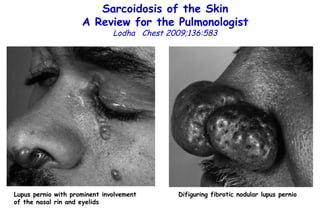
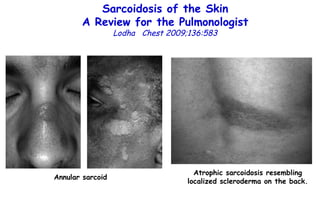
Determinants of Hypercapnia in Obese Patients With Obstructive Sleep Apnea Kaw  Chest 2009;136:787 daytime hypercapnia (PaCO 2 , ≥45 mm Hg) in obese patients  (body mass index  [BMI],  ≥ 30 kg/m 2 ) with OSA  (apnea-hypopnea index [AHI],  ≥ 5) 15 studies (n=4,250) % patients with daytime hypercapnia 19% 20 – 15 – 10 – 5 – 0 Patients with hypercapnia had higher BMI (MD, 3.1 kg/m 2 )  and AHI (MD, 12.5) than eucapnic patients.

Obstructive Sleep Apnea in Children Relative Contributions of Body Mass Index and  Adenotonsillar Hypertrophy  Dayyat  Chest 2009;136:137 206 nonobese habitually snoring children with polysomnographically diagnosed obstructive sleep apnea (OSA)  206 obese children Size estimates of tonsils and adenoids, and Mallampati class scores were obtained The  Mallampati score assigns a score of 1 when the protruded tongue does not obfuscate the visual sighting of the soft palate, fauces, uvula, and tonsillar pillars;  it assigns a score of 4 only when the hard palate can be visualized.  Mallampati SR, Gatt SP, Gugino LD, et al. A clinical sign to  predict difficult tracheal intubation: a prospective study. Can  Anaesth Soc J 1985; 32:429 .   Adenoid size was determined from a blind review of lateral neck radiographs.
Obstructive Sleep Apnea in Children Relative Contributions of Body Mass Index and  Adenotonsillar Hypertrophy  Dayyat  Chest 2009;136:137 206 nonobese habitually snoring children with polysomnographically diagnosed obstructive sleep apnea (OSA)  206 obese children Size estimates of tonsils and adenoids, and Mallampati class scores were obtained A score of 0 corresponded to the absence of adenoid tissues; a score of +1 indicated an adenoid size of 0 to 25% of the retropalatal airway; a score +2 indicated an adenoid size of 25 to 50% of the retropalatal airway; a score of +3 indicated an adenoid size of 50 to 75% of the retropalatal airway; and a score of +4 indicated an adenoid size of >75% of the retropalatal  airway lumen.
Scatterplot between the  OAHI (obstructive apnea-hypopnea index)  as a measure of OSA severity and adenotonsillar size sum score  Obstructive Sleep Apnea in Children Relative Contributions of Body Mass Index and  Adenotonsillar Hypertrophy  Dayyat  Chest 2009;136:137 nonobese children  r =0.22; p<0.001 obese habitually snoring children with OSA
Scatterplot between the  OAHI (obstructive apnea-hypopnea index)  as a measure of OSA severity and adenotonsillar size sum score  Obstructive Sleep Apnea in Children Relative Contributions of Body Mass Index and  Adenotonsillar Hypertrophy  Dayyat  Chest 2009;136:137 nonobese children  r =0.22; p<0.001 obese habitually snoring children with OSA There  was a modest association between adenotonsillar size and OAHI in nonobese children (r=0.22; p<0.001) but not in obese children.
Box plots of adenotonsillar size scores among young obese (YOB) and old obese (OOB) children and nonobese children.  A denotonsillar size scores are significantly lower in both YOB and OOB children compared to their nonobese counterparts  (young nonobese [YNO] and old nonobese  [ONO]) [p<0.0001]. Obstructive Sleep Apnea in Children Relative Contributions of Body Mass Index and  Adenotonsillar Hypertrophy  Dayyat  Chest 2009;136:137 Children with OSA Children with OAHI
Box plots of adenotonsillar size scores among young obese (YOB) and old obese (OOB) children and nonobese children.  A denotonsillar size scores are significantly lower in both YOB and OOB children compared to their nonobese counterparts  (young nonobese [YNO] and old nonobese  [ONO]) [p<0.0001]. Obstructive Sleep Apnea in Children Relative Contributions of Body Mass Index and  Adenotonsillar Hypertrophy  Dayyat  Chest 2009;136:137 Children with OSA Children with OAHI The magnitude of adenotonsillar hypertrophy required for any given magnitude of OAHI is more likely to be smaller in obese children compared to nonobese children.
Increased Mallampati  scores in obese children suggest that soft-tissue changes and potentially fat deposition in the upper airway may play a significant role in the global differences in tonsillar and adenoidal size among obese and nonobese children with OSA. Mallampati class scores among YOB, OOB, and nonobese children with OSA. Mallampati class scores were significantly higher in both YOB and OOB children compared to YNOB and ONOB children (p<0.0001). Obstructive Sleep Apnea in Children Relative Contributions of Body Mass Index and  Adenotonsillar Hypertrophy  Dayyat  Chest 2009;136:137
Adipokines in children with Obstructive Sleep Apnea and the effects of treatment   Li  CHEST 2010;137:529 Scatterplot of adiponectin (mg/L) against BMI  z  –score. 141 children with habitual snoring and symptoms suggestive of OSA. Sleep apnea symptom questionnaire. Overnight polysomnography. OSA if an obstructive apnea index > 1.
Adipokines in children with Obstructive Sleep Apnea and the effects of treatment   Li  CHEST 2010;137:529 141 children with habitual snoring and symptoms suggestive of OSA. Sleep apnea symptom questionnaire. Overnight polysomnography. OSA if an obstructive apnea index > 1. Scatterplot of leptin (μg/L) against BMI  z  –score.
141 children with habitual snoring and symptoms suggestive of OSA. Sleep apnea symptom questionnaire. Overnight polysomnography. OSA if an obstructive apnea index > 1. Subjects with OSA did not have significantly different adiponectin and leptin concentrations than those without OSA. Adipokines in children with Obstructive Sleep Apnea and the effects of treatment   Li  CHEST 2010;137:529 Scatterplot of leptin (μg/L) against BMI  z  –score.
Childhood obstructive sleep apnoea (OSA) is relatively common, occurring in at least 2% of children. An apnoea-hypopnoea index  (AHI) ≥1.5/h is considered statistically abnormal .  However, this does not mean that every child with an AHI ≥1.5/h will benefit from treatment. Childhood obstructive sleep apnoea: to treat or not to treat, that is the question   Marcus  Thorax 2010 65: 4-5
The  usual treatment for OSA in young children is  adenotonsillectomy . Should children with mild OSA be subjected to this surgery,  with all of its potential attendant complications?  To resolve this controversy, we need the answer to two questions: - What is the clinical outcome of mild OSA?  - What is the natural history of mild OSA if left untreated? Childhood obstructive sleep apnoea: to treat or not to treat, that is the question   Marcus  Thorax 2010 65: 4-5
Change in obstructive apnoea-hypopnoea index of each subject over 2-year follow-up period. Natural history and predictors for progression of mild childhood obstructive sleep apnoea   Li  Thorax 2010;65:27–31 The prevalence of OSA in children aged 6–13 years.  The first 56 consecutive children identified with mild OSA (apnoea-hypopnoea index 1–5) were invited for a repeat assessment  2 years after the diagnosis.
Natural history and predictors for progression of mild childhood obstructive sleep apnoea   Li  Thorax 2010;65:27–31 % children with worsened OSA at follow-up 30 –25 - 20 - 15 -10 - 5 - 0 29% The prevalence of OSA in children aged 6–13 years.  The first 56 consecutive children identified with mild OSA (apnoea-hypopnoea index 1–5) were invited for a repeat assessment  2 years after the diagnosis.
Natural history and predictors for progression of mild childhood obstructive sleep apnoea   Li  Thorax 2010;65:27–31 % children with worsened OSA at follow-up 30 –25 - 20 - 15 -10 - 5 - 0 29% The prevalence of OSA in children aged 6–13 years.  The first 56 consecutive children identified with mild OSA (apnoea-hypopnoea index 1–5) were invited for a repeat assessment  2 years after the diagnosis. Compared  with those in whom  OSA had not worsened, the  worsened OSA  group had a  greater increase in waist circumference, a higher prevalence of large tonsils  (occupying ≥ 50% of the airway) at both baseline and follow-up, and a  higher prevalence of habitual  snoring  at both baseline  and  follow-up.
* p <0.05 (paired  t  test) Demographic, clinical and socioeconomic features of referent group and group with worsened obstructive sleep apnoea (OSA) Natural history and predictors for progression of mild childhood obstructive sleep apnoea   Li  Thorax 2010;65:27–31
Natural history and predictors for progression of mild childhood obstructive sleep apnoea   Li  Thorax 2010;65:27–31
Mild OSA in the majority of children does not resolve spontaneously. Subjects with tonsillar hypertrophy, especially boys, should be closely monitored to allow early detection of worsening OSA.  Weight control should be stressed in the management of childhood OSA. Natural history and predictors for progression of mild childhood obstructive sleep apnoea   Li  Thorax 2010;65:27–31 Conclusions:
Alveolite allergica da aspergillo
An unusual cause of blindness   Seville   ERJ 2010:35:216  Computed tomography head scan of the axial section showing large  aspergilloma  invading the sphenoethmoid sinus and extending posteriorly with compression  of the left optic nerve.  Computed tomography scan of the coronal section of the chest showing severe proximal bronchiectasis consistent with a diagnosis of allergic  bronchopulmonary aspergillosis .
Dysfunctional breathing
Masqueraders of exercise-induced  vocal cord dysfunction Tilles   JACI 2009;124:377  This report describes 5 cases involving recurrent respiratory symptoms caused by physiologically significant anatomical abnormalities resulting in symptoms during exercise. In each case, an asthma specialist suspected exercise-induced VCD and referred the patient to our VCD clinic for symptom provocation and laryngoscopy.
Masqueraders of exercise-induced  vocal cord dysfunction Tilles   JACI 2009;124:377
Masqueraders of exercise-induced  vocal cord dysfunction Tilles   JACI 2009;124:377    Left ,  Laryngoscopy photograph from patient 4 shows membranous stenosis just below the glottis with a small round posterior airway.  Middle ,  Flow volume loop from patient 4 with significantly decreased expiratory and inspiratory flows, suggesting fixed obstruction.
Masqueraders of exercise-induced  vocal cord dysfunction Tilles   JACI 2009;124:377    Left ,  Laryngoscopy photograph from patient 4 shows membranous stenosis just below the glottis with a small round posterior airway.  Middle ,  Flow volume loop from patient 4 with significantly decreased expiratory and inspiratory flows, suggesting fixed obstruction.  This illustrates the importance of examining both the flow volume loop and numeric data before interpreting abnormal findings. FEF 50 /FIF 50 , Ratio of forced expiratory flow to forced inspiratory flow at 50% FVC.
Broncodisplasia polmonare
Injected intravenously on Day 4 with either  bone marrow stromal cells  (BMSCs) or BMSC-conditioned media (CM) Injection of BMSCs reduced alveolar loss and lung inflammation, and prevented pulmonary hypertension .  Injection of BMSC-CM had a more pronounced effect  than BMSCs, preventing both vessel remodeling and alveolar injury. Treated animals had normal alveolar numbers at  Day 14 of hyperoxia and a drastically  reduced lung neutrophil and macrophage accumulation.  Neonatal mice exposed to hyperoxia (75% O 2 )  On day 14 Bone Marrow Stromal Cells Attenuate Lung Injury in a Murine Model of Neonatal Chronic Lung Disease   Aslam   AJRCCM   2009:180:1122
Injected intravenously on Day 4 with either  bone marrow stromal cells  (BMSCs) or BMSC-conditioned media (CM) Injection of BMSCs reduced alveolar loss and lung inflammation, and prevented pulmonary hypertension .  Injection of BMSC-CM had a more pronounced effect  than BMSCs, preventing both vessel remodeling and alveolar injury. Treated animals had normal alveolar numbers at  Day 14 of hyperoxia and a drastically  reduced lung neutrophil and macrophage accumulation.  Neonatal mice exposed to hyperoxia (75% O 2 )  On day 14 Bone Marrow Stromal Cells Attenuate Lung Injury in a Murine Model of Neonatal Chronic Lung Disease   Aslam   AJRCCM   2009:180:1122 BMSCs act in a paracrine manner via the release of immunomodulatory factors.
Rationale :  Bronchopulmonary dysplasia (BPD) and emphysema are characterized by arrested alveolar development or loss of alveoli; both are significant global health problems and currently lack effective therapy.  Bone marrow–derived mesenchymal stem cells  (BMSCs) prevent adult lung injury, but their therapeutic potential in neonatal lung disease is unknown.  Objectives :  We hypothesized that   intratracheal delivery  of BMSCs would prevent alveolar destruction in experimental BPD. Airway Delivery of Mesenchymal Stem Cells Prevents Arrested Alveolar Growth in Neonatal Lung Injury in Rats   van Haaften   AJRCCM 2009:180:1131
Airway Delivery of Mesenchymal Stem Cells Prevents Arrested Alveolar Growth in Neonatal Lung Injury in Rats   van Haaften   AJRCCM 2009:180:1131  Intratracheal administration of bone marrow mesenchymal stem cells. Chronic hyperoxia-induced model of BPD  in newborn rats from birth to 14 days. MSCs prevent arrested alveolar and vascular growth  in part through paracrine activity.   Stem cell–based therapies may offer new therapeutic avenues for lung diseases that currently lack efficient treatments.
The EPICure study: maximal exercise and physical activity in school children born extremely preterm Welsh  Thorax 2010;65:165 Rationale:   Evidence regarding exercise capacity and physical activity in children born extremely preterm (EP) is limited.  Since survivors remain at high risk for developing bronchopulmonary dysplasia (BPD) and longterm pulmonary sequelae, reductions in exercise capacity and activity levels may be present. Objectives:   To compare maximal exercise ventilation  characteristics and physical activity levels at 11 years of age in children born EP (<25 completed weeks gestation) with those of full-term controls.
The EPICure study: maximal exercise and physical activity in school children born extremely preterm Welsh  Thorax 2010;65:165 Spirometry, body  plethysmography and gas transfer testing.  A peak exercise test  on a cycle ergometer. Physical activity monitored by accelerometry for  7 days. 38 extremely preterm (EP) children (71% prior BPD) and 38  controls. Those born EP had significantly lower Z-scores for FEV 1  and gas transfer and significantly greater Z-scores for residual volume and RV/Total Lung Capacity. EP birth was associated with a significant reduction in peak oxygen consumption.  EP children employed greater breathing frequencies and lower tidal  volumes during peak exercise.
The EPICure study: maximal exercise and physical activity in school children born extremely preterm Welsh  Thorax 2010;65:165 Spirometry, body  plethysmography and gas transfer testing.  A peak exercise test  on a cycle ergometer. Physical activity monitored by accelerometry for  7 days. 38 extremely preterm (EP) children (71% prior BPD) and 38  controls. Those born EP had significantly lower Z-scores for FEV 1  and gas transfer and significantly greater Z-scores for residual volume and RV/Total Lung Capacity. EP birth was associated with a significant reduction in peak oxygen consumption.  EP children employed greater breathing frequencies and lower tidal  volumes during peak exercise.   No differences were observed in physical activity between groups.
The EPICure study: maximal exercise and physical activity in school children born extremely preterm Welsh  Thorax 2010;65:165 Conclusions:  The reduction in peak oxygen consumption in children born EP, and alterations in ventilatory adaptations during peak exercise were not explained by differences in physical activity, but probably reflects the long-term pathophysiological impact of EP birth.
Anche il russamento semplice non va bene: -aumenta la pressione arteriosa  -induce lesioni alle terminazioni nervose  –aumenta lo stress ossidativo  -aumenta infiammazione e patologia cardiovascolare, I risvegli notturni frequenti raddoppiano il rischio di sviluppo d’asma non allergico, Nel bambino con asma la prevalenza di russamento e di apnea ostruttiva nel sonno aumenta con la gravità della malattia, C’è un rapporto tra gravità di apnea ostruttiva nel sonno e LTE4 nelle urine, Le apnee ostruttive nel sonno sono presenti nel 2% dei bambini e non è opportuno ritardare l’adenotonsillectomia nei bambini che russano abitualmente, hanno tonsille grandie circonferenza addominale aumentata, Se sei un topo e hai la BDP hai buone probabiltà di recuperare. Take home
sarcoidosis
Sarcoidosis of the Skin A Review for the Pulmonologist Lodha  Chest 2009;136:583 Sarcoidosis is a multisystem disease of  undetermined etiology characterized  by the formation of noncaseating  epithelioid-cell granulomas in multiple  organs or tissues. The incidence peaks between the second and third  decades. The European  prevalence is estimated at 40 cases per 100,000  persons.
Sarcoidosis of the Skin A Review for the Pulmonologist Lodha  Chest 2009;136:583 Sarcoidosis is one of the “great imitators”  of medicine. Physicians who treat  patients with sarcoidosis should be aware of the disease’s diverse organ manifestations, but particularly those appearing on the skin because these can be disfiguring, have prognostic importance, and may not be readily diagnosed even by skin specialists.
Sarcoidosis of the Skin A Review for the Pulmonologist Lodha  Chest 2009;136:583 Sarcoid-associated erythema nodosum
Sarcoidosis of the Skin A Review for the Pulmonologist Lodha  Chest 2009;136:583 Papular sarcoid resembling xanthelasma Irregular infiltrated erythamatous sarcoid plaque
Sarcoidosis of the Skin A Review for the Pulmonologist Lodha  Chest 2009;136:583
Sarcoidosis of the Skin A Review for the Pulmonologist Lodha  Chest 2009;136:583 Sarcoid plaques in light-exposed areas Lichenified hyperkeratotic plaque on the knees resembling psoriasis
Sarcoidosis of the Skin A Review for the Pulmonologist Lodha  Chest 2009;136:583 Annular sarcoid plaque infiltrating scalp (resembling tinea capitis)
Sarcoidosis of the Skin A Review for the Pulmonologist Lodha  Chest 2009;136:583 Lupus pernio with prominent involvement of the nasal rin and eyelids Difiguring fibrotic nodular lupus pernio
Sarcoidosis of the Skin A Review for the Pulmonologist Lodha  Chest 2009;136:583 Annular sarcoid Atrophic sarcoidosis resembling localized scleroderma on the back.
Sarcoidosis of the Skin A Review for the Pulmonologist Lodha  Chest 2009;136:583 Eroded atrophic plaques and sarcoidal ulcers with  granulomatous edges.
Sarcoidosis of the Skin A Review for the Pulmonologist Lodha  Chest 2009;136:583 Hypopigmented sarcoid patches on the anterior  surface of the legs. Ichthyosiform sarcoid with  characteristic polygonal scale on the anterior leg.
Sarcoidosis of the Skin A Review for the Pulmonologist Lodha  Chest 2009;136:583 Sarcoidal subcutaneous granulomas . Raised granulomas of sarcoid infiltrating a tattoo.
Sarcoidosis of the Skin A Review for the Pulmonologist Lodha  Chest 2009;136:583 Eroded granulomatous sarcoidal plaque surrounded by nonscarring area of hair loss.
Sarcoidosis of the Skin A Review for the Pulmonologist Lodha  Chest 2009;136:583 Treatment: Oral corticosteroids remain the “gold standard” for severe or disfiguring cutaneous sarcoidosis.  They are rapidly effective in skin disease but do not  usually  produce sustained remissions, and their numerous  deleterious effects prevent prolonged use. It may be  possible to discontinue systemic corticosteroids earlier  by concomitantly administering a steroid-sparing  immunosuppressive agent or by initiating  intralesional or  topical corticosteroid therapy.
Interstitial pneumonia OR Diffuse Lung Diseases
Background :The study was conducted in order to determine if the glycoprotein KL-6 is a useful biomarker in differentiating neuroendocrine cell hyperplasia of infancy (NEHI), a benign form of children’s interstitial lung disease, from the more severe inborn errors of surfactant metabolism (IESM), since their clinical presentation can be similar. Serum KL-6 differentiates neuroendocrine cell hyperplasia of infancy from the inborn errors of surfactant metabolism   Doan  Thorax 2009;64:677–681
Serum KL-6 levels 10 healthy control children,  6 with NEHI and  13 with IESM  (4 with surfactant protein C (SP-C) and  9 with ABCA3 mutations). Serum KL-6 levels in the study groups  (with group medians).NEHI, neuroendocrine cell hyperplasia of infancy; SP-C, surfactant protein C. Serum KL-6 differentiates neuroendocrine cell hyperplasia of infancy from the inborn errors of surfactant metabolism   Doan  Thorax 2009;64:677–681
Serum KL-6 levels in the study groups  (with group medians).NEHI, neuroendocrine cell hyperplasia of infancy; SP-C, surfactant protein C. Serum KL-6 differentiates neuroendocrine cell hyperplasia of infancy from the inborn errors of surfactant metabolism   Doan  Thorax 2009;64:677–681 Children with NEHI have normal KL-6 levels, in contrast to those with IESM, who have elevated serum KL-6 levels.
Images at different time points in the same patient with biopsy-proven NEHI, demonstrating classic  (A)  and more diffuse  (B)  patterns of ground-glass opacification.  Serum KL-6 differentiates neuroendocrine cell hyperplasia of infancy from the inborn errors of surfactant metabolism   Doan  Thorax 2009;64:677–681
CT in a 3-month-old infant with ABCA3 mutations showing diffuse ground-glass opacification and very subtle septal thickening.   CT in another 3-month-old infant with ABCA3 mutations revealing more patchy ground-glass opacification but with prominent interstitial thickening.   Serum KL-6 differentiates neuroendocrine cell hyperplasia of infancy from the inborn errors of surfactant metabolism   Doan  Thorax 2009;64:677–681
KL-6, a glycoprotein that is preferentially expressed in the normal lung by type 2 alveolar cells and bronchiolar epithelial cells. Investigators have demonstrated increased expression of KL-6 on regenerating alveolar cells in patients with various types of ILD, with correspondingly high serum levels.  Such elevated KL-6 levels have also been reported in various forms of chILD, while normal levels are seen in asthma, bronchiolitis, pertussis, common viral and bacterial pneumonias, and acute eosinophilic pneumonia Furthermore, while KL-6 levels have been correlated with disease activity, they do not appear to be affected by steroid therapy. Serum KL-6 differentiates neuroendocrine cell hyperplasia of infancy from the inborn errors of surfactant metabolism   Doan  Thorax 2009;64:677–681
Bronchiolitis obliterans
Eosinophilic pneumonia
Hypereosinophilic syndrome: A multicenter, retrospective analysis of clinical characteristics  and response to therapy.  Ogbogu   JACI  2009:124:1319  Hypereosinophilic syndrome (HES) is a diverse group of rare disorders defined by the  presence of persistent peripheral blood eosinophilia ≥1.5 × 10 9 /L , the absence of a secondary cause of eosinophilia, and evidence of eosinophil-associated end organ damage. The 2 subtypes of HES are lymphocytic variant HES  (L-HES), in which the underlying cause of the eosinophilia is secretion of eosinophilopoietic cytokines by T lymphocytes, and myeloproliferative HES/chronic eosinophilic leukemia (CEL).
Hypereosinophilic syndrome: A multicenter, retrospective analysis of clinical characteristics  and response to therapy.  Ogbogu   JACI  2009:124:1319  Clinical manifestations of HES at initial presentation (A)  and at the time of the retrospective analysis (B).
Intensive Care
Between 1999 and 2000, 1 year of screening was performed at all  hospitals admitting critically ill children in King County, Washington. 39 children met the criteria for acute lung injury,resulting in a calculated incidence of 12.8 cases per  100 000 person-years. Severe sepsis  (with pneumonia as the infection focus) was the most common risk factor. Incidence and Outcomes of Pediatric Acute Lung Injury (ALI)  Zimmerman Pediatrics 2009;124;87
Risk factors for children with ALI (N=39) Incidence and Outcomes of Pediatric Acute Lung Injury (ALI)  Zimmerman Pediatrics 2009;124;87
Mortality Rates And Resource Utilization Among Subgroups Of Children With ALI Of Varyng Severity Incidence and Outcomes of Pediatric Acute Lung Injury (ALI)  Zimmerman Pediatrics 2009;124;87
swine influenza A  (H1N1) virus infection
The differences between  outbreak  and  pandemic  classification lie in the virulence and communicability of the outbreak strain, and the selective pressure that promotes viral genetic drift and shift.  Social factors that affect whether an outbreak becomes a pandemic include the timing of the outbreak and the recognition of its severity by health organizations.  Influenza Exerts Continued Pressure in an Era of Modern Medicine.   Noah   Am J Respir Cell Mol Biol 2009;41:3
Influenza Exerts Continued Pressure in an Era of Modern Medicine.   Noah   Am J Respir Cell Mol Biol 2009;41:3  Vaccination remains the principal means for controlling influenza.  The selection process for the strains incorporated into the trivalent vaccine (generally composed of an H1N1, an H3N2, and a B-type strain) requires year-round surveillance.  The effectiveness of the resultant trivalent vaccine depends upon how well the chosen strains match the predicted circulating strains.  INFLUENZA: THE STATISTICS
Influenza Exerts Continued Pressure in an Era of Modern Medicine.   Noah   Am J Respir Cell Mol Biol 2009;41:3  Influenza types A and B virus infections in humans results  in an estimated 150,000–200,000 hospitalizations and  30,000–50,000 deaths in the United States annually. In the event of a highly pathogenic pandemic, the Centers for Disease Control and Prevention (CDC) has predicted a 3- to  7-fold increase in hospitalization and mortality rates and at least a 20-fold. Influenza pandemics are likely to be many times more devastating in regions of the world where health resources are lacking. Finally, the potential decimation of the domestic fowl or swine populations by pathogenic influenza would have  a tremendous economic impact on worldwide markets.  INFLUENZA: THE STATISTICS
Influenza Exerts Continued Pressure in an Era of Modern Medicine.   Noah   Am J Respir Cell Mol Biol 2009;41:3  Although there is no guarantee that the strains picked for the vaccine will be the circulating strains during the subsequent flu season, there is an estimated 90% match between vaccine strains and circulating strains each season. Increasing the number of vaccinated people is one strategy for mitigating seasonal influenza outbreaks.  INFLUENZA: THE STATISTICS
Influenza Exerts Continued Pressure in an Era of Modern Medicine.   Noah   Am J Respir Cell Mol Biol 2009;41:3  Influenza particles are spherical (~ 100 nm diameter), with  a lipid bilayer derived from the host plasma membrane.  The virion contains a matrix protein (M1) and three transmembrane proteins (hemagglutinin [HA] and neuraminidase [NA]), which are the major antigenic determinants, and a small membrane-bound protein (M2). Beneath the matrix coat is the helical ribonucleocapsid, which includes the vRNA genome, nucleoprotein (NP), nuclear export protein (NEP), and the three viral polymerase subunits  (PB1, PB2, PA).  THE INFLUENZA REPLICATION CYCLE, SHIFT, AND DRIFT
Influenza Exerts Continued Pressure in an Era of Modern Medicine.   Noah   Am J Respir Cell Mol Biol 2009;41:3  Influenza particles are spherical (~ 100 nm diameter), with  a lipid bilayer derived from the host plasma membrane.  The virion contains a matrix protein (M1) and three transmembrane proteins (hemagglutinin [HA] and neuraminidase [NA]), which are the major antigenic determinants, and a small membrane-bound protein (M2). Beneath the matrix coat is the helical ribonucleocapsid, which includes the vRNA genome, nucleoprotein (NP), nuclear export protein (NEP), and the three viral polymerase subunits  (PB1, PB2, PA).  There are 16 different HA, and nine different NAs.  THE INFLUENZA REPLICATION CYCLE, SHIFT, AND DRIFT
Influenza Exerts Continued Pressure in an Era of Modern Medicine.   Noah   Am J Respir Cell Mol Biol 2009;41:3  The high rate of annual influenza infection is attributed partially to the ability of the virus to acquire random mutations in its surface proteins ( antigenic drift ) that allow  it to evade immunogenic recognition, and partially to its ability to shuffle its genomic constellation ( antigenic shift ), resulting in a genetic reassortment that may combine separate strain idiosyncrasies into a single virus with increased virulence.  This strategy allows seasonal influenza to evade humoral immunity established in previous seasons. THE INFLUENZA REPLICATION CYCLE, SHIFT, AND DRIFT
Influenza Exerts Continued Pressure in an Era of Modern Medicine.   Noah   Am J Respir Cell Mol Biol 2009;41:3  “ Shifting &quot; can occur through inter-reservoir crossover of strains (i.e., from avian to human), or through an intermediate reservoir (e.g., swine) that can be infected by separate strains that are normally specific for either birds or humans.  Genetic reassortment (shift) of more than one viral strain in an intermediate reservoir can create a new human influenza A subtype virus.  THE INFLUENZA REPLICATION CYCLE, SHIFT, AND DRIFT
Influenza Exerts Continued Pressure in an Era of Modern Medicine.   Noah   Am J Respir Cell Mol Biol 2009;41:3  “ Shifting &quot; can occur through inter-reservoir crossover of strains (i.e., from avian to human), or through an intermediate reservoir (e.g., swine) that can be infected by separate strains that are normally specific for either birds or humans.  Genetic reassortment (shift) of more than one viral strain in an intermediate reservoir can create a new human influenza A subtype virus.  This is probably what happened in the case of the recent swine flu emergence.  THE INFLUENZA REPLICATION CYCLE, SHIFT, AND DRIFT
Influenza Exerts Continued Pressure in an Era of Modern Medicine.   Noah   Am J Respir Cell Mol Biol 2009;41:3  The novel swine influenza strain has characteristics of a pandemic candidate, namely that the virus easily spreads from person to person in a sustained pattern, and resulted in a life-threatening illness in Mexico.  THE INFLUENZA REPLICATION CYCLE, SHIFT, AND DRIFT
Influenza Exerts Continued Pressure in an Era of Modern Medicine.   Noah   Am J Respir Cell Mol Biol 2009;41:3  Peak influenza cases are typically reported during December through March in North America, although the influenza season officially ends May. Antiviral drugs (such as oseltamivir and amantadine), are widely available and are effective against influenza, if prescribed either prophylactically or shortly after influenza infection.  OFF SEASON OUTBREAKS: PRECURSOR TO PANDEMIC?
Influenza Exerts Continued Pressure in an Era of Modern Medicine.   Noah   Am J Respir Cell Mol Biol 2009;41:3  During the most recent influenza season, an increasing resistance in H1N1 isolates to the neuraminidase inhibitor oseltamivir was observed. As of December 2008, of 50 H1N1 viruses from 12 states, 98% tested by the CDC were resistant to oseltamivir,  and 2% of these were resistant to zanamivir.  Occurrence after the standard influenza season is an uncommon event because influenza is notably less communicable in the warmer and more humid conditions present in the northern hemisphere during summer the communicability of the virus in Mexico in April is an interesting puzzle.  OFF SEASON OUTBREAKS: PRECURSOR TO PANDEMIC?
Influenza Exerts Continued Pressure in an Era of Modern Medicine.   Noah   Am J Respir Cell Mol Biol 2009;41:3  CHARACTERISTICS THAT MAKE IT A CANDIDATE FOR A PANDEMIC  The late-season outbreak likely excludes it from inclusion  in the next season's trivalent vaccine.  Combination of low apparent common immunity coupled with the remarkable human-to-human communicability in warm weather conditions. Elevated apparent mortality in regions without modern supportive medical care. Likelihood of otherwise healthy, non–risk group individuals (generally age 18–49) to become infected with the virus.
Influenza Exerts Continued Pressure in an Era of Modern Medicine .  Noah   Am J Respir Cell Mol Biol 2009;41:3  CHALLENGES FOR EXPANDED RESEARCH AND SURVEILLANCE  The  influenza A subtype  represents a great threat to civic welfare. It is the only strain to exhibit antigenic shift and has accounted for all known  high-mortality epidemics and pandemics. Influenza remains one of the 10 most common causes of death in the United States.
Background:  The rapidly evolving pandemic of novel 2009 swine-origin influenza A (H1N1) virus (S-OIV) demands that accurate and practical diagnostics be urgently evaluated for their potential clinical utility. Objective:  To determine the diagnostic accuracy of a rapid influenza diagnostic test (RIDT) and direct fluorescent antibody (DFA) assay for S-OIV by using reverse-transcription polymerase chain reaction (RTPCR) as the reference standard. Sensitivity of Rapid Influenza Diagnostic Testing for Swine-Origin 2009 A (H1N1) Influenza Virus in Children Hawkes  Pediatrics 2010;125:e639
Rapid influenza diagnostic test (RIDT)   62% 99 % SENSITIVITY (TRUE +) SPECIFITY (TRUE -) 820 children. Rapid influenza diagnostic test (RIDT) compared with RT-PCR. Sensitivity of Rapid Influenza Diagnostic Testing for Swine-Origin 2009 A (H1N1) Influenza Virus in Children Hawkes  Pediatrics 2010;125:e639   100 – 80 – 60 – 40 – 20 – 0
Rapid influenza diagnostic test (RIDT)   62% 99 % SENSITIVITY (TRUE +) SPECIFITY (TRUE -) 820 children. Rapid influenza diagnostic test (RIDT) compared with RT-PCR. Sensitivity of Rapid Influenza Diagnostic Testing for Swine-Origin 2009 A (H1N1) Influenza Virus in Children Hawkes  Pediatrics 2010;125:e639   100 – 80 – 60 – 40 – 20 – 0 RIDT sensitivity for influenza viruses was significantly higher in children 5 years of age or younger ( P= .003) and in patients  presenting≤2 days after symptom onset ( P< .001).
Objective:  To evaluate the performance of a rapid influenza diagnostic test (RIDT) in detecting H1N1 2009 influenza A virus in respiratory samples from pediatric patients in comparison to that of real-time reverse-transcriptase polymerase chain reaction (rRT-PCR) and viral culture. Performance of a Rapid Influenza Test in Children During the H1N1 2009 Influenza A Outbreak Cruz  Pediatrics 2010;125:e645
With rRT-PCR as the reference 45% 98.6% SENSITIVITY (TRUE +) SPECIFITY (TRUE -) 3030 specimens had RIDT results paired with both rRT-PCR and viral culture results. Sensitivity of Rapid Influenza Diagnostic Testing for Swine-Origin 2009 A (H1N1) Influenza Virus in Children Hawkes  Pediatrics 2010;125:e639   100 – 80 – 60 – 40 – 20 – 0 RIDT
Using viral culture as the reference standard 55% 95.6% SENSITIVITY (TRUE +) SPECIFITY (TRUE -) 3030 specimens had RIDT results paired with both rRT-PCR and viral culture results. Sensitivity of Rapid Influenza Diagnostic Testing for Swine-Origin 2009 A (H1N1) Influenza Virus in Children Hawkes  Pediatrics 2010;125:e639   100 – 80 – 60 – 40 – 20 – 0 RIDT
Using viral culture as the reference standard 55% 95.6% SENSITIVITY (TRUE +) SPECIFITY (TRUE -) 3030 specimens had RIDT results paired with both rRT-PCR and viral culture results. Sensitivity of Rapid Influenza Diagnostic Testing for Swine-Origin 2009 A (H1N1) Influenza Virus in Children Hawkes  Pediatrics 2010;125:e639   100 – 80 – 60 – 40 – 20 – 0 RIDT The RIDT had relatively  poor sensitivity  but  excellent specificity .
Effector T cells control lung inflammation during acute influenza virus infection by producing IL-10.   Sun  Nat Med 2009;15:277±84. Interleukin 10 (IL10) is an anti-inflammatory cytokine recognised to prevent excessive injury in bacterial and parasitic infections . Infected with influenza virus knock-out mice, with effector T cell (Teff) depletion. effector T cell (Teff) which producers IL-10 6000 pg/mL in BAL. no IL-10 in BAL drammatic increase in mortality
2% US oseltamivir-resistant influenza A (H1N1) 2007-8 2008-9 98.5% Infections with oseltamivir-resistant influenza A (H1N1) virus in the United States.   Dharan JAMA 2009; 301:1034-41 D ata submitted to the Centres for Disease Control and Prevention by US public health laboratories.  142 out of 1155 cases of influenza A (H1N1) tested were resistant to oseltamivir. 100 – 90 – 80 – 70 – 60 – 50 – 40 – 30 – 20 – 10 – 0
2% 2007-8 2008-9 98.5% Infections with oseltamivir-resistant influenza A (H1N1) virus in the United States.   Dharan JAMA 2009; 301:1034-41 D ata submitted to the Centres for Disease Control and Prevention by US public health laboratories.  142 out of 1155 cases of influenza A (H1N1) tested were resistant to oseltamivir. 100 – 90 – 80 – 70 – 60 – 50 – 40 – 30 – 20 – 10 – 0 This study highlights an important issue of the emergence of treatment-resistant influenza strains and the need for  further antiviral development. US oseltamivir-resistant influenza A (H1N1)
Effects of Oseltamivir on Influenza-Related Complications in Children With Chronic Medical Conditions  Piedra  Pediatrics 2009;124:170 Patients who were given oseltamivir  (n= 1634) within 1 day after influenza diagnosis were compared with those for patients who received no antiviral therapy (n=3721) 6 influenza seasons RELATIVE RISKS FOR PATIENTS GIVEN OSELTAMIVIR VS NO ANTIVIRAL THERAPY
Effects of Oseltamivir on Influenza-Related Complications in Children With Chronic Medical Conditions  Piedra  Pediatrics 2009;124:170 Patients who were given oseltamivir  (n= 1634) within 1 day after influenza diagnosis were compared with those for patients who received no antiviral therapy (n=3721) 6 influenza seasons When prescribed at influenza diagnosis, oseltamivir was associated with reduced risks of influenza-related complications and hospitalizations RELATIVE RISKS FOR PATIENTS GIVEN OSELTAMIVIR VS NO ANTIVIRAL THERAPY
HEALTH CARE WORKER KNOWLEDGE, ATTITUDES, AND BELIEFS REGARDING MANDATORY INFLUENZA VACCINATION  Douville   Arch Ped Adoles Med 2010;164:33 % employees considering influenza vaccination should be  mandatory  for health care workers who did not have a medical contraindication 70% 94% who favored mandatory immunization had been immunized themselves 80 – 70 – 60 – 50 – 40 – 30 – 20 – 10 – 0 585  health care workers, including physicians, nurses, and all other hospital employees
Individuals who supported mandatory policies were more likely to believe that the  vaccine is safe  for both children and adults.  There was no significant difference between the percentages of promandate and antimandate employees who believed influenza was dangerous for the patients where they work (66.5% and 62%, respectively,  p=0.07 ).  Only  29%  of  antimandate  employees believed they were at high risk of contracting influenza, compared with  51%  of  promandate  employees ( p<0.001 ) HEALTH CARE WORKER KNOWLEDGE, ATTITUDES, AND BELIEFS REGARDING MANDATORY INFLUENZA VACCINATION  Douville   Arch Ped Adoles Med 2010;164:33
Clinical pearls for preventing, diagnosing, and treating seasonal and 2009 H1N1 influenza infection in patients with asthma Rank   JACI 2009;124:1123  1) How should patients with asthma be vaccinated for seasonal or 2009 H1N1 influenza?  Patients with asthma should receive the trivalent inactivated vaccine (TIV) intramuscularly.  Adults and children >3 years old should receive 0.5 mL per dose,  and those <3 years old should receive 0.25 mL.  Adults and older children should be injected in the deltoid, infants and younger children in the anterior-lateral thigh. Patients <9 years old with no previous seasonal influenza vaccine should receive a booster vaccine 4 weeks after the initial dose.
Clinical pearls for preventing, diagnosing, and treating seasonal and 2009 H1N1 influenza infection in patients with asthma Rank   JACI 2009;124:1123  1) How should patients with asthma be vaccinated for seasonal or 2009 H1N1 influenza?  Patients with asthma should receive the trivalent inactivated vaccine (TIV) intramuscularly.  Adults and children >3 years old should receive 0.5 mL per dose,  and those <3 years old should receive 0.25 mL.  Adults and older children should be injected in the deltoid, infants and younger children in the anterior-lateral thigh. Patients <9 years old with no previous seasonal influenza vaccine should receive a booster vaccine 4 weeks after the initial dose.  Only children <9 years old will need a booster vaccination 3 weeks after the initial 2009 H1N1 vaccination.
Clinical pearls for preventing, diagnosing, and treating seasonal and 2009 H1N1 influenza infection in patients with asthma Rank   JACI 2009;124:1123  1) How should patients with asthma be vaccinated for seasonal or 2009 H1N1 influenza?  Patients with asthma should receive the trivalent inactivated vaccine (TIV) intramuscularly.  Adults and children >3 years old should receive 0.5 mL per dose,  and those <3 years old should receive 0.25 mL.  Adults and older children should be injected in the deltoid, infants and younger children in the anterior-lateral thigh. Patients <9 years old with no previous seasonal influenza vaccine should receive a booster vaccine 4 weeks after the initial dose.  Live attenuated influenza vaccine (LAIV) is not currently recommended for patients with asthma primarily because of concerns about triggering an asthma exacerbation.
Clinical pearls for preventing, diagnosing, and treating seasonal and 2009 H1N1 influenza infection in patients with asthma Rank   JACI 2009;124:1123  2) What if a patient with asthma is allergic to egg or has a history of an allergic reaction to influenza vaccination?  A previous study suggests that patients with egg allergy  (as defined by a convincing clinical history plus either positive skin testing or positive oral challenge testing to egg) can safely receive an influenza vaccine when egg protein is <1.2 μg/mL,  a skin prick test to neat influenza vaccine is negative, and the vaccine is administered in split dosing (1/10 dose and 9/10 dose).   James JM. J Pediatr 1998;133:624–628
Clinical pearls for preventing, diagnosing, and treating seasonal and 2009 H1N1 influenza infection in patients with asthma Rank   JACI 2009;124:1123  2) What if a patient with asthma is allergic to egg or has a history of an allergic reaction to influenza vaccination?  If skin tests to influenza vaccine are positive, we recommend a discussion of risks and benefits with the patient.  If, after this discussion, it is determined that the benefits outweigh the risks, we recommend proceeding with the following intramuscular graded dose challenge protocol: 1.  0.05 mL 1:10 vaccine 2.  0.05 mL neat vaccine 3.  0.1 mL neat vaccine 4.  0.15 mL neat vaccine 5.  0.2 mL neat vaccine
Clinical pearls for preventing, diagnosing, and treating seasonal and 2009 H1N1 influenza infection in patients with asthma Rank   JACI 2009;124:1123  2) What if a patient with asthma is allergic to egg or has a history of an allergic reaction to influenza vaccination?  If skin tests to influenza vaccine are positive, we recommend a discussion of risks and benefits with the patient.  If, after this discussion, it is determined that the benefits outweigh the risks, we recommend proceeding with the following intramuscular graded dose challenge protocol: 1.  0.05 mL 1:10 vaccine 2.  0.05 mL neat vaccine 3.  0.1 mL neat vaccine 4.  0.15 mL neat vaccine 5.  0.2 mL neat vaccine A graded dose challenge protocol should only be conducted in a setting in which anaphylaxis can be promptly evaluated and treated.
Clinical pearls for preventing, diagnosing, and treating seasonal and 2009 H1N1 influenza infection in patients with asthma Rank   JACI 2009;124:1123  2) What if a patient with asthma is allergic to egg or has a history of an allergic reaction to influenza vaccination?  Data on the risk of allergic-type reactions with subsequent vaccination (either booster vaccination in the same season or subsequent annual vaccination) are limited. We suggest repeat skin testing because lot-to-lot variability in egg protein concentration and other potentially allergic constituents of the vaccine is unknown.
Clinical pearls for preventing, diagnosing, and treating seasonal and 2009 H1N1 influenza infection in patients with asthma Rank   JACI 2009;124:1123  3) How should influenza in patients with asthma be treated?  Patients with asthma who present with concerning signs and symptoms of lower respiratory tract infection and suspected influenza should be treated with antiviral medication even if more than 48 hours have elapsed since symptoms started.  In addition, patients with asthma should be treated for asthma exacerbation per their personalized written asthma action plan. Complications of influenza infection such as bacterial pneumonia should be considered. Evaluation of fatal pediatric 2009 H1N1 influenza cases found  Staphylococcus aureus  to be the most common bacteria isolated (including some cases of methicillin-resistant  S aureus ).
Clinical pearls for preventing, diagnosing, and treating seasonal and 2009 H1N1 influenza infection in patients with asthma Rank   JACI 2009;124:1123  3) How should influenza in patients with asthma be treated?  Antiviral medication choice depends on the influenza strain type and resistance patterns. Strain type can be obtained directly from test results (if the RT-PCR technique is used) or can be estimated by community surveillance reports.  Seasonal influenza A H1N1-type (not 2009 H1N1) is resistant to oseltamivir, whereas type A H3N2-type is not. The influenza type B strain that circulated in the  2008 to 2009 season was susceptible to oseltamivir.
Clinical pearls for preventing, diagnosing, and treating seasonal and 2009 H1N1 influenza infection in patients with asthma Rank   JACI 2009;124:1123  3) How should influenza in patients with asthma be treated?  Oseltamivir is recommended for influenza B, influenza  A H3N2-like, and 2009 H1N1.  Zanamivir recommended for influenza A seasonal H1N1-like because of oseltamivir resistance.  Zanamivir is active against all currently circulating influenza strains but should be used cautiously in patients with asthma because of case reports of severe bronchospasm.
Clinical pearls for preventing, diagnosing, and treating seasonal and 2009 H1N1 influenza infection in patients with asthma Rank   JACI 2009;124:1123  4) When should patients with asthma receive antiviral chemoprophylaxis for influenza?  Patients with asthma who are in close contact with known influenza cases should be offered vaccination with TIV and continue chemoprophylaxis for 10 days beyond the time of exposure.  If the patient is <9 years old and has not received influenza vaccine in previous seasons (requires a booster vaccination), chemoprophylaxis should be continued for 2 weeks after the booster vaccination.
Lives on the line? Ethics and practicalities of  duty of care in pandemics and disasters   Simonds  ERJ 2009:34:303  All epidemics of infectious disease raise ethical issues, from the restriction of individual liberty to triaging and resource allocation.  What are the duties of the healthcare worker in pandemics of virulent infectious disease?  Although all hospital workers are exposed to some risk  of infection, the extent of this risk is not distributed equally.
Lives on the line? Ethics and practicalities of  duty of care in pandemics and disasters   Simonds  ERJ 2009:34:303  We simply do not know how virulent the virus will  be in any pandemic.  Press coverage is often alarmist  (&quot;killer/deadly bug&quot;). Conversely, cynicism and criticism of &quot;medical hype&quot; may be evident if initial cases are mild.  Relevant assumptions, misperceptions and unknowns
Lives on the line? Ethics and practicalities of  duty of care in pandemics and disasters   Simonds  ERJ 2009:34:303  National pandemic flu preparedness plans are working on the estimate of a pandemic influenza attack rate of up to 50%, with ≈ 2.5% mortality.  It is thought that ≈ 4% of those who are symptomatic will require hospital admission, and  25% of these will need intensive care if facilities are available.  Relevant assumptions, misperceptions and unknowns
Lives on the line? Ethics and practicalities of  duty of care in pandemics and disasters   Simonds  ERJ 2009:34:303  National pandemic flu preparedness plans are working on the estimate of a pandemic influenza attack rate of up to 50%, with ≈ 2.5% mortality.  It is thought that ≈ 4% of those who are symptomatic will require hospital admission, and  25% of these will need intensive care if facilities are available.  Relevant assumptions, misperceptions and unknowns  Clearly these figures can be revised if the virus proves less virulent and cases can be cared for in the community.
Lives on the line? Ethics and practicalities of  duty of care in pandemics and disasters   Simonds  ERJ 2009:34:303  It is estimated that 30–50% of the healthcare workforce will be absent temporarily due to infection, quarantine, childcare, care of other dependants, or transport difficulties.  This will put pressure on remaining team members and require diversification of work practices.  This diversification will occur at trigger points.  Relevant assumptions, misperceptions and unknowns
Lives on the line? Ethics and practicalities of  duty of care in pandemics and disasters   Simonds  ERJ 2009:34:303  It is estimated that 30–50% of the healthcare workforce will be absent temporarily due to infection, quarantine, childcare, care of other dependants, or transport difficulties.  This will put pressure on remaining team members and require diversification of work practices.  This diversification will occur at trigger points.  Relevant assumptions, misperceptions and unknowns  Elective surgery and admissions will cease, freeing up surgeons, anaesthesiologists.
Lives on the line? Ethics and practicalities of  duty of care in pandemics and disasters   Simonds  ERJ 2009:34:303  In high-risk emergency situations, such as in epidemics or bioterrorist attacks, the doctor is subject to a number of competing duties:  1)  a duty to patients;  2)  a duty to protect oneself from undue risk of harm;  3)  a duty to one's family;  4)  a duty to colleagues whose workloads and risk of  harm will increase in one's absence;  5)  a duty to society.  Duty of the professional
Lives on the line? Ethics and practicalities of  duty of care in pandemics and disasters   Simonds  ERJ 2009:34:303  20% would refuse to care for patients in an unknown, lethal outbreak.  28% of healthcare professionals surveyed at a University Hospital in Regensburg agreed that healthcare workers were professionally permitted to abandon their workplace to protect themselves or their family.  Duty of the professional
Lives on the line? Ethics and practicalities of  duty of care in pandemics and disasters   Simonds  ERJ 2009:34:303  Ethical principles   The &quot;Four Principles&quot; approach to medical ethics was  developed in the 1970s in the USA:  “ Respect for autonomy&quot; (obligation to respect the  self-determination of moral agents). “ Beneficence&quot; (obligation to benefit).  “ Non-maleficence&quot; (obligation not to cause net harm). “ Justice&quot; (obligation to act fairly).
Lives on the line? Ethics and practicalities of  duty of care in pandemics and disasters   Simonds  ERJ 2009:34:303  Beneficence Duty of care to patients.  Responsibility to support the hospital, colleagues, profession and society. Duty to act in the best interests of relatives and loved ones. Duty to be reasonably informed about prevention, treatment, management and other relevant aspects of pandemic flu.
Lives on the line? Ethics and practicalities of  duty of care in pandemics and disasters   Simonds  ERJ 2009:34:303  Non-maleficence   Obligation to minimise risk to patients, other staff members, family, society and oneself ( e.g.  not going to work when sick and of limited use, not deviating from standard operating procedures when performing invasive procedures). Obligation to prevent further spread of disease by sound infection control and other appropriate measures. Also, healthcare workers must be aware that a refusal to treat patients may lead to loss of trust in medical professionals, loss of status and other professional harms.
Lives on the line? Ethics and practicalities of  duty of care in pandemics and disasters   Simonds  ERJ 2009:34:303  Respect for autonomy   Obligation to respect the autonomous decisions  of stakeholders and their evaluations of risks  and benefits.
Lives on the line? Ethics and practicalities of  duty of care in pandemics and disasters   Simonds  ERJ 2009:34:303  Justice   Fair treatment of medical staff, patients, colleagues, relatives, hospital and society,  including in situations where resources are limited.  As far as is possible in the circumstances,  respect for human rights of all involved.  Obligation to act within terms of the employment contract.
Lives on the line? Ethics and practicalities of  duty of care in pandemics and disasters   Simonds  ERJ 2009:34:303  Reciprocity   While staff have a duty to work unless there is significant risk of serious harm, the hospital has reciprocal duties to its employees. These duties include:  communication to staff on what is expected of them and how to minimise risk to themselves through appropriate infection control measures;  adequate support to enable staff to perform their duties;  adequate resources, including personal protective equipment;  skill training;  a safe environment;  accommodation;  means of communication between teams and for support,  e.g.  mobile phones and mobile e-mail devices;
Lives on the line? Ethics and practicalities of  duty of care in pandemics and disasters   Simonds  ERJ 2009:34:303  Reciprocity   medical advice,  e.g.  screening when attending for duty;  counselling and psychological support;  adequate security,  e.g.  for ambulance staff, those working in emergency room areas and dispensing oseltamivir;  provision of post-exposure antiviral medication, if staff are exposed and fulfill criteria as contact;  vaccination (it is not yet clear if frontline staff will receive preferential vaccination once a vaccine is available; this will probably be determined during the course of the pandemic, depending on various factors, such as the availability of the vaccine, the population most affected, and the lethality of the virus).
H1N1 pneumonitis treated with intravenous zanamivir I M Kidd,  Lancet 2010;374:1036 22-year-old woman, neutropenic after chemotherapy for Hodgkin’s disease
H1N1 pneumonitis treated with intravenous zanamivir I M Kidd,  Lancet 2010;374:1036 22-year-old woman, neutropenic after chemotherapy for Hodgkin’s disease On d 16, intravenous  zanamivir 600 mg twice daily (provided by GlaxoSmithKline, Brentford, Middlesex) was started as unlicensed antiviral monotherapy
New drugs for exacerbations of chronic obstructive pulmonary disease  Hansel,  Lancet 2010;374:744 Tobacco smoking is the dominant risk factor for chronic obstructive pulmonary disease (COPD), but viral and bacterial infections are the major causes of exacerbations in later stages of disease; Reactive oxygen species (ROS), pathogen-associated molecular patterns (PAMPs), and damage-associated molecular patterns (DAMPs) activate families  of pattern recognition receptors (PRRs).
Increased oxidative stress might play a key part in COPD exacerbations because it amplifies the inflammatory response and might inhibit antiinflammatory effects of corticosteroids; Therefore treatment with  antioxidants  could be useful; Dietary polyphenols in  red wine  ( resveratrol ), tomatoes   ( stilbenes ), and  tumeric  ( curcumin ) act as antioxidants. New drugs for exacerbations of chronic obstructive pulmonary disease  Hansel,  Lancet 2010;374:744

Pulmonology

  • 1.
    WHAT YOU SHOULDHAVE READ BUT….2010 pulmonology University of Verona, Italy Attilio Boner
  • 2.
  • 3.
  • 4.
    Influence of AmbientAir Pollutant Sources on Clinical Encounters for Infant Bronchiolitis Karr AJRCCM 2009:180:995 Infants with bronchiolitis (n = 11,675) matched to control subjects. IN INFANTS WHO LIVED WITHIN 50 METERS OF A MAJOR HIGHWAY % Increase in the Risk of Hospitalization for Bronchiolitis 6% 10 – 9 – 8 – 7 – 6 – 5 – 4 – 3 – 2 – 1 – 0
  • 5.
    Influence of AmbientAir Pollutant Sources on Clinical Encounters for Infant Bronchiolitis Karr AJRCCM 2009:180:995 Infants with bronchiolitis (n = 11,675) matched to control subjects. IN INFANTS WHO LIVED WITHIN 50 METERS OF A MAJOR HIGHWAY % Increase in the Risk of Hospitalization for Bronchiolitis 6% 10 – 9 – 8 – 7 – 6 – 5 – 4 – 3 – 2 – 1 – 0 Increase in lifetime exposure to NO 2 , NO, SO 2 , CO, was associated with increased risk of bronchiolitis.
  • 6.
    Cigarette Smoke AltersRespiratory Syncytial Virus–Induced Apoptosis and Replication Groskreutz Am J Respir Cell Mol Biol 2009;41:189 Exposed to cigarette smoke extract for 2 days Primary airway epithelial cells Followed by 1 day of RSV exposure Less apoptosis when cells were treated with cigarette smoke before viral infection. Viral load was increased.
  • 7.
    Cigarette Smoke AltersRespiratory Syncytial Virus–Induced Apoptosis and Replication Groskreutz Am J Respir Cell Mol Biol 2009;41:189 Exposed to cigarette smoke extract for 2 days Primary airway epithelial cells Followed by 1 day of RSV exposure Less apoptosis when cells were treated with cigarette smoke before viral infection. Viral load was increased. Cigarette smoke causes necrosis rather than apoptosis in viral infection, resulting in increased inflammation and enhanced viral replication.
  • 8.
    Cytokine responses incord blood predict the severity of later respiratory syncytial virus infection Juntti JACI 2009;124:52 Background: It has been claimed that an early respiratory syncytial virus (RSV) infection can induce asthma and recurrent wheezing. Objective: We addressed the question of whether infants contracting an early RSV infection differ from healthy children in their cytokine production at birth.
  • 9.
    Cytokine responses incord blood predict the severity of later respiratory syncytial virus infection Juntti JACI 2009;124:52 cord blood samples from 1084 newborns (birth cohort) 47 of these newborns with RSV infection before 6 months of age. had higher LPS-stimulated combined IL-6 and IL-8 responses than the infants treated as outpatients ( P = .005). showed lower IL-1β, IL-2, IL-4, IL-5, and IL-10 responses than those treated as outpatients ( P = .02). Infants hospitalized for RSV infection:
  • 10.
    Cytokine responses incord blood predict the severity of later respiratory syncytial virus infection Juntti JACI 2009;124:52 2.20 High IL-6 and IL-8 responsiveness OR FOR SEVERE BRONCHIOLITIS 2.5 – 2.0 – 1.5 – 1.0 – 0.5 – 0 P=0.01 cord blood samples from 1084 newborns (birth cohort) 47 of these newborns with RSV infection before 6 months of age.
  • 11.
    Cytokine responses incord blood predict the severity of later respiratory syncytial virus infection Juntti JACI 2009;124:52 2.20 High IL-6 and IL-8 responsiveness OR FOR SEVERE BRONCHIOLITIS 2.5 – 2.0 – 1.5 – 1.0 – 0.5 – 0 P=0.01 cord blood samples from 1084 newborns (birth cohort) 47 of these newborns with RSV infection before 6 months of age. Natural differences in innate immunity predispose children to severe RSV infection rather than the infection modifying immune responses in childhood.
  • 12.
    Surfactant protein A (SP-A) is now recognized as a pattern recognition receptor functioning as a component of the innate immune system . The human SP-A gene locus consists of 2 functional genes, SP-A1 and SP-A2. Both SP-A loci are polymorphic, with several single-nucleotide polymorphisms (SNPs) Surfactant Protein A2 Polymorphisms and Disease Severity in a Respiratory Syncytial Virus-Infected Population Saleeby J Pediatr 2010;156:409
  • 13.
    0.15 1.0 –0.5 – 0 Infected children aged ≤ 24 months enrolled in 3 RSV seasons. SP-A genotyping. OR for hospitalization in homozygote for 1A° allele Surfactant Protein A2 Polymorphisms and Disease Severity in a Respiratory Syncytial Virus-Infected Population Saleeby J Pediatr 2010;156:409 P=0.001
  • 14.
    2.15 Infected childrenaged ≤ 24 months enrolled in 3 RSV seasons. SP-A genotyping. OR in subjects homozygous or heterozygous for an asparagine at amino acid position 9 Surfactant Protein A2 Polymorphisms and Disease Severity in a Respiratory Syncytial Virus-Infected Population Saleeby J Pediatr 2010;156:409 P=0.022 3 – 2 – 1 – 0 intensive care admission
  • 15.
    Does Low BirthWeight Confer a Lifelong Respiratory Disadvantage? Greenough Am J Respir Crit Care Med 2009;180:107 Almost 20 years ago Barker reported that airway function was diminished in adults born with lower birth weight and speculated that prenatal nutrition might program fetal lung growth. Subsequently, evidence has shown that low birth weight is associated with excess respiratory morbidity in adults, regardless of whether the low birth weight was the result of in utero growth retardation or premature birth.
  • 16.
    Low Birth Weightand Respiratory Disease in Adulthood A Population-based Case-Control Study Walter Am J Respir Crit Care Med 2009;180:176 Rationale : The proportion of low and very low birth weight births is increasing. Infants and children with a history of low and very low birth weight have an increased risk of respiratory illnesses, but it is unknown if clinically significant disease persists into adulthood. Objectives : To determine if a history of low birth weight is associated with hospitalization for respiratory illness in adulthood.
  • 17.
    Low Birth Weightand Respiratory Disease in Adulthood A Population-based Case-Control Study Walter Am J Respir Crit Care Med 2009;180:176 Case-control study. Cases adults 18 to 27 yrs hospitalized for a respiratory illness from 1998 to 2007 . 18,445 control subjects. <1.500g OR FOR HOSPITALIZATION <1.500-2.499g >2.500g 1.83 1.34 1 p<0.0005 P=0.001 2.0 – 1.5 – 1.0 – 0.5 – 0 BIRTH WEIGHT
  • 18.
    Low Birth Weightand Respiratory Disease in Adulthood A Population-based Case-Control Study Walter Am J Respir Crit Care Med 2009;180:176 Case-control study. Cases adults 18 to 27 yrs hospitalized for a respiratory illness from 1998 to 2007 . 18,445 control subjects. <1.500g OR FOR HOSPITALIZATION <1.500-2.499g >2.500g 1.83 1.34 1 p<0.0005 P=0.001 2.0 – 1.5 – 1.0 – 0.5 – 0 BIRTH WEIGHT Adults with a history of very low birth weight or moderately low birth weight were at increased risk of hospitalization for respiratory illness.
  • 19.
    Relative Impact ofInfluenza and Respiratory Syncytial Virus in Young Children Bourgeois Pediatrics 2009;124:e1072 Patients who were aged ≤7 years and treated in the ED of a tertiary care pediatric hospital 2 winter seasons between 2003 and 2005. ED VISITS FOR 1000 CHILDREN 10.2 30 – 20 – 10 – 0 21.5 INFLUENZA RSV ATTRIBUTABLE TO
  • 20.
    Relative Impact ofInfluenza and Respiratory Syncytial Virus in Young Children Bourgeois Pediatrics 2009;124:e1072 Patients who were aged ≤7 years and treated in the ED of a tertiary care pediatric hospital 2 winter seasons between 2003 and 2005. ED VISITS FOR 1000 CHILDREN 10.2 30 – 20 – 10 – 0 21.5 INFLUENZA RSV ATTRIBUTABLE TO Children who were aged 0 to 23 months and infected with RSV had the highest rate of ED visits with 64.4 visits per 1000 children.
  • 21.
  • 22.
    Inter-observer agreement betweenphysicians, nurses, and respiratory therapists for respiratory clinical evaluation in bronchiolitis Gajdos, Ped Pul 2009;44:754 5/60 85% 51/60 82 physicians, nurses, and respiratory therapists aimed to evaluate inter-observer agreement for clinical evaluations in children hospitalized for a first episode of bronchiolitis. score
  • 23.
    Inter-observer agreement betweenphysicians, nurses, and respiratory therapists for respiratory clinical evaluation in bronchiolitis Gajdos, Ped Pul 2009;44:754 5/60 85% 51/60 82 physicians, nurses, and respiratory therapists aimed to evaluate inter-observer agreement for clinical evaluations in children hospitalized for a first episode of bronchiolitis. score Overall inter-observer agreement for all provider pairs was 93.1%.
  • 24.
    a consecutive cohortof infants hospitalized with RSV from the available literature 5575 hospitalized patients with RSV Incidence of apnea 25 – 20 – 15 – 10 – 5 – 0 TERM Incidence of Apnea in Infants Hospitalized with Respiratory Syncytial Virus Bronchiolitis: A Systematic Review S Ralston, J Ped 2009;155;728 PRETERM 1.2% 23.8% INFANTS
  • 25.
    a consecutive cohortof infants hospitalized with RSV from the available literature 5575 hospitalized patients with RSV Incidence of apnea 25 – 20 – 15 – 10 – 5 – 0 TERM Incidence of Apnea in Infants Hospitalized with Respiratory Syncytial Virus Bronchiolitis: A Systematic Review S Ralston, J Ped 2009;155;728 PRETERM 1.2% 23.8% INFANTS Recent studies have found a <1% incidence of apnea with RSV in previously healthy term infants
  • 26.
    LDH Concentration inNasal-Wash Fluid as a Biochemical Predictor of Bronchiolitis Severity Laham Pediatrics 2010;125:e225 OBJECTIVE: Because the decision to hospitalize an infant with bronchiolitis is often supported by subjective criteria and objective indicators of bronchiolitis severity are lacking, we tested the hypothesis that lactate dehydrogenase (LDH), which is released from injured cells , is a useful biochemical indicator of bronchiolitis severity.
  • 27.
    LDH Concentration inNasal-Wash Fluid as a Biochemical Predictor of Bronchiolitis Severity Laham Pediatrics 2010;125:e225 % Children with isolates 66% 70 – 60 – 50 – 40 – 30 – 20 – 10 – 0 19% RSV Rhinovirus Nasal wash (NW) 101 children (median age: 5.6 mo), 98 with brochiolitis
  • 28.
    LDH Concentration inNasal-Wash Fluid as a Biochemical Predictor of Bronchiolitis Severity Laham Pediatrics 2010;125:e225 Nasal wash LDH concentration, U/mL Values in the upper quartile were associated with ~80% risk reduction in hospitalization, likely reflecting a robust antiviral response. Nasal wash (NW) 101 children (median age: 5.6 mo), 98 with brochiolitis
  • 29.
    LDH Concentration inNasal-Wash Fluid as a Biochemical Predictor of Bronchiolitis Severity Laham Pediatrics 2010;125:e225 Nasal wash concentrations according to hospitalization status Nasal wash (NW) 101 children (median age: 5.6 mo), 98 with brochiolitis
  • 30.
    LDH Concentration inNasal-Wash Fluid as a Biochemical Predictor of Bronchiolitis Severity Laham Pediatrics 2010;125:e225 Nasal wash (NW) 101 children (median age: 5.6 months), 98 with brochiolitis Nasal wash concentrations according to hospitalization status NW LDH may be a useful biomarker to assist the clinician in the decision to hospitalize a child with bronchiolitis
  • 31.
  • 32.
    Bronchiolitis: Recent Evidenceon Diagnosis and Management Zorc Pediatrics 2010;125:342 Summary of Recent Evidence for Therapies Used for Bronchiolitis
  • 33.
    Hypertonic saline orhigh volume normal saline for viral bronchiolitis: Mechanisms and rationale Mandelberg, Ped Pul 2010;45:36 Mucus clearance ( MC ). Airway surface liquid ( ASL ). MC failure is a dominant factor not only in CF but in most airway diseases. Exacerbations in many airway diseases result from intermittent catastrophic failures of MC due to dehydration of ASL often triggered by viral infections . Thus, therapy to maintain ASL hydration is probably important during viral exacerbations not only in CF patients but in all chronic airway diseases.
  • 34.
    Hypertonic saline orhigh volume normal saline for viral bronchiolitis: Mechanisms and rationale Mandelberg, Ped Pul 2010;45:36 Efficient clearance requires the coordinated interaction of two separate layers: an overlying transported mucus layer (ML) and a separate, distinct environment near the cell surface called periciliary liquid (PCL).
  • 35.
    Hypertonic saline orhigh volume normal saline for viral bronchiolitis: Mechanisms and rationale Mandelberg, Ped Pul 2010;45:36 Maintaining normal height of the PCL (around 7 ц m) is crucial for maintaining normal airway mucociliary clearance (MCC) so that the moving tips of the cilia will precisely contact the lower margin of the ML. periciliary liquid ≈ 7 ц m
  • 36.
    Hypertonic saline orhigh volume normal saline for viral bronchiolitis: Mechanisms and rationale Mandelberg, Ped Pul 2010;45:36 Dehydration of the airway surface liquid occurs in response to a relatively mild RSV infection. The ML then donates water to preserve at least some Mucus clearance while maintaining the PCL height close to the normal approximately 7 ц m and resulting in Mucus layer dehydration. H 2 O
  • 37.
    When this donormechanism is exhausted, the ML has no more water to donate, the PCL may start to contract to the poin that MCC is impossible. Hypertonic saline or high volume normal saline for viral bronchiolitis: Mechanisms and rationale Mandelberg, Ped Pul 2010;45:36 H 2 O X
  • 38.
    High volume normalsaline alone is as effective as nebulized salbutamol-normal saline, epinephrine-normal saline, and 3% saline in mild bronchiolitis Anil, Ped Pul 2010;45:41 186 children (mean age 9.5 ± 5.3 months), with mild bronchiolitis. 4 ml dose either of : - 1.5 mg epinephrine plus normal saline or - 1.5 mg epinephrine plus 3% saline or - 2.5 mg salbutamol plus normal saline or - 2.5 mg salbutamol plus 3% saline or - normal saline alone at 0 and 30 min . There were no significant differences between the outcome variables of the groups. All treatment modalities used in this study, including a total of 8 ml normal saline inhalation at 30-min interval showed clinically significant and swift improvement in mildly affected ambulatory infants with acute bronchiolitis.
  • 39.
    High volume normalsaline alone is as effective as nebulized salbutamol-normal saline, epinephrine-normal saline, and 3% saline in mild bronchiolitis Anil, Ped Pul 2010;45:41 Clinical Severity Scores Wang E, Milner R, Navas J, Maj H. Observe agreement for respiratory signs and oxymetry in infants hospitalized with lower respiratory infections. Am Rev Respir Dis 1992;145:106–109.
  • 40.
    3556 infants 800infants randomised into four groups: nebulised epinephrine plus oral dexamethasone ( group 1 ); nebulised epinephrine plus oral placebo ( group 2 ); nebulised placebo plus oral dexamethasone ( group 3 ); and nebulised placebo plus oral placebo ( group 4 ). Combining epinephrine and dexamethasone led to a reduction in the rate of hospital admissions of 35%. Infants in group 1 had lower respiratory rates and lower respiratory distress assessment index scores during the first hour of the study, were discharged earlier from medical care and appeared to return to quiet breathing and normal or almost normal feeding more quickly (secondary outcomes) than those in the placebo group. Epinephrine and dexamethasone in children with bronchiolitis. Plint N Engl J Med 2009;360:2079–89.
  • 41.
    Effect of dexamethasoneon respiratory syncytial virus-induced lung inflammation in children: results of a randomized, placebo controlled clinical trial Somers Pediatr Allergy Immunol 2009:20:477 The effect of i.v. dexamethasone on cytokine concentrations in tracheal aspirates (TA) of children with severe RSV disease and to correlate them with disease severity. i.v. dexamethasone (0.5 mg/kg; n = 22) vs. placebo (n = 19). Systemic administration of dexamethasone did not have a consistent effect on concentrations of pro-inflammatory cytokines . This may help explain, at least in part, the lack of clinical benefit of steroid treatment in children with severe RSV bronchiolitis .
  • 42.
    Epinephrine and Dexamethasonein Children with Bronchiolitis Amy C. Plint, N Engl J Med 2009;360:2079 a multicenter, double-blind, placebo-controlled trial in which 800 infants (6 weeks to 12 months of age) with bronchiolitis who were seen in the pediatric emergency department were randomly assigned to one of four study groups. One group received two treatments of nebulized epinephrine (3 ml of epinephrine in a 1:1000 solution per treatment) and a total of six oral doses of dexamethasone (1.0 mg per kilogram of body weight in the emergency department and 0.6 mg per kilogram for an additional 5 days) (the epinephrine–dexamethasone group ), the second group received nebulized epinephrine and oral placebo (the epinephrine group ), the third received nebulized placebo and oral dexamethasone (the dexamethasone group ), the fourth received nebulized placebo and oral placebo (the placebo group ). The primary outcome was hospital admission within 7 days after the day of enrollment (the initial visit to the emergency department).
  • 43.
    Epinephrine and Dexamethasonein Children with Bronchiolitis Amy C. Plint, N Engl J Med 2009;360:2079 Frequency and Relative Risk of Hospital Admission on the Day of the Initial Emergency Department Visit, by Day 7, and by Day 22.
  • 44.
    Epinephrine and Dexamethasonein Children with Bronchiolitis Amy C. Plint, N Engl J Med 2009;360:2079 Cumulative Admissions during the First 7 Days after the Initial Emergency Department Visit, According to Study Group. Enrollment data represent all patients admitted at their initial visit to the Emergency department, and data for day 1 represent patients admitted within 24 hours of this visit.
  • 45.
    % pts admittedto the hospital by day 7 30 – 20 – 10 – 0 P=0.02 RR = 0.65 26.4% 25.6% 23.7% 17.1% epinephrine–dexamethasone epinephrine group dexamethasone group placebo group Epinephrine and Dexamethasone in Children with Bronchiolitis Amy C. Plint, N Engl J Med 2009;360:2079
  • 46.
    Epinephrine and Dexamethasonein Children with Bronchiolitis Amy C. Plint, N Engl J Med 2009;360:2079 Median Days to Symptom Resolution, with Ratio to Placebo Value.
  • 47.
    Epinephrine and Dexamethasonein Children with Bronchiolitis Amy C. Plint, N Engl J Med 2009;360:2079 We found an unexpected synergism between epinephrine and dexamethasone. Combined therapy with epinephrine and dexamethasone, as compared with placebo, appeared to reduce the rate of hospital admission in the 7 days after study enrollment by 9% points, with a relative risk reduction of 35%. These results were not modified by RSV status, presence or absence of a history of atopy, or the severity or the duration of illness.
  • 48.
    Given the smalleffect size of the study — 11 infants would have to be treated to prevent one hospital admission — it does not seem practical to apply the treatment, especially considering the potential effects of high-dose corticosteroids on brain and lung development in such young children. What is the best way to treat wheezing in a preschooler? The Challenge of Managing Wheezing in Infants Editorial Urs Frey N Engl J Med 2009;360:2130
  • 49.
    “… Although itis essential during the first episode to provide supportive care — including supplemental oxygen, hydration, nutrition, and short-term bronchodilation — the key intervention is close follow-up . We need to assess risk factors and symptom history and make sure that we identify and treat children with unremitting wheezing. In these children, particularly those presenting with signs of atopy, maintenance treatment can be initiated with inhaled corticosteroids , administered through an appropriate spacer, or with leukotriene-receptor antagonists.” The Challenge of Managing Wheezing in Infants Editorial Urs Frey N Engl J Med 2009;360:2130
  • 50.
    44 children aged3–24 months with acute bronchiolitis, still requiring oxygen supplementation 24 h after admission to hospital oxygen supplementation at home with support from ‘‘hospital in the home’’ (HiTH) or to continue oxygen supplementation in hospital. HOME OXYGEN FOR CHILDREN WITH ACUTE BRONCHIOLITIS Tie Arch Dis Child 2009;94:641 Hours in hospital 100 – 90 – 80 – 70 – 60 – 50 – 40 – 30 – 20 – 10 – 0 55.2h HiTH 96.9h CONTROLS
  • 51.
    44 children aged3–24 months with acute bronchiolitis, still requiring oxygen supplementation 24 h after admission to hospital oxygen supplementation at home with support from ‘‘hospital in the home’’ (HiTH) or to continue oxygen supplementation in hospital. HOME OXYGEN FOR CHILDREN WITH ACUTE BRONCHIOLITIS Tie Arch Dis Child 2009;94:641 Hours in hospital 100 – 90 – 80 – 70 – 60 – 50 – 40 – 30 – 20 – 10 – 0 55.2h HiTH 96.9h CONTROLS Children in the HiTH group spent almost 2 days less in a hospital bed
  • 52.
    HOME OXYGEN FORCHILDREN WITH ACUTE BRONCHIOLITIS Tie Arch Dis Child 2009;94:641
  • 53.
    HOME OXYGEN FORCHILDREN WITH ACUTE BRONCHIOLITIS Tie Arch Dis Child 2009;94:641 ‘‘ safety in air test’’, designed to provide some degree of reassurance that if oxygen supplementation were interrupted for an extended period the child would not develop sudden, life-threatening hypoxia. The test involved continuous monitoring of pulse oxygen saturation (SpO 2 ) levels and clinical status of the child, while in room air, over a period of 20 minutes. If SpO 2 remained at ≥ 80% the child was considered to pass the test.
  • 54.
  • 55.
    Exploring the Associationbetween Severe Respiratory Syncytial Virus Infection and Asthma. A Registry-based Twin Study Thomsen Am J Respir Crit Care Med 2009;179:1091 All twins born in Denmark between 1994 and 2000 (8,280 pairs). Information on asthma obtained from hospital discharge registries and parent-completed questionnaires. RSV hospitalization and asthma were positively associated ( r =0.43), and genetic determinants for the two disorders overlapped completely.
  • 56.
    Exploring the Associationbetween Severe Respiratory Syncytial Virus Infection and Asthma. A Registry-based Twin Study Thomsen Am J Respir Crit Care Med 2009;179:1091 All twins born in Denmark between 1994 and 2000 (8,280 pairs). Information on asthma obtained from hospital discharge registries and parent-completed questionnaires. A model in which asthma &quot;causes&quot; RSV hospitalization fitted the data significantly better than a model in which RSV hospitalization &quot;causes&quot; asthma ( P <0.001).
  • 57.
    Exploring the Associationbetween Severe Respiratory Syncytial Virus Infection and Asthma. A Registry-based Twin Study Thomsen Am J Respir Crit Care Med 2009;179:1091 All twins born in Denmark between 1994 and 2000 (8,280 pairs). Information on asthma obtained from hospital discharge registries and parent-completed questionnaires. A model in which asthma &quot;causes&quot; RSV hospitalization fitted the data significantly better than a model in which RSV hospitalization &quot;causes&quot; asthma ( P <0.001). RSV infection that is severe enough to warrant hospitalization does not cause asthma but is an indicator of the genetic predisposition to asthma.
  • 58.
    Eosinophil activity ininfants hospitalized for wheezing and risk of persistent childhood asthma Hyvärinen Pediatr Allergy Immunol 2010:21:96 % Children with Persistent Childhood Asthma (PCA) 25% 30 – 25 – 20 – 15 – 10 – 0 5 – 0 Blood eosinophil count (B-EOS), eosinophil cationic protein in serum (S-ECP) or in nasopharyngeal aspirate (NPA-ECP). 1992–1993, 100 infants aged <24 months were hospitalized for wheezing associated with respiratory infection. Follow-up 4-12 yrs.
  • 59.
    Eosinophil activity ininfants hospitalized for wheezing and risk of persistent childhood asthma Hyvärinen Pediatr Allergy Immunol 2010:21:96 Blood eosinophil count (B-EOS), eosinophil cationic protein in serum (S-ECP) or in nasopharyngeal aspirate (NPA-ECP). 1992–1993, 100 infants aged <24 months were hospitalized for wheezing associated with respiratory infection. Follow-up 4-12 yrs. Fold Increase for Persistent Childhood Asthma (PCA) in Children with B-EOS  ≥ 0.450×10 9   cells/l 2.9 6.1 6.7 S-ECP ≥20.0 μg/l NPA-ECP ≥815.0 ng/g 10 – 9 – 8 – 7 – 6 – 5 – 4 – 3 – 2 – 1 – 0
  • 60.
    Eosinophil activity ininfants hospitalized for wheezing and risk of persistent childhood asthma Hyvärinen Pediatr Allergy Immunol 2010:21:96 Blood eosinophils (B-EOS), serum eosinophil cationic protein (S-ECP) and nasopharyngeal ECP (NPA-ECP) measured during acute wheezing in infancy, in relation to Persistent Childhood Asthma (PCA) .
  • 61.
    Recurrent wheezing afterrespiratory syncytial virus or non-respiratory syncytial virus bronchiolitis in infancy: a 3-year follow-up. Valkonen Allergy 2009:64:1359 Background:  Recent studies have suggested that rhinovirus -associated early wheezing is a greater risk factor for development of recurrent wheezing in children than is early wheezing associated with respiratory syncytial virus (RSV). We determined the development of recurrent wheezing in young children within 3 years after hospitalization for RSV or non-RSV bronchiolitis.
  • 62.
    Recurrent wheezing afterrespiratory syncytial virus or non-respiratory syncytial virus bronchiolitis in infancy: a 3-year follow-up. Valkonen Allergy 2009:64:1359 All children <2 years of age admitted because of bronchiolitis. Nasopharyngeal aspirates for viral antigens for RSV, influenza A and B viruses, parainfluenza types 1, 2, and 3 viruses, and adenovirus. The age distribution of children hospitalized with RSV or non-RSV bronchiolitis
  • 63.
    Recurrent wheezing afterrespiratory syncytial virus or non-respiratory syncytial virus bronchiolitis in infancy: a 3-year follow-up. Valkonen Allergy 2009:64:1359 All children <2 years of age admitted because of bronchiolitis. Nasopharyngeal aspirates for viral antigens for RSV, influenza A and B viruses, parainfluenza types 1, 2, and 3 viruses, and adenovirus. Development of recurrent wheezing within 3 years
  • 64.
    Recurrent wheezing afterrespiratory syncytial virus or non-respiratory syncytial virus bronchiolitis in infancy: a 3-year follow-up. Valkonen Allergy 2009:64:1359 All children <2 years of age admitted because of bronchiolitis. Nasopharyngeal aspirates for viral antigens for RSV, influenza A and B viruses, parainfluenza types 1, 2, and 3 viruses, and adenovirus. Children hospitalized with bronchiolitis caused by other viruses than RSV develop recurrent wheezing at substantially higher rates during a 3-year follow-up period Development of recurrent wheezing within 3 years
  • 65.
    50% 70% YESNO School age outcome of hospitalisation with respiratory syncytial virus infection of prematurely born infants Greenough, Thorax 2009 64: 490-495 Children hospitalised with RSV infection (n=14); Children hospitalised for non-RSV causes (n=63). FEF 50 (% pred) at age 8-10 yrs 80 – 70 – 60 – 50 – 40 – 30 – 20 – 10 – 0 p=0.03 RSV
  • 66.
    School age outcomeof hospitalisation with respiratory syncytial virus infection of prematurely born infants Greenough, Thorax 2009 64: 490-495 50% 70% YES NO Children hospitalised with RSV infection (n=14); Children hospitalised for non-RSV causes (n=63). FEF 50 (% pred) at age 8-10 yrs 80 – 70 – 60 – 50 – 40 – 30 – 20 – 10 – 0 p=0.03 RSV In prematurely born children who had BPD, hospitalisation due to RSV infection in the first 2 years is associated with reduced airway calibre at school age.
  • 67.
    Pediatric obstructive sleepapnea: A potential late consequence of respiratory syncitial virus bronchiolitis Ayelet Snow Ped Pul 2009;44:1186 21 children (mean age 5.2  years) with RSV- bronchiolitis during their first year of life Overnight sleep study (NPSG). Children recruited from the general population with no history of RSV bronchiolitis served as a control group. 3 – 2 – 1 – 0 2.3 0.6 RSV bronchiolitis Controls OBSTRUCTIVE APNEA/HYPOPNEA INDEX p <0.05
  • 68.
    Pediatric obstructive sleepapnea: A potential late consequence of respiratory syncitial virus bronchiolitis Ayelet Snow PP 2009;44:1186 1.3 RSV bronchiolitis Controls p <0.05 1.3 – 1.2 – 1.1 - 1.0 – 0.9 – 0.8 – 0.7 – 0.6 – 0.5 – 0.4 – 0.3 – 0.2 – 0.1 – 0 0.1 RESPIRATORY AROUSAL INDICES 21 children (mean age 5.2  years) with RSV- bronchiolitis during their first year of life Overnight sleep study (NPSG). Children recruited from the general population with no history of RSV bronchiolitis served as a control group.
  • 69.
    Pediatric obstructive sleepapnea: A potential late consequence of respiratory syncitial virus bronchiolitis Ayelet Snow PP 2009;44:1186 Awakenings were defined as sustained arousal lasting for ≥ 15 sec. Arousals were expressed as the total number of arousals per hour of TST (arousal index). The apnea index was defined as the number of episodes of apnea per hour of the total sleep time (TST). Obstructive apnea was defined as the absence of airflow with continued chest wall and abdominal movements for the duration of at least 2 breaths. The obstructive apnea/hypopnea index (AHI) was defined as the number of episodes of obstructive apnea and hypopnea per hour of TST.      TO P      ABSTRACT     ME THODS     RE SULTS     DI SCUSSION     Su pport statement     St atement of interest     AC KNOWLEDGEMENTS     RE FERENCES      TO P      ABSTRACT     ME THODS     RE SULTS     DI SCUSSION     Su pport statement     St atement of interest     AC KNOWLEDGEMENTS     RE FERENCES
  • 70.
    Esiste uno scoreclinico che può essere utilizzato anche dal personale paramedico, Attenti all’apnea soprattutto nel prematuro, È chiaro perché funziona l’ipertonica ma anche la soluzione fisiologica, Alcuni bambini possono continuare l’ossigeno-terapia a domicilio ma con una buona organizzazione dei servizi, L’eosinofilia e l’eziologia da rinovirus sono predittivi di possibile problema persistente.
  • 71.
  • 72.
    The online CoughClinic: developing guideline-based diagnosis and advice . Dettmar ERJ 2009:34:819 8,546 adults with chronic cough completed the Cough Clinic diagnostic questionnaire. Response to 16 specific questions.
  • 73.
    Cough with eating(during or straight after meals) Reflux Cough with certain foods Reflux Cough when you get out of bed in the morning Reflux Cough brought on by singing or speaking (for example, on the telephone) Reflux Hoarseness or a problem with your voice Reflux Clearing your throat Reflux Cough after lying down Reflux Heartburn, chest pain, indigestion or stomach acid coming up Reflux Questions used to ascertain the probable medical condition responsible for a patient's chronic cough N° Question Weighting The online Cough Clinic: developing guideline-based diagnosis and advice . Dettmar ERJ 2009:34:819
  • 74.
    Wheezing or chesttightness in general Asthma Cough waking you from sleep Asthma Shortness of breath when not coughing Asthma Blocked or stuffy nose Rhinitis Excess mucus in the throat, or dripping down the back of the nose Rhinitis Itchy nose and/or sneezing Rhinitis Loss of the sense of smell Rhinitis A feeling that mucus is running down the back of your throat Rhinitis N° Question Weighting The severity of the above key diagnostic symptoms was rated on a Likert scale (0–5). The questions were asked in a random order and not as listed. The online Cough Clinic: developing guideline-based diagnosis and advice . Dettmar ERJ 2009:34:819 Questions used to ascertain the probable medical condition responsible for a patient's chronic cough
  • 75.
    Breakdown of agesof the population completing the questionnaire. There was no specific dominant age group. Probable diagnosis of medical condition responsible for chronic cough in 8,546 patients completing the Cough Clinic questionnaire. The online Cough Clinic: developing guideline-based diagnosis and advice . Dettmar ERJ 2009:34:819
  • 76.
    Cough in thePediatric Population Goldsobel J Pediatr 2010;156:352
  • 77.
    Cough in thePediatric Population Goldsobel J Pediatr 2010;156:352 Algorithm for evaluating chronic cough in children
  • 78.
    Cough in thePediatric Population Goldsobel J Pediatr 2010;156:352 Algorithm for evaluating specific chronic cough in children
  • 79.
    40 children (age range, 5 to 12 years) with chronic cough (> 8 weeks duration) with no obvious cause who were referred by their primary care physicians. % children 27.5% asthma 20% Multiple etiologies Associated Factors in Children With Chronic Cough Khoshoo Chest 2009;136:811 5% aspiration 30 – 20 – 10 – 0 2.5% 22.5% 12.5% allergy GER infection
  • 80.
    40 children (age range, 5 to 12 years) with chronic cough (> 8 weeks duration) with no obvious cause who were referred by their primary care physicians. % children 27.5% asthma 20% Multiple etiologies Associated Factors in Children With Chronic Cough Khoshoo Chest 2009;136:811 5% aspiration 30 – 20 – 10 – 0 2.5% 22.5% 12.5% allergy GER infection Reflux, allergy, and asthma accounted for > 80% of the likely etiologic factors of chronic cough in children and responded to appropriate treatment.
  • 81.
    Background: Chroniccough is common, and medical treatment can be ineffective. Mindfulness is a psychological intervention that aims to teach moment-to-moment non-judgemental awareness of thoughts, feelings and sensations and has proven effective in the management of several chronic disease states including chronic pain, depression, fibromyalgia and psoriasis. Mindfulness training is classically led by experts and practised in group sessions over an 8- to 10-week period with regular homework activities to encourage integration of the coping strategies into everyday life. The effect of mindfulness meditation on cough reflex sensitivity Young Thorax 2009; 64: 993-998
  • 82.
    30 healthy subjectsand 30 patients with chronic cough; Cough reflex sensitivity to citric acid (C5) with urge to cough rated following each inhalation; Randomised to ( 1 ) no intervention, ( 2 ) mindfulness or ( 3 ) no intervention but modified cough challenge (subjects suppress coughing). Changes in cough reflex sensitivity to citric acid in healthy volunteers for the control, mindfulness intervention and voluntary cough suppression groups. The effect of mindfulness meditation on cough reflex sensitivity Young Thorax 2009; 64: 993-998
  • 83.
    30 healthy subjectsand 30 patients with chronic cough; Cough reflex sensitivity to citric acid (C5) with urge to cough rated following each inhalation; Randomised to ( 1 ) no intervention, ( 2 ) mindfulness or ( 3 ) no intervention but modified cough challenge (subjects suppress coughing). Changes in urge to cough at the citric acid cough threshold (C5) in healthy volunteers for the control, mindfulness intervention and voluntary cough suppression groups. The effect of mindfulness meditation on cough reflex sensitivity Young Thorax 2009; 64: 993-998
  • 84.
    30 healthy subjectsand 30 patients with chronic cough; Cough reflex sensitivity to citric acid (C5) with urge to cough rated following each inhalation; Randomised to ( 1 ) no intervention, ( 2 ) mindfulness or ( 3 ) no intervention but modified cough challenge (subjects suppress coughing). Changes in cough reflex sensitivity to citric acid in patients with chronic cough for the control, mindfulness intervention and voluntary cough suppression groups. The effect of mindfulness meditation on cough reflex sensitivity Young Thorax 2009; 64: 993-998
  • 85.
    30 healthy subjectsand 30 patients with chronic cough; Cough reflex sensitivity to citric acid (C5) with urge to cough rated following each inhalation; Randomised to ( 1 ) no intervention, ( 2 ) mindfulness or ( 3 ) no intervention but modified cough challenge (subjects suppress coughing). Changes in urge to cough at the citric acid cough threshold (C5) in patients with chronic cough for the control, mindfulness intervention and voluntary cough suppression groups. The effect of mindfulness meditation on cough reflex sensitivity Young Thorax 2009; 64: 993-998
  • 86.
    Changes in urgeto cough at the citric acid cough threshold (C5) in patients with chronic cough for the control, mindfulness intervention and voluntary cough suppression groups. 30 healthy subjects and 30 patients with chronic cough; Cough reflex sensitivity to citric acid (C5) with urge to cough rated following each inhalation; Randomised to (1) no intervention, (2) mindfulness or (3) no intervention but modified cough challenge (subjects suppress coughing). Compared with control, mindfulness decreased cough reflex sensitivity in healthy volunteers, but did not alter cough threshold in patients with chronic cough. Both groups were able to suppress cough responses to citric acid inhalation . The effect of mindfulness meditation on cough reflex sensitivity Young Thorax 2009; 64: 993-998
  • 87.
  • 88.
  • 89.
    Long-Term Exposure toAmbient Air Pollution and Risk of Hospitalization with Community-acquired Pneumonia in Older Adults Neupane AJRCCM 2009:181:47 NO 2 2.3 2.26 2.5 – 2.0 – 1.5 – 1.0 – 0.5 – 0 PM 2.5 345 patients aged ≥ 65 years hospitalized for community-acquired pneumonia. 494 controls. Levels of nitrogen dioxide, sulfur dioxide, and PM2.5 before the study period at the residential addresses of participants. p=0.012 LONG-TERM EXPOSURE TO HIGHER LEVELS OR for Hospitalization for Pneumonia 2.3 p=0.007
  • 90.
    Serum 25 hydroxyvitaminD [25(OH)D] levels. Young children with bronchiolitis (n = 55) or pneumonia (n = 50). (ALRI) Subjects without respiratory symptoms (n = 92). Vitamin D deficiency in young children with severe acute lower respiratory infection McNally, Ped Pul 2009;44:981
  • 91.
    Vitamin D deficiencyin young children with severe acute lower respiratory infection McNally, Ped Pul 2009;44:981 Serum 25 hydroxyvitamin D [25(OH)D] levels. Young children with bronchiolitis (n = 55) or pneumonia (n = 50). (ALRI) Subjects without respiratory symptoms (n = 92). The mean vitamin D level for the entire ALRI group was not significantly different from the control group (81 ± 40 vs. 83 ± 30 nmol/L, respectively).
  • 92.
    Vitamin D deficiencyin young children with severe acute lower respiratory infection McNally, Ped Pul 2009;44:981 Serum 25 hydroxyvitamin D [25(OH)D] levels. Young children with bronchiolitis (n = 55) or pneumonia (n = 50). (ALRI) Subjects without respiratory symptoms (n = 92). 87 49 P=0.001
  • 93.
    Vitamin D deficiencyin young children with severe acute lower respiratory infection McNally, Ped Pul 2009;44:981 Serum 25 hydroxyvitamin D [25(OH)D] levels. Young children with bronchiolitis (n = 55) or pneumonia (n = 50). (ALRI) Subjects without respiratory symptoms (n = 92). The mean vitamin D level for the ALRI subjects admitted to the pediatric intensive care unit (49 ± 24 nmol/L) was significantly lower (p=0.001) than that observed for both control (83 ± 30 nmol/L) and ALRI subjects admitted to the general pediatrics ward (87 ± 39 nmol/L). P=0.001 87 49
  • 94.
    Vitamin D deficiencyin young children with severe acute lower respiratory infection McNally, Ped Pul 2009;44:981 Serum 25 hydroxyvitamin D [25(OH)D] levels. Young children with bronchiolitis (n = 55) or pneumonia (n = 50). (ALRI) Subjects without respiratory symptoms (n = 92). P=0.001 Vitamin D deficiency (<50 nmol/L) remained associated with ALRI requiring admission to pediatric intensive care unit after the inclusion of prematurity into a multivariate logistic regression model. 87 49
  • 95.
    Vitamin D influencesantimicrobial activity, inflammation, and coagulation partly by regulating calcium and phosphorous homeostasis and by acting on lymphocytes , neutrophils , macrophages , and respiratory epithelial cells through vitamin D receptors . In addition, the activity of Toll-like receptor (TLR)-4, responsible for initiating the immune response through pathogen associated molecular patterns, are modulated by vitamin D. Vitamin D also stimulates the innate immune system through vitamin D receptor-dependent expression of antimicrobial peptides ( cathelicidin and defensins ) and regulation of TLR signaling. Human antimicrobial peptides synthesized and expressed by macrophages, neutrophils, and respiratory epithelium have activity against bacteria and some respiratory viruses, including influenza and respiratory syncytial virus Vitamin D deficiency in young children with severe acute lower respiratory infection McNally, Ped Pul 2009;44:981
  • 96.
    Nutritional rickets andvitamin D deficiency Association with the outcomes of childhood very severe pneumonia: A prospective cohort study Banajeh, Ped Pul 2009;44:1207 19.9 35.2 Prospective cohort study. 152 children aged 2-59 months with very severe pneumonia (VSP). 50 – 40 – 30 – 20 – 10 – 0 37.2% 47.3% p=0.019 % circulatin neutrophils ≤ 30nmol/L >30nmol/L Vitamin D levels
  • 97.
    Nutritional rickets andvitamin D deficiency Association with the outcomes of childhood very severe pneumonia: A prospective cohort study Banajeh, Ped Pul 2009;44:1207 19.9 35.2 Prospective cohort study. 152 children aged 2-59 months with very severe pneumonia (VSP). 25 – 20 – 15 – 10 – 5 – 0 20.6% 6% p=0.031 % treatment failure Vitamin D levels ≤30nmol/L rachitic non-rachitic
  • 98.
    19.9 35.2 Prospectivecohort study. 152 children aged 2-59 months with very severe pneumonia (VSP). 85.9% 89.8% Day–5 Oxigen saturation ≤ 30nmol/L >30nmol/L 90 – 80 – 70 – 60 – 50 – 40 – 30 – 20 – 10 – 0 p=0.03 Vitamin D levels Nutritional rickets and vitamin D deficiency Association with the outcomes of childhood very severe pneumonia: A prospective cohort study Banajeh, Ped Pul 2009;44:1207
  • 99.
    19.9 35.2 Prospectivecohort study. 152 children aged 2-59 months with very severe pneumonia (VSP). 85.9% 89.8% Day–5 Oxigen saturation ≤ 30nmol/L >30nmol/L 90 – 80 – 70 – 60 – 50 – 40 – 30 – 20 – 10 – 0 p=0.03 Vitamin D levels Nutritional rickets and vitamin D deficiency Association with the outcomes of childhood very severe pneumonia: A prospective cohort study Banajeh, Ped Pul 2009;44:1207 Vitamin D deficiency significantly associated with treatment outcome and VDD significantly predict both reduced circulating PMNs, and Day-5 hypoxemia (SpO 2 %, <88%).
  • 100.
    5420 LRTI-associatedinfant deaths in the United States during 1999 –2004 Risk Factors for Lower Respiratory Tract Infection Death Among Infants in the United States, 1999-2004 Singleton Pediatrics 2009;124;e768 40 – 30 – 20 – 10 – 0 1.2 1.21 2.3 32 18 GENDER MALE BIRTH WEIGHT <2500 MOTHER AGE <20 GESTATIONAL AGE <32 W APGAR SCORE <7 AT 5 MIN OR FOR DEATH
  • 101.
    2.4 UNMARIED MOTHER>3 SIBLING NO PRENATAL CARE MATERNAL ALCOOL MATERNAL TOBACCO OR FOR DEATH 5 – 4 – 3 – 2 – 1 – 0 2 4.7 1.9 2.1 Risk Factors for Lower Respiratory Tract Infection Death Among Infants in the United States, 1999-2004 Singleton Pediatrics 2009;124;e768
  • 102.
    Severity of PneumococcalPneumonia Associated With Genomic Bacterial Load Rello Chest 2009;136:832 Background : There is a clinical need for more objective methods of identifying patients at risk for septic shock and poorer outcomes among those with community-acquired pneumonia (CAP). As viral load is useful in viral infections, we hypothesized that bacterial load may be associated with outcomes in patients with pneumococcal pneumonia.
  • 103.
    8 – 7– 6 – 5 – 4 – 3 – 2 – 1 – 0 Quantification of Streptococcus pneumoniae DNA level by real-time polymerase chain reaction (rt-PCR) on whole-blood samples 353 patients OR in patients with positive S pneumoniae rt-PCR assay for 7.08 MORTALITY 7.96 MECHANICAL VENTILATION Severity of Pneumococcal Pneumonia Associated With Genomic Bacterial Load Rello Chest 2009;136:832 6.29 SHOCK
  • 104.
    8 – 7– 6 – 5 – 4 – 3 – 2 – 1 – 0 Quantification of Streptococcus pneumoniae DNA level by real-time polymerase chain reaction (rt-PCR) on whole-blood samples 353 patients OR in patients with positive S pneumoniae rt-PCR assay for 7.08 MORTALITY 7.96 MECHANICAL VENTILATION Severity of Pneumococcal Pneumonia Associated With Genomic Bacterial Load Rello Chest 2009;136:832 6.29 SHOCK In patients with pneumococcal pneumonia, bacterial load is associated with the likelihood of death, the risk of septic shock, and the need for MV. High genomic bacterial load for S pneumoniae may be a useful tool for severity assessment .
  • 105.
    Pnumonia Etiology atypical bacteria
  • 106.
    93.7% Impact ofweather factors on Mycoplasma pneumoniae pneumonia D. Onozuka, Thorax 2009 64: 507-511 Data on cases of M . pneumoniae pneumonia and weather factors from 1999 to 2007; 13 056 M.pneumoniae pneumonia cases. % cases under 15 years of age 100 – 90 – 80 – 70 – 60 – 50 – 40 – 30 – 20 – 10 – 0
  • 107.
    +16.9% +4.1% forevery 1°C increase in the average temperature for every 1% increase in relative humidity The weekly number of M pneumoniae pneumonia cases increased by 20 – 15 – 10 – 5 – 0 Impact of weather factors on Mycoplasma pneumoniae pneumonia Onozuka, Thorax 2009 64: 507-511 Data on cases of M . pneumoniae pneumonia and weather factors from 1999 to 2007; 13 056 M.pneumoniae pneumonia cases.
  • 108.
    +16.9% +4.1% forevery 1°C increase in the average temperature for every 1% increase in relative humidity The weekly number of M pneumoniae pneumonia cases increased by 20 – 15 – 10 – 5 – 0 Impact of weather factors on Mycoplasma pneumoniae pneumonia Onozuka, Thorax 2009 64: 507-511 Data on cases of M . pneumoniae pneumonia and weather factors from 1999 to 2007; 13 056 M.pneumoniae pneumonia cases. Cases of M pneumoniae pneumonia increased significantly with increased average temperature and relative humidity.
  • 109.
    Epidemiological longitudinal studysuggested that the survival and spread of M pneumoniae were highly favoured during the spring and early autumn season. M pneumoniae pneumonia cases are likely to increase with climate change. Data on cases of M . pneumoniae pneumonia and weather factors from 1999 to 2007; 13 056 M.pneumoniae pneumonia cases. Impact of weather factors on Mycoplasma pneumoniae pneumonia Onozuka, Thorax 2009 64: 507-511
  • 110.
    Increased serum interleukin-5and vascular endothelial growth factor in children with acute mycoplasma pneumonia and wheeze Ic Sun Choi Ped Pul 2009;44:423 58 patients with mycoplasma pneumonia (12 with wheeze, Group1 ; 46 without wheeze, Group 2 ). 36 patients of non-mycoplasma pneumonia ( Group 3 ). Serum interleukin (IL)-5 levels      TO P      ABSTRACT     ME THODS     RE SULTS     DI SCUSSION     Su pport statement     St atement of interest     AC KNOWLEDGEMENTS     RE FERENCES      TO P      ABSTRACT     ME THODS     RE SULTS     DI SCUSSION     Su pport statement     St atement of interest     AC KNOWLEDGEMENTS     RE FERENCES
  • 111.
    58 patients withmycoplasma pneumonia (12 with wheeze, Group1 ; 46 without wheeze, Group 2 ). 36 patients of non-mycoplasma pneumonia ( Group 3 ). Increased serum interleukin-5 and vascular endothelial growth factor in children with acute mycoplasma pneumonia and wheeze Ic Sun Choi Ped Pul 2009;44:423 Serum vascular endothelial growth factor (VEGF) levels      TO P      ABSTRACT     ME THODS     RE SULTS     DI SCUSSION     Su pport statement     St atement of interest     AC KNOWLEDGEMENTS     RE FERENCES      TO P      ABSTRACT     ME THODS     RE SULTS     DI SCUSSION     Su pport statement     St atement of interest     AC KNOWLEDGEMENTS     RE FERENCES
  • 112.
    58 patients withmycoplasma pneumonia (12 with wheeze, Group1 ; 46 without wheeze, Group 2 ). 36 patients of non-mycoplasma pneumonia ( Group 3 ). Increased serum interleukin-5 and vascular endothelial growth factor in children with acute mycoplasma pneumonia and wheeze Ic Sun Choi Ped Pul 2009;44:423 Serum vascular endothelial growth factor (VEGF) levels IL-5 and VEGF may play an important role in the occurrence of wheeze during acute mycoplasma pneumonia.      TO P      ABSTRACT     ME THODS     RE SULTS     DI SCUSSION     Su pport statement     St atement of interest     AC KNOWLEDGEMENTS     RE FERENCES      TO P      ABSTRACT     ME THODS     RE SULTS     DI SCUSSION     Su pport statement     St atement of interest     AC KNOWLEDGEMENTS     RE FERENCES
  • 113.
    Clinical Predictors ofPneumonia Among Children With Wheezing Bonnie Pediatrics 2009; 124:1 526 children ≤21 years of age with wheezing on examination Chest radiography performed because of possible pneumonia % PATIENTS WITH RADIOGRAPHIC PNEUMONIA 4.9 % 5 – 4 – 3 – 2 – 1 – 0
  • 114.
    Clinical Predictors ofPneumonia Among Children With Wheezing Bonnie Pediatrics 2009; 124:1 OR FOR PNEUMONIA 1.39 OXIGEN SATURATION ≤92% FEVER AT HOME ABDOMINAL PAIN 5 – 4 – 3 – 2 – 1 – 0 3.06 1.92 2.85 TEMPERATURE IN THE ED ≥ 38°C
  • 115.
  • 116.
    130 ± <48h 400 – 350 – 300 – 250 – 200 – 150 – 100 – 0 50 – 0 327 ± Adults with severe pneumococcal pneumonia. 32 patients were included; 13 patients had <48 h of evolution and 19 patients had been sick for >48 h. The impact of time on the systemic inflammatory response in pneumococcal pneumonia Calbo ERJ 2010;35:614 CPR Levels (pg/ml) ≥ 48 h P<0.001 85 131 Group
  • 117.
    6 ± <48h 9 ± Adults with severe pneumococcal pneumonia. 32 patients were included; 13 patients had <48 h of evolution and 19 patients had been sick for >48 h. The impact of time on the systemic inflammatory response in pneumococcal pneumonia Calbo ERJ 2010;35:614 Fibrinogen mg/ml ≥ 48 h p=0.001 1.8 2 10 – 9 – 8 – 7 – 6 – 5 – 4 – 3 – 2 – 1 – 0 Group
  • 118.
    Admission hypoglycaemia isassociated with adverse outcome in community-acquired pneumonia Singanayagam ERJ 2009:34:932 1050 consecutive patients presenting with a primary diagnosis of CAP. Patients were divided into two groups, hypoglycaemic (<4.4 mmol·L –1 or <79.0 mg·dL –1 ) and nonhypoglycaemic (≥4.4 mmol·L –1 or 79.0 mg·dL –1 ). 5.4% 10 – 9 – 8 – 7 – 6 – 5 – 4 – 3 – 2 – 1 – 0 % PATIENTS WITH HYPOGLYCEMIA
  • 119.
    Admission hypoglycaemia isassociated with adverse outcome in community-acquired pneumonia Singanayagam ERJ 2009:34:932 5.4% OR in Hypoglycemia Patients for 30-day mortality Need for inotropic support Mechanical ventilation 2.25 3.38 2.9 4.0 – 3.5 – 3.0 – 2.5 – 2.0 – 1.5 – 1.0 – 0.5 – 0
  • 120.
    89% 21% AspirateLavage Evaluation of the effect of diagnostic methodology on the reported incidence of ventilator-associated pneumonia Conway Thorax 2009 64: 516-522 Aspirate and lavage were compared using paired samples from 53 patients with suspected VAP. 100 – 90 – 80 – 70 – 60 – 50 – 40 – 30 – 20 – 10 – 0 % cases considered affected by VAP P<0.0001
  • 121.
    89% 21% AspirateLavage Evaluation of the effect of diagnostic methodology on the reported incidence of ventilator-associated pneumonia Conway Thorax 2009 64: 516-522 Aspirate and lavage were compared using paired samples from 53 patients with suspected VAP. 100 – 90 – 80 – 70 – 60 – 50 – 40 – 30 – 20 – 10 – 0 % cases considered affected by VAP P<0.0001 Changing from exclusive aspirate to lavage diagnosis would decrease reported pneumonia incidence by 76% and antibiotic use by 30%.
  • 122.
    Procalcitonin for reducedantibiotic exposure in ventilator-associated pneumonia: a randomised study Stolz ERJ 2009:34:1364 A procalcitonin level of <0.25 µg·L –1 suggested the absence of VAP and discontinuation of antibiotics was strongly encouraged. A procalcitonin level between 0.25 and 0.5 µg·L –1 or a decrease by ≥ 80% compared with day 0 indicated that bacterial infection was unlikely and reduction or discontinuation of antibiotics was encouraged. A procalcitonin level ≥ 0.5 µg·L –1 or decrease by <80% compared with day 0 was considered to indicate unresolved bacterial infection and reduction or discontinuation of antibiotics was discouraged. A procalcitonin level of >1 µg·L –1 strongly suggested unresolved bacterial infection and antibiotic discontinuation was strongly discouraged.
  • 123.
    Procalcitonin for reducedantibiotic exposure in ventilator-associated pneumonia: a randomised study Stolz ERJ 2009:34:1364 101 patients with VAP were assigned to an antibiotic discontinuation strategy according to guidelines (control group) or to serum procalcitonin concentrations (procalcitonin group). Reduction in the Overall Duration of Antibiotic Therapy in the Procalcitonin Group 0 -10 – -20 – -30 – -27% p=0.038
  • 124.
  • 125.
    Targeted treatment wasassociated with: a slightly higher overall cost (€1657.00 vs €1617.20, p=0.28 ), reduction in the incidence of adverse events (9% vs 18%, p=0.12) and lower exposure to broad-spectrum antimicrobials (154.4 vs 183.3 defined daily doses per 100 patient days). 177 pts: 89 assigned to empirical treatment and 88 to targeted treatment on the basis of the results from antigen tests. Prospective, randomised study to compare empirical treatment versus targeted treatment on the basis of the urine antigen results in hospitalised patients with community-acquired pneumonia Falguera Thorax 2010;65:101
  • 126.
    Prospective, randomised studyto compare empirical treatment versus targeted treatment on the basis of the urine antigen results in hospitalised patients with community-acquired pneumonia Falguera Thorax 2010;65:101 Targeted treatment was associated with: a slightly higher overall cost (€1657.00 vs €1617.20, p=0.28 ), reduction in the incidence of adverse events (9% vs 18%, p=0.12) and lower exposure to broad-spectrum antimicrobials (154.4 vs 183.3 defined daily doses per 100 patient days). 177 pts: 89 assigned to empirical treatment and 88 to targeted treatment on the basis of the results from antigen tests. No statistically significant differences in other outcome parameters were observed.
  • 127.
    % pts withclinical relapse 12% 15 – 10 – 5 – 0 3% P=0.04 target empirical treatment 177 pts: 89 assigned to empirical treatment and 88 to targeted treatment on the basis of the results from antigen tests. Prospective, randomised study to compare empirical treatment versus targeted treatment on the basis of the urine antigen results in hospitalised patients with community-acquired pneumonia Falguera Thorax 2010;65:101
  • 128.
    Prospective, randomised studyto compare empirical treatment versus targeted treatment on the basis of the urine antigen results in hospitalised patients with community-acquired pneumonia Falguera Thorax 2010;65:101 % pts with clinical relapse 12% 15 – 10 – 5 – 0 3% P=0.04 target empirical treatment 177 pts: 89 assigned to empirical treatment and 88 to targeted treatment on the basis of the results from antigen tests. The routine implementation of urine antigen detection tests does not carry substantial outcome-related or economic benefits to hospitalised patients with community-acquired pneumonia.
  • 129.
    Prospective randomised studyto compare empirical treatment versus targeted treatment on the basis of the urine antigen results in hospitalised patients with community-acquired pneumonia. Editorial Mandell Thorax 2010;65:93 Number of potential aetiological agents: bacteria (Streptococcus pneumoniae, Haemophilus influenzae, Staphylococcus aureus), atypical organisms (Mycoplasma pneumoniae, Chlamydophila pneumoniae, Legionella species) and viruses. Streptococcus pneumoniae can be particularly difficult to diagnose. Its identification in sputum may simply represent colonisation and its isolation from blood is woefully insensitive. The overall sensitivity of the pneumococcal urinary antigen test is <80%. The specificity in adult patients with CAP can exceed 95%. False positives have been seen in children with chronic respiratory disease colonised with S pneumoniae and in patients who had a prior episode within the previous 3 months.
  • 130.
    One of themain issues in the treatment of CAP is whether empirical therapy or pathogen-directed therapy is better. Arguments in favour of an empirical approach include: the aetiological pathogen is not known with certainty; there may be multiple pathogens in a particular patient; and combination treatment may provide a benefit in certain cases, while those in favour of a directed treatment approach include: less antibiotic selection pressure; may lessen antimicrobial resistance development; and lower costs. Prospective randomised study to compare empirical treatment versus targeted treatment on the basis of the urine antigen results in hospitalised patients with community-acquired pneumonia. Editorial Mandell Thorax 2010;65:93
  • 131.
    One of themain issues in the treatment of CAP is whether empirical therapy or pathogen-directed therapy is better. Arguments in favour of an empirical approach include: the aetiological pathogen is not known with certainty; there may be multiple pathogens in a particular patient; and combination treatment may provide a benefit in certain cases, while those in favour of a directed treatment approach include: less antibiotic selection pressure; may lessen antimicrobial resistance development; and lower costs. Prospective randomised study to compare empirical treatment versus targeted treatment on the basis of the urine antigen results in hospitalised patients with community-acquired pneumonia. Editorial Mandell Thorax 2010;65:93 For sicker patients in particular, the arguments in support of empirical treatment prevail.
  • 132.
    One of themain issues in the treatment of CAP is whether empirical therapy or pathogen-directed therapy is better. Arguments in favour of an empirical approach include: the aetiological pathogen is not known with certainty; there may be multiple pathogens in a particular patient; and combination treatment may provide a benefit in certain cases, while those in favour of a directed treatment approach include: less antibiotic selection pressure; may lessen antimicrobial resistance development; and lower costs. Prospective randomised study to compare empirical treatment versus targeted treatment on the basis of the urine antigen results in hospitalised patients with community-acquired pneumonia. Editorial Mandell Thorax 2010;65:93 For pneumococcal bacteraemia combination treatment, particularly with a β -lactam and a macrolide, results in better outcomes.
  • 133.
    Antibiotic Resistance inCommunity-Acquired Pneumonia Caused by Streptococcus Pneumoniae, Methicillin- Resistant S taphylococcus aureus, and Acinetobacter baumannii Ho CHEST 2009; 136:1119 In Europe, penicillin nonsusceptibility rates in France are 58%, but only 11% in Austria and 6% in Germany In Spain, the macrolide resistance rate is reported to range from 28 to 64% Drug resistence S. Pneumoniae (DRSP)
  • 134.
    Antibiotic Resistance inCommunity-Acquired Pneumonia Caused by Streptococcus Pneumoniae, Methicillin- Resistant S taphylococcus aureus, and Acinetobacter baumannii Ho CHEST 2009; 136:1119 In Europe, penicillin nonsusceptibility rates in France are 58%, but only 11% in Austria and 6% in Germany In Spain, the macrolide resistance rate is reported to range from 28 to 64% Drug resistence S. Pneumoniae (DRSP) Penicillin-intermediate or penicillin-resistant pneumococci are more likely than susceptible isolates to have resistance to macrolides
  • 135.
    Currently, the newerfluoroquinolones remain active against >98% of the pneumococci, Nonetheless, significant fluoroquinolone resistance rates ( >5%) have been found by local studies in Italy, The use of the heptavalent pneumococcal conjugate vaccine (PCV-7, targeting serotypes 4, 6B, 9V, 14, 18C, 19F, and 23F) in the year 2000 for children was followed by a drastic reduction in the incidence of pneumococcal infections among both children and adults. Because PCV-7 serotypes are often penicillin and multidrug resistant. Antibiotic Resistance in Community-Acquired Pneumonia Caused by Streptococcus Pneumoniae, Methicillin- Resistant S taphylococcus aureus, and Acinetobacter baumannii Ho CHEST 2009; 136:1119 Drug resistence S. Pneumoniae (DRSP)
  • 136.
    At the currentlevel of penicillin resistance, the clinical outcome of pneumococcal pneumonia is not adversely affected when appropriate β -lactam agents ( eg, penicillin, ampicillin, amoxicillin, cefotaxime, and ceftriaxone) and doses are used. Maintaining a serum concentration above the minimum inhibitory concentration (MIC) for 40% of the dosing intervals for β -lactam antibiotics are predictive of favorable outcomes. Antibiotic Resistance in Community-Acquired Pneumonia Caused by Streptococcus Pneumoniae, Methicillin- Resistant S taphylococcus aureus, and Acinetobacter baumannii Ho CHEST 2009; 136:1119 Clinical relevance of antibiotic resistance of S. Pneumoniae
  • 137.
    There is noevidence of bacteriologic failure for pneumococcal pneumonia with cefotaxime or ceftriaxone . In contrast, patients who were treated with cefuroxime and were infected with pneumococci with in vitro nonsusceptibility to cefuroxime experienced significantly higher mortality rates. Pharmacokinetics-pharmacodynamics principles indicate that some oral cephalosporins, including cephalothin , cefaclor , cefixime , and ceftibuten , are likely to be ineffective for the treatment of penicillinresistant S pneumoniae. Antibiotic Resistance in Community-Acquired Pneumonia Caused by Streptococcus Pneumoniae, Methicillin- Resistant S taphylococcus aureus, and Acinetobacter baumannii Ho CHEST 2009; 136:1119 Clinical relevance of antibiotic resistance of S. Pneumoniae
  • 138.
    Unlike penicillin resistance,the existing data suggest that resistance to macrolides and fluoroquinolones could lead to treatment failures. The older fluoroquinolones, including ciprofloxacin and ofloxacin and levofloxacin , which are poorly active against pneumococci, should not be used for the treatment of suspected or confirmed pneumococcal infection in the respiratory tract. No treatment failure of S pneumoniae infections has been reported to occur with moxifloxacin and gatifloxacin . Antibiotic Resistance in Community-Acquired Pneumonia Caused by Streptococcus Pneumoniae, Methicillin- Resistant S taphylococcus aureus, and Acinetobacter baumannii Ho CHEST 2009; 136:1119 Clinical relevance of antibiotic resistance of S. Pneumoniae
  • 139.
    When a patientwith mild CAP caused by S pneumoniae is initially treated with an antibiotic to which the organism is resistant, there is evidence of an increased risk of progression to serious disease. Failures associated with the macrolides are increasing. When S pneumoniae is established or strongly suspected as the causative pathogen, the preferred antimicrobial agents are penicillin G or amoxicillin. Some investigators have advocated combination therapy with both a penicillin and a macrolide for critically ill patients with pneumococcal bacteremia, but the necessity of this beyond the initial 2 days and in patients with CAP of mild-to-moderate severity remains controversial. Treatment of S. Pneumoniae Antibiotic Resistance in Community-Acquired Pneumonia Caused by Streptococcus Pneumoniae, Methicillin- Resistant S taphylococcus aureus, and Acinetobacter baumannii Ho CHEST 2009; 136:1119
  • 140.
    Patients with CA-MRSAinfection most commonly present with skin and soft-tissue infections. Occasionally CA-MRSA can manifest as a severe disease such as necrotizing fasciitis, endocarditis, sepsis syndrome, and necrotizing pneumonia are more common in winter, and occur in association with influenza and parainfluenza virus. Community-acquired methicillin-resistant S aureus (CA-MRSA) Antibiotic Resistance in Community-Acquired Pneumonia Caused by Streptococcus Pneumoniae, Methicillin- Resistant S taphylococcus aureus, and Acinetobacter baumannii Ho CHEST 2009; 136:1119
  • 141.
    In 1999, S aureus carrying PVL was associated with a highly fatal form of pneumonia that is characterized by extensive lung necrosis. Typical features of necrotizing pneumonia caused by PVL-positive S aureus include high fever ( > 39°C), rapid breathing (respiratory rate, > 40 breaths/min), hemoptysis, leukopenia, extensive pulmonary involvement, and rapid progression to ARDS. Unique Features of Panton-Valentine leukocidin PVL-Positive S aureus Pneumonia Antibiotic Resistance in Community-Acquired Pneumonia Caused by Streptococcus Pneumoniae, Methicillin- Resistant S taphylococcus aureus, and Acinetobacter baumannii Ho CHEST 2009; 136:1119
  • 142.
    In 1999, S aureus carrying PVL was associated with a highly fatal form of pneumonia that is characterized by extensive lung necrosis. Typical features of necrotizing pneumonia caused by PVL-positive S aureus include high fever ( > 39°C), rapid breathing (respiratory rate, > 40 breaths/min), hemoptysis, leukopenia, extensive pulmonary involvement, and rapid progression to ARDS. Unique Features of Panton-Valentine leukocidin PVL-Positive S aureus Pneumonia Antibiotic Resistance in Community-Acquired Pneumonia Caused by Streptococcus Pneumoniae, Methicillin- Resistant S taphylococcus aureus, and Acinetobacter baumannii Ho CHEST 2009; 136:1119 Patients with the disease tend to be children and young adults with no underlying illness
  • 143.
    In 1999, S aureus carrying PVL was associated with a highly fatal form of pneumonia that is characterized by extensive lung necrosis. Typical features of necrotizing pneumonia caused by PVL-positive S aureus include high fever ( > 39°C), rapid breathing (respiratory rate, > 40 breaths/min), hemoptysis, leukopenia, extensive pulmonary involvement, and rapid progression to ARDS. Unique Features of Panton-Valentine leukocidin PVL-Positive S aureus Pneumonia Antibiotic Resistance in Community-Acquired Pneumonia Caused by Streptococcus Pneumoniae, Methicillin- Resistant S taphylococcus aureus, and Acinetobacter baumannii Ho CHEST 2009; 136:1119 Predictors of mortality included airway bleeding, erythroderma, and leukopenia
  • 144.
    Because CA-MRSA isa rare cause of CAP in most communities, the routine incorporation of agents with anti-MRSA activity into empirical therapy cannot be justified. However, a high index of suspicion for CA-MRSA pneumonia is required during the influenza season, especially in those young, healthy persons with rapidly progressive cavitary infiltrates and in those with a history of MRSA infection or close contact with an MRSA-infected person. Treatment of CA-MRSA Pneumonia Antibiotic Resistance in Community-Acquired Pneumonia Caused by Streptococcus Pneumoniae, Methicillin- Resistant S taphylococcus aureus, and Acinetobacter baumannii Ho CHEST 2009; 136:1119
  • 145.
    In general, CA-MRSAis usually susceptible in vitro to vancomycin, linezolid, trimethoprim-sulfamethoxazole , rifampin, and tigecycline. CA-MRSA is sometimes susceptible to clindamycin, but the D-test has to be done to determine the presence of in vitro inducible resistance. From 2003 to 2004, all of the CA-MRSA isolates were uniformly resistant to macrolides , and one-half of them were not susceptible to treatment with fluoroquinolones. Treatment of CA-MRSA Pneumonia Antibiotic Resistance in Community-Acquired Pneumonia Caused by Streptococcus Pneumoniae, Methicillin- Resistant S taphylococcus aureus, and Acinetobacter baumannii Ho CHEST 2009; 136:1119
  • 146.
    In general, CA-MRSAis usually susceptible in vitro to vancomycin, linezolid, trimethoprim-sulfamethoxazole, rifampin, and tigecycline. CA-MRSA is sometimes susceptible to clindamycin, but the D-test has to be done to determine the presence of in vitro inducible resistance. From 2003 to 2004, all of the CA-MRSA isolates were uniformly resistant to macrolides, and one-half of them were not susceptible to treatment with fluoroquinolones. Treatment of CA-MRSA Pneumonia Antibiotic Resistance in Community-Acquired Pneumonia Caused by Streptococcus Pneumoniae, Methicillin- Resistant S taphylococcus aureus, and Acinetobacter baumannii Ho CHEST 2009; 136:1119 The 2007 Infectious Diseases Society of America/American Thoracic Society guidelines recommended the addition of vancomycin or linezolid for empirical treatment of CAP if CA-MRSA is a consideration
  • 147.
    In general, CA-MRSAis usually susceptible in vitro to vancomycin, linezolid, trimethoprim-sulfamethoxazole, rifampin, and tigecycline. CA-MRSA is sometimes susceptible to clindamycin, but the D-test has to be done to determine the presence of in vitro inducible resistance. From 2003 to 2004, all of the CA-MRSA isolates were uniformly resistant to macrolides, and one-half of them were not susceptible to treatment with fluoroquinolones. Treatment of CA-MRSA Pneumonia Antibiotic Resistance in Community-Acquired Pneumonia Caused by Streptococcus Pneumoniae, Methicillin- Resistant S taphylococcus aureus, and Acinetobacter baumannii Ho CHEST 2009; 136:1119 Linezolid (10 mg/Kg 8-12 h in chidren) may be a better choice due to its good pharmacokinetic profile in the lung
  • 148.
    In the 2009British Thoracic Society guidelines for CAP, combination therapy with linezolid, clindamycin, and rifampicin is recommended when necrotizing pneumonia caused by PVL-positive S aureus is strongly suspected. For patients with influenza and CA-MRSA coinfection, combined therapy with an antibiotic and an antiviral agent should be considered. In a mouse model of postinfluenza pneumococcal pneumonia, it was found that ampicillin alone did not improve mortality. When the mice were treated with both oseltamivir and ampicillin, all deaths were prevented. Antibiotic Resistance in Community-Acquired Pneumonia Caused by Streptococcus Pneumoniae, Methicillin- Resistant S taphylococcus aureus, and Acinetobacter baumannii Ho CHEST 2009; 136:1119 Treatment of CA-MRSA Pneumonia
  • 149.
    A baumannii isan aerobic Gram-negative coccobacillus that is ubiquitous in soil and fresh water, and it is a well-known and common cause of hospital-acquired A baumannii pneumonia (HAP-AB). In contrast, CAP-AB has been reported sporadically in Asian-Pacific countries, especially during the warmer and more humid seasons. CAP-AB tends to affect older people. Reported risk factors are cigarette smoking and COPD, alcoholism, diabetes mellitus, organ failures, and malignancies. Antibiotic Resistance in Community-Acquired Pneumonia Caused by Streptococcus Pneumoniae, Methicillin- Resistant S taphylococcus aureus, and Acinetobacter baumannii Ho CHEST 2009; 136:1119 Community-Acquired A BAUMANNII Pneumonia
  • 150.
    A baumannii strainsisolated in patients with CAP-AB are generally resistant to treatment with ampicillin, cefotaxime, chloramphenicol, aztreonam, and cefoperazone. A baumannii strains were sensitive to aminoglycosides , antipseudomonal penicillins, imipenem, fluoroquinolones and ceftazidime. Antibiotic Resistance in Community-Acquired Pneumonia Caused by Streptococcus Pneumoniae, Methicillin- Resistant S taphylococcus aureus, and Acinetobacter baumannii Ho CHEST 2009; 136:1119 Community-Acquired A BAUMANNII Pneumonia
  • 151.
    MRSA as acause of community-acquired pneumonia Nakou ERJ 2009:34:1013 S. aureus has led to a multidrug-resistant pathogen, meticillin-resistant S. aureus (MRSA) after the introduction of methicillin into clinical practice in the 1960s. MRSA is resistant to β-lactam antibiotics, including penicillin and cephalosporins. Resistance is mediated by penicillin binding protein 2a, a penicillin binding protein encoded by the mecA gene that permits growth in the presence of methicillin.
  • 152.
    MRSA as acause of community-acquired pneumonia Nakou ERJ 2009:34:1013 MRSA was only a nosocomial pathogen. In the mid 1990s, MRSA began to be detected in the community, i.e. community-acquired MRSA (CA-MRSA). It is the leading cause of identifiable skin and soft tissue infections seen in USA emergency rooms. CA-MRSA may be associated with the presence of Panton Valentine leukocidin (PVL), a staphylococcal membrane toxin that targets leucocytes. PVL isolates have been linked to severe infections and necrotising pneumonia.
  • 153.
    MRSA as acause of community-acquired pneumonia Nakou ERJ 2009:34:1013 Compared with nosocomial MRSA, CA-MRSA isolates are commonly sensitive to antibiotics such as clindamycin, fluoroquinolones, trimethoprim–sulfamethoxazole, tetracyclines and rifampicin. There is evidence of increasing prevalence of asymptomatic colonisation among children and adults in the community, which is typically resistant to β-lactam and macrolide antimicrobial agents and contains genes for PVL toxin.
  • 154.
    MRSA as acause of community-acquired pneumonia Nakou ERJ 2009:34:1013 Compared with nosocomial MRSA, CA-MRSA isolates are commonly sensitive to antibiotics such as clindamycin, fluoroquinolones, trimethoprim–sulfamethoxazole, tetracyclines and rifampicin. There is evidence of increasing prevalence of asymptomatic colonisation among children and adults in the community, which is typically resistant to β-lactam and macrolide antimicrobial agents and contains genes for PVL toxin. Guidelines recommend vancomycin or linezolid.
  • 155.
    MRSA as acause of community-acquired pneumonia Nakou ERJ 2009:34:1013 Post-influenza staphylococcal pneumonia has been reported during influenza pandemics. There is evidence of mechanisms indicating influenza interaction with S. aureus : an influenza-induced increase in S. aureus -specific adhesion throughout the respiratory tract and S. aureus -specific proteases, which may increase influenza viral replication. MRSA should remain in the differential diagnosis of severe CAP occurring during the influenza season, especially in those with cavitary infiltrates and in those with a history of MRSA infection.
  • 156.
    What is MRSA? Pantosti ERJ 2009:34:1190 Typically, CA-MRSA strains cause skin and soft tissue infections, including furuncles, abscesses, impetigo and cellulitis. Infections are often recurrent and outbreaks have been reported. Rarely, CA-MRSA are associated with severe infections with high mortality, such as sepsis and Waterhouse-Friderichsen syndrome, necrotising fasciitis and necrotising pneumonia. Necrotising pneumonia occurs in young patients, is often preceded by influenza virus infection or an influenza-like illness, is characterised by multiple cavitating lung infiltrates and mortality can exceed 50%.
  • 157.
    What is MRSA? Pantosti ERJ 2009:34:1190 The proportion of methicillin-resistant Staphylococcus aureus (MRSA) isolates from bloodstream infections in Europe in 2007.
  • 158.
    MRSA as acause of lung infection including airway infection, community-acquired pneumonia and hospital-acquired pneumonia Defres ERJ 2009:34:1470 Staphylococci are Gram-positive spherical bacteria that occur in microscopic clusters resembling grapes. Staphylococcus aureus mainly colonises the nasal passages, but it may be found regularly in most other anatomical sites. Carrier rates in adults vary from 20–50% with people being persistent carriers, intermittent carriers or noncarriers. A large study found that 24% of people persistently carry S. aureus and 57% are intermittent carriers whilst 20% were never colonised.
  • 159.
    MRSA as acause of lung infection including airway infection, community-acquired pneumonia and hospital-acquired pneumonia Defres ERJ 2009:34:1470 Some of the virulence determinants of Staphylococcus aureus . TSST: toxic shock syndrome toxin.
  • 160.
    MRSA as acause of lung infection including airway infection, community-acquired pneumonia and hospital-acquired pneumonia Defres ERJ 2009:34:1470 S. aureus virulence factors include the following. Surface proteins, for example protein A, that promote adherence and hence colonisation of host tissues. Different S. aureus strains may have different groups of these proteins predisposing them to different kinds of infections. Invasions that promote bacterial spread in tissues (leukocidin, kinases and hyaluronidase). Membrane damaging toxins that lyse eukaryotic cell membranes (haemolysins, leukotoxin and leukocidin). Exotoxins that damage host tissues or otherwise provoke symptoms of disease (SAE-G, TSST-1, exfoliatin toxin and Panton–Valentine leukocidin (PVL)). Inherent and acquired resistance to antimicrobial therapeutic agents.
  • 161.
    MRSA as acause of lung infection including airway infection, community-acquired pneumonia and hospital-acquired pneumonia Defres ERJ 2009:34:1470 Initially, MRSA was exclusively associated with acquisition from hospitals and other healthcare settings. However, in the late 1990s true CA-MRSA was identified as the cause of severe and fatal infections occurring in clusters of previously healthy children in North America, who had no identifiable associations with healthcare settings. Cases of CA-MRSA causing skin and soft tissue infections and necrotising pneumonia have since been widely reported in otherwise healthy individuals.
  • 162.
    MRSA as acause of lung infection including airway infection, community-acquired pneumonia and hospital-acquired pneumonia Defres ERJ 2009:34:1470 Hospital-acquired pneumonia (HAP) or nosocomial pneumonia is usually defined as pneumonia developing ≥ 48 h after admission to hospital that was not incubating at the time of admission. Ventilator-associated pneumonia (VAP) is usually defined as pneumonia developing ≥ 48 h after implementation of endotracheal intubation and/or mechanical ventilation and which was not present prior to intubation. VAP can be divided into early and late onset. Early-onset disease occurs within 4–5 days of admission and tends to be caused by antibiotic-susceptible community-type pathogens, whereas late-onset disease tends to be caused by antibiotic-resistant pathogens.
  • 163.
    MRSA as acause of lung infection including airway infection, community-acquired pneumonia and hospital-acquired pneumonia Defres ERJ 2009:34:1470 Hospital-acquired pneumonia (HAP) or nosocomial pneumonia is usually defined as pneumonia developing ≥ 48 h after admission to hospital that was not incubating at the time of admission. Ventilator-associated pneumonia (VAP) is usually defined as pneumonia developing ≥ 48 h after implementation of endotracheal intubation and/or mechanical ventilation and which was not present prior to intubation. VAP can be divided into early and late onset. Early-onset disease occurs within 4–5 days of admission and tends to be caused by antibiotic-susceptible community-type pathogens, whereas late-onset disease tends to be caused by antibiotic-resistant pathogens. However, some studies have found an increasing frequency of early-onset HAP caused by pathogens more commonly associated with nosocomial disease.
  • 164.
    MRSA as acause of lung infection including airway infection, community-acquired pneumonia and hospital-acquired pneumonia Defres ERJ 2009:34:1470 Healthcare-associated pneumonia HCAP, has been defined as pneumonia occurring in any patient who had: been admitted to an acute care hospital for ≥2 days within 90 days of the infection; been a resident in a nursing home or long-term care facility (LTCF); attended a hospital or haemodialysis clinic; or received recent intravenous antibiotic therapy, chemotherapy or wound care within the 30 days prior to the current infection.
  • 165.
    MRSA as acause of lung infection including airway infection, community-acquired pneumonia and hospital-acquired pneumonia Defres ERJ 2009:34:1470 In the European setting, S. aureus remains an unusual primary cause of community-acquired pneumonia (CAP), although it is an important cause of pneumonia and death following influenza.
  • 166.
    MRSA as acause of lung infection including airway infection, community-acquired pneumonia and hospital-acquired pneumonia Defres ERJ 2009:34:1470 HAP and VAP Until recently S. aureus accounted for ≈ 1–5% of CAP cases and ≈10–15% of HAP cases, but over the past 10–20 yrs there has been important changes in the epidemiology of Staphylococcal pneumonia . First, there has been a dramatic increase in the proportion of S. aureus infections due to MRSA, which is now responsible for >50% of all S. aureus infections in some intensive care units (ICUs).
  • 167.
    MRSA as acause of lung infection including airway infection, community-acquired pneumonia and hospital-acquired pneumonia Defres ERJ 2009:34:1470 HAP and VAP HAP requires the entry of microbial pathogens into the lower respiratory tract followed by colonisation which, if the body's defences are overwhelmed, leads to overt infection. Factors such as the severity of the patient's underlying disease, prior surgery, exposure to antibiotics, other medications, and exposure to invasive respiratory devices and equipment are important in the pathogenesis of HAP and VAP.
  • 168.
    MRSA as acause of lung infection including airway infection, community-acquired pneumonia and hospital-acquired pneumonia Defres ERJ 2009:34:1470 HAP and VAP HAP requires the entry of microbial pathogens into the lower respiratory tract followed by colonisation which, if the body's defences are overwhelmed, leads to overt infection. Factors such as the severity of the patient's underlying disease, prior surgery, exposure to antibiotics, other medications, and exposure to invasive respiratory devices and equipment are important in the pathogenesis of HAP and VAP. Early-onset disease, defined as within 4 days of hospitalisation, has a better prognosis and is more likely to be caused by antibiotic-sensitive bacteria.
  • 169.
    MRSA as acause of lung infection including airway infection, community-acquired pneumonia and hospital-acquired pneumonia Defres ERJ 2009:34:1470 HAP and VAP A prospective study comparing VAP outcome by causative pathogen demonstrated that, in patients who received appropriate initial antimicrobial therapy, cases due to MRSA still had a significantly slower clinical resolution than those due to other pathogens. Resolution of fever and hypoxia within 72 h occurred in only 30% of MRSA VAP cases, compared to 93.3% of methicilin-sensitive S. aureus (MSSA) VAP cases, 100% due to H. influenzae and 73% due to Pseudomonas aeruginosa . Vidaur L. Eur Respir Rev 2007;16:31–32
  • 170.
    MRSA as acause of lung infection including airway infection, community-acquired pneumonia and hospital-acquired pneumonia Defres ERJ 2009:34:1470 A new form of CAP There has been an emergence of CA-MRSA CAP being reported on both sides of the Atlantic. Although CA-MRSA is primarily a cause of skin and soft tissue infections, it can also cause severe necrotising pneumonia. Characteristics of CA-MRSA CAP often frequently occur in young previously healthy adults, up to 75% of cases, with a preceding flu-like illness. Sufferers rapidly develop severe respiratory symptoms, often including haemoptysis, hypotension and a high fever. Characteristically, leukopenia occurs and C-reactive protein is elevated (>350 g·L –1 ). CXR findings of multilobar cavitating alveolar infiltration are also consistent with CA-MRSA.
  • 171.
    MRSA as acause of lung infection including airway infection, community-acquired pneumonia and hospital-acquired pneumonia Defres ERJ 2009:34:1470 when to suspect CA-MRSA in community-acquired pneumonia When to suspect CA-MRSA Influenza-like prodrome Severe respiratory symptoms with a rapidly progressive pneumonia evolving to acute respiratory distress syndrome Fever >39°C Haemoptysis Hypotension Leukopenia Chest radiograph showing multilobar infiltrates which may have cavitated Known to be colonised with CA-MRSA or recent travel to an endemic area, such as North America, and recent contact with CA-MRSA Belong to a group associated with increased rates of colonisation of CA-MRSA Previous history or family history of recurrent furuncles or skin abscesses (two or more in past 6 months) CA-MRSA: community-acquired methicillin-resistant Staphylococcus aureus . Nathwani J Antimicrob Chem 2008;61:976
  • 172.
    MRSA as acause of lung infection including airway infection, community-acquired pneumonia and hospital-acquired pneumonia Defres ERJ 2009:34:1470
  • 173.
    MRSA as acause of lung infection including airway infection, community-acquired pneumonia and hospital-acquired pneumonia Defres ERJ 2009:34:1470 INVESTIGATIONS FOR STAPHYLOCOCCAL PNEUMONIA Obtaining isolates of the organism Endotracheal cultures should not be used to diagnose VAP as bronchoalveolar lavage specimens are preferred. For HAP nonbronchoscopy-directed (blind) bronchoalveolar lavage should be used. Blood cultures are more likely to be positive in secondary pneumonia where the primary source is elsewhere, such as infective endocarditis or discitis, rather than in primary pneumonia (90% versus 20%).
  • 174.
    MRSA as acause of lung infection including airway infection, community-acquired pneumonia and hospital-acquired pneumonia Defres ERJ 2009:34:1470 INVESTIGATIONS FOR STAPHYLOCOCCAL PNEUMONIA The antibiogram: antibiotic sensitivities After isolating S. aureus , sensitivity testing for various antibiotics will determine whether it is MRSA or not, and which antibiotics may be clinically effective. The antibiogram of CA-MRSA is commonly only resistant to the β-lactams and susceptible to most other antibiotic classes.
  • 175.
    MRSA as acause of lung infection including airway infection, community-acquired pneumonia and hospital-acquired pneumonia Defres ERJ 2009:34:1470 INVESTIGATIONS FOR STAPHYLOCOCCAL PNEUMONIA Molecular techniques Novel laboratory techniques, including microarrays to detect PVL and possibly other staphylococcal toxins or superantigens, may aid in the diagnosis of CA-MRSA pneumonia. These microarrays can reveal if the isolates are harbouring the genes for several toxins including PVL and leukocidin, which have been linked with pulmonary disease and have been associated with CA-MRSA isolates. Also under investigation and development are molecular-based rapid tests to detect PVL, mec A and SCC mec type IV.
  • 176.
    MRSA as acause of lung infection including airway infection, community-acquired pneumonia and hospital-acquired pneumonia Defres ERJ 2009:34:1470 INVESTIGATIONS FOR STAPHYLOCOCCAL PNEUMONIA Radiological investigations No radiological features are highly specific for Staphylococcal pneumonia. Early in the disease progression of CAP with S. aureus there may be minimal infiltrates but they rapidly progress, even within hours. Infiltrates are more likely to cavitate, which may be seen on serial CXR and best confirmed by a computed tomography scan. Pleural effusions, pneumatoceles and pneumothoraces are also common findings.
  • 177.
    MRSA as acause of lung infection including airway infection, community-acquired pneumonia and hospital-acquired pneumonia Defres ERJ 2009:34:1470 INVESTIGATIONS FOR STAPHYLOCOCCAL PNEUMONIA Radiological investigations No radiological features are highly specific for Staphylococcal pneumonia. Early in the disease progression of CAP with S. aureus there may be minimal infiltrates but they rapidly progress, even within hours. Infiltrates are more likely to cavitate, which may be seen on serial CXR and best confirmed by a computed tomography scan. Pleural effusions, pneumatoceles and pneumothoraces are also common findings. Clinically however, there may be a suspicion of MRSA as the causative organism in VAP as patients tend to have more severe disease and respond more slowly to appropriate antimicrobial therapy.
  • 178.
    MRSA as acause of lung infection including airway infection, community-acquired pneumonia and hospital-acquired pneumonia Defres ERJ 2009:34:1470 Necrotising pneumonia on A ) a chest radiograph and B ) a computed tomography (CT) scan obtained on day 3. The CT scan shows multiple bilateral nodular and cavity lesions.
  • 179.
    MRSA as acause of lung infection including airway infection, community-acquired pneumonia and hospital-acquired pneumonia Defres ERJ 2009:34:1470 The frequency of pneumonia caused by HA-MRSA and CA-MRSA is increasing. HA-MRSA traditionally occurs in the hospital setting. A new form of MRSA, more virulent and frequently more toxin producing (including PVL toxin), is emerging from the community. It is primarily affecting young healthy individuals and has a high mortality rate. Vancomycin has been disappointing in treating MRSA pneumonia and although linezolid may be a better choice. Combination therapy with clindamycin and immunoglobulin may be helpful in cases of CA-MRSA where there is PVL production causing haemorrhagic and necrotising pneumonia. CONCLUSIONS
  • 180.
    Effect of LinezolidCompared With Glycopeptides (Vancomycin, Teicoplanin) in Methicillin-Resistant Staphylococcus aureus Severe Pneumonia in Piglets Luna Chest 2009;135:1564 Infected with MRSA Severe pneumonia Lung pathology score was lower in those receiving LZD vs those receiving glycopeptides (Vancomycin, Teicoplanin) (p=0.049) Survival at 72 h was higher in the LZD.
  • 181.
    The survival timeup to 72 hours analyzed for the different groups Pathology score according to the different AMT received by the piglets. AMT= antimicrobial therapy MV= mechanical ventilation Effect of Linezolid Compared With Glycopeptides (Vancomycin, Teicoplanin) in Methicillin-Resistant Staphylococcus aureus Severe Pneumonia in Piglets Luna Chest 2009;135:1564
  • 182.
    Macrolide resistance in Streptococcus pyogenes : A marker of an overuse of macrolides Matti Korppi, Ped Pulmonol 2009;44:1246 There is no need to treat pharyngitis by macrolides, since nearly all streptococcal strains are sensitive to penicillin and cephalosporins. Thus, macrolide resistance in S. pyogenes is not a therapeutic problem, not even in penicillin-allergic patients who can be treated, for example, by cephalosporins. Merely, macrolide resistance in S. pyogenes is a marker of an overuse of macrolides in the population , and the true problem is the development of macrolid resistance in S. pneumoniae .
  • 183.
    Thus, macrolidescannot be used any more as an only drug in the treatment of community-acquired pneumonia (CAP) in children , even though Mycoplasma pneumoniae or Chlamydia pneumoniae is suspected . M.pneumoniae and C. pneumoniae together cause over half of the CAP cases in over 5 years old and even more in over 10 years old children. However, S. pneumoniae should be covered also in these cases, since a third of atypical bacterial CAP cases are mixed infections with pneumococcus . Korppi M., Respirology 2004;9:109. Macrolide resistance in Streptococcus pyogenes : A marker of an overuse of macrolides Matti Korppi, Ped Pulmonol 2009;44:1246
  • 184.
    A Randomized Trialof Dental Brushing for Preventing Ventilator-Associated Pneumonia Pobo Chest 2009;136:433 adult patients intubated for > 48 h oral care every 8 h with 0.12% chlorhexidine digluconate (standard group) or standard oral care plus electric toothbrushing (toothbrush group) 147 patients (74 toothbrush group) Kaplan-Meier curve comparing VAP incidence in toothbrush and standard groups.
  • 185.
    A Randomized Trialof Dental Brushing for Preventing Ventilator-Associated Pneumonia Pobo Chest 2009;136:433 adult patients intubated for > 48 h oral care every 8 h with 0.12% chlorhexidine digluconate (standard group) or standard oral care plus electric toothbrushing (toothbrush group) 147 patients (74 toothbrush group) Kaplan-Meier curve comparing VAP incidence in toothbrush and standard groups. The toothbrush group and standard group had similar rates of suspected VAP (20.3% vs 24.7%; p= 0.55).
  • 186.
    A Randomized Trialof Dental Brushing for Preventing Ventilator-Associated Pneumonia Pobo Chest 2009;136:433 adult patients intubated for > 48 h oral care every 8 h with 0.12% chlorhexidine digluconate (standard group) or standard oral care plus electric toothbrushing (toothbrush group) 147 patients (74 toothbrush group) Kaplan-Meier curve comparing VAP incidence in toothbrush and standard groups. The addition of electric toothbrushing to standard oral care with 0.12% chlorhexidine digluconate is not effective for the prevention of VAP
  • 187.
    Nonresolving pneumonia andrash in an adult: pulmonary involvements in Kawasaki's disease Ugi ERJ 2010;35:452 Slowly resolving or nonresolving pneumonia is a challenge for physicians. The most common clinical error when approaching these patients is to subsequently treat the patient with different antibiotics over an extended period of time, without questioning the cause of treatment failure. Mostly, slowly resolving pneumonias are due to host defence or infectious causes. Nonresolving pneumonias are usually of noninfectious origin and, in the majority of cases, require invasive diagnostic techniques to be confirmed.
  • 188.
    Nonresolving pneumonia andrash in an adult: pulmonary involvements in Kawasaki's disease Ugi ERJ 2010;35:452 A 19-yr-old male developed dyspnoea, dry cough and bilateral reticulo-nodular infiltrates on chest radiograph. On admission he was still febrile (38.5°C), had generalised oedema and required 6 L·min –1 oxygen to achieve a saturation of 96%. On physical examination crackles were noted on lung auscultation, along with bi-basal dullness to percussion of the thorax.
  • 189.
    Nonresolving pneumonia andrash in an adult: pulmonary involvements in Kawasaki's disease Ugi ERJ 2010;35:452 Additionally, bilateral conjunctival injections, cervical and axillary lymphadenopathy and markedly reddened pharynx were observed. Computed tomography scan revealed massive bilateral pleural effusions with bilaterally disseminated patchy infiltrates and ground-glass alterations, modest pericardial effusion and enlarged axillary and mediastinal lymph-nodes.
  • 190.
    Nonresolving pneumonia andrash in an adult: pulmonary involvements in Kawasaki's disease Ugi ERJ 2010;35:452 Additionally, bilateral conjunctival injections, cervical and axillary lymphadenopathy and markedly reddened pharynx were observed. Computed tomography scan revealed massive bilateral pleural effusions with bilaterally disseminated patchy infiltrates and ground-glass alterations, modest pericardial effusion and enlarged axillary and mediastinal lymph-nodes. Based on the assumption of progressive, therapy was piperacillin/tazobactam and clarithromycin.
  • 191.
    Nonresolving pneumonia andrash in an adult: pulmonary involvements in Kawasaki's disease Ugi ERJ 2010;35:452 Maculo-squamous exanthema was progressive and he developed palmo-plantar desquamations. He remained febrile and serological markers of infections continued to be elevated. All serological and rheumatological analyses, as well as microbiology and virology were negative.
  • 192.
    Nonresolving pneumonia andrash in an adult: pulmonary involvements in Kawasaki's disease Ugi ERJ 2010;35:452 Maculo-squamous exanthema was progressive and he developed palmo-plantar desquamations. He remained febrile and serological markers of infections continued to be elevated. All serological and rheumatological analyses, as well as microbiology and virology were negative. The next diagnostic step would have been bronchoscopy including bronchoalveolar lavage.
  • 193.
    Nonresolving pneumonia andrash in an adult: pulmonary involvements in Kawasaki's disease Ugi ERJ 2010;35:452 As no infectious aetiology could be established and the patient fulfilled the major criteria for the diagnosis of Kawasaki's disease , antibiotic treatment was withdrawn and high-dose intravenous immunoglobulins at a dose of 2.0 g per kg bodyweight and acetylsalicylic acid were administered. The patient remained febrile for >30 h after administration of the first dose of i.v. immunoglobulins; thus, a second dose was given, according to the American Heart Association's statement on the management of Kawasaki's disease. Thereafter, the patient was finally afebrile.
  • 194.
    PLEURITE EMPIEMAepidemiologia e diagnosi
  • 195.
    Pediatric parapneumonic pleuraleffusion:Epidemiology, clinical characteristics, and microbiological diagnosis Hernández-Bou Ped Pul 2009;44:1192 Prospective study of patients <18 years admitted for pneumonic pleural effusion (PPE) between September 2003 and December 2006. 40 – 30 – 20 – 10 – 0 CASES PER 100,000 19.9 35.2 2004 2006      TO P      ABSTRACT     ME THODS     RE SULTS     DI SCUSSION     Su pport statement     St atement of interest     AC KNOWLEDGEMENTS     RE FERENCES      TO P      ABSTRACT     ME THODS     RE SULTS     DI SCUSSION     Su pport statement     St atement of interest     AC KNOWLEDGEMENTS     RE FERENCES
  • 196.
    Pediatric parapneumonic pleuraleffusion:Epidemiology, clinical characteristics, and microbiological diagnosis Hernández-Bou Ped Pul 2009;44:1192 Prospective study of patients <18 years admitted for pneumonic pleural effusion (PPE) between September 2003 and December 2006. 40 – 30 – 20 – 10 – 0 CASES PER 100,000 19.9 35.2 2004 2006 S. pneumoniae was the main causal agent. Non-vaccine serotypes (NVS) predominated (81.5%), and serotype 1 was responsible for 38.5% of cases.      TO P      ABSTRACT     ME THODS     RE SULTS     DI SCUSSION     Su pport statement     St atement of interest     AC KNOWLEDGEMENTS     RE FERENCES      TO P      ABSTRACT     ME THODS     RE SULTS     DI SCUSSION     Su pport statement     St atement of interest     AC KNOWLEDGEMENTS     RE FERENCES
  • 197.
    Streptococcus pneumoniae continuesto be the principal etiological agent of PPE in the pediatric population. S. pneumoniae is divided into 91 serotypes, only a few of which are responsiblefor most cases of invasive pneumococcaldisease (IPD). Pneumococcal conjugate heptavalent vaccine (PCV-7) contains (4, 6B, 9V, 14, 18C, 19F, and 23F). Pediatric parapneumonic pleural effusion:Epidemiology, clinical characteristics, and microbiological diagnosis Hernández-Bou Ped Pul 2009;44:1192 Serotypes 1 and 19 A are the most frequent causes of PPE      TO P      ABSTRACT     ME THODS     RE SULTS     DI SCUSSION     Su pport statement     St atement of interest     AC KNOWLEDGEMENTS     RE FERENCES      TO P      ABSTRACT     ME THODS     RE SULTS     DI SCUSSION     Su pport statement     St atement of interest     AC KNOWLEDGEMENTS     RE FERENCES
  • 198.
    Empyema Hospitalizations Increasedin US Children Despite Pneumococcal Conjugate Vaccine Li Pediatrics 2010;125:26 Hospitalizations of children ≤ 18 years associated with empyema in 1997, 2000, 2003, and 2006 % increase in empyema-associated hospitalization rate from 1997 to 2006 70% 70 – 60 – 50 – 40 – 30 – 20 – 10 – 0
  • 199.
    Empyema Hospitalizations Increasedin US Children Despite Pneumococcal Conjugate Vaccine Li Pediatrics 2010;125:26 Hospitalizations of children ≤ 18 years associated with empyema in 1997, 2000, 2003, and 2006 % increase in empyema-associated hospitalization rate from 1997 to 2006 70% 70 – 60 – 50 – 40 – 30 – 20 – 10 – 0 The rate of invasive pneumococcal disease (pneumonia, sepsis, or meningitis caused by Streptococcus pneumoniae) decreased 50%, and t he rate of bacterial pneumonia decreased 13%.
  • 200.
    Because Parapneumonic effusion(PPEs) <10 mm in thickness on the lateral decubitus radiograph usually resolve with antibiotics, both the British Thoracic Society and the American College of Chest Physicians guidelines suggest that only PPEs with pleural fluid thickness (PFT) >10 mm on the lateral decubitus radiograph, ultrasound or CT scan should be sampled . What size parapneumonic effusions should be sampled? Skouras Thorax 2010;65:91
  • 201.
    We examined theassociation between pleural fluid thickness ( PFT) and the development of pleural complications in all patients with pneumonia admitted Hospital during a 55-month period and had a chest radiograph and CT scan within 24 h with a pleural effusion and infiltrate. PFT on the CT scan was assessed by measuring the maximal distance between the outside of the lung and the inside of the chest wall in millimetres. A pleural complication was said to occur when the patient underwent tube thoracostomy , thoracoscopy or thoracotomy . What size parapneumonic effusions should be sampled? Skouras Thorax 2010;65:91
  • 202.
    We examined theassociation between pleural fluid thickness ( PFT) and the development of pleural complications in all patients with pneumonia admitted Hospital during a 55-month period and had a chest radiograph and CT scan within 24 h with a pleural effusion and infiltrate. PFT on the CT scan was assessed by measuring the maximal distance between the outside of the lung and the inside of the chest wall in millimetres. A pleural complication was said to occur when the patient underwent tube thoracostomy , thoracoscopy or thoracotomy . What size parapneumonic effusions should be sampled? Skouras Thorax 2010;65:91 Our hypothesis was that parapneumonic effusions <20 mm in thickness on the CT scan have a very low incidence of pleural complications.
  • 203.
    5.6% incidence ofpleural complications ( thoracoscopy or thoracotomy ) <20mm ≥ 20mm 59% 63 patients Parapneumonic effusions thickness (mm) 70 – 60 - 50 - 40 - 30 – 20 – 10 – 0 PPEs What size parapneumonic effusions should be sampled? Skouras Thorax 2010;65:91
  • 204.
    Conclusions: aPFT of <20 mm on the CT scan identifies the PPEs that will most probably not require operational intervention and whose sampling will probably not alter their management. However, we do not believe that a chest CT scan should be used routinely in the evaluation of patients with pneumonia, as chest ultrasound presents a comparable performance in the diagnosis of pleural effusions. P=0.055 What size parapneumonic effusions should be sampled? Skouras Thorax 2010;65:91
  • 205.
    Ultrasound in PeripheralPulmonary Air-Fluid Lesions Color Doppler Imaging as an Aid in Differentiating Empyema and Abscess Chen Chest 2009;135:1426 patients who had had peripheral air-fluid lesions due to empyema or lung abscess color Doppler ultrasound and grayscale ultrasound examinations The four sonographic characteristics observed and analyzed: The wall characteristics of the lesions (wall width, luminal margin, outer margin, and chest wall angle) Split pleura sign Internal echogenicity (suspended microbubble sign, complex-septated effusions, and passive atelectasis) identification of color Doppler ultrasound vessel signals in pericavitary lesions (consolidation or atelectasis)
  • 206.
    patients who hadhad peripheral air-fluid lesions due to empyema or lung abscess color Doppler ultrasound and grayscale ultrasound examinations Ultrasound in Peripheral Pulmonary Air-Fluid Lesions Color Doppler Imaging as an Aid in Differentiating Empyema and Abscess Chen Chest 2009;135:1426 The four sonographic characteristics observed and analyzed: The wall characteristics of the lesions (wall width, luminal margin, outer margin, and chest wall angle) Split pleura sign Internal echogenicity (suspended microbubble sign, complex-septated effusions, and passive atelectasis) identification of color Doppler ultrasound vessel signals in pericavitary lesions (consolidation or atelectasis) The identification of color Doppler ultrasound vessel signals in pericavitary consolidation was the most useful and specific for identifying lung abscesses.
  • 207.
    patients who hadhad peripheral air-fluid lesions due to empyema or lung abscess color Doppler ultrasound and grayscale ultrasound examinations Ultrasound in Peripheral Pulmonary Air-Fluid Lesions Color Doppler Imaging as an Aid in Differentiating Empyema and Abscess Chen Chest 2009;135:1426 The four sonographic characteristics observed and analyzed: The wall characteristics of the lesions (wall width, luminal margin, outer margin, and chest wall angle) Split pleura sign Internal echogenicity (suspended microbubble sign, complex-septated effusions, and passive atelectasis) identification of color Doppler ultrasound vessel signals in pericavitary lesions (consolidation or atelectasis) Color Doppler ultrasound is a powerful tool for differentiating the peripheral air-fluid abscess from empyema, with high specificity and without any risk.
  • 208.
    a-An empyema in the right upper lobe. Ultrasound examination of the chest revealed a hypoechoic lesion with complex-septated effusions (arrow), passive atelectasis (arrowhead), width uniformity, and smooth luminal and outer margins. Color Doppler ultrasound could not identify vessel signals in pericavitary atelectasis. b-An abscess in the right lower lobe. Ultrasound examination of the chest revealed a hypoechoic lesion with typical pulmonary consolidation (characterized by tree-shaped air bronchogram with ramifications) arrowhead, irregular wall width, and irregular luminal and outer margins. Color Doppler ultrasound could identify vessel signals in pericavitary consolidation (arrow). Ultrasound in Peripheral Pulmonary Air-Fluid Lesions Color Doppler Imaging as an Aid in Differentiating Empyema and Abscess Chen Chest 2009;135:1426
  • 209.
    a: radiograph shows an air-fluid level (arrow) in the left lower lobe. b: grayscale ultrasound examination reveals a hypoechoic lesion with suspended microbubble sign (arrowhead), irregular wall width, and irregular luminal and outer margins (arrow). The sonographic characteristics favored lung abscess. c: color Doppler ultrasound, however, could not identify vessel signals in pericavitary lesion (arrow). EMPYEMA Ultrasound in Peripheral Pulmonary Air-Fluid Lesions Color Doppler Imaging as an Aid in Differentiating Empyema and Abscess Chen Chest 2009;135:1426
  • 210.
    d : radiographshows an air-fluid level (arrow) in the right lower lobe. e: grayscale ultrasound examination reveals a hypoechoic lesion with suspended microbubble signs (arrowhead), irregular wall width, and irregular luminal and outer margins (arrow). The sonographic characteristics favored lung abscess. f: color Doppler ultrasound also could identify vessel signals in pericavitary consolidation (arrow). ABSCESS Ultrasound in Peripheral Pulmonary Air-Fluid Lesions Color Doppler Imaging as an Aid in Differentiating Empyema and Abscess Chen Chest 2009;135:1426
  • 211.
    a: chestradiograph shows an air-fluid level (arrow) in the right lower lobe. b: CT scan image shows a cavitary lesion with an air-fluid level (arrowhead) and split pleura sign (arrow). c: grayscale ultrasound examination reveals a band-like shape with smooth margin and straight air-bronchograms (arrowhead) not like typical pulmonary consolidation characterized by irregular, serrated, and somewhat blurred margin and a marked tree-shaped air bronchogram with ramifications. The band-like shape does not surround the air-fluid lesion continuously (arrow), which is a typical (continued) presentation of passive atelectasis. d: the vessels in passive atelectasis, like the air bronchogram, are relatively straight. Ultrasound in Peripheral Pulmonary Air-Fluid Lesions Color Doppler Imaging as an Aid in Differentiating Empyema and Abscess Chen Chest 2009;135:1426 EMPYEMA
  • 212.
    e: radiographshows an air-fluid level (arrow) in the left lower lobe. f: CT scan image shows a cavitary lesion with an air-fluid level (arrowhead), mimicking split pleura sign (arrow). g: grayscale ultrasound examination of the chest reveals a hypoechoic lesion with suspended microbubble sign (arrowhead), which is surrounded by whole-lung parenchyma (arrow). h: color Doppler ultrasound can identify vessel signals in pericavitary consolidation in a lung abscess. The vessels in pulmonary consolidation are abundant, branching, and twisted. Ultrasound in Peripheral Pulmonary Air-Fluid Lesions Color Doppler Imaging as an Aid in Differentiating Empyema and Abscess Chen Chest 2009;135:1426 ABSCESS
  • 213.
    The Dynamic AirBronchogram A Lung Ultrasound Sign of Alveolar Consolidation Ruling Out Atelectasis Lichtenstein Chest 2009;135:1421 52 patients with proven pneumonia 16 patients with proven resorptive atelectasis The air bronchogram dynamic was analyzed within the ultrasound area of consolidation. The air bronchograms in the pneumonia group yielded the dynamic air bronchogram in 32 patients and a static air bronchogram in 20. In the atelectasis group, air bronchograms yielded a dynamic air bronchogram in 1 out of 16 patients.
  • 214.
    52 patients withproven pneumonia 16 patients with proven resorptive atelectasis The air bronchogram dynamic was analyzed within the ultrasound area of consolidation. The air bronchograms in the pneumonia group yielded the dynamic air bronchogram in 32 patients and a static air bronchogram in 20. In the atelectasis group, air bronchograms yielded a dynamic air bronchogram in 1 out of 16 patients. In patients with alveolar consolidation displaying air bronchograms on an ultrasound, the dynamic air bronchogram indicated pneumonia, distinguishing it from resorptive atelectasis. The Dynamic Air Bronchogram A Lung Ultrasound Sign of Alveolar Consolidation Ruling Out Atelectasis Lichtenstein Chest 2009;135:1421
  • 215.
    The shred sign. Alveolar consolidation of the lingula. This image shows a mass abutting the pleural line (arrowheads) with a tissue-like pattern. This figure highlights the shredded lower border, limited by the arrows, which is the shred sign. A pleural effusion would have a lower border that is regular and roughly parallel to the pleural line ( ie, the lung line). The Dynamic Air Bronchogram A Lung Ultrasound Sign of Alveolar Consolidation Ruling Out Atelectasis Lichtenstein Chest 2009;135:1421
  • 216.
    Dynamic air bronchogram (real time). Left : tubular bright artifactual structures within a consolidation corresponding to air bronchograms in expiratory time. White arrows indicate consolidated lung tissue. Note punctiform air bronchograms (black arrow). The arrowhead indicates the diaphragm. Right : centrifugal progression of the air bronchograms in inspiratory time (arrows). The excursion can be measured at least equal to 1 cm. The Dynamic Air Bronchogram A Lung Ultrasound Sign of Alveolar Consolidation Ruling Out Atelectasis Lichtenstein Chest 2009;135:1421 expire inspire
  • 217.
    Dynamic air bronchogram (M-mode). The M-mode analyzes one line of the real-time image in function of time, making dynamic events appear on static images. The centrifugal inspiratory shift of the air bronchograms is objectified (somewhat sinusoidal line). Static air bronchograms would yield horizontal lines, indicating absence of dynamic. Exp expiration; Insp =inspiration. The Dynamic Air Bronchogram A Lung Ultrasound Sign of Alveolar Consolidation Ruling Out Atelectasis Lichtenstein Chest 2009;135:1421
  • 218.
    Spontaneous Middle LobeTorsion Secondary to Pleural Effusion Raynaud Chest 2009;136:281 Pulmonary torsion is very rare, and usually occurs following lung resection. We report a case of spontaneous middle lobe torsion in a patient presenting with a right pleural effusion. The condition was treated by lobectomy through a totally thoracoscopic approach.
  • 219.
    Spontaneous Middle LobeTorsion Secondary to Pleural Effusion Raynaud Chest 2009;136:281 Chest CT scan demonstrating a condensed and consolidated middle lobe. A: a regular, noninjected axial slice.
  • 220.
    Spontaneous Middle LobeTorsion Secondary to Pleural Effusion Raynaud Chest 2009;136:281 Chest CT scan demonstrating a condensed and consolidated middle lobe. B: a coronal slice after processing with minimal intensity projection.
  • 221.
    Spontaneous Middle LobeTorsion Secondary to Pleural Effusion Raynaud Chest 2009;136:281 Chest CT scan demonstrating a condensed and consolidated middle lobe. B: a coronal slice after processing with minimal intensity projection. Thoracoscopic close-up view of the middle lobe pedicle showing 360° clockwise torsion as indicated by the arrow. ML =middle lobe; RLL =right lower lobe; RUL =right upper l obe.
  • 222.
    Diagnostic and PrognosticValues of Pleural Fluid Procalcitonin in Parapneumonic Pleural Effusions Lin Chest 2009;136:205 82 adult patients with pleural effusions divided into two groups: the parapneumonic pleural effusion (PPPE) group (n =45); and the non-PPPE group (n= 37) Levels of pleural fluid (PF) PCT and serum (S) PCT. PCT in serum
  • 223.
    Diagnostic and PrognosticValues of Pleural Fluid Procalcitonin in Parapneumonic Pleural Effusions Lin Chest 2009;136:205 82 adult patients with pleural effusions divided into two groups: the parapneumonic pleural effusion (PPPE) group (n =45); and the non-PPPE group (n= 37) Levels of pleural fluid (PF) PCT and serum (S) PCT. PCT in pleural fluid
  • 224.
    Diagnostic and PrognosticValues of Pleural Fluid Procalcitonin in Parapneumonic Pleural Effusions Lin Chest 2009;136:205 82 adult patients with pleural effusions divided into two groups: the parapneumonic pleural effusion (PPPE) group (n =45); and the non-PPPE group (n= 37) Levels of pleural fluid (PF) PCT and serum (S) PCT. PCT in pleural fluid S-PCT had a better diagnostic performance than PF-PCT
  • 225.
  • 226.
    A symptomatic pleuraleffusion is a common cause of presentation to medical admission units. Traditionally, large-bore Argyle-type drains were inserted but, over the past decade, there has been a move to inserting small-bore 10–12 French gauge drains using the Seldinger technique. The reasons for this include a perceived reduction in patient discomfort and invasiveness, and the apparent ease and speed of insertion of the smaller drains. Seldinger chest drain insertion: simpler but not necessarily safer Maskell Thorax 2010;65:5-6
  • 227.
    Seldinger chest draininsertion: simpler but not necessarily safer Maskell Thorax 2010;65:5-6 The Seldinger technique is a medical procedure to obtain safe access to blood vessels and other hollow organs . It is named after Dr. Sven-Ivar Seldinger (1921-1998), a Swedish radiologist . The desired vessel or cavity punctured with a sharp hollow needle called a trocar , with ultrasound guidance if necessary. A round-tipped guidewire is then advanced through the lumen of the trocar, and the trocar is withdrawn. A &quot; sheath &quot; or blunt cannula can now be passed over the guidewire into the cavity or vessel. Alternatively, drainage tubes are passed over the guidewire (as in chest drains or nephrostomies ). After passing a sheath of tube, the guidewire is withdrawn.
  • 228.
    Surveys on chestdrain insertion have shown that, even among experienced respiratory physicians and thoracic surgeons, overpenetration of the trocar and visceral injuries using Argyle-type chest drains occur. It has been assumed that the recent change in chest drain insertion to the use of smaller bore chest drains inserted using the Seldinger technique is safer, but there is at present no evidence to support this assumption. Seldinger chest drain insertion: simpler but not necessarily safer Maskell Thorax 2010;65:5-6
  • 229.
    Complications ofsmall-bore chest tubes include: Puncture of the intercostal artery. Over-introduction of the dilator into the chest cavity causing organ perforation. Hospital-acquired pleural infection using a non-aseptic technique. Inadequate ‘‘stay’’ suture allowing the chest tube to fall out. Tube blockage, which may be more common than with larger bore Argyle drains. Seldinger chest drain insertion: simpler but not necessarily safer Maskell Thorax 2010;65:5-6
  • 230.
    The recent NationalPatient Safety Agency (NPSA) alert reported 12 deaths and 15 cases of serious harm related to chest drain insertion between January 2005 and March 2008. Deaths were secondary to puncture of the heart, lungs and liver. Small-bore chest drain misplaced in left ventricle Seldinger chest drain insertion: simpler but not necessarily safer Maskell Thorax 2010;65:5-6
  • 231.
    Ultrasound guidance has been shown to detect fluid more accurately than by chest radiography , to decrease the incidence of failed aspirations and the incidence of complications , and to be significantly better than clinical examination in choosing a site for safe aspiration or drain insertion. There may be a temptation with the aid of ultrasound to forget the golden rule of drain insertion over the rib , and to attempt drain insertion into small posteriorly or technically difficult positioned pleural collections which may lead to an increase in the incidence of complications . Seldinger chest drain insertion: simpler but not necessarily safer Maskell Thorax 2010;65:5-6
  • 232.
    < 10 F36% 36% The Relationship Between Chest Tube Size and Clinical Outcome in Pleural Infection Rahman CHEST 2010;137:536 405 patients with pleural infection. Utility of fibrinolytic therapy with chest tubes of differing size. % patients either died or required thoracic surgery 50 – 40 – 30 – 20 – 10 – 0 40% 44% > 20 F 15-20 F 10-15 F TUBE SIZE
  • 233.
    < 10 F36% 36% The Relationship Between Chest Tube Size and Clinical Outcome in Pleural Infection Rahman CHEST 2010;137:536 405 patients with pleural infection. Utility of fibrinolytic therapy with chest tubes of differing size. % patients either died or required thoracic surgery 50 – 40 – 30 – 20 – 10 – 0 40% 44% > 20 F 15-20 F 10-15 F Pain scores were substantially higher in patients receiving larger tubes. TUBE SIZE
  • 234.
    < 10 F36% 36% The Relationship Between Chest Tube Size and Clinical Outcome in Pleural Infection Rahman CHEST 2010;137:536 405 patients with pleural infection. Utility of fibrinolytic therapy with chest tubes of differing size. % patients either died or required thoracic surgery 50 – 40 – 30 – 20 – 10 – 0 40% 44% > 20 F 15-20 F 10-15 F Smaller size tubes may be the initial treatment of choice for pleural infection. TUBE SIZE
  • 235.
    Interventional Management ofPleural Infections Heffner CHEST 2009; 136:1148
  • 236.
    Interventional Management ofPleural Infections Heffner CHEST 2009; 136:1148 Mortality rates are between 7% and 33%, with mortality rates >50% among elderly patients with comorbidities. Empyema has increased in incidence during the last 2 decades. increase in the empyema incidence rate by 2.8% per year from 1987 to 2004.
  • 237.
    Interventional Management ofPleural Infections Heffner CHEST 2009; 136:1148 Mortality rates are between 7% and 33%, with mortality rates >50% among elderly patients with comorbidities. Empyema has increased in incidence during the last 2 decades. increase in the empyema incidence rate by 2.8% per year from 1987 to 2004. An aging population, longer survival times for immunocompromised patients and those with comorbid diseases, and changing virulence of pleural pathogens suggest that these incidence trends will continue.
  • 238.
    Interventional Management ofPleural Infections Heffner CHEST 2009; 136:1148 Modern principles of empyema management promote early diagnosis and prompt pleural drainage. Delays in initiating effective drainage prolong hospital stays, increase the likelihood that more invasive drainage procedures will be required, and increase mortality and morbidity. Unfortunately, studies have demonstrated that physicians commonly delay diagnosis and drainage for patients with pleural infections.
  • 239.
    Interventional Management ofPleural Infections Heffner CHEST 2009; 136:1148 Modern principles of empyema management promote early diagnosis and prompt pleural drainage. Delays in initiating effective drainage prolong hospital stays, increase the likelihood that more invasive drainage procedures will be required, and increase mortality and morbidity. Unfortunately, studies have demonstrated that physicians commonly delay diagnosis and drainage for patients with pleural infections. Every patient who is at risk for pleural infections should undergo an initial evaluation to detect pleural fluid, determine the likelihood that the fluid is infected, and ensure prompt drainage when indicated
  • 240.
    Pleural effusions secondary to pneumonia are termed parapneumonic effusions. Most of these effusions remain sterile and resolve with antibiotic therapy (termed uncomplicated parapneumonic effusions ) Infections of the pleural space develop in a small subset of patients and require drainage for full recovery (termed complicated parapneumonic effusions ). Pathophysiologic Classification and Clinical Staging of Pleural Infections Interventional Management of Pleural Infections Heffner CHEST 2009; 136:1148
  • 241.
    Pleural effusions secondary to pneumonia are termed parapneumonic effusions. Most of these effusions remain sterile and resolve with antibiotic therapy (termed uncomplicated parapneumonic effusions ) Infections of the pleural space develop in a small subset of patients and require drainage for full recovery (termed complicated parapneumonic effusions ). Pathophysiologic Classification and Clinical Staging of Pleural Infections Interventional Management of Pleural Infections Heffner CHEST 2009; 136:1148 Without effective drainage, complicated parapneumonic effusions progress to frank intrapleural pus, which defines the presence of an empyema
  • 242.
    Pleural effusions secondary to pneumonia are termed parapneumonic effusions. Most of these effusions remain sterile and resolve with antibiotic therapy (termed uncomplicated parapneumonic effusions ) Infections of the pleural space develop in a small subset of patients and require drainage for full recovery (termed complicated parapneumonic effusions ). Pathophysiologic Classification and Clinical Staging of Pleural Infections Interventional Management of Pleural Infections Heffner CHEST 2009; 136:1148 This progression may occur rapidly over a few days and necessitate surgical drainage
  • 243.
    Serial chest radiographsand CT scan images demonstrating rapid progression of infected pleural fluid to an empyema that required surgical drainage. A: a chest radiograph obtained at hospital admission demonstrates a right pleural effusion and parenchymal density at the right lung base. Therapy with antibiotics was begun, but thoracentesis was not performed. The effusion became massive 3 days later ( B) when a noncontrasted CT scan (C) demonstrated multiple locules that contained viscous pus during surgical drainage. Without contrast, the CT scan could not clearly differentiate in some areas between loculated fluid and lung consolidation. Pathophysiologic Classification and Clinical Staging of Pleural Infections Interventional Management of Pleural Infections Heffner CHEST 2009; 136:1148 admission 3 days later 3 days later
  • 244.
    Progression to empyemaoccurs in three phases: The exudative phase develops when inflammatory fluid enters the pleural space across vascular and visceral pleural membranes that have increased permeability due to pneumonia. Pleural fluid is nonviscous, free-flowing, and readily drained by thoracentesis or chest tube. Unremitting inflammation deposits fibrin that coats the visceral pleura and promotes the formation of locules that impede lung reexpansion during attempts at fluid drainage. Pleural fluid becomes purulent and increasingly viscous. This fibrinopurulent phase may respond to therapy with antibiotics and chest tube drainage but often requires intervention to break down adhesions. If a fibropurulent effusion remains undrained, fibroblasts eventually deposit fibrotic tissue that encases the lung in inelastic peels. At this organizing phase , resolution of the empyema requires surgical procedures. Pathophysiologic Classification and Clinical Staging of Pleural Infections Interventional Management of Pleural Infections Heffner CHEST 2009; 136:1148
  • 245.
    Progression to empyemaoccurs in three phases: The exudative phase develops when inflammatory fluid enters the pleural space across vascular and visceral pleural membranes that have increased permeability due to pneumonia. Pleural fluid is nonviscous, free-flowing, and readily drained by thoracentesis or chest tube. Unremitting inflammation deposits fibrin that coats the visceral pleura and promotes the formation of locules that impede lung reexpansion during attempts at fluid drainage. Pleural fluid becomes purulent and increasingly viscous. This fibrinopurulent phase may respond to therapy with antibiotics and chest tube drainage but often requires intervention to break down adhesions. If a fibropurulent effusion remains undrained, fibroblasts eventually deposit fibrotic tissue that encases the lung in inelastic peels. At this organizing phase , resolution of the empyema requires surgical procedures. Pathophysiologic Classification and Clinical Staging of Pleural Infections Interventional Management of Pleural Infections Heffner CHEST 2009; 136:1148 The three phases of empyema represent a continuum of events with no clear demarcations.
  • 246.
    Pathophysiologic Classification andClinical Staging of Pleural Infections Interventional Management of Pleural Infections Heffner CHEST 2009; 136:1148
  • 247.
    Pathophysiologic Classification andClinical Staging of Pleural Infections Interventional Management of Pleural Infections Heffner CHEST 2009; 136:1148
  • 248.
    Pathophysiologic Classification andClinical Staging of Pleural Infections Interventional Management of Pleural Infections Heffner CHEST 2009; 136:1148 Note: Uncomplicated parapneumonic effusions left undrained should have thoracentesis repeated if the effusion enlarges or the clinical condition deteriorates.
  • 249.
    Parapneumonic effusions representthe most common cause of exudative effusions and occur in 20 to 57% of hospitalized patients with pneumonia. Empyemas occur in 1 to 5% of hospitalized patients with parapneumonic effusions. Pathophysiologic Classification and Clinical Staging of Pleural Infections Interventional Management of Pleural Infections Heffner CHEST 2009; 136:1148
  • 250.
    Basic principles ofmanagement (ie, rapid detection of infected pleural fluid and prompt, complete drainage when necessary) are important. A multidisciplinary approach that coordinates pulmonary, thoracic surgery, and interventional radiology expertise. Therapeutic Approaches to Pleural Infections Interventional Management of Pleural Infections Heffner CHEST 2009; 136:1148
  • 251.
    When the clinicalpresentation and pleural fluid analysis do not establish a clear indication for pleural fluid drainage, the ACCP guidelines recommend repeating diagnostic thoracentesis to measure pleural fluid biomarkers again and reassess the need for drainage. Some centers recommend daily therapeutic thoracentesis with or without pleural lavage when infected effusions reaccumulate. This approach may require an average of eight thoracenteses in > 2 to 4 weeks. Therapeutic Approaches to Pleural Infections: serial thoracentesis. Interventional Management of Pleural Infections Heffner CHEST 2009; 136:1148
  • 252.
    When the clinicalpresentation and pleural fluid analysis do not establish a clear indication for pleural fluid drainage, the ACCP guidelines recommend repeating diagnostic thoracentesis to measure pleural fluid biomarkers again and reassess the need for drainage. Some centers recommend daily therapeutic thoracentesis with or without pleural lavage when infected effusions reaccumulate. This approach may require an average of eight thoracenteses in > 2 to 4 weeks. Therapeutic Approaches to Pleural Infections: serial thoracentesis. Interventional Management of Pleural Infections Heffner CHEST 2009; 136:1148 Most experts avoid repeating multiple thoracenteses because more effective and minimally invasive drainage procedures using small-bore catheters allow faster recovery and shorter hospital
  • 253.
    Interventional Management ofPleural Infections Heffner CHEST 2009; 136:1148 Therapeutic Approaches to Pleural Infections: Chest tube drainage . Chest tubes vary in size but can be classified as large-bore ( 24F to 34F) or small-bore (8F to 24F). Tubes can be guided by fluoroscopy, ultrasonography (US), or CT imaging. Techniques for the insertion of chest tubes include intercostal incisions (for large-bore tubes) or use of a trocar or Seldinger technique (8F to 28F tubes).
  • 254.
    Interventional Management ofPleural Infections Heffner CHEST 2009; 136:1148 Therapeutic Approaches to Pleural Infections: Chest tube drainage . Chest tubes vary in size but can be classified as large-bore ( 24F to 34F) or small-bore (8F to 24F). Tubes can be guided by fluoroscopy, ultrasonography (US), or CT imaging. Techniques for the insertion of chest tubes include intercostal incisions (for large-bore tubes) or use of a trocar or Seldinger technique (8F to 28F tubes). Complete reexpansion of the lung, as demonstrated by repeat imaging, resolution of clinical and laboratory signs of infection, and avoidance of surgical drainage define successful drainage.
  • 255.
    For patients withviscous pleural pus, the surgical tradition recommends the use of large-bore chest tubes (28F to 32F). Clinical studies, however, indicate that small-bore pigtail catheters ( <12F) can successfully drain infected pleural fluid, including loculated empyemas, in 70% to 100% of instances. Six to 20% of patients treated initially with small-bore catheters eventually require surgical drainage. Interventional Management of Pleural Infections Heffner CHEST 2009; 136:1148 Therapeutic Approaches to Pleural Infections: Chest tube drainage .
  • 256.
    Several factors promotethe efficacy of small-bore catheters: 1. monitoring chest tube function and flushing tubes with a saline solution several times a day, 2. malfunctioning tubes are immediately repositioned or replaced, 3. replacing 8F to 12F catheters with larger bore tubes (upsizing) if initial fluid drainage appears to be incomplete. Interventional Management of Pleural Infections Heffner CHEST 2009; 136:1148 Therapeutic Approaches to Pleural Infections: Chest tube drainage .
  • 257.
    Several factors promotethe efficacy of small-bore catheters: 1. monitoring chest tube function and flushing tubes with a saline solution several times a day, 2. malfunctioning tubes are immediately repositioned or replaced, 3. replacing 8F to 12F catheters with larger bore tubes (upsizing) if initial fluid drainage appears to be incomplete. Interventional Management of Pleural Infections Heffner CHEST 2009; 136:1148 Therapeutic Approaches to Pleural Infections: Chest tube drainage . Interventional radiologists can insert catheters up to 28F by image-guided trocar or Seldinger techniques
  • 258.
    Several factors promotethe efficacy of small-bore catheters: 1. monitoring chest tube function and flushing tubes with a saline solution several times a day, 2. malfunctioning tubes are immediately repositioned or replaced, 3. replacing 8F to 12F catheters with larger bore tubes (upsizing) if initial fluid drainage appears to be incomplete. Interventional Management of Pleural Infections Heffner CHEST 2009; 136:1148 Therapeutic Approaches to Pleural Infections: Chest tube drainage . Image guidance allows placement of several catheters for multiple noncommunicating pleural fluid collections including associated extrathoracic abscesses
  • 259.
    ( A) showsdense airspace consolidation in the left lower lobe and lingula with fluid tracking laterally (arrows). The patient underwent image-guided drainage of thick pus with a small-bore catheter. A sagittal sonographic image ( B, cephalad to the left of the image) shows no residual fluid. The sonogram ( B) demonstrates the echogenic visceral pleural line peripherally (arrows). Interventional Management of Pleural Infections Heffner CHEST 2009; 136:1148 Therapeutic Approaches to Pleural Infections: Chest tube drainage .
  • 260.
    A frontal chestradiograph (A) and a lateral chest radiograph (B) show a lenticularly shaped right posterolateral pleura-based opacity (*) with a small density in the upper major fissure (arrow in B) Interventional Management of Pleural Infections Heffner CHEST 2009; 136:1148 Therapeutic Approaches to Pleural Infections: Chest tube drainage .
  • 261.
    Both densities weredemonstrated by CT scanning to be intrapleural locules. The apparent elevation of the right diaphragm suggests a subpulmonic effusion. A contrast-enhanced CT scan through the lower chest ( C) shows a multiloculated right pleural collection. A CT scan obtained during the placement of a 28F drainage tube ( D) shows a tube positioned within the dependent region of the fluid collection. The patient recovered without additional interventions and had minimal residual pleural thickening 19 days later ( E). Interventional Management of Pleural Infections Heffner CHEST 2009; 136:1148 Therapeutic Approaches to Pleural Infections: Chest tube drainage .
  • 262.
    Pleural imaging (superiorto left of image) during sonographically guided tube (T) drainage of an empyema (E) with multiple septations (S). L =lung. Interventional Management of Pleural Infections Heffner CHEST 2009; 136:1148 Therapeutic Approaches to Pleural Infections: Chest tube drainage .
  • 263.
    Complications occur in3% of patients treated with image-guided small-bore catheters. Pigtail catheter dislodgement rates are 8 to 13%. Blind tube insertion has moderate success ( <50%). Failure is attributed to the misplacement of tubes distant from pleural locules, multiple noncommunicating locules, tube kinking, or obstruction by secretions. Interventional Management of Pleural Infections Heffner CHEST 2009; 136:1148 Therapeutic Approaches to Pleural Infections: Chest tube drainage .
  • 264.
    Complications occur in3% of patients treated with image-guided small-bore catheters Pigtail catheter dislodgement rates are 8 to 13% Blind tube insertion has moderate success ( 50%) Failure is attributed to the misplacement of tubes distant from pleural locules, multiple noncommunicating locules, tube kinking, or obstruction by secretions Complications, include hemorrhage, perforation of the diaphragm, lung, or abdominal viscera and tube misplacement into fissures or extrapleural tissue planes Interventional Management of Pleural Infections Heffner CHEST 2009; 136:1148 Therapeutic Approaches to Pleural Infections: Chest tube drainage .
  • 265.
    Interventional Management ofPleural Infections Heffner CHEST 2009; 136:1148 Therapeutic Approaches to Pleural Infections: Fibrinolytic Therapy . When an infected pleural space progresses to the fibrinopurulent phase: 1. Streptokinase, urokinase, and rtPA (intrapleural tissue plasminogen activator), 2. Streptokinase often loses effectiveness due to immune-mediated neutralization.
  • 266.
    Interventional Management ofPleural Infections Heffner CHEST 2009; 136:1148 Therapeutic Approaches to Pleural Infections: Fibrinolytic Therapy . When an infected pleural space progresses to the fibrinopurulent phase: 1. Streptokinase, urokinase, and rtPA (intrapleural tissue plasminogen activator), 2. Streptokinase often loses effectiveness due to immune-mediated neutralization. Gervais et al, opined that rtPA successfully drained effusions that would otherwise have required surgery Gervais DA, Levis DA, Hahn PF, et al. Adjunctive intrapleural tissue plasminogen activator administered via chest tubes placed with imaging guidance: effectiveness and risk for hemorrhage. Radiology 2008; 246:956
  • 267.
    Current evidence doesnot support routine fibrinolytic therapy for unselected patients with parapneumonic effusions. Subgroups of patients with loculated or septated infected pleural effusions may benefit. As a prudent approach, pending future clinical trials would reserve therapy with fibrinolytic drugs for patients whose pleural effusions fail to drain completely after initial catheter insertion. Chest tubes should be sized appropriately for the fluid viscosity, with timely catheter upsizing performed as needed. Interventional Management of Pleural Infections Heffner CHEST 2009; 136:1148 Therapeutic Approaches to Pleural Infections: Fibrinolytic Therapy .
  • 268.
    Current evidence doesnot support routine fibrinolytic therapy for unselected patients with parapneumonic effusions. Subgroups of patients with loculated or septated infected pleural effusions may benefit. As a prudent approach, pending future clinical trials would reserve therapy with fibrinolytic drugs for patients whose pleural effusions fail to drain completely after initial catheter insertion. Chest tubes should be sized appropriately for the fluid viscosity, with timely catheter upsizing performed as needed. Definitive surgical drainage should not be delayed for appropriate operative candidates if fibrinolysis fails to drain the effusion rapidly and completely Interventional Management of Pleural Infections Heffner CHEST 2009; 136:1148 Therapeutic Approaches to Pleural Infections: Fibrinolytic Therapy .
  • 269.
    Chest CT scanimage of a multiloculated empyema ( A) that required percutaneous placement of a large-bore catheter. After subsequent instillation of rtPA, a contrast-enhanced scan ( B) at the level of the aortic arch shows the tube in the pleural space posteriorly with minimal residual pleural fluid or thickening (white curved arrows) and regions of edema (black curved arrows) of the extrapleural fat (black straight arrows), a finding often seen on CT scans of patients with empyema. Interventional Management of Pleural Infections Heffner CHEST 2009; 136:1148 Therapeutic Approaches to Pleural Infections: Fibrinolytic Therapy .
  • 270.
    The viscosity ofpus is largely attributable to its deoxyribose nucleoprotein content. Fibrinolytic drugs have negligible effects on decreasing the viscosity of empyema pus in contrast to agents that depolymerize DNA, such as human recombinant deoxyribonuclease . Recombinant deoxyribonuclease has been reported to improve drainage in a single patient who did not respond to fibrinolytic therapy. Interventional Management of Pleural Infections Heffner CHEST 2009; 136:1148 Therapeutic Approaches to Pleural Infections: Fibrinolytic Therapy .
  • 271.
    The complications offibrinolysis include chest pain, fever, hemothorax, hematuria, and allergic reactions to streptokinase. With the use of rtPA, systemic hemorrhage has not been reported except in patients receiving concomitant full-dose anticoagulation. Interventional Management of Pleural Infections Heffner CHEST 2009; 136:1148 Therapeutic Approaches to Pleural Infections: Fibrinolytic Therapy .
  • 272.
    Hemothorax complicating intrapleuralinstillation of rtPA for a loculated empyema. An unenhanced CT scan ( A) shows right anterior, posterolateral, and paraspinal and small left pleural fluid collections with a pigtail catheter entering the right chest wall (arrow) with its tip terminating in the posterolateral fluid collection (not shown in A). Intrapleural rtPA was instilled into the anterior fluid collection through a second pigtail catheter. Three days later ( B), the anterior collection drained but posterolateral collection persisted. After the instillation of additional rtPA, pleural drainage became bloody, and a repeat unenhanced CT scan ( C) demonstrated a large, anterior fluid collection with high-attenuation material dependently (black arrow) reflecting a loculated hemothorax that displaced the anterior catheter (white arrows). The posterior fluid collection in C increased slightly compared with B, suggesting posterior accumulation of blood from the anterior hemorrhage. This series of images demonstrates the difficulty in establishing by CT scan whether different pleural fluid collections intercommunicate Interventional Management of Pleural Infections Heffner CHEST 2009; 136:1148 Therapeutic Approaches to Pleural Infections: Fibrinolytic Therapy .
  • 273.
    Interventional Management ofPleural Infections Heffner CHEST 2009; 136:1148 Therapeutic Approaches to Pleural Infections: Thorascopy . Thoracoscopy provides minimally invasive access to the pleural space for patients with free-flowing or multiloculated effusions to suction viscous pleural fluid, lyse adhesions to promote drainage of locules, and place chest tubes in dependent regions of pleural fluid under direct visualization. Inability of the reinflated lung to expand to the chest wall and diaphragm indicates an unsuccessful thoracoscopy and a need for thoracotomy.
  • 274.
    Interventional Management ofPleural Infections Heffner CHEST 2009; 136:1148 Therapeutic Approaches to Pleural Infections: Thorascopy . Thoracoscopy provides minimally invasive access to the pleural space for patients with free-flowing or multiloculated effusions to suction viscous pleural fluid, lyse adhesions to promote drainage of locules, and place chest tubes in dependent regions of pleural fluid under direct visualization. Inability of the reinflated lung to expand to the chest wall and diaphragm indicates an unsuccessful thoracoscopy and a need for thoracotomy. Advantages of thoracoscopic pleural drainage compared with thoracotomy include less postoperative pain, lower costs, shorter hospital stays, and better cosmetic results. Available thoracoscopic procedures include medical thoracoscopy and video-assisted thoracoscopic surgery (VATS)
  • 275.
    A thoracic surgeonperforms VATS with patients under general anesthesia. Decortication and pleurectomy can be performed. VATS provides wide access to the pleural space in many patients but may be inadequate to reach all fluid collections for advanced empyemas and dense adhesions or widely distributed locules. Interventional Management of Pleural Infections Heffner CHEST 2009; 136:1148 Therapeutic Approaches to Pleural Infections: Thorascopy .
  • 276.
    A thoracic surgeonperforms VATS with patients under general anesthesia. Decortication and pleurectomy can be performed. VATS provides wide access to the pleural space in many patients but may be inadequate to reach all fluid collections for advanced empyemas and dense adhesions or widely distributed locules. Interventional Management of Pleural Infections Heffner CHEST 2009; 136:1148 Therapeutic Approaches to Pleural Infections: Thorascopy . The overall success rate, as defined by complete recovery without requiring thoracotomy, is 60 to 100% for fibrinopurulent effusions
  • 277.
    A thoracic surgeonperforms VATS with patients under general anesthesia. Decortication and pleurectomy can be performed. VATS provides wide access to the pleural space in many patients but may be inadequate to reach all fluid collections for advanced empyemas and dense adhesions or widely distributed locules. Interventional Management of Pleural Infections Heffner CHEST 2009; 136:1148 Therapeutic Approaches to Pleural Infections: Thorascopy . Many centers reserve VATS for the treatment of patients with fibrinopurulent effusions, although some surgeons initially treat empyemas in the organizing phase with VATS, with conversion to thoracotomy if necessary.
  • 278.
    Interventional Management ofPleural Infections Heffner CHEST 2009; 136:1148 Therapeutic Approaches to Pleural Infections: Thorascopy . Epidemiologic noted a lower overall mortality for patients with empyema from 1987 to 2004, during which time progressively more patients underwent surgical drainage (either thoracotomy or thoracoscopy), as opposed to chest tube drainage. Some experts have proposed initial thoracoscopy for all patients with fibrinopurulent or organized empyemas, while others have recommended a trial of image-guided catheter drainage with or without fibrinolytic therapy.
  • 279.
    Interventional Management ofPleural Infections Heffner CHEST 2009; 136:1148 Therapeutic Approaches to Pleural Infections: Thorascopy . Epidemiologic noted a lower overall mortality for patients with empyema from 1987 to 2004, during which time progressively more patients underwent surgical drainage (either thoracotomy or thoracoscopy), as opposed to chest tube drainage. Some experts have proposed initial thoracoscopy for all patients with fibrinopurulent or organized empyemas, while others have recommended a trial of image-guided catheter drainage with or without fibrinolytic therapy. Regardless of the approach, definitive surgical drainage should not be delayed inappropriately if initial drainage by chest tubes proves unsuccessful.
  • 280.
    Interventional Management ofPleural Infections Heffner CHEST 2009; 136:1148 Therapeutic Approaches to Pleural Infections: Thorascopy . Epidemiologic noted a lower overall mortality for patients with empyema from 1987 to 2004, during which time progressively more patients underwent surgical drainage (either thoracotomy or thoracoscopy), as opposed to chest tube drainage. Some experts have proposed initial thoracoscopy for all patients with fibrinopurulent or organized empyemas, while others have recommended a trial of image-guided catheter drainage with or without fibrinolytic therapy. Experts variably define the acceptable durations of catheter trials before thoracoscopy as 1 to 7 days. In our experience, the failure to aspirate pleural fluid through an initial image-guided thoracentesis warrants immediate referral to VATS
  • 281.
    Interventional Management ofPleural Infections Heffner CHEST 2009; 136:1148 Therapeutic Approaches to Pleural Infections: Thorascopy . A patient with a right-sided empyema underwent VATS because fluid was loculated and could not be sampled by diagnostic thoracentesis. The postoperative chest radiograph ( A ) demonstrated large-bore chest tubes, and left upper lobe fibronodular densities and apical pleural capping consistent with the previously treated tuberculosis of the patient.
  • 282.
    Interventional Management ofPleural Infections Heffner CHEST 2009; 136:1148 Therapeutic Approaches to Pleural Infections: Thorascopy . A postoperative CT scan ( B ) demonstrated residual fluid, which drained subsequently through the superiorly placed chest tubes (not shown in B ). The CT scan ( B ) demonstrates the split pleura sign with separation of the contrast enhanced visceral and parietal pleura (black arrows), which suggests intrapleural infection. The CT scan also shows expansion of the extrapleural fat (white arrow).
  • 283.
    Interventional Management ofPleural Infections Heffner CHEST 2009; 136:1148 Therapeutic Approaches to Pleural Infections: Thoracotomy, Decortication, and Open Drainage . Complete or partial decortication through a full or limited thoracotomy can evacuate intrapleural pus and remove fibrous tissue. Thoracotomy remains the main salvage procedure after unsuccessful thoracoscopy, as defined by the failure of lung expansion to the chest wall. The mortality rate is 3% to 10%, with a median postsurgery hospital stay of 7 days.
  • 284.
    Interventional Management ofPleural Infections Heffner CHEST 2009; 136:1148 Therapeutic Approaches to Pleural Infections: Thoracotomy, Decortication, and Open Drainage . Complete or partial decortication through a full or limited thoracotomy can evacuate intrapleural pus and remove fibrous tissue. Thoracotomy remains the main salvage procedure after unsuccessful thoracoscopy, as defined by the failure of lung expansion to the chest wall. The mortality rate is 3% to 10%, with a median postsurgery hospital stay of 7 days. Patients with organized empyemas who cannot tolerate thoracotomy or have trapped lungs can undergo rib resection with open drainage.
  • 285.
    Interventional Management ofPleural Infections Heffner CHEST 2009; 136:1148 Therapeutic Approaches to Pleural Infections: Thoracotomy, Decortication, and Open Drainage . Chronic empyemas with bronchopleural fistulas also may require long-term open drainage to prevent persistent pleural suppuration when patients are treated with chest tube drainage alone. Decortication by thoracotomy is also indicated for seriously ill and toxic patients with associated mediastinitis or bronchopleural fistulas who require mediastinal drainage or fistula closure.
  • 286.
    Interventional Management ofPleural Infections Heffner CHEST 2009; 136:1148 Therapeutic Approaches to Pleural Infections: Thoracotomy, Decortication, and Open Drainage . A patient with a chronic left-sided empyema and bronchopleural fistula due to recurrent pneumonia underwent drainage of pleural pus with a large-bore chest tube. The initial chest CT scan ( A ) also shows middle and right lower lobe airspace opacities and a chronic right effusion that was not infected at the time. There is left visceral pleural thickening (arrows) with a left pneumothorax (ptx) and lobulated parietal pleural thickening. Several months after removal of the chest tube,
  • 287.
    Interventional Management ofPleural Infections Heffner CHEST 2009; 136:1148 Therapeutic Approaches to Pleural Infections: Thoracotomy, Decortication, and Open Drainage . Another CT scan ( B ) showed a high-density, left-sided pleural fluid with no reexpansion of the left lung and a thick parietal pleura (arrow). The right effusion has increased in size with passive right lower lobe atelectasis, with associated parietal pleural thickening (arrow) due to intrapleural infection. The patient underwent open drainage of the left effusion and placement of a right intrapleural catheter.
  • 288.
    Interventional Management ofPleural Infections Heffner CHEST 2009; 136:1148 Therapeutic Approaches to Pleural Infections: Thoracotomy, Decortication, and Open Drainage . Some experts recommend proceeding directly to thoracotomy (or VATS in selected instances) without prior chest tube drainage for toxic patients with virulent multi-drug-resistant pathogens and multiorgan dysfunction.
  • 289.
    Interventional Management ofPleural Infections Heffner CHEST 2009; 136:1148 Conclusions Modern principles of managing pleural space infections emphasize: The importance of the early detection of effusions in patients with pneumonia. The prompt drainage of complicated parapneumonic effusions and empyemas.
  • 290.
    19.9 35.2 Twosystematic reviews of studies regarding the treatment of empyema in children show that the early use of video-assisted thoracoscopy (VATS) decreases the number of days compared to an initial conservative management (thoracic drainage with or without fibrinolysis). Avansino J, Pediatrics 2005;115:1652 Gates RL, J Pediatr Surg 2004;39:1638 Pediatric parapneumonic pleural effusion:Epidemiology, clinical characteristics, and microbiological diagnosis Hernández-Bou Ped Pul 2009;44:1192      TO P      ABSTRACT     ME THODS     RE SULTS     DI SCUSSION     Su pport statement     St atement of interest     AC KNOWLEDGEMENTS     RE FERENCES      TO P      ABSTRACT     ME THODS     RE SULTS     DI SCUSSION     Su pport statement     St atement of interest     AC KNOWLEDGEMENTS     RE FERENCES
  • 291.
    19.9 35.2 Twosystematic reviews of studies regarding the treatment of empyema in children show that the early use of video-assisted thoracoscopy (VATS) decreases the number of days compared to an initial conservative management (thoracic drainage with or without fibrinolysis). Avansino J, Pediatrics 2005;115:1652 Gates RL, J Pediatr Surg 2004;39:1638 Pediatric parapneumonic pleural effusion:Epidemiology, clinical characteristics, and microbiological diagnosis Hernández-Bou Ped Pul 2009;44:1192 The need for appropriate diagnostic tools, as well as for surgeons with experience in the various techniques used, means that the management of PPE depends in large measure on the material and professional resources available at each hospital.      TO P      ABSTRACT     ME THODS     RE SULTS     DI SCUSSION     Su pport statement     St atement of interest     AC KNOWLEDGEMENTS     RE FERENCES      TO P      ABSTRACT     ME THODS     RE SULTS     DI SCUSSION     Su pport statement     St atement of interest     AC KNOWLEDGEMENTS     RE FERENCES
  • 292.
    19.9 35.2 Twosystematic reviews of studies regarding the treatment of empyema in children show that the early use of video-assisted thoracoscopy (VATS) decreases the number of days compared to an initial conservative management (thoracic drainage with or without fibrinolysis). Avansino J, Pediatrics 2005;115:1652 Gates RL, J Pediatr Surg 2004;39:1638 Pediatric parapneumonic pleural effusion:Epidemiology, clinical characteristics, and microbiological diagnosis Hernández-Bou Ped Pul 2009;44:1192 That fibrinolytic therapy is an acceptable alternative to VATS, particularly in institutions where a pediatric surgeon is not readily available.      TO P      ABSTRACT     ME THODS     RE SULTS     DI SCUSSION     Su pport statement     St atement of interest     AC KNOWLEDGEMENTS     RE FERENCES      TO P      ABSTRACT     ME THODS     RE SULTS     DI SCUSSION     Su pport statement     St atement of interest     AC KNOWLEDGEMENTS     RE FERENCES
  • 293.
    Il deficit divitamina D è un fattore di rischio per polmonite più grave, Se aumentano T° ed umidità pensa al micoplasma, specialmente in primavera ed autunno, Nel soggetto con “wheezing” sospetta la polmonite se ha dolore addominale, febbre e SaO 2 ≤92%, La terapia empirica con macrolide e β -lattanmico va bene. La pleurite parapneumonica è in aumento ed è prevalentemente causata dal pneumococco (sierotipi 1 e 19, non inclusi nel PCV-7), Fino a < 20 mm di spessore di versamento si può aspettare…ma monitoraggio delle condizioni cliniche e con ecografia.
  • 294.
  • 295.
  • 296.
    5/60 Retrospective reviewof 18 children with primary immunodeficiency. The diagnosis of primary immunodeficiency was established at median (range) age 3.4 (1-13) years, and bronchiectasis at 9.3 (3.1-13.8) years. There was no significant difference between baseline and follow-up median HRCT-chest scores. Bronchiectasis secondary to primary immunodeficiency in children: Longitudinal changes in structure and function. Haidopoulou, Ped Pul 2009;44:669
  • 297.
    5/60 Retrospective reviewof 18 children with primary immunodeficiency. The diagnosis of primary immunodeficiency was established at median (range) age 3.4 (1-13) years, and bronchiectasis at 9.3 (3.1-13.8) years. There was no significant difference between baseline and follow-up median HRCT-chest scores. Bronchiectasis secondary to primary immunodeficiency in childhood is not always a progressive condition, suggesting a potential to slow or prevent disease progression with appropriate treatment. Bronchiectasis secondary to primary immunodeficiency in children: Longitudinal changes in structure and function. Haidopoulou, Ped Pul 2009;44:669
  • 298.
    Bronchiectasis secondary toprimary immunodeficiency in children: Longitudinal changes in structure and function. Haidopoulou, Ped Pul 2009;44:669 Improvement in CT appearances. Baseline HRCT-chest scan in a 13-year-old female with CVID. There is mild bronchiectasis with mucus plugging in the right middle lobe (white arrow). There is (chronic) collapse with bronchial dilatation of the left lower lobe. Bhalla score=13. Follow-up HRCT-chest scan performed 26 months after scan in (a). The changes in the right middle lobe have almost completely resolved. There has been reinflation of the left lower lobe but there is residual mild bronchial dilatation (not shown) and mucus plugging (arrow).
  • 299.
    Correlation between HRCT-chestscores at baseline and follow-up (higher scores imply worse features). Correlation between HRCT-chest scores and FEV 1 predicted (at baseline and follow-up). Bronchiectasis secondary to primary immunodeficiency in children: Longitudinal changes in structure and function. Haidopoulou, Ped Pul 2009;44:669
  • 300.
    In children withbronchiectasis secondary to primary immunodeficiency, structural changes recorded on HRCT chest may remain stable or improve in some patients. Introduction of aggressive etiology-specific and respiratory treatment has the potential to halt the progress or lead to improvemen of bronchiectasis. Bronchiectasis secondary to primary immunodeficiency in children: Longitudinal changes in structure and function. Haidopoulou, Ped Pul 2009;44:669
  • 301.
  • 302.
    European Community RespiratoryHealth Survey participants aged 20–45 years randomly selected from general populations. Spirometry in 1991–3 (n=13,359) and 9 years later (n=7,738). Maternal asthma, paternal asthma, childhood asthma, maternal smoking and childhood respiratory infections Early life origins of chronic obstructive pulmonary disease Svanes Thorax 2010;65:14–20 were defined as ‘‘childhood disadvantage factors’’
  • 303.
    % subjects withone or more childhood disadvantage factors 40% 40 – 30 – 20 – 10 – 0 Associated with lower FEV 1 Early life origins of chronic obstructive pulmonary disease Svanes Thorax 2010;65:14–20 Maternal asthma, paternal asthma, childhood asthma, maternal smoking childhood respiratory infections
  • 304.
    COPD increased withincreasing childhood disadvantage (OR for FEV 1 /FVC ≤ 70%) 1.7 6.3 1 1 7.2 ≥ 3 1.6 ≥ 3 n°FACTORS IN MEN n°FACTORS IN WOMEN 8 – 7 – 6 – 5 – 4 – 3 – 2 – 1 – 0 Early life origins of chronic obstructive pulmonary disease Svanes Thorax 2010;65:14–20
  • 305.
    Associations of chronicobstructive pulmonary disease (COPD)* with (A) individual childhood disadvantage factors and (B) with the number of childhood disadvantage factors. COPD defined as FEV 1 /FVC < 0.70 and FEV 1 < 80% predicted Early life origins of chronic obstructive pulmonary disease Svanes Thorax 2010;65:14–20
  • 306.
    COPD is a disease of childhood that becomes manifest in adults . Combining paediatric risk factors (such as a personal history of asthma , a parental history of asthma or early respiratory infections ) with early exposure to tobacco smoke resulted in a risk that rivalled or exceeded that seen from the traditional COPD risk factor of cigarette smoking. While cigarette smoking remains an undeniable risk factor, it is clear that not all smokers have the same risk of developing COPD and its complications . COPD as a disease of children: hype or hope for better understanding? Mannino Thorax 2010; 65: 1-2
  • 307.
    Some asthma phenotypesin children do look like COPD in that they seem to be related to ‘‘irritant’’ exposure and show some evidence of impaired lung function. Some recent data support the finding that measures of lung function at a mean age of 2 months track into young adulthood. Subjects entering adulthood with poor lung function are probably at an increased risk for developing COPD. COPD as a disease of children: hype or hope for better understanding? Mannino Thorax 2010; 65: 1-2
  • 308.
    Chronic Bronchitis, COPD,and Lung Function in Farmers The Role of Biological Agents Eduard Chest 2009;136:716 4,735 Norwegian farmers Personal exposures to dust, fungal spores, actinomycete spores, endotoxins, bacteria, storage mites, (1  3)-ß-D-glucans, fungal antigens, organic dust, inorganic dust, silica, ammonia, and hydrogen sulfide OR for chronic bronchitis in livestock farmers 1.9 2 – 1 – 0 COMPARED TO CROP FARMERS
  • 309.
    4,735 Norwegian farmersPersonal exposures to dust, fungal spores, actinomycete spores, endotoxins, bacteria, storage mites, (1  3)-ß-D-glucans, fungal antigens, organic dust, inorganic dust, silica, ammonia, and hydrogen sulfide OR for COPD in livestock farmers 1.4 2 – 1 – 0 COMPARED TO CROP FARMERS Chronic Bronchitis, COPD, and Lung Function in Farmers The Role of Biological Agents Eduard Chest 2009;136:716
  • 310.
    4,735 Norwegian farmersPersonal exposures to dust, fungal spores, actinomycete spores, endotoxins, bacteria, storage mites, (1  3)-ß-D-glucans, fungal antigens, organic dust, inorganic dust, silica, ammonia, and hydrogen sulfide OR for COPD in livestock farmers 1.4 2 – 1 – 0 COMPARED TO CROP FARMERS FEV 1 (-41 mL) was significantly reduced in livestock farmer Chronic Bronchitis, COPD, and Lung Function in Farmers The Role of Biological Agents Eduard Chest 2009;136:716
  • 311.
    4,735 Norwegian farmersPersonal exposures to dust, fungal spores, actinomycete spores, endotoxins, bacteria, storage mites, (1  3)-ß-D-glucans, fungal antigens, organic dust, inorganic dust, silica, ammonia, and hydrogen sulfide OR for COPD in livestock farmers 1.4 2 – 1 – 0 COMPARED TO CROP FARMERS Livestock farmers have an increased risk of chronic bronchitis, COPD, and reduced FEV 1 . Ammonia, hydrogen sulfide, inorganic dust, and organic dust may be causally involved. Chronic Bronchitis, COPD, and Lung Function in Farmers The Role of Biological Agents Eduard Chest 2009;136:716
  • 312.
    1412 participants inthe long-term Tucson Epidemiological Study of Airway Obstructive Disease who at enrolment (1972–1973) were 21–80 years old and had FEV 1 /FVC ≥ 70% and no asthma Chronic bronchitis was defined as cough and phlegm production on most days for ≥ 3 months in 2 or more consecutive years. Airflow limitation was defined as the first follow-up survey with FEV 1 /FVC <70%. Chronic bronchitis before age 50 years predicts incident airflow limitation and mortality risk Guerra Thorax 2009;64:894–900
  • 313.
    Chronic bronchitis beforeage 50 years predicts incident airflow limitation and mortality risk Guerra Thorax 2009;64:894–900 1412 participants in the long-term Tucson Epidemiological Study of Airway Obstructive Disease who at enrolment (1972–1973) were 21–80 years old and had FEV 1 /FVC ≥ 70% and no asthma Chronic bronchitis was defined as cough and phlegm production on most days for ≥ 3 months in 2 or more consecutive years. Airflow limitation was defined as the first follow-up survey with FEV 1 /FVC <70%. Age < 50 years vs ≥ 50 years
  • 314.
    Kaplan–Meier survival curvesfor all-cause mortality. Chronic bronchitis before age 50 years predicts incident airflow limitation and mortality risk Guerra Thorax 2009;64:894–900 (A)Survival curves for the four groups generated by the combination of smoking status (ever smoked at least 1 pack-year vs never smoked 1 pack-year) and chronic bronchitis (C. Bronchitis) at enrolment. (B) Survival curves for the four groups generated by the combination of age (<50 years vs ≥50 years) and chronic bronchitis at enrolment.
  • 315.
    In subjects withchronic bronchitis at enrolment HR for development of airflow limitation (FEV 1 /FVC ≤70%) 2.2 <50 0.9 >50 3 – 2 – 1 – 0 Years old Chronic bronchitis before age 50 years predicts incident airflow limitation and mortality risk Guerra Thorax 2009;64:894–900
  • 316.
    Vitamin D deficiencyis highly prevalent in COPD and correlates with variants in the vitamin D-binding gene Janssens Thorax 2010;65:215–220 Serum 25-hydroxyvitamin D (25-OHD) levels. 414 (ex)-smokers > 50 yrs with COPD. rs7041 and rs4588 variants in the vitamin D-binding gene (GC).
  • 317.
    Vitamin D deficiencyis highly prevalent in COPD and correlates with variants in the vitamin D-binding gene Janssens Thorax 2010;65:215–220 Serum 25-hydroxyvitamin D (25-OHD) levels. 414 (ex)-smokers > 50 yrs with COPD. rs7041 and rs4588 variants in the vitamin D-binding gene (GC). In patients with COPD, 25-OHD levels correlated significantly with FEV 1 ( r=0.28, p<0.0001)
  • 318.
    Vitamin D deficiencyis highly prevalent in COPD and correlates with variants in the vitamin D-binding gene Janssens Thorax 2010;65:215–220 25-OHD levels according to the various GOLD (Global Initiative for Obstructive Lung Disease) stages . Serum 25-hydroxyvitamin D (25-OHD) levels. 414 (ex)-smokers > 50 yrs with COPD. rs7041 and rs4588 variants in the vitamin D-binding gene (GC).
  • 319.
    Vitamin D deficiencyis highly prevalent in COPD and correlates with variants in the vitamin D-binding gene Janssens Thorax 2010;65:215–220 % patients having 25-OHD levels - >30 ng/ml (white)  desiderable - 30-20 ng/ml (grey)  sufficient - <20 ng/ml (black)  deficient Serum 25-hydroxyvitamin D (25-OHD) levels. 414 (ex)-smokers > 50 yrs with COPD. rs7041 and rs4588 variants in the vitamin D-binding gene (GC).
  • 320.
    Vitamin D deficiencyis highly prevalent in COPD and correlates with variants in the vitamin D-binding gene Janssens Thorax 2010;65:215–220 % patients having 25-OHD levels - >30 ng/ml (white)  desiderable - 30-20 ng/ml (grey)  sufficient - <20 ng/ml (black)  deficient Serum 25-hydroxyvitamin D (25-OHD) levels. 414 (ex)-smokers > 50 yrs with COPD. rs7041 and rs4588 variants in the vitamin D-binding gene (GC). Vitamin D deficiency occurs frequently in COPD and correlates with severity of COPD.
  • 321.
    Vitamin D deficiencyis highly prevalent in COPD and correlates with variants in the vitamin D-binding gene Janssens Thorax 2010;65:215–220 Univariate analysis of variance comparing mean 25-OHD serum levels according to the different genotypes of the vitamin D-binding gene (GC)
  • 322.
    Vitamin D deficiencyis highly prevalent in COPD and correlates with variants in the vitamin D-binding gene Janssens Thorax 2010;65:215–220 Univariate analysis of variance comparing mean 25-OHD serum levels according to the different genotypes of the vitamin D-binding gene (GC) Notably, 76% and 100% of patients with GOLD stage 3 and 4 homozygous for the rs7041 T allele exhibited 25-OHD levels <20 ng/ml.
  • 323.
    Widespread presence inalmost all mammalian cells of key activating and inactivating enzymes of vitamin D and its intracellular receptor, VDR. 3% of the mouse and human genome is regulated via the vitamin D pathway is indicative for a much broader role than initially presumed. (Uitterlinden AG Gene 2004;338:143–156) There is growing evidence for the role vitamin D might play in controlling the risk of many chronic illnesses including common cancers, myopathy, autoimmune disease, diabetes and the metabolic syndrome, infections, and cardiovascular disease. Vitamin D Beyond Bones in Chronic Obstructive Pulmonary Disease: Time to Act Janssens AJRCCM 2009:179:630
  • 324.
    25-OHD is hydroxylatedinto the active vitamin D metabolite 1,25-(OH) 2 D by 1 α -hydroxylase. 1 α -Hydroxylase is also present in cells of several extrarenal tissues such as skin, bone, prostate, and many immune cells. Although the enzyme found here is identical to the one that is expressed in the kidney, its expression is regulated by immune signals instead of mediators of bone and calcium homeostasis. Overbergh L. Clin Exp Immunol 2000;120:139–146 van Etten E. J Steroid Biochem Mol Biol 2005;97:93–101 Vitamin D Beyond Bones in Chronic Obstructive Pulmonary Disease: Time to Act Janssens AJRCCM 2009:179:630
  • 325.
    Vitamin D BeyondBones in Chronic Obstructive Pulmonary Disease: Time to Act Janssens AJRCCM 2009:179:630 Schematic presentation of calcemic and extracalcemic effects of vitamin D that are potentially important in patients with COPD.
  • 326.
  • 327.
    Lung Disease atDiagnosis in Infants with Cystic Fibrosis Detected by Newborn Screening Sly Am J Respir Crit Care Med 2009;180:146 Rationale : The promise of newborn screening ( NBS ) for cystic fibrosis (CF) has not been fully realized, and the extent of improvement in respiratory outcomes is unclear. We hypothesized that significant lung disease was present at diagnosis. Objectives : To determine the extent of lung disease in a geographically defined population of infants with CF diagnosed after detection by NBS.
  • 328.
    Lung Disease atDiagnosis in Infants with Cystic Fibrosis Detected by Newborn Screening Sly Am J Respir Crit Care Med 2009;180:146 57 infants (median age, 3.6 mo) with CF bronchoalveolar lavage and chest computed tomography (CT). % CHILDREN WITH LUNG BACTERIAL INFECTION DESPITE NO SYMPTOMS 21.1% 25 – 20 – 15 – 10 – 5 – 0
  • 329.
    Lung Disease atDiagnosis in Infants with Cystic Fibrosis Detected by Newborn Screening Sly Am J Respir Crit Care Med 2009;180:146 % CHILDREN WITH ABNORMAL CT 80.7% 90 – 80 – 70 – 60 – 50 – 40 – 30 – 20 – 10 – 0 57 infants (median age, 3.6 mo) with CF bronchoalveolar lavage and chest computed tomography (CT).
  • 330.
    Lung Disease atDiagnosis in Infants with Cystic Fibrosis Detected by Newborn Screening Sly Am J Respir Crit Care Med 2009;180:146 Normal scan Representative images from chest computed tomography scans 57 infants (median age, 3.6 mo) with CF bronchoalveolar lavage and chest computed tomography (CT).
  • 331.
    Lung Disease atDiagnosis in Infants with Cystic Fibrosis Detected by Newborn Screening Sly Am J Respir Crit Care Med 2009;180:146 Bronchial dilatation (arrow) Representative images from chest computed tomography scans 57 infants (median age, 3.6 mo) with CF bronchoalveolar lavage and chest computed tomography (CT).
  • 332.
    Lung Disease atDiagnosis in Infants with Cystic Fibrosis Detected by Newborn Screening Sly Am J Respir Crit Care Med 2009;180:146 Bronchial wall thickening (arrows) Representative images from chest computed tomography scans 57 infants (median age, 3.6 mo) with CF bronchoalveolar lavage and chest computed tomography (CT).
  • 333.
    Lung Disease atDiagnosis in Infants with Cystic Fibrosis Detected by Newborn Screening Sly Am J Respir Crit Care Med 2009;180:146 Gas trapping (arrows) Representative images from chest computed tomography scans 57 infants (median age, 3.6 mo) with CF bronchoalveolar lavage and chest computed tomography (CT).
  • 334.
    Background: Inpatients with symptoms suggestive of cystic fibrosis (CF) and intermediate sweat chloride values (30–60 mmol/l), extensive CFTR gene mutation analysis and nasal potential difference (NPD) measurement are used as additional diagnostic tests and a positive result in either test provides evidence of CFTR dysfunction. To define the phenotype of such patients and confirm the validity of grouping them, patients with intermediate sweat chloride values in whom either additional CF diagnostic test was abnormal were compared with subjects in whom this was not the case and patients with classic CF. Phenotypic characterisation of patients with intermediate sweat chloride values: towards validation of the European diagnostic algorithm for cystic fibrosis Goubau Thorax 2009 64: 683-691
  • 335.
    Phenotypic characterisation ofpatients with intermediate sweat chloride values: towards validation of the European diagnostic algorithm for cystic fibrosis Goubau Thorax 2009 64: 683-691
  • 336.
    59 patients withCFTR dysfunction, 46 with an intermediate sweat chloride concentration but no evidence of CFTR dysfunction (CF unlikely), 103 patients with CF and pancreatic sufficiency (CF-PS), 62 with CF and pancreatic insufficiency (CF-PI). Phenotypic characterisation of patients with intermediate sweat chloride values: towards validation of the European diagnostic algorithm for cystic fibrosis Goubau Thorax 2009 64: 683-691
  • 337.
    59 patients withCFTR dysfunction, 46 with an intermediate sweat chloride concentration but no evidence of CFTR dysfunction (CF unlikely), 103 patients with CF and pancreatic sufficiency (CF-PS), 62 with CF and pancreatic insufficiency (CF-PI). Phenotypic characterisation of patients with intermediate sweat chloride values: towards validation of the European diagnostic algorithm for cystic fibrosis Goubau Thorax 2009 64: 683-691
  • 338.
    Distribution of lungdisease severity according to FEV 1 % predicted normal ≥90% (white), mild 70–89% (pale), moderate 40–69% grey), severe <40% (dark). Phenotypic characterisation of patients with intermediate sweat chloride values: towards validation of the European diagnostic algorithm for cystic fibrosis Goubau Thorax 2009 64: 683-691
  • 339.
    % patients withisolation of Pseudomonas aeruginosa (PA) or Staphylococcal aureus (SA) from the respiratory tract (dark); % subjects with chronic P aeruginosa colonisation (grey). Phenotypic characterisation of patients with intermediate sweat chloride values: towards validation of the European diagnostic algorithm for cystic fibrosis Goubau Thorax 2009 64: 683-691
  • 340.
    Oropharyngeal flora inhealthy infants: Observations and implications for cystic fibrosis care David Carlson Ped Pul 2009;44:497 Oropharyngeal cultures. 104 healthy infants <12 months old to correct interpret the results of CF patients Well infants in the first 48 hr of life had very few pathogenic organisms found in their oropharyngeal cultures; 1/21 had S. aureus . Of the 83 samples from infants over 48 hr of age, we found that 27% (23/83) had S. aureus. Many infants had polymicrobial cultures ( E. coli , E. cloacae , H. influenzae , or M. catarrhalis ) . 3.6% of cultures were positive for non-mucoid Pseudomonas aeruginosa.
  • 341.
    Oropharyngeal flora inhealthy infants: Observations and implications for cystic fibrosis care David Carlson Ped Pul 2009;44:497 Oropharyngeal cultures. 104 healthy infants <12 months old . Well infants in the first 48 hr of life had very few pathogenic organisms found in their oropharyngeal cultures; 1/21 had S. aureus . Of the 83 samples from infants over 48 hr of age, we found that 27% (23/83) had S. aureus. Many infants had polymicrobial cultures ( E. coli , E. cloacae , H. influenzae , or M. catarrhalis ) . 3.6% of cultures were positive for non-mucoid Pseudomonas aeruginosa. S. aureus and enteric gram-negative organisms, including non-mucoid Ps. aeruginosa , can be found in the oropharynx of well children up to 1 year of age.
  • 342.
    Oropharyngeal flora inhealthy infants: Observations and implications for cystic fibrosis care David Carlson Ped Pul 2009;44:497
  • 343.
    1) Pathogenstypically associated with pediatric CF disease such as S. aureus, H. influenzae, St. maltophilia, and Ps. aeruginosa can be recovered from the oropharynx of non-CF affected infants. 2) In CF patients worth noting the presence of many of the same organisms in the oropharynx in fairly similar proportions, but with more gram-negative organisms recovered from CF patients as they age. Oropharyngeal flora in healthy infants: Observations and implications for cystic fibrosis care David Carlson Ped Pul 2009;44:497
  • 344.
    Cough-generated aerosols of Pseudomonas aeruginosa and other Gram-negative bacteria from patients with cystic fibrosis Wainwright Thorax 2009; 64: 926-931 Background: Pseudomonas aeruginosa is the most common bacterial pathogen in patients with cystic fibrosis (CF). Current infection control guidelines aim to prevent transmission via contact and respiratory droplet routes and do not consider the possibility of airborne transmission. It was hypothesised that subjects with CF produce viable respirable bacterial aerosols with coughing.
  • 345.
    P aeruginosa was isolated in cough aerosols of 25 subjects (89%). In 4 cases the same genotype was isolated from ambient room air. 15 children and 13 adults with CF, 26 chronically infected with P aeruginosa. Cough aerosols were collected during 5 min of voluntary coughing Cough-generated aerosols of Pseudomonas aeruginosa and other Gram-negative bacteria from patients with cystic fibrosis Wainwright Thorax 2009; 64: 926-931
  • 346.
    15 children and 13 adults with CF, 26 chronically infected with P aeruginosa. Cough aerosols were collected during 5 min of voluntary coughing Cough-generated aerosols of Pseudomonas aeruginosa and other Gram-negative bacteria from patients with cystic fibrosis Wainwright Thorax 2009; 64: 926-931 Approximately 70% of viable aerosols collected during voluntary coughing were of particles ≤3.3 μ m aerodynamic diameter. P aeruginosa, Burkholderia cenocepacia, Stenotrophomonas maltophilia and Achromobacter xylosoxidans were cultivated from respiratory particles in this size range.
  • 347.
    15 children and 13 adults with CF, 26 chronically infected with P aeruginosa. Cough aerosols were collected during 5 min of voluntary coughing Cough-generated aerosols of Pseudomonas aeruginosa and other Gram-negative bacteria from patients with cystic fibrosis Wainwright Thorax 2009; 64: 926-931 Approximately 70% of viable aerosols collected during voluntary coughing were of particles ≤3.3 μ m aerodynamic diameter. P aeruginosa, Burkholderia cenocepacia, Stenotrophomonas maltophilia and Achromobacter xylosoxidans were cultivated from respiratory particles in this size range. During coughing, patients with CF produce viable aerosols of P.aeruginosa and other Gram-negative bacteria of respirable size range, suggesting the potential for airborne transmission.
  • 348.
    Distribution of totalcorrected voluntary cough aerosols. B, subject with Burkholderia cenocepacia ; CFU, colony forming unit; +, positive ambient air samples isolated . Cough-generated aerosols of Pseudomonas aeruginosa and other Gram-negative bacteria from patients with cystic fibrosis Wainwright Thorax 2009; 64: 926-931
  • 349.
    Correlation of baselineforced expiratory volume in 1s (FEV 1 ) with logarithmic total corrected count from cough aerosols during voluntary coughing. CFU, colony forming unit; +, positive ambient air samples isolated. Particle size distribution of logarithmic corrected total cough aerosol counts in colony forming units (CFU). Cough-generated aerosols of Pseudomonas aeruginosa and other Gram-negative bacteria from patients with cystic fibrosis Wainwright Thorax 2009; 64: 926-931
  • 350.
    The source ofpathogens for patients with cystic fibrosis (CF) is often unknown. Potential sources include the natural environment the healthcare environment and other patients with CF. Infection control strategies to minimise transmission between patients with CF have been implemented in CF centres around the world. Patients and their families are also taught to implement infection control practices including hand hygiene and respiratory hygiene which includes containment of respiratory tract secretions and maintaining a distance least 1m from others with CF. Furthering our understanding of pathogen transmission in cystic fibrosis Saiman Thorax 2009; 64: 921-922
  • 351.
    Episodes of acuteworsening of respiratory symptoms, often referred to as &quot;pulmonary exacerbations.&quot; clinical features of an exacerbation may include increased cough, increased sputum production, shortness of breath, chest pain, loss of appetite, loss of weight, and lung function decline. Cystic Fibrosis Pulmonary Guidelines: Treatment of Pulmonary Exacerbations Flume AJRCCM 2009:180:802
  • 352.
    Episodes of acuteworsening of respiratory symptoms, often referred to as &quot;pulmonary exacerbations.&quot; clinical features of an exacerbation may include increased cough, increased sputum production, shortness of breath, chest pain, loss of appetite, loss of weight, and lung function decline. Cystic Fibrosis Pulmonary Guidelines: Treatment of Pulmonary Exacerbations Flume AJRCCM 2009:180:802 Pulmonary exacerbations have an adverse impact on patients' quality of life and a major impact on the overall cost of care.
  • 353.
    RECOMMENDATION GRADE DEFINITIONSAND SUGGESTIONS FOR PRACTICE Grade Definition Suggestions for Practice A The Committee recommends the service. Offer/provide this service. There is high certainty that the net benefit is substantial. B The Committee recommends the service. Offer/provide this service. There is high certainty that the net benefit is moderate or there is moderate certainty that the net benefit is moderate to substantial. C The Committee recommends against routinely Offer/provide this service only if providing the service. There may be other considerations support considerations that support providing offering or providing the service the service to an individual patient. to an individual patient. There is moderate or high certainty that the net benefit is small. Cystic Fibrosis Pulmonary Guidelines: Treatment of Pulmonary Exacerbations Flume AJRCCM 2009:180:802
  • 354.
    RECOMMENDATION GRADE DEFINITIONSAND SUGGESTIONS FOR PRACTICE Grade Definition Suggestions for Practice D The Committee recommends against the service. Discourage the use of this There is moderate or high certainty that the service. service has no net benefit or that the harm outweighs the benefits. I The Committee concludes that the current evidence Read clinical considerations is insufficient to assess the balance of benefits and section of the recommendations harms of the service. Evidence is lacking, of poor If the service is offered, quality, or conflicting, and the balance of benefits patients should understand and harms cannot be determined. the uncertainty about the balance of benefits and harms. Cystic Fibrosis Pulmonary Guidelines: Treatment of Pulmonary Exacerbations Flume AJRCCM 2009:180:802
  • 355.
    Site of Treatment Intravenous (IV) antibiotic therapy, is a component of treatment. There is only one trial demonstrated similar results in most outcome measures which for home and hospital settings. If there is any doubt, admission to the hospital is the suggested option. Cystic Fibrosis Pulmonary Guidelines: Treatment of Pulmonary Exacerbations Flume AJRCCM 2009:180:802
  • 356.
    Site of Treatment Nutritional needs, elevated in most patients with CF, are even greater during an exacerbation. Patients may demonstrate glucose intolerance during an exacerbation; those patients with CF-related diabetes typically require increased insulin during treatment of an exacerbation. An additional concern includes patients with renal dysfunction who will need close observation for potential deterioration and drug monitoring. Cystic Fibrosis Pulmonary Guidelines: Treatment of Pulmonary Exacerbations Flume AJRCCM 2009:180:802
  • 357.
    Recommendation: The CFFoundation recommends against delivery of intravenous antibiotics in a nonhospital setting unless resources and support equivalent to the hospital setting can be assured for the treatment of an acute exacerbation of pulmonary disease. (Grade I recommendation.) Cystic Fibrosis Pulmonary Guidelines: Treatment of Pulmonary Exacerbations Flume AJRCCM 2009:180:802
  • 358.
    Continuing Chronic Therapiesfor Maintenance of Lung Health Any recommended chronic therapy should be continued during treatment of a pulmonary exacerbation. Airway clearance therapies should be intensified as part of the treatment of an acute exacerbation (increased time for each treatment as well as an increase in the frequency of treatments). The use of other chronic therapies, may require consideration, such as the use of high-dose nonsteroidal antiinflammatory agents (e.g., ibuprofen) in the setting of IV aminoglycosides due to a potential increased risk of nephrotoxicity. Cystic Fibrosis Pulmonary Guidelines: Treatment of Pulmonary Exacerbations Flume AJRCCM 2009:180:802
  • 359.
    CF Foundation concludesthat there is insufficient evidence to recommend for or against continued use of inhaled antibiotics in patients treated with the same antibiotics intravenously for the treatment of an acute exacerbation of pulmonary disease (Grade I recommendation.) CF Foundation recommends continuing chronic therapies for maintenance of lung health during treatment of an acute exacerbation of pulmonary disease. (Grade B recommendation). CF Foundation recommends that airway clearance therapy be increased as part of the treatment of an acute exacerbation of pulmonary disease. (Grade B recommendation). Cystic Fibrosis Pulmonary Guidelines: Treatment of Pulmonary Exacerbations Flume AJRCCM 2009:180:802
  • 360.
    The standard approachto antibiotic treatment of P. aeruginosa in patients with CF has been to use two antipseudomonal drugs to enhance activity and reduce selection of resistant organisms. The CF Foundation concludes that there is insufficient evidence to recommend the use of a single antibiotic as being equivalent to the use of more than one antibiotic class for treatment of Pseudomonas infection during an acute exacerbation of pulmonary disease. (Grade I recommendation.) Number of Antibiotics Used to Treat Pseudomonas aeruginosa Cystic Fibrosis Pulmonary Guidelines: Treatment of Pulmonary Exacerbations Flume AJRCCM 2009:180:802
  • 361.
    Aminoglycoside has concentration-dependenteffects on bacteria (i.e., increased killing as concentrations are increased). Once-daily dosing would allow for a greater peak concentration that would improve efficacy while reducing the overall exposure to the drug, decreasing the risk of toxicity. Dose of 10 mg/kg/d tobramycin given every 24 hours. The CF Foundation recommends that once-daily dosing of aminoglycosides is preferable. Dosing of Antibiotics Cystic Fibrosis Pulmonary Guidelines: Treatment of Pulmonary Exacerbations Flume AJRCCM 2009:180:802
  • 362.
    β-Lactam antibiotics demonstratetime-dependent pharmacodynamic properties-that is, maintaining the concentration at a given multiple above the minimum inhibitory concentration for longer portions of the dosing interval is associated with better antibacterial effect, but increasing the concentration above this multiple does not improve the killing effect. Dosing of Antibiotics Cystic Fibrosis Pulmonary Guidelines: Treatment of Pulmonary Exacerbations Flume AJRCCM 2009:180:802
  • 363.
    Cystic Fibrosis PulmonaryGuidelines: Treatment of Pulmonary Exacerbations Flume AJRCCM 2009:180:802 Optimal duration of antibiotic therapy is an important question that should be studied further. Studies of duration of IV antibiotic therapy have been performed for the treatment of ventilator-associated pneumonia (comparing 8–15 d of antibiotic treatment) and such a strategy might be successful for CF exacerbations as well. Duration of Antibiotic Treatment
  • 364.
    Method: Spray-drieddry powder mannitol was prepackaged into gelatin capsules (40 mg per capsule) and administered via a breath-activated inhaler device (Osmohaler; Plastiape, Osnago, Italy). Patients were instructed on inhaler technique, and all manoeuvres during study visits were supervised by the study investigator. Subjects inhaled 400 m g (10 capsules) twice a day. All children were pre-treated with their usual bronchodilator (400 μ g of Salbutamol or 1 m g of Terbutaline) 15 min prior to inhalation the mannitol. Comparison of inhaled mannitol, daily rhDNase and a combination of both in children with cystic fibrosis: a randomised trial Minasian Thorax 2010;65:27–31
  • 365.
    +6.7% +7.2% +1.9% ns MANNITOL rhDNase MANNITOL and rhDNase 8 – 7 – 6 – 5 – 4 – 3 – 2 – 1 – 0 P=0.055 P=0.029 Comparison of inhaled mannitol, daily rhDNase and a combination of both in children with cystic fibrosis: a randomised trial Minasian Thorax 2010;65:27–31 % change in FEV 1 post treatment 38 children allocated to one of three consecutive 12-week treatment blocks: 1) inhaled mannitol alone, 2) nebulised rhDNase alone 3) mannitol + rhDNase.
  • 366.
  • 367.
    Diagnostic Testing ofPatients Suspected of Primary Ciliary Dyskinesia. O'Callaghan AJRCCM 2010;181:307 Rationale: Electron microscopy (EM) of ciliated epithelium is widely used to diagnose primary ciliary dyskinesia (PCD). Ciliary beat frequency (CBF) has been used to screen samples to determine whether EM is indicated. Beat pattern analysis has been advocated as an additional diagnostic test. Neither has been subject to formal review. Objectives: To determine the ability of CBF and beat pattern analysis to predict EM-diagnosed PCD.
  • 368.
    Diagnostic Testing ofPatients Suspected of Primary Ciliary Dyskinesia. O'Callaghan AJRCCM 2010;181:307 CBF calculation and beat pattern analysis and EM on nasal tissue from 371 patients consecutively referred. With EM as the &quot;gold standard,&quot; (ROC) curves were constructed. % Pts with PCD 18.8% 20 – 15 – 10 – 0 5 – 0 70/371
  • 369.
    Diagnostic Testing ofPatients Suspected of Primary Ciliary Dyskinesia. O'Callaghan AJRCCM 2010;181:307 CBF calculation and beat pattern analysis and EM on nasal tissue from 371 patients consecutively referred. With EM as the &quot;gold standard,&quot; (ROC) curves were constructed. Ciliary Beat Frequency <11 Hz Specificity PPV NPV 90 – 80 – 70 – 60 – 50 – 40 – 30 – 20 – 10 – 0 100 – 87.1% 50.0% 95.8% 77.2% Sensitivity
  • 370.
    Diagnostic Testing ofPatients Suspected of Primary Ciliary Dyskinesia. O'Callaghan AJRCCM 2010;181:307 CBF calculation and beat pattern analysis and EM on nasal tissue from 371 patients consecutively referred. With EM as the &quot;gold standard,&quot; (ROC) curves were constructed. Ciliary Beat Frequency <11 Hz Specificity PPV NPV 90 – 80 – 70 – 60 – 50 – 40 – 30 – 20 – 10 – 0 100 – 87.1% 50.0% 95.8% 77.2% Sensitivity The use of CBF alone to screen which biopsies should have EM will result in a significant number of missed diagnoses.
  • 371.
    Diagnostic Testing ofPatients Suspected of Primary Ciliary Dyskinesia. O'Callaghan AJRCCM 2010;181:307 CBF calculation and beat pattern analysis and EM on nasal tissue from 371 patients consecutively referred. With EM as the &quot;gold standard,&quot; (ROC) curves were constructed. ≥ 90% o f Ciliated Edges were Dyskinetic 90 – 80 – 70 – 60 – 50 – 40 – 30 – 20 – 10 – 0 100 – 97.1% 84.6% 93.2% 95.3% Specificity PPV NPV Sensitivity
  • 372.
    Diagnostic Testing ofPatients Suspected of Primary Ciliary Dyskinesia. O'Callaghan AJRCCM 2010;181:307 CBF calculation and beat pattern analysis and EM on nasal tissue from 371 patients consecutively referred. With EM as the &quot;gold standard,&quot; (ROC) curves were constructed. ≥ 90% o f Ciliated Edges were Dyskinetic 90 – 80 – 70 – 60 – 50 – 40 – 30 – 20 – 10 – 0 100 – 97.1% 84.6% 93.2% 95.3% Specificity PPV NPV Sensitivity Ciliary beat pattern analysis is a more sensitive and specific test for PCD with higher PPV and NPV.
  • 373.
    The diagnosis ofprimary ciliary dyskinesia (PCD) can be challenging, and it may be particularly difficult to distinguish primary ciliary disease from the secondary changes after infections. The purpose of the study was to evaluate if nasal epithelial cells, obtained with nasal brushing instead of a biopsy, could be used in a culture system for the diagnosis of PCD in difficult cases. Simplified cell culture method for the diagnosis of atypical primary ciliary dyskinesia. Pifferi, Boner Thorax 2009;64:1077–1081
  • 374.
    % patients withPCD 22% SCD ? 63% 15% 70 – 60 - 50 - 40 - 30 – 20 – 10 – 0 Ciliary motion analysis (CMA) and transmission electron microscopy (TEM) . 59 subjects with persistent or recurrent pneumonia. Simplified cell culture method for the diagnosis of atypical primary ciliary dyskinesia. Pifferi, Boner Thorax 2009;64:1077–1081
  • 375.
    % patients withPCD 22% SCD ? 63% 15% 70 – 60 - 50 - 40 - 30 – 20 – 10 – 0 Ciliary motion analysis (CMA) and transmission electron microscopy (TEM) . 59 subjects with persistent or recurrent pneumonia. Ciliogenesis in culture allowed the diagnosis of PCD in four of these patients, it was indicative of a secondary defect in two subjects, and it was not helpful in the remaining three patients. Simplified cell culture method for the diagnosis of atypical primary ciliary dyskinesia. Pifferi, Boner Thorax 2009;64:1077–1081
  • 376.
    Simplified diagnostic algorithmfor atypical primary ciliary dyskinesia (*nasal nitric oxide evaluations might be of help in the diagnostic process). Simplified cell culture method for the diagnosis of atypical primary ciliary dyskinesia. Pifferi, Boner Thorax 2009;64:1077–1081
  • 377.
  • 378.
  • 379.
    Increasing Proportions ofAdvanced Pulmonary Tuberculosis Reported in the United States: Are Delays in Diagnosis on the Rise? Wallace AJRCCM 2009:180:1016 Pulmonary tuberculosis cases in persons > 15 years of age reported to the U.S. National Tuberculosis Surveillance System from 1993 through 2006. 35,584 cases of advanced pulmonary tuberculosis (APT). 125,077 cases of non-APT. Robert Koch (1842-1910)
  • 380.
    1993 Proportions ofpulmonary TB cases with advanced pulmonary TB defined as as culture-positive pulmonary TB with lung cavitation and AFB smear-positive sputum results 18.5% 26.1% 30 – 25 – 20 – 15 – 10 – 5 – 0 2006 Increasing Proportions of Advanced Pulmonary Tuberculosis Reported in the United States: Are Delays in Diagnosis on the Rise? Wallace AJRCCM 2009:180:1016 Combination of consolidation and cavitation in the right apex consistent with active pulmonary tuberculosis.
  • 381.
    1993 Proportions ofpulmonary TB cases with advanced pulmonary TB defined as as culture-positive pulmonary TB with lung cavitation and AFB smear-positive sputum results 18.5% 26.1% 30 – 25 – 20 – 15 – 10 – 5 – 0 2006 The proportion of APT increased greatest among whites (65.4%), employed (63.3%), and U.S. born (59.2%). Increasing Proportions of Advanced Pulmonary Tuberculosis Reported in the United States: Are Delays in Diagnosis on the Rise? Wallace AJRCCM 2009:180:1016
  • 382.
    It seems that tuberculosis (TB) is being forgotten in low-TB–burdened countries. The probability that a physician in the United States or in Western Europe is involved in the management of a TB case is rather low. As a result, the current generation of physicians may not have sufficient experience with TB to suspect it, let alone to diagnose and treat it. Searching for the Tuberculosis &quot;Needle in the Haystack&quot;: Do We Need a New Approach to Find Tuberculosis in Countries with a Low Burden of Tuberculosis? Migliori AJRCCM 2009:180:916
  • 383.
    It seems that tuberculosis (TB) is being forgotten in low-TB–burdened countries. The probability that a physician in the United States or in Western Europe is involved in the management of a TB case is rather low. As a result, the current generation of physicians may not have sufficient experience with TB to suspect it, let alone to diagnose and treat it. Searching for the Tuberculosis &quot;Needle in the Haystack&quot;: Do We Need a New Approach to Find Tuberculosis in Countries with a Low Burden of Tuberculosis? Migliori AJRCCM 2009:180:916 A number of recent studies in the United States and Europe have suggested that there are delays in the diagnosis of TB.
  • 384.
    It seems that tuberculosis (TB) is being forgotten in low-TB–burdened countries. The probability that a physician in the United States or in Western Europe is involved in the management of a TB case is rather low. As a result, the current generation of physicians may not have sufficient experience with TB to suspect it, let alone to diagnose and treat it. Searching for the Tuberculosis &quot;Needle in the Haystack&quot;: Do We Need a New Approach to Find Tuberculosis in Countries with a Low Burden of Tuberculosis? Migliori AJRCCM 2009:180:916 This has at least two consequences: The development of advanced pulmonary TB with lung cavitation. Increased risk of trasmission.
  • 385.
    Searching for theTuberculosis &quot;Needle in the Haystack&quot;: Do We Need a New Approach to Find Tuberculosis in Countries with a Low Burden of Tuberculosis? Migliori AJRCCM 2009:180:916 The problem is not that TB is difficult to diagnose once it has been considered but that TB is considered late. Any patient with: cough of greater than 2-weeks duration with one additional symptom of: fever, night sweats, weight loss, or haemoptysis. is recommended for TB evaluation including: chest radiography and 3 sputum analyses for acid-fast bacilli smear and culture
  • 386.
    Searching for theTuberculosis &quot;Needle in the Haystack&quot;: Do We Need a New Approach to Find Tuberculosis in Countries with a Low Burden of Tuberculosis? Migliori AJRCCM 2009:180:916 The problem is not that TB is difficult to diagnose once it has been considered but that TB is considered late. Any patient with: cough of greater than 2-weeks duration with one additional symptom of: fever, night sweats, weight loss, or haemoptysis. is recommended for TB evaluation including: chest radiography and 3 sputum analyses for acid-fast bacilli smear and culture These symptoms undoubtedly occur in persons with TB.
  • 387.
    Diagnosing Latent TuberculosisInfection Guess Who's Coming to Dinner? Richeldi Am J Respir Crit Care Med 2009;180:1 The Mantoux tuberculin skin test (TST) developed in the 19 th century that is still present in clinical medicine“. However TST has at least three major pitfalls : Its specificity is low in vaccinated persons , and its sensitivity is suboptimal in individuals with reduced cellular immunity . Interpretation of the size of skin induration is complicated by &quot;boosting,&quot; i.e., an increase in size reaction in the absence of a new Mycobacterium tuberculosis infection. Interpretation of the variations of TST reactions, known as reversions and conversions, is complex, insofar as these changes might be due to reinfection with M. tuberculosis , loss of specific cell memory, immunological recall, or random variability.
  • 388.
    Diagnosing Latent TuberculosisInfection Guess Who's Coming to Dinner? Richeldi Am J Respir Crit Care Med 2009;180:1 The Mantoux tuberculin skin test (TST) developed in the 19 th century that is still present in clinical medicine“. However TST has at least three major pitfalls : Its specificity is low in vaccinated persons, and its sensitivity is suboptimal in individuals with reduced cellular immunity. Interpretation of the size of skin induration is complicated by &quot;boosting,&quot; i.e., an increase in size reaction in the absence of a new Mycobacterium tuberculosis infection. Interpretation of the variations of TST reactions, known as reversions and conversions, is complex, insofar as these changes might be due to reinfection with M. tuberculosis , loss of specific cell memory, immunological recall, or random variability. A new generation of diagnostic tools, the IFN-release assays (IGRA), have many advantages over the TST, such as being ex vivo and thus not confounded by boosting.
  • 389.
    Every time Mycobacteriumtuberculosis is recovered from human specimens by microbiological culture, the diagnosis of active tuberculosis (TB) is definite. As culture growth of M. tuberculosis may take 2 weeks on average, clinicians need to rely on other methods to achieve rapid diagnosis of active TB and justify the decision to treat the patient . Interferon- γ release assays for the diagnosis of active tuberculosis: sensible or silly? Lange Eur Respir J 2009; 33:1250
  • 390.
    The decision toinitiate anti-TB treatment can be difficult, especially in children, and is currently based on different criteria including: medical history and local epidemiology; chest radiography; the microscopic detection of acid fast bacilli (AFB); amplification of M. tuberculosis nucleic acids from biological specimens; the detection of mycobacteria-specific immune responses in the tuberculin skin test (TST); IFN- Υ release assays (IGRAs). Interferon- γ release assays for the diagnosis of active tuberculosis: sensible or silly? Lange Eur Respir J 2009; 33:1250
  • 391.
    The decision toinitiate anti-TB treatment can be difficult, especially in children, and is currently based on different criteria including: medical history and local epidemiology; chest radiography; the microscopic detection of acid fast bacilli (AFB); amplification of M. tuberculosis nucleic acids from biological specimens; the detection of mycobacteria-specific immune responses in the tuberculin skin test (TST); IFN- Υ release assays (IGRAs). Interferon- γ release assays for the diagnosis of active tuberculosis: sensible or silly? Lange Eur Respir J 2009; 33:1250 IGRAs, commercially available QuantiFERON-TB-Gold and T-SPOT.TB test are advanced tools for the immunodiagnosis of latent TB infection (LTBI).
  • 392.
    In contrast tothe mixture of antigens in the purified protein derivate, which is used in the in vivo TST, the IGRA detects effector memory responses to a limited number of specific RD1 peptides by peripheral blood mononuclear cells (PBMC) ex vivo. The genes that encode for the RD1 proteins are absent in the bacille Calmette-Guérin (BCG) vaccine strain. Consequently, in BCG-vaccinated recent contacts of infectious cases, IGRA responses correlate better to M. tuberculosis exposure than the TST . Interferon- γ release assays for the diagnosis of active tuberculosis: sensible or silly? Lange Eur Respir J 2009; 33:1250
  • 393.
    A prospective studythat evaluated the predictive value of IGRA for the development of active TB in contacts of patients with TB suggested superiority over the TST, although the effect was less pronounced in another study in children. Diel R. AJRCCM 2008;177:1164–1170 . Bakir M. Ann Intern Med 2008;149:777–787. Interferon- γ release assays for the diagnosis of active tuberculosis: sensible or silly? Lange Eur Respir J 2009; 33:1250
  • 394.
    The role ofIGRA for the diagnosis of active TB is less clear, particularly in children . In 10–15% of children and 50% of adult cases with active pulmonary TB (those with a positive sputum AFB smear), immunodiagnosis by TST or IGRA is unnecessary and makes little sense. In this situation, molecular nucleic acid amplification tests (NAAT) can be applied rapidly to identify the bacilli as M. tuberculosis (in contrast to nontuberculous mycobacteria) and provide useful information on the presence of rifampicin resistance. Sam IC. Emerg Infect Dis 2006;12:752–759 Interferon- γ release assays for the diagnosis of active tuberculosis: sensible or silly? Lange Eur Respir J 2009; 33:1250
  • 395.
    The role ofIGRA for the diagnosis of active TB is less clear, particularly in children. In 10–15% of children and 50% of adult cases with active pulmonary TB (those with a positive sputum AFB smear), immunodiagnosis by TST or IGRA is unnecessary and makes little sense. In this situation, molecular nucleic acid amplification tests (NAAT) can be applied rapidly to identify the bacilli as M. tuberculosis (in contrast to nontuberculous mycobacteria) and provide useful information on the presence of rifampicin resistance. Sam IC. Emerg Infect Dis 2006;12:752–759 Interferon- γ release assays for the diagnosis of active tuberculosis: sensible or silly? Lange Eur Respir J 2009; 33:1250 Immunodiagnosis may have some utility when AFB-sputum smears, and when available nucleic acid amplification tests (NAAT), of TB suspects are negative.
  • 396.
    The role ofIGRA for the diagnosis of active TB is less clear, particularly in children. In 10–15% of children and 50% of adult cases with active pulmonary TB (those with a positive sputum AFB smear), immunodiagnosis by TST or IGRA is unnecessary and makes little sense. In this situation, molecular nucleic acid amplification tests (NAAT) can be applied rapidly to identify the bacilli as M. tuberculosis (in contrast to nontuberculous mycobacteria) and provide useful information on the presence of rifampicin resistance. Sam IC. Emerg Infect Dis 2006;12:752–759 Interferon- γ release assays for the diagnosis of active tuberculosis: sensible or silly? Lange Eur Respir J 2009; 33:1250 In those with negative sputum smears, a common finding in children, positive IGRA results (when performed on PBMC) and/or TST results are of limited direct value as immunodiagnostic tests are not likely to distinguish active TB from LTBI .
  • 397.
    Why is itthat IGRA cannot distinguish between active TB and latent TB? IGRAs have been designed to measure the IFN- Υ production by peripheral blood cells, predominantly a distinct subgroup of T-lymphocytes. However, only 2–5% of the lymphocyte pool of the human body circulates in the blood. The number of effector memory T-cells are very low in the blood. In active TB, the memory T-cells that develop into effector memory T-cells are recruited to the site of infection. Interferon- γ release assays for the diagnosis of active tuberculosis: sensible or silly? Lange Eur Respir J 2009; 33:1250
  • 398.
    Do igras havea role in the diagnosis of active TB? As IGRA cannot distinguish between LTBI and active TB, a positive IGRA result may not necessarily indicate active TB (this is almost certainly true in high TB prevalence settings). An isolated negative IGRA result would not conclusively rule out active disease in an individual suspected to have TB; this also applies to the TST. Meta-analyses suggest that IGRA have a sensitivity of 70–90% in active TB and sensitivity may be lower in high TB incidence settings . Interferon- γ release assays for the diagnosis of active tuberculosis: sensible or silly? Lange Eur Respir J 2009; 33:1250
  • 399.
    Do igras havea role in the diagnosis of active TB? As IGRA cannot distinguish between LTBI and active TB, a positive IGRA result may not necessarily indicate active TB (this is almost certainly true in high TB prevalence settings). An isolated negative IGRA result would not conclusively rule out active disease in an individual suspected to have TB; this also applies to the TST. Meta-analyses suggest that IGRA have a sensitivity of 70–90% in active TB and sensitivity may be lower in high TB incidence settings . However, meta-analysis estimates of sensitivity are mainly based on studies in adults. Interferon- γ release assays for the diagnosis of active tuberculosis: sensible or silly? Lange Eur Respir J 2009; 33:1250
  • 400.
    Would the situationimprove if both TST and IGRA were used in combination? The negative predictive value for M. tuberculosis infection is >95% if both IGRA and TST test results are negative. Therefore, negative combined test results almost exclude the diagnosis of both LTBI and active TB in immunocompetent individuals. Dosanjh DPAnn Intern Med 2008;148:325–336. Goletti D PLoS ONE 2008;3:e3417 But with any &quot;negative result&quot; it is essential that appropriate controls are in place to detect deleterious handling of the samples that may increase the possibility of false negative results. Interferon- γ release assays for the diagnosis of active tuberculosis: sensible or silly? Lange Eur Respir J 2009; 33:1250
  • 401.
    As previously suggested,for the diagnosis of active TB, positive test results of IGRA and TST will be most useful where the pre-test probability of active TB is high and the pre-test probability of latent infection is low. This applies best to persons with clinical manifestations of active TB who lack risk factors of exposure to M. tuberculosis. Interferon- γ release assays for the diagnosis of active tuberculosis: sensible or silly? Lange Eur Respir J 2009; 33:1250 Would the situation improve if both TST and IGRA were used in combination?
  • 402.
    What is thecurrent evidence for use of IGRAS in clinical practice? There may be two situations where IGRAs offer additional clinical value beyond the TST: In those who are vaccinated with BCG after infancy or in those receive repeated BCG boosters. IGRAs are superior to the TST because they are unlikely to be falsely positive. frequencies of positive immune responses to IGRA are higher in severely immunosuppressed individuals than to the TST, but data from longitudinal studies on the incidence of TB in those who were tested are, unfortunately, still missing. Interferon- γ release assays for the diagnosis of active tuberculosis: sensible or silly? Lange Eur Respir J 2009; 33:1250
  • 403.
    CONCLUSION None ofthe immune-based tests (TST, IGRA from peripheral blood or antibody-based serological tests) can replace conventional tests such as smear microscopy, culture and NAAT for the diagnosis of active TB. In contrast, local immunodiagnosis by BAL-ELISPOT or fluorescence-activated cell sorter (FACS) analysis is a promising method under evaluation to distinguish LTBI from active TB in suspects of pulmonary TB with negative AFB-sputum smears and NAAT results. Jafari C Eur Respir J 2008;32: Suppl. 52 1s This approach may be most applicable for a rapid decision to initiate anti-TB treatment in settings where bronchoscopy is routinely performed in patients with negative AFB smears and where the technology for ELISPOT and/or FACS analysis exists. Strassburg A Eur Respir J 2008;31:1132–1135 Interferon- γ release assays for the diagnosis of active tuberculosis: sensible or silly? Lange Eur Respir J 2009; 33:1250
  • 404.
    Bckground : dataare lacking on the performance of interferon- γ release assays (IGRAs) in children. Although IGRAs are recommended for screening for latent tuberculosis infection (LTBI), many clinicians wish to employ them as a diagnostic test for active tuberculosis (TB). The objective of the present study was to compare the performance of the two commercially available IGRAs and the tuberculin skin test (TST) side-by-side in children with active TB and LTBI. Interferon- γ release assays do not identify more children with active tuberculosis than the tuberculin skin test B. Kampmann E R J 2009; 33:1374      TO P      ABSTRACT     ME THODS     RE SULTS     DI SCUSSION     Su pport statement     St atement of interest     AC KNOWLEDGEMENTS     RE FERENCES      TO P      ABSTRACT     ME THODS     RE SULTS     DI SCUSSION     Su pport statement     St atement of interest     AC KNOWLEDGEMENTS     RE FERENCES
  • 405.
    209 children investigatedfor active (n = 91) or latent TB (n = 118). TST, QuantiFERON-TB Gold In-tube (QFG-IT) and T-SPOT.TB simultaneously used. 100 – 90 – 80 – 70 – 60 – 50 – 40 – 30 – 20 – 10 – 0 83% 80% 58% SENSITIVITY IN CULTURE-CONFIRMED ACTIVE TB TST QFG-IT T-SPOT.TB Interferon- γ release assays do not identify more children with active tuberculosis than the tuberculin skin test B. Kampmann E R J 2009; 33:1374      TO P      ABSTRACT     ME THODS     RE SULTS     DI SCUSSION     Su pport statement     St atement of interest     AC KNOWLEDGEMENTS     RE FERENCES      TO P      ABSTRACT     ME THODS     RE SULTS     DI SCUSSION     Su pport statement     St atement of interest     AC KNOWLEDGEMENTS     RE FERENCES
  • 406.
    209 children investigatedfor active (n = 91) or latent TB (n = 118). TST, QuantiFERON-TB Gold In-tube (QFG-IT) and T-SPOT.TB simultaneously used. 100 – 90 – 80 – 70 – 60 – 50 – 40 – 30 – 20 – 10 – 0 83% 80% 58% SENSITIVITY IN CULTURE-CONFIRMED ACTIVE TB TST QFG-IT T-SPOT.TB Interferon- γ release assays do not identify more children with active tuberculosis than the tuberculin skin test B. Kampmann E R J 2009; 33:1374 IGRAs did not perform significantly better than TST      TO P      ABSTRACT     ME THODS     RE SULTS     DI SCUSSION     Su pport statement     St atement of interest     AC KNOWLEDGEMENTS     RE FERENCES      TO P      ABSTRACT     ME THODS     RE SULTS     DI SCUSSION     Su pport statement     St atement of interest     AC KNOWLEDGEMENTS     RE FERENCES
  • 407.
    209 children investigatedfor active (n = 91) or latent TB (n = 118). TST, QuantiFERON-TB Gold In-tube (QFG-IT) and T-SPOT.TB simultaneously used. 100 – 90 – 80 – 70 – 60 – 50 – 40 – 30 – 20 – 10 – 0 83% 80% 58% SENSITIVITY IN CULTURE-CONFIRMED ACTIVE TB TST QFG-IT T-SPOT.TB Interferon- γ release assays do not identify more children with active tuberculosis than the tuberculin skin test B. Kampmann E R J 2009; 33:1374 The agreement between QFG-IT and T-SPOT.TB in culture-confirmed TB was poor at 66.7%      TO P      ABSTRACT     ME THODS     RE SULTS     DI SCUSSION     Su pport statement     St atement of interest     AC KNOWLEDGEMENTS     RE FERENCES      TO P      ABSTRACT     ME THODS     RE SULTS     DI SCUSSION     Su pport statement     St atement of interest     AC KNOWLEDGEMENTS     RE FERENCES
  • 408.
    Interferon- γ release assays do not identify more children with active tuberculosis than the tuberculin skin test B. Kampmann E R J 2009; 33:1374 100 – 90 – 80 – 70 – 60 – 50 – 40 – 30 – 20 – 10 – 0 83% 92% 75% 77% In LTBI agreement between QFG-IT and T-SPOT.TB TST and T-SPOT.TB QFG-IT and TST      TO P      ABSTRACT     ME THODS     RE SULTS     DI SCUSSION     Su pport statement     St atement of interest     AC KNOWLEDGEMENTS     RE FERENCES      TO P      ABSTRACT     ME THODS     RE SULTS     DI SCUSSION     Su pport statement     St atement of interest     AC KNOWLEDGEMENTS     RE FERENCES
  • 409.
    Interferon- γ release assays do not identify more children with active tuberculosis than the tuberculin skin test B. Kampmann E R J 2009; 33:1374 100 – 90 – 80 – 70 – 60 – 50 – 40 – 30 – 20 – 10 – 0 83% 92% 75% 77% In LTBI agreement between QFG-IT and T-SPOT.TB TST and T-SPOT.TB QFG-IT and TST If used for diagnosis of latent tuberculosis infection, interferon- γ release assays could significantly reduce the numbers of children receiving chemoprophylaxis. Very good concordance between both tests was found .      TO P      ABSTRACT     ME THODS     RE SULTS     DI SCUSSION     Su pport statement     St atement of interest     AC KNOWLEDGEMENTS     RE FERENCES      TO P      ABSTRACT     ME THODS     RE SULTS     DI SCUSSION     Su pport statement     St atement of interest     AC KNOWLEDGEMENTS     RE FERENCES
  • 410.
    Interferon- γ release assays do not identify more children with active tuberculosis than the tuberculin skin test B. Kampmann E R J 2009; 33:1374 The diagnosis of active TB remains a challenge in paediatrics, as bacteriological confirmation is the exception rather than the rule , because of the paucibacillary nature of the disease and the relative difficulties in collecting adequate samples for microbiology. Starke JR. Pediatr Infect Dis J 2000;19:1095      TO P      ABSTRACT     ME THODS     RE SULTS     DI SCUSSION     Su pport statement     St atement of interest     AC KNOWLEDGEMENTS     RE FERENCES      TO P      ABSTRACT     ME THODS     RE SULTS     DI SCUSSION     Su pport statement     St atement of interest     AC KNOWLEDGEMENTS     RE FERENCES
  • 411.
    Interferon- γ release assays do not identify more children with active tuberculosis than the tuberculin skin test B. Kampmann E R J 2009; 33:1374 Paediatricians around the globe will acknowledge that the majority of their patients are treated for TB in the absence of fulfilling the gold standard of bacteriological confirmation, and will instead receive a 6-month course of TB treatment based on a combination of clinical signs and symptoms, suggestive radiology, history of household exposure or travel to TB-endemic countries, as well as the TST results. Marais BJ Pediatrics 2006;118:e1350      TO P      ABSTRACT     ME THODS     RE SULTS     DI SCUSSION     Su pport statement     St atement of interest     AC KNOWLEDGEMENTS     RE FERENCES      TO P      ABSTRACT     ME THODS     RE SULTS     DI SCUSSION     Su pport statement     St atement of interest     AC KNOWLEDGEMENTS     RE FERENCES
  • 412.
    Interferon- γ release assays do not identify more children with active tuberculosis than the tuberculin skin test B. Kampmann E R J 2009; 33:1374 Paediatricians around the globe will acknowledge that the majority of their patients are treated for TB in the absence of fulfilling the gold standard of bacteriological confirmation , and will instead receive a 6-month course of TB treatment based on a combination of clinical signs and symptoms, suggestive radiology, history of household exposure or travel to TB-endemic countries, as well as the TST results. Marais BJ Pediatrics 2006;118:e1350 Treatment is often justified, in retrospect, through the dramatic improvement of clinical symptoms.      TO P      ABSTRACT     ME THODS     RE SULTS     DI SCUSSION     Su pport statement     St atement of interest     AC KNOWLEDGEMENTS     RE FERENCES      TO P      ABSTRACT     ME THODS     RE SULTS     DI SCUSSION     Su pport statement     St atement of interest     AC KNOWLEDGEMENTS     RE FERENCES
  • 413.
    Interferon- γ release assays do not identify more children with active tuberculosis than the tuberculin skin test B. Kampmann E R J 2009; 33:1374 In conclusion , a negative IGRA should not dissuade paediatricians from diagnosing and treating active TB. In the context of screening for LTBI, the use of IGRAs in place of TST would significantly reduce the number of children receiving chemoprophylaxis with good concordance between both assays.      TO P      ABSTRACT     ME THODS     RE SULTS     DI SCUSSION     Su pport statement     St atement of interest     AC KNOWLEDGEMENTS     RE FERENCES      TO P      ABSTRACT     ME THODS     RE SULTS     DI SCUSSION     Su pport statement     St atement of interest     AC KNOWLEDGEMENTS     RE FERENCES
  • 414.
    Comparison of interferon-γrelease assays (IGRA) and tuberculin skin test (TST) in predicting active tuberculosis (TB) in children in the UK: a paediatric TB network Study A R J Bamford, Arch Dis Child 2010;95:180 333 children aged 2 months to 16 years sensitivity of TST and IGRA in definite (culture confirmed) and probable TB in children % children with 50 – 40 – 30 – 20 – 10 – 0 Definite TB Probable TB 43.8% 146/333 14.7% 49/333
  • 415.
    Comparison of interferon-γrelease assays (IGRA) and tuberculin skin test (TST) in predicting active tuberculosis (TB) in children in the UK: a paediatric TB network Study A R J Bamford, Arch Dis Child 2010;95:180 100 - 90 - 80 – 70 – 60 – 50 – 40 – 30 – 20 – 10 – 0 Sensitivity for Definite TB TST Qunatiferon-gold in tube T-Spot 78% 82% 66% 333 children aged 2 months to 16 years sensitivity of TST and IGRA in definite (culture confirmed) and probable TB in children
  • 416.
    Comparison of interferon-γrelease assays (IGRA) and tuberculin skin test (TST) in predicting active tuberculosis (TB) in children in the UK: a paediatric TB network Study A R J Bamford, Arch Dis Child 2010;95:180 100 - 90 - 80 – 70 – 60 – 50 – 40 – 30 – 20 – 10 – 0 Sensitivity for Definite TB TST Qunatiferon-gold in tube T-Spot 78% 82% 66% 333 children aged 2 months to 16 years sensitivity of TST and IGRA in definite (culture confirmed) and probable TB in children Combining the results of TST and IGRA increased the sensitivity to 96%
  • 417.
    Comparison of interferon-γrelease assays (IGRA) and tuberculin skin test (TST) in predicting active tuberculosis (TB) in children in the UK: a paediatric TB network Study A R J Bamford, Arch Dis Child 2010;95:180 A negative IGRA does not exclude active TB disease, but a combination of TST and IGRA increases the sensitivity for identifying children with active TB.
  • 418.
    Evaluating the non-tuberculousmycobacteria effect in the tuberculosis infection diagnosis Latorre ERJ 2010;35:338 The aim of the present study was to determine the role of previous non-tuberculous mycobacteria sensitisation in children as a factor of discordant results between tuberculin skin test (TST) and an in vitro T-cell based assay (T-SPOT.TB; Oxford Immunotec, Oxford, UK).
  • 419.
    Evaluating the non-tuberculousmycobacteria effect in the tuberculosis infection diagnosis Latorre ERJ 2010;35:338 21 non-bacille Calmette-Guérin-vaccinated paediatric patients for suspicious of latent tuberculosis infection (LTBI). These patients yielded a positive TST and a negative T-SPOT.TB . Fully reactive % Patients with T-cells Reactive to Mycobacterium Avium Negative Intermediate 50 – 40 – 30 – 20 – 10 – 0 47.6% 28.6% 23.8% T-cell reaction
  • 420.
    Evaluating the non-tuberculousmycobacteria effect in the tuberculosis infection diagnosis Latorre ERJ 2010;35:338 21 non-bacille Calmette-Guérin-vaccinated paediatric patients for suspicious of latent tuberculosis infection (LTBI). These patients yielded a positive TST and a negative T-SPOT.TB. Fully reactive % Patients with T-cells Reactive to Mycobacterium Avium Negative Intermediate 50 – 40 – 30 – 20 – 10 – 0 47.6% 28.6% 23.8% Previous non-tuberculous mycobacteria sensitisation induces false-positive results in the TST for diagnosing LTBI and the use of -interferon tests could avoid unnecessary chemoprophylaxis treatment among a child population. T-cell reaction
  • 421.
  • 422.
    Latent TB InfectionTreatment Acceptance and Completion in the United States and Canada Horsburgh Jr Chest 2010;137:401 Treatment of latent TB infection (LTBI) is essential for preventing TB, but acceptance and completion of this treatment have not been systematically assessed. 720 subjects tested and offered treatment. % subjects with LTBI who declined treatment 17.1% 20 – 15 – 10 – 5 – 0
  • 423.
    Latent TB InfectionTreatment Acceptance and Completion in the United States and Canada Horsburgh Jr Chest 2010;137:401 Treatment of latent TB infection (LTBI) is essential for preventing TB, but acceptance and completion of this treatment have not been systematically assessed. 720 subjects tested and offered treatment. OR for declining treatment 4.74 P=0.003 5 – 4 - 3 – 2 – 1 - 0 0.19 Employees at healthcare facilities In contact with a patient with TB
  • 424.
    Latent TB InfectionTreatment Acceptance and Completion in the United States and Canada Horsburgh Jr Chest 2010;137:401 Treatment of latent TB infection (LTBI) is essential for preventing TB, but acceptance and completion of this treatment have not been systematically assessed. 720 subjects tested and offered treatment. % subjects failing to complete the recommended course 52.7% 60 – 50 - 40 - 30 – 20 – 10 - 0
  • 425.
    Latent TB InfectionTreatment Acceptance and Completion in the United States and Canada Horsburgh Jr Chest 2010;137:401 OR for failing to complete the recommended course 2.08 3 – 2 – 1 – 0 2.94 2.13 1.49 1.37 9-month isoniazid regimen Residence in a congregate setting (nursing home, shelter, or jail) Injection drug use Age ≥15 years Health-care workers
  • 426.
    11.1% median prevalenceof resistance to any drug new cases of tuberculosis Epidemiology of antituberculosis drug resistance 2002–07: an updated analysis of the Global Project on Anti-Tuberculosis Drug Resistance Surveillance A Wright, Lancet 2010;373:1861 90726 patients in 83 countries between 2002 and 2007 20 – 10 – 0
  • 427.
    11.1% median prevalenceof resistance to any drug new cases of tuberculosis Epidemiology of antituberculosis drug resistance 2002–07: an updated analysis of the Global Project on Anti-Tuberculosis Drug Resistance Surveillance A Wright, Lancet 2010;373:1861 90726 patients in 83 countries between 2002 and 2007 20 – 10 – 0 Trend analysis showed that between 1994 and 2007, the prevalence of multidrug-resistant (MDR) tuberculosis in new cases increased substantially in South Korea and in Russia and in China. Data on drug is unavailable in Africa
  • 428.
    In the caseof MDRTB, this relates to the loss of the highly potent antituberculosis drugs: isoniazid , the drug with the strongest early bactericidal action against Mycobacterium tuberculosis complex, and rifampicin , which acts against bacilli that are no longer in the active phase of replication. Extensively drug-resistant tuberculosis in the UK:1995 to 2007 Abubakar, Thorax 2009 64: 512-515
  • 429.
    Proportion of isolatesresistant to second-line antituberculosis drugs 5.5% 5.6% Ethionamide Amikacin p-aminosalicylic acid (PAS) 16.7% Extensively drug-resistant tuberculosis in the UK:1995 to 2007 Abubakar, Thorax 2009 64: 512-515 14% Ciprofloxacin The emergence of m ulti d rug- r esistant t u b erculosis (MDRTB) and extensively drug-resistant tuberculosis (XDRTB). 678 patients with culture confirmed MDRTB. 20 – 15 – 10 – 5 – 0
  • 430.
    Proportion of isolatesresistant to second-line antituberculosis drugs 5.5% 5.6% Ethionamide Amikacin p-aminosalicylic acid (PAS) 16.7% Extensively drug-resistant tuberculosis in the UK:1995 to 2007 Abubakar, Thorax 2009 64: 512-515 14% Ciprofloxacin The emergence of m ulti d rug- r esistant t u b erculosis (MDRTB) and extensively drug-resistant tuberculosis (XDRTB). 678 patients with culture confirmed MDRTB. 20 – 15 – 10 – 5 – 0 Levels of MDRTB remain low, and those of XDRTB very low
  • 431.
    Intrathoracic nontuberculous mycobacterialinfections in otherwise healthy children Freeman, Ped Pul 2009;44:1051 Nontuberculous mycobacterial (NTM) infection is typically associated with lymphadenitis in immune competent children, and disseminated disease in children with immune deficiencies. Isolated pulmonary NTM disease is seen in cystic fibrosis, and is increasingly recognized in immunocompetent elderly women, where it is associated with an increased incidence of cystic fibrosis transmembrane regulator (CFTR) mutations. Clinical presentations of five otherwise healthy children with pulmonary NTM were reviewed. All patients were successfully treated with anti-mycobacterial therapy with or without surgery claritromycin and ciprofloxacin. Pulmonary NTM infection should be considered in otherwise healthy young children presenting with refractory stridor or wheezing with endobronchial lesions or hilar lymphadenopathy.
  • 432.
    Patient Characteristics Intrathoracicnontuberculous mycobacterial infections in otherwise healthy children Freeman, Ped Pul 2009;44:1051
  • 433.
    Intrathoracic nontuberculous mycobacterialinfections in otherwise healthy children Freeman, Ped Pul 2009;44:1051 Chest CT of patient 4 at diagnosis showing hilar lymphadenopathy and air trapping of the right lung.
  • 434.
    NTM are ubiquitousin the environment, but are an uncommon etiology of infection. In immunocompetent children, NTM are most commonly associated with cervical lymphadenitis, typically between the ages of 1 and 5 years. The portal of entry for the mycobacteria is hypothesized to be the oropharynx through ingestion of contaminated soil and water. These infections present in a subacute manner, and full excision is usually curative without a need for additional antimicrobials. Intrathoracic nontuberculous mycobacterial infections in otherwise healthy children Freeman, Ped Pul 2009;44:1051
  • 435.
    When excision isnot performed or is incomplete, antimycobacterial medications including clarithromycin, azithromycin, ethambutol, and rifampin, either in combination or individually are usually effective. Resolution may even occur without antimicrobial therapy. Disseminated NTM infection, such as osteomyelitis, hepatosplenic disease, and multiple site cutaneous disease, is usually associated with immune deficiencies. Intrathoracic nontuberculous mycobacterial infections in otherwise healthy children Freeman, Ped Pul 2009;44:1051
  • 436.
    La COPD iniziain età pediatrica, La TBC viene diagnosticata in ritardo, soprattutto nei Paesi a bassa prevalenza e nei soggetti a basso rischio, I test in vitro (IGRA) vanno meglio della prova alla tubercolina per la diagnosi di TBC latente ma non per la diagnosi di TBC attiva, Non escludere la TBC solo perché un IGRA è negativo, Se IGRA e Mantoux sono entrambi positivi …la diagnosi è fatta. Se la Mantoux è positiva e il test in vitro (IGRA) è negativo ed il paziente non è stato vaccinato per la TBC, pensa all’infezione da micobatteri non-tubercolari.
  • 437.
  • 438.
    Suspected Foreign BodyInhalation in Children: What Are the Indications for Bronchoscopy? S Cohen,J Ped 2009;155:276 Health history, physical examination, and radiologic examination were performed before bronchoscopy in all 142 children referred for suspected FB inhalation between 2003 and 2005 An FB was found in: 42 children with abnormal physical and radiologic findings; 17 children with abnormal physical or radiologic findings; 2 children with normal physical and radiologic finding but persistent cough
  • 439.
    Suspected Foreign BodyInhalation in Children: What Are the Indications for Bronchoscopy? S Cohen,J Ped 2009;155:276 Health history, physical examination, and radiologic examination were performed before bronchoscopy in all 142 children referred for suspected FB inhalation between 2003 and 2005 Bronchoscopy revealed no FB in the children with normal physical and radiologic examinations and no symptoms (n = 16)
  • 440.
    Suspected Foreign BodyInhalation in Children: What Are the Indications for Bronchoscopy? S Cohen,J Ped 2009;155:276 Health history, physical examination, and radiologic examination were performed before bronchoscopy in all 142 children referred for suspected FB inhalation between 2003 and 2005 Bronchoscopy revealed no FB in the children with normal physical and radiologic examinations and no symptoms (n = 16) In children with a history of choking, bronchoscopy is mandatory in the presence of persistent symptoms, such as cough, dyspnea, and fever, or any abnormal physical or chest radiography findings. Bronchoscopy is not necessary in asymptomatic children with normal physical and radiographic examinations
  • 441.
    Suspected Foreign BodyInhalation in Children: What Are the Indications for Bronchoscopy? S Cohen,J Ped 2009;155:276 A recommended decision tree for FB aspiration in children
  • 442.
  • 443.
  • 444.
    A previously healthy37-year-old man with an upper airway viral infection presented with a progressive onset of neck pain with odinophagia and pretracheal tenderness after repetitive sneezing efforts. Upon examination, cervical subcutaneous emphysema was the only finding. The chest radiograph confirmed the presence of pneumomediastinum. Pneumomediastinum after sneezing Souza Thorax 2009;64:1104
  • 445.
    Transverse view Coronalview 3D reconstruction Cervical and chest CT scans performed during a Valsalva manoeuvre showing bilateral laryngoceles (white stars) with a rupture in the left one (black arrow) and perilaryngeal air extending to the subcarinal level (white arrows). Pneumomediastinum after sneezing Souza Thorax 2009;64:1104
  • 446.
    Laryngoceles are dilationsof the laryngeal saccule, usually unilateral, more commonly found in men and classified into internal, external or mixed. The aetiology of laryngoceles is still unknown; they may be related to congenital defects or anatomical variations, but a causal association with activities related to an increase in airway pressure such as playing brass instruments has also been advocated. Owing to the transient increase in airway pressure, sneezing might act as a trigger for the development of pneumomediastinum. Pneumomediastinum after sneezing Souza Thorax 2009;64:1104
  • 447.
  • 448.
    190 children age6 to 13 years overnight sleep study and ambulatory blood pressure monitoring nonsnoring controls; children with primary snoring; children with an apnea-hypopnea index (AHI) of 1 to 3; children with an AHI > 3. Blood Pressure is Elevated in Children with Primary Snoring Albert M. Li, J Ped 2009;155:362 P=0.005 P=0.0003 P=0.013 Circles (O) and crosses (X) represent daytime and nighttime BP Systolic BP Diastolic BP
  • 449.
    190 children age6 to 13 years overnight sleep study and ambulatory blood pressure monitoring nonsnoring controls; children with primary snoring; children with an apnea-hypopnea index (AHI) of 1 to 3; children with an AHI > 3. Blood Pressure is Elevated in Children with Primary Snoring Albert M. Li, J Ped 2009;155:362 P=0.005 P=0.0003 P=0.013 Circles (O) and crosses (X) represent daytime and nighttime BP Systolic BP Diastolic BP Primary Snoring was demonstrated to be an aspect of the dose-response relationship between sleep-disorder breathing and blood pressure in children and should not be considered completely benign
  • 450.
    Quantitative Sensory Testingin the Oropharynx A Means of Showing Nervous Lesions in Patients With Obstructive Sleep Apnea and Snoring Hagander Chest 2009;136:481 Background: It is not fully understood why habitual snoring frequently progresses to obstructive sleep apnea syndrome (OSAS). Vibrations per se may cause peripheral nerve lesions. Therefore, snoring vibrations could cause nervous lesions , leading to impaired reflex activation of dilating muscles at inspiration. In this study, the methodology for quantitative sensory testing in the oropharynx was developed, and the presence of sensory nerve lesions in patients with OSAS and snoring was evaluated.
  • 451.
    Quantitative Sensory Testingin the Oropharynx A Means of Showing Nervous Lesions in Patients With Obstructive Sleep Apnea and Snoring Hagander Chest 2009;136:481 Vibration detection thresholds (VDTs) and/or cold detection thresholds (CDTs) were tested at the tonsillar pillars, tongue, lip, and finger. 23 nonsnoring individuals, 13 habitual snorers (apnea-hypopnea index [AHI] < 10), and 31 patients with OSAS (AHI > 20). The tool used for VDT testing with a custom-made intraoral probe. (Vibrameter Type IV; Somedic Inc; Sollentuna, Sweden)
  • 452.
    Quantitative Sensory Testingin the Oropharynx A Means of Showing Nervous Lesions in Patients With Obstructive Sleep Apnea and Snoring Hagander Chest 2009;136:481 Vibration detection thresholds (VDTs) and/or cold detection thresholds (CDTs) were tested at the tonsillar pillars, tongue, lip, and finger. 23 nonsnoring individuals, 13 habitual snorers (apnea-hypopnea index [AHI] < 10), and 31 patients with OSAS (AHI > 20). The intraoral probe for CDT testing , using a thermal sensory analyzer. (Medoc 2000 TSA; Medoc Inc; Ramat Yishai, Israel)
  • 453.
    Quantitative Sensory Testingin the Oropharynx A Means of Showing Nervous Lesions in Patients With Obstructive Sleep Apnea and Snoring Hagander Chest 2009;136:481 Vibration detection thresholds (VDTs) and/or cold detection thresholds (CDTs) were tested at the tonsillar pillars, tongue, lip, and finger. 23 nonsnoring individuals, 13 habitual snorers (apnea-hypopnea index [AHI] < 10), and 31 patients with OSAS (AHI > 20).
  • 454.
    Quantitative Sensory Testingin the Oropharynx A Means of Showing Nervous Lesions in Patients With Obstructive Sleep Apnea and Snoring Hagander Chest 2009;136:481 Vibration detection thresholds (VDTs) and/or cold detection thresholds (CDTs) were tested at the tonsillar pillars, tongue, lip, and finger. 23 nonsnoring individuals, 13 habitual snorers (apnea-hypopnea index [AHI] < 10), and 31 patients with OSAS (AHI > 20).
  • 455.
    Quantitative Sensory Testingin the Oropharynx A Means of Showing Nervous Lesions in Patients With Obstructive Sleep Apnea and Snoring Hagander Chest 2009;136:481 Vibration detection thresholds (VDTs) and/or cold detection thresholds (CDTs) were tested at the tonsillar pillars, tongue, lip, and finger. 23 nonsnoring individuals, 13 habitual snorers (apnea-hypopnea index [AHI] < 10), and 31 patients with OSAS (AHI > 20). Signs of sensory nervous lesions were present in the oropharynx of most patients with OSAS and some snorers, supporting the hypothesis of a progressive oropharyngeal nervous lesion.
  • 456.
    Large-scale epidemiological studieshave demonstrated an independent relationship between OSAS and various cardiovascular disorders. Increased levels of various circulating markers of inflammation including TNF- α , IL-6, IL-8 and C-reactive protein (CRP) have been reported as associated with future cardiovascular risk. There is increasing evidence of elevated inflammatory markers in OSAS with a significant fall after effective treatment with continuous positive airway pressure. This evidence is particularly strong for TNF α . Systemic inflammation: a key factor in the pathogenesis of cardiovascular complications in obstructive sleep apnoea syndrome? Ryan Thorax 2009;64:631–636.
  • 457.
    Intermittent hypoxia, thehallmark of OSAS, results in activation of pro-inflammatory transcription factors such as nuclear factor kappa B (NF-kB) and activator protein (AP)-1. These promote activation of various inflammatory cells, particularly lymphocytes and monocytes, with the downstream consequence of expression of pro-inflammatory mediators that may lead to endothelial dysfunction. Systemic inflammation: a key factor in the pathogenesis of cardiovascular complications in obstructive sleep apnoea syndrome? Ryan Thorax 2009;64:631–636.
  • 458.
    Mechanisms associated withobstructive sleep apnoea syndrome (OSAS) contributing to cardiovascular diseases. Systemic inflammation: a key factor in the pathogenesis of cardiovascular complications in obstructive sleep apnoea syndrome? Ryan Thorax 2009;64:631–636.
  • 459.
    Selective activation ofinflammatory pathways by intermittent hypoxia. Intermittent hypoxia leads to a preferential activation of nuclear factor kappa B (NF- κ B)-dependent inflammatory pathways over adaptive hypoxia-inducible factor 1 (HIF-1) mediated pathways. Systemic inflammation: a key factor in the pathogenesis of cardiovascular complications in obstructive sleep apnoea syndrome? Ryan Thorax 2009;64:631–636.
  • 460.
    This results inthe production of various pro-inflammatory mediators which, in turn, mediates the interaction of inflammatory and endothelial cells resulting in endothelial dysfunction. ICAM-1, intercellular adhesion molecule1; IL,interleukin; OSAS, obstructive sleep apnoea syndrome; TNFa, tumour necrosis factor a; VCAM-1, vascular adhesion molecule 1. Systemic inflammation: a key factor in the pathogenesis of cardiovascular complications in obstructive sleep apnoea syndrome? Ryan Thorax 2009;64:631–636.
  • 461.
    Sleep-Disordered Breathing andBehaviors of Inner-City Children With Asthma Fagnano Pediatrics 2009;124:218 194 asthmatic children (aged 4 –10 years) Sleep-Related Breathing Disorder Questionnaire that contains 3 subscales: snoring, sleepiness , and attention/hyperactivity A sleep score of > 0.33 was considered indicative of SDB 33% % CHILDREN WITH SDB 50 – 40 – 30 – 20 – 10 – 0
  • 462.
    Sleep-Disordered Breathing andBehaviors of Inner-City Children With Asthma Fagnano Pediatrics 2009;124:218 194 asthmatic children (aged 4 –10 years) Sleep-Related Breathing Disorder Questionnaire that contains 3 subscales: snoring, sleepiness , and attention/hyperactivity A sleep score of > 0.33 was considered indicative of SDB 33% % CHILDREN WITH SDB 50 – 40 – 30 – 20 – 10 – 0 Children with SDB had significantly worse behavior scores anxious/depressed, hyperactive (3.0 vs 1.8), peer conflict (0.74 vs 0.43), and immature
  • 463.
    Sleep-Disordered Breathing andBehaviors of Inner-City Children With Asthma Fagnano Pediatrics 2009;124:218 194 asthmatic children (aged 4 –10 years) Sleep-Related Breathing Disorder Questionnaire that contains 3 subscales: snoring, sleepiness , and attention/hyperactivity A sleep score of > 0.33 was considered indicative of SDB 33% % CHILDREN WITH SDB 50 – 40 – 30 – 20 – 10 – 0 Poor sleep was independently associated with behavior problems in a large proportion of urban children with asthma
  • 464.
    Frequent nocturnal awakeningin early life is associated with nonatopic asthma in children Kozyrskyj ERJ 2009:34:1288 A community-based birth cohort. Followed up at years 1, 2, 3, 6, 8, 10 and 14. Parent-completed questionnaires. In Children with Frequent Nocturnal Awakening During the First 3 Yrs OR for Non-Atopic Asthma at Age 6 and 14 Yrs 2.18 2.5 – 2.0 – 1.5 – 1.0 – 0.5 – 0
  • 465.
    Frequent nocturnal awakeningin early life is associated with nonatopic asthma in children Kozyrskyj ERJ 2009:34:1288 A community-based birth cohort. Followed up at years 1, 2, 3, 6, 8, 10 and 14. Parent-completed questionnaires. In Children with Frequent Nocturnal Awakening During the First 3 Yrs OR for Non-Atopic Asthma at Age 6 and 14 Yrs 2.18 2.5 – 2.0 – 1.5 – 1.0 – 0.5 – 0 There was no effect on atopic asthma.
  • 466.
    While shorter durationof sleep has been linked to hyperactivity disorders and obesity in children, to the best of our knowledge, this is the first report of frequent nocturnal awakening in early life and asthma development. Several pro-inflammatory cytokines, such as IL-6 , IL-1 and TNF- α , participate in sleep control. Two of these cytokines, IL-6 and TNF- α , are elevated in sleep-deprived adults. TNF- α has been implicated in neutrophilic inflammation in neutrophilic airway inflammation has been observed in children with sleep apnoea. Frequent nocturnal awakening in early life is associated with nonatopic asthma in children Kozyrskyj ERJ 2009:34:1288
  • 467.
    Associations of tonsillarhypertrophy and snoring with history of wheezing in childhood Kaditis Pediatric Pulmonology 2009;45:255 Tonsillar Hypertrophy In Children with a History of Wheezing OR for Snoring 2.34 1.73 2.5 – 2.0 – 1.5 – 1.0 – 0.5 – 0 p=0.001 p=0.013 Wheezing requiring treatment. Snoring ≥ 1 night/week. Tonsillar hypertrophy. 442 children mean age: 7.6 years
  • 468.
    Associations of tonsillarhypertrophy and snoring with history of wheezing in childhood Kaditis Pediatric Pulmonology 2009;45:255 Tonsillar Hypertrophy In Children with a History of Wheezing OR for Snoring 2.34 1.73 2.5 – 2.0 – 1.5 – 1.0 – 0.5 – 0 p=0.001 p=0.013 Wheezing requiring treatment. Snoring ≥ 1 night/week. Tonsillar hypertrophy. 442 children mean age: 7.6 years Children with history of wheezing have more frequently tonsillar hypertrophy than those without wheezing. Tonsillar hypertrophy may mediate at least in part the reported association between asthma and obstructive sleep-disordered breathing in childhood.
  • 469.
    Prevalence of obstructivesleep apnea–hypopnea in severe versus moderate asthma Julien JACI 2009;124:371 Overnight home polysomnography. 26 patients with severe asthma. 26 patients with moderate asthma. 26 controls without asthma. SEVERE % Subjects with Apnea–Hypopnea Index ≥15 Events/h of Sleep MODERATE CONTROLS 31% 58% 88% 90 – 80 – 70 – 60 – 50 – 40 – 30 – 20 – 10 – 0 P< 0.001 for trend ASTHMA
  • 470.
    Prevalence of obstructivesleep apnea–hypopnea in severe versus moderate asthma Julien JACI 2009;124:371 Overnight home polysomnography. 26 patients with severe asthma. 26 patients with moderate asthma. 26 controls without asthma. SEVERE % Subjects with Apnea–Hypopnea Index ≥15 Events/h of Sleep MODERATE CONTROLS 31% 58% 88% 90 – 80 – 70 – 60 – 50 – 40 – 30 – 20 – 10 – 0 P< 0.001 for trend These observations suggest potential pathophysiologic interactions between obstructive sleep apnea–hypopnea and asthma severity and control. ASTHMA
  • 471.
    Awakenings weredefined as sustained arousal lasting for ≥ 15 sec. Arousals were expressed as the total number of arousals per hour of TST ( arousal index ). The apnea index was defined as the number of episodes of apnea per hour of the total sleep time (TST). Obstructive apnea was defined as the absence of airflow with continued chest wall and abdominal movements for the duration of at least 2 breaths. The obstructive apnea/hypopnea index (AHI) was defined as the number of episodes of obstructive apnea and hypopnea per hour of TST. Pediatric obstructive sleep apnea: A potential late consequence of respiratory syncitial virus bronchiolitis Ayelet Snow Ped Pul 2009;44:1186      TO P      ABSTRACT     ME THODS     RE SULTS     DI SCUSSION     Su pport statement     St atement of interest     AC KNOWLEDGEMENTS     RE FERENCES      TO P      ABSTRACT     ME THODS     RE SULTS     DI SCUSSION     Su pport statement     St atement of interest     AC KNOWLEDGEMENTS     RE FERENCES
  • 472.
    Pediatric obstructive sleepapnea: A potential late consequence of respiratory syncitial virus bronchiolitis Ayelet Snow Ped Pul 2009;44:1186 21 children (mean age 5.2  years) with RSV- bronchiolitis during their first year of life Overnight sleep study (NPSG). Children recruited from the general population with no history of RSV bronchiolitis served as a control group. 3 – 2 – 1 – 0 2.3 0.6 RSV bronchiolitis Controls OBSTRUCTIVE APNEA/HYPOPNEA INDEX p <0.05
  • 473.
    1.3 RSV bronchiolitisControls p <0.05 1.3 – 1.2 – 1.1 - 1.0 – 0.9 – 0.8 – 0.7 – 0.6 – 0.5 – 0.4 – 0.3 – 0.2 – 0.1 – 0 0.1 RESPIRATORY AROUSAL INDICES 21 children (mean age 5.2  years) with RSV- bronchiolitis during their first year of life Overnight sleep study (NPSG). Children recruited from the general population with no history of RSV bronchiolitis served as a control group. Pediatric obstructive sleep apnea: A potential late consequence of respiratory syncitial virus bronchiolitis Ayelet Snow Ped Pul 2009;44:1186
  • 474.
    Urine Concentrations ofCysteinyl Leukotrienes in Children With Obstructive Sleep-Disordered Breathing (SDB) Kaditis Chest 2009;135:1496 19 children with moderate-to-severe SDB (OAHI: 14.4±9.6 episodes/h) 29 subjects with mild SDB (OAHI: 2.9±0.8 episodes/h) 26 children with primary snoring (PS) (OAHI: 1.1 ± 0.3episodes/h) 18 control subjects (OAHI: 0.7±0.3 episodes/h) r =0.40; p <0.01
  • 475.
    Urine Concentrations ofCysteinyl Leukotrienes in Children With Obstructive Sleep-Disordered Breathing (SDB) Kaditis Chest 2009;135:1496 19 children with moderate-to-severe SDB (OAHI: 14.4±9.6 episodes/h) 29 subjects with mild SDB (OAHI: 2.9±0.8 episodes/h) 26 children with primary snoring (PS) (OAHI: 1.1 ± 0.3episodes/h) 18 control subjects (OAHI: 0.7±0.3 episodes/h) InCysLTs correlated significantly with log-transformed obstructive apnea hypopnea index (OAHI) in 92 children with obstructive SDB ( r =0.40; p <0.01). r =0.40; p <0.01
  • 476.
    Urine Concentrations ofCysteinyl Leukotrienes in Children With Obstructive Sleep-Disordered Breathing (SDB) Kaditis Chest 2009;135:1496 19 children with moderate-to-severe SDB (OAHI: 14.4±9.6 episodes/h) 29 subjects with mild SDB (OAHI: 2.9±0.8 episodes/h) 26 children with primary snoring (PS) (OAHI: 1.1 ± 0.3episodes/h) 18 control subjects (OAHI: 0.7±0.3 episodes/h) This finding indicates that 5-lipoxygenase pathway products participate in the pathogenesis of obstructive sleep apnea in childhood or alternatively that SDB promotes CysLTs biosynthesis. r =0.40; p <0.01
  • 477.
    Increased urinary leukotrieneE 4 excretion in obstructive sleep apnea: Effects of obesity and hypoxia Stanke-Labesque JACI 2009;124:364 Urinary leukotriene E 4 (U-LTE 4 ) in OSA 72 patients with OSA
  • 478.
    Increased urinary leukotrieneE 4 excretion in obstructive sleep apnea: Effects of obesity and hypoxia Stanke-Labesque JACI 2009;124:364 Urinary leukotriene E 4 (U-LTE 4 ) in OSA Compared with patients with normal weight, LTE 4 urinary concentrations are significantly higher in overweight and obese patients with OSA.
  • 479.
    Two-Dimensional Differential In-GelElectrophoresis Proteomic Approaches Reveal Urine Candidate Biomarkers in Pediatric Obstructive Sleep Apnea Gozal AJRCCM 2009:180:1253 Morning urine proteins from 60 children with polysomnographically confirmed OSA and from matched children with primary snoring (n = 30) and control subjects (n = 30). A total of 16 proteins that are differentially expressed in OSA were identified, and 7 were confirmed by either immunoblots or ELISA. Uromodulin, urocortin-3, orosomucoid-1, and kallikrein presence of values beyond the calculated cutoff concentrations for three or more of the proteins yielded a sensitivity of 95% and a specificity of 100%.
  • 480.
    Determinants of Hypercapniain Obese Patients With Obstructive Sleep Apnea Kaw Chest 2009;136:787 daytime hypercapnia (PaCO 2 , ≥45 mm Hg) in obese patients (body mass index [BMI], ≥ 30 kg/m 2 ) with OSA (apnea-hypopnea index [AHI], ≥ 5) Metaanalysis of 15 studies (n=4,250) % patients with daytime hypercapnia 19% 20 – 15 – 10 – 5 – 0
  • 481.
    Determinants of Hypercapniain Obese Patients With Obstructive Sleep Apnea Kaw Chest 2009;136:787 daytime hypercapnia (PaCO 2 , ≥45 mm Hg) in obese patients (body mass index [BMI], ≥ 30 kg/m 2 ) with OSA (apnea-hypopnea index [AHI], ≥ 5) 15 studies (n=4,250) % patients with daytime hypercapnia 19% 20 – 15 – 10 – 5 – 0 Patients with hypercapnia had higher BMI (MD, 3.1 kg/m 2 ) and AHI (MD, 12.5) than eucapnic patients.
  • 482.
    Obstructive Sleep Apneain Children Relative Contributions of Body Mass Index and Adenotonsillar Hypertrophy Dayyat Chest 2009;136:137 206 nonobese habitually snoring children with polysomnographically diagnosed obstructive sleep apnea (OSA) 206 obese children Size estimates of tonsils and adenoids, and Mallampati class scores were obtained The Mallampati score assigns a score of 1 when the protruded tongue does not obfuscate the visual sighting of the soft palate, fauces, uvula, and tonsillar pillars; it assigns a score of 4 only when the hard palate can be visualized. Mallampati SR, Gatt SP, Gugino LD, et al. A clinical sign to predict difficult tracheal intubation: a prospective study. Can Anaesth Soc J 1985; 32:429 . Adenoid size was determined from a blind review of lateral neck radiographs.
  • 483.
    Obstructive Sleep Apneain Children Relative Contributions of Body Mass Index and Adenotonsillar Hypertrophy Dayyat Chest 2009;136:137 206 nonobese habitually snoring children with polysomnographically diagnosed obstructive sleep apnea (OSA) 206 obese children Size estimates of tonsils and adenoids, and Mallampati class scores were obtained A score of 0 corresponded to the absence of adenoid tissues; a score of +1 indicated an adenoid size of 0 to 25% of the retropalatal airway; a score +2 indicated an adenoid size of 25 to 50% of the retropalatal airway; a score of +3 indicated an adenoid size of 50 to 75% of the retropalatal airway; and a score of +4 indicated an adenoid size of >75% of the retropalatal airway lumen.
  • 484.
    Scatterplot between the OAHI (obstructive apnea-hypopnea index) as a measure of OSA severity and adenotonsillar size sum score Obstructive Sleep Apnea in Children Relative Contributions of Body Mass Index and Adenotonsillar Hypertrophy Dayyat Chest 2009;136:137 nonobese children r =0.22; p<0.001 obese habitually snoring children with OSA
  • 485.
    Scatterplot between the OAHI (obstructive apnea-hypopnea index) as a measure of OSA severity and adenotonsillar size sum score Obstructive Sleep Apnea in Children Relative Contributions of Body Mass Index and Adenotonsillar Hypertrophy Dayyat Chest 2009;136:137 nonobese children r =0.22; p<0.001 obese habitually snoring children with OSA There was a modest association between adenotonsillar size and OAHI in nonobese children (r=0.22; p<0.001) but not in obese children.
  • 486.
    Box plots ofadenotonsillar size scores among young obese (YOB) and old obese (OOB) children and nonobese children. A denotonsillar size scores are significantly lower in both YOB and OOB children compared to their nonobese counterparts (young nonobese [YNO] and old nonobese [ONO]) [p<0.0001]. Obstructive Sleep Apnea in Children Relative Contributions of Body Mass Index and Adenotonsillar Hypertrophy Dayyat Chest 2009;136:137 Children with OSA Children with OAHI
  • 487.
    Box plots ofadenotonsillar size scores among young obese (YOB) and old obese (OOB) children and nonobese children. A denotonsillar size scores are significantly lower in both YOB and OOB children compared to their nonobese counterparts (young nonobese [YNO] and old nonobese [ONO]) [p<0.0001]. Obstructive Sleep Apnea in Children Relative Contributions of Body Mass Index and Adenotonsillar Hypertrophy Dayyat Chest 2009;136:137 Children with OSA Children with OAHI The magnitude of adenotonsillar hypertrophy required for any given magnitude of OAHI is more likely to be smaller in obese children compared to nonobese children.
  • 488.
    Increased Mallampati scores in obese children suggest that soft-tissue changes and potentially fat deposition in the upper airway may play a significant role in the global differences in tonsillar and adenoidal size among obese and nonobese children with OSA. Mallampati class scores among YOB, OOB, and nonobese children with OSA. Mallampati class scores were significantly higher in both YOB and OOB children compared to YNOB and ONOB children (p<0.0001). Obstructive Sleep Apnea in Children Relative Contributions of Body Mass Index and Adenotonsillar Hypertrophy Dayyat Chest 2009;136:137
  • 489.
    Adipokines in childrenwith Obstructive Sleep Apnea and the effects of treatment Li CHEST 2010;137:529 Scatterplot of adiponectin (mg/L) against BMI z –score. 141 children with habitual snoring and symptoms suggestive of OSA. Sleep apnea symptom questionnaire. Overnight polysomnography. OSA if an obstructive apnea index > 1.
  • 490.
    Adipokines in childrenwith Obstructive Sleep Apnea and the effects of treatment Li CHEST 2010;137:529 141 children with habitual snoring and symptoms suggestive of OSA. Sleep apnea symptom questionnaire. Overnight polysomnography. OSA if an obstructive apnea index > 1. Scatterplot of leptin (μg/L) against BMI z –score.
  • 491.
    141 children withhabitual snoring and symptoms suggestive of OSA. Sleep apnea symptom questionnaire. Overnight polysomnography. OSA if an obstructive apnea index > 1. Subjects with OSA did not have significantly different adiponectin and leptin concentrations than those without OSA. Adipokines in children with Obstructive Sleep Apnea and the effects of treatment Li CHEST 2010;137:529 Scatterplot of leptin (μg/L) against BMI z –score.
  • 492.
    Childhood obstructive sleepapnoea (OSA) is relatively common, occurring in at least 2% of children. An apnoea-hypopnoea index (AHI) ≥1.5/h is considered statistically abnormal . However, this does not mean that every child with an AHI ≥1.5/h will benefit from treatment. Childhood obstructive sleep apnoea: to treat or not to treat, that is the question Marcus Thorax 2010 65: 4-5
  • 493.
    The usualtreatment for OSA in young children is adenotonsillectomy . Should children with mild OSA be subjected to this surgery, with all of its potential attendant complications? To resolve this controversy, we need the answer to two questions: - What is the clinical outcome of mild OSA? - What is the natural history of mild OSA if left untreated? Childhood obstructive sleep apnoea: to treat or not to treat, that is the question Marcus Thorax 2010 65: 4-5
  • 494.
    Change in obstructiveapnoea-hypopnoea index of each subject over 2-year follow-up period. Natural history and predictors for progression of mild childhood obstructive sleep apnoea Li Thorax 2010;65:27–31 The prevalence of OSA in children aged 6–13 years. The first 56 consecutive children identified with mild OSA (apnoea-hypopnoea index 1–5) were invited for a repeat assessment 2 years after the diagnosis.
  • 495.
    Natural history andpredictors for progression of mild childhood obstructive sleep apnoea Li Thorax 2010;65:27–31 % children with worsened OSA at follow-up 30 –25 - 20 - 15 -10 - 5 - 0 29% The prevalence of OSA in children aged 6–13 years. The first 56 consecutive children identified with mild OSA (apnoea-hypopnoea index 1–5) were invited for a repeat assessment 2 years after the diagnosis.
  • 496.
    Natural history andpredictors for progression of mild childhood obstructive sleep apnoea Li Thorax 2010;65:27–31 % children with worsened OSA at follow-up 30 –25 - 20 - 15 -10 - 5 - 0 29% The prevalence of OSA in children aged 6–13 years. The first 56 consecutive children identified with mild OSA (apnoea-hypopnoea index 1–5) were invited for a repeat assessment 2 years after the diagnosis. Compared with those in whom OSA had not worsened, the worsened OSA group had a greater increase in waist circumference, a higher prevalence of large tonsils (occupying ≥ 50% of the airway) at both baseline and follow-up, and a higher prevalence of habitual snoring at both baseline and follow-up.
  • 497.
    * p <0.05(paired t test) Demographic, clinical and socioeconomic features of referent group and group with worsened obstructive sleep apnoea (OSA) Natural history and predictors for progression of mild childhood obstructive sleep apnoea Li Thorax 2010;65:27–31
  • 498.
    Natural history andpredictors for progression of mild childhood obstructive sleep apnoea Li Thorax 2010;65:27–31
  • 499.
    Mild OSA inthe majority of children does not resolve spontaneously. Subjects with tonsillar hypertrophy, especially boys, should be closely monitored to allow early detection of worsening OSA. Weight control should be stressed in the management of childhood OSA. Natural history and predictors for progression of mild childhood obstructive sleep apnoea Li Thorax 2010;65:27–31 Conclusions:
  • 500.
  • 501.
    An unusual causeof blindness Seville ERJ 2010:35:216 Computed tomography head scan of the axial section showing large aspergilloma invading the sphenoethmoid sinus and extending posteriorly with compression of the left optic nerve. Computed tomography scan of the coronal section of the chest showing severe proximal bronchiectasis consistent with a diagnosis of allergic bronchopulmonary aspergillosis .
  • 502.
  • 503.
    Masqueraders of exercise-induced vocal cord dysfunction Tilles JACI 2009;124:377 This report describes 5 cases involving recurrent respiratory symptoms caused by physiologically significant anatomical abnormalities resulting in symptoms during exercise. In each case, an asthma specialist suspected exercise-induced VCD and referred the patient to our VCD clinic for symptom provocation and laryngoscopy.
  • 504.
    Masqueraders of exercise-induced vocal cord dysfunction Tilles JACI 2009;124:377
  • 505.
    Masqueraders of exercise-induced vocal cord dysfunction Tilles JACI 2009;124:377   Left , Laryngoscopy photograph from patient 4 shows membranous stenosis just below the glottis with a small round posterior airway. Middle , Flow volume loop from patient 4 with significantly decreased expiratory and inspiratory flows, suggesting fixed obstruction.
  • 506.
    Masqueraders of exercise-induced vocal cord dysfunction Tilles JACI 2009;124:377   Left , Laryngoscopy photograph from patient 4 shows membranous stenosis just below the glottis with a small round posterior airway. Middle , Flow volume loop from patient 4 with significantly decreased expiratory and inspiratory flows, suggesting fixed obstruction. This illustrates the importance of examining both the flow volume loop and numeric data before interpreting abnormal findings. FEF 50 /FIF 50 , Ratio of forced expiratory flow to forced inspiratory flow at 50% FVC.
  • 507.
  • 508.
    Injected intravenously onDay 4 with either bone marrow stromal cells (BMSCs) or BMSC-conditioned media (CM) Injection of BMSCs reduced alveolar loss and lung inflammation, and prevented pulmonary hypertension . Injection of BMSC-CM had a more pronounced effect than BMSCs, preventing both vessel remodeling and alveolar injury. Treated animals had normal alveolar numbers at Day 14 of hyperoxia and a drastically reduced lung neutrophil and macrophage accumulation. Neonatal mice exposed to hyperoxia (75% O 2 ) On day 14 Bone Marrow Stromal Cells Attenuate Lung Injury in a Murine Model of Neonatal Chronic Lung Disease Aslam AJRCCM 2009:180:1122
  • 509.
    Injected intravenously onDay 4 with either bone marrow stromal cells (BMSCs) or BMSC-conditioned media (CM) Injection of BMSCs reduced alveolar loss and lung inflammation, and prevented pulmonary hypertension . Injection of BMSC-CM had a more pronounced effect than BMSCs, preventing both vessel remodeling and alveolar injury. Treated animals had normal alveolar numbers at Day 14 of hyperoxia and a drastically reduced lung neutrophil and macrophage accumulation. Neonatal mice exposed to hyperoxia (75% O 2 ) On day 14 Bone Marrow Stromal Cells Attenuate Lung Injury in a Murine Model of Neonatal Chronic Lung Disease Aslam AJRCCM 2009:180:1122 BMSCs act in a paracrine manner via the release of immunomodulatory factors.
  • 510.
    Rationale : Bronchopulmonary dysplasia (BPD) and emphysema are characterized by arrested alveolar development or loss of alveoli; both are significant global health problems and currently lack effective therapy. Bone marrow–derived mesenchymal stem cells (BMSCs) prevent adult lung injury, but their therapeutic potential in neonatal lung disease is unknown. Objectives : We hypothesized that intratracheal delivery of BMSCs would prevent alveolar destruction in experimental BPD. Airway Delivery of Mesenchymal Stem Cells Prevents Arrested Alveolar Growth in Neonatal Lung Injury in Rats van Haaften AJRCCM 2009:180:1131
  • 511.
    Airway Delivery ofMesenchymal Stem Cells Prevents Arrested Alveolar Growth in Neonatal Lung Injury in Rats van Haaften AJRCCM 2009:180:1131 Intratracheal administration of bone marrow mesenchymal stem cells. Chronic hyperoxia-induced model of BPD in newborn rats from birth to 14 days. MSCs prevent arrested alveolar and vascular growth in part through paracrine activity. Stem cell–based therapies may offer new therapeutic avenues for lung diseases that currently lack efficient treatments.
  • 512.
    The EPICure study:maximal exercise and physical activity in school children born extremely preterm Welsh Thorax 2010;65:165 Rationale: Evidence regarding exercise capacity and physical activity in children born extremely preterm (EP) is limited. Since survivors remain at high risk for developing bronchopulmonary dysplasia (BPD) and longterm pulmonary sequelae, reductions in exercise capacity and activity levels may be present. Objectives: To compare maximal exercise ventilation characteristics and physical activity levels at 11 years of age in children born EP (<25 completed weeks gestation) with those of full-term controls.
  • 513.
    The EPICure study:maximal exercise and physical activity in school children born extremely preterm Welsh Thorax 2010;65:165 Spirometry, body plethysmography and gas transfer testing. A peak exercise test on a cycle ergometer. Physical activity monitored by accelerometry for 7 days. 38 extremely preterm (EP) children (71% prior BPD) and 38 controls. Those born EP had significantly lower Z-scores for FEV 1 and gas transfer and significantly greater Z-scores for residual volume and RV/Total Lung Capacity. EP birth was associated with a significant reduction in peak oxygen consumption. EP children employed greater breathing frequencies and lower tidal volumes during peak exercise.
  • 514.
    The EPICure study:maximal exercise and physical activity in school children born extremely preterm Welsh Thorax 2010;65:165 Spirometry, body plethysmography and gas transfer testing. A peak exercise test on a cycle ergometer. Physical activity monitored by accelerometry for 7 days. 38 extremely preterm (EP) children (71% prior BPD) and 38 controls. Those born EP had significantly lower Z-scores for FEV 1 and gas transfer and significantly greater Z-scores for residual volume and RV/Total Lung Capacity. EP birth was associated with a significant reduction in peak oxygen consumption. EP children employed greater breathing frequencies and lower tidal volumes during peak exercise. No differences were observed in physical activity between groups.
  • 515.
    The EPICure study:maximal exercise and physical activity in school children born extremely preterm Welsh Thorax 2010;65:165 Conclusions: The reduction in peak oxygen consumption in children born EP, and alterations in ventilatory adaptations during peak exercise were not explained by differences in physical activity, but probably reflects the long-term pathophysiological impact of EP birth.
  • 516.
    Anche il russamentosemplice non va bene: -aumenta la pressione arteriosa -induce lesioni alle terminazioni nervose –aumenta lo stress ossidativo -aumenta infiammazione e patologia cardiovascolare, I risvegli notturni frequenti raddoppiano il rischio di sviluppo d’asma non allergico, Nel bambino con asma la prevalenza di russamento e di apnea ostruttiva nel sonno aumenta con la gravità della malattia, C’è un rapporto tra gravità di apnea ostruttiva nel sonno e LTE4 nelle urine, Le apnee ostruttive nel sonno sono presenti nel 2% dei bambini e non è opportuno ritardare l’adenotonsillectomia nei bambini che russano abitualmente, hanno tonsille grandie circonferenza addominale aumentata, Se sei un topo e hai la BDP hai buone probabiltà di recuperare. Take home
  • 517.
  • 518.
    Sarcoidosis of theSkin A Review for the Pulmonologist Lodha Chest 2009;136:583 Sarcoidosis is a multisystem disease of undetermined etiology characterized by the formation of noncaseating epithelioid-cell granulomas in multiple organs or tissues. The incidence peaks between the second and third decades. The European prevalence is estimated at 40 cases per 100,000 persons.
  • 519.
    Sarcoidosis of theSkin A Review for the Pulmonologist Lodha Chest 2009;136:583 Sarcoidosis is one of the “great imitators” of medicine. Physicians who treat patients with sarcoidosis should be aware of the disease’s diverse organ manifestations, but particularly those appearing on the skin because these can be disfiguring, have prognostic importance, and may not be readily diagnosed even by skin specialists.
  • 520.
    Sarcoidosis of theSkin A Review for the Pulmonologist Lodha Chest 2009;136:583 Sarcoid-associated erythema nodosum
  • 521.
    Sarcoidosis of theSkin A Review for the Pulmonologist Lodha Chest 2009;136:583 Papular sarcoid resembling xanthelasma Irregular infiltrated erythamatous sarcoid plaque
  • 522.
    Sarcoidosis of theSkin A Review for the Pulmonologist Lodha Chest 2009;136:583
  • 523.
    Sarcoidosis of theSkin A Review for the Pulmonologist Lodha Chest 2009;136:583 Sarcoid plaques in light-exposed areas Lichenified hyperkeratotic plaque on the knees resembling psoriasis
  • 524.
    Sarcoidosis of theSkin A Review for the Pulmonologist Lodha Chest 2009;136:583 Annular sarcoid plaque infiltrating scalp (resembling tinea capitis)
  • 525.
    Sarcoidosis of theSkin A Review for the Pulmonologist Lodha Chest 2009;136:583 Lupus pernio with prominent involvement of the nasal rin and eyelids Difiguring fibrotic nodular lupus pernio
  • 526.
    Sarcoidosis of theSkin A Review for the Pulmonologist Lodha Chest 2009;136:583 Annular sarcoid Atrophic sarcoidosis resembling localized scleroderma on the back.
  • 527.
    Sarcoidosis of theSkin A Review for the Pulmonologist Lodha Chest 2009;136:583 Eroded atrophic plaques and sarcoidal ulcers with granulomatous edges.
  • 528.
    Sarcoidosis of theSkin A Review for the Pulmonologist Lodha Chest 2009;136:583 Hypopigmented sarcoid patches on the anterior surface of the legs. Ichthyosiform sarcoid with characteristic polygonal scale on the anterior leg.
  • 529.
    Sarcoidosis of theSkin A Review for the Pulmonologist Lodha Chest 2009;136:583 Sarcoidal subcutaneous granulomas . Raised granulomas of sarcoid infiltrating a tattoo.
  • 530.
    Sarcoidosis of theSkin A Review for the Pulmonologist Lodha Chest 2009;136:583 Eroded granulomatous sarcoidal plaque surrounded by nonscarring area of hair loss.
  • 531.
    Sarcoidosis of theSkin A Review for the Pulmonologist Lodha Chest 2009;136:583 Treatment: Oral corticosteroids remain the “gold standard” for severe or disfiguring cutaneous sarcoidosis. They are rapidly effective in skin disease but do not usually produce sustained remissions, and their numerous deleterious effects prevent prolonged use. It may be possible to discontinue systemic corticosteroids earlier by concomitantly administering a steroid-sparing immunosuppressive agent or by initiating intralesional or topical corticosteroid therapy.
  • 532.
    Interstitial pneumonia ORDiffuse Lung Diseases
  • 533.
    Background :The studywas conducted in order to determine if the glycoprotein KL-6 is a useful biomarker in differentiating neuroendocrine cell hyperplasia of infancy (NEHI), a benign form of children’s interstitial lung disease, from the more severe inborn errors of surfactant metabolism (IESM), since their clinical presentation can be similar. Serum KL-6 differentiates neuroendocrine cell hyperplasia of infancy from the inborn errors of surfactant metabolism Doan Thorax 2009;64:677–681
  • 534.
    Serum KL-6 levels10 healthy control children, 6 with NEHI and 13 with IESM (4 with surfactant protein C (SP-C) and 9 with ABCA3 mutations). Serum KL-6 levels in the study groups (with group medians).NEHI, neuroendocrine cell hyperplasia of infancy; SP-C, surfactant protein C. Serum KL-6 differentiates neuroendocrine cell hyperplasia of infancy from the inborn errors of surfactant metabolism Doan Thorax 2009;64:677–681
  • 535.
    Serum KL-6 levelsin the study groups (with group medians).NEHI, neuroendocrine cell hyperplasia of infancy; SP-C, surfactant protein C. Serum KL-6 differentiates neuroendocrine cell hyperplasia of infancy from the inborn errors of surfactant metabolism Doan Thorax 2009;64:677–681 Children with NEHI have normal KL-6 levels, in contrast to those with IESM, who have elevated serum KL-6 levels.
  • 536.
    Images at differenttime points in the same patient with biopsy-proven NEHI, demonstrating classic (A) and more diffuse (B) patterns of ground-glass opacification. Serum KL-6 differentiates neuroendocrine cell hyperplasia of infancy from the inborn errors of surfactant metabolism Doan Thorax 2009;64:677–681
  • 537.
    CT in a3-month-old infant with ABCA3 mutations showing diffuse ground-glass opacification and very subtle septal thickening. CT in another 3-month-old infant with ABCA3 mutations revealing more patchy ground-glass opacification but with prominent interstitial thickening. Serum KL-6 differentiates neuroendocrine cell hyperplasia of infancy from the inborn errors of surfactant metabolism Doan Thorax 2009;64:677–681
  • 538.
    KL-6, a glycoproteinthat is preferentially expressed in the normal lung by type 2 alveolar cells and bronchiolar epithelial cells. Investigators have demonstrated increased expression of KL-6 on regenerating alveolar cells in patients with various types of ILD, with correspondingly high serum levels. Such elevated KL-6 levels have also been reported in various forms of chILD, while normal levels are seen in asthma, bronchiolitis, pertussis, common viral and bacterial pneumonias, and acute eosinophilic pneumonia Furthermore, while KL-6 levels have been correlated with disease activity, they do not appear to be affected by steroid therapy. Serum KL-6 differentiates neuroendocrine cell hyperplasia of infancy from the inborn errors of surfactant metabolism Doan Thorax 2009;64:677–681
  • 539.
  • 540.
  • 541.
    Hypereosinophilic syndrome: Amulticenter, retrospective analysis of clinical characteristics and response to therapy. Ogbogu JACI 2009:124:1319 Hypereosinophilic syndrome (HES) is a diverse group of rare disorders defined by the presence of persistent peripheral blood eosinophilia ≥1.5 × 10 9 /L , the absence of a secondary cause of eosinophilia, and evidence of eosinophil-associated end organ damage. The 2 subtypes of HES are lymphocytic variant HES (L-HES), in which the underlying cause of the eosinophilia is secretion of eosinophilopoietic cytokines by T lymphocytes, and myeloproliferative HES/chronic eosinophilic leukemia (CEL).
  • 542.
    Hypereosinophilic syndrome: Amulticenter, retrospective analysis of clinical characteristics and response to therapy. Ogbogu JACI 2009:124:1319 Clinical manifestations of HES at initial presentation (A) and at the time of the retrospective analysis (B).
  • 543.
  • 544.
    Between 1999 and2000, 1 year of screening was performed at all hospitals admitting critically ill children in King County, Washington. 39 children met the criteria for acute lung injury,resulting in a calculated incidence of 12.8 cases per 100 000 person-years. Severe sepsis (with pneumonia as the infection focus) was the most common risk factor. Incidence and Outcomes of Pediatric Acute Lung Injury (ALI) Zimmerman Pediatrics 2009;124;87
  • 545.
    Risk factors forchildren with ALI (N=39) Incidence and Outcomes of Pediatric Acute Lung Injury (ALI) Zimmerman Pediatrics 2009;124;87
  • 546.
    Mortality Rates AndResource Utilization Among Subgroups Of Children With ALI Of Varyng Severity Incidence and Outcomes of Pediatric Acute Lung Injury (ALI) Zimmerman Pediatrics 2009;124;87
  • 547.
    swine influenza A (H1N1) virus infection
  • 548.
    The differences between outbreak and pandemic classification lie in the virulence and communicability of the outbreak strain, and the selective pressure that promotes viral genetic drift and shift. Social factors that affect whether an outbreak becomes a pandemic include the timing of the outbreak and the recognition of its severity by health organizations. Influenza Exerts Continued Pressure in an Era of Modern Medicine. Noah Am J Respir Cell Mol Biol 2009;41:3
  • 549.
    Influenza Exerts ContinuedPressure in an Era of Modern Medicine. Noah Am J Respir Cell Mol Biol 2009;41:3 Vaccination remains the principal means for controlling influenza. The selection process for the strains incorporated into the trivalent vaccine (generally composed of an H1N1, an H3N2, and a B-type strain) requires year-round surveillance. The effectiveness of the resultant trivalent vaccine depends upon how well the chosen strains match the predicted circulating strains. INFLUENZA: THE STATISTICS
  • 550.
    Influenza Exerts ContinuedPressure in an Era of Modern Medicine. Noah Am J Respir Cell Mol Biol 2009;41:3 Influenza types A and B virus infections in humans results in an estimated 150,000–200,000 hospitalizations and 30,000–50,000 deaths in the United States annually. In the event of a highly pathogenic pandemic, the Centers for Disease Control and Prevention (CDC) has predicted a 3- to 7-fold increase in hospitalization and mortality rates and at least a 20-fold. Influenza pandemics are likely to be many times more devastating in regions of the world where health resources are lacking. Finally, the potential decimation of the domestic fowl or swine populations by pathogenic influenza would have a tremendous economic impact on worldwide markets. INFLUENZA: THE STATISTICS
  • 551.
    Influenza Exerts ContinuedPressure in an Era of Modern Medicine. Noah Am J Respir Cell Mol Biol 2009;41:3 Although there is no guarantee that the strains picked for the vaccine will be the circulating strains during the subsequent flu season, there is an estimated 90% match between vaccine strains and circulating strains each season. Increasing the number of vaccinated people is one strategy for mitigating seasonal influenza outbreaks. INFLUENZA: THE STATISTICS
  • 552.
    Influenza Exerts ContinuedPressure in an Era of Modern Medicine. Noah Am J Respir Cell Mol Biol 2009;41:3 Influenza particles are spherical (~ 100 nm diameter), with a lipid bilayer derived from the host plasma membrane. The virion contains a matrix protein (M1) and three transmembrane proteins (hemagglutinin [HA] and neuraminidase [NA]), which are the major antigenic determinants, and a small membrane-bound protein (M2). Beneath the matrix coat is the helical ribonucleocapsid, which includes the vRNA genome, nucleoprotein (NP), nuclear export protein (NEP), and the three viral polymerase subunits (PB1, PB2, PA). THE INFLUENZA REPLICATION CYCLE, SHIFT, AND DRIFT
  • 553.
    Influenza Exerts ContinuedPressure in an Era of Modern Medicine. Noah Am J Respir Cell Mol Biol 2009;41:3 Influenza particles are spherical (~ 100 nm diameter), with a lipid bilayer derived from the host plasma membrane. The virion contains a matrix protein (M1) and three transmembrane proteins (hemagglutinin [HA] and neuraminidase [NA]), which are the major antigenic determinants, and a small membrane-bound protein (M2). Beneath the matrix coat is the helical ribonucleocapsid, which includes the vRNA genome, nucleoprotein (NP), nuclear export protein (NEP), and the three viral polymerase subunits (PB1, PB2, PA). There are 16 different HA, and nine different NAs. THE INFLUENZA REPLICATION CYCLE, SHIFT, AND DRIFT
  • 554.
    Influenza Exerts ContinuedPressure in an Era of Modern Medicine. Noah Am J Respir Cell Mol Biol 2009;41:3 The high rate of annual influenza infection is attributed partially to the ability of the virus to acquire random mutations in its surface proteins ( antigenic drift ) that allow it to evade immunogenic recognition, and partially to its ability to shuffle its genomic constellation ( antigenic shift ), resulting in a genetic reassortment that may combine separate strain idiosyncrasies into a single virus with increased virulence. This strategy allows seasonal influenza to evade humoral immunity established in previous seasons. THE INFLUENZA REPLICATION CYCLE, SHIFT, AND DRIFT
  • 555.
    Influenza Exerts ContinuedPressure in an Era of Modern Medicine. Noah Am J Respir Cell Mol Biol 2009;41:3 “ Shifting &quot; can occur through inter-reservoir crossover of strains (i.e., from avian to human), or through an intermediate reservoir (e.g., swine) that can be infected by separate strains that are normally specific for either birds or humans. Genetic reassortment (shift) of more than one viral strain in an intermediate reservoir can create a new human influenza A subtype virus. THE INFLUENZA REPLICATION CYCLE, SHIFT, AND DRIFT
  • 556.
    Influenza Exerts ContinuedPressure in an Era of Modern Medicine. Noah Am J Respir Cell Mol Biol 2009;41:3 “ Shifting &quot; can occur through inter-reservoir crossover of strains (i.e., from avian to human), or through an intermediate reservoir (e.g., swine) that can be infected by separate strains that are normally specific for either birds or humans. Genetic reassortment (shift) of more than one viral strain in an intermediate reservoir can create a new human influenza A subtype virus. This is probably what happened in the case of the recent swine flu emergence. THE INFLUENZA REPLICATION CYCLE, SHIFT, AND DRIFT
  • 557.
    Influenza Exerts ContinuedPressure in an Era of Modern Medicine. Noah Am J Respir Cell Mol Biol 2009;41:3 The novel swine influenza strain has characteristics of a pandemic candidate, namely that the virus easily spreads from person to person in a sustained pattern, and resulted in a life-threatening illness in Mexico. THE INFLUENZA REPLICATION CYCLE, SHIFT, AND DRIFT
  • 558.
    Influenza Exerts ContinuedPressure in an Era of Modern Medicine. Noah Am J Respir Cell Mol Biol 2009;41:3 Peak influenza cases are typically reported during December through March in North America, although the influenza season officially ends May. Antiviral drugs (such as oseltamivir and amantadine), are widely available and are effective against influenza, if prescribed either prophylactically or shortly after influenza infection. OFF SEASON OUTBREAKS: PRECURSOR TO PANDEMIC?
  • 559.
    Influenza Exerts ContinuedPressure in an Era of Modern Medicine. Noah Am J Respir Cell Mol Biol 2009;41:3 During the most recent influenza season, an increasing resistance in H1N1 isolates to the neuraminidase inhibitor oseltamivir was observed. As of December 2008, of 50 H1N1 viruses from 12 states, 98% tested by the CDC were resistant to oseltamivir, and 2% of these were resistant to zanamivir. Occurrence after the standard influenza season is an uncommon event because influenza is notably less communicable in the warmer and more humid conditions present in the northern hemisphere during summer the communicability of the virus in Mexico in April is an interesting puzzle. OFF SEASON OUTBREAKS: PRECURSOR TO PANDEMIC?
  • 560.
    Influenza Exerts ContinuedPressure in an Era of Modern Medicine. Noah Am J Respir Cell Mol Biol 2009;41:3 CHARACTERISTICS THAT MAKE IT A CANDIDATE FOR A PANDEMIC The late-season outbreak likely excludes it from inclusion in the next season's trivalent vaccine. Combination of low apparent common immunity coupled with the remarkable human-to-human communicability in warm weather conditions. Elevated apparent mortality in regions without modern supportive medical care. Likelihood of otherwise healthy, non–risk group individuals (generally age 18–49) to become infected with the virus.
  • 561.
    Influenza Exerts ContinuedPressure in an Era of Modern Medicine . Noah Am J Respir Cell Mol Biol 2009;41:3 CHALLENGES FOR EXPANDED RESEARCH AND SURVEILLANCE The influenza A subtype represents a great threat to civic welfare. It is the only strain to exhibit antigenic shift and has accounted for all known high-mortality epidemics and pandemics. Influenza remains one of the 10 most common causes of death in the United States.
  • 562.
    Background: Therapidly evolving pandemic of novel 2009 swine-origin influenza A (H1N1) virus (S-OIV) demands that accurate and practical diagnostics be urgently evaluated for their potential clinical utility. Objective: To determine the diagnostic accuracy of a rapid influenza diagnostic test (RIDT) and direct fluorescent antibody (DFA) assay for S-OIV by using reverse-transcription polymerase chain reaction (RTPCR) as the reference standard. Sensitivity of Rapid Influenza Diagnostic Testing for Swine-Origin 2009 A (H1N1) Influenza Virus in Children Hawkes Pediatrics 2010;125:e639
  • 563.
    Rapid influenza diagnostictest (RIDT) 62% 99 % SENSITIVITY (TRUE +) SPECIFITY (TRUE -) 820 children. Rapid influenza diagnostic test (RIDT) compared with RT-PCR. Sensitivity of Rapid Influenza Diagnostic Testing for Swine-Origin 2009 A (H1N1) Influenza Virus in Children Hawkes Pediatrics 2010;125:e639 100 – 80 – 60 – 40 – 20 – 0
  • 564.
    Rapid influenza diagnostictest (RIDT) 62% 99 % SENSITIVITY (TRUE +) SPECIFITY (TRUE -) 820 children. Rapid influenza diagnostic test (RIDT) compared with RT-PCR. Sensitivity of Rapid Influenza Diagnostic Testing for Swine-Origin 2009 A (H1N1) Influenza Virus in Children Hawkes Pediatrics 2010;125:e639 100 – 80 – 60 – 40 – 20 – 0 RIDT sensitivity for influenza viruses was significantly higher in children 5 years of age or younger ( P= .003) and in patients presenting≤2 days after symptom onset ( P< .001).
  • 565.
    Objective: Toevaluate the performance of a rapid influenza diagnostic test (RIDT) in detecting H1N1 2009 influenza A virus in respiratory samples from pediatric patients in comparison to that of real-time reverse-transcriptase polymerase chain reaction (rRT-PCR) and viral culture. Performance of a Rapid Influenza Test in Children During the H1N1 2009 Influenza A Outbreak Cruz Pediatrics 2010;125:e645
  • 566.
    With rRT-PCR asthe reference 45% 98.6% SENSITIVITY (TRUE +) SPECIFITY (TRUE -) 3030 specimens had RIDT results paired with both rRT-PCR and viral culture results. Sensitivity of Rapid Influenza Diagnostic Testing for Swine-Origin 2009 A (H1N1) Influenza Virus in Children Hawkes Pediatrics 2010;125:e639 100 – 80 – 60 – 40 – 20 – 0 RIDT
  • 567.
    Using viral cultureas the reference standard 55% 95.6% SENSITIVITY (TRUE +) SPECIFITY (TRUE -) 3030 specimens had RIDT results paired with both rRT-PCR and viral culture results. Sensitivity of Rapid Influenza Diagnostic Testing for Swine-Origin 2009 A (H1N1) Influenza Virus in Children Hawkes Pediatrics 2010;125:e639 100 – 80 – 60 – 40 – 20 – 0 RIDT
  • 568.
    Using viral cultureas the reference standard 55% 95.6% SENSITIVITY (TRUE +) SPECIFITY (TRUE -) 3030 specimens had RIDT results paired with both rRT-PCR and viral culture results. Sensitivity of Rapid Influenza Diagnostic Testing for Swine-Origin 2009 A (H1N1) Influenza Virus in Children Hawkes Pediatrics 2010;125:e639 100 – 80 – 60 – 40 – 20 – 0 RIDT The RIDT had relatively poor sensitivity but excellent specificity .
  • 569.
    Effector T cellscontrol lung inflammation during acute influenza virus infection by producing IL-10. Sun Nat Med 2009;15:277±84. Interleukin 10 (IL10) is an anti-inflammatory cytokine recognised to prevent excessive injury in bacterial and parasitic infections . Infected with influenza virus knock-out mice, with effector T cell (Teff) depletion. effector T cell (Teff) which producers IL-10 6000 pg/mL in BAL. no IL-10 in BAL drammatic increase in mortality
  • 570.
    2% US oseltamivir-resistantinfluenza A (H1N1) 2007-8 2008-9 98.5% Infections with oseltamivir-resistant influenza A (H1N1) virus in the United States. Dharan JAMA 2009; 301:1034-41 D ata submitted to the Centres for Disease Control and Prevention by US public health laboratories. 142 out of 1155 cases of influenza A (H1N1) tested were resistant to oseltamivir. 100 – 90 – 80 – 70 – 60 – 50 – 40 – 30 – 20 – 10 – 0
  • 571.
    2% 2007-8 2008-998.5% Infections with oseltamivir-resistant influenza A (H1N1) virus in the United States. Dharan JAMA 2009; 301:1034-41 D ata submitted to the Centres for Disease Control and Prevention by US public health laboratories. 142 out of 1155 cases of influenza A (H1N1) tested were resistant to oseltamivir. 100 – 90 – 80 – 70 – 60 – 50 – 40 – 30 – 20 – 10 – 0 This study highlights an important issue of the emergence of treatment-resistant influenza strains and the need for further antiviral development. US oseltamivir-resistant influenza A (H1N1)
  • 572.
    Effects of Oseltamiviron Influenza-Related Complications in Children With Chronic Medical Conditions Piedra Pediatrics 2009;124:170 Patients who were given oseltamivir (n= 1634) within 1 day after influenza diagnosis were compared with those for patients who received no antiviral therapy (n=3721) 6 influenza seasons RELATIVE RISKS FOR PATIENTS GIVEN OSELTAMIVIR VS NO ANTIVIRAL THERAPY
  • 573.
    Effects of Oseltamiviron Influenza-Related Complications in Children With Chronic Medical Conditions Piedra Pediatrics 2009;124:170 Patients who were given oseltamivir (n= 1634) within 1 day after influenza diagnosis were compared with those for patients who received no antiviral therapy (n=3721) 6 influenza seasons When prescribed at influenza diagnosis, oseltamivir was associated with reduced risks of influenza-related complications and hospitalizations RELATIVE RISKS FOR PATIENTS GIVEN OSELTAMIVIR VS NO ANTIVIRAL THERAPY
  • 574.
    HEALTH CARE WORKERKNOWLEDGE, ATTITUDES, AND BELIEFS REGARDING MANDATORY INFLUENZA VACCINATION Douville Arch Ped Adoles Med 2010;164:33 % employees considering influenza vaccination should be mandatory for health care workers who did not have a medical contraindication 70% 94% who favored mandatory immunization had been immunized themselves 80 – 70 – 60 – 50 – 40 – 30 – 20 – 10 – 0 585 health care workers, including physicians, nurses, and all other hospital employees
  • 575.
    Individuals who supportedmandatory policies were more likely to believe that the vaccine is safe for both children and adults. There was no significant difference between the percentages of promandate and antimandate employees who believed influenza was dangerous for the patients where they work (66.5% and 62%, respectively, p=0.07 ). Only 29% of antimandate employees believed they were at high risk of contracting influenza, compared with 51% of promandate employees ( p<0.001 ) HEALTH CARE WORKER KNOWLEDGE, ATTITUDES, AND BELIEFS REGARDING MANDATORY INFLUENZA VACCINATION Douville Arch Ped Adoles Med 2010;164:33
  • 576.
    Clinical pearls forpreventing, diagnosing, and treating seasonal and 2009 H1N1 influenza infection in patients with asthma Rank JACI 2009;124:1123 1) How should patients with asthma be vaccinated for seasonal or 2009 H1N1 influenza?  Patients with asthma should receive the trivalent inactivated vaccine (TIV) intramuscularly. Adults and children >3 years old should receive 0.5 mL per dose, and those <3 years old should receive 0.25 mL. Adults and older children should be injected in the deltoid, infants and younger children in the anterior-lateral thigh. Patients <9 years old with no previous seasonal influenza vaccine should receive a booster vaccine 4 weeks after the initial dose.
  • 577.
    Clinical pearls forpreventing, diagnosing, and treating seasonal and 2009 H1N1 influenza infection in patients with asthma Rank JACI 2009;124:1123 1) How should patients with asthma be vaccinated for seasonal or 2009 H1N1 influenza?  Patients with asthma should receive the trivalent inactivated vaccine (TIV) intramuscularly. Adults and children >3 years old should receive 0.5 mL per dose, and those <3 years old should receive 0.25 mL. Adults and older children should be injected in the deltoid, infants and younger children in the anterior-lateral thigh. Patients <9 years old with no previous seasonal influenza vaccine should receive a booster vaccine 4 weeks after the initial dose. Only children <9 years old will need a booster vaccination 3 weeks after the initial 2009 H1N1 vaccination.
  • 578.
    Clinical pearls forpreventing, diagnosing, and treating seasonal and 2009 H1N1 influenza infection in patients with asthma Rank JACI 2009;124:1123 1) How should patients with asthma be vaccinated for seasonal or 2009 H1N1 influenza?  Patients with asthma should receive the trivalent inactivated vaccine (TIV) intramuscularly. Adults and children >3 years old should receive 0.5 mL per dose, and those <3 years old should receive 0.25 mL. Adults and older children should be injected in the deltoid, infants and younger children in the anterior-lateral thigh. Patients <9 years old with no previous seasonal influenza vaccine should receive a booster vaccine 4 weeks after the initial dose. Live attenuated influenza vaccine (LAIV) is not currently recommended for patients with asthma primarily because of concerns about triggering an asthma exacerbation.
  • 579.
    Clinical pearls forpreventing, diagnosing, and treating seasonal and 2009 H1N1 influenza infection in patients with asthma Rank JACI 2009;124:1123 2) What if a patient with asthma is allergic to egg or has a history of an allergic reaction to influenza vaccination?  A previous study suggests that patients with egg allergy (as defined by a convincing clinical history plus either positive skin testing or positive oral challenge testing to egg) can safely receive an influenza vaccine when egg protein is <1.2 μg/mL, a skin prick test to neat influenza vaccine is negative, and the vaccine is administered in split dosing (1/10 dose and 9/10 dose). James JM. J Pediatr 1998;133:624–628
  • 580.
    Clinical pearls forpreventing, diagnosing, and treating seasonal and 2009 H1N1 influenza infection in patients with asthma Rank JACI 2009;124:1123 2) What if a patient with asthma is allergic to egg or has a history of an allergic reaction to influenza vaccination?  If skin tests to influenza vaccine are positive, we recommend a discussion of risks and benefits with the patient. If, after this discussion, it is determined that the benefits outweigh the risks, we recommend proceeding with the following intramuscular graded dose challenge protocol: 1. 0.05 mL 1:10 vaccine 2. 0.05 mL neat vaccine 3. 0.1 mL neat vaccine 4. 0.15 mL neat vaccine 5. 0.2 mL neat vaccine
  • 581.
    Clinical pearls forpreventing, diagnosing, and treating seasonal and 2009 H1N1 influenza infection in patients with asthma Rank JACI 2009;124:1123 2) What if a patient with asthma is allergic to egg or has a history of an allergic reaction to influenza vaccination?  If skin tests to influenza vaccine are positive, we recommend a discussion of risks and benefits with the patient. If, after this discussion, it is determined that the benefits outweigh the risks, we recommend proceeding with the following intramuscular graded dose challenge protocol: 1. 0.05 mL 1:10 vaccine 2. 0.05 mL neat vaccine 3. 0.1 mL neat vaccine 4. 0.15 mL neat vaccine 5. 0.2 mL neat vaccine A graded dose challenge protocol should only be conducted in a setting in which anaphylaxis can be promptly evaluated and treated.
  • 582.
    Clinical pearls forpreventing, diagnosing, and treating seasonal and 2009 H1N1 influenza infection in patients with asthma Rank JACI 2009;124:1123 2) What if a patient with asthma is allergic to egg or has a history of an allergic reaction to influenza vaccination?  Data on the risk of allergic-type reactions with subsequent vaccination (either booster vaccination in the same season or subsequent annual vaccination) are limited. We suggest repeat skin testing because lot-to-lot variability in egg protein concentration and other potentially allergic constituents of the vaccine is unknown.
  • 583.
    Clinical pearls forpreventing, diagnosing, and treating seasonal and 2009 H1N1 influenza infection in patients with asthma Rank JACI 2009;124:1123 3) How should influenza in patients with asthma be treated?  Patients with asthma who present with concerning signs and symptoms of lower respiratory tract infection and suspected influenza should be treated with antiviral medication even if more than 48 hours have elapsed since symptoms started. In addition, patients with asthma should be treated for asthma exacerbation per their personalized written asthma action plan. Complications of influenza infection such as bacterial pneumonia should be considered. Evaluation of fatal pediatric 2009 H1N1 influenza cases found Staphylococcus aureus to be the most common bacteria isolated (including some cases of methicillin-resistant S aureus ).
  • 584.
    Clinical pearls forpreventing, diagnosing, and treating seasonal and 2009 H1N1 influenza infection in patients with asthma Rank JACI 2009;124:1123 3) How should influenza in patients with asthma be treated?  Antiviral medication choice depends on the influenza strain type and resistance patterns. Strain type can be obtained directly from test results (if the RT-PCR technique is used) or can be estimated by community surveillance reports. Seasonal influenza A H1N1-type (not 2009 H1N1) is resistant to oseltamivir, whereas type A H3N2-type is not. The influenza type B strain that circulated in the 2008 to 2009 season was susceptible to oseltamivir.
  • 585.
    Clinical pearls forpreventing, diagnosing, and treating seasonal and 2009 H1N1 influenza infection in patients with asthma Rank JACI 2009;124:1123 3) How should influenza in patients with asthma be treated?  Oseltamivir is recommended for influenza B, influenza A H3N2-like, and 2009 H1N1. Zanamivir recommended for influenza A seasonal H1N1-like because of oseltamivir resistance. Zanamivir is active against all currently circulating influenza strains but should be used cautiously in patients with asthma because of case reports of severe bronchospasm.
  • 586.
    Clinical pearls forpreventing, diagnosing, and treating seasonal and 2009 H1N1 influenza infection in patients with asthma Rank JACI 2009;124:1123 4) When should patients with asthma receive antiviral chemoprophylaxis for influenza?  Patients with asthma who are in close contact with known influenza cases should be offered vaccination with TIV and continue chemoprophylaxis for 10 days beyond the time of exposure. If the patient is <9 years old and has not received influenza vaccine in previous seasons (requires a booster vaccination), chemoprophylaxis should be continued for 2 weeks after the booster vaccination.
  • 587.
    Lives on theline? Ethics and practicalities of duty of care in pandemics and disasters Simonds ERJ 2009:34:303 All epidemics of infectious disease raise ethical issues, from the restriction of individual liberty to triaging and resource allocation. What are the duties of the healthcare worker in pandemics of virulent infectious disease? Although all hospital workers are exposed to some risk of infection, the extent of this risk is not distributed equally.
  • 588.
    Lives on theline? Ethics and practicalities of duty of care in pandemics and disasters Simonds ERJ 2009:34:303 We simply do not know how virulent the virus will be in any pandemic. Press coverage is often alarmist (&quot;killer/deadly bug&quot;). Conversely, cynicism and criticism of &quot;medical hype&quot; may be evident if initial cases are mild. Relevant assumptions, misperceptions and unknowns
  • 589.
    Lives on theline? Ethics and practicalities of duty of care in pandemics and disasters Simonds ERJ 2009:34:303 National pandemic flu preparedness plans are working on the estimate of a pandemic influenza attack rate of up to 50%, with ≈ 2.5% mortality. It is thought that ≈ 4% of those who are symptomatic will require hospital admission, and 25% of these will need intensive care if facilities are available. Relevant assumptions, misperceptions and unknowns
  • 590.
    Lives on theline? Ethics and practicalities of duty of care in pandemics and disasters Simonds ERJ 2009:34:303 National pandemic flu preparedness plans are working on the estimate of a pandemic influenza attack rate of up to 50%, with ≈ 2.5% mortality. It is thought that ≈ 4% of those who are symptomatic will require hospital admission, and 25% of these will need intensive care if facilities are available. Relevant assumptions, misperceptions and unknowns Clearly these figures can be revised if the virus proves less virulent and cases can be cared for in the community.
  • 591.
    Lives on theline? Ethics and practicalities of duty of care in pandemics and disasters Simonds ERJ 2009:34:303 It is estimated that 30–50% of the healthcare workforce will be absent temporarily due to infection, quarantine, childcare, care of other dependants, or transport difficulties. This will put pressure on remaining team members and require diversification of work practices. This diversification will occur at trigger points. Relevant assumptions, misperceptions and unknowns
  • 592.
    Lives on theline? Ethics and practicalities of duty of care in pandemics and disasters Simonds ERJ 2009:34:303 It is estimated that 30–50% of the healthcare workforce will be absent temporarily due to infection, quarantine, childcare, care of other dependants, or transport difficulties. This will put pressure on remaining team members and require diversification of work practices. This diversification will occur at trigger points. Relevant assumptions, misperceptions and unknowns Elective surgery and admissions will cease, freeing up surgeons, anaesthesiologists.
  • 593.
    Lives on theline? Ethics and practicalities of duty of care in pandemics and disasters Simonds ERJ 2009:34:303 In high-risk emergency situations, such as in epidemics or bioterrorist attacks, the doctor is subject to a number of competing duties: 1) a duty to patients; 2) a duty to protect oneself from undue risk of harm; 3) a duty to one's family; 4) a duty to colleagues whose workloads and risk of harm will increase in one's absence; 5) a duty to society. Duty of the professional
  • 594.
    Lives on theline? Ethics and practicalities of duty of care in pandemics and disasters Simonds ERJ 2009:34:303 20% would refuse to care for patients in an unknown, lethal outbreak. 28% of healthcare professionals surveyed at a University Hospital in Regensburg agreed that healthcare workers were professionally permitted to abandon their workplace to protect themselves or their family. Duty of the professional
  • 595.
    Lives on theline? Ethics and practicalities of duty of care in pandemics and disasters Simonds ERJ 2009:34:303 Ethical principles The &quot;Four Principles&quot; approach to medical ethics was developed in the 1970s in the USA: “ Respect for autonomy&quot; (obligation to respect the self-determination of moral agents). “ Beneficence&quot; (obligation to benefit). “ Non-maleficence&quot; (obligation not to cause net harm). “ Justice&quot; (obligation to act fairly).
  • 596.
    Lives on theline? Ethics and practicalities of duty of care in pandemics and disasters Simonds ERJ 2009:34:303 Beneficence Duty of care to patients. Responsibility to support the hospital, colleagues, profession and society. Duty to act in the best interests of relatives and loved ones. Duty to be reasonably informed about prevention, treatment, management and other relevant aspects of pandemic flu.
  • 597.
    Lives on theline? Ethics and practicalities of duty of care in pandemics and disasters Simonds ERJ 2009:34:303 Non-maleficence Obligation to minimise risk to patients, other staff members, family, society and oneself ( e.g. not going to work when sick and of limited use, not deviating from standard operating procedures when performing invasive procedures). Obligation to prevent further spread of disease by sound infection control and other appropriate measures. Also, healthcare workers must be aware that a refusal to treat patients may lead to loss of trust in medical professionals, loss of status and other professional harms.
  • 598.
    Lives on theline? Ethics and practicalities of duty of care in pandemics and disasters Simonds ERJ 2009:34:303 Respect for autonomy Obligation to respect the autonomous decisions of stakeholders and their evaluations of risks and benefits.
  • 599.
    Lives on theline? Ethics and practicalities of duty of care in pandemics and disasters Simonds ERJ 2009:34:303 Justice Fair treatment of medical staff, patients, colleagues, relatives, hospital and society, including in situations where resources are limited. As far as is possible in the circumstances, respect for human rights of all involved. Obligation to act within terms of the employment contract.
  • 600.
    Lives on theline? Ethics and practicalities of duty of care in pandemics and disasters Simonds ERJ 2009:34:303 Reciprocity While staff have a duty to work unless there is significant risk of serious harm, the hospital has reciprocal duties to its employees. These duties include: communication to staff on what is expected of them and how to minimise risk to themselves through appropriate infection control measures; adequate support to enable staff to perform their duties; adequate resources, including personal protective equipment; skill training; a safe environment; accommodation; means of communication between teams and for support, e.g. mobile phones and mobile e-mail devices;
  • 601.
    Lives on theline? Ethics and practicalities of duty of care in pandemics and disasters Simonds ERJ 2009:34:303 Reciprocity medical advice, e.g. screening when attending for duty; counselling and psychological support; adequate security, e.g. for ambulance staff, those working in emergency room areas and dispensing oseltamivir; provision of post-exposure antiviral medication, if staff are exposed and fulfill criteria as contact; vaccination (it is not yet clear if frontline staff will receive preferential vaccination once a vaccine is available; this will probably be determined during the course of the pandemic, depending on various factors, such as the availability of the vaccine, the population most affected, and the lethality of the virus).
  • 602.
    H1N1 pneumonitis treatedwith intravenous zanamivir I M Kidd, Lancet 2010;374:1036 22-year-old woman, neutropenic after chemotherapy for Hodgkin’s disease
  • 603.
    H1N1 pneumonitis treatedwith intravenous zanamivir I M Kidd, Lancet 2010;374:1036 22-year-old woman, neutropenic after chemotherapy for Hodgkin’s disease On d 16, intravenous zanamivir 600 mg twice daily (provided by GlaxoSmithKline, Brentford, Middlesex) was started as unlicensed antiviral monotherapy
  • 604.
    New drugs forexacerbations of chronic obstructive pulmonary disease Hansel, Lancet 2010;374:744 Tobacco smoking is the dominant risk factor for chronic obstructive pulmonary disease (COPD), but viral and bacterial infections are the major causes of exacerbations in later stages of disease; Reactive oxygen species (ROS), pathogen-associated molecular patterns (PAMPs), and damage-associated molecular patterns (DAMPs) activate families of pattern recognition receptors (PRRs).
  • 605.
    Increased oxidative stressmight play a key part in COPD exacerbations because it amplifies the inflammatory response and might inhibit antiinflammatory effects of corticosteroids; Therefore treatment with antioxidants could be useful; Dietary polyphenols in red wine ( resveratrol ), tomatoes ( stilbenes ), and tumeric ( curcumin ) act as antioxidants. New drugs for exacerbations of chronic obstructive pulmonary disease Hansel, Lancet 2010;374:744