Alejandro Llaves and
Oscar Corcho
Ontology Engineering Group
Universidad Politécnica de Madrid
Madrid, Spain
allaves@fi.upm.es
May 31 2015
Scalability in RDF Stream
Processing Systems
Alejandro Llaves and
Oscar Corcho
Ontology Engineering Group
Universidad Politécnica de Madrid
Madrid, Spain
allaves@fi.upm.es
May 31 2015
What we do to improve
Scalability in our RDF Stream
Processing System
Outline

Towards efficient processing of RDF data streams

Architecture overview

Parallelizing the pre-processing of sensor data streams

Example of use: CSIRO's Sensor Cloud

Discussion and future work
Towards efficient processing of RDF data streams

Goal: to develop a stream processing engine
capable of adapting to variable conditions, such as
changing rates of input data, failure of processing
nodes, or distribution of workload, while serving
complex continuous queries.

Example of query execution parallelization (OrdRing 2014)
Project
Project
Project
Project
Simple Join
Simple Join
Simple Join
Simple Join
Windowing
<t1, t3...>
Windowing
<t0, t2...>
Windowing
<t1, t3...>
Windowing
<t0, t2...>
Storm topology example (4 nodes)
SELECT ?obs.value ?sensors.location
FROM NAMED STREAM <obs> [60 SEC TO NOW]
FROM NAMED STREAM <sensors> [60 SEC TO NOW]
WHERE obs.sensorId = sensors.id ;
SPOUT
<obs>
Triple2Graph
Output
SPOUT
<sensors> Triple2Graph
t0
t1
t2
t3
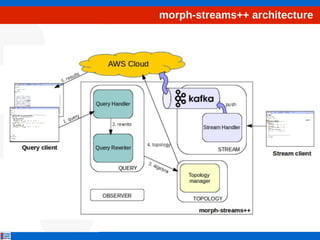
morph-streams++ architecture
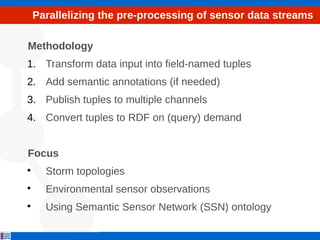
Parallelizing the pre-processing of sensor data streams
Methodology
1. Transform data input into field-named tuples
2. Add semantic annotations (if needed)
3. Publish tuples to multiple channels
4. Convert tuples to RDF on (query) demand
Focus

Storm topologies

Environmental sensor observations

Using Semantic Sensor Network (SSN) ontology
Example of use: CSIRO's Sensor Cloud (1/3)
Sensor Cloud

Viticulture, water
management, weather
monitoring, oyster farming...

RESTful API – JSON

Network → Platform →
Sensor → Phenomenon →
Observation

Lack of semantic
descriptions, e.g.
rain_trace vs Rain.

Multiple HTTP requests to
query various streams.
Source: CSIRO
Example of use: CSIRO's Sensor Cloud (2/3)
1.Sensor Cloud messages to field-named tuples
2.SWEET annotations for phenomena
<sample time=”2015­05­28T16:30” value=”48” sensor=”bom_gov_au.94961.air.rel_hum”/>
[“2015­05­28T16:32”, “2015­05­28T16:30”, “48”, “bom_gov_au”, “94961”, “air”, “rel_hum”,
“­43.3167”, “147.0075”]
network
phenomenon
platform sensorsampling time
system time
latitude longitude
Example of use: CSIRO's Sensor Cloud (3/3)
3.Publish to multiple channels
4.Convert tuples to SSN model on (query) demand
Publish2Kafka
Publish2Kafka
SWEET
Annotation
SWEET
Annotation
SC2Tuple
SC2Tuple
Sensor Cloud
spout
sweet:Rainfall
All tuples
sweet:RelativeHumidity
sweet:Rainfall
All tuples
sweet:RelativeHumidity Kafka
spout
Tuple2SSN
Tuple2SSN
to be continued...
Query: heavy rainfall events
Discussion and future work
Conclusion

Division of work into simple tasks.

Parallelize any parallelizable task.

Delay RDF generation and convert on demand.
Future work

Evaluation and benchmarking.

SSN mapping interface.

Topology package: executing distributed queries (Storm).

theObserver (theO) package: monitoring scalability metrics
for adaptive query processing.
The presented research has has been funded by Ministerio de
Economía y Competitividad (Spain) under the project ”4V:
Volumen, Velocidad, Variedad y Validez en la Gestión Innovadora
de Datos” (TIN2013-46238-C4-2-R), by the EU Marie Curie
IRSES project SemData (612551), and supported by an AWS in
Education Research Grant award.
Alejandro Llaves
allaves@fi.upm.es
Thanks!

What we do to improve scalability in our RDF processing system

  • 1.
    Alejandro Llaves and OscarCorcho Ontology Engineering Group Universidad Politécnica de Madrid Madrid, Spain allaves@fi.upm.es May 31 2015 Scalability in RDF Stream Processing Systems
  • 2.
    Alejandro Llaves and OscarCorcho Ontology Engineering Group Universidad Politécnica de Madrid Madrid, Spain allaves@fi.upm.es May 31 2015 What we do to improve Scalability in our RDF Stream Processing System
  • 3.
    Outline  Towards efficient processingof RDF data streams  Architecture overview  Parallelizing the pre-processing of sensor data streams  Example of use: CSIRO's Sensor Cloud  Discussion and future work
  • 4.
    Towards efficient processingof RDF data streams  Goal: to develop a stream processing engine capable of adapting to variable conditions, such as changing rates of input data, failure of processing nodes, or distribution of workload, while serving complex continuous queries.  Example of query execution parallelization (OrdRing 2014) Project Project Project Project Simple Join Simple Join Simple Join Simple Join Windowing <t1, t3...> Windowing <t0, t2...> Windowing <t1, t3...> Windowing <t0, t2...> Storm topology example (4 nodes) SELECT ?obs.value ?sensors.location FROM NAMED STREAM <obs> [60 SEC TO NOW] FROM NAMED STREAM <sensors> [60 SEC TO NOW] WHERE obs.sensorId = sensors.id ; SPOUT <obs> Triple2Graph Output SPOUT <sensors> Triple2Graph t0 t1 t2 t3
  • 5.
  • 6.
    Parallelizing the pre-processingof sensor data streams Methodology 1. Transform data input into field-named tuples 2. Add semantic annotations (if needed) 3. Publish tuples to multiple channels 4. Convert tuples to RDF on (query) demand Focus  Storm topologies  Environmental sensor observations  Using Semantic Sensor Network (SSN) ontology
  • 7.
    Example of use:CSIRO's Sensor Cloud (1/3) Sensor Cloud  Viticulture, water management, weather monitoring, oyster farming...  RESTful API – JSON  Network → Platform → Sensor → Phenomenon → Observation  Lack of semantic descriptions, e.g. rain_trace vs Rain.  Multiple HTTP requests to query various streams. Source: CSIRO
  • 8.
    Example of use:CSIRO's Sensor Cloud (2/3) 1.Sensor Cloud messages to field-named tuples 2.SWEET annotations for phenomena <sample time=”2015­05­28T16:30” value=”48” sensor=”bom_gov_au.94961.air.rel_hum”/> [“2015­05­28T16:32”, “2015­05­28T16:30”, “48”, “bom_gov_au”, “94961”, “air”, “rel_hum”, “­43.3167”, “147.0075”] network phenomenon platform sensorsampling time system time latitude longitude
  • 9.
    Example of use:CSIRO's Sensor Cloud (3/3) 3.Publish to multiple channels 4.Convert tuples to SSN model on (query) demand Publish2Kafka Publish2Kafka SWEET Annotation SWEET Annotation SC2Tuple SC2Tuple Sensor Cloud spout sweet:Rainfall All tuples sweet:RelativeHumidity sweet:Rainfall All tuples sweet:RelativeHumidity Kafka spout Tuple2SSN Tuple2SSN to be continued... Query: heavy rainfall events
  • 10.
    Discussion and futurework Conclusion  Division of work into simple tasks.  Parallelize any parallelizable task.  Delay RDF generation and convert on demand. Future work  Evaluation and benchmarking.  SSN mapping interface.  Topology package: executing distributed queries (Storm).  theObserver (theO) package: monitoring scalability metrics for adaptive query processing.
  • 11.
    The presented researchhas has been funded by Ministerio de Economía y Competitividad (Spain) under the project ”4V: Volumen, Velocidad, Variedad y Validez en la Gestión Innovadora de Datos” (TIN2013-46238-C4-2-R), by the EU Marie Curie IRSES project SemData (612551), and supported by an AWS in Education Research Grant award. Alejandro Llaves allaves@fi.upm.es Thanks!