Rapid Response Teams Training
1
A2.1 Rapid Response Teams
composition and roles
Updated: May 2022
Rapid Response Teams Advanced Training Package
Rapid Response Teams Training
2
Learning objectives
At the end of this session you should be able to :
• Explain what is a RRT and its characteristics
• Describe the composition of a RRT and key activities of each RRT member
• List the key partners for the RRT during its intervention
• Describe the link between RRTs and the emergency response system.
Rapid Response Teams Training
3
Oultine
1. Characteristics of an RRT
2. Composition of the RRT
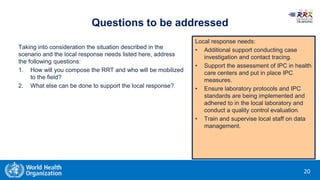
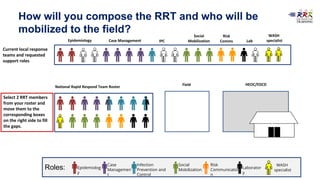
3. Practicing with a scenario
4. RRTs as part of the Emergency Response System
5. Examples of tasks of RRT members
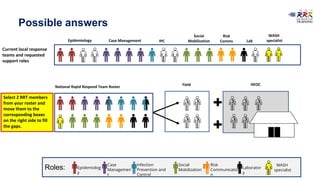
6. References and guidelines
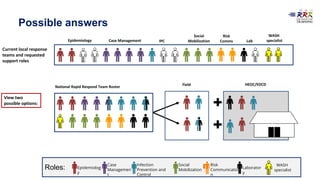
7. Additional learning resources
Rapid Response Teams Training
4
1. Characteristics of an RRT
Rapid Response Teams Training
5
What are the characteristics of a Rapid Response
Team?
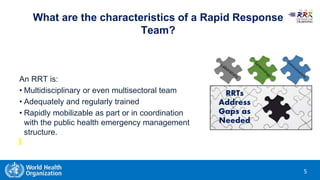
An RRT is:
• Multidisciplinary or even multisectoral team
• Adequately and regularly trained
• Rapidly mobilizable as part or in coordination
with the public health emergency management
structure.
Rapid Response Teams Training
6
2. Composition of an RRT
Rapid Response Teams Training
7
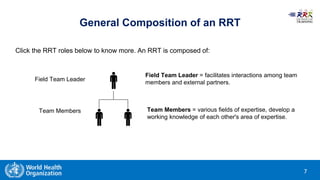
Team Members
Field Team Leader = facilitates interactions among team
members and external partners.
Field Team Leader
General Composition of an RRT
Team Members = various fields of expertise, develop a
working knowledge of each other's area of expertise.
Click the RRT roles below to know more. An RRT is composed of:
Rapid Response Teams Training
8
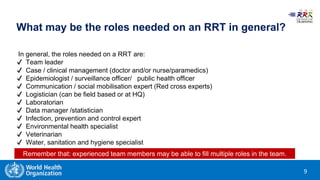
What may be the roles needed on an RRT, in general?
Rapid Response Teams Training
9
What may be the roles needed on an RRT in general?
Remember that: experienced team members may be able to fill multiple roles in the team.
In general, the roles needed on a RRT are:
✔ Team leader
✔ Case / clinical management (doctor and/or nurse/paramedics)
✔ Epidemiologist / surveillance officer/ public health officer
✔ Communication / social mobilisation expert (Red cross experts)
✔ Logistician (can be field based or at HQ)
✔ Laboratorian
✔ Data manager /statistician
✔ Infection, prevention and control expert
✔ Environmental health specialist
✔ Veterinarian
✔ Water, sanitation and hygiene specialist
Rapid Response Teams Training
10
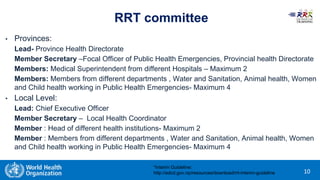
RRT committee
• Provinces:
Lead- Province Health Directorate
Member Secretary –Focal Officer of Public Health Emergencies, Provincial health Directorate
Members: Medical Superintendent from different Hospitals – Maximum 2
Members: Members from different departments , Water and Sanitation, Animal health, Women
and Child health working in Public Health Emergencies- Maximum 4
• Local Level:
Lead: Chief Executive Officer
Member Secretary – Local Health Coordinator
Member : Head of different health institutions- Maximum 2
Member : Members from different departments , Water and Sanitation, Animal health, Women
and Child health working in Public Health Emergencies- Maximum 4
*Interim Guideline:
http://edcd.gov.np/resources/download/rrt-interim-guideline
Rapid Response Teams Training
11
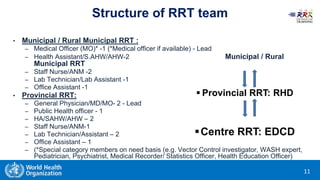
Structure of RRT team
• Municipal / Rural Municipal RRT :
– Medical Officer (MO)* -1 (*Medical officer if available) - Lead
– Health Assistant/S.AHW/AHW-2 Municipal / Rural
Municipal RRT
– Staff Nurse/ANM -2
– Lab Technician/Lab Assistant -1
– Office Assistant -1
• Provincial RRT:
– General Physician/MD/MO- 2 - Lead
– Public Health officer - 1
– HA/SAHW/AHW – 2
– Staff Nurse/ANM-1
– Lab Technician/Assistant – 2
– Office Assistant – 1
– (*Special category members on need basis (e.g. Vector Control investigator, WASH expert,
Pediatrician, Psychiatrist, Medical Recorder/ Statistics Officer, Health Education Officer)
 Provincial RRT: RHD
Centre RRT: EDCD
Rapid Response Teams Training
12
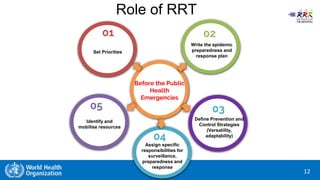
Write the
epidemic
preparedness
and response
plan
Before the Public
Health
Emergencies
01
Define Prevention and
Control Strategies
(Versatility,
adaptability)
02
05 03
Write the epidemic
preparedness and
response plan
04
Assign specific
responsibilities for
surveillance,
preparedness and
response
Identify and
mobilise resources
Set Priorities
Role of RRT
Rapid Response Teams Training
13
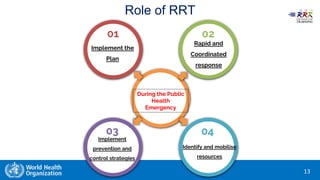
During the Public
Health
Emergency
Implement the
Plan
01
Rapid and
Coordinated
response
02
Implement
prevention and
control strategies
03
Identify and mobilise
resources
04
Role of RRT
Rapid Response Teams Training
14
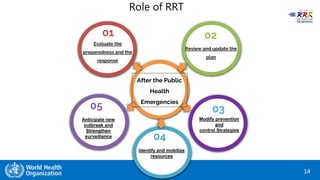
Write the
epidemic
preparedness
and response
plan
After the Public
Health
Emergencies
01
Modify prevention
and
control Strategies
02
05 03
Review and update the
plan
04
Identify and mobilize
resources
Anticipate new
outbreak and
Strengthen
surveillance
Evaluate the
preparedness and the
response
Role of RRT
Rapid Response Teams Training
15
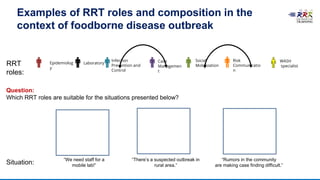
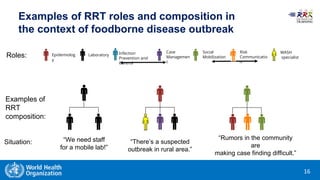
Examples of RRT roles and composition in the
context of foodborne disease outbreak
Epidemiolog
y
Social
Mobilization
Laboratory WASH
specialist
Risk
Communicatio
n
RRT
roles:
Infection
Prevention and
Control
Situation: “We need staff for a
mobile lab!”
“There’s a suspected outbreak in
rural area.”
“Rumors in the community
are making case finding difficult.”
Question:
Which RRT roles are suitable for the situations presented below?
Case
Managemen
t
Rapid Response Teams Training
16
Examples of RRT roles and composition in
the context of foodborne disease outbreak
Epidemiolog
y
Social
Mobilization
Laboratory
Case
Managemen
t
Risk
Communicatio
n
Roles:
Examples of
RRT
composition:
“We need staff
for a mobile lab!”
Situation:
Infection
Prevention and
Control
“There’s a suspected
outbreak in rural area.”
“Rumors in the community
are
making case finding difficult.”
WASH
specialist
Rapid Response Teams Training
17
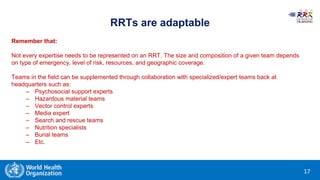
RRTs are adaptable
Remember that:
Not every expertise needs to be represented on an RRT. The size and composition of a given team depends
on type of emergency, level of risk, resources, and geographic coverage.
Teams in the field can be supplemented through collaboration with specialized/expert teams back at
headquarters such as:
– Psychosocial support experts
– Hazardous material teams
– Vector control experts
– Media expert
– Search and rescue teams
– Nutrition specialists
– Burial teams
– Etc.
Rapid Response Teams Training
18
3. Practicing with a scenario
Rapid Response Teams Training
19
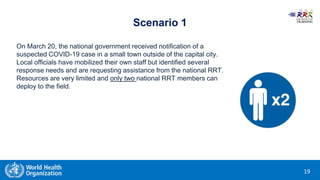
Scenario 1
On March 20, the national government received notification of a
suspected COVID-19 case in a small town outside of the capital city.
Local officials have mobilized their own staff but identified several
response needs and are requesting assistance from the national RRT.
Resources are very limited and only two national RRT members can
deploy to the field.
Rapid Response Teams Training
20
Questions to be addressed
Taking into consideration the situation described in the
scenario and the local response needs listed here, address
the following questions:
1. How will you compose the RRT and who will be mobilized
to the field?
2. What else can be done to support the local response?
Local response needs:
• Additional support conducting case
investigation and contact tracing.
• Support the assessment of IPC in health
care centers and put in place IPC
measures.
• Ensure laboratory protocols and IPC
standards are being implemented and
adhered to in the local laboratory and
conduct a quality control evaluation.
• Train and supervise local staff on data
management.
Rapid Response Teams Training
21
Epidemiology Case Management IPC
Current local response
teams and requested
support roles
How will you compose the RRT and who will be
mobilized to the field?
Select 2 RRT members
from your roster and
move them to the
corresponding boxes
on the right side to fill
the gaps.
Social
Mobilization Lab
Risk
Comms
National Rapid Respond Team Roster
Field
Response
Headquarters
HEOC/EDCD
WASH
specialist
Epidemiolog
y
Social
Mobilization
Laborator
y
Case
Managemen
t
Risk
Communicatio
n
Roles: Infection
Prevention and
Control
WASH
specialist
Rapid Response Teams Training
22
Epidemiology Case Management IPC
Current local response
teams and requested
support roles
Possible answers
Social
Mobilization Lab
Risk
Comms
National Rapid Respond Team Roster
Field
Response
Headquarters
HEOC
Epidemiolog
y
Social
Mobilization
Laborator
y
Case
Managemen
t
Risk
Communicatio
n
Roles: Infection
Prevention and
Control
? ?
? ?
? ? ?
? ?
Select 2 RRT members
from your roster and
move them to the
corresponding boxes
on the right side to fill
the gaps.
WASH
specialist
WASH
specialist
Rapid Response Teams Training
23
Epidemiology Case Management IPC
Current local response
teams and requested
support roles
Possible answers
View two
possible options:
Social
Mobilization Lab
Risk
Comms
National Rapid Respond Team Roster
Field
Response
Headquarters
HEOC/EDCD
WASH
specialist
Epidemiolog
y
Social
Mobilization
Laborator
y
Case
Managemen
t
Risk
Communicatio
n
Roles: Infection
Prevention and
Control
WASH
specialist
Rapid Response Teams Training
24
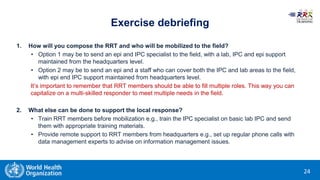
Exercise debriefing
1. How will you compose the RRT and who will be mobilized to the field?
• Option 1 may be to send an epi and IPC specialist to the field, with a lab, IPC and epi support
maintained from the headquarters level.
• Option 2 may be to send an epi and a staff who can cover both the IPC and lab areas to the field,
with epi end IPC support maintained from headquarters level.
It’s important to remember that RRT members should be able to fill multiple roles. This way you can
capitalize on a multi-skilled responder to meet multiple needs in the field.
2. What else can be done to support the local response?
• Train RRT members before mobilization e.g., train the IPC specialist on basic lab IPC and send
them with appropriate training materials.
• Provide remote support to RRT members from headquarters e.g., set up regular phone calls with
data management experts to advise on information management issues.
Rapid Response Teams Training
25
What else can be done to support the local response?
RRT members may not have the appropriate expertise for a given emergency. To prepare and/or
support them you may consider the following:
– Train RRT members before mobilization (just-in time training) e.g., train the IPC specialist on
basic lab IPC and send them with appropriate training materials.
Not all support needs to go to the field, support can be provided by staff at headquarters:
– Provide remote support to RRT members e.g., set up regular phone calls with data
management experts to advise on information management issues.
Rapid Response Teams Training
26
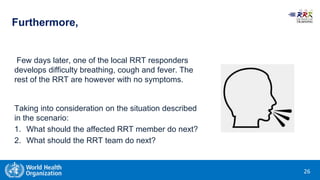
Furthermore,
Few days later, one of the local RRT responders
develops difficulty breathing, cough and fever. The
rest of the RRT are however with no symptoms.
Taking into consideration on the situation described
in the scenario:
1. What should the affected RRT member do next?
2. What should the RRT team do next?
Rapid Response Teams Training
27
Possible answers
1. The RRT member should report symptoms
immediately to the team lead and self-isolate.
1. Team lead should report the event to the RRT
manager back at headquarters. All
exposed RRT responders with close contact
to the sick responder should self-isolate as
well - SETTING AN EXAMPLE.

RRT composition and role scenario in .pptx

  • 1.
    Rapid Response TeamsTraining 1 A2.1 Rapid Response Teams composition and roles Updated: May 2022 Rapid Response Teams Advanced Training Package
  • 2.
    Rapid Response TeamsTraining 2 Learning objectives At the end of this session you should be able to : • Explain what is a RRT and its characteristics • Describe the composition of a RRT and key activities of each RRT member • List the key partners for the RRT during its intervention • Describe the link between RRTs and the emergency response system.
  • 3.
    Rapid Response TeamsTraining 3 Oultine 1. Characteristics of an RRT 2. Composition of the RRT 3. Practicing with a scenario 4. RRTs as part of the Emergency Response System 5. Examples of tasks of RRT members 6. References and guidelines 7. Additional learning resources
  • 4.
    Rapid Response TeamsTraining 4 1. Characteristics of an RRT
  • 5.
    Rapid Response TeamsTraining 5 What are the characteristics of a Rapid Response Team? An RRT is: • Multidisciplinary or even multisectoral team • Adequately and regularly trained • Rapidly mobilizable as part or in coordination with the public health emergency management structure.
  • 6.
    Rapid Response TeamsTraining 6 2. Composition of an RRT
  • 7.
    Rapid Response TeamsTraining 7 Team Members Field Team Leader = facilitates interactions among team members and external partners. Field Team Leader General Composition of an RRT Team Members = various fields of expertise, develop a working knowledge of each other's area of expertise. Click the RRT roles below to know more. An RRT is composed of:
  • 8.
    Rapid Response TeamsTraining 8 What may be the roles needed on an RRT, in general?
  • 9.
    Rapid Response TeamsTraining 9 What may be the roles needed on an RRT in general? Remember that: experienced team members may be able to fill multiple roles in the team. In general, the roles needed on a RRT are: ✔ Team leader ✔ Case / clinical management (doctor and/or nurse/paramedics) ✔ Epidemiologist / surveillance officer/ public health officer ✔ Communication / social mobilisation expert (Red cross experts) ✔ Logistician (can be field based or at HQ) ✔ Laboratorian ✔ Data manager /statistician ✔ Infection, prevention and control expert ✔ Environmental health specialist ✔ Veterinarian ✔ Water, sanitation and hygiene specialist
  • 10.
    Rapid Response TeamsTraining 10 RRT committee • Provinces: Lead- Province Health Directorate Member Secretary –Focal Officer of Public Health Emergencies, Provincial health Directorate Members: Medical Superintendent from different Hospitals – Maximum 2 Members: Members from different departments , Water and Sanitation, Animal health, Women and Child health working in Public Health Emergencies- Maximum 4 • Local Level: Lead: Chief Executive Officer Member Secretary – Local Health Coordinator Member : Head of different health institutions- Maximum 2 Member : Members from different departments , Water and Sanitation, Animal health, Women and Child health working in Public Health Emergencies- Maximum 4 *Interim Guideline: http://edcd.gov.np/resources/download/rrt-interim-guideline
  • 11.
    Rapid Response TeamsTraining 11 Structure of RRT team • Municipal / Rural Municipal RRT : – Medical Officer (MO)* -1 (*Medical officer if available) - Lead – Health Assistant/S.AHW/AHW-2 Municipal / Rural Municipal RRT – Staff Nurse/ANM -2 – Lab Technician/Lab Assistant -1 – Office Assistant -1 • Provincial RRT: – General Physician/MD/MO- 2 - Lead – Public Health officer - 1 – HA/SAHW/AHW – 2 – Staff Nurse/ANM-1 – Lab Technician/Assistant – 2 – Office Assistant – 1 – (*Special category members on need basis (e.g. Vector Control investigator, WASH expert, Pediatrician, Psychiatrist, Medical Recorder/ Statistics Officer, Health Education Officer)  Provincial RRT: RHD Centre RRT: EDCD
  • 12.
    Rapid Response TeamsTraining 12 Write the epidemic preparedness and response plan Before the Public Health Emergencies 01 Define Prevention and Control Strategies (Versatility, adaptability) 02 05 03 Write the epidemic preparedness and response plan 04 Assign specific responsibilities for surveillance, preparedness and response Identify and mobilise resources Set Priorities Role of RRT
  • 13.
    Rapid Response TeamsTraining 13 During the Public Health Emergency Implement the Plan 01 Rapid and Coordinated response 02 Implement prevention and control strategies 03 Identify and mobilise resources 04 Role of RRT
  • 14.
    Rapid Response TeamsTraining 14 Write the epidemic preparedness and response plan After the Public Health Emergencies 01 Modify prevention and control Strategies 02 05 03 Review and update the plan 04 Identify and mobilize resources Anticipate new outbreak and Strengthen surveillance Evaluate the preparedness and the response Role of RRT
  • 15.
    Rapid Response TeamsTraining 15 Examples of RRT roles and composition in the context of foodborne disease outbreak Epidemiolog y Social Mobilization Laboratory WASH specialist Risk Communicatio n RRT roles: Infection Prevention and Control Situation: “We need staff for a mobile lab!” “There’s a suspected outbreak in rural area.” “Rumors in the community are making case finding difficult.” Question: Which RRT roles are suitable for the situations presented below? Case Managemen t
  • 16.
    Rapid Response TeamsTraining 16 Examples of RRT roles and composition in the context of foodborne disease outbreak Epidemiolog y Social Mobilization Laboratory Case Managemen t Risk Communicatio n Roles: Examples of RRT composition: “We need staff for a mobile lab!” Situation: Infection Prevention and Control “There’s a suspected outbreak in rural area.” “Rumors in the community are making case finding difficult.” WASH specialist
  • 17.
    Rapid Response TeamsTraining 17 RRTs are adaptable Remember that: Not every expertise needs to be represented on an RRT. The size and composition of a given team depends on type of emergency, level of risk, resources, and geographic coverage. Teams in the field can be supplemented through collaboration with specialized/expert teams back at headquarters such as: – Psychosocial support experts – Hazardous material teams – Vector control experts – Media expert – Search and rescue teams – Nutrition specialists – Burial teams – Etc.
  • 18.
    Rapid Response TeamsTraining 18 3. Practicing with a scenario
  • 19.
    Rapid Response TeamsTraining 19 Scenario 1 On March 20, the national government received notification of a suspected COVID-19 case in a small town outside of the capital city. Local officials have mobilized their own staff but identified several response needs and are requesting assistance from the national RRT. Resources are very limited and only two national RRT members can deploy to the field.
  • 20.
    Rapid Response TeamsTraining 20 Questions to be addressed Taking into consideration the situation described in the scenario and the local response needs listed here, address the following questions: 1. How will you compose the RRT and who will be mobilized to the field? 2. What else can be done to support the local response? Local response needs: • Additional support conducting case investigation and contact tracing. • Support the assessment of IPC in health care centers and put in place IPC measures. • Ensure laboratory protocols and IPC standards are being implemented and adhered to in the local laboratory and conduct a quality control evaluation. • Train and supervise local staff on data management.
  • 21.
    Rapid Response TeamsTraining 21 Epidemiology Case Management IPC Current local response teams and requested support roles How will you compose the RRT and who will be mobilized to the field? Select 2 RRT members from your roster and move them to the corresponding boxes on the right side to fill the gaps. Social Mobilization Lab Risk Comms National Rapid Respond Team Roster Field Response Headquarters HEOC/EDCD WASH specialist Epidemiolog y Social Mobilization Laborator y Case Managemen t Risk Communicatio n Roles: Infection Prevention and Control WASH specialist
  • 22.
    Rapid Response TeamsTraining 22 Epidemiology Case Management IPC Current local response teams and requested support roles Possible answers Social Mobilization Lab Risk Comms National Rapid Respond Team Roster Field Response Headquarters HEOC Epidemiolog y Social Mobilization Laborator y Case Managemen t Risk Communicatio n Roles: Infection Prevention and Control ? ? ? ? ? ? ? ? ? Select 2 RRT members from your roster and move them to the corresponding boxes on the right side to fill the gaps. WASH specialist WASH specialist
  • 23.
    Rapid Response TeamsTraining 23 Epidemiology Case Management IPC Current local response teams and requested support roles Possible answers View two possible options: Social Mobilization Lab Risk Comms National Rapid Respond Team Roster Field Response Headquarters HEOC/EDCD WASH specialist Epidemiolog y Social Mobilization Laborator y Case Managemen t Risk Communicatio n Roles: Infection Prevention and Control WASH specialist
  • 24.
    Rapid Response TeamsTraining 24 Exercise debriefing 1. How will you compose the RRT and who will be mobilized to the field? • Option 1 may be to send an epi and IPC specialist to the field, with a lab, IPC and epi support maintained from the headquarters level. • Option 2 may be to send an epi and a staff who can cover both the IPC and lab areas to the field, with epi end IPC support maintained from headquarters level. It’s important to remember that RRT members should be able to fill multiple roles. This way you can capitalize on a multi-skilled responder to meet multiple needs in the field. 2. What else can be done to support the local response? • Train RRT members before mobilization e.g., train the IPC specialist on basic lab IPC and send them with appropriate training materials. • Provide remote support to RRT members from headquarters e.g., set up regular phone calls with data management experts to advise on information management issues.
  • 25.
    Rapid Response TeamsTraining 25 What else can be done to support the local response? RRT members may not have the appropriate expertise for a given emergency. To prepare and/or support them you may consider the following: – Train RRT members before mobilization (just-in time training) e.g., train the IPC specialist on basic lab IPC and send them with appropriate training materials. Not all support needs to go to the field, support can be provided by staff at headquarters: – Provide remote support to RRT members e.g., set up regular phone calls with data management experts to advise on information management issues.
  • 26.
    Rapid Response TeamsTraining 26 Furthermore, Few days later, one of the local RRT responders develops difficulty breathing, cough and fever. The rest of the RRT are however with no symptoms. Taking into consideration on the situation described in the scenario: 1. What should the affected RRT member do next? 2. What should the RRT team do next?
  • 27.
    Rapid Response TeamsTraining 27 Possible answers 1. The RRT member should report symptoms immediately to the team lead and self-isolate. 1. Team lead should report the event to the RRT manager back at headquarters. All exposed RRT responders with close contact to the sick responder should self-isolate as well - SETTING AN EXAMPLE.