Journal of Resources Development and Management www.iiste.org
ISSN 2422-8397 An International Peer-reviewed Journal
Vol.4, 2015
57
Analysis of Inter - Household Willingness to Pay for Solid Waste
Management in Mwanza City, Tanzania
Ramadhan Rajabu Sizya.
Trade officer, Mwanza city Council, Tanzania and External Associate, Research for Poverty Alleviation (RePoA)
in Economic Growth, P.O Box 1333 Mwanza, Tanzania.
Email: ramasizya@gmail.com
Abstract
This study used the (Close-ended) contingent valuation approach to examine the relationship between selected
socio-economic characteristics of households and their willingness to pay for improved solid waste management.
Binary responses were used to obtain survey data from 300 households randomly selected from Mwanza City,
Tanzania and the logit regression technique was used to estimate the determinants of selected dependent
variables on willingness to pay. Evidence from the logit model indicated that seven variables had significant
influence on the households’ willingness-to-pay. With exceptional of age, environmental knowledge and
secondary education dummy, post vocational, primary education and income of respondents variables were
positive and statistically significant at P < 0.05 but household type and legal regulatory on environment were
negative and significant at P > 0.05. The results from the study have further suggested that individual household
are willing to pay for solid waste management.
Key Words: Willingness to Pay; Solid Waste; Solid Waste Management; Contingent Valuation
1. Introduction
Tanzania is one of the least developed countries with only 6.4% real Growth Domestic Product (GDP) per
capital growth. It is one of the fastest growing populations in the world, which reached 41.9 millions with
fertility rate of 5.4, of it s population 26% are living in urban centre and 74% are living in rural areas with annual
growth rate of 4.7%. Life expectancy is very low (54.6 years for male and 56.4 years for female) 1
(NBS, 2010).
Continuing population growth and urbanization in Tanzania in particular makes the provision of urban
environmental services very difficult. The most difficult challenge many cities in the developing world as far as
Mwanza is concern are facing today in relation to environmental health service is the proper management of
solid waste. Mwanza City (MC) is one of the cities in Tanzania which are facing the problem. Solid waste
management has been undertaken by the city council until July 1999 when it was privatised to private sectors.
Today solid waste management is being undertaken by Department of Health and Cleanness with Private
Collectors, Community Based Organisations’ (CBOs) and Non Government Organisations (NGOs). This helped
to reduce bureaucracy compared to the previous structure as it was undertaken by the Department of Health and
Cleanliness alone.
The management of solid waste involves storage at the source (primary storage or secondary storage), collection,
transportation and final disposal of the refuse. There is no one best method of managing solid waste that can
serve best in all cities. One has to approach managing solid waste in an innovative manner since selection of the
best device and practice at each stage depends on a variety of specific circumstances to the city under
consideration. The factors include socioeconomic as well as the nature and volume of waste (UNEP, 1987).
Solid waste is a general term used to describe non-liquid waste materials arising from various consumption and
production activities of people. Economic activities are generating substantial quantities of solid waste. Currently,
it is estimated that the rate of solid waste generation in the City is between 0.6 – 0.75 kg per capital per day.
Thus the amount of solid waste from domestic, institutional and commercial activities is estimated at about 375,
000 kg per day. Industrial solid waste, largely from factories and industries, is assumed to be in the region of
500,000 kg per day. On a daily basis therefore, about 875,000kg of solid waste are generated in the Mwanza City
(MCC, 2009). The MCC operates a refuse collection fleet made up of only 4 operating trucks, which could only
collect around 30 percent of the total solid waste from residential, institutional and commercial premises and
mostly within the Central Business District (CBD) areas.
Previously waste collected was disposed of at an inadequately managed dumpsite at Nyakato area, which is
about of 8km from the central area. The rest (70) percent) of the daily solid waste generated are, in most cases
left uncollected and form heaps of rotting garbage all over Mwanza. During the rainy season, uncollected refuse
is washed away and through stomata drains, dumped into Lake Victoria (MCC, 2009). The City Council is all the
1
The figure above is projection based on the 2002 population and housing census rates.
Journal of Resources Development and Management www.iiste.org
ISSN 2422-8397 An International Peer-reviewed Journal
Vol.4, 2015
58
time trying to find solution to the problem of solid wastes management. Recently, the City Council has
established partnerships with (CBOs) and a Private Company to clean and deal with solid wastes in the City.
Solid waste generation tends to be an increasing function of income both within a country and across countries.
Cointreau (1992) stated that waste generation per capital per day in kilogram is in the range of 0.4-0.6, 0.5-0.9
and 0.7-1.8 for low, middle and higher income countries, respectively. In Mwanza city, there are mainly five
types of solid waste collection systems which are door -to-door, block, recycling, landfilling and container
(transfer station).
There is a large and growing literature in both developed and developing countries in the world that attempt to
explain the theoretical perspectives used to explore the theoretical threads on the causal relationship leading to
the solid waste management (SWM). Theoretical perspectives will help us to elucidate the new theoretical
insights on SWM. Most of the models resulting from previous studies of the solid waste management were based
on qualitative research which permits them to base on the assumption, question and logic of the theories. All
solid wastes are the inescapable and “unfortunate” consequences of human activities. If these wastes are not
properly dealt with, they can cause tremendous damage to consumers, firms and the nation at large since most
wastes have externality effect.
Externality is a situation where one or more of the variables in the consumption function of an individual or
production function of a firm fall under the control of another economic agent. Externality can be positive or
negative. Positive externality occurs when one economic agent benefits from the action of another economic
agent whereas negative externality decreases the utility or production of another economic agent – like disposing
solid waste on street or into a river (Hodge, 1995).
The Local Government Finances Act of 1982 gives urban authorities powers to raise local revenue. Sources of
local revenue include development levies, market dues, business licenses, property taxes, road tolls, and user
charges. The central Government envisaged that urban authorities would depend on themselves to a large extent,
except in the provision of services, in which function they acted as agents of the central Government for example,
in the provision solid waste management services. With very few exceptions, urban authorities in Tanzania have
continued to rely heavily on the central Government for most of their revenue. Therefore, their ability to manage
services they provides has depended on how much the central Government can allocate to each urban authority,
and this has not been much (MCC,2011). For example 2010/11 and 2011/12, the MCC requested 7.320 billion
Tshs. from the central Government for the whole activities of the Health related manners but the amount do not
reach in the respectable time. For this the services providers are operating under the credit manners, when it
comes they received not the whole amount. The central Government was supposed to fully cover this cost.
2. Empirical part
A number of empirical studies in the area of environmental and public goods have used the Contingent Valuation
Method (CVM) and reliable results have been found. In Tanzania, little researches have been undertaken using
this method and have shown that CVM is an important instrument.
Contingent Valuation Method (CVM) is a survey method used to elicit consumers’ valuation of goods and
services not sold in the market place, by showing their Willingness to Pay (WTP). The method has extensively
been used in the valuation of non-market resources such as recreation, wildlife and environmental quality.
Kartman (1997) addressed some methodological issues in CVM by applying it in the area of health. He
measured willingness to pay for reduction in Angina Pectores attacks- WTP for a more effective drug. For this, a
sample of 402 Swedish Angens Pectores patients was interviewed by telephone with bidding game with open-
ended format. Logistic regression analysis was run for binary questions. In analysis, income was significant at
1% level. For log- linear specifications were given. Based on 40 McFadden’s R2
and the percentage of correctly
predicted responses, the log-linear specification that fits the binary data was found to be best. Alemu (2000) used
CVM to examine whether rural households of Ethiopia are willing to pay for community forestry or not. The
data for this study was collected in 1996 using binary with open-ended follow up formats. The result shows that
CVM could be used to value environmental good even in rural Ethiopia. In the questionnaires, households were
given the chance to contribute money or labour to the proposed plantation. This is due to liquidity problems rural
people have which helped to make the survey more realistic. The Tobit regression showed that income,
household size, distance of homestead to plantation, number of trees owned and sex of household head are found
to be significant variables explaining willingness to pay for community forestry in rural Ethiopia.
Bartone & Bernstein (1993) noted that changing economic trends and rapid urbanization also complicate solid
Journal of Resources Development and Management www.iiste.org
ISSN 2422-8397 An International Peer-reviewed Journal
Vol.4, 2015
59
waste management in developing countries. Consequently, solid waste is not only increasing in quantity but also
changing in composition from less organic to more paper, packing wastes, plastics, glass, metal wastes among
other types, a fact leading to the low collection rates.
2.1 Willingness to pay for solid waste management
WTP is ‘the maximum amount consumers are prepared to pay for a good or service’ (ADB, 2007). More
specifically, WTP is the amount of money that a person is willing and able to pay to enjoy recreational facilities
(McConnell, 1985). It measures whether an individual is willing to forego their income in order to obtain more
goods/services, and is typically used for non-market goods. Most empirical studies have shown inadequate Solid
Waste Management as it threatens human health. Sustainable environment suggest the Willingness – to – Pay as
one of the device that can increase the Management of Waste and increase environmental sustainability. An
environmental impact associated with the inadequate Solid Waste Management (SWM) has already been noticed
as a problem facing Developing Countries including Tanzania, Mwanza City in particular.
Niringiye and Douglason (2010) made a (close-ended) dichotomous choice contingent valuation method (CVM)
to elicit households’ willingness to pay for improvement in solid waste management in Kampala City. The logit
(double log) linear regression model was used to obtain the willingness to pay of the households for improved
waste management. The logit linear model which is based on the cumulative probability function was adopted
because of its ability to deal with a dichotomous dependent variable and a well established theoretical
background.
Logistic regression is a uni/multivariate technique which allows for estimating the probability that an event will
occur or not through prediction of a binary dependent outcome from a set of independent variables. To identify
the factors influencing willingness to pay for improved waste management by households, the household
responses to the maximum willingness to pay question is regressed against socioeconomic characteristics of the
household.
The logistic (double log) linear regression function for this study is used and specified as follows:
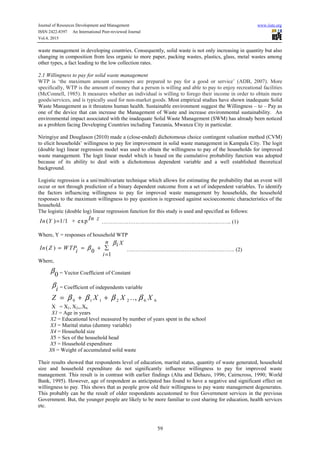
( ) 1/1 + exp In zIn Y = …………………………………………………….….…….. (1)
Where, Y = responses of household WTP
( )
0
1
n Xi
In Z WTP
i
i
β
β ∑= = +
=
………………………………………….…..……. (2)
Where,
0
β = Vector Coefficient of Constant
i
β = Coefficient of independents variable
0 1 1 2 2 6 6..,Z X X Xβ β β β= + +
X = X1, X2,,.X6
X1 = Age in years
X2 = Educational level measured by number of years spent in the school
X3 = Marital status (dummy variable)
X4 = Household size
X5 = Sex of the household head
X5 = Household expenditure
X6 = Weight of accumulated solid waste
Their results showed that respondents level of education, marital status, quantity of waste generated, household
size and household expenditure do not significantly influence willingness to pay for improved waste
management. This result is in contrast with earlier findings (Alta and Dehazo, 1996; Cairncross, 1990; World
Bank, 1995). However, age of respondent as anticipated has found to have a negative and significant effect on
willingness to pay. This shows that as people grow old their willingness to pay waste management degenerates.
This probably can be the result of older respondents accustomed to free Government services in the previous
Government. But, the younger people are likely to be more familiar to cost sharing for education, health services
etc.
Journal of Resources Development and Management www.iiste.org
ISSN 2422-8397 An International Peer-reviewed Journal
Vol.4, 2015
60
Most of reviewed literature indicates that CVM can be used in different areas when market prices are missing
and CVM is a better environmental valuation method, for it can capture both use and non-uses values. These
literatures have helped for this research to identify the potential socioeconomic, demographic and factors related
to the good under consideration that could help to explain willingness to pay.
One of the main criticisms on Close – ended CVM relates to the fact that many people have little experience in
making explicit decision on the value of the environmental good. Therefore, some people have difficulties to
accept results obtained through CVM as true willingness to pay which will be revealed if the good valued were
to be supplied in reality. But many studies have shown that Close – ended CVM can give a reliable result if
applied correctly and carefully (Akilu, 2002).
3. Data Analysis Methods
3.1 Choice of the Model and Description of variables
The model used is the Logit model where respondents were asked to whether they are willing or not to pay for
solid waste management, its choice is motivated by discussion in previous sections. The information obtained
from the study was used to test the model, for the previously mentioned improved SWM as a function of several
variables. These are income of household (Y), household type (Hh), education (Edu), environmental knowledge
(Kn), age (Age), marital status (Mar) and legal regulatory on environment (Leg). The questionnaire also assessed
WTPi if the individual were willing to pay for improved SWM. In this study the WPT has been defined as the
whether individual is willing to pay or not. The model was chosen due to its relevance to the area of study.
3.2 Choice of the variables
The dependent variable used in the study is the Willingness to Pay for improved solid waste management
involves the binary choice i.e. including the two alternative responses. This is considered to be good for
estimating the WTP of individuals. The independent variables included in the WTP function are the income,
household type, education, environmental knowledge, age, marital status and legal regulatory on environment.
3.2.1 Binary choice model
Suppose an individual n is faced with a choice between two alternatives from a choice set (i,j)Cn= , where
alternative i represent choosing to vote “Yes” for willingness to pay for SWM and alternative j represents
choosing to vote “no” for not willing to pay for SWM. An individual n derives utility Uin by choosing
alternative i and U
jn by choosing alternative j. Based on the idea Hanemann and Kanninen (1998), If we
define WTP = 1 if i and WTP =0 if j and using the condition that individual is rational in choosing either of the
two options it can be represented by income I
in , Utilities derived from WTPi Uin and U
ij can be
formulated as follows:
(1, )
,
U V e v I A S e
in in in n n n in
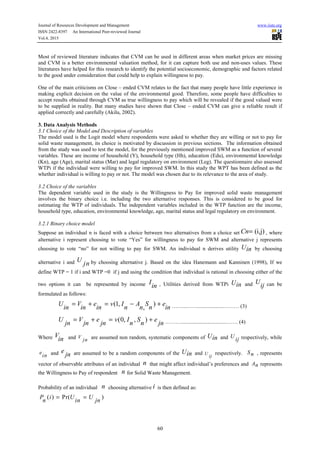
= + = − + ……...……...................……… (3)
(0, , )U V e v I S e
jn jn jn n n jn
= + = + ……….................................……. (4)
Where V
in and V
jn are assumed non random, systematic components of Uin and U
ij respectively, while
e
in and e
jn are assumed to be a random components of the Uin and U
ij
respectively. Sn , represents
vector of observable attributes of an individual n that might affect individual’s preferences and An represents
the Willingness to Pay of respondent n for Solid Waste Management.
Probability of an individual n choosing alternative i is then defined as:
( ) Pr( )P i U U
n in jn
= =
Journal of Resources Development and Management www.iiste.org
ISSN 2422-8397 An International Peer-reviewed Journal
Vol.4, 2015
61
Pr( . )V e V ein in in jn= + +
Pr{ (1, , ) . (0, , )v I A S e v I S e
n n n n n n jn
= − − +
Pr{ (1, , ) (0, , )}e e v I A S v I S
jn in n n n n n
= − = − − ….……………....… (5)
While the probability of an individual n choosing alternative j is defined as:
( ) 1 ( )P j P i
n n
= − …………………………………………………. (6)
Under the assumption that e e e
n jn in
= − is logistically distributed, probability that an individual n will
choose alternative i can be written as
exp 1
( )
( )exp exp 1 exp
vin
P i
n vin vjn vin vij
µ
µ µ µ= =
− −+ +
………..……………………. (7)
This is binary Logit model which is used to determine the willingness to pay of individual/respondents.
4. Empirical Model Specification
4.1 Empirical Model Specification for Willingness to pay
The main objective of the study was to determine factors that influence the households’ willingness to pay and to
allow inclusion of the respondents’ social economic factors into the WTP function. Incorporation of variables
into the WTP helps to gain information on validity and reliability of the results from the empirical analysis (Mc
Connell, 2002). To obtain the willingness to pay of the inter-household for the SWM, the responses of the inter-
household willingness to pay was regressed through the Logistic model. Logistic regression is useful in the
situation where prediction of the presence or absence of an outcome based on values of a set of predicator
variables is needed. The Logistic regression coefficients are used to estimate coefficient for each of independent
variables in the model.
In the analysis the outcome of the response, household Willingness to pay or not does not matter. The major
interest is the Likelihood or Probability of outcome .The binary response in this study is whether the respondents
are willing to pay or not for the Solid Waste Management. If Y is the Random Variable dichotomous, it can then
be assumed that it takes the value of 0 or 1, where 0 denotes the non-occurrence of event in the question and 1
denotes the occurrences (Maddala, 1983). If X’s characteristics are to be related to occurrences of this outcome,
then the logistic model specifies that the conditional probability of event (i.e. that Y = 1) given the value of X1…,
Xp is as follows:
1
( )
[1 exp ( )]
P Y WTPi
Xii iiα β
= =
+ − +∑ ………………………...…………………. (8)
Where:
1 if Household is willing to Pay for SW M
0 If Household is not willing to Pay for SW M
Yi={
α = Constant term
X = Independent Variable (Socio-economic factors)
iiβ = Logistic Coefficients for the independent Variables
iε = Error Term2
2
For more details see logistic models in Maddala, G .S (1983). Limited Dependents and Qualitative Variable in
Econometrics, Cambridge University Press. Cambridge.
Journal of Resources Development and Management www.iiste.org
ISSN 2422-8397 An International Peer-reviewed Journal
Vol.4, 2015
62
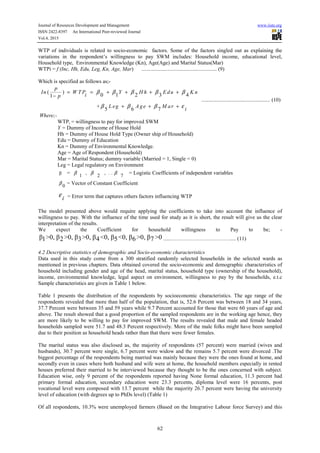
WTP of individuals is related to socio-economic factors. Some of the factors singled out as explaining the
variations in the respondent’s willingness to pay SWM includes: Household income, educational level,
Household type, Environmental Knowledge (Kn), Age(Age) and Marital Status(Mar)
WTPi = f (Inc, Hh, Edu, Leg, Kn, Age, Mar) ........................................................ (9)
Which is specified as follows as;-
( )
0 1 2 3 41
+
5 6 7
p
In W T P Y H h E du K n
ip
L eg A ge M ar
i
β β β β β
β β β ε
= = + + + +
−
+ + +
................................................... (10)
Where;-
WTPi = willingness to pay for improved SWM
Y = Dummy of Income of House Hold
Hh = Dummy of House Hold Type (Owner ship of Household)
Edu = Dummy of Education
Kn = Dummy of Environmental Knowledge.
Age = Age of Respondent (Household)
Mar = Marital Status; dummy variable (Married = 1, Single = 0)
Leg = Legal regulatory on Environment
β = , , . .
1 2 7
β β β = Logistic Coefficients of independent variables
0
β = Vector of Constant Coefficient
i
ε = Error term that captures others factors influencing WTP
The model presented above would require applying the coefficients to take into account the influence of
willingness to pay. With the influence of the time used for study as it is short, the result will give us the clear
interpretation of the results.
We expect the Coefficient for household willingness to Pay to be; -
β >0, β >0, β >0, β <0, β <0, β >0, β >01 2 3 4 5 6 7 ......…………………………….... (11)
4.2 Descriptive statistics of demographic and Socio-economic characteristics
Data used in this study come from a 300 stratified randomly selected households in the selected wards as
mentioned in previous chapters. Data obtained covered the socio-economic and demographic characteristics of
household including gender and age of the head, marital status, household type (ownership of the household),
income, environmental knowledge, legal aspect on environment, willingness to pay by the households, e.t.c
Sample characteristics are given in Table 1 below.
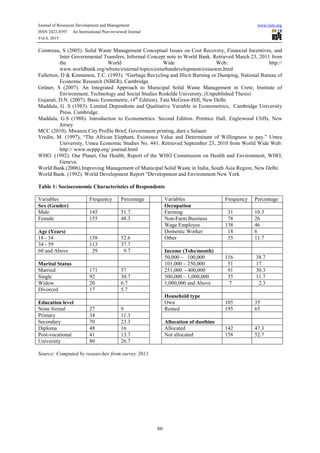
Table 1 presents the distribution of the respondents by socioeconomic characteristics. The age range of the
respondents revealed that more than half of the population, that is, 52.6 Percent was between 18 and 34 years,
37.7 Percent were between 35 and 59 years while 9.7 Percent accounted for those that were 60 years of age and
above. The result showed that a good proportion of the sampled respondents are in the working age hence, they
are more likely to be willing to pay for improved SWM. The results revealed that male and female headed
households sampled were 51.7 and 48.3 Percent respectively. More of the male folks might have been sampled
due to their position as household heads rather than that there were fewer females.
The marital status was also disclosed as, the majority of respondents (57 percent) were married (wives and
husbands), 30.7 percent were single, 6.7 percent were widow and the remains 5.7 percent were divorced .The
biggest percentage of the respondents being married was mainly because they were the ones found at home, and
secondly even in cases where both husband and wife were at home, the household members especially in rented
houses preferred their married to be interviewed because they thought to be the ones concerned with subject.
Education wise, only 9 percent of the respondents reported having None formal education, 11.3 percent had
primary formal education, secondary education were 23.3 percents, diploma level were 16 percents, post
vocational level were composed with 13.7 percent while the majority 26.7 percent were having the university
level of education (with degrees up to PhDs level) (Table 1)
Of all respondents, 10.3% were unemployed farmers (Based on the Integrative Labour force Survey) and this
Journal of Resources Development and Management www.iiste.org
ISSN 2422-8397 An International Peer-reviewed Journal
Vol.4, 2015
63
was followed by those engaged in Non- farm business (26 percent). Majority of respondent were wage employee
(employed in private organisations and Government institute) constituted 46 percent, this is the facts that wage
employee were the one found in the week days at their respective housed. Domestic workers constitutes of 6
percents. The others occupation is 11.7 percent this is not surprising as most of the respondents belong to these
groups can not identify themselves to what they actually doing in their daily life and therefore it becomes
difficult to get a job which they specifically doing(Table 1).
To add-on (Table 1), the monthly income received and generated from various occupations, the majority of
respondents (about 38.7 Percent) are having income between Tshs. 50,000 – 100,000 per month in other revenue
generating activities. 17 percent of respondents were having income between Tshs. 101,000 – 250,000 per month,
30.3 percent composed with respondents of income revenue generation per month between Tshs. 251,000 –
400,000, 11.7 percent of respondents is composed with those having income between Tshs. 500,000 – 1,000,000.
The low percentage of 2.3 percentages is composed with the respondents having income of about Tshs.1,
000,001 and above.
However the information they disclosed do not resemble to what they actually say about their income as most
respondents did not disclose the real value of their monthly income. The level of household life styles is
generally high (Researcher Observation). The result also reveals that, the household type of respondents, the
majority of respondents (65 percent) are living in rented house and remaining proportion of 35 percent constitute
about 35 percent.
4.3 Empirical results
4.3.1 Determinants of Willingness to pay for improved solid waste management
Contingent Valuation Method (CVM) through the Logistic regression analysis was constructed to ascertain
factors that could influence the willingness to pay by some selected respondents and not others in the study area,
based on Closed–Ended Format (dichotomous choice question), simply asks if the respondent is willing to pay a
specified amount of money for the proposed change. This method has the advantage of being familiar with
respondents like in real world markets where buyers face posted prices so it is easier for buyers to answer. But,
this method suffers from a number of shortcomings. One of which is starting value biases. This method gives
limited information on benefits and hence suffers from efficiency. Moreover, large sample is required for
estimation of benefits, because maximum willingness to pay is not obtained directly from this method.
Willingness to pay (whether and individual is willing to pay or not for solid waste management) was regressed
on income, household type, education, environmental knowledge/awareness, legal regulatory, age and marital
status using the maximum – likelihood estimation procedure.
Before the maximum likelihood estimates was run, test was made for the prevalence of multicollinearity since
this problem reduces the precision of estimating the coefficient of variables having this problem.
According to Gujarati 1997, a correlation coefficient of 0.8 is sufficient to indicate the existence of
multicollinearity problem and one solution to solve this problem is to drop one of the variables creating the
problem. Based on this non formal education dummy and Diploma dummy of household are dropped because
they were found to be significantly correlated with each counterpart. One problem that may arise when we drop a
variable is specification problems. We did not check the significant effect of other variable to be included in the
model because the variable dropped are some part of the main variable it’s not a variable as a whole. The
decision to drop these dummy variables was based on the higher relevance of the later variable observed from
regression results.
As discussed in the previous sections maximum likelihood estimates made a Logit Model to identify the socio –
economic factors that affect a household is willing to pay for improved solid waste management.
The maximum likelihood estimates for a household to be willing to pay or not was corrected for potential
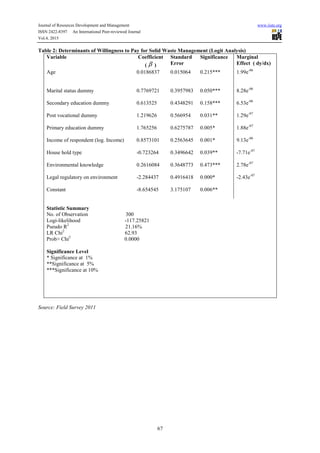
heteroscedasticity problem. As shown in table 4.5 the LR chi square which is 62.93% shows the overall
significance of the Logit Model at 5% level of significance, while a Logi-likelihood is -117.25821. Negative log
likelihood shows that a model will be evaluated as fitting the data better if the chi-square for comparison with a
model with a deviance is statistically significant. The pseudo R2
is 21.16%, which implies that percentage of the
variation in the probability of being willing to pay or not is explained by the variables included in the model. We
can not be surprised on the value of R2
because the conventional measure of goodness of fit of it is not
particularly meaningful in binary regressed models (Gujarati, 2007:618). However the marginal effect were
further generated [y = Pr (wtp) (predict)] by using mfx command. The marginal effect is then simply the
gradient of the logistic CDF at this mean value. (Norton, 2004). The marginal effects are nonlinear functions of
Journal of Resources Development and Management www.iiste.org
ISSN 2422-8397 An International Peer-reviewed Journal
Vol.4, 2015
64
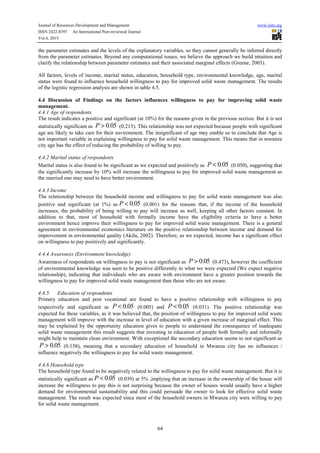
the parameter estimates and the levels of the explanatory variables, so they cannot generally be inferred directly
from the parameter estimates. Beyond any computational issues, we believe the approach we build intuition and
clarify the relationship between parameter estimates and their associated marginal effects (Greene, 2003).
All factors, levels of income, marital status, education, household type, environmental knowledge, age, marital
status were found to influence household willingness to pay for improved solid waste management. The results
of the logistic regression analysis are shown in table 4.5.
4.4 Discussion of Findings on the factors influences willingness to pay for improving solid waste
management.
4.4.1 Age of respondents
The result indicates a positive and significant (at 10%) for the reasons given in the previous section. But it is not
statistically significant as 0.05P > (0.215). This relationship was not expected because people with significant
age are likely to take care for their environment. The insignificant of age may enable us to conclude that Age is
not important variable in explaining willingness to pay for solid waste management. This means that in mwanza
city age has the effect of reducing the probability of willing to pay.
4.4.2 Marital status of respondents
Marital status is also found to be significant as we expected and positively as 0.05P < (0.050), suggesting that
the significantly increase by 10% will increase the willingness to pay for improved solid waste management as
the married one may need to have better environment.
4.4.3 Income
The relationship between the household income and willingness to pay for solid waste management was also
positive and significant (at 1%) as 0.05P < (0.001) for the reasons that, if the income of the household
increases, the probability of being willing to pay will increase as well, keeping all other factors constant. In
addition to that, most of household with formally income have the eligibility criteria to have a better
environment hence improve their willingness to pay for improved solid waste management. There is a general
agreement in environmental economics literature on the positive relationship between income and demand for
improvement in environmental quality (Akilu, 2002). Therefore, as we expected, income has a significant effect
on willingness to pay positively and significantly.
4.4.4 Awareness (Environment knowledge)
Awareness of respondents on willingness to pay is not significant as 0.05P > (0.473), however the coefficient
of environmental knowledge was seen to be positive differently to what we were expected (We expect negative
relationship), indicating that individuals who are aware with environment have a greater position towards the
willingness to pay for improved solid waste management than those who are not aware.
4.4.5 Education of respondents
Primary education and post vocational are found to have a positive relationship with willingness to pay
respectively and significant as 0.05P < (0.005) and 0.05P < (0.031). The positive relationship was
expected for these variables, as it was believed that, the position of willingness to pay for improved solid waste
management will improve with the increase in level of education with a given increase of marginal effect. This
may be explained by the opportunity education gives to people to understand the consequence of inadequate
solid waste management this result suggests that investing in education of people both formally and informally
might help to maintain clean environment. With exceptional the secondary education seems to not significant as
0.05P > (0.158), meaning that a secondary education of household in Mwanza city has no influences /
influence negatively the willingness to pay for solid waste management.
4.4.6 Household type
The household type found to be negatively related to the willingness to pay for solid waste management. But it is
statistically significant as 0.05P < (0.039) at 5% ,implying that an increase in the ownership of the house will
increase the willingness to pay this is not surprising because the owner of houses would usually have a higher
demand for environmental sustainability and this could persuade the owner to look for effective solid waste
management. The result was expected since most of the household owners in Mwanza city were willing to pay
for solid waste management.
Journal of Resources Development and Management www.iiste.org
ISSN 2422-8397 An International Peer-reviewed Journal
Vol.4, 2015
65
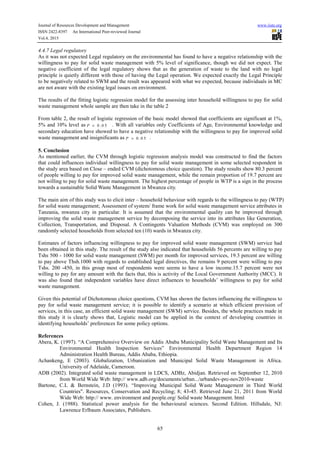
4.4.7 Legal regulatory
As it was not expected Legal regulatory on the environmental has found to have a negative relationship with the
willingness to pay for solid waste management with 5% level of significance, though we did not expect. The
negative coefficient of the legal regulatory shows that as the generation of waste to the land with no legal
principle is quietly different with those of having the Legal operation. We expected exactly the Legal Principle
to be negatively related to SWM and the result was appeared with what we expected, because individuals in MC
are not aware with the existing legal issues on environment.
The results of the fitting logistic regression model for the assessing inter household willingness to pay for solid
waste management whole sample are then take in the table 2
From table 2, the result of logistic regression of the basic model showed that coefficients are significant at 1%,
5% and 10% level as 0 .0 5P < . With all variables only Coefficients of Age, Environmental knowledge and
secondary education have showed to have a negative relationship with the willingness to pay for improved solid
waste management and insignificants as 0 .0 5P > .
5. Conclusion
As mentioned earlier, the CVM through logistic regression analysis model was constructed to find the factors
that could influences individual willingness to pay for solid waste management in some selected respondent in
the study area based on Close – ended CVM (dichotomous choice question). The study results show 80.3 percent
of people willing to pay for improved solid waste management, while the remain proportion of 19.7 percent are
not willing to pay for solid waste management. The highest percentage of people in WTP is a sign in the process
towards a sustainable Solid Waste Management in Mwanza city.
The main aim of this study was to elicit inter – household behaviour with regards to the willingness to pay (WTP)
for solid waste management; Assessment of system/ frame work for solid waste management service attributes in
Tanzania, mwanza city in particular. It is assumed that the environmental quality can be improved through
improving the solid waste management service by decomposing the service into its attributes like Generation,
Collection, Transportation, and Disposal. A Contingents Valuation Methods (CVM) was employed on 300
randomly selected households from selected ten (10) wards in Mwanza city.
Estimates of factors influencing willingness to pay for improved solid waste management (SWM) service had
been obtained in this study. The result of the study also indicated that households 56 percents are willing to pay
Tshs 500 - 1000 for solid waste management (SWM) per month for improved services, 19.3 percent are willing
to pay above Thsh.1000 with regards to established legal directives, the remains 9 percent were willing to pay
Tshs. 200 -450, in this group most of respondents were seems to have a low income.15.7 percent were not
willing to pay for any amount with the facts that, this is activity of the Local Government Authority (MCC). It
was also found that independent variables have direct influences to households’ willingness to pay for solid
waste management.
Given this potential of Dichotomous choice questions, CVM has shown the factors influencing the willingness to
pay for solid waste management service; it is possible to identify a scenario at which efficient provision of
services, in this case, an efficient solid waste management (SWM) service. Besides, the whole practices made in
this study it is clearly shows that, Logistic model can be applied in the context of developing countries in
identifying households’ preferences for some policy options.
References
Abera, K. (1997). “A Comprehensive Overview on Addis Ababa Municipality Solid Waste Management and Its
Environmental Health Inspection Services” Environmental Health Department Region 14
Administration Health Bureau, Addis Ababa, Ethiopia.
Achankeng, E (2003). Globalization, Urbanization and Municipal Solid Waste Management in Africa.
University of Adelaide, Cameroon.
ADB (2002). Integrated solid waste management in LDCS, ADBz, Abidjan. Retrieved on September 12, 2010
from World Wide Web: http:// www.adb.org/documents/urban.../urbandev-prc-nov2010-waste
Bartone, C.L & Bernstein, J.D (1993). “Improving Municipal Solid Waste Management in Third World
Countries". Resources, Conservation and Recycling; 8; 43-45. Retrieved June 21, 2011 from World
Wide Web: http:// www. environment and people.org/ Solid waste Management. html
Cohen, J. (1988). Statistical power analysis for the behavioural sciences. Second Edition. Hillsdale, NJ:
Lawrence Erlbaum Associates, Publishers.
Journal of Resources Development and Management www.iiste.org
ISSN 2422-8397 An International Peer-reviewed Journal
Vol.4, 2015
66
Cointreau, S (2005). Solid Waste Management Conceptual Issues on Cost Recovery, Financial Incentives, and
Inter Governmental Transfers, Informal Concept note to World Bank. Retrieved March 23, 2011 from
the World Wide Web: http://
www.worldbank.org/wbsite/external/topics/exturbandevelopment/extuswm.html
Fullerton, D & Kinnamon, T.C. (1993). “Garbage Recycling and Illicit Burning or Dumping, National Bureau of
Economic Research (NBER), Cambridge.
Grüner, S (2007). An Integrated Approach to Municipal Solid Waste Management in Crete, Institute of
Environment, Technology and Social Studies Roskilde University, (Unpublished Thesis)
Gujarati, D.N. (2007). Basic Econometric, (4th
Edition), Tata McGraw-Hill, New Delhi
Maddala, G .S (1983). Limited Dependents and Qualitative Variable in Econometrics, Cambridge University
Press. Cambridge.
Maddala, G.S (1988). Introduction to Econometrics. Second Edition. Prentice Hall, Englewood Cliffs, New
Jersey
MCC (2010). Mwanza City Profile Brief, Government printing, dare s Salaam
Vredin, M. (1997), “The African Elephant, Existence Value and Determinant of Willingness to pay.” Umea
University, Umea Economic Studies No. 441. Retrieved September 23, 2010 from World Wide Web:
http:// www.ncppp.org/ journal.html
WHO. (1992). Our Planet, Our Health; Report of the WHO Commission on Health and Environment, WHO,
Geneva.
World Bank.(2006).Improving Management of Municipal Solid Waste in India, South Asia Region, New Delhi.
World Bank. (1992). World Development Report “Development and Environment New York
Table 1: Socioeconomic Characteristics of Respondents
Variables Frequency Percentage Variables Frequency Percentage
Sex (Gender) Occupation
Male 145 51.7 Farming 31 10.3
Female 155 48.3 Non-Farm Business 78 26
Wage Employee 138 46
Age (Years) Domestic Worker 18 6
18 - 34 158 52.6 Other 35 11.7
34 - 59 113 37.7
60 and Above 29 9.7 Income (Tshs/month)
50,000 – 100,000 116 38.7
Marital Status 101,000 – 250,000 51 17
Married 171 57 251,000 - 400,000 91 30.3
Single 92 30.7 500,000 – 1,000,000 35 11.7
Widow 20 6.7 1,000,000 and Above 7 2.3
Divorced 17 5.7
Household type
Education level Own 105 35
None formal 27 9 Rented 195 65
Primary 34 11.3
Secondary 70 23.3 Allocation of dustbins
Diploma 48 16 Allocated 142 47.3
Post-vocational 41 13.7 Not allocated 158 52.7
University 80 26.7
Source: Computed by researcher from survey 2011
Journal of Resources Development and Management www.iiste.org
ISSN 2422-8397 An International Peer-reviewed Journal
Vol.4, 2015
67
Table 2: Determinants of Willingness to Pay for Solid Waste Management (Logit Analysis)
Variable Coefficient
( β )
Standard
Error
Significance Marginal
Effect ( dy/dx)
Age 0.0186837 0.015064 0.215*** 1.99e-06
Marital status dummy 0.7769721 0.3957983 0.050*** 8.28e-06
Secondary education dummy 0.613525 0.4348291 0.158*** 6.53e-06
Post vocational dummy 1.219626 0.566954 0.031** 1.29e-07
Primary education dummy 1.765256 0.6275787 0.005* 1.88e-07
Income of respondent (log. Income) 0.8573101 0.2563645 0.001* 9.13e-06
House hold type -0.723264 0.3496642 0.039** -7.71e-07
Environmental knowledge 0.2616084 0.3648773 0.473*** 2.78e-07
Legal regulatory on environment -2.284437 0.4916418 0.000* -2.43e-07
Constant -8.654545 3.175107 0.006**
Statistic Summary
No. of Observation 300
Logi-likelihood -117.25821
Pseudo R2
21.16%
LR Chi2
62.93
Prob> Chi2
0.0000
Significance Level
* Significance at 1%
**Significance at 5%
***Significance at 10%
Source: Field Survey 2011

RRSizya

  • 1.
    Journal of ResourcesDevelopment and Management www.iiste.org ISSN 2422-8397 An International Peer-reviewed Journal Vol.4, 2015 57 Analysis of Inter - Household Willingness to Pay for Solid Waste Management in Mwanza City, Tanzania Ramadhan Rajabu Sizya. Trade officer, Mwanza city Council, Tanzania and External Associate, Research for Poverty Alleviation (RePoA) in Economic Growth, P.O Box 1333 Mwanza, Tanzania. Email: ramasizya@gmail.com Abstract This study used the (Close-ended) contingent valuation approach to examine the relationship between selected socio-economic characteristics of households and their willingness to pay for improved solid waste management. Binary responses were used to obtain survey data from 300 households randomly selected from Mwanza City, Tanzania and the logit regression technique was used to estimate the determinants of selected dependent variables on willingness to pay. Evidence from the logit model indicated that seven variables had significant influence on the households’ willingness-to-pay. With exceptional of age, environmental knowledge and secondary education dummy, post vocational, primary education and income of respondents variables were positive and statistically significant at P < 0.05 but household type and legal regulatory on environment were negative and significant at P > 0.05. The results from the study have further suggested that individual household are willing to pay for solid waste management. Key Words: Willingness to Pay; Solid Waste; Solid Waste Management; Contingent Valuation 1. Introduction Tanzania is one of the least developed countries with only 6.4% real Growth Domestic Product (GDP) per capital growth. It is one of the fastest growing populations in the world, which reached 41.9 millions with fertility rate of 5.4, of it s population 26% are living in urban centre and 74% are living in rural areas with annual growth rate of 4.7%. Life expectancy is very low (54.6 years for male and 56.4 years for female) 1 (NBS, 2010). Continuing population growth and urbanization in Tanzania in particular makes the provision of urban environmental services very difficult. The most difficult challenge many cities in the developing world as far as Mwanza is concern are facing today in relation to environmental health service is the proper management of solid waste. Mwanza City (MC) is one of the cities in Tanzania which are facing the problem. Solid waste management has been undertaken by the city council until July 1999 when it was privatised to private sectors. Today solid waste management is being undertaken by Department of Health and Cleanness with Private Collectors, Community Based Organisations’ (CBOs) and Non Government Organisations (NGOs). This helped to reduce bureaucracy compared to the previous structure as it was undertaken by the Department of Health and Cleanliness alone. The management of solid waste involves storage at the source (primary storage or secondary storage), collection, transportation and final disposal of the refuse. There is no one best method of managing solid waste that can serve best in all cities. One has to approach managing solid waste in an innovative manner since selection of the best device and practice at each stage depends on a variety of specific circumstances to the city under consideration. The factors include socioeconomic as well as the nature and volume of waste (UNEP, 1987). Solid waste is a general term used to describe non-liquid waste materials arising from various consumption and production activities of people. Economic activities are generating substantial quantities of solid waste. Currently, it is estimated that the rate of solid waste generation in the City is between 0.6 – 0.75 kg per capital per day. Thus the amount of solid waste from domestic, institutional and commercial activities is estimated at about 375, 000 kg per day. Industrial solid waste, largely from factories and industries, is assumed to be in the region of 500,000 kg per day. On a daily basis therefore, about 875,000kg of solid waste are generated in the Mwanza City (MCC, 2009). The MCC operates a refuse collection fleet made up of only 4 operating trucks, which could only collect around 30 percent of the total solid waste from residential, institutional and commercial premises and mostly within the Central Business District (CBD) areas. Previously waste collected was disposed of at an inadequately managed dumpsite at Nyakato area, which is about of 8km from the central area. The rest (70) percent) of the daily solid waste generated are, in most cases left uncollected and form heaps of rotting garbage all over Mwanza. During the rainy season, uncollected refuse is washed away and through stomata drains, dumped into Lake Victoria (MCC, 2009). The City Council is all the 1 The figure above is projection based on the 2002 population and housing census rates.
  • 2.
    Journal of ResourcesDevelopment and Management www.iiste.org ISSN 2422-8397 An International Peer-reviewed Journal Vol.4, 2015 58 time trying to find solution to the problem of solid wastes management. Recently, the City Council has established partnerships with (CBOs) and a Private Company to clean and deal with solid wastes in the City. Solid waste generation tends to be an increasing function of income both within a country and across countries. Cointreau (1992) stated that waste generation per capital per day in kilogram is in the range of 0.4-0.6, 0.5-0.9 and 0.7-1.8 for low, middle and higher income countries, respectively. In Mwanza city, there are mainly five types of solid waste collection systems which are door -to-door, block, recycling, landfilling and container (transfer station). There is a large and growing literature in both developed and developing countries in the world that attempt to explain the theoretical perspectives used to explore the theoretical threads on the causal relationship leading to the solid waste management (SWM). Theoretical perspectives will help us to elucidate the new theoretical insights on SWM. Most of the models resulting from previous studies of the solid waste management were based on qualitative research which permits them to base on the assumption, question and logic of the theories. All solid wastes are the inescapable and “unfortunate” consequences of human activities. If these wastes are not properly dealt with, they can cause tremendous damage to consumers, firms and the nation at large since most wastes have externality effect. Externality is a situation where one or more of the variables in the consumption function of an individual or production function of a firm fall under the control of another economic agent. Externality can be positive or negative. Positive externality occurs when one economic agent benefits from the action of another economic agent whereas negative externality decreases the utility or production of another economic agent – like disposing solid waste on street or into a river (Hodge, 1995). The Local Government Finances Act of 1982 gives urban authorities powers to raise local revenue. Sources of local revenue include development levies, market dues, business licenses, property taxes, road tolls, and user charges. The central Government envisaged that urban authorities would depend on themselves to a large extent, except in the provision of services, in which function they acted as agents of the central Government for example, in the provision solid waste management services. With very few exceptions, urban authorities in Tanzania have continued to rely heavily on the central Government for most of their revenue. Therefore, their ability to manage services they provides has depended on how much the central Government can allocate to each urban authority, and this has not been much (MCC,2011). For example 2010/11 and 2011/12, the MCC requested 7.320 billion Tshs. from the central Government for the whole activities of the Health related manners but the amount do not reach in the respectable time. For this the services providers are operating under the credit manners, when it comes they received not the whole amount. The central Government was supposed to fully cover this cost. 2. Empirical part A number of empirical studies in the area of environmental and public goods have used the Contingent Valuation Method (CVM) and reliable results have been found. In Tanzania, little researches have been undertaken using this method and have shown that CVM is an important instrument. Contingent Valuation Method (CVM) is a survey method used to elicit consumers’ valuation of goods and services not sold in the market place, by showing their Willingness to Pay (WTP). The method has extensively been used in the valuation of non-market resources such as recreation, wildlife and environmental quality. Kartman (1997) addressed some methodological issues in CVM by applying it in the area of health. He measured willingness to pay for reduction in Angina Pectores attacks- WTP for a more effective drug. For this, a sample of 402 Swedish Angens Pectores patients was interviewed by telephone with bidding game with open- ended format. Logistic regression analysis was run for binary questions. In analysis, income was significant at 1% level. For log- linear specifications were given. Based on 40 McFadden’s R2 and the percentage of correctly predicted responses, the log-linear specification that fits the binary data was found to be best. Alemu (2000) used CVM to examine whether rural households of Ethiopia are willing to pay for community forestry or not. The data for this study was collected in 1996 using binary with open-ended follow up formats. The result shows that CVM could be used to value environmental good even in rural Ethiopia. In the questionnaires, households were given the chance to contribute money or labour to the proposed plantation. This is due to liquidity problems rural people have which helped to make the survey more realistic. The Tobit regression showed that income, household size, distance of homestead to plantation, number of trees owned and sex of household head are found to be significant variables explaining willingness to pay for community forestry in rural Ethiopia. Bartone & Bernstein (1993) noted that changing economic trends and rapid urbanization also complicate solid
  • 3.
    Journal of ResourcesDevelopment and Management www.iiste.org ISSN 2422-8397 An International Peer-reviewed Journal Vol.4, 2015 59 waste management in developing countries. Consequently, solid waste is not only increasing in quantity but also changing in composition from less organic to more paper, packing wastes, plastics, glass, metal wastes among other types, a fact leading to the low collection rates. 2.1 Willingness to pay for solid waste management WTP is ‘the maximum amount consumers are prepared to pay for a good or service’ (ADB, 2007). More specifically, WTP is the amount of money that a person is willing and able to pay to enjoy recreational facilities (McConnell, 1985). It measures whether an individual is willing to forego their income in order to obtain more goods/services, and is typically used for non-market goods. Most empirical studies have shown inadequate Solid Waste Management as it threatens human health. Sustainable environment suggest the Willingness – to – Pay as one of the device that can increase the Management of Waste and increase environmental sustainability. An environmental impact associated with the inadequate Solid Waste Management (SWM) has already been noticed as a problem facing Developing Countries including Tanzania, Mwanza City in particular. Niringiye and Douglason (2010) made a (close-ended) dichotomous choice contingent valuation method (CVM) to elicit households’ willingness to pay for improvement in solid waste management in Kampala City. The logit (double log) linear regression model was used to obtain the willingness to pay of the households for improved waste management. The logit linear model which is based on the cumulative probability function was adopted because of its ability to deal with a dichotomous dependent variable and a well established theoretical background. Logistic regression is a uni/multivariate technique which allows for estimating the probability that an event will occur or not through prediction of a binary dependent outcome from a set of independent variables. To identify the factors influencing willingness to pay for improved waste management by households, the household responses to the maximum willingness to pay question is regressed against socioeconomic characteristics of the household. The logistic (double log) linear regression function for this study is used and specified as follows: ( ) 1/1 + exp In zIn Y = …………………………………………………….….…….. (1) Where, Y = responses of household WTP ( ) 0 1 n Xi In Z WTP i i β β ∑= = + = ………………………………………….…..……. (2) Where, 0 β = Vector Coefficient of Constant i β = Coefficient of independents variable 0 1 1 2 2 6 6..,Z X X Xβ β β β= + + X = X1, X2,,.X6 X1 = Age in years X2 = Educational level measured by number of years spent in the school X3 = Marital status (dummy variable) X4 = Household size X5 = Sex of the household head X5 = Household expenditure X6 = Weight of accumulated solid waste Their results showed that respondents level of education, marital status, quantity of waste generated, household size and household expenditure do not significantly influence willingness to pay for improved waste management. This result is in contrast with earlier findings (Alta and Dehazo, 1996; Cairncross, 1990; World Bank, 1995). However, age of respondent as anticipated has found to have a negative and significant effect on willingness to pay. This shows that as people grow old their willingness to pay waste management degenerates. This probably can be the result of older respondents accustomed to free Government services in the previous Government. But, the younger people are likely to be more familiar to cost sharing for education, health services etc.
  • 4.
    Journal of ResourcesDevelopment and Management www.iiste.org ISSN 2422-8397 An International Peer-reviewed Journal Vol.4, 2015 60 Most of reviewed literature indicates that CVM can be used in different areas when market prices are missing and CVM is a better environmental valuation method, for it can capture both use and non-uses values. These literatures have helped for this research to identify the potential socioeconomic, demographic and factors related to the good under consideration that could help to explain willingness to pay. One of the main criticisms on Close – ended CVM relates to the fact that many people have little experience in making explicit decision on the value of the environmental good. Therefore, some people have difficulties to accept results obtained through CVM as true willingness to pay which will be revealed if the good valued were to be supplied in reality. But many studies have shown that Close – ended CVM can give a reliable result if applied correctly and carefully (Akilu, 2002). 3. Data Analysis Methods 3.1 Choice of the Model and Description of variables The model used is the Logit model where respondents were asked to whether they are willing or not to pay for solid waste management, its choice is motivated by discussion in previous sections. The information obtained from the study was used to test the model, for the previously mentioned improved SWM as a function of several variables. These are income of household (Y), household type (Hh), education (Edu), environmental knowledge (Kn), age (Age), marital status (Mar) and legal regulatory on environment (Leg). The questionnaire also assessed WTPi if the individual were willing to pay for improved SWM. In this study the WPT has been defined as the whether individual is willing to pay or not. The model was chosen due to its relevance to the area of study. 3.2 Choice of the variables The dependent variable used in the study is the Willingness to Pay for improved solid waste management involves the binary choice i.e. including the two alternative responses. This is considered to be good for estimating the WTP of individuals. The independent variables included in the WTP function are the income, household type, education, environmental knowledge, age, marital status and legal regulatory on environment. 3.2.1 Binary choice model Suppose an individual n is faced with a choice between two alternatives from a choice set (i,j)Cn= , where alternative i represent choosing to vote “Yes” for willingness to pay for SWM and alternative j represents choosing to vote “no” for not willing to pay for SWM. An individual n derives utility Uin by choosing alternative i and U jn by choosing alternative j. Based on the idea Hanemann and Kanninen (1998), If we define WTP = 1 if i and WTP =0 if j and using the condition that individual is rational in choosing either of the two options it can be represented by income I in , Utilities derived from WTPi Uin and U ij can be formulated as follows: (1, ) , U V e v I A S e in in in n n n in = + = − + ……...……...................……… (3) (0, , )U V e v I S e jn jn jn n n jn = + = + ……….................................……. (4) Where V in and V jn are assumed non random, systematic components of Uin and U ij respectively, while e in and e jn are assumed to be a random components of the Uin and U ij respectively. Sn , represents vector of observable attributes of an individual n that might affect individual’s preferences and An represents the Willingness to Pay of respondent n for Solid Waste Management. Probability of an individual n choosing alternative i is then defined as: ( ) Pr( )P i U U n in jn = =
  • 5.
    Journal of ResourcesDevelopment and Management www.iiste.org ISSN 2422-8397 An International Peer-reviewed Journal Vol.4, 2015 61 Pr( . )V e V ein in in jn= + + Pr{ (1, , ) . (0, , )v I A S e v I S e n n n n n n jn = − − + Pr{ (1, , ) (0, , )}e e v I A S v I S jn in n n n n n = − = − − ….……………....… (5) While the probability of an individual n choosing alternative j is defined as: ( ) 1 ( )P j P i n n = − …………………………………………………. (6) Under the assumption that e e e n jn in = − is logistically distributed, probability that an individual n will choose alternative i can be written as exp 1 ( ) ( )exp exp 1 exp vin P i n vin vjn vin vij µ µ µ µ= = − −+ + ………..……………………. (7) This is binary Logit model which is used to determine the willingness to pay of individual/respondents. 4. Empirical Model Specification 4.1 Empirical Model Specification for Willingness to pay The main objective of the study was to determine factors that influence the households’ willingness to pay and to allow inclusion of the respondents’ social economic factors into the WTP function. Incorporation of variables into the WTP helps to gain information on validity and reliability of the results from the empirical analysis (Mc Connell, 2002). To obtain the willingness to pay of the inter-household for the SWM, the responses of the inter- household willingness to pay was regressed through the Logistic model. Logistic regression is useful in the situation where prediction of the presence or absence of an outcome based on values of a set of predicator variables is needed. The Logistic regression coefficients are used to estimate coefficient for each of independent variables in the model. In the analysis the outcome of the response, household Willingness to pay or not does not matter. The major interest is the Likelihood or Probability of outcome .The binary response in this study is whether the respondents are willing to pay or not for the Solid Waste Management. If Y is the Random Variable dichotomous, it can then be assumed that it takes the value of 0 or 1, where 0 denotes the non-occurrence of event in the question and 1 denotes the occurrences (Maddala, 1983). If X’s characteristics are to be related to occurrences of this outcome, then the logistic model specifies that the conditional probability of event (i.e. that Y = 1) given the value of X1…, Xp is as follows: 1 ( ) [1 exp ( )] P Y WTPi Xii iiα β = = + − +∑ ………………………...…………………. (8) Where: 1 if Household is willing to Pay for SW M 0 If Household is not willing to Pay for SW M Yi={ α = Constant term X = Independent Variable (Socio-economic factors) iiβ = Logistic Coefficients for the independent Variables iε = Error Term2 2 For more details see logistic models in Maddala, G .S (1983). Limited Dependents and Qualitative Variable in Econometrics, Cambridge University Press. Cambridge.
  • 6.
    Journal of ResourcesDevelopment and Management www.iiste.org ISSN 2422-8397 An International Peer-reviewed Journal Vol.4, 2015 62 WTP of individuals is related to socio-economic factors. Some of the factors singled out as explaining the variations in the respondent’s willingness to pay SWM includes: Household income, educational level, Household type, Environmental Knowledge (Kn), Age(Age) and Marital Status(Mar) WTPi = f (Inc, Hh, Edu, Leg, Kn, Age, Mar) ........................................................ (9) Which is specified as follows as;- ( ) 0 1 2 3 41 + 5 6 7 p In W T P Y H h E du K n ip L eg A ge M ar i β β β β β β β β ε = = + + + + − + + + ................................................... (10) Where;- WTPi = willingness to pay for improved SWM Y = Dummy of Income of House Hold Hh = Dummy of House Hold Type (Owner ship of Household) Edu = Dummy of Education Kn = Dummy of Environmental Knowledge. Age = Age of Respondent (Household) Mar = Marital Status; dummy variable (Married = 1, Single = 0) Leg = Legal regulatory on Environment β = , , . . 1 2 7 β β β = Logistic Coefficients of independent variables 0 β = Vector of Constant Coefficient i ε = Error term that captures others factors influencing WTP The model presented above would require applying the coefficients to take into account the influence of willingness to pay. With the influence of the time used for study as it is short, the result will give us the clear interpretation of the results. We expect the Coefficient for household willingness to Pay to be; - β >0, β >0, β >0, β <0, β <0, β >0, β >01 2 3 4 5 6 7 ......…………………………….... (11) 4.2 Descriptive statistics of demographic and Socio-economic characteristics Data used in this study come from a 300 stratified randomly selected households in the selected wards as mentioned in previous chapters. Data obtained covered the socio-economic and demographic characteristics of household including gender and age of the head, marital status, household type (ownership of the household), income, environmental knowledge, legal aspect on environment, willingness to pay by the households, e.t.c Sample characteristics are given in Table 1 below. Table 1 presents the distribution of the respondents by socioeconomic characteristics. The age range of the respondents revealed that more than half of the population, that is, 52.6 Percent was between 18 and 34 years, 37.7 Percent were between 35 and 59 years while 9.7 Percent accounted for those that were 60 years of age and above. The result showed that a good proportion of the sampled respondents are in the working age hence, they are more likely to be willing to pay for improved SWM. The results revealed that male and female headed households sampled were 51.7 and 48.3 Percent respectively. More of the male folks might have been sampled due to their position as household heads rather than that there were fewer females. The marital status was also disclosed as, the majority of respondents (57 percent) were married (wives and husbands), 30.7 percent were single, 6.7 percent were widow and the remains 5.7 percent were divorced .The biggest percentage of the respondents being married was mainly because they were the ones found at home, and secondly even in cases where both husband and wife were at home, the household members especially in rented houses preferred their married to be interviewed because they thought to be the ones concerned with subject. Education wise, only 9 percent of the respondents reported having None formal education, 11.3 percent had primary formal education, secondary education were 23.3 percents, diploma level were 16 percents, post vocational level were composed with 13.7 percent while the majority 26.7 percent were having the university level of education (with degrees up to PhDs level) (Table 1) Of all respondents, 10.3% were unemployed farmers (Based on the Integrative Labour force Survey) and this
  • 7.
    Journal of ResourcesDevelopment and Management www.iiste.org ISSN 2422-8397 An International Peer-reviewed Journal Vol.4, 2015 63 was followed by those engaged in Non- farm business (26 percent). Majority of respondent were wage employee (employed in private organisations and Government institute) constituted 46 percent, this is the facts that wage employee were the one found in the week days at their respective housed. Domestic workers constitutes of 6 percents. The others occupation is 11.7 percent this is not surprising as most of the respondents belong to these groups can not identify themselves to what they actually doing in their daily life and therefore it becomes difficult to get a job which they specifically doing(Table 1). To add-on (Table 1), the monthly income received and generated from various occupations, the majority of respondents (about 38.7 Percent) are having income between Tshs. 50,000 – 100,000 per month in other revenue generating activities. 17 percent of respondents were having income between Tshs. 101,000 – 250,000 per month, 30.3 percent composed with respondents of income revenue generation per month between Tshs. 251,000 – 400,000, 11.7 percent of respondents is composed with those having income between Tshs. 500,000 – 1,000,000. The low percentage of 2.3 percentages is composed with the respondents having income of about Tshs.1, 000,001 and above. However the information they disclosed do not resemble to what they actually say about their income as most respondents did not disclose the real value of their monthly income. The level of household life styles is generally high (Researcher Observation). The result also reveals that, the household type of respondents, the majority of respondents (65 percent) are living in rented house and remaining proportion of 35 percent constitute about 35 percent. 4.3 Empirical results 4.3.1 Determinants of Willingness to pay for improved solid waste management Contingent Valuation Method (CVM) through the Logistic regression analysis was constructed to ascertain factors that could influence the willingness to pay by some selected respondents and not others in the study area, based on Closed–Ended Format (dichotomous choice question), simply asks if the respondent is willing to pay a specified amount of money for the proposed change. This method has the advantage of being familiar with respondents like in real world markets where buyers face posted prices so it is easier for buyers to answer. But, this method suffers from a number of shortcomings. One of which is starting value biases. This method gives limited information on benefits and hence suffers from efficiency. Moreover, large sample is required for estimation of benefits, because maximum willingness to pay is not obtained directly from this method. Willingness to pay (whether and individual is willing to pay or not for solid waste management) was regressed on income, household type, education, environmental knowledge/awareness, legal regulatory, age and marital status using the maximum – likelihood estimation procedure. Before the maximum likelihood estimates was run, test was made for the prevalence of multicollinearity since this problem reduces the precision of estimating the coefficient of variables having this problem. According to Gujarati 1997, a correlation coefficient of 0.8 is sufficient to indicate the existence of multicollinearity problem and one solution to solve this problem is to drop one of the variables creating the problem. Based on this non formal education dummy and Diploma dummy of household are dropped because they were found to be significantly correlated with each counterpart. One problem that may arise when we drop a variable is specification problems. We did not check the significant effect of other variable to be included in the model because the variable dropped are some part of the main variable it’s not a variable as a whole. The decision to drop these dummy variables was based on the higher relevance of the later variable observed from regression results. As discussed in the previous sections maximum likelihood estimates made a Logit Model to identify the socio – economic factors that affect a household is willing to pay for improved solid waste management. The maximum likelihood estimates for a household to be willing to pay or not was corrected for potential heteroscedasticity problem. As shown in table 4.5 the LR chi square which is 62.93% shows the overall significance of the Logit Model at 5% level of significance, while a Logi-likelihood is -117.25821. Negative log likelihood shows that a model will be evaluated as fitting the data better if the chi-square for comparison with a model with a deviance is statistically significant. The pseudo R2 is 21.16%, which implies that percentage of the variation in the probability of being willing to pay or not is explained by the variables included in the model. We can not be surprised on the value of R2 because the conventional measure of goodness of fit of it is not particularly meaningful in binary regressed models (Gujarati, 2007:618). However the marginal effect were further generated [y = Pr (wtp) (predict)] by using mfx command. The marginal effect is then simply the gradient of the logistic CDF at this mean value. (Norton, 2004). The marginal effects are nonlinear functions of
  • 8.
    Journal of ResourcesDevelopment and Management www.iiste.org ISSN 2422-8397 An International Peer-reviewed Journal Vol.4, 2015 64 the parameter estimates and the levels of the explanatory variables, so they cannot generally be inferred directly from the parameter estimates. Beyond any computational issues, we believe the approach we build intuition and clarify the relationship between parameter estimates and their associated marginal effects (Greene, 2003). All factors, levels of income, marital status, education, household type, environmental knowledge, age, marital status were found to influence household willingness to pay for improved solid waste management. The results of the logistic regression analysis are shown in table 4.5. 4.4 Discussion of Findings on the factors influences willingness to pay for improving solid waste management. 4.4.1 Age of respondents The result indicates a positive and significant (at 10%) for the reasons given in the previous section. But it is not statistically significant as 0.05P > (0.215). This relationship was not expected because people with significant age are likely to take care for their environment. The insignificant of age may enable us to conclude that Age is not important variable in explaining willingness to pay for solid waste management. This means that in mwanza city age has the effect of reducing the probability of willing to pay. 4.4.2 Marital status of respondents Marital status is also found to be significant as we expected and positively as 0.05P < (0.050), suggesting that the significantly increase by 10% will increase the willingness to pay for improved solid waste management as the married one may need to have better environment. 4.4.3 Income The relationship between the household income and willingness to pay for solid waste management was also positive and significant (at 1%) as 0.05P < (0.001) for the reasons that, if the income of the household increases, the probability of being willing to pay will increase as well, keeping all other factors constant. In addition to that, most of household with formally income have the eligibility criteria to have a better environment hence improve their willingness to pay for improved solid waste management. There is a general agreement in environmental economics literature on the positive relationship between income and demand for improvement in environmental quality (Akilu, 2002). Therefore, as we expected, income has a significant effect on willingness to pay positively and significantly. 4.4.4 Awareness (Environment knowledge) Awareness of respondents on willingness to pay is not significant as 0.05P > (0.473), however the coefficient of environmental knowledge was seen to be positive differently to what we were expected (We expect negative relationship), indicating that individuals who are aware with environment have a greater position towards the willingness to pay for improved solid waste management than those who are not aware. 4.4.5 Education of respondents Primary education and post vocational are found to have a positive relationship with willingness to pay respectively and significant as 0.05P < (0.005) and 0.05P < (0.031). The positive relationship was expected for these variables, as it was believed that, the position of willingness to pay for improved solid waste management will improve with the increase in level of education with a given increase of marginal effect. This may be explained by the opportunity education gives to people to understand the consequence of inadequate solid waste management this result suggests that investing in education of people both formally and informally might help to maintain clean environment. With exceptional the secondary education seems to not significant as 0.05P > (0.158), meaning that a secondary education of household in Mwanza city has no influences / influence negatively the willingness to pay for solid waste management. 4.4.6 Household type The household type found to be negatively related to the willingness to pay for solid waste management. But it is statistically significant as 0.05P < (0.039) at 5% ,implying that an increase in the ownership of the house will increase the willingness to pay this is not surprising because the owner of houses would usually have a higher demand for environmental sustainability and this could persuade the owner to look for effective solid waste management. The result was expected since most of the household owners in Mwanza city were willing to pay for solid waste management.
  • 9.
    Journal of ResourcesDevelopment and Management www.iiste.org ISSN 2422-8397 An International Peer-reviewed Journal Vol.4, 2015 65 4.4.7 Legal regulatory As it was not expected Legal regulatory on the environmental has found to have a negative relationship with the willingness to pay for solid waste management with 5% level of significance, though we did not expect. The negative coefficient of the legal regulatory shows that as the generation of waste to the land with no legal principle is quietly different with those of having the Legal operation. We expected exactly the Legal Principle to be negatively related to SWM and the result was appeared with what we expected, because individuals in MC are not aware with the existing legal issues on environment. The results of the fitting logistic regression model for the assessing inter household willingness to pay for solid waste management whole sample are then take in the table 2 From table 2, the result of logistic regression of the basic model showed that coefficients are significant at 1%, 5% and 10% level as 0 .0 5P < . With all variables only Coefficients of Age, Environmental knowledge and secondary education have showed to have a negative relationship with the willingness to pay for improved solid waste management and insignificants as 0 .0 5P > . 5. Conclusion As mentioned earlier, the CVM through logistic regression analysis model was constructed to find the factors that could influences individual willingness to pay for solid waste management in some selected respondent in the study area based on Close – ended CVM (dichotomous choice question). The study results show 80.3 percent of people willing to pay for improved solid waste management, while the remain proportion of 19.7 percent are not willing to pay for solid waste management. The highest percentage of people in WTP is a sign in the process towards a sustainable Solid Waste Management in Mwanza city. The main aim of this study was to elicit inter – household behaviour with regards to the willingness to pay (WTP) for solid waste management; Assessment of system/ frame work for solid waste management service attributes in Tanzania, mwanza city in particular. It is assumed that the environmental quality can be improved through improving the solid waste management service by decomposing the service into its attributes like Generation, Collection, Transportation, and Disposal. A Contingents Valuation Methods (CVM) was employed on 300 randomly selected households from selected ten (10) wards in Mwanza city. Estimates of factors influencing willingness to pay for improved solid waste management (SWM) service had been obtained in this study. The result of the study also indicated that households 56 percents are willing to pay Tshs 500 - 1000 for solid waste management (SWM) per month for improved services, 19.3 percent are willing to pay above Thsh.1000 with regards to established legal directives, the remains 9 percent were willing to pay Tshs. 200 -450, in this group most of respondents were seems to have a low income.15.7 percent were not willing to pay for any amount with the facts that, this is activity of the Local Government Authority (MCC). It was also found that independent variables have direct influences to households’ willingness to pay for solid waste management. Given this potential of Dichotomous choice questions, CVM has shown the factors influencing the willingness to pay for solid waste management service; it is possible to identify a scenario at which efficient provision of services, in this case, an efficient solid waste management (SWM) service. Besides, the whole practices made in this study it is clearly shows that, Logistic model can be applied in the context of developing countries in identifying households’ preferences for some policy options. References Abera, K. (1997). “A Comprehensive Overview on Addis Ababa Municipality Solid Waste Management and Its Environmental Health Inspection Services” Environmental Health Department Region 14 Administration Health Bureau, Addis Ababa, Ethiopia. Achankeng, E (2003). Globalization, Urbanization and Municipal Solid Waste Management in Africa. University of Adelaide, Cameroon. ADB (2002). Integrated solid waste management in LDCS, ADBz, Abidjan. Retrieved on September 12, 2010 from World Wide Web: http:// www.adb.org/documents/urban.../urbandev-prc-nov2010-waste Bartone, C.L & Bernstein, J.D (1993). “Improving Municipal Solid Waste Management in Third World Countries". Resources, Conservation and Recycling; 8; 43-45. Retrieved June 21, 2011 from World Wide Web: http:// www. environment and people.org/ Solid waste Management. html Cohen, J. (1988). Statistical power analysis for the behavioural sciences. Second Edition. Hillsdale, NJ: Lawrence Erlbaum Associates, Publishers.
  • 10.
    Journal of ResourcesDevelopment and Management www.iiste.org ISSN 2422-8397 An International Peer-reviewed Journal Vol.4, 2015 66 Cointreau, S (2005). Solid Waste Management Conceptual Issues on Cost Recovery, Financial Incentives, and Inter Governmental Transfers, Informal Concept note to World Bank. Retrieved March 23, 2011 from the World Wide Web: http:// www.worldbank.org/wbsite/external/topics/exturbandevelopment/extuswm.html Fullerton, D & Kinnamon, T.C. (1993). “Garbage Recycling and Illicit Burning or Dumping, National Bureau of Economic Research (NBER), Cambridge. Grüner, S (2007). An Integrated Approach to Municipal Solid Waste Management in Crete, Institute of Environment, Technology and Social Studies Roskilde University, (Unpublished Thesis) Gujarati, D.N. (2007). Basic Econometric, (4th Edition), Tata McGraw-Hill, New Delhi Maddala, G .S (1983). Limited Dependents and Qualitative Variable in Econometrics, Cambridge University Press. Cambridge. Maddala, G.S (1988). Introduction to Econometrics. Second Edition. Prentice Hall, Englewood Cliffs, New Jersey MCC (2010). Mwanza City Profile Brief, Government printing, dare s Salaam Vredin, M. (1997), “The African Elephant, Existence Value and Determinant of Willingness to pay.” Umea University, Umea Economic Studies No. 441. Retrieved September 23, 2010 from World Wide Web: http:// www.ncppp.org/ journal.html WHO. (1992). Our Planet, Our Health; Report of the WHO Commission on Health and Environment, WHO, Geneva. World Bank.(2006).Improving Management of Municipal Solid Waste in India, South Asia Region, New Delhi. World Bank. (1992). World Development Report “Development and Environment New York Table 1: Socioeconomic Characteristics of Respondents Variables Frequency Percentage Variables Frequency Percentage Sex (Gender) Occupation Male 145 51.7 Farming 31 10.3 Female 155 48.3 Non-Farm Business 78 26 Wage Employee 138 46 Age (Years) Domestic Worker 18 6 18 - 34 158 52.6 Other 35 11.7 34 - 59 113 37.7 60 and Above 29 9.7 Income (Tshs/month) 50,000 – 100,000 116 38.7 Marital Status 101,000 – 250,000 51 17 Married 171 57 251,000 - 400,000 91 30.3 Single 92 30.7 500,000 – 1,000,000 35 11.7 Widow 20 6.7 1,000,000 and Above 7 2.3 Divorced 17 5.7 Household type Education level Own 105 35 None formal 27 9 Rented 195 65 Primary 34 11.3 Secondary 70 23.3 Allocation of dustbins Diploma 48 16 Allocated 142 47.3 Post-vocational 41 13.7 Not allocated 158 52.7 University 80 26.7 Source: Computed by researcher from survey 2011
  • 11.
    Journal of ResourcesDevelopment and Management www.iiste.org ISSN 2422-8397 An International Peer-reviewed Journal Vol.4, 2015 67 Table 2: Determinants of Willingness to Pay for Solid Waste Management (Logit Analysis) Variable Coefficient ( β ) Standard Error Significance Marginal Effect ( dy/dx) Age 0.0186837 0.015064 0.215*** 1.99e-06 Marital status dummy 0.7769721 0.3957983 0.050*** 8.28e-06 Secondary education dummy 0.613525 0.4348291 0.158*** 6.53e-06 Post vocational dummy 1.219626 0.566954 0.031** 1.29e-07 Primary education dummy 1.765256 0.6275787 0.005* 1.88e-07 Income of respondent (log. Income) 0.8573101 0.2563645 0.001* 9.13e-06 House hold type -0.723264 0.3496642 0.039** -7.71e-07 Environmental knowledge 0.2616084 0.3648773 0.473*** 2.78e-07 Legal regulatory on environment -2.284437 0.4916418 0.000* -2.43e-07 Constant -8.654545 3.175107 0.006** Statistic Summary No. of Observation 300 Logi-likelihood -117.25821 Pseudo R2 21.16% LR Chi2 62.93 Prob> Chi2 0.0000 Significance Level * Significance at 1% **Significance at 5% ***Significance at 10% Source: Field Survey 2011