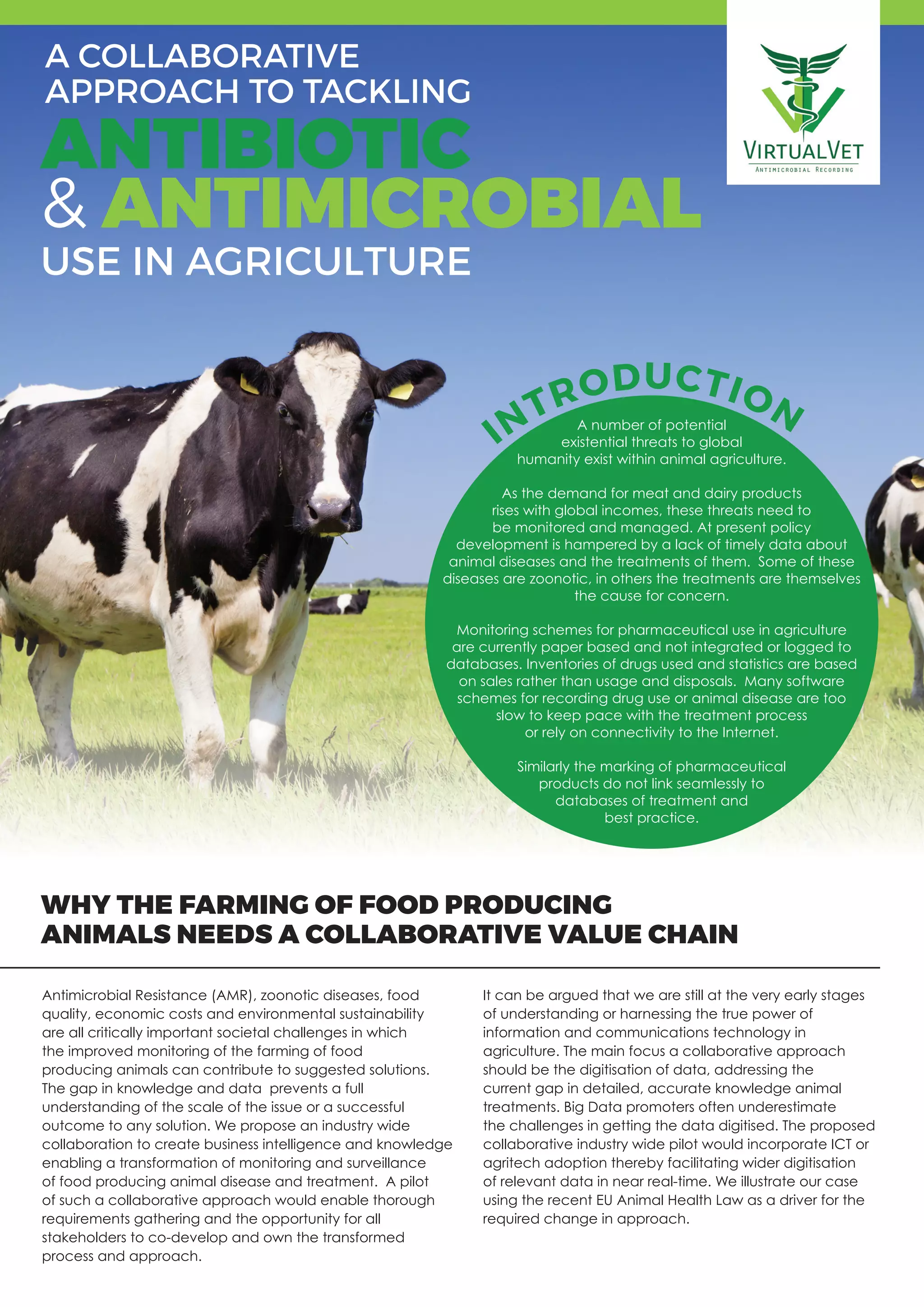
A number of potential
existential threats to global
humanity exist within animal agriculture.
As the demand for meat and dairy products
rises with global incomes, these threats need to
be monitored and managed. At present policy
development is hampered by a lack of timely data about
animal diseases and the treatments of them. Some of these
diseases are zoonotic, in others the treatments are themselves
the cause for concern.
Monitoring schemes for pharmaceutical use in agriculture
are currently paper based and not integrated or logged to
databases. Inventories of drugs used and statistics are based
on sales rather than usage and disposals. Many software
schemes for recording drug use or animal disease are too
slow to keep pace with the treatment process
or rely on connectivity to the Internet.
Similarly the marking of pharmaceutical
products do not link seamlessly to
databases of treatment and
best practice.
INTRODUCTION
Antimicrobial Resistance (AMR), zoonotic diseases, food
quality, economic costs and environmental sustainability
are all critically important societal challenges in which
the improved monitoring of the farming of food
producing animals can contribute to suggested solutions.
The gap in knowledge and data prevents a full
understanding of the scale of the issue or a successful
outcome to any solution. We propose an industry wide
collaboration to create business intelligence and knowledge
enabling a transformation of monitoring and surveillance
of food producing animal disease and treatment. A pilot
of such a collaborative approach would enable thorough
requirements gathering and the opportunity for all
stakeholders to co-develop and own the transformed
process and approach.
It can be argued that we are still at the very early stages
of understanding or harnessing the true power of
information and communications technology in
agriculture. The main focus a collaborative approach
should be the digitisation of data, addressing the
current gap in detailed, accurate knowledge animal
treatments. Big Data promoters often underestimate
the challenges in getting the data digitised. The proposed
collaborative industry wide pilot would incorporate ICT or
agritech adoption thereby facilitating wider digitisation
of relevant data in near real-time. We illustrate our case
using the recent EU Animal Health Law as a driver for the
required change in approach.
WHY THE FARMING OF FOOD PRODUCING
ANIMALS NEEDS A COLLABORATIVE VALUE CHAIN
ANTIBIOTIC
& ANTIMICROBIAL
USE IN AGRICULTURE
A COLLABORATIVE
APPROACH TO TACKLING
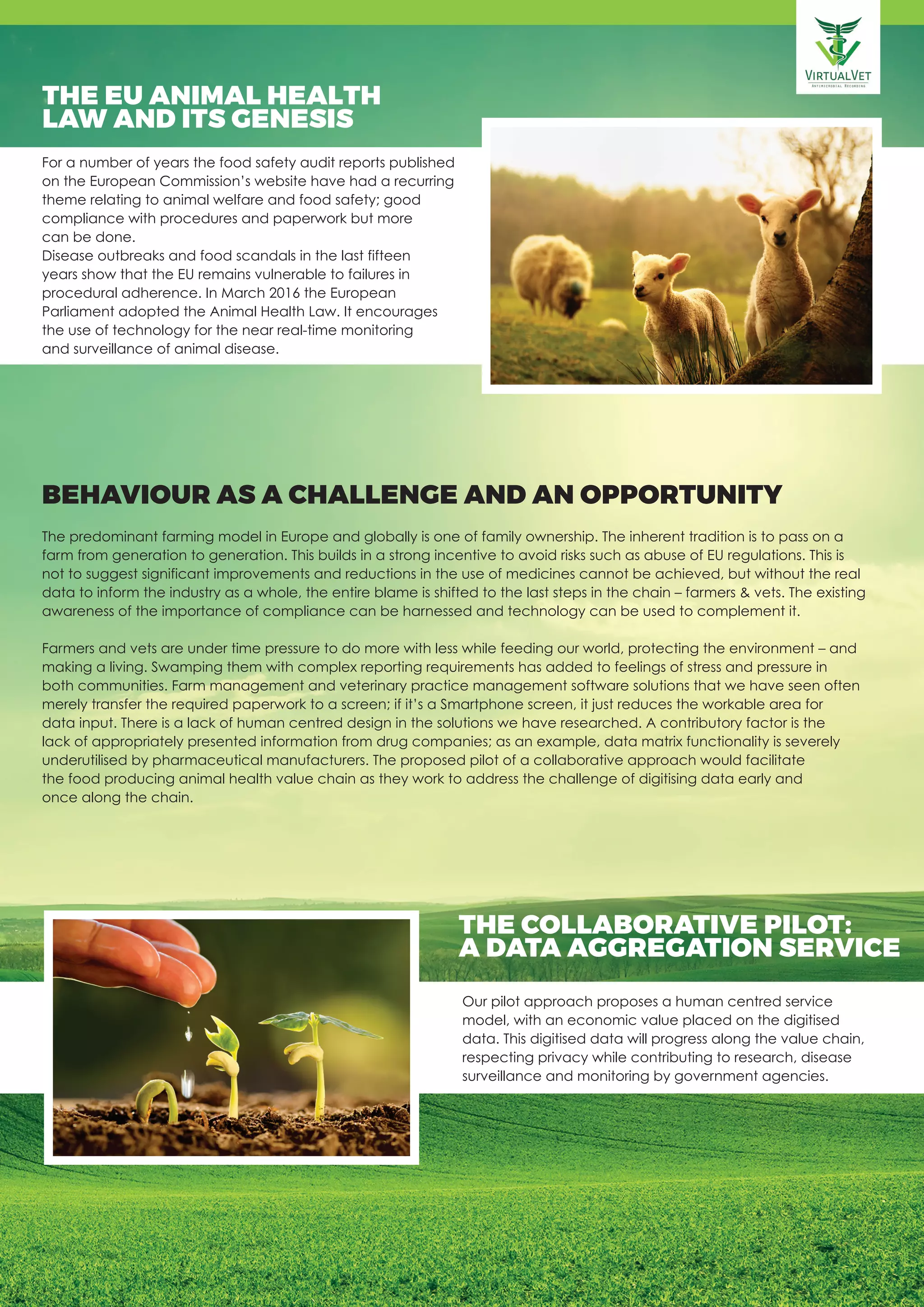
For a number of years the food safety audit reports published
on the European Commission’s website have had a recurring
theme relating to animal welfare and food safety; good
compliance with procedures and paperwork but more
can be done.
Disease outbreaks and food scandals in the last fifteen
years show that the EU remains vulnerable to failures in
procedural adherence. In March 2016 the European
Parliament adopted the Animal Health Law. It encourages
the use of technology for the near real-time monitoring
and surveillance of animal disease.
The predominant farming model in Europe and globally is one of family ownership. The inherent tradition is to pass on a
farm from generation to generation. This builds in a strong incentive to avoid risks such as abuse of EU regulations. This is
not to suggest significant improvements and reductions in the use of medicines cannot be achieved, but without the real
data to inform the industry as a whole, the entire blame is shifted to the last steps in the chain – farmers & vets. The existing
awareness of the importance of compliance can be harnessed and technology can be used to complement it.
Farmers and vets are under time pressure to do more with less while feeding our world, protecting the environment – and
making a living. Swamping them with complex reporting requirements has added to feelings of stress and pressure in
both communities. Farm management and veterinary practice management software solutions that we have seen often
merely transfer the required paperwork to a screen; if it’s a Smartphone screen, it just reduces the workable area for
data input. There is a lack of human centred design in the solutions we have researched. A contributory factor is the
lack of appropriately presented information from drug companies; as an example, data matrix functionality is severely
underutilised by pharmaceutical manufacturers. The proposed pilot of a collaborative approach would facilitate
the food producing animal health value chain as they work to address the challenge of digitising data early and
once along the chain.
THE EU ANIMAL HEALTH
LAW AND ITS GENESIS
BEHAVIOUR AS A CHALLENGE AND AN OPPORTUNITY
THE COLLABORATIVE PILOT:
A DATA AGGREGATION SERVICE
Our pilot approach proposes a human centred service
model, with an economic value placed on the digitised
data. This digitised data will progress along the value chain,
respecting privacy while contributing to research, disease
surveillance and monitoring by government agencies.
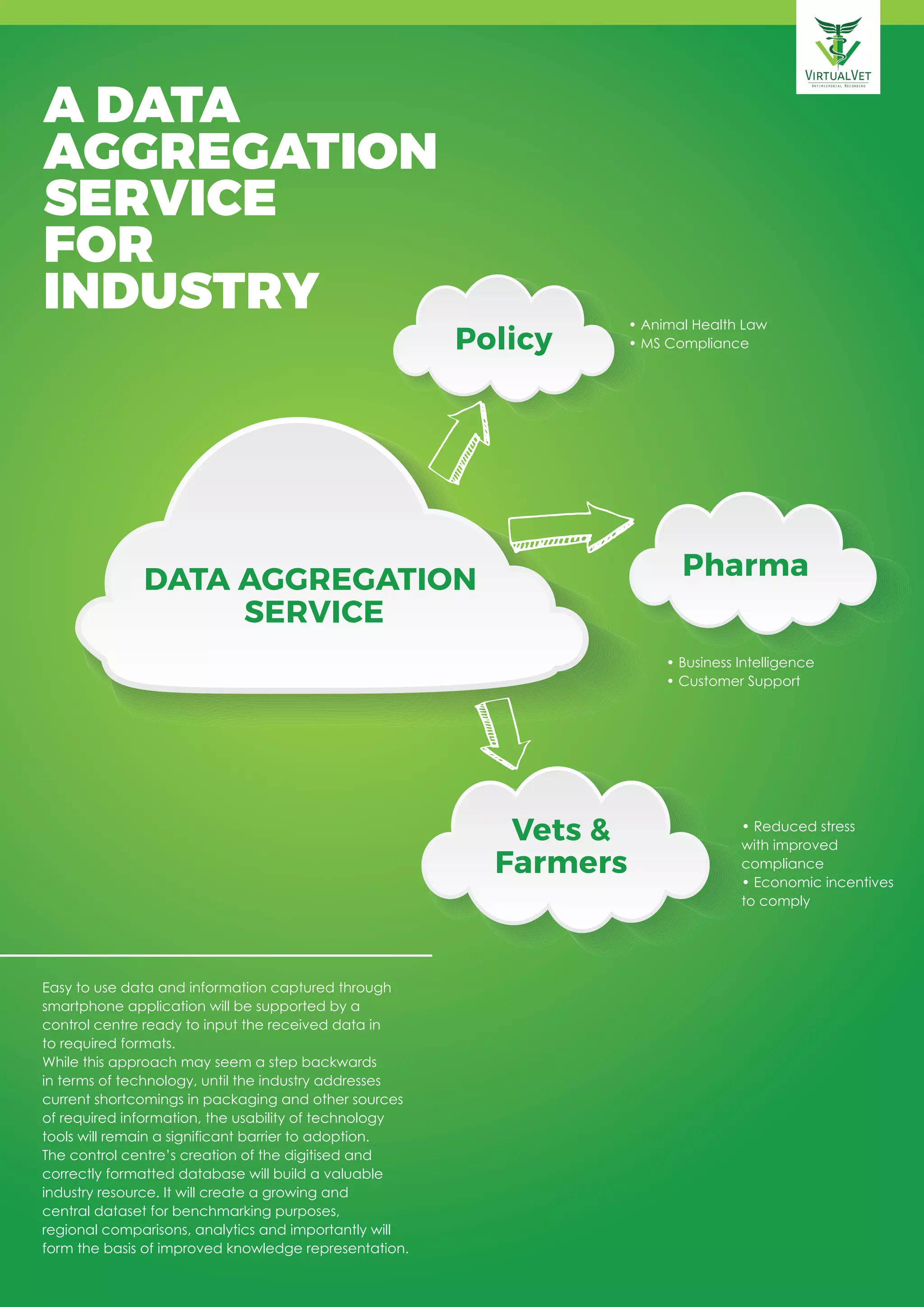
DATA AGGREGATION
SERVICE
Policy
Pharma
Vets &
Farmers
• Animal Health Law
• MS Compliance
• Business Intelligence
• Customer Support
• Reduced stress
with improved
compliance
• Economic incentives
to comply
A DATA
AGGREGATION
SERVICE
FOR
INDUSTRY
Easy to use data and information captured through
smartphone application will be supported by a
control centre ready to input the received data in
to required formats.
While this approach may seem a step backwards
in terms of technology, until the industry addresses
current shortcomings in packaging and other sources
of required information, the usability of technology
tools will remain a significant barrier to adoption.
The control centre’s creation of the digitised and
correctly formatted database will build a valuable
industry resource. It will create a growing and
central dataset for benchmarking purposes,
regional comparisons, analytics and importantly will
form the basis of improved knowledge representation.
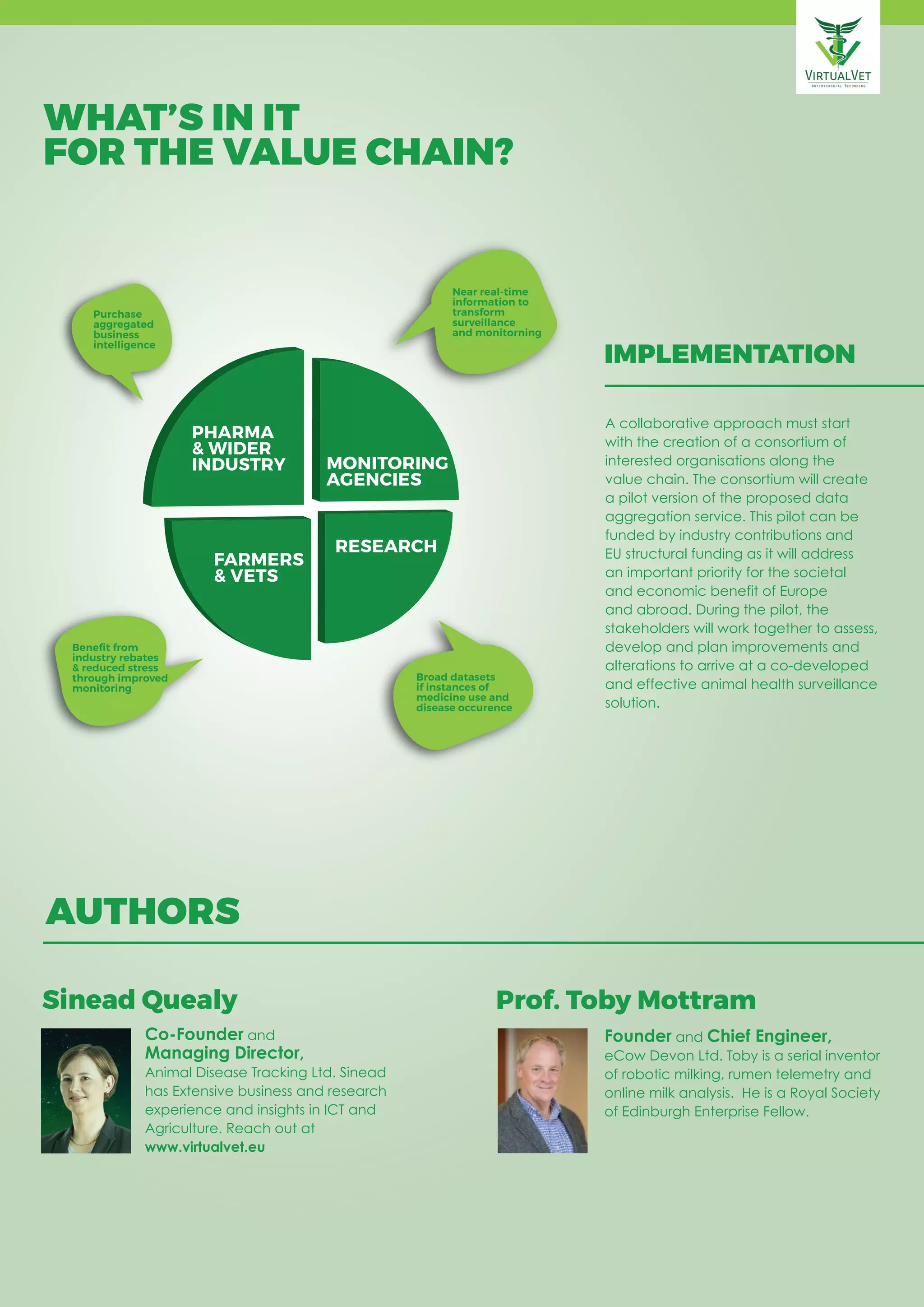
PHARMA
& WIDER
INDUSTRY MONITORING
AGENCIES
RESEARCH
FARMERS
& VETS
Purchase
aggregated
business
intelligence
Near real-time
information to
transform
surveillance
and monitorning
Broad datasets
if instances of
medicine use and
disease occurence
Benefit from
industry rebates
& reduced stress
through improved
monitoring
WHAT’S IN IT
FOR THE VALUE CHAIN?
A collaborative approach must start
with the creation of a consortium of
interested organisations along the
value chain. The consortium will create
a pilot version of the proposed data
aggregation service. This pilot can be
funded by industry contributions and
EU structural funding as it will address
an important priority for the societal
and economic benefit of Europe
and abroad. During the pilot, the
stakeholders will work together to assess,
develop and plan improvements and
alterations to arrive at a co-developed
and effective animal health surveillance
solution.
IMPLEMENTATION
AUTHORS
Co-Founder and
Managing Director,
Animal Disease Tracking Ltd. Sinead
has Extensive business and research
experience and insights in ICT and
Agriculture. Reach out at
www.virtualvet.eu
Founder and Chief Engineer,
eCow Devon Ltd. Toby is a serial inventor
of robotic milking, rumen telemetry and
online milk analysis. He is a Royal Society
of Edinburgh Enterprise Fellow.
Sinead Quealy Prof. Toby Mottram

VirtualVet Vision

  • 1.
    A number ofpotential existential threats to global humanity exist within animal agriculture. As the demand for meat and dairy products rises with global incomes, these threats need to be monitored and managed. At present policy development is hampered by a lack of timely data about animal diseases and the treatments of them. Some of these diseases are zoonotic, in others the treatments are themselves the cause for concern. Monitoring schemes for pharmaceutical use in agriculture are currently paper based and not integrated or logged to databases. Inventories of drugs used and statistics are based on sales rather than usage and disposals. Many software schemes for recording drug use or animal disease are too slow to keep pace with the treatment process or rely on connectivity to the Internet. Similarly the marking of pharmaceutical products do not link seamlessly to databases of treatment and best practice. INTRODUCTION Antimicrobial Resistance (AMR), zoonotic diseases, food quality, economic costs and environmental sustainability are all critically important societal challenges in which the improved monitoring of the farming of food producing animals can contribute to suggested solutions. The gap in knowledge and data prevents a full understanding of the scale of the issue or a successful outcome to any solution. We propose an industry wide collaboration to create business intelligence and knowledge enabling a transformation of monitoring and surveillance of food producing animal disease and treatment. A pilot of such a collaborative approach would enable thorough requirements gathering and the opportunity for all stakeholders to co-develop and own the transformed process and approach. It can be argued that we are still at the very early stages of understanding or harnessing the true power of information and communications technology in agriculture. The main focus a collaborative approach should be the digitisation of data, addressing the current gap in detailed, accurate knowledge animal treatments. Big Data promoters often underestimate the challenges in getting the data digitised. The proposed collaborative industry wide pilot would incorporate ICT or agritech adoption thereby facilitating wider digitisation of relevant data in near real-time. We illustrate our case using the recent EU Animal Health Law as a driver for the required change in approach. WHY THE FARMING OF FOOD PRODUCING ANIMALS NEEDS A COLLABORATIVE VALUE CHAIN ANTIBIOTIC & ANTIMICROBIAL USE IN AGRICULTURE A COLLABORATIVE APPROACH TO TACKLING
  • 2.
    For a numberof years the food safety audit reports published on the European Commission’s website have had a recurring theme relating to animal welfare and food safety; good compliance with procedures and paperwork but more can be done. Disease outbreaks and food scandals in the last fifteen years show that the EU remains vulnerable to failures in procedural adherence. In March 2016 the European Parliament adopted the Animal Health Law. It encourages the use of technology for the near real-time monitoring and surveillance of animal disease. The predominant farming model in Europe and globally is one of family ownership. The inherent tradition is to pass on a farm from generation to generation. This builds in a strong incentive to avoid risks such as abuse of EU regulations. This is not to suggest significant improvements and reductions in the use of medicines cannot be achieved, but without the real data to inform the industry as a whole, the entire blame is shifted to the last steps in the chain – farmers & vets. The existing awareness of the importance of compliance can be harnessed and technology can be used to complement it. Farmers and vets are under time pressure to do more with less while feeding our world, protecting the environment – and making a living. Swamping them with complex reporting requirements has added to feelings of stress and pressure in both communities. Farm management and veterinary practice management software solutions that we have seen often merely transfer the required paperwork to a screen; if it’s a Smartphone screen, it just reduces the workable area for data input. There is a lack of human centred design in the solutions we have researched. A contributory factor is the lack of appropriately presented information from drug companies; as an example, data matrix functionality is severely underutilised by pharmaceutical manufacturers. The proposed pilot of a collaborative approach would facilitate the food producing animal health value chain as they work to address the challenge of digitising data early and once along the chain. THE EU ANIMAL HEALTH LAW AND ITS GENESIS BEHAVIOUR AS A CHALLENGE AND AN OPPORTUNITY THE COLLABORATIVE PILOT: A DATA AGGREGATION SERVICE Our pilot approach proposes a human centred service model, with an economic value placed on the digitised data. This digitised data will progress along the value chain, respecting privacy while contributing to research, disease surveillance and monitoring by government agencies.
  • 3.
    DATA AGGREGATION SERVICE Policy Pharma Vets & Farmers •Animal Health Law • MS Compliance • Business Intelligence • Customer Support • Reduced stress with improved compliance • Economic incentives to comply A DATA AGGREGATION SERVICE FOR INDUSTRY Easy to use data and information captured through smartphone application will be supported by a control centre ready to input the received data in to required formats. While this approach may seem a step backwards in terms of technology, until the industry addresses current shortcomings in packaging and other sources of required information, the usability of technology tools will remain a significant barrier to adoption. The control centre’s creation of the digitised and correctly formatted database will build a valuable industry resource. It will create a growing and central dataset for benchmarking purposes, regional comparisons, analytics and importantly will form the basis of improved knowledge representation.
  • 4.
    PHARMA & WIDER INDUSTRY MONITORING AGENCIES RESEARCH FARMERS &VETS Purchase aggregated business intelligence Near real-time information to transform surveillance and monitorning Broad datasets if instances of medicine use and disease occurence Benefit from industry rebates & reduced stress through improved monitoring WHAT’S IN IT FOR THE VALUE CHAIN? A collaborative approach must start with the creation of a consortium of interested organisations along the value chain. The consortium will create a pilot version of the proposed data aggregation service. This pilot can be funded by industry contributions and EU structural funding as it will address an important priority for the societal and economic benefit of Europe and abroad. During the pilot, the stakeholders will work together to assess, develop and plan improvements and alterations to arrive at a co-developed and effective animal health surveillance solution. IMPLEMENTATION AUTHORS Co-Founder and Managing Director, Animal Disease Tracking Ltd. Sinead has Extensive business and research experience and insights in ICT and Agriculture. Reach out at www.virtualvet.eu Founder and Chief Engineer, eCow Devon Ltd. Toby is a serial inventor of robotic milking, rumen telemetry and online milk analysis. He is a Royal Society of Edinburgh Enterprise Fellow. Sinead Quealy Prof. Toby Mottram