RPALM
People, Process, and Technology
RPALM™ is a rapid assessment methodology that can be leveraged at
any phase of your journey to SAP S/4HANA
RPALM™ is an accelerated and results-driven methodology:
• Designed to provide tactical and strategic key improvement recommendations
to go from current state to desired end state within a proposed timeline.
• Stands for ResultsPositive Application Lifecycle Management (RPALM™)
Assessment Methodology
• A proprietary methodology designed to be prescriptive and lightweight,
covering 21 topical areas across 3 main ALM categories.
• Prescriptive in that we answer the who, when, how, why, and what through a
series of focused interviews and expert analysis of project artifacts*.
• Lightweight in that we employ a results-oriented mindset that delivers a fast,
actionable, comprehensive, and no-frills assessment of your current ALM
environment within 3 weeks.
• People, Process, and Technology – RPALM™ is an assessment methodology
that can be leveraged at any phase of the system delivery lifecycle.
*The RPALM™ methodology leverages industry expertise of practicing QA Leaders and Test Managers.
Derived from real-world experienced QA professionals, RPALM™ cuts straight to the fundamental
components that your organizations can employ quickly to gain visibility, reduce costs, increase
delivery control, and improve overall solution delivery quality.
What is the RPALM™ assessment methodology?
Provides an objective assessment of current state (‘As-is’):
• Analysis and understanding your current business needs
• Assess current level of adoption with recommendations for adoption level increase
• Assess the level of business value realized from your current ALM investment, while
identifying hidden opportunities to extract more value
• Provides an independent audit and health check report with details of identified issues
Confirms desired end state (‘To-be’):
• Present and discuss key recommendations
• Present and discuss industry best practices detailed for each ALM area discussed
• Showcase Overall Maturity Rating with respect to RPALM™ Assessment Methodology*
Provides Actionable ALM Implementation Roadmap, including:
• Quick wins and low hanging fruit
• Short term options and recommendations
• Long term options and recommendations
*The RPALM (ResultsPositive ALM™ Assessment Methodology) approach is an actionable methodology aimed
at increasing organizational awareness and implementation of tactical ALM principles that ultimately
encourages project stakeholders to embrace a holistic ALM-centric approach to software quality management
rather than subscribing to a reactive mentality of defect management.
Business Value of RPALM™
How RPALM™ Delivers Positive Results, Fast
RPALM™ leverages sound quality assurance principles:
• We employ a holistic and umbrella mentality, knowing that:
– A sound ALM foundation reduces defects, decreases cost, and mitigates risk project risk.
– We cut across the Application Lifecycle to provide immediate feedback
– Traceability is the cornerstone of high quality software delivery
– People, Process, and Technology must work in harmony
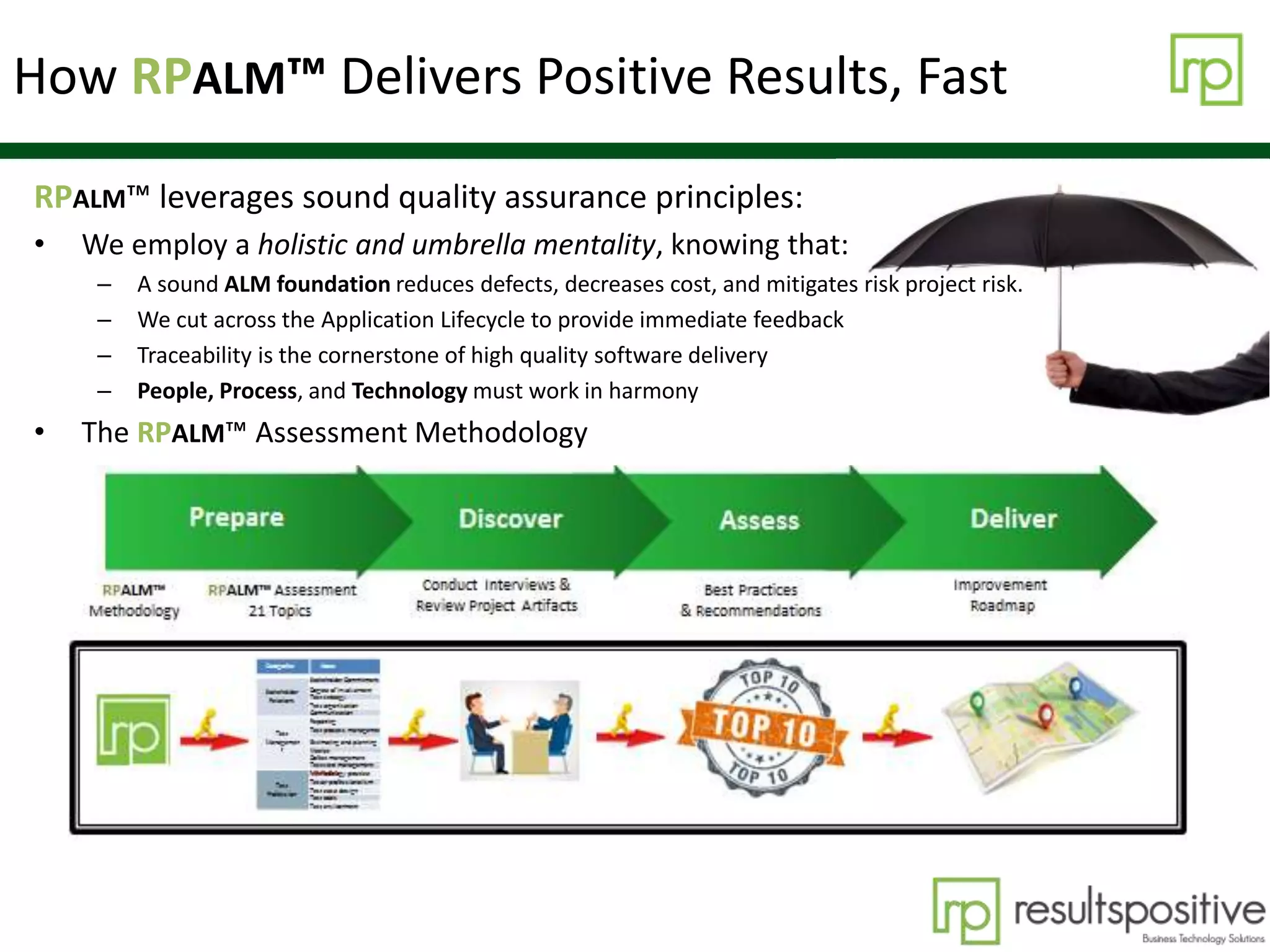
• The RPALM™ Assessment Methodology
Agenda
RPALM™ Engagement Approach
• Review draft deliverables
with sponsors
• Iterate and update
deliverables
• Review final deliverables
with sponsors, governance
committee and executives
• Document assessment
findings
• Review Top 10 findings with
project sponsors
• Analyze assessment findings
• Identify opportunities and
solution recommendations
• Draft Roadmap
• Develop estimates by phase
• Document business case
benefits
• Conduct requirements tracing
workshop
• Conduct visionary “end-state”
workshops
• Conduct ALM best practice
sessions – “end-state” inputs
• Conduct individual interviews
• Conduct group discovery
sessions
• Review current processes,
governance model, and
reporting
• Confirm engagement goals and objectives
• Confirm critical success factors
• Collect and review “as-is” documentation
• Confirm participants and roles &
responsibilities
• Tailor and confirm project schedule and
workshop / interview days/times
• Review and discuss 21 key factors
• Confirm buy-in of requirements tracing
workshop (function of RPALM™)
• Schedule workshops and interviews
Establish the
ground rules
Discover Assess DeliverPrepare
RPALM™
Methodology
RPALM™ Assessment
21 Topics
Conduct Interviews &
Review Project Artifacts
Best Practices
& Recommendations
Improvement
Roadmap
TPI DB
Categories Areas
Stakeholder
Relations
Stakeholder Commitment
Degree of involvement
Test strategy
Test organization
Communication
Test
Managemen
t
Reporting
Test process management
Estimating and planning
Metrics
Defect management
Testware management
Test
Profession
Methodology practice
Tester professionalism
Test case design
Test tools
Test environment
Agenda
RPALM™ Areas of Focus
Interviews and Artifact Review Blueprint & Road Map Development
• Solution Blueprint
• ALM Roadmap
• Implementation Road Map
• Phased implementation road map
Review ALM best practices and related
maturity models
Utilize analysis of current processes,
organization structures, and tools to develop
Blue Print & Road Map
RPALM™ 21 Topics across People, Process, and Technology
• Commitment to Quality
• Team Harmony
• Perceived Engagement
• Communication Effectiveness
• Quality Organization
• Test & ALM Strategy
• End User Empathy
• ALM Toolset Analysis
• Interface Analysis
• Automated Tool Analysis
• Requirements Tool Analysis
• Manual Testing Tool Analysis
• Performance Tool Analysis
• Peripheral Tool Analysis
People ALM Process Technology
• Requirement Intake Process
• Design Process
• Build Process
• Test Planning & Design Process
• Reporting Process
• Testware Management
• Traceability Discipline
• Conduct requirements tracing workshop
• Conduct visionary “end-state” workshops
• Conduct ALM best practice sessions – “end-state” inputs
• Conduct individual interviews
• Conduct group discovery sessions
• Review current processes, governance model, and reporting
How RPALM™ Supports Your SAP S/4 Hana Journey
RPALM™ recognizes the evolutionary nature of change:
• We view each evolution as an opportunity for improvement:
– Each “step” to the desired end-state of S/4 HANA Cloud comes with it’s own challenges and opportunities
– Recognizing that “overkill” often occurs with supporting technologies, we work with you to recommend the
right mix of people, process, and tools to optimize and protect your critical SAP assets.
– People, Process, and Technology must work in harmony
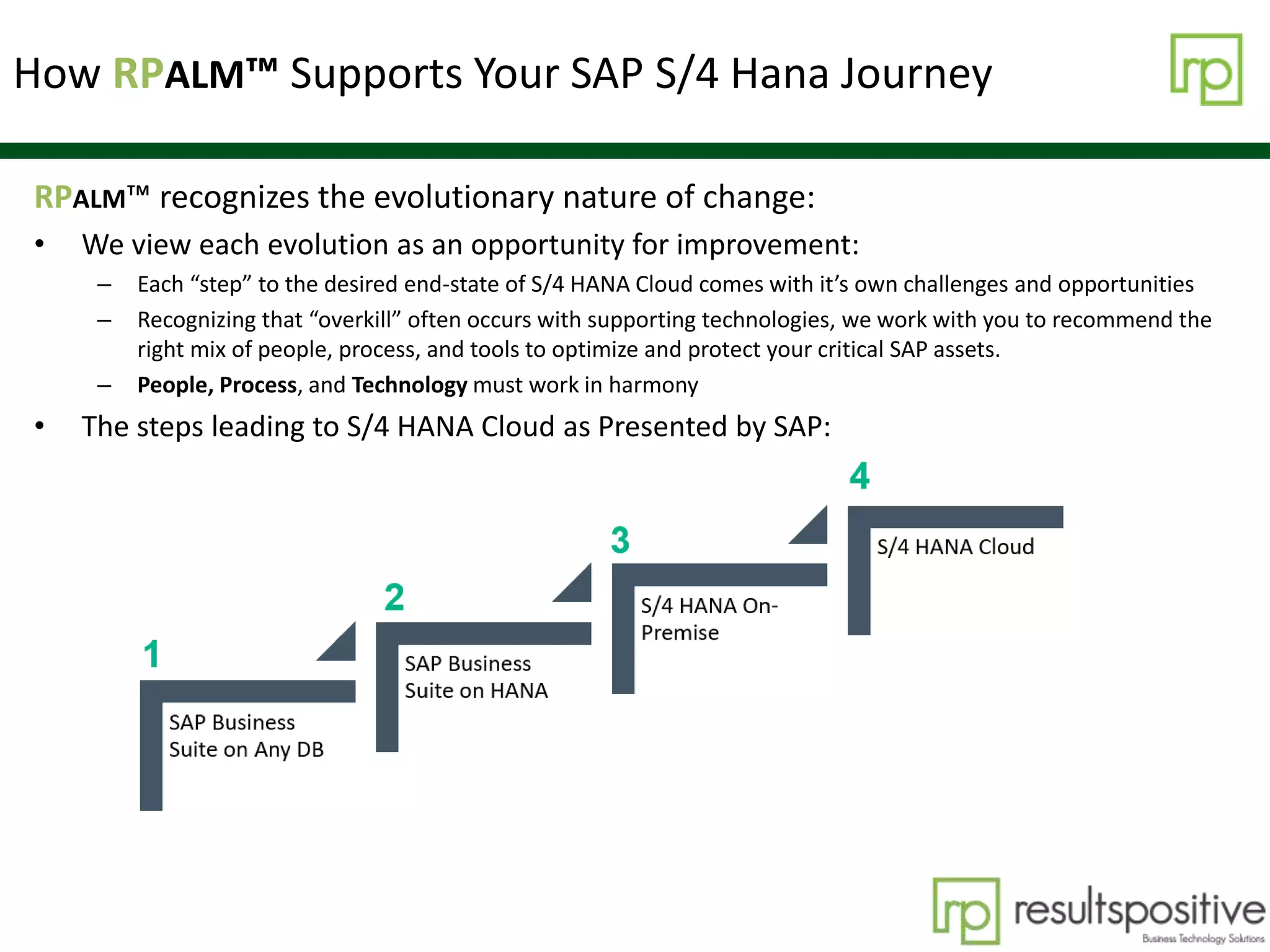
• The steps leading to S/4 HANA Cloud as Presented by SAP:
Agenda
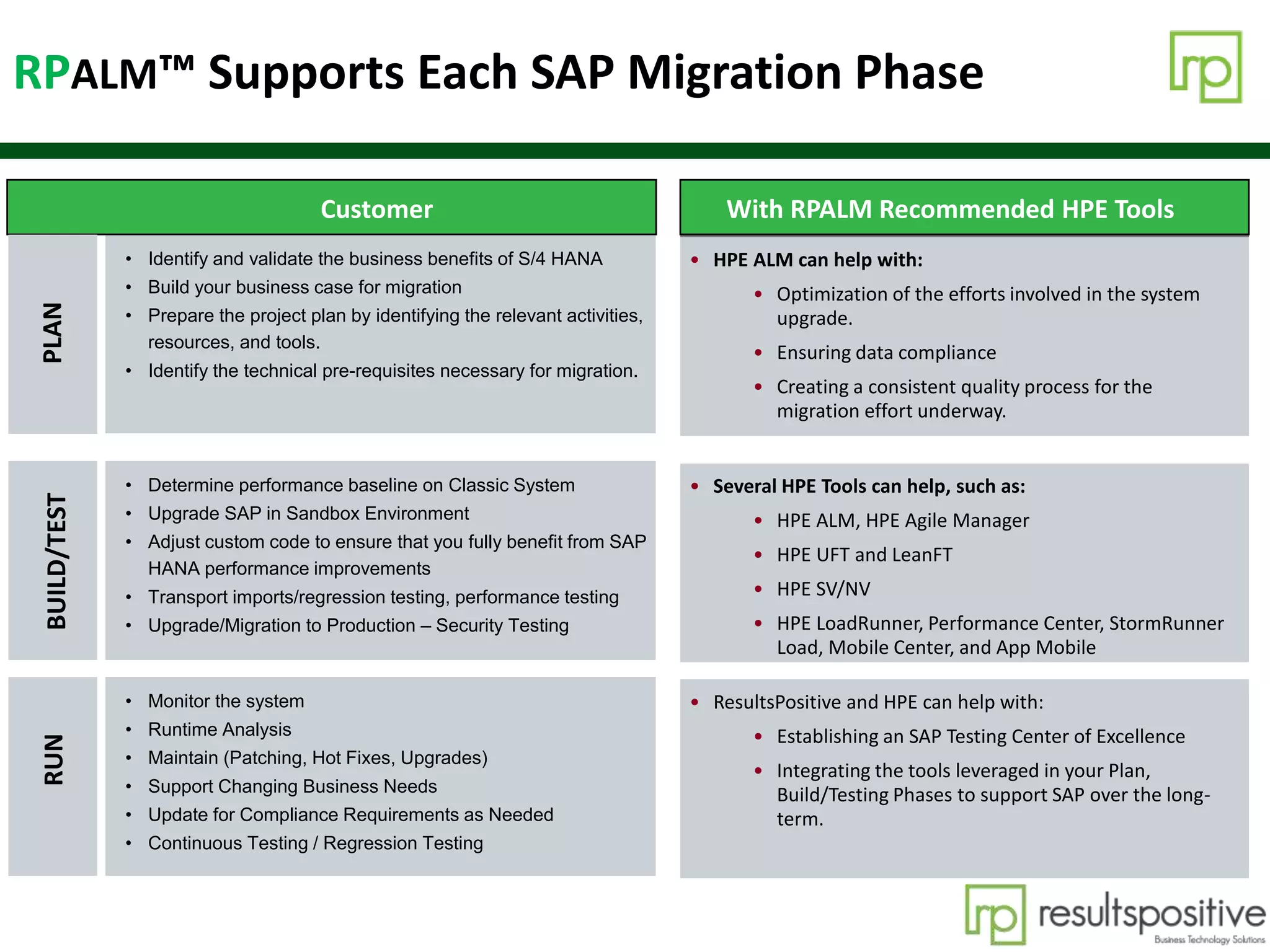
RPALM™ Supports Each SAP Migration Phase
Customer With RPALM Recommended HPE Tools
• HPE ALM can help with:
• Optimization of the efforts involved in the system
upgrade.
• Ensuring data compliance
• Creating a consistent quality process for the
migration effort underway.
• Identify and validate the business benefits of S/4 HANA
• Build your business case for migration
• Prepare the project plan by identifying the relevant activities,
resources, and tools.
• Identify the technical pre-requisites necessary for migration.
• Several HPE Tools can help, such as:
• HPE ALM, HPE Agile Manager
• HPE UFT and LeanFT
• HPE SV/NV
• HPE LoadRunner, Performance Center, StormRunner
Load, Mobile Center, and App Mobile
• Determine performance baseline on Classic System
• Upgrade SAP in Sandbox Environment
• Adjust custom code to ensure that you fully benefit from SAP
HANA performance improvements
• Transport imports/regression testing, performance testing
• Upgrade/Migration to Production – Security Testing
• ResultsPositive and HPE can help with:
• Establishing an SAP Testing Center of Excellence
• Integrating the tools leveraged in your Plan,
Build/Testing Phases to support SAP over the long-
term.
• Monitor the system
• Runtime Analysis
• Maintain (Patching, Hot Fixes, Upgrades)
• Support Changing Business Needs
• Update for Compliance Requirements as Needed
• Continuous Testing / Regression Testing
PLANBUILD/TESTRUN
HPE Quality Solutions for SAP Migrations
Supported SAP Technologies
Solution Manager v7.2 with HPE ALM
– Transfer business blueprints and test assets from SAP Solution Manager to HPE QC
– Analyze the impact of any change in the business process change analyzer
– Optimize test scope in SAP Solution Manager
Example of End-to-End Integration
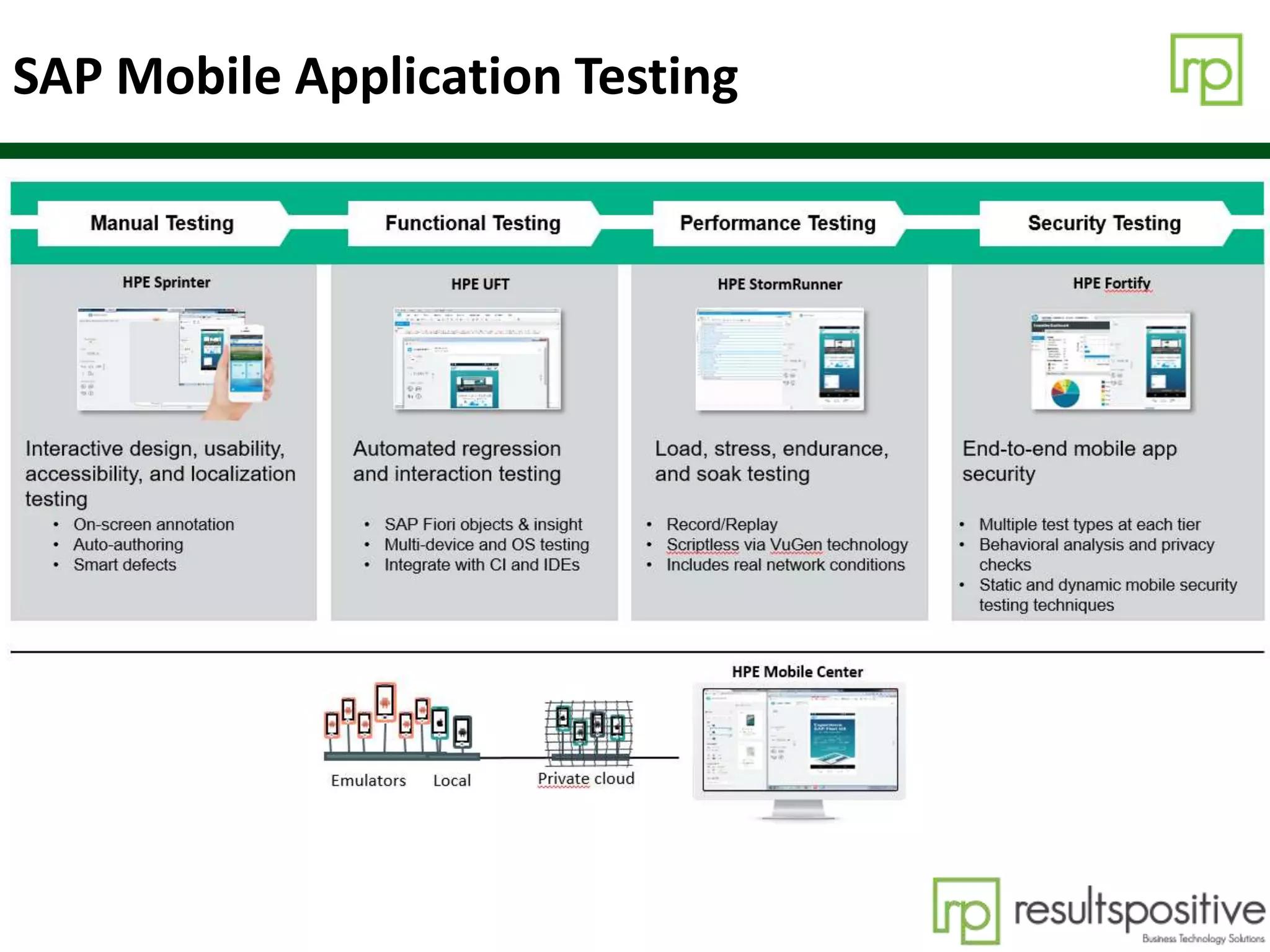
SAP Mobile Application Testing
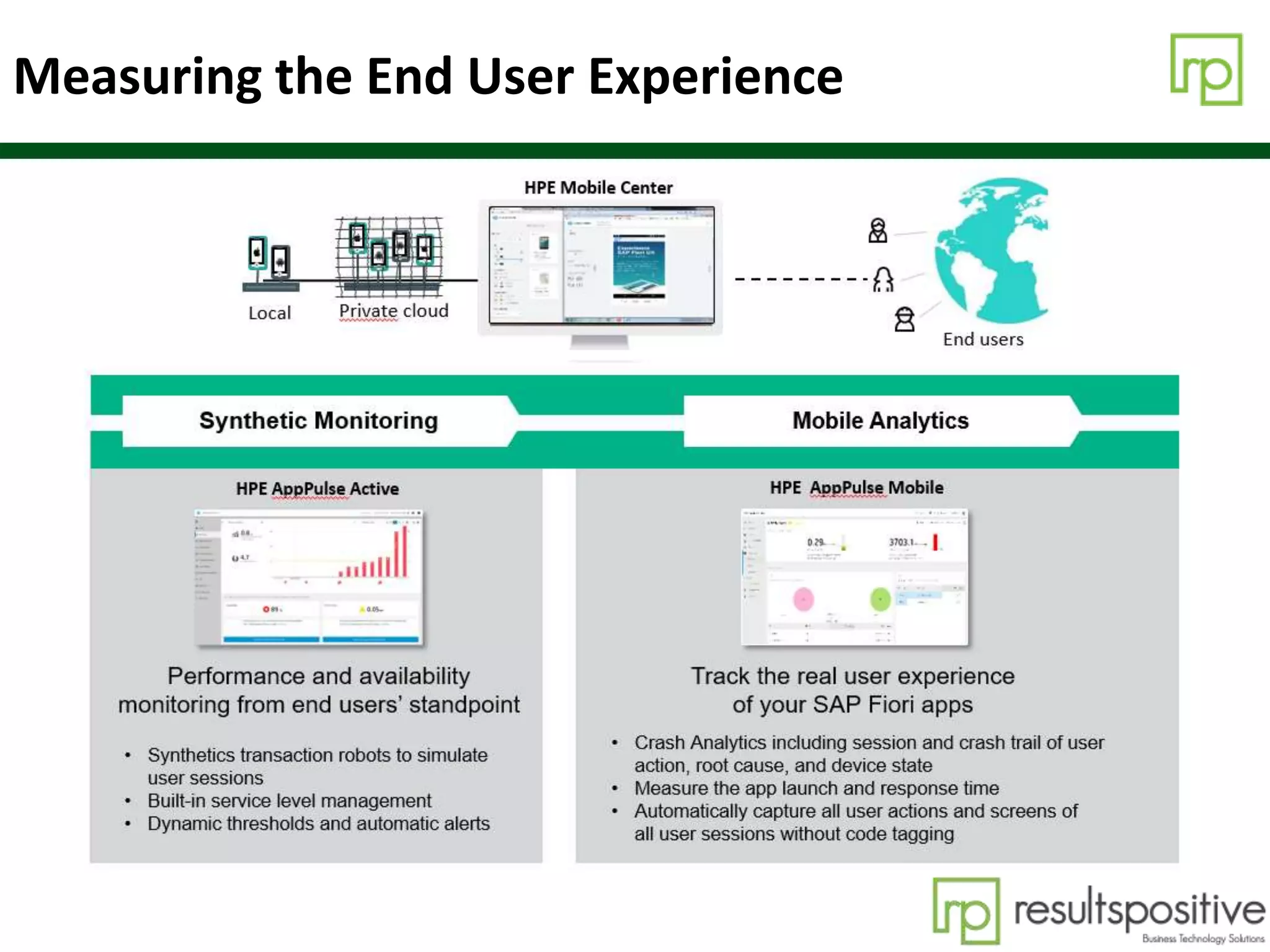
Measuring the End User Experience
AgendaDeliverables
• High level implementation road map
• Phased implementation options
Implementation
Road Map
• Solution Blueprint
• Quick Win and Short Term recommendations & benefits
• Long Term recommendations & benefits
Solution Blueprint &
Recommendation
• Documented customer goals & objectives
• As-is Assessment Findings
• As-is Process Assessment Analysis
Assessment
Findings
Make a Difference Today
Matt Angerer
mangerer@resultspositive.com
www.resultspositive.com

RPALM for SAP S/4 Journey

  • 1.
    RPALM People, Process, andTechnology RPALM™ is a rapid assessment methodology that can be leveraged at any phase of your journey to SAP S/4HANA
  • 2.
    RPALM™ is anaccelerated and results-driven methodology: • Designed to provide tactical and strategic key improvement recommendations to go from current state to desired end state within a proposed timeline. • Stands for ResultsPositive Application Lifecycle Management (RPALM™) Assessment Methodology • A proprietary methodology designed to be prescriptive and lightweight, covering 21 topical areas across 3 main ALM categories. • Prescriptive in that we answer the who, when, how, why, and what through a series of focused interviews and expert analysis of project artifacts*. • Lightweight in that we employ a results-oriented mindset that delivers a fast, actionable, comprehensive, and no-frills assessment of your current ALM environment within 3 weeks. • People, Process, and Technology – RPALM™ is an assessment methodology that can be leveraged at any phase of the system delivery lifecycle. *The RPALM™ methodology leverages industry expertise of practicing QA Leaders and Test Managers. Derived from real-world experienced QA professionals, RPALM™ cuts straight to the fundamental components that your organizations can employ quickly to gain visibility, reduce costs, increase delivery control, and improve overall solution delivery quality. What is the RPALM™ assessment methodology?
  • 3.
    Provides an objectiveassessment of current state (‘As-is’): • Analysis and understanding your current business needs • Assess current level of adoption with recommendations for adoption level increase • Assess the level of business value realized from your current ALM investment, while identifying hidden opportunities to extract more value • Provides an independent audit and health check report with details of identified issues Confirms desired end state (‘To-be’): • Present and discuss key recommendations • Present and discuss industry best practices detailed for each ALM area discussed • Showcase Overall Maturity Rating with respect to RPALM™ Assessment Methodology* Provides Actionable ALM Implementation Roadmap, including: • Quick wins and low hanging fruit • Short term options and recommendations • Long term options and recommendations *The RPALM (ResultsPositive ALM™ Assessment Methodology) approach is an actionable methodology aimed at increasing organizational awareness and implementation of tactical ALM principles that ultimately encourages project stakeholders to embrace a holistic ALM-centric approach to software quality management rather than subscribing to a reactive mentality of defect management. Business Value of RPALM™
  • 4.
    How RPALM™ DeliversPositive Results, Fast RPALM™ leverages sound quality assurance principles: • We employ a holistic and umbrella mentality, knowing that: – A sound ALM foundation reduces defects, decreases cost, and mitigates risk project risk. – We cut across the Application Lifecycle to provide immediate feedback – Traceability is the cornerstone of high quality software delivery – People, Process, and Technology must work in harmony • The RPALM™ Assessment Methodology
  • 5.
    Agenda RPALM™ Engagement Approach •Review draft deliverables with sponsors • Iterate and update deliverables • Review final deliverables with sponsors, governance committee and executives • Document assessment findings • Review Top 10 findings with project sponsors • Analyze assessment findings • Identify opportunities and solution recommendations • Draft Roadmap • Develop estimates by phase • Document business case benefits • Conduct requirements tracing workshop • Conduct visionary “end-state” workshops • Conduct ALM best practice sessions – “end-state” inputs • Conduct individual interviews • Conduct group discovery sessions • Review current processes, governance model, and reporting • Confirm engagement goals and objectives • Confirm critical success factors • Collect and review “as-is” documentation • Confirm participants and roles & responsibilities • Tailor and confirm project schedule and workshop / interview days/times • Review and discuss 21 key factors • Confirm buy-in of requirements tracing workshop (function of RPALM™) • Schedule workshops and interviews Establish the ground rules Discover Assess DeliverPrepare RPALM™ Methodology RPALM™ Assessment 21 Topics Conduct Interviews & Review Project Artifacts Best Practices & Recommendations Improvement Roadmap TPI DB Categories Areas Stakeholder Relations Stakeholder Commitment Degree of involvement Test strategy Test organization Communication Test Managemen t Reporting Test process management Estimating and planning Metrics Defect management Testware management Test Profession Methodology practice Tester professionalism Test case design Test tools Test environment
  • 6.
    Agenda RPALM™ Areas ofFocus Interviews and Artifact Review Blueprint & Road Map Development • Solution Blueprint • ALM Roadmap • Implementation Road Map • Phased implementation road map Review ALM best practices and related maturity models Utilize analysis of current processes, organization structures, and tools to develop Blue Print & Road Map RPALM™ 21 Topics across People, Process, and Technology • Commitment to Quality • Team Harmony • Perceived Engagement • Communication Effectiveness • Quality Organization • Test & ALM Strategy • End User Empathy • ALM Toolset Analysis • Interface Analysis • Automated Tool Analysis • Requirements Tool Analysis • Manual Testing Tool Analysis • Performance Tool Analysis • Peripheral Tool Analysis People ALM Process Technology • Requirement Intake Process • Design Process • Build Process • Test Planning & Design Process • Reporting Process • Testware Management • Traceability Discipline • Conduct requirements tracing workshop • Conduct visionary “end-state” workshops • Conduct ALM best practice sessions – “end-state” inputs • Conduct individual interviews • Conduct group discovery sessions • Review current processes, governance model, and reporting
  • 7.
    How RPALM™ SupportsYour SAP S/4 Hana Journey RPALM™ recognizes the evolutionary nature of change: • We view each evolution as an opportunity for improvement: – Each “step” to the desired end-state of S/4 HANA Cloud comes with it’s own challenges and opportunities – Recognizing that “overkill” often occurs with supporting technologies, we work with you to recommend the right mix of people, process, and tools to optimize and protect your critical SAP assets. – People, Process, and Technology must work in harmony • The steps leading to S/4 HANA Cloud as Presented by SAP:
  • 8.
    Agenda RPALM™ Supports EachSAP Migration Phase Customer With RPALM Recommended HPE Tools • HPE ALM can help with: • Optimization of the efforts involved in the system upgrade. • Ensuring data compliance • Creating a consistent quality process for the migration effort underway. • Identify and validate the business benefits of S/4 HANA • Build your business case for migration • Prepare the project plan by identifying the relevant activities, resources, and tools. • Identify the technical pre-requisites necessary for migration. • Several HPE Tools can help, such as: • HPE ALM, HPE Agile Manager • HPE UFT and LeanFT • HPE SV/NV • HPE LoadRunner, Performance Center, StormRunner Load, Mobile Center, and App Mobile • Determine performance baseline on Classic System • Upgrade SAP in Sandbox Environment • Adjust custom code to ensure that you fully benefit from SAP HANA performance improvements • Transport imports/regression testing, performance testing • Upgrade/Migration to Production – Security Testing • ResultsPositive and HPE can help with: • Establishing an SAP Testing Center of Excellence • Integrating the tools leveraged in your Plan, Build/Testing Phases to support SAP over the long- term. • Monitor the system • Runtime Analysis • Maintain (Patching, Hot Fixes, Upgrades) • Support Changing Business Needs • Update for Compliance Requirements as Needed • Continuous Testing / Regression Testing PLANBUILD/TESTRUN
  • 9.
    HPE Quality Solutionsfor SAP Migrations
  • 10.
  • 11.
    Solution Manager v7.2with HPE ALM – Transfer business blueprints and test assets from SAP Solution Manager to HPE QC – Analyze the impact of any change in the business process change analyzer – Optimize test scope in SAP Solution Manager
  • 12.
  • 13.
  • 14.
    Measuring the EndUser Experience
  • 15.
    AgendaDeliverables • High levelimplementation road map • Phased implementation options Implementation Road Map • Solution Blueprint • Quick Win and Short Term recommendations & benefits • Long Term recommendations & benefits Solution Blueprint & Recommendation • Documented customer goals & objectives • As-is Assessment Findings • As-is Process Assessment Analysis Assessment Findings
  • 16.
    Make a DifferenceToday Matt Angerer mangerer@resultspositive.com www.resultspositive.com