Industry       motorcycles, lawnmowers
Successor(s)   Royal Enfield (India)
Founded        1893, as Enfield Manufacturing Co.
               Ltd.
Defunct        1971
Headquarters   Redditch, Worcestershire, England

Key people     Founders Albert Eadie and Robert
               Walker Smith
Products       Royal Enfield
               Clipper, Crusader, Bullet, Intercept
               or, WD/RE, Super Meteor
F i r s t Wo r l d Wa r ( 1 9 1 1 – 1 9 2 0 )


1913 Enfield 425cc

In 1911, prior to the outbreak of the First World War in 1914,
Enfield added the word "Royal" to its name. They supplied large
numbers of motorcycles to the British War Department and also
won a motorcycle contract for the Imperial Russian Government.
Enfield used its own 225 cc two-stroke single and 425 ccV-twin
engines.[4] They also produced an 8 hp motorcycle sidecar model
fitted with a Vickers machine gun
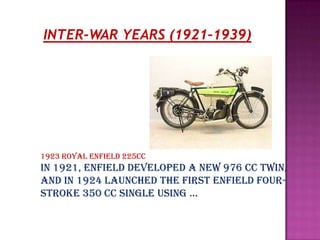
INTER-WAR YEARS (1921–1939)


1923 Royal Enfield 225cc
In 1921, Enfield developed a new 976 cc twin,
and in 1924 launched the first Enfield four-
stroke 350 cc single using …
S E C O N D W O R L D WA R ( 1 9 3 9 – 1 9 4 5 )


  During world War II, The Enfield Cycle Company was called
  upon by the British authorities to develop and manufacture
  military motorcycles. The models produced for the military
  were the WD/C 350 cc SIDEVALVE, WD/CO 350 cc OHV,
  WD/D 250 cc SV, WD/G 350 cc OHV and WD/L 570 cc SV.
  One of the most well-known ENFIELDS was the Royal
  Enfield WD/RE, known as the Flying Flea, a lightweight
  125 cc motorcycle designed to be dropped by parachute with
  airborne troops.[2]
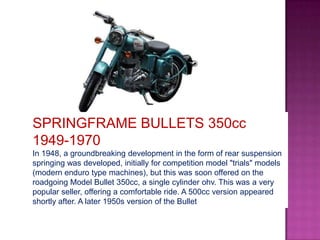
SPRINGFRAME BULLETS 350cc
1949-1970
In 1948, a groundbreaking development in the form of rear suspension
springing was developed, initially for competition model "trials" models
(modern enduro type machines), but this was soon offered on the
roadgoing Model Bullet 350cc, a single cylinder ohv. This was a very
popular seller, offering a comfortable ride. A 500cc version appeared
shortly after. A later 1950s version of the Bullet
Royal Enfield Interceptor


early seventies, the English factories made a final attempt
with the 1962–1968 [7] series I and Series II. During the
onslaught of the better engineered Japanese motorcycle
manufacturers in the late sixties and Made largely for the US
market, it sported lots of chrome and strong performance,
completing the quarter mile in less than 13 seconds at speeds
well above 175 km/h (105 mph).[8]
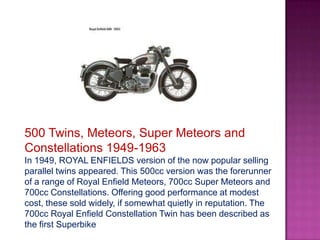
500 Twins, Meteors, Super Meteors and
Constellations 1949-1963
In 1949, ROYAL ENFIELDS version of the now popular selling
parallel twins appeared. This 500cc version was the forerunner
of a range of Royal Enfield Meteors, 700cc Super Meteors and
700cc Constellations. Offering good performance at modest
cost, these sold widely, if somewhat quietly in reputation. The
700cc Royal Enfield Constellation Twin has been described as
the first Superbike
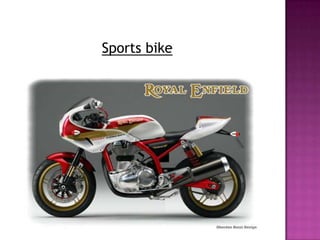
Sports bike
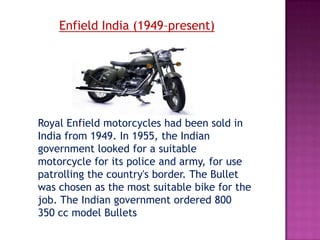
Enfield India (1949–present)


Royal Enfield motorcycles had been sold in
India from 1949. In 1955, the Indian
government looked for a suitable
motorcycle for its police and army, for use
patrolling the country's border. The Bullet
was chosen as the most suitable bike for the
job. The Indian government ordered 800
350 cc model Bullets
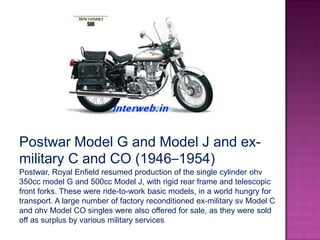
Postwar Model G and Model J and ex-
military C and CO (1946–1954)
Postwar, Royal Enfield resumed production of the single cylinder ohv
350cc model G and 500cc Model J, with rigid rear frame and telescopic
front forks. These were ride-to-work basic models, in a world hungry for
transport. A large number of factory reconditioned ex-military sv Model C
and ohv Model CO singles were also offered for sale, as they were sold
off as surplus by various military services
logos
Brand Ambassador
Queries…
Thank you…

Royal enfield [balu]

  • 2.
    Industry motorcycles, lawnmowers Successor(s) Royal Enfield (India) Founded 1893, as Enfield Manufacturing Co. Ltd. Defunct 1971 Headquarters Redditch, Worcestershire, England Key people Founders Albert Eadie and Robert Walker Smith Products Royal Enfield Clipper, Crusader, Bullet, Intercept or, WD/RE, Super Meteor
  • 3.
    F i rs t Wo r l d Wa r ( 1 9 1 1 – 1 9 2 0 ) 1913 Enfield 425cc In 1911, prior to the outbreak of the First World War in 1914, Enfield added the word "Royal" to its name. They supplied large numbers of motorcycles to the British War Department and also won a motorcycle contract for the Imperial Russian Government. Enfield used its own 225 cc two-stroke single and 425 ccV-twin engines.[4] They also produced an 8 hp motorcycle sidecar model fitted with a Vickers machine gun
  • 4.
    INTER-WAR YEARS (1921–1939) 1923Royal Enfield 225cc In 1921, Enfield developed a new 976 cc twin, and in 1924 launched the first Enfield four- stroke 350 cc single using …
  • 5.
    S E CO N D W O R L D WA R ( 1 9 3 9 – 1 9 4 5 ) During world War II, The Enfield Cycle Company was called upon by the British authorities to develop and manufacture military motorcycles. The models produced for the military were the WD/C 350 cc SIDEVALVE, WD/CO 350 cc OHV, WD/D 250 cc SV, WD/G 350 cc OHV and WD/L 570 cc SV. One of the most well-known ENFIELDS was the Royal Enfield WD/RE, known as the Flying Flea, a lightweight 125 cc motorcycle designed to be dropped by parachute with airborne troops.[2]
  • 6.
    SPRINGFRAME BULLETS 350cc 1949-1970 In1948, a groundbreaking development in the form of rear suspension springing was developed, initially for competition model "trials" models (modern enduro type machines), but this was soon offered on the roadgoing Model Bullet 350cc, a single cylinder ohv. This was a very popular seller, offering a comfortable ride. A 500cc version appeared shortly after. A later 1950s version of the Bullet
  • 7.
    Royal Enfield Interceptor earlyseventies, the English factories made a final attempt with the 1962–1968 [7] series I and Series II. During the onslaught of the better engineered Japanese motorcycle manufacturers in the late sixties and Made largely for the US market, it sported lots of chrome and strong performance, completing the quarter mile in less than 13 seconds at speeds well above 175 km/h (105 mph).[8]
  • 8.
    500 Twins, Meteors,Super Meteors and Constellations 1949-1963 In 1949, ROYAL ENFIELDS version of the now popular selling parallel twins appeared. This 500cc version was the forerunner of a range of Royal Enfield Meteors, 700cc Super Meteors and 700cc Constellations. Offering good performance at modest cost, these sold widely, if somewhat quietly in reputation. The 700cc Royal Enfield Constellation Twin has been described as the first Superbike
  • 9.
  • 10.
    Enfield India (1949–present) RoyalEnfield motorcycles had been sold in India from 1949. In 1955, the Indian government looked for a suitable motorcycle for its police and army, for use patrolling the country's border. The Bullet was chosen as the most suitable bike for the job. The Indian government ordered 800 350 cc model Bullets
  • 11.
    Postwar Model Gand Model J and ex- military C and CO (1946–1954) Postwar, Royal Enfield resumed production of the single cylinder ohv 350cc model G and 500cc Model J, with rigid rear frame and telescopic front forks. These were ride-to-work basic models, in a world hungry for transport. A large number of factory reconditioned ex-military sv Model C and ohv Model CO singles were also offered for sale, as they were sold off as surplus by various military services
  • 12.
  • 13.
  • 14.
  • 15.