1 . M i s s L i X i a
2 . M i s s Ya t a P h o l p r a s i t
3 . M i s s B e n j a w a n N g a m w o n g w i w a t
Roy
Adaptation
Model
Assist. Prof. Dr. Charuwan Kritpracha
Who is Roy?
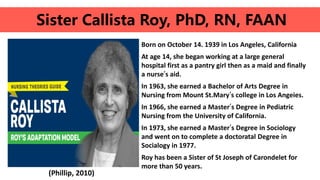
Born on October 14. 1939 in Los Angeles, California
At age 14, she began working at a large general
hospital first as a pantry girl then as a maid and finally
a nurse’s aid.
In 1963, she earned a Bachelor of Arts Degree in
Nursing from Mount St.Mary’s college in Los Angeies.
In 1966, she earned a Master’s Degree in Pediatric
Nursing from the University of California.
In 1973, she earned a Master’s Degree in Sociology
and went on to complete a doctoratal Degree in
Socialogy in 1977.
Roy has been a Sister of St Joseph of Carondelet for
more than 50 years.
Sister Callista Roy, PhD, RN, FAAN
(Phillip, 2010)
Major influences
Roy credits her family religious
commitment and her teacher and
mentors as her major influences.
Roy claims a spirit of faith
hope love and commitment to God
and service to others was central to
her family life.
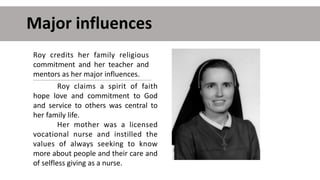
Her mother was a licensed
vocational nurse and instilled the
values of always seeking to know
more about people and their care and
of selfless giving as a nurse.
Stimulus for Theory Development
Roy’s Adaptation Model - Grand Nursing Theory
She believed nurses need to be flexible in order to provide the best care for their
patients. Each patient is different and should be cared for based on the individual
needs of that particular patient (Tiedeman, M. E., 2006).
In 1964, when Roy was a graduate student, she was challenged by
a nursing faculty member Dorothey E. Johnson
[Behavioral Systems Nursing Theorist] to develop a conceptual
model for nursing practice (Tiedeman, M. E., 2006).
While working as a pediatric nurse, Roy observed the resiliency
of children and noted their ability to adapt to the physical and
psychological changes they were experiencing
(Tiedeman, M. E., 2006).
Abstract
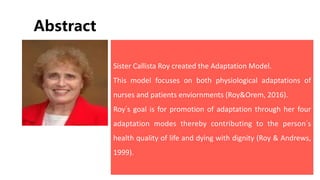
Sister Callista Roy created the Adaptation Model.
This model focuses on both physiological adaptations of
nurses and patients enviornments (Roy&Orem, 2016).
Roy’s goal is for promotion of adaptation through her four
adaptation modes thereby contributing to the person’s
health quality of life and dying with dignity (Roy & Andrews,
1999).
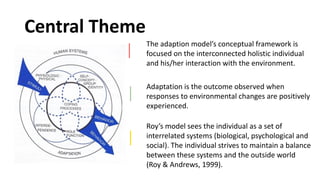
Central Theme
The adaption model’s conceptual framework is
focused on the interconnected holistic individual
and his/her interaction with the environment.
Adaptation is the outcome observed when
responses to environmental changes are positively
experienced.
Roy’s model sees the individual as a set of
interrelated systems (biological, psychological and
social). The individual strives to maintain a balance
between these systems and the outside world
(Roy & Andrews, 1999).
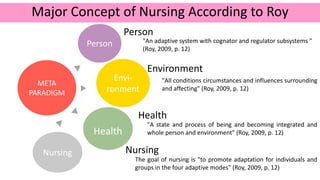
Person
Envi-
ronment
Health
META
PARADIGM
Person
"An adaptive system with cognator and regulator subsystems "
(Roy, 2009, p. 12)
Environment
"All conditions circumstances and influences surrounding
and affecting" (Roy, 2009, p. 12)
Health
"A state and process of being and becoming integrated and
whole person and environment" (Roy, 2009, p. 12)
Major Concept of Nursing According to Roy
Nursing Nursing
The goal of nursing is "to promote adaptation for individuals and
groups in the four adaptive modes" (Roy, 2009, p. 12)
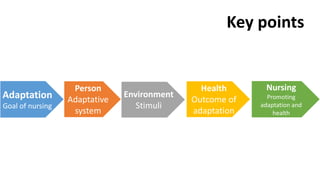
Key points
Adaptation
Goal of nursing
Person
Adaptative
system
Environment
Stimuli
Health
Outcome of
adaptation
Nursing
Promoting
adaptation and
health
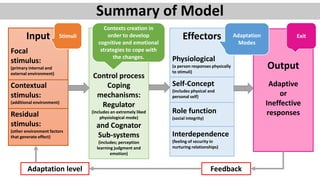
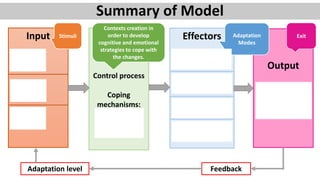
Summary of Model
Input
Focal
stimulus:
(primary internal and
external environment)
Contextual
stimulus:
(additional environment)
Residual
stimulus:
(other environment factors
that generate effect)
Control process
Coping
mechanisms:
Regulator
(includes an extremely liked
physiological mode)
and Cognator
Sub-systems
(includes; perception
learning judgment and
emotion)
Effectors
Physiological
(a person responses physically
to stimuli)
Self-Concept
(includes physical and
personal self)
Role function
(social integrity)
Interdependence
(feeling of security in
nurturing relationships)
Output
Adaptive
or
Ineffective
responses
Contexts creation in
order to develop
cognitive and emotional
strategies to cope with
the changes.
Stimuli Adaptation
Modes
Exit
Adaptation level Feedback
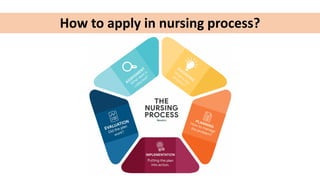
How to apply in nursing process?
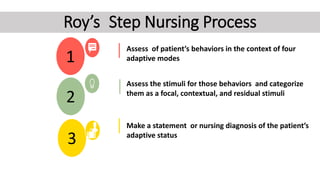
Roy’s Step Nursing Process
1
2
3
Assess of patient’s behaviors in the context of four
adaptive modes
Assess the stimuli for those behaviors and categorize
them as a focal, contextual, and residual stimuli
Make a statement or nursing diagnosis of the patient’s
adaptive status
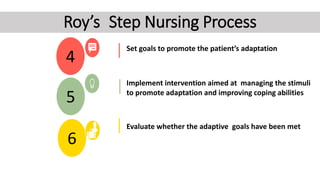
Roy’s Step Nursing Process
4
5
6
Set goals to promote the patient’s adaptation
Implement intervention aimed at managing the stimuli
to promote adaptation and improving coping abilities
Evaluate whether the adaptive goals have been met
https://www.youtube.com/watch?v=NtWXGI_3acU&feature=youtu.be
What’s
Problem?
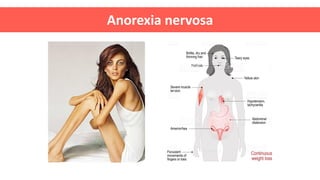
Anorexia nervosa
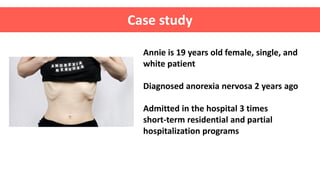
Case study
Annie is 19 years old female, single, and
white patient
Diagnosed anorexia nervosa 2 years ago
Admitted in the hospital 3 times
short-term residential and partial
hospitalization programs
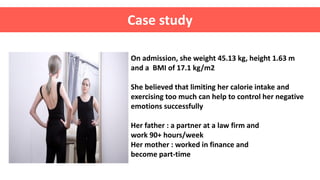
On admission, she weight 45.13 kg, height 1.63 m
and a BMI of 17.1 kg/m2
She believed that limiting her calorie intake and
exercising too much can help to control her negative
emotions successfully
Her father : a partner at a law firm and
work 90+ hours/week
Her mother : worked in finance and
become part-time
Case study
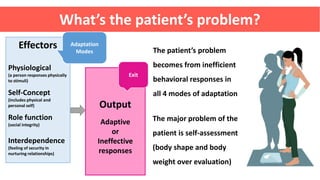
What’s the patient’s problem?
The patient’s problem
becomes from inefficient
behavioral responses in
all 4 modes of adaptation
The major problem of the
patient is self-assessment
(body shape and body
weight over evaluation)
Effectors
Physiological
(a person responses physically
to stimuli)
Self-Concept
(includes physical and
personal self)
Role function
(social integrity)
Interdependence
(feeling of security in
nurturing relationships)
Adaptation
Modes
Output
Adaptive
or
Ineffective
responses
Exit
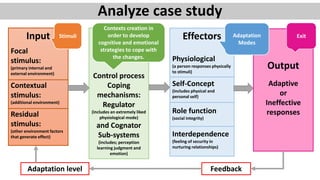
Analyze case study
Input
Focal
stimulus:
(primary internal and
external environment)
Contextual
stimulus:
(additional environment)
Residual
stimulus:
(other environment factors
that generate effect)
Control process
Coping
mechanisms:
Regulator
(includes an extremely liked
physiological mode)
and Cognator
Sub-systems
(includes; perception
learning judgment and
emotion)
Effectors
Physiological
(a person responses physically
to stimuli)
Self-Concept
(includes physical and
personal self)
Role function
(social integrity)
Interdependence
(feeling of security in
nurturing relationships)
Output
Adaptive
or
Ineffective
responses
Contexts creation in
order to develop
cognitive and emotional
strategies to cope with
the changes.
Stimuli Adaptation
Modes
Exit
Adaptation level Feedback
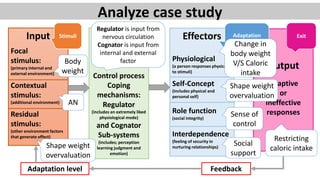
Analyze case study
Input
Focal
stimulus:
(primary internal and
external environment)
Contextual
stimulus:
(additional environment)
Residual
stimulus:
(other environment factors
that generate effect)
Control process
Coping
mechanisms:
Regulator
(includes an extremely liked
physiological mode)
and Cognator
Sub-systems
(includes; perception
learning judgment and
emotion)
Effectors
Physiological
(a person responses physically
to stimuli)
Self-Concept
(includes physical and
personal self)
Role function
(social integrity)
Interdependence
(feeling of security in
nurturing relationships)
Output
Adaptive
or
Ineffective
responses
Contexts creation in
order to develop
cognitive and emotional
strategies to cope with
the changes.
Stimuli Adaptation
Modes
Exit
Adaptation level Feedback
Body
weight
AN
Shape weight
overvaluation
Regulator is input from
nervous circulation
Cognator is input from
internal and external
factor
Change in
body weight
V/S Caloric
intake
Shape weight
overvaluation
Sense of
control
Social
support
Restricting
caloric intake
What is the goal
of nursing care?
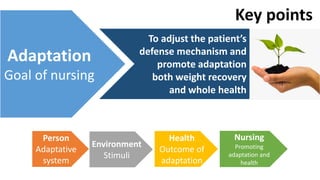
Key points
Adaptation
Goal of nursing
Person
Adaptative
system
Environment
Stimuli
Health
Outcome of
adaptation
Nursing
Promoting
adaptation and
health
To adjust the patient’s
defense mechanism and
promote adaptation
both weight recovery
and whole health
Effectors
Physiological
(a person responses physically
to stimuli)
Self-Concept
(includes physical and
personal self)
Role function
(social integrity)
Interdependence
(feeling of security in
nurturing relationships)
Adaptation
Modes
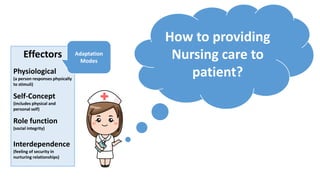
How to providing
Nursing care to
patient?
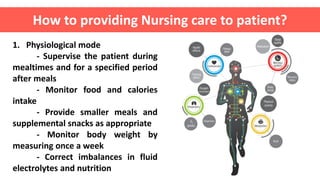
1. Physiological mode
- Supervise the patient during
mealtimes and for a specified period
after meals
- Monitor food and calories
intake
- Provide smaller meals and
supplemental snacks as appropriate
- Monitor body weight by
measuring once a week
- Correct imbalances in fluid
electrolytes and nutrition
How to providing Nursing care to patient?
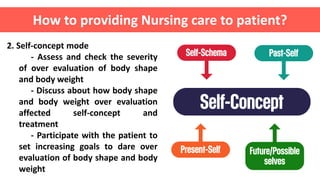
2. Self-concept mode
- Assess and check the severity
of over evaluation of body shape
and body weight
- Discuss about how body shape
and body weight over evaluation
affected self-concept and
treatment
- Participate with the patient to
set increasing goals to dare over
evaluation of body shape and body
weight
How to providing Nursing care to patient?
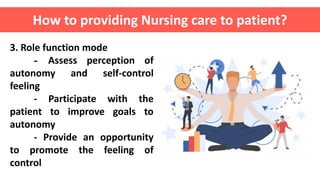
3. Role function mode
- Assess perception of
autonomy and self-control
feeling
- Participate with the
patient to improve goals to
autonomy
- Provide an opportunity
to promote the feeling of
control
How to providing Nursing care to patient?
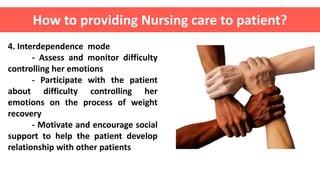
4. Interdependence mode
- Assess and monitor difficulty
controlling her emotions
- Participate with the patient
about difficulty controlling her
emotions on the process of weight
recovery
- Motivate and encourage social
support to help the patient develop
relationship with other patients
How to providing Nursing care to patient?
How to apply
in nursing
research?
How to apply in nursing research?
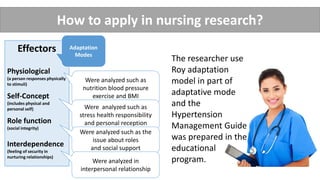
The researcher use
Roy adaptation
model in part of
adaptative mode
and the
Hypertension
Management Guide
was prepared in the
educational
program.
How to apply in nursing research?
Effectors
Physiological
(a person responses physically
to stimuli)
Self-Concept
(includes physical and
personal self)
Role function
(social integrity)
Interdependence
(feeling of security in
nurturing relationships)
Adaptation
Modes
Were analyzed such as
nutrition blood pressure
exercise and BMI
Were analyzed such as
stress health responsibility
and personal reception
Were analyzed such as the
issue about roles
and social support
Were analyzed in
interpersonal relationship
Question?
Summary of Model
Input
Focal
stimulus:
Contextual
stimulus:
Residual
stimulus:
Control process
Coping
mechanisms:
Regulator and
Cognator
Sub-systems
Effectors
Physiological
(person responses physically)
Self-Concept
(includes physical and
personal self)
Role function
(Social integrity)
Interdependence
(feeling of security in
nurturing relationships)
Output
Adaptive or
ineffective
responses
Contexts creation in
order to develop
cognitive and emotional
strategies to cope with
the changes.
Stimuli Exit
Adaptation level Feedback
Adaptation
Modes
Thanks you

Roy theory presentation

  • 1.
    1 . Mi s s L i X i a 2 . M i s s Ya t a P h o l p r a s i t 3 . M i s s B e n j a w a n N g a m w o n g w i w a t Roy Adaptation Model Assist. Prof. Dr. Charuwan Kritpracha
  • 2.
  • 3.
    Born on October14. 1939 in Los Angeles, California At age 14, she began working at a large general hospital first as a pantry girl then as a maid and finally a nurse’s aid. In 1963, she earned a Bachelor of Arts Degree in Nursing from Mount St.Mary’s college in Los Angeies. In 1966, she earned a Master’s Degree in Pediatric Nursing from the University of California. In 1973, she earned a Master’s Degree in Sociology and went on to complete a doctoratal Degree in Socialogy in 1977. Roy has been a Sister of St Joseph of Carondelet for more than 50 years. Sister Callista Roy, PhD, RN, FAAN (Phillip, 2010)
  • 4.
    Major influences Roy creditsher family religious commitment and her teacher and mentors as her major influences. Roy claims a spirit of faith hope love and commitment to God and service to others was central to her family life. Her mother was a licensed vocational nurse and instilled the values of always seeking to know more about people and their care and of selfless giving as a nurse.
  • 5.
    Stimulus for TheoryDevelopment Roy’s Adaptation Model - Grand Nursing Theory She believed nurses need to be flexible in order to provide the best care for their patients. Each patient is different and should be cared for based on the individual needs of that particular patient (Tiedeman, M. E., 2006). In 1964, when Roy was a graduate student, she was challenged by a nursing faculty member Dorothey E. Johnson [Behavioral Systems Nursing Theorist] to develop a conceptual model for nursing practice (Tiedeman, M. E., 2006). While working as a pediatric nurse, Roy observed the resiliency of children and noted their ability to adapt to the physical and psychological changes they were experiencing (Tiedeman, M. E., 2006).
  • 6.
    Abstract Sister Callista Roycreated the Adaptation Model. This model focuses on both physiological adaptations of nurses and patients enviornments (Roy&Orem, 2016). Roy’s goal is for promotion of adaptation through her four adaptation modes thereby contributing to the person’s health quality of life and dying with dignity (Roy & Andrews, 1999).
  • 7.
    Central Theme The adaptionmodel’s conceptual framework is focused on the interconnected holistic individual and his/her interaction with the environment. Adaptation is the outcome observed when responses to environmental changes are positively experienced. Roy’s model sees the individual as a set of interrelated systems (biological, psychological and social). The individual strives to maintain a balance between these systems and the outside world (Roy & Andrews, 1999).
  • 8.
    Person Envi- ronment Health META PARADIGM Person "An adaptive systemwith cognator and regulator subsystems " (Roy, 2009, p. 12) Environment "All conditions circumstances and influences surrounding and affecting" (Roy, 2009, p. 12) Health "A state and process of being and becoming integrated and whole person and environment" (Roy, 2009, p. 12) Major Concept of Nursing According to Roy Nursing Nursing The goal of nursing is "to promote adaptation for individuals and groups in the four adaptive modes" (Roy, 2009, p. 12)
  • 9.
    Key points Adaptation Goal ofnursing Person Adaptative system Environment Stimuli Health Outcome of adaptation Nursing Promoting adaptation and health
  • 10.
    Summary of Model Input Focal stimulus: (primaryinternal and external environment) Contextual stimulus: (additional environment) Residual stimulus: (other environment factors that generate effect) Control process Coping mechanisms: Regulator (includes an extremely liked physiological mode) and Cognator Sub-systems (includes; perception learning judgment and emotion) Effectors Physiological (a person responses physically to stimuli) Self-Concept (includes physical and personal self) Role function (social integrity) Interdependence (feeling of security in nurturing relationships) Output Adaptive or Ineffective responses Contexts creation in order to develop cognitive and emotional strategies to cope with the changes. Stimuli Adaptation Modes Exit Adaptation level Feedback
  • 11.
    How to applyin nursing process?
  • 12.
    Roy’s Step NursingProcess 1 2 3 Assess of patient’s behaviors in the context of four adaptive modes Assess the stimuli for those behaviors and categorize them as a focal, contextual, and residual stimuli Make a statement or nursing diagnosis of the patient’s adaptive status
  • 13.
    Roy’s Step NursingProcess 4 5 6 Set goals to promote the patient’s adaptation Implement intervention aimed at managing the stimuli to promote adaptation and improving coping abilities Evaluate whether the adaptive goals have been met
  • 14.
  • 15.
  • 16.
  • 17.
    Case study Annie is19 years old female, single, and white patient Diagnosed anorexia nervosa 2 years ago Admitted in the hospital 3 times short-term residential and partial hospitalization programs
  • 18.
    On admission, sheweight 45.13 kg, height 1.63 m and a BMI of 17.1 kg/m2 She believed that limiting her calorie intake and exercising too much can help to control her negative emotions successfully Her father : a partner at a law firm and work 90+ hours/week Her mother : worked in finance and become part-time Case study
  • 19.
    What’s the patient’sproblem? The patient’s problem becomes from inefficient behavioral responses in all 4 modes of adaptation The major problem of the patient is self-assessment (body shape and body weight over evaluation) Effectors Physiological (a person responses physically to stimuli) Self-Concept (includes physical and personal self) Role function (social integrity) Interdependence (feeling of security in nurturing relationships) Adaptation Modes Output Adaptive or Ineffective responses Exit
  • 20.
    Analyze case study Input Focal stimulus: (primaryinternal and external environment) Contextual stimulus: (additional environment) Residual stimulus: (other environment factors that generate effect) Control process Coping mechanisms: Regulator (includes an extremely liked physiological mode) and Cognator Sub-systems (includes; perception learning judgment and emotion) Effectors Physiological (a person responses physically to stimuli) Self-Concept (includes physical and personal self) Role function (social integrity) Interdependence (feeling of security in nurturing relationships) Output Adaptive or Ineffective responses Contexts creation in order to develop cognitive and emotional strategies to cope with the changes. Stimuli Adaptation Modes Exit Adaptation level Feedback
  • 21.
    Analyze case study Input Focal stimulus: (primaryinternal and external environment) Contextual stimulus: (additional environment) Residual stimulus: (other environment factors that generate effect) Control process Coping mechanisms: Regulator (includes an extremely liked physiological mode) and Cognator Sub-systems (includes; perception learning judgment and emotion) Effectors Physiological (a person responses physically to stimuli) Self-Concept (includes physical and personal self) Role function (social integrity) Interdependence (feeling of security in nurturing relationships) Output Adaptive or Ineffective responses Contexts creation in order to develop cognitive and emotional strategies to cope with the changes. Stimuli Adaptation Modes Exit Adaptation level Feedback Body weight AN Shape weight overvaluation Regulator is input from nervous circulation Cognator is input from internal and external factor Change in body weight V/S Caloric intake Shape weight overvaluation Sense of control Social support Restricting caloric intake
  • 22.
    What is thegoal of nursing care?
  • 23.
    Key points Adaptation Goal ofnursing Person Adaptative system Environment Stimuli Health Outcome of adaptation Nursing Promoting adaptation and health To adjust the patient’s defense mechanism and promote adaptation both weight recovery and whole health
  • 24.
    Effectors Physiological (a person responsesphysically to stimuli) Self-Concept (includes physical and personal self) Role function (social integrity) Interdependence (feeling of security in nurturing relationships) Adaptation Modes How to providing Nursing care to patient?
  • 25.
    1. Physiological mode -Supervise the patient during mealtimes and for a specified period after meals - Monitor food and calories intake - Provide smaller meals and supplemental snacks as appropriate - Monitor body weight by measuring once a week - Correct imbalances in fluid electrolytes and nutrition How to providing Nursing care to patient?
  • 26.
    2. Self-concept mode -Assess and check the severity of over evaluation of body shape and body weight - Discuss about how body shape and body weight over evaluation affected self-concept and treatment - Participate with the patient to set increasing goals to dare over evaluation of body shape and body weight How to providing Nursing care to patient?
  • 27.
    3. Role functionmode - Assess perception of autonomy and self-control feeling - Participate with the patient to improve goals to autonomy - Provide an opportunity to promote the feeling of control How to providing Nursing care to patient?
  • 28.
    4. Interdependence mode -Assess and monitor difficulty controlling her emotions - Participate with the patient about difficulty controlling her emotions on the process of weight recovery - Motivate and encourage social support to help the patient develop relationship with other patients How to providing Nursing care to patient?
  • 29.
    How to apply innursing research?
  • 30.
    How to applyin nursing research?
  • 31.
    The researcher use Royadaptation model in part of adaptative mode and the Hypertension Management Guide was prepared in the educational program. How to apply in nursing research? Effectors Physiological (a person responses physically to stimuli) Self-Concept (includes physical and personal self) Role function (social integrity) Interdependence (feeling of security in nurturing relationships) Adaptation Modes Were analyzed such as nutrition blood pressure exercise and BMI Were analyzed such as stress health responsibility and personal reception Were analyzed such as the issue about roles and social support Were analyzed in interpersonal relationship
  • 32.
  • 33.
    Summary of Model Input Focal stimulus: Contextual stimulus: Residual stimulus: Controlprocess Coping mechanisms: Regulator and Cognator Sub-systems Effectors Physiological (person responses physically) Self-Concept (includes physical and personal self) Role function (Social integrity) Interdependence (feeling of security in nurturing relationships) Output Adaptive or ineffective responses Contexts creation in order to develop cognitive and emotional strategies to cope with the changes. Stimuli Exit Adaptation level Feedback Adaptation Modes
  • 34.