USING UNDERWATER ROBOTS TO BUILD YOUR
STEM PIPELINE
Delve into using underwater
robots to engage students
with hands-on problem-
solving activities. Lessons will
incorporate Common Core,
science, and engineering.
Presenters
Diana CostM.Ed. NSF Master Teacher Fellow (Global
Learning Charter Public School: New Bedford, MA);
Keith Bradley (Somerset Middle School: Somerset,
MA);
Meghan Abella-Bowen (Bristol Community College:
Fall River, MA);
Darlease Monteiro (Global Learning Charter Public
School: New Bedford, MA)
BACKGROUND
GLCPS
Urban secondary school in New Bedford,
Massachusetts.
Title I school with over 74% of the student
population on free and reduced lunch.
Historically, only 60% of students graduating
from New Bedford move on to postsecondary
education
Goal increase interest in STEAM (science,
technology, engineering, arts, and math) fields.
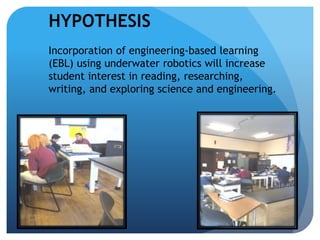
HYPOTHESIS
Incorporation of engineering-based learning
(EBL) using underwater robotics will increase
student interest in reading, researching,
writing, and exploring science and engineering.
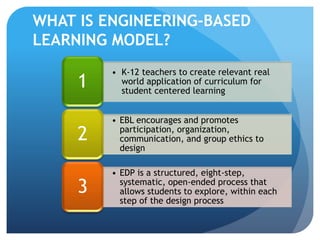
• K-12 teachers to create relevant real
world application of curriculum for
student centered learning
1
• EBL encourages and promotes
participation, organization,
communication, and group ethics to
design
2
• EDP is a structured, eight-step,
systematic, open-ended process that
allows students to explore, within each
step of the design process
3
WHAT IS ENGINEERING-BASED
LEARNING MODEL?
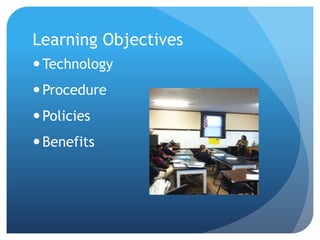
Learning Objectives
Technology
Procedure
Policies
Benefits
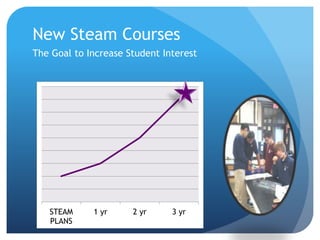
New Steam Courses
The Goal to Increase Student Interest
STEAM
PLANS
1 yr 2 yr 3 yr
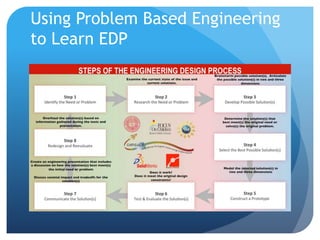
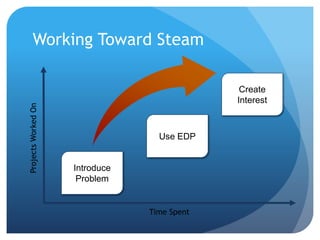
Using Problem Based Engineering
to Learn EDP
Time Spent
ProjectsWorkedOn
Introduce
Problem
Create
Interest
Working Toward Steam
Use EDP
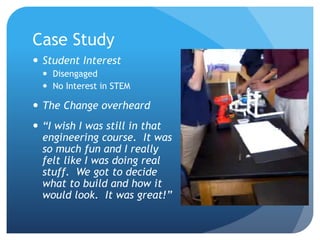
Case Study
 Student Interest
 Disengaged
 No Interest in STEM
 The Change overheard
 “I wish I was still in that
engineering course. It was
so much fun and I really
felt like I was doing real
stuff. We got to decide
what to build and how it
would look. It was great!”

ROV NSTA Presentation-jsc

  • 1.
    USING UNDERWATER ROBOTSTO BUILD YOUR STEM PIPELINE Delve into using underwater robots to engage students with hands-on problem- solving activities. Lessons will incorporate Common Core, science, and engineering.
  • 2.
    Presenters Diana CostM.Ed. NSFMaster Teacher Fellow (Global Learning Charter Public School: New Bedford, MA); Keith Bradley (Somerset Middle School: Somerset, MA); Meghan Abella-Bowen (Bristol Community College: Fall River, MA); Darlease Monteiro (Global Learning Charter Public School: New Bedford, MA)
  • 3.
    BACKGROUND GLCPS Urban secondary schoolin New Bedford, Massachusetts. Title I school with over 74% of the student population on free and reduced lunch. Historically, only 60% of students graduating from New Bedford move on to postsecondary education Goal increase interest in STEAM (science, technology, engineering, arts, and math) fields.
  • 4.
    HYPOTHESIS Incorporation of engineering-basedlearning (EBL) using underwater robotics will increase student interest in reading, researching, writing, and exploring science and engineering.
  • 5.
    • K-12 teachersto create relevant real world application of curriculum for student centered learning 1 • EBL encourages and promotes participation, organization, communication, and group ethics to design 2 • EDP is a structured, eight-step, systematic, open-ended process that allows students to explore, within each step of the design process 3 WHAT IS ENGINEERING-BASED LEARNING MODEL?
  • 6.
  • 7.
    New Steam Courses TheGoal to Increase Student Interest STEAM PLANS 1 yr 2 yr 3 yr
  • 8.
    Using Problem BasedEngineering to Learn EDP
  • 9.
  • 10.
    Case Study  StudentInterest  Disengaged  No Interest in STEM  The Change overheard  “I wish I was still in that engineering course. It was so much fun and I really felt like I was doing real stuff. We got to decide what to build and how it would look. It was great!”