Stormwater Environmental
Literacy Project
Jaclyn Austin
Resource Teacher
Office of Secondary Science
Howard County Public School System
Emily Perry
Science Team Leader
Thomas Viaduct Middle School
Howard County Public School System
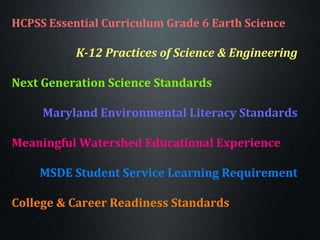
HCPSS Essential Curriculum Grade 6 Earth Science
K-12 Practices of Science & Engineering
Next Generation Science Standards
Maryland Environmental Literacy Standards
Meaningful Watershed Educational Experience
MSDE Student Service Learning Requirement
College & Career Readiness Standards
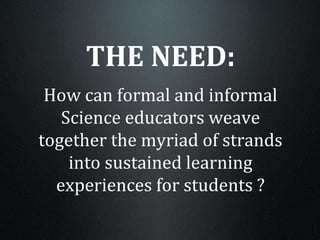
THE NEED:
How can formal and informal
Science educators weave
together the myriad of strands
into sustained learning
experiences for students ?
Establish our Loom:
Partnership
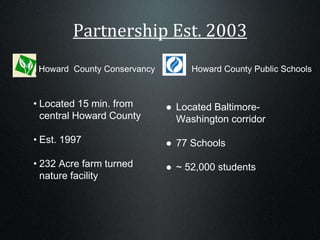
Partnership Est. 2003
Howard County Conservancy
• Located 15 min. from
central Howard County
• Est. 1997
• 232 Acre farm turned
nature facility
Howard County Public Schools
● Located Baltimore-
Washington corridor
● 77 Schools
● ~ 52,000 students
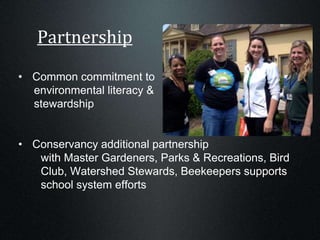
Partnership
• Common commitment to
environmental literacy &
stewardship
• Conservancy additional partnership
with Master Gardeners, Parks & Recreations, Bird
Club, Watershed Stewards, Beekeepers supports
school system efforts
Readying the Warp:
Partnership Planning
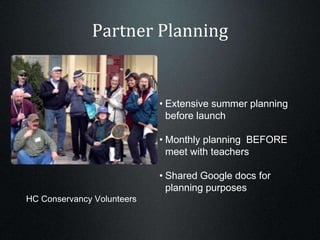
Partner Planning
HC Conservancy Volunteers
• Extensive summer planning
before launch
• Monthly planning BEFORE
meet with teachers
• Shared Google docs for
planning purposes
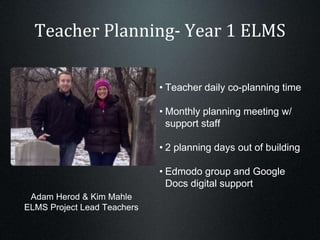
Teacher Planning- Year 1 ELMS
Adam Herod & Kim Mahle
ELMS Project Lead Teachers
• Teacher daily co-planning time
• Monthly planning meeting w/
support staff
• 2 planning days out of building
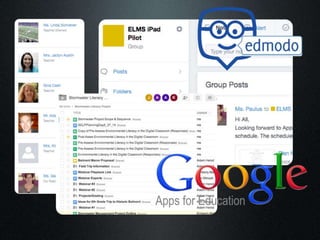
• Edmodo group and Google
Docs digital support
Teacher Planning- Year 2
ELMS & TVMS
• Summer Planning
• Teacher daily co-planning time
• Quarterly planning meeting w/ support staff
• 3 planning days out of building (subs provided)
• Google Docs digital support
Teachers were able to collaborate with the
secondary science office, as well as the
Howard County Conservancy through on-
site and off-site meetings, and Google drive.
And our greatest tool happened to be
Google drive, where we were able to
construct and organize documents to
support our efforts.
Adam Herod
6th Grade Science ELMS
Creating the Weft:
Student Experiences
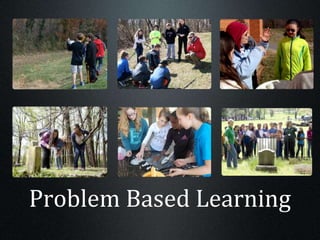
Problem Based Learning
Connected
Learning
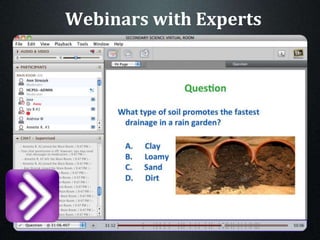
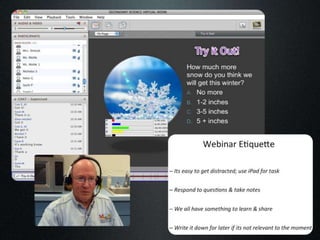
Webinars with Experts
"Working on the service learning project
this year has been so exciting!
It has provided both myself and my
students with technological growth.
Participating in the live webinars is brand
new to me and my students.”
Robert Stimmel
6th Grade Science
Thomas Viaduct Middle
Meaningful
Watershed
Experiences
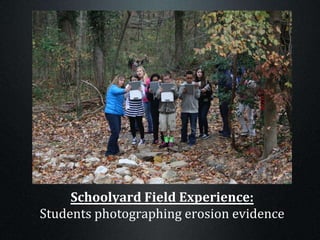
Schoolyard Field Experience:
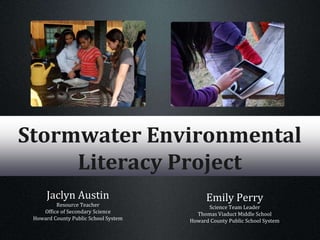
Students photographing erosion evidence
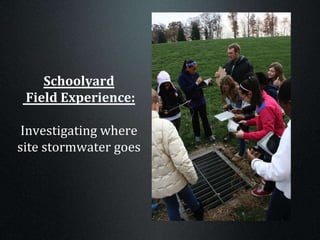
Schoolyard
Field Experience:
Investigating where
site stormwater goes
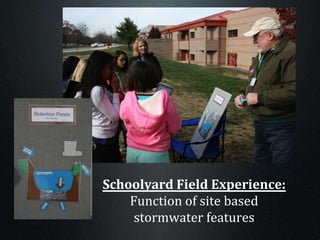
Schoolyard Field Experience:
Function of site based
stormwater features
Schoolyard Field Experience:
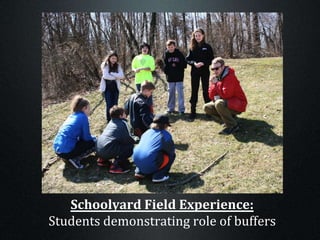
Students demonstrating role of buffers
Belmont Field Experience:
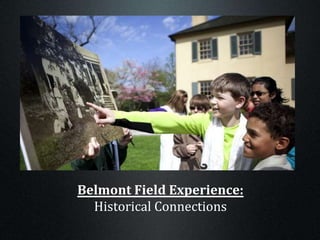
Historical Connections
Belmont Field Experience:
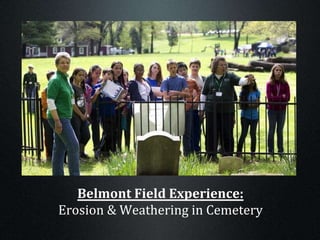
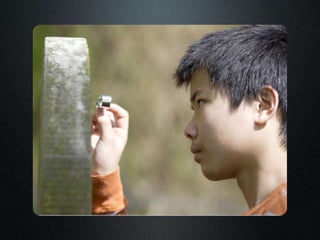
Erosion & Weathering in Cemetery
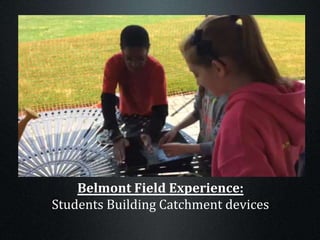
Belmont Field Experience:
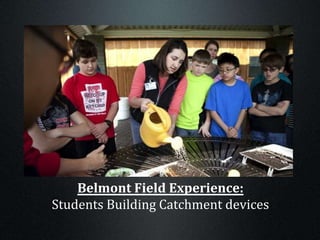
Students Building Catchment devices
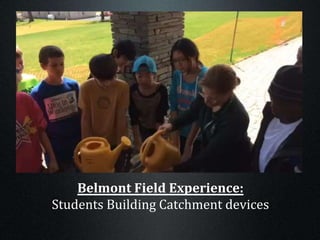
Belmont Field Experience:
Students Building Catchment devices
Belmont Field Experience:
Students Building Catchment devices
STAGE FOUR:
Binding Off
NEXT STEPS
• New Model of Learning
• Watershed Wednesdays
• Grade Level Team Collaboration
• Continuation at Elkridge Landing
• Expansion to Thomas Viaduct
What you leave behind is not
what is engraved in stone
monuments,
but what is woven into
the lives of others
-Pericles
SESSION MATERIALS
Follow your Presenters:
@Jaclyn_Austin
@emily_fkperry
Email:
Jaclyn_Austin@hcpss.org
Emily_Perry@hcpss.org
Visit the NSTA Learning Center
to Download all
Materialhttp://tinyurl.com/NSTAStormwa
ter
More Information
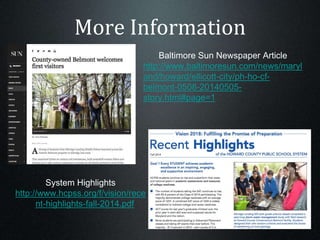
System Highlights
http://www.hcpss.org/f/vision/rece
nt-highlights-fall-2014.pdf
Baltimore Sun Newspaper Article
http://www.baltimoresun.com/news/maryl
and/howard/ellicott-city/ph-ho-cf-
belmont-0508-20140505-
story.html#page=1

NSTA stormwater presentation

Editor's Notes

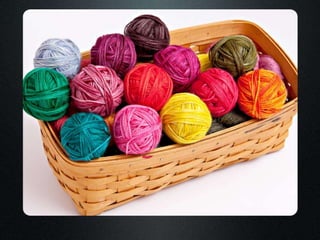
  • #3  In today’s world of education, teachers are expected to be master weavers. Common Core State Standards, The K-12 Practices of Science & Engineering, HCPSS Essential Curriculum Objectives, Next Generation Science Standards, National Educational Standards for Technology, MD Environmental Literacy Standards, and Student Service Learning requirements are all important as individual threads. Many of them are overwhelmed by the colorful yarn bin as they begint o plan for instruction
  • #4  YOU HAVE A LOOM IN FRONT OF YOU representing some of the different pieces Science educators are asked to weave together right now. You will use it as we share how these different standards and requirements were woven together throughout the project. As a curricular staff member, my role is to assist teachers in understanding this transition and helping them to plan for instruction that seamlessly weaves these expectations together with other standards and expectations. What problem or idea could we have students wrestle with to weave these together? Without a robust question or problem, it would just be a list of items to learn. -met with Ann to discuss & brainstorm. Settled on Stormwater in 6th Grade Earth Science due to the connection with the content and the opportunity to weave these items
  • #5  A teacher might weave together a few of these threads into one learning experience for greater impact. How can we create something meaningful and engaging for students with all of these different strands?
  • #6 Before we begin to weave these strands together into meaningful learning, we must first establish which strands are important for Science educators to balance.
  • #7  Length of partnership- since 2003, WOW! HCPSS has staffed a ½ time environmental educator at the Conservancy to serve all schools. Connection of partnership has grown as staff Our respective roles within HCPSS reaching out to support staff within science
  • #8 helps to connect classroom teachers to individuals and volunteers to assist with Environmental Literacy efforts Common unifying goals keeps us grounded in what is best for students
  • #9 In order to create this kind of colorful tapestry around one issue, we must have supportive threads to serve as the warp on our loom. Without these strands the weaving will fall apart.
  • #11 Sub Days provided by Science
  • #12 Sub Days provided by Science
  • #13  The warp supports for this project were created by the establishment of a professional learning community at ELMS by principal Gina Cash. In the second year of the PLC’s staff could self select projects of interest to further their understanding of how to utilize technology to enhance student learning. I presented the Stormwater issue to the science teachers as asked them to join me as we created a unique opportunity for students. We met once monthly face to face followed by the opportunities to connect digitally through Edmodo, GAFE and email. My office supported the project by providing sub days twice during the year to gather teachers for a full day of face-to-face planning and collaboration. The HC Conservancy allowed Ann to be available to meet with the teachers and myself as much as possible.
  • #15 Now that our teachers had the supports needed, we could begin to meld the different pieces together into the learning experiences for students
  • #16  Our problem posed to students to students was the challenge of Stormwater and the effect it has on our watershed. By engaging students with this problem over the course of the year, we give them an opportunity to find deeper meaning and encourage application the knowledge they have acquired through 6th grade Earth Science If we are to help empower the next generation of problem solvers, we must give students opportunities such as this and the TIME to seek meaning and show understanding. SHARE TIMELINE IN THE BOOKLET. VISIT TIMELINE IN BOOKLET As you can see form the overview of the project, students had opportunities to engage with HC Conservancy staff and community experts all throughout the school year to keep visiting the issue of stormwater. SET UP VIDEO ON NEXT SLIDE Favorite student question- Can we manipulate the land?
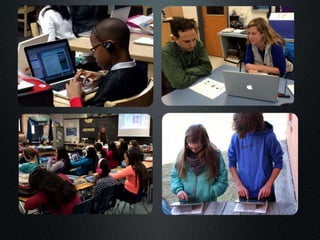
  • #18  Students had multiple opportunties to engage with the topic in a variety of different ways Synchronous Pre-Webinars & Webinars Recorded Webinars Use of iPads during the field experiences They were able to express and represent their learning in a multitude of ways using technology Student final projects are still under development and include things like presentations, website creation, iMovie creatio ANECDOTE ABOUT iPAD team @ BELMONT
  • #19 Utilizing the Blackboard Collaborate app and program we were able to conduct live webinars connecting students to community experts on different topics surrounding our stormwater issue. We learned quickly through student surveys that the students wanted to individually connect with the experts. I worked quickly to connect with OIT, Digital Learning and the ELMS Tech Teacher to find a solution that could work after the first attempt.
  • #20 We discovered we needed to help students understand HOW to engage with this digital Some of the ways to incorporate the technology happened organically
  • #27 Connections to other contents helped with grade level staff buy in Students themselves were connected historically to the property and shared this with us
  • #32 Their comes a point in weaving where you are ready to finish your work and step back to reflect, this is known as binding off
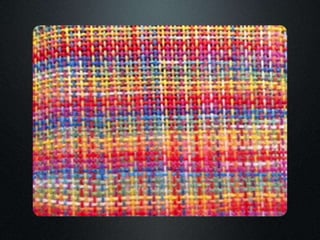
  • #33 Now as you look at the loom you have created you may notice that the lines have become blurred. It is hard to tell where one initiative begins and ends, one colorful strand leads into the next. The original components become almost unrecognizeable, but what does become clearer… FLIP THEIR PAPER THEN CLICK
  • #34 IS THE LEARNING EXPERIENCE FOR OUR STUDENTS When our work is finished, It would be like a beautiful tapestry. The threads would weave into something functional, attractive, easy to share & store, and best of all, reusable. When you look at it you would see the items as an integrated whole and not individual threads. These are the types of learning experiences our stakeholders demand for our students. These are the types of experiences that will encourage individuals who can critically think, collaborate, communicate and solve problems in their community and world.
  • #35 A dedicated time for this new model of learning TLC model expanded to high school program.
  • #36 I challenge us to seek new ways to reach out to each other and collaborate to weave our strands together, and work to create a more colorful tapestry for the Howard County Public School System