Introduction
• • RoundRobin is a preemptive CPU scheduling
algorithm.
• • Each process gets an equal fixed time called
Time Quantum.
• • Ideal for time-sharing and multi-user
operating systems.
3.
Definition
• • Eachprocess receives CPU time in cyclic
order.
• • A process is preempted when its time
quantum expires.
• • Ensures fairness and avoids starvation.
4.
How Round RobinWorks
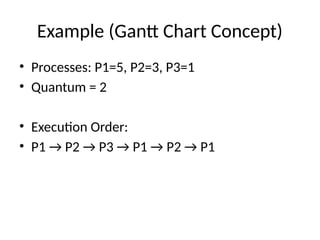
• 1. All processes are placed in a ready queue.
• 2. CPU executes each process for a fixed time
quantum.
• 3. If process is not finished, it is moved to
queue end.
• 4. Repeat cycle until all processes complete.
5.
Key Concept: TimeQuantum
• • If quantum is too small → Many context
switches → Overhead increases.
• • If quantum is too large → RR behaves like
FCFS.
• • Must be chosen carefully for balanced
performance.
Advantages
• • Fairto all processes.
• • No starvation.
• • Low response time.
• • Ideal for interactive and time-sharing
systems.
8.
Disadvantages
• • Highoverhead due to frequent context
switching.
• • High turnaround time.
• • Performance depends heavily on time
quantum.
• • Not optimal for CPU-bound tasks.
9.
Applications
• • Time-sharingoperating systems.
• • Interactive systems and user interfaces.
• • Network routers and packet scheduling.
10.
Conclusion
• • RoundRobin ensures fairness and
responsiveness.
• • Widely used in multitasking operating
systems.
• • Efficiency depends on selecting an
appropriate time quantum.


![제 23회 보아즈(BOAZ) 빅데이터 컨퍼런스 - [MBOAX] : ABSA를 활용한 소비자 반응 분석 기반 운영 효율화 대시보드 설계](https://cdn.slidesharecdn.com/ss_thumbnails/3-1boaz23rdconferencemboax-260203102709-9d519923-thumbnail.jpg?width=640&height=640&fit=bounds)


