Carol M. Mangione, MD, MSPH
Barbara A. Levy and Gerald S. Levey Professor of Medicine and Public Health
Associate Director, UCLA CTSI
David Geffen School of Medicine at UCLA, UCLA Fielding School of Public Health
How to anticipate and plan for an R grant
application
Outline
• Strategies for making the most of the research you
conduct during the K award
• The importance of relationship building at the NIH
• Keep an eye out for the FOAs and RFAs that are the
best fit for your work
• Next Generation Researchers Initiative
• Getting Organized:
– Your results
– Your team
– Your timeline
Making the most of the K research
• Early on, try to identify at least one research
question and testable hypothesis that is
important regardless of the direction or
significance of your findings.
• If you can link the K research to the first R grant
this will help you have strong preliminary studies
and it will be easier to defend why the work
proposed in the R is the most important and
logical next step and why you are the best PI to
do this work
Making the most of the K research
• Get out front with your research findings so that
you start to develop a name and identity in your
field
– Present your work at the most important meetings
– Take advantage of opportunities to participate in NIH
conferences and other symposia in your field
– Get to know the most prominent scientists in your
field so that you can get their input on your work
– Publish… try not to get scooped!
– Time is your most precious commodity, don’t waste it
on low yield activities – If you are not sure which ones
fall in this category, talk to your mentor
Be aware of who else is working in
your area of research!
• Literature search
- Pubmed: what has been published
- Google scholar (may pick up abstracts
presented at meetings)
• NIH reporter (grants that have been funded
already)
- http://projectreporter.nih.gov/reporter.cfm
Making the most of the K research
• Look for opportunities to be independent of your
mentor
– In some fields this is accomplished by working and
publishing with more than one senior researcher
– Or, you may have the opportunity to “PI” a smaller
foundation grant in your field that is related to or is an
extension of your main work
– Early on, talk to your mentor about what you should
do now or in the next couple of years so that when
the first R goes in with you as PI there will not be
questions about your independence.
Relationship Building at the NIH
• Establish relationships with the program officers
at the institute(s) in your research area
• Know the institute’s priority areas in your field
• Each Institute handles grants in slightly different
ways
• 2 parts:
– Program- Includes the Institutes that set the research
priorities – get to know your institute’s priorities!
– Review - CSR or Center for Scientific Review
• Evaluates the scientific merits of the proposals
• http://www.csr.nih.gov
Sign up for the NIH GUIDE ListServe
http://grants1.nih.gov/grants/guide/listserv.htm
once a week receive a Table of
Contents with ‘links’ to PAs,
Notices, FOAs and RFAs
The best way to know your institute
Resources
• NIH Guide for Grants and Contracts
• Institute web pages
• Grants Net (http://www.grantsnet.org)
• Mentors and colleagues
• NIH staff
NIH Program staff
 Program
Director/Administrator
or ‘Project Officer’
 Works for an Institute or
Center
 Handles pre-application
questions
 Manages grant
portfolios
 Develops RFAs and PAs
Observers at study
section meetings
Handles post-review
issues
Sends out summary
statements
Initiates funding plans
Reviews yearly progress
reports
Governmental Alphabet Soup
• NIH - National Institutes of Health
• AHRQ - Agency for Healthcare Research and
Quality
• PCORI – Patient Centered Outcomes Research
Institute
• RFA - Request for application
• RFP - Request for proposals
• PA - Program announcement
• FOA – Funding opportunity announcement
Funding the transition from K to R
• Look for funding announcements, preferably RFAs
or FOAs that have specific dollars allocated to
your area
• What if there aren’t any or what if the pay lines
are unrealistically low?
– Consider foundations, professional organizations,
industry, or institutional grants to tide you over
– Awards from these sources can keep you working,
publishing, and staying active in the field and can
strengthen your portfolio while you try to identify the
best opportunity at NIH
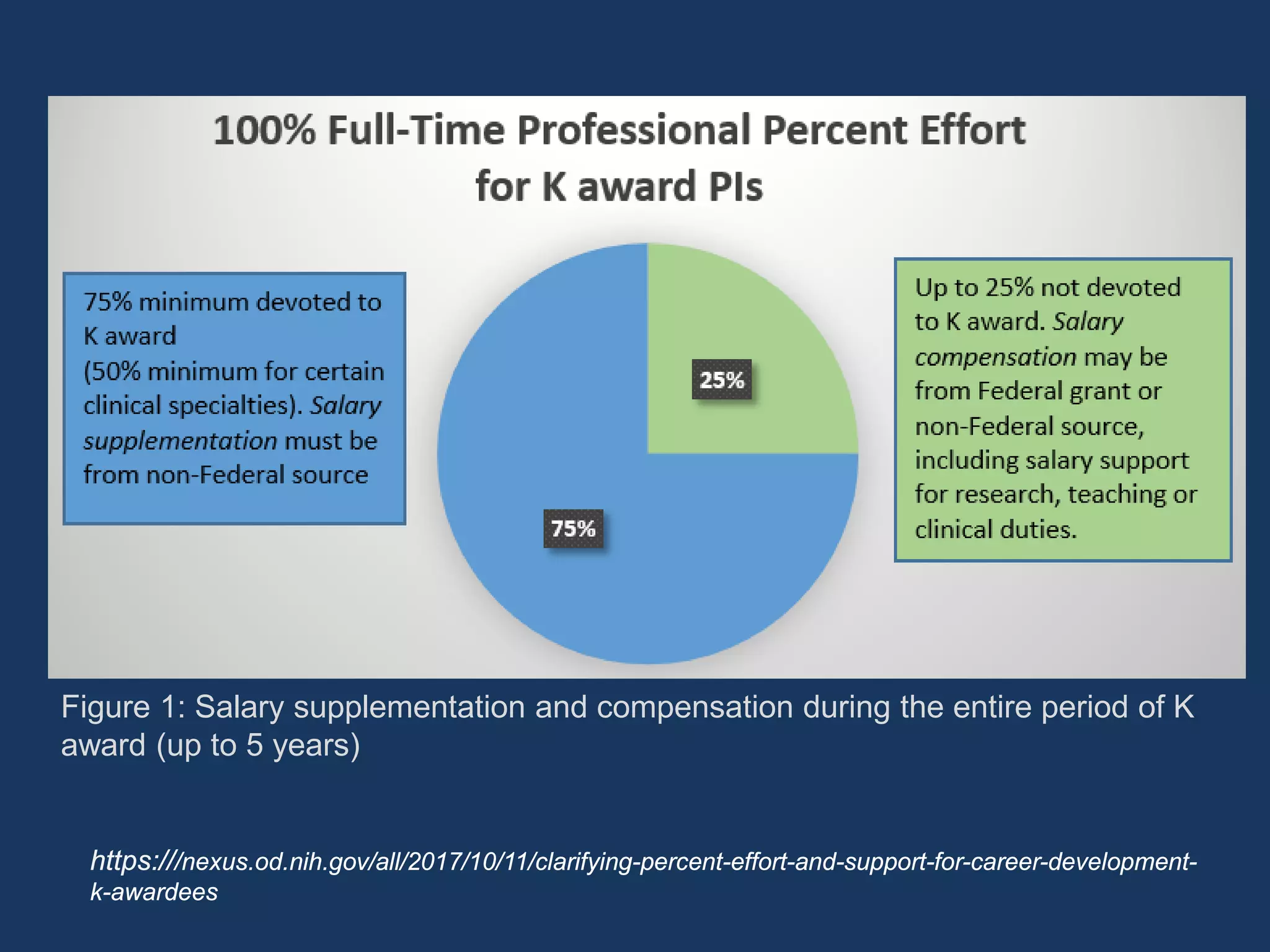
% Effort and Support for K Awardees
• Commit minimum 75% full-time professional
effort.
• Remaining effort (up to 25%) to additional
research, teaching, clinical work, or other efforts
complementary to career development of the K
awardee.
• Institutions normally supplement the salary of K
award PIs up to a level that is consistent with the
institution’s salary scale.
https://nexus.od.nih.gov/all/2017/10/11/clarifying-percent-effort-and-support-for-career-
development-k-awardees/
Salary Supplementation (NOT-OD-17-094)
• Effort directly committed to the K award - must be
from non-Federal sources (including institutional
sources) and not require extra duties that would
interfere with the goals of the K award.
• Effort not directly committed to the K award,
recipients may devote effort, with compensation,
on Federal or non-Federal sources as PD/PI or in
another role (e.g., co-I), as long the specific aims
of the other supporting grant(s) differ from those
of the K award.
https://nexus.od.nih.gov/all/2017/10/11/clarifying-percent-effort-and-support-for-career-
development-k-awardees/
https:///nexus.od.nih.gov/all/2017/10/11/clarifying-percent-effort-and-support-for-career-development-
k-awardees
Figure 1: Salary supplementation and compensation during the entire period of K
award (up to 5 years)
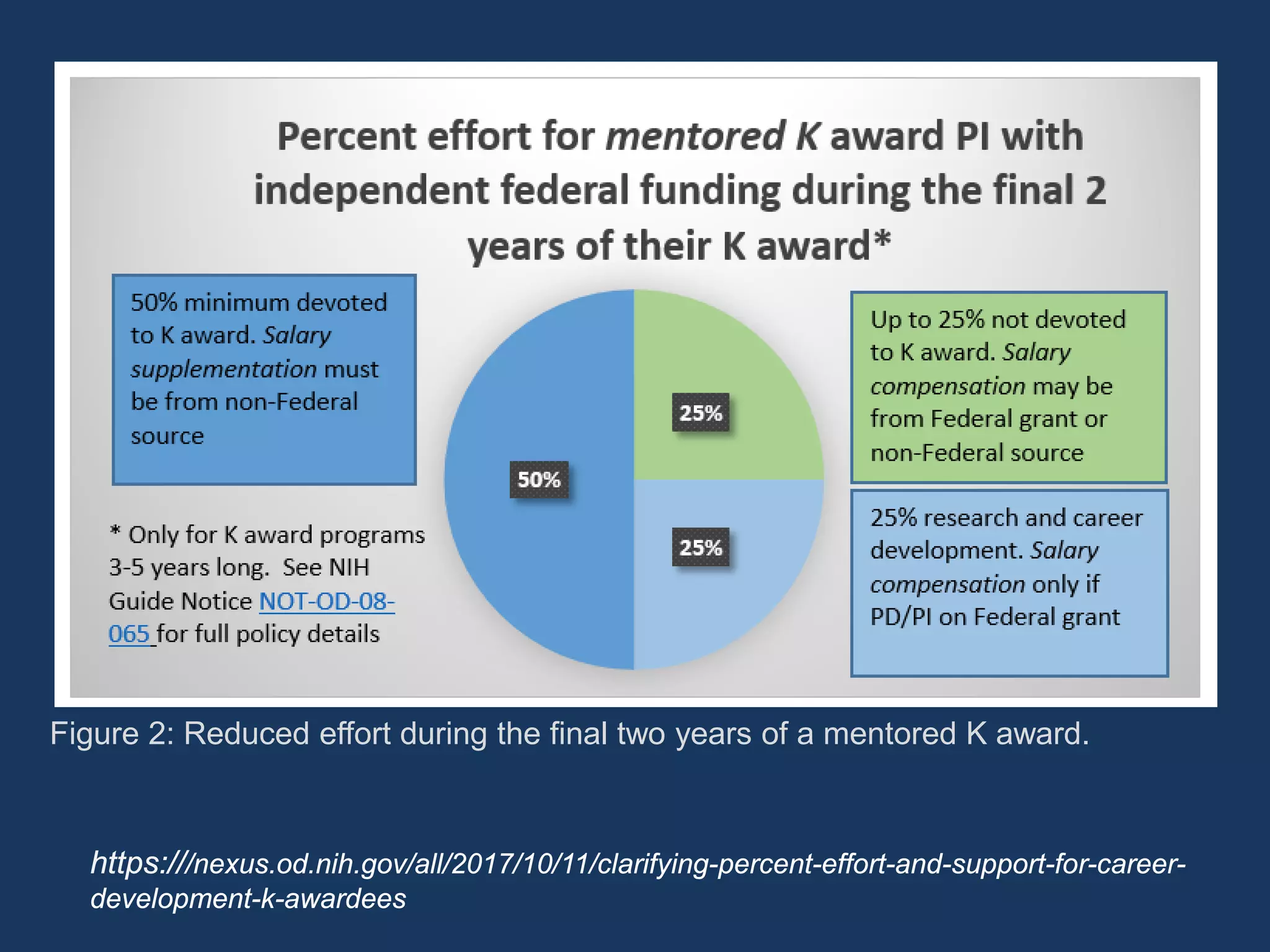
K to R % Effort (NOT-OD-08-065, NOT-OD-18-157)
During the last two years of a mentored career development
award (K01, K07, K08, K22, K23, K25, K12/KL2), NIH will permit
you to receive concurrent salary support from any peer-
reviewed grant from any federal agency and NON-FEDERAL
SOURCES (NOT-OD-18-157), if you meet the following criteria:
– You are the PI on a competing research project grant, or
director of a sub-project on a multi-component grant of at least
$100,000 in direct costs.
– Your K award is active when the R, P or U grant is submitted.
– If awarding entity allows such an arrangement.
– Under those circumstances, you may reduce your K award's
time and effort to 50%.
– NIH will adjust salary for reduced effort but will provide full
research development support costs.
https:///nexus.od.nih.gov/all/2017/10/11/clarifying-percent-effort-and-support-for-career-
development-k-awardees
Figure 2: Reduced effort during the final two years of a mentored K award.
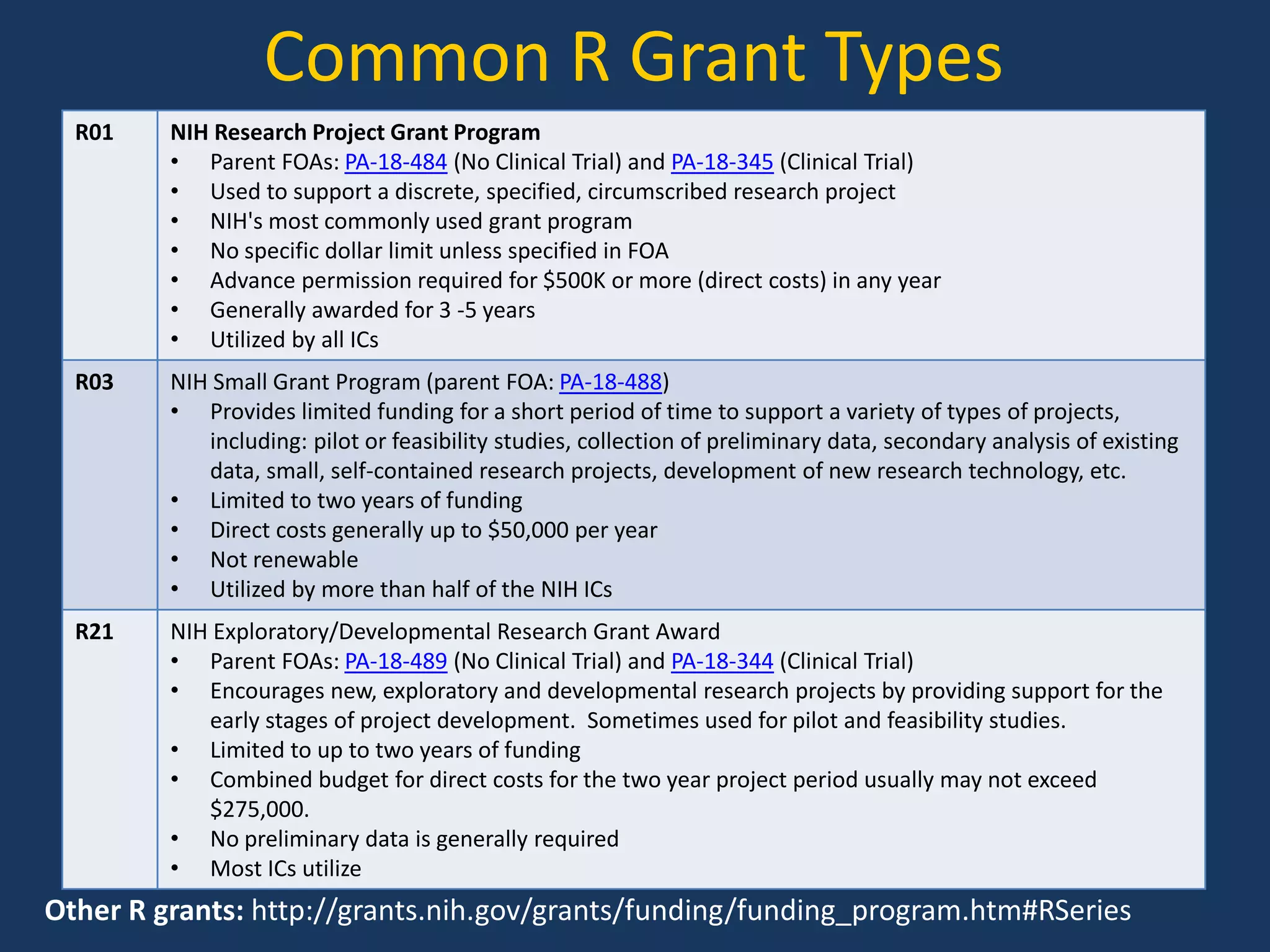
Common R Grant Types
R01 NIH Research Project Grant Program
• Parent FOAs: PA-18-484 (No Clinical Trial) and PA-18-345 (Clinical Trial)
• Used to support a discrete, specified, circumscribed research project
• NIH's most commonly used grant program
• No specific dollar limit unless specified in FOA
• Advance permission required for $500K or more (direct costs) in any year
• Generally awarded for 3 -5 years
• Utilized by all ICs
R03 NIH Small Grant Program (parent FOA: PA-18-488)
• Provides limited funding for a short period of time to support a variety of types of projects,
including: pilot or feasibility studies, collection of preliminary data, secondary analysis of existing
data, small, self-contained research projects, development of new research technology, etc.
• Limited to two years of funding
• Direct costs generally up to $50,000 per year
• Not renewable
• Utilized by more than half of the NIH ICs
R21 NIH Exploratory/Developmental Research Grant Award
• Parent FOAs: PA-18-489 (No Clinical Trial) and PA-18-344 (Clinical Trial)
• Encourages new, exploratory and developmental research projects by providing support for the
early stages of project development. Sometimes used for pilot and feasibility studies.
• Limited to up to two years of funding
• Combined budget for direct costs for the two year project period usually may not exceed
$275,000.
• No preliminary data is generally required
• Most ICs utilize
Other R grants: http://grants.nih.gov/grants/funding/funding_program.htm#RSeries
New Investigators (NI)
Definition: A PD/PI is identified as a New
Investigator if he/she has not previously
competed successfully for an NIH-
supported research project other than early
stage or small research grants (R03, R21) or for
training, infrastructure, and career awards (F, T,
K).
Early Stage Investigators (ESI)
• ESIs are New Investigators who are:
– Within 10 years of completing terminal research degree.
– Within 10 years of completing residency (or equivalent.
– Extension: injury, parental leave (NOT-OD-09-034)
• Breaks for ESIs
– Separate payline 5-10 points higher
– Fund all years requested
– Expedited review for revision if within 5-10% of payline
(NOT-OD-06-013)
– First competitive renewal: 5 points higher
• Applies to R01 applications only
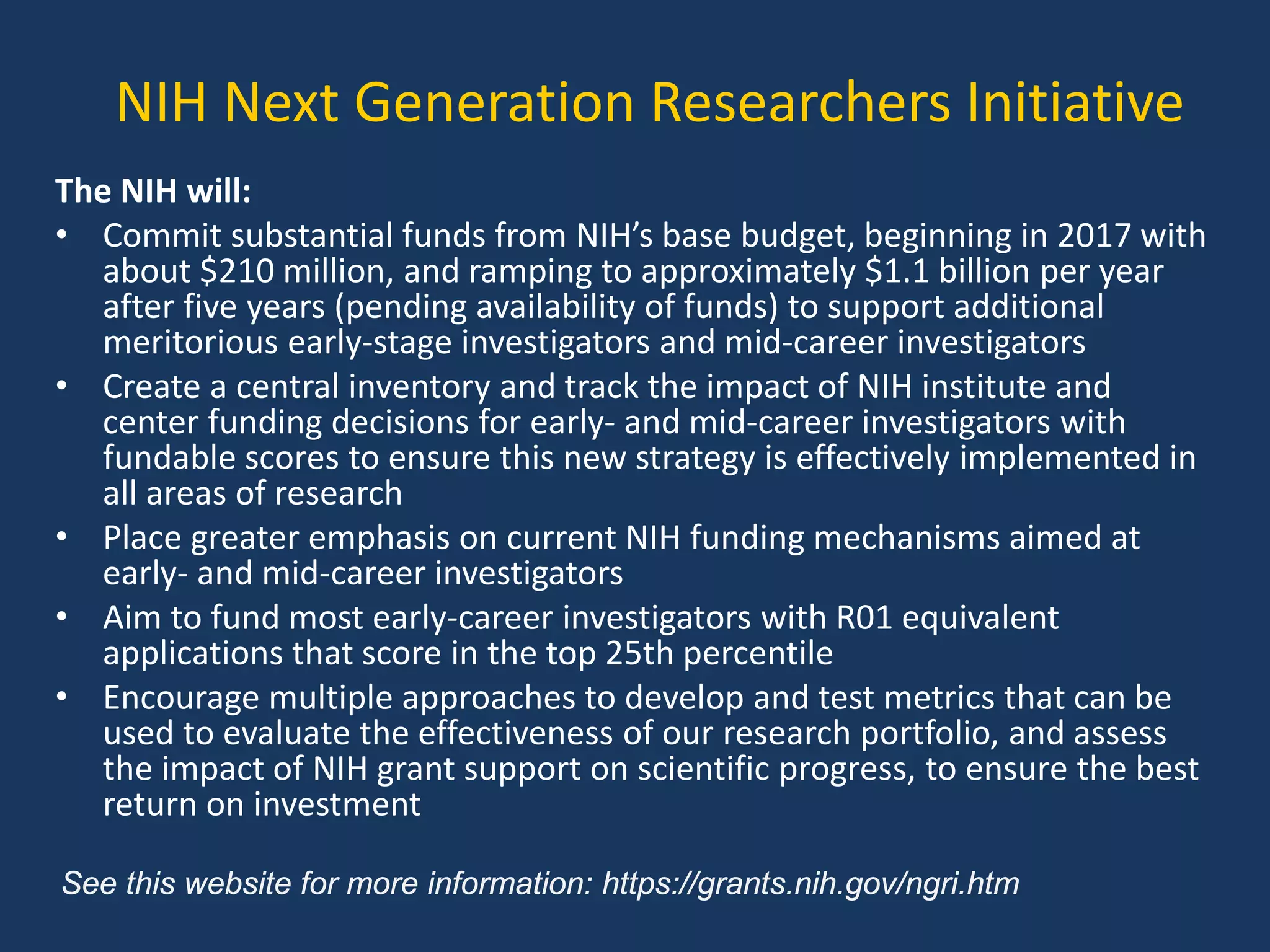
NIH Next Generation Researchers Initiative
The NIH will:
• Commit substantial funds from NIH’s base budget, beginning in 2017 with
about $210 million, and ramping to approximately $1.1 billion per year
after five years (pending availability of funds) to support additional
meritorious early-stage investigators and mid-career investigators
• Create a central inventory and track the impact of NIH institute and
center funding decisions for early- and mid-career investigators with
fundable scores to ensure this new strategy is effectively implemented in
all areas of research
• Place greater emphasis on current NIH funding mechanisms aimed at
early- and mid-career investigators
• Aim to fund most early-career investigators with R01 equivalent
applications that score in the top 25th percentile
• Encourage multiple approaches to develop and test metrics that can be
used to evaluate the effectiveness of our research portfolio, and assess
the impact of NIH grant support on scientific progress, to ensure the best
return on investment
See this website for more information: https://grants.nih.gov/ngri.htm
NIH Next Generation Researchers Initiative
Applications will receive special consideration if you are:
• an early-stage investigator (within 10 years of completing your
terminal research degree or medical residency and have not
previously received a substantial independent NIH research
award) and receive a score in the top 25th percentile (or an
impact score of 35 if the application is not percentiled)
• a mid-career investigator (within 10 years of receiving your first
NIH R01 equivalent award) who scores in the 25th percentile,
and either:
– are at risk of losing all support, or,
– are a particularly promising investigator currently supported
by a single ongoing award (i.e, NIH will prioritize funding an
additional concurrent research project grant award)
See this website for more information: https://grants.nih.gov/ngri.htm
Stephen I. Katz Early Stage Investigator
Research Grant Program
PAR-21-038 & PAR-21-039
• The new Katz R01 award program will build on the
successful Next Generation Researchers Initiative.
• ESIs may apply for this new opportunity to support their
innovative ideas if they are proposing research that is a
change in direction from their past work and experience,
and for which they have no preliminary data.
• ESIs who have preliminary data for research projects or
those who want to continue on with their current research
direction, NIH’s Parent R01 funding opportunities are still
available.
• The first due date for applications is January 26, 2021.
https://grants.nih.gov/funding/katz-esi-r01.htm
New Investigator R01 Resubmission Policy
NOT-OD-19-053
The special New Investigator (NI) deadline for next round resubmission of A1
R01 applications will be eliminated.
Starting with R01 applications submitted for due dates on or after January 25,
2019:
• New Investigator (NI) R01 applications will be reviewed on the same timeline
as other applications submitted to the same FOA.
• NI R01 applications will be clustered together for review within a meeting.
• Summary statements for all NI R01 applications will be prioritized: to the
extent possible, they will be released before summary statements for other
applications reviewed in the same meeting.
• In general, summary statements will be available no later than 30 days
before council.
• A1 resubmission of NI R01 applications will be accepted on the resubmission
due date of any Program Announcement (PA, PAR, or PAS), both standard
and special due dates, that accepts resubmission applications. See the NIH
Resubmission Policy for requirements and instructions.
https://grants.nih.gov/grants/guide/notice-files/NOT-OD-19-053.html
https://grants.nih.gov/grants/guide/notice-files/NOT-OD-18-197.html
First steps in R proposal preparation
• Take a hard look at what you have published and try
to build the R around your most significant research
findings – this may or may not be your K funded
research
• Decide where will it go and/or who your audience is
• Check NIH Reporter to make sure that the study isn’t
already underway
• Requires several months of reading, organizing,
writing, and revising
Review and Award Cycles
Cycle I Cycle II Cycle III
Scientific
Merit
Review
June – July October –
November
February -
March
Advisory
Council
Round
August or
October *
January May
Earliest Start
Date
September or
December *
April July
* Advisory Council Round for Cycle I applications may be August or October, and
their earliest project start date may be September or December respectively.
First steps in proposal preparation
• EARLY ON talk to the scientific administrator!
• Follow the written guidelines from the funder carefully
– Outline of the structure
– Page limits
– Font sizes
– Funding limits
– Elements that must be included
– Priority areas
Get Organized
• Work from an outline
• Establish a timeline for completing the proposal - make
time to work on this
• Have the project team meet periodically
• Give assignments with deadlines
• Make deadlines for yourself
• Find a model proposal
– recently funded by the same agency
– look over the reviews if you can get a hold of them
• REVIEW, PRETEST, REVISE RETEATABLY
Are You On the Fence About Whether to Resubmit?
Summary
• Things won’t go as smoothly as this talk
sounds
• Be flexible, take advantage of unexpected
opportunities when they come your way
• Be very protective of your time
• The drought at NIH seems to be slowly
improving, so be strategic, keep doing the
research you love and you will be in the
strongest position to compete when the time
is right to submit an R
NIH Award Success

How to Anticipate and Plan for an R Grant Application (2020)

  • 1.
    Carol M. Mangione,MD, MSPH Barbara A. Levy and Gerald S. Levey Professor of Medicine and Public Health Associate Director, UCLA CTSI David Geffen School of Medicine at UCLA, UCLA Fielding School of Public Health How to anticipate and plan for an R grant application
  • 2.
    Outline • Strategies formaking the most of the research you conduct during the K award • The importance of relationship building at the NIH • Keep an eye out for the FOAs and RFAs that are the best fit for your work • Next Generation Researchers Initiative • Getting Organized: – Your results – Your team – Your timeline
  • 3.
    Making the mostof the K research • Early on, try to identify at least one research question and testable hypothesis that is important regardless of the direction or significance of your findings. • If you can link the K research to the first R grant this will help you have strong preliminary studies and it will be easier to defend why the work proposed in the R is the most important and logical next step and why you are the best PI to do this work
  • 4.
    Making the mostof the K research • Get out front with your research findings so that you start to develop a name and identity in your field – Present your work at the most important meetings – Take advantage of opportunities to participate in NIH conferences and other symposia in your field – Get to know the most prominent scientists in your field so that you can get their input on your work – Publish… try not to get scooped! – Time is your most precious commodity, don’t waste it on low yield activities – If you are not sure which ones fall in this category, talk to your mentor
  • 5.
    Be aware ofwho else is working in your area of research! • Literature search - Pubmed: what has been published - Google scholar (may pick up abstracts presented at meetings) • NIH reporter (grants that have been funded already) - http://projectreporter.nih.gov/reporter.cfm
  • 6.
    Making the mostof the K research • Look for opportunities to be independent of your mentor – In some fields this is accomplished by working and publishing with more than one senior researcher – Or, you may have the opportunity to “PI” a smaller foundation grant in your field that is related to or is an extension of your main work – Early on, talk to your mentor about what you should do now or in the next couple of years so that when the first R goes in with you as PI there will not be questions about your independence.
  • 7.
    Relationship Building atthe NIH • Establish relationships with the program officers at the institute(s) in your research area • Know the institute’s priority areas in your field • Each Institute handles grants in slightly different ways • 2 parts: – Program- Includes the Institutes that set the research priorities – get to know your institute’s priorities! – Review - CSR or Center for Scientific Review • Evaluates the scientific merits of the proposals • http://www.csr.nih.gov
  • 8.
    Sign up forthe NIH GUIDE ListServe http://grants1.nih.gov/grants/guide/listserv.htm once a week receive a Table of Contents with ‘links’ to PAs, Notices, FOAs and RFAs The best way to know your institute
  • 9.
    Resources • NIH Guidefor Grants and Contracts • Institute web pages • Grants Net (http://www.grantsnet.org) • Mentors and colleagues • NIH staff
  • 10.
    NIH Program staff Program Director/Administrator or ‘Project Officer’  Works for an Institute or Center  Handles pre-application questions  Manages grant portfolios  Develops RFAs and PAs Observers at study section meetings Handles post-review issues Sends out summary statements Initiates funding plans Reviews yearly progress reports
  • 11.
    Governmental Alphabet Soup •NIH - National Institutes of Health • AHRQ - Agency for Healthcare Research and Quality • PCORI – Patient Centered Outcomes Research Institute • RFA - Request for application • RFP - Request for proposals • PA - Program announcement • FOA – Funding opportunity announcement
  • 12.
    Funding the transitionfrom K to R • Look for funding announcements, preferably RFAs or FOAs that have specific dollars allocated to your area • What if there aren’t any or what if the pay lines are unrealistically low? – Consider foundations, professional organizations, industry, or institutional grants to tide you over – Awards from these sources can keep you working, publishing, and staying active in the field and can strengthen your portfolio while you try to identify the best opportunity at NIH
  • 13.
    % Effort andSupport for K Awardees • Commit minimum 75% full-time professional effort. • Remaining effort (up to 25%) to additional research, teaching, clinical work, or other efforts complementary to career development of the K awardee. • Institutions normally supplement the salary of K award PIs up to a level that is consistent with the institution’s salary scale. https://nexus.od.nih.gov/all/2017/10/11/clarifying-percent-effort-and-support-for-career- development-k-awardees/
  • 14.
    Salary Supplementation (NOT-OD-17-094) •Effort directly committed to the K award - must be from non-Federal sources (including institutional sources) and not require extra duties that would interfere with the goals of the K award. • Effort not directly committed to the K award, recipients may devote effort, with compensation, on Federal or non-Federal sources as PD/PI or in another role (e.g., co-I), as long the specific aims of the other supporting grant(s) differ from those of the K award. https://nexus.od.nih.gov/all/2017/10/11/clarifying-percent-effort-and-support-for-career- development-k-awardees/
  • 15.
  • 16.
    K to R% Effort (NOT-OD-08-065, NOT-OD-18-157) During the last two years of a mentored career development award (K01, K07, K08, K22, K23, K25, K12/KL2), NIH will permit you to receive concurrent salary support from any peer- reviewed grant from any federal agency and NON-FEDERAL SOURCES (NOT-OD-18-157), if you meet the following criteria: – You are the PI on a competing research project grant, or director of a sub-project on a multi-component grant of at least $100,000 in direct costs. – Your K award is active when the R, P or U grant is submitted. – If awarding entity allows such an arrangement. – Under those circumstances, you may reduce your K award's time and effort to 50%. – NIH will adjust salary for reduced effort but will provide full research development support costs.
  • 17.
  • 18.
    Common R GrantTypes R01 NIH Research Project Grant Program • Parent FOAs: PA-18-484 (No Clinical Trial) and PA-18-345 (Clinical Trial) • Used to support a discrete, specified, circumscribed research project • NIH's most commonly used grant program • No specific dollar limit unless specified in FOA • Advance permission required for $500K or more (direct costs) in any year • Generally awarded for 3 -5 years • Utilized by all ICs R03 NIH Small Grant Program (parent FOA: PA-18-488) • Provides limited funding for a short period of time to support a variety of types of projects, including: pilot or feasibility studies, collection of preliminary data, secondary analysis of existing data, small, self-contained research projects, development of new research technology, etc. • Limited to two years of funding • Direct costs generally up to $50,000 per year • Not renewable • Utilized by more than half of the NIH ICs R21 NIH Exploratory/Developmental Research Grant Award • Parent FOAs: PA-18-489 (No Clinical Trial) and PA-18-344 (Clinical Trial) • Encourages new, exploratory and developmental research projects by providing support for the early stages of project development. Sometimes used for pilot and feasibility studies. • Limited to up to two years of funding • Combined budget for direct costs for the two year project period usually may not exceed $275,000. • No preliminary data is generally required • Most ICs utilize Other R grants: http://grants.nih.gov/grants/funding/funding_program.htm#RSeries
  • 19.
    New Investigators (NI) Definition:A PD/PI is identified as a New Investigator if he/she has not previously competed successfully for an NIH- supported research project other than early stage or small research grants (R03, R21) or for training, infrastructure, and career awards (F, T, K).
  • 20.
    Early Stage Investigators(ESI) • ESIs are New Investigators who are: – Within 10 years of completing terminal research degree. – Within 10 years of completing residency (or equivalent. – Extension: injury, parental leave (NOT-OD-09-034) • Breaks for ESIs – Separate payline 5-10 points higher – Fund all years requested – Expedited review for revision if within 5-10% of payline (NOT-OD-06-013) – First competitive renewal: 5 points higher • Applies to R01 applications only
  • 21.
    NIH Next GenerationResearchers Initiative The NIH will: • Commit substantial funds from NIH’s base budget, beginning in 2017 with about $210 million, and ramping to approximately $1.1 billion per year after five years (pending availability of funds) to support additional meritorious early-stage investigators and mid-career investigators • Create a central inventory and track the impact of NIH institute and center funding decisions for early- and mid-career investigators with fundable scores to ensure this new strategy is effectively implemented in all areas of research • Place greater emphasis on current NIH funding mechanisms aimed at early- and mid-career investigators • Aim to fund most early-career investigators with R01 equivalent applications that score in the top 25th percentile • Encourage multiple approaches to develop and test metrics that can be used to evaluate the effectiveness of our research portfolio, and assess the impact of NIH grant support on scientific progress, to ensure the best return on investment See this website for more information: https://grants.nih.gov/ngri.htm
  • 22.
    NIH Next GenerationResearchers Initiative Applications will receive special consideration if you are: • an early-stage investigator (within 10 years of completing your terminal research degree or medical residency and have not previously received a substantial independent NIH research award) and receive a score in the top 25th percentile (or an impact score of 35 if the application is not percentiled) • a mid-career investigator (within 10 years of receiving your first NIH R01 equivalent award) who scores in the 25th percentile, and either: – are at risk of losing all support, or, – are a particularly promising investigator currently supported by a single ongoing award (i.e, NIH will prioritize funding an additional concurrent research project grant award) See this website for more information: https://grants.nih.gov/ngri.htm
  • 23.
    Stephen I. KatzEarly Stage Investigator Research Grant Program PAR-21-038 & PAR-21-039 • The new Katz R01 award program will build on the successful Next Generation Researchers Initiative. • ESIs may apply for this new opportunity to support their innovative ideas if they are proposing research that is a change in direction from their past work and experience, and for which they have no preliminary data. • ESIs who have preliminary data for research projects or those who want to continue on with their current research direction, NIH’s Parent R01 funding opportunities are still available. • The first due date for applications is January 26, 2021. https://grants.nih.gov/funding/katz-esi-r01.htm
  • 24.
    New Investigator R01Resubmission Policy NOT-OD-19-053 The special New Investigator (NI) deadline for next round resubmission of A1 R01 applications will be eliminated. Starting with R01 applications submitted for due dates on or after January 25, 2019: • New Investigator (NI) R01 applications will be reviewed on the same timeline as other applications submitted to the same FOA. • NI R01 applications will be clustered together for review within a meeting. • Summary statements for all NI R01 applications will be prioritized: to the extent possible, they will be released before summary statements for other applications reviewed in the same meeting. • In general, summary statements will be available no later than 30 days before council. • A1 resubmission of NI R01 applications will be accepted on the resubmission due date of any Program Announcement (PA, PAR, or PAS), both standard and special due dates, that accepts resubmission applications. See the NIH Resubmission Policy for requirements and instructions. https://grants.nih.gov/grants/guide/notice-files/NOT-OD-19-053.html https://grants.nih.gov/grants/guide/notice-files/NOT-OD-18-197.html
  • 25.
    First steps inR proposal preparation • Take a hard look at what you have published and try to build the R around your most significant research findings – this may or may not be your K funded research • Decide where will it go and/or who your audience is • Check NIH Reporter to make sure that the study isn’t already underway • Requires several months of reading, organizing, writing, and revising
  • 26.
    Review and AwardCycles Cycle I Cycle II Cycle III Scientific Merit Review June – July October – November February - March Advisory Council Round August or October * January May Earliest Start Date September or December * April July * Advisory Council Round for Cycle I applications may be August or October, and their earliest project start date may be September or December respectively.
  • 27.
    First steps inproposal preparation • EARLY ON talk to the scientific administrator! • Follow the written guidelines from the funder carefully – Outline of the structure – Page limits – Font sizes – Funding limits – Elements that must be included – Priority areas
  • 28.
    Get Organized • Workfrom an outline • Establish a timeline for completing the proposal - make time to work on this • Have the project team meet periodically • Give assignments with deadlines • Make deadlines for yourself • Find a model proposal – recently funded by the same agency – look over the reviews if you can get a hold of them • REVIEW, PRETEST, REVISE RETEATABLY
  • 29.
    Are You Onthe Fence About Whether to Resubmit?
  • 30.
    Summary • Things won’tgo as smoothly as this talk sounds • Be flexible, take advantage of unexpected opportunities when they come your way • Be very protective of your time • The drought at NIH seems to be slowly improving, so be strategic, keep doing the research you love and you will be in the strongest position to compete when the time is right to submit an R
  • 31.