
K08 – K 23 – KO1 Grant Applications
Individual Career Development Awards
Isidro B. Salusky, MD
Distinguished Professor of Pediatrics
Division Chief, Pediatric Nephrology
Director Training Program in Translational Science
David Geffen School of Medicine at UCLA
K23/08/01: NIH Mentored Clinical Scientist
Research Career Development Award
• Intensive, supervised research experience in the fields of biomedical and
behavioral research, including translational research
• Participating ICs vary in programmatic and budgetary specifics, and in size
and duration of awards
• Candidate must devote a minimum of 9 person months (75% of full-time
professional effort) to specified research plan
• In general, candidates can request 3-5 years, depending on individual
needs to achieve research independence
• Awards are not renewable and are not transferable from one PI to
another
• Not all ICs utilize the K08 so prospective applicants should contact the
relevant NIH staff for IC-specific information on restrictions
K23/K08 Application Outline (cont)
• Specific Aims (1 page)
• Career Development Plan Sections: Candidate's Background, Career Goals,
and Objectives; Career Development/Training Activities during Award Period;
Training in the Responsible Conduct of Research + Research Strategy
Sections: Significance, Innovation, Scientific Premise, Approach = 12 pages
total (including figures, tables, graphs, etc.)
• Bibliography and Literature Cited
• Human Subjects Sections: Protection of Human Subjects, Inclusion of Women
and Minorities, Targeted/Planned Enrollment Table, Inclusion of Children
• Other Research Plan Sections: Vertebrate Animals, Select Agent Scientific
rigor and biological variables, Research, Consortium/Contractual
Arrangements, Resource Sharing Plan
K23/K08 Application Outline (cont)
• Cover Letter (obligatory)
• Letters of Reference (minimum 3, maximum 5): due by the
application receipt deadline date
• Statements of Support from Mentor, Co-Mentors, Consultants,
Contributors
• Appendix (optional)
K23/K08/KO1: NIH Mentored Research Career
Development Award
SPECIAL REQUIREMENT: Mentor(s)
• Applicant must name a primary sponsor/mentor, who
together with the candidate is responsible for the planning,
direction, and execution of the career development
program. Co-Primary mentors.
• The mentor should be recognized as an accomplished
investigator with a track record of success in training similar
investigators.
• The mentor should have sufficient independent support to
cover the costs of the proposed project in excess of the
allowable costs of this award.
• Candidates may also nominate co-mentors as appropriate
to the goals of the specified research program.
MENTOR
•Experience
•Availability
•Interest to work
•Track record with previous mentees
•Adequate resources: grant support
•The choice of one or two senior scientists is the single most
important decision. Seek for complimentary expertise
K23/K08/KO1: NIH Mentored Research Career
Development Award
SPECIAL REQUIREMENT: Institutional Environment
• Demonstrate your institution’s strong, well-established record
of career development activities and faculty qualified in
biomedical, behavioral, or clinical-translational research to
serve as mentors. (CTSI award if available)
• Demonstrate the institution’s commitment to your
development as a productive investigator and willingness to
allow the protected time needed to complete your career
development program .
• Describe a career development program that will maximize the
use of this environment, including available facilities and
resources.
K23/K08 Candidate Information and Career
Development Plan
Candidate’s Background
• Describe your commitment to an academic career in patient-
oriented research for the K23/KO1 or biomedical/behavioral
research for the K08.
• Describe your professional responsibilities in the grantee institution
and elsewhere and show their relation to the proposed activities on
the career award.
• Present evidence of your ability to interact and collaborate with
other scientists.
• Describe prior training and how it relates to your objectives and
long-term career plans.
K23/K08/KO1 Candidate Information and Career
Development Plan
Candidate’s Background (cont.)
• Describe your research efforts to this point in your research career,
including publications and prior research interests and experience.
• Provide evidence of your potential to develop into an independent
investigator.
• Include a statement that you will commit at least 9 person-months
(75% of full-time professional effort) to the research program and
related career development activities. The mentor and department
chair must agree and provide a statement in the application
documenting that this percentage of protected time.
K23/K08/KO1 Candidate Information and Career
Development Plan
Career Goals and Objectives
Describe a systematic plan that
(1) shows a logical progression from prior research and training
experiences to the training and research experiences that will occur
during the career award period and then to independent investigator
status
(2) justifies the need for further career development to become an
independent investigator
(3) describes how your line of work that will differ from your mentor
(4) utilizes the relevant research and educational resources of the
institution
K23/K08/KO1 Candidate Information and Career
Development Plan
Career Development/Training Activities
• You and your mentor(s) are jointly responsible for the
preparation of the Career Development Plan. A timeline is often
helpful. You may form an advisory committee to monitor
progress through the career development program.
• The didactic (if any) and the research aspects of the plan must be
designed to develop the necessary knowledge and research skills
in scientific areas relevant to your career goals.
• Describe your professional responsibilities/activities, including
other research projects, beyond the minimum required 75%
effort commitment to the K award.
Career Development and Training Activities
• Formal coursework
• Meetings and seminars
• Mentorship plan
• Scientific meetings and papers
• Career development timeline
• Plan to independence
Examples of Formal Coursework
• Master of Science in Clinical Research
• Audit/enroll in graduate courses:
• Concepts in Molecular Biosciences (Molecular Biology 254A;
3 units)
• Concepts in Molecular Biosciences (Molecular Biology 254B;
3 units)
• Concepts in Molecular Biosciences (Molecular Biology 254C;
3 units)
• Mechanisms and Modeling in Bioanalytical Assays (Biomath
209; 4 units)
• Mouse Molecular Genetics (MIMG C222; 2 units)
K23/K08/KO1 Statements of Support
Statements by Mentor and Co-Mentors
•The application must include a statement from the mentor, providing
(1) information on his/her research qualifications and previous experience
as a research supervisor
(2) a plan that describes the nature of the direct supervision and mentoring
that will occur during the proposed award period, as aligned with the
Research Strategy
(3) a plan for your career progression to move from the mentored stage to
independent research investigator status during the project period of the
award
(4) a plan for monitoring your research, publications, and progression
toward independence
(5) documentation of the availability of sufficient research support and
facilities for high-quality research
(6) description of courses, seminars, and opportunities for interaction with
other scientists and trainees, including training in career skills such as grant
writing and effective presentations
K23/K08/KO1 Statements of Support
Statements by Mentor and Any Co-Mentors (cont.)
•Similar information must be provided by any co-mentor (s). If more
than one co-mentor is proposed, the respective areas of expertise
and responsibility of each should be described.
•Co-mentors should clearly describe how they will coordinate the
mentoring of the candidate. If any of the co-mentors are not
located at the home institution, a statement regarding the modes
and frequency of communication with you should be provided.
•The primary mentor must agree to provide annual evaluations of
your progress as required in the annual progress report.
K23/K08/KO1 Statements of Support
Statement by Consultants and/or Contributors
• Signed statements must be provided by each
consultant/collaborator, confirming participation in the project and
describing their specific roles.
• Collaborators and consultants do not need to provide biographical
sketches, but each must clearly document appropriate expertise in
the proposed areas of consulting/collaboration.
• Collaborators/consultants are generally not directly involved in the
development of the career of the candidate as an independent
investigator.
K23/K08/KO1 Candidate Information and Career
Development Plan
Training in the Responsible Conduct of Research
• Applications must include a plan to obtain instruction in the responsible
conduct of research.
• Document prior instruction in responsible conduct of research during your
current career stage (including the date of last occurrence) and propose
plans to receive instruction in responsible conduct of research.
• Such plans must address five instructional components: format, subject
matter, faculty participation, duration of instruction, and frequency of
instruction.
• The plan may include career stage-appropriate, individualized instruction
or independent scholarly activities that will enhance your understanding
of ethical issues related to your specific research activities and the societal
impact of that research.
• The role of the sponsor/mentor in responsible conduct of research
instruction must be described.
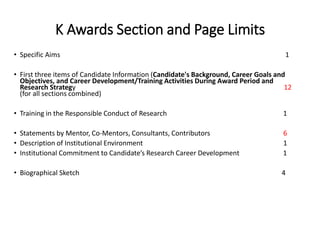
K Awards Section and Page Limits
• Specific Aims 1
• First three items of Candidate Information (Candidate's Background, Career Goals and
Objectives, and Career Development/Training Activities During Award Period and
Research Strategy 12
(for all sections combined)
• Training in the Responsible Conduct of Research 1
• Statements by Mentor, Co-Mentors, Consultants, Contributors 6
• Description of Institutional Environment 1
• Institutional Commitment to Candidate’s Research Career Development 1
• Biographical Sketch 4
K23/K08/KO1 Research Plan
Specific Aims and Research Strategy
• SPECIFIC AIMS (1 page)
•What do you intend to do?
• RESEARCH STRATEGY (12 pages, including Career Development Plan)
• Significance
•What has already been done in the field(s) and why is the proposed project important in
the context of prior work?
• Innovation
•What is novel about the proposed project and how will it advance the field(s)?
• Approach
•How are you going to achieve the specific aims of the project?
- Scientific Premise
Specific Aims
• One page limit
• One paragraph introduction to the topic: Broad enough to provide background
information yet narrow enough to provide focus for the project
• State concisely the goals of the proposed research and summarize the
expected outcome(s), including the impact that the results of the proposed
research will exert on the research field(s) involved
• List succinctly the specific objectives of the research proposed, e.g., to test a
stated hypothesis, create a novel design, solve a specific problem, challenge
an existing paradigm or clinical practice, address a critical barrier to progress
in the field, or develop new technology
• Focus and rewrite/hone
Research Strategy Significance (1-2 pages)
• Outline the background for the current proposal
• Critically evaluate current knowledge
• Supporting information
• Conflicting information
• Your own data, if available
• Identify gaps in existing knowledge that the project will fill
• Link to specific aims or hypotheses
• Link to broader, long-term objectives
Significance
•Outline the background
• Not a general review
• Select salient features and focus on key issues
• Provide perspective
• Develop concepts
•Evaluate current knowledge
• Consider conflicting views and acknowledge work that has
already been done
• Be knowledgeable
• Be diplomatic
• Be precise
Significance
• Make the task of the reviewer easy
• Develop a consistent sequence or pattern for the
discussion of the various specific aims or hypotheses
• Carry this sequence on through the Innovation and
Approach sections of the Research Strategy
• Carefully consider the placement of tables and figures
Scientific Premise
•Describe the scientific premise for the project,
including consideration of the strengths and
weaknesses of published research or preliminary data
crucial to the support of your application
• Example: ‘The rationale of our proposal is strongly supported by
published human and animal studies as by our own preliminary
data. Elucidating how EPO and iron will contribute to …will fill
important gaps in the understanding of’ ….
Innovation
•Identify key areas where information is missing, and
innovation is needed to fill knowledge gaps
• Focus the attention of the reviewer
• Make it interesting
• Sell the product
• Provide new information, either your own or others
• Offer new perspectives
•Describe how the specific aims or hypotheses will fill
gaps in our current knowledge
•Together, Specific Aims, Significance, and Innovation
should provide an integrated and compelling
justification for the project
Approach
•Preliminary data
•Describe the work to be done to
• Address each specific aim
• Test each hypothesis
•Outline how each study or experiment will address the
specific aims or hypotheses described previously
Approach
•Organization is important
•Follow a logical sequence
•Describe methods to be used
• General (overview)
• Study design
• Lab procedures
• Statistical procedures
• Justify
• Specific studies or experiments
• Technical / methodological issues
• Document
Approach
General Methods
• Clinical project
• Measurement instruments
• Study population
• Recruitment
• Longitudinal follow-up
• Laboratory project
• Cell or tissue culture methods
• Specific analytical procedures
• Precision and accuracy of methods
• Previous experience
Approach
Experimental Procedures
• Describe experiments in sufficient detail
• How they are done
• Data to be obtained
• How data are analyzed
• Results expected
• Conclusions reached
• Expected findings
• Unexpected findings
• Alternative interpretations
• Additional studies
• Relate results and interpretation to specific aims /
hypotheses
Approach
Experimental Procedures
• To address Specific Aim #1
• Experiment #1
• Experiment #2
• To address Specific Aim #2
• Experiment #3
• Experiment #4
• Experiment #5
Approach
Experimental Procedures
• To address Specific Aim #1
• Experiment #1
• Procedure
• Analysis / interpretation
New Application - Key Issues
•Can this person do the work?
• Proven methods
• Technical expertise
• Resources available
• Study population
• Access
• Follow-up
• Background and experience
• Publications
• Collaborators
Training in the Responsible Conduct of Research
•Class examples:
• Responsible Conduct of Research Involving Humans course
(Biomathematics M261)
• Research Integrity in Cellular Biology, Molecular Biology, and
Biochemistry Research (Chem C250)
• Ethics and Accountability in Biomedical Research (MIMG C234)
K23/K08/KO1 Research Plan: Specific Aims and
Research Strategy
Data and Safety Monitoring Plan (when applicable):
• Individual NIH institutes may have specific requirements for data
and safety monitoring of clinical trials. Candidates proposing to
conduct clinical trials should consult with relevant IC staff.
• A plan for data and safety monitoring must be included in
research plans involving phase I or phase II clinical trials. In
general, this requirement may be satisfied in the application by
providing documentation that the sponsoring institution has an
approved plan in place and providing a brief description of the
key elements of the plan.
K23/K08/KO1 Letters of Reference
• Electronic submission of reference letters is a separate process
from submitting an application electronically. Reference letters are
submitted directly by the referees through the eRA Commons; must
be submitted NO LATER THAN application submission due date.
• You must arrange to have at least 3 (but no more than 5) letters of
reference submitted on your behalf. The letters should be from
well-established scientists (referees) and should address your
qualifications and competence as well as your potential for
becoming an independent investigator. These letters should be
from individuals not directly involved in the application, but who
are familiar with your educational background, training, and
interests.
• Applications that are missing the required letters of reference may
be delayed in the review process or not accepted.
K23/K08/KO1 Environment and Institutional
Commitment to the Candidate
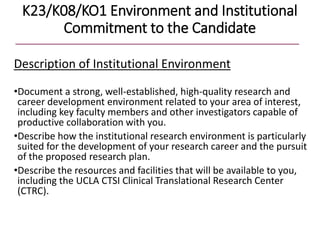
Description of Institutional Environment
•Document a strong, well-established, high-quality research and
career development environment related to your area of interest,
including key faculty members and other investigators capable of
productive collaboration with you.
•Describe how the institutional research environment is particularly
suited for the development of your research career and the pursuit
of the proposed research plan.
•Describe the resources and facilities that will be available to you,
including the UCLA CTSI Clinical Translational Research Center
(CTRC).
Environment and Institutional Commitment to
the Candidate
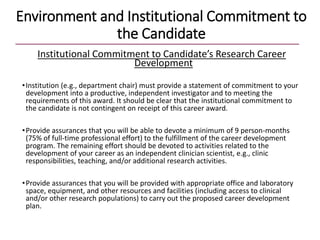
Institutional Commitment to Candidate’s Research Career
Development
•Institution (e.g., department chair) must provide a statement of commitment to your
development into a productive, independent investigator and to meeting the
requirements of this award. It should be clear that the institutional commitment to
the candidate is not contingent on receipt of this career award.
•Provide assurances that you will be able to devote a minimum of 9 person-months
(75% of full-time professional effort) to the fulfillment of the career development
program. The remaining effort should be devoted to activities related to the
development of your career as an independent clinician scientist, e.g., clinic
responsibilities, teaching, and/or additional research activities.
•Provide assurances that you will be provided with appropriate office and laboratory
space, equipment, and other resources and facilities (including access to clinical
and/or other research populations) to carry out the proposed career development
plan.
Environment and Institutional Commitment
to the Candidate
Institutional Commitment to Candidate’s Research
Career Development
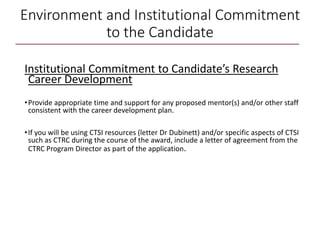
•Provide appropriate time and support for any proposed mentor(s) and/or other staff
consistent with the career development plan.
•If you will be using CTSI resources (letter Dr Dubinett) and/or specific aspects of CTSI
such as CTRC during the course of the award, include a letter of agreement from the
CTRC Program Director as part of the application.
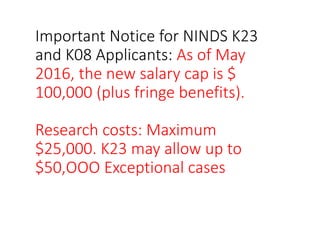
Important Notice for NINDS K23
and K08 Applicants: As of May
2016, the new salary cap is $
100,000 (plus fringe benefits).
Research costs: Maximum
$25,000. K23 may allow up to
$50,OOO Exceptional cases
Call for change
•Concern over reproducibility and
transparency in methods and reporting of
findings
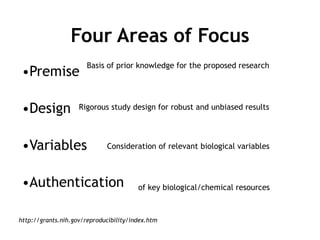
Four Areas of Focus
•Premise
•Design
•Variables
•Authentication
Basis of prior knowledge for the proposed research
Rigorous study design for robust and unbiased results
Consideration of relevant biological variables
of key biological/chemical resources
http://grants.nih.gov/reproducibility/index.htm
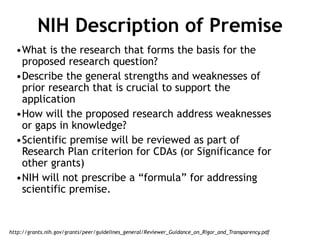
NIH Description of Premise
•What is the research that forms the basis for the
proposed research question?
•Describe the general strengths and weaknesses of
prior research that is crucial to support the
application
•How will the proposed research address weaknesses
or gaps in knowledge?
•Scientific premise will be reviewed as part of
Research Plan criterion for CDAs (or Significance for
other grants)
•NIH will not prescribe a “formula” for addressing
scientific premise.
http://grants.nih.gov/grants/peer/guidelines_general/Reviewer_Guidance_on_Rigor_and_Transparency.pdf
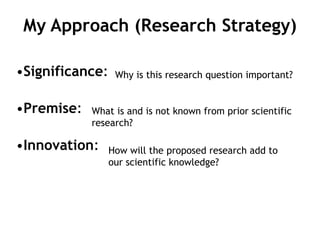
My Approach (Research Strategy)
•Significance:
•Premise:
•Innovation:
Why is this research question important?
What is and is not known from prior scientific
research?
How will the proposed research add to
our scientific knowledge?
Rigor
•“The strict application of the scientific method to
ensure robust and unbiased experimental design,
methodology, analysis, interpretation and reporting
of results.”
•”Full transparency in reporting experimental
details”
•Will be assessed as part of the Research Plan
criterion for CDAs (Approach criterion for other
grants)
http://grants.nih.gov/reproducibility/index.htm
Elements of Rigor
•Study design
•Appropriate controls
•Replication of experiments
•Randomization
•Blinding
•Sample size/power
•Statistical Methods
•Missing data
•Confounding variables
•Selection bias
Adapted from presentation by Jennifer Kemp, U of Colorado
Consideration of relevant
biological variables
•Consideration of “critical factors affecting health or
disease in vertebrate animals or human subjects.”
•Consideration of sex as a biological variables must
be addressed.
•Other biological variables: age, weight, genetic
strain.
•Can be taken into account in the Approach or
Research Plan criterion score.
Resource Authentication
• Key biological/chemical resources:
- May differ from lab to lab or over time
- Could influence research data
- Integral to proposed research
• Separate attachment (1 page or less) and should
not include authentication data.
• Will be reviewed after scoring grant.
Additional Sources for Instructions
• https://www.nih.gov/research-training/rigor-
reproducibility
• http://grants.nih.gov/reproducibility/index.htm
• http://grants.nih.gov/reproducibility/faqs.htm

Writing the NIH K Award (2021)

  • 1.
    K08 – K23 – KO1 Grant Applications Individual Career Development Awards Isidro B. Salusky, MD Distinguished Professor of Pediatrics Division Chief, Pediatric Nephrology Director Training Program in Translational Science David Geffen School of Medicine at UCLA
  • 2.
    K23/08/01: NIH MentoredClinical Scientist Research Career Development Award • Intensive, supervised research experience in the fields of biomedical and behavioral research, including translational research • Participating ICs vary in programmatic and budgetary specifics, and in size and duration of awards • Candidate must devote a minimum of 9 person months (75% of full-time professional effort) to specified research plan • In general, candidates can request 3-5 years, depending on individual needs to achieve research independence • Awards are not renewable and are not transferable from one PI to another • Not all ICs utilize the K08 so prospective applicants should contact the relevant NIH staff for IC-specific information on restrictions
  • 3.
    K23/K08 Application Outline(cont) • Specific Aims (1 page) • Career Development Plan Sections: Candidate's Background, Career Goals, and Objectives; Career Development/Training Activities during Award Period; Training in the Responsible Conduct of Research + Research Strategy Sections: Significance, Innovation, Scientific Premise, Approach = 12 pages total (including figures, tables, graphs, etc.) • Bibliography and Literature Cited • Human Subjects Sections: Protection of Human Subjects, Inclusion of Women and Minorities, Targeted/Planned Enrollment Table, Inclusion of Children • Other Research Plan Sections: Vertebrate Animals, Select Agent Scientific rigor and biological variables, Research, Consortium/Contractual Arrangements, Resource Sharing Plan
  • 4.
    K23/K08 Application Outline(cont) • Cover Letter (obligatory) • Letters of Reference (minimum 3, maximum 5): due by the application receipt deadline date • Statements of Support from Mentor, Co-Mentors, Consultants, Contributors • Appendix (optional)
  • 5.
    K23/K08/KO1: NIH MentoredResearch Career Development Award SPECIAL REQUIREMENT: Mentor(s) • Applicant must name a primary sponsor/mentor, who together with the candidate is responsible for the planning, direction, and execution of the career development program. Co-Primary mentors. • The mentor should be recognized as an accomplished investigator with a track record of success in training similar investigators. • The mentor should have sufficient independent support to cover the costs of the proposed project in excess of the allowable costs of this award. • Candidates may also nominate co-mentors as appropriate to the goals of the specified research program.
  • 6.
    MENTOR •Experience •Availability •Interest to work •Trackrecord with previous mentees •Adequate resources: grant support •The choice of one or two senior scientists is the single most important decision. Seek for complimentary expertise
  • 7.
    K23/K08/KO1: NIH MentoredResearch Career Development Award SPECIAL REQUIREMENT: Institutional Environment • Demonstrate your institution’s strong, well-established record of career development activities and faculty qualified in biomedical, behavioral, or clinical-translational research to serve as mentors. (CTSI award if available) • Demonstrate the institution’s commitment to your development as a productive investigator and willingness to allow the protected time needed to complete your career development program . • Describe a career development program that will maximize the use of this environment, including available facilities and resources.
  • 8.
    K23/K08 Candidate Informationand Career Development Plan Candidate’s Background • Describe your commitment to an academic career in patient- oriented research for the K23/KO1 or biomedical/behavioral research for the K08. • Describe your professional responsibilities in the grantee institution and elsewhere and show their relation to the proposed activities on the career award. • Present evidence of your ability to interact and collaborate with other scientists. • Describe prior training and how it relates to your objectives and long-term career plans.
  • 9.
    K23/K08/KO1 Candidate Informationand Career Development Plan Candidate’s Background (cont.) • Describe your research efforts to this point in your research career, including publications and prior research interests and experience. • Provide evidence of your potential to develop into an independent investigator. • Include a statement that you will commit at least 9 person-months (75% of full-time professional effort) to the research program and related career development activities. The mentor and department chair must agree and provide a statement in the application documenting that this percentage of protected time.
  • 10.
    K23/K08/KO1 Candidate Informationand Career Development Plan Career Goals and Objectives Describe a systematic plan that (1) shows a logical progression from prior research and training experiences to the training and research experiences that will occur during the career award period and then to independent investigator status (2) justifies the need for further career development to become an independent investigator (3) describes how your line of work that will differ from your mentor (4) utilizes the relevant research and educational resources of the institution
  • 11.
    K23/K08/KO1 Candidate Informationand Career Development Plan Career Development/Training Activities • You and your mentor(s) are jointly responsible for the preparation of the Career Development Plan. A timeline is often helpful. You may form an advisory committee to monitor progress through the career development program. • The didactic (if any) and the research aspects of the plan must be designed to develop the necessary knowledge and research skills in scientific areas relevant to your career goals. • Describe your professional responsibilities/activities, including other research projects, beyond the minimum required 75% effort commitment to the K award.
  • 12.
    Career Development andTraining Activities • Formal coursework • Meetings and seminars • Mentorship plan • Scientific meetings and papers • Career development timeline • Plan to independence
  • 13.
    Examples of FormalCoursework • Master of Science in Clinical Research • Audit/enroll in graduate courses: • Concepts in Molecular Biosciences (Molecular Biology 254A; 3 units) • Concepts in Molecular Biosciences (Molecular Biology 254B; 3 units) • Concepts in Molecular Biosciences (Molecular Biology 254C; 3 units) • Mechanisms and Modeling in Bioanalytical Assays (Biomath 209; 4 units) • Mouse Molecular Genetics (MIMG C222; 2 units)
  • 14.
    K23/K08/KO1 Statements ofSupport Statements by Mentor and Co-Mentors •The application must include a statement from the mentor, providing (1) information on his/her research qualifications and previous experience as a research supervisor (2) a plan that describes the nature of the direct supervision and mentoring that will occur during the proposed award period, as aligned with the Research Strategy (3) a plan for your career progression to move from the mentored stage to independent research investigator status during the project period of the award (4) a plan for monitoring your research, publications, and progression toward independence (5) documentation of the availability of sufficient research support and facilities for high-quality research (6) description of courses, seminars, and opportunities for interaction with other scientists and trainees, including training in career skills such as grant writing and effective presentations
  • 15.
    K23/K08/KO1 Statements ofSupport Statements by Mentor and Any Co-Mentors (cont.) •Similar information must be provided by any co-mentor (s). If more than one co-mentor is proposed, the respective areas of expertise and responsibility of each should be described. •Co-mentors should clearly describe how they will coordinate the mentoring of the candidate. If any of the co-mentors are not located at the home institution, a statement regarding the modes and frequency of communication with you should be provided. •The primary mentor must agree to provide annual evaluations of your progress as required in the annual progress report.
  • 16.
    K23/K08/KO1 Statements ofSupport Statement by Consultants and/or Contributors • Signed statements must be provided by each consultant/collaborator, confirming participation in the project and describing their specific roles. • Collaborators and consultants do not need to provide biographical sketches, but each must clearly document appropriate expertise in the proposed areas of consulting/collaboration. • Collaborators/consultants are generally not directly involved in the development of the career of the candidate as an independent investigator.
  • 17.
    K23/K08/KO1 Candidate Informationand Career Development Plan Training in the Responsible Conduct of Research • Applications must include a plan to obtain instruction in the responsible conduct of research. • Document prior instruction in responsible conduct of research during your current career stage (including the date of last occurrence) and propose plans to receive instruction in responsible conduct of research. • Such plans must address five instructional components: format, subject matter, faculty participation, duration of instruction, and frequency of instruction. • The plan may include career stage-appropriate, individualized instruction or independent scholarly activities that will enhance your understanding of ethical issues related to your specific research activities and the societal impact of that research. • The role of the sponsor/mentor in responsible conduct of research instruction must be described.
  • 18.
    K Awards Sectionand Page Limits • Specific Aims 1 • First three items of Candidate Information (Candidate's Background, Career Goals and Objectives, and Career Development/Training Activities During Award Period and Research Strategy 12 (for all sections combined) • Training in the Responsible Conduct of Research 1 • Statements by Mentor, Co-Mentors, Consultants, Contributors 6 • Description of Institutional Environment 1 • Institutional Commitment to Candidate’s Research Career Development 1 • Biographical Sketch 4
  • 19.
    K23/K08/KO1 Research Plan SpecificAims and Research Strategy • SPECIFIC AIMS (1 page) •What do you intend to do? • RESEARCH STRATEGY (12 pages, including Career Development Plan) • Significance •What has already been done in the field(s) and why is the proposed project important in the context of prior work? • Innovation •What is novel about the proposed project and how will it advance the field(s)? • Approach •How are you going to achieve the specific aims of the project? - Scientific Premise
  • 20.
    Specific Aims • Onepage limit • One paragraph introduction to the topic: Broad enough to provide background information yet narrow enough to provide focus for the project • State concisely the goals of the proposed research and summarize the expected outcome(s), including the impact that the results of the proposed research will exert on the research field(s) involved • List succinctly the specific objectives of the research proposed, e.g., to test a stated hypothesis, create a novel design, solve a specific problem, challenge an existing paradigm or clinical practice, address a critical barrier to progress in the field, or develop new technology • Focus and rewrite/hone
  • 21.
    Research Strategy Significance(1-2 pages) • Outline the background for the current proposal • Critically evaluate current knowledge • Supporting information • Conflicting information • Your own data, if available • Identify gaps in existing knowledge that the project will fill • Link to specific aims or hypotheses • Link to broader, long-term objectives
  • 22.
    Significance •Outline the background •Not a general review • Select salient features and focus on key issues • Provide perspective • Develop concepts •Evaluate current knowledge • Consider conflicting views and acknowledge work that has already been done • Be knowledgeable • Be diplomatic • Be precise
  • 23.
    Significance • Make thetask of the reviewer easy • Develop a consistent sequence or pattern for the discussion of the various specific aims or hypotheses • Carry this sequence on through the Innovation and Approach sections of the Research Strategy • Carefully consider the placement of tables and figures
  • 24.
    Scientific Premise •Describe thescientific premise for the project, including consideration of the strengths and weaknesses of published research or preliminary data crucial to the support of your application • Example: ‘The rationale of our proposal is strongly supported by published human and animal studies as by our own preliminary data. Elucidating how EPO and iron will contribute to …will fill important gaps in the understanding of’ ….
  • 25.
    Innovation •Identify key areaswhere information is missing, and innovation is needed to fill knowledge gaps • Focus the attention of the reviewer • Make it interesting • Sell the product • Provide new information, either your own or others • Offer new perspectives •Describe how the specific aims or hypotheses will fill gaps in our current knowledge •Together, Specific Aims, Significance, and Innovation should provide an integrated and compelling justification for the project
  • 26.
    Approach •Preliminary data •Describe thework to be done to • Address each specific aim • Test each hypothesis •Outline how each study or experiment will address the specific aims or hypotheses described previously
  • 27.
    Approach •Organization is important •Followa logical sequence •Describe methods to be used • General (overview) • Study design • Lab procedures • Statistical procedures • Justify • Specific studies or experiments • Technical / methodological issues • Document
  • 28.
    Approach General Methods • Clinicalproject • Measurement instruments • Study population • Recruitment • Longitudinal follow-up • Laboratory project • Cell or tissue culture methods • Specific analytical procedures • Precision and accuracy of methods • Previous experience
  • 29.
    Approach Experimental Procedures • Describeexperiments in sufficient detail • How they are done • Data to be obtained • How data are analyzed • Results expected • Conclusions reached • Expected findings • Unexpected findings • Alternative interpretations • Additional studies • Relate results and interpretation to specific aims / hypotheses
  • 30.
    Approach Experimental Procedures • Toaddress Specific Aim #1 • Experiment #1 • Experiment #2 • To address Specific Aim #2 • Experiment #3 • Experiment #4 • Experiment #5
  • 31.
    Approach Experimental Procedures • Toaddress Specific Aim #1 • Experiment #1 • Procedure • Analysis / interpretation
  • 32.
    New Application -Key Issues •Can this person do the work? • Proven methods • Technical expertise • Resources available • Study population • Access • Follow-up • Background and experience • Publications • Collaborators
  • 33.
    Training in theResponsible Conduct of Research •Class examples: • Responsible Conduct of Research Involving Humans course (Biomathematics M261) • Research Integrity in Cellular Biology, Molecular Biology, and Biochemistry Research (Chem C250) • Ethics and Accountability in Biomedical Research (MIMG C234)
  • 34.
    K23/K08/KO1 Research Plan:Specific Aims and Research Strategy Data and Safety Monitoring Plan (when applicable): • Individual NIH institutes may have specific requirements for data and safety monitoring of clinical trials. Candidates proposing to conduct clinical trials should consult with relevant IC staff. • A plan for data and safety monitoring must be included in research plans involving phase I or phase II clinical trials. In general, this requirement may be satisfied in the application by providing documentation that the sponsoring institution has an approved plan in place and providing a brief description of the key elements of the plan.
  • 35.
    K23/K08/KO1 Letters ofReference • Electronic submission of reference letters is a separate process from submitting an application electronically. Reference letters are submitted directly by the referees through the eRA Commons; must be submitted NO LATER THAN application submission due date. • You must arrange to have at least 3 (but no more than 5) letters of reference submitted on your behalf. The letters should be from well-established scientists (referees) and should address your qualifications and competence as well as your potential for becoming an independent investigator. These letters should be from individuals not directly involved in the application, but who are familiar with your educational background, training, and interests. • Applications that are missing the required letters of reference may be delayed in the review process or not accepted.
  • 36.
    K23/K08/KO1 Environment andInstitutional Commitment to the Candidate Description of Institutional Environment •Document a strong, well-established, high-quality research and career development environment related to your area of interest, including key faculty members and other investigators capable of productive collaboration with you. •Describe how the institutional research environment is particularly suited for the development of your research career and the pursuit of the proposed research plan. •Describe the resources and facilities that will be available to you, including the UCLA CTSI Clinical Translational Research Center (CTRC).
  • 37.
    Environment and InstitutionalCommitment to the Candidate Institutional Commitment to Candidate’s Research Career Development •Institution (e.g., department chair) must provide a statement of commitment to your development into a productive, independent investigator and to meeting the requirements of this award. It should be clear that the institutional commitment to the candidate is not contingent on receipt of this career award. •Provide assurances that you will be able to devote a minimum of 9 person-months (75% of full-time professional effort) to the fulfillment of the career development program. The remaining effort should be devoted to activities related to the development of your career as an independent clinician scientist, e.g., clinic responsibilities, teaching, and/or additional research activities. •Provide assurances that you will be provided with appropriate office and laboratory space, equipment, and other resources and facilities (including access to clinical and/or other research populations) to carry out the proposed career development plan.
  • 38.
    Environment and InstitutionalCommitment to the Candidate Institutional Commitment to Candidate’s Research Career Development •Provide appropriate time and support for any proposed mentor(s) and/or other staff consistent with the career development plan. •If you will be using CTSI resources (letter Dr Dubinett) and/or specific aspects of CTSI such as CTRC during the course of the award, include a letter of agreement from the CTRC Program Director as part of the application.
  • 39.
    Important Notice forNINDS K23 and K08 Applicants: As of May 2016, the new salary cap is $ 100,000 (plus fringe benefits). Research costs: Maximum $25,000. K23 may allow up to $50,OOO Exceptional cases
  • 43.
    Call for change •Concernover reproducibility and transparency in methods and reporting of findings
  • 44.
    Four Areas ofFocus •Premise •Design •Variables •Authentication Basis of prior knowledge for the proposed research Rigorous study design for robust and unbiased results Consideration of relevant biological variables of key biological/chemical resources http://grants.nih.gov/reproducibility/index.htm
  • 45.
    NIH Description ofPremise •What is the research that forms the basis for the proposed research question? •Describe the general strengths and weaknesses of prior research that is crucial to support the application •How will the proposed research address weaknesses or gaps in knowledge? •Scientific premise will be reviewed as part of Research Plan criterion for CDAs (or Significance for other grants) •NIH will not prescribe a “formula” for addressing scientific premise. http://grants.nih.gov/grants/peer/guidelines_general/Reviewer_Guidance_on_Rigor_and_Transparency.pdf
  • 46.
    My Approach (ResearchStrategy) •Significance: •Premise: •Innovation: Why is this research question important? What is and is not known from prior scientific research? How will the proposed research add to our scientific knowledge?
  • 47.
    Rigor •“The strict applicationof the scientific method to ensure robust and unbiased experimental design, methodology, analysis, interpretation and reporting of results.” •”Full transparency in reporting experimental details” •Will be assessed as part of the Research Plan criterion for CDAs (Approach criterion for other grants) http://grants.nih.gov/reproducibility/index.htm
  • 48.
    Elements of Rigor •Studydesign •Appropriate controls •Replication of experiments •Randomization •Blinding •Sample size/power •Statistical Methods •Missing data •Confounding variables •Selection bias Adapted from presentation by Jennifer Kemp, U of Colorado
  • 49.
    Consideration of relevant biologicalvariables •Consideration of “critical factors affecting health or disease in vertebrate animals or human subjects.” •Consideration of sex as a biological variables must be addressed. •Other biological variables: age, weight, genetic strain. •Can be taken into account in the Approach or Research Plan criterion score.
  • 50.
    Resource Authentication • Keybiological/chemical resources: - May differ from lab to lab or over time - Could influence research data - Integral to proposed research • Separate attachment (1 page or less) and should not include authentication data. • Will be reviewed after scoring grant.
  • 51.
    Additional Sources forInstructions • https://www.nih.gov/research-training/rigor- reproducibility • http://grants.nih.gov/reproducibility/index.htm • http://grants.nih.gov/reproducibility/faqs.htm