Rules of Origin
in FTA Systems
Gabby(Gabyoung) Shim
Director, FTA Cooperation Division,
Korea Customs Service
and
WCO Technical Trainer on ROO
SNU GSIS Training Program on FTA Policy & Strategy
April 29(Wed), 2015, Seoul National University, Korea
Contents
I. Korea’s FTA Implementation in Brief
II. Rules of Origin under FTA in Korea
III. Origin Procedure under FTA in Korea
IV. Summary and Implication
2
I. Korea’s FTA Implementation in Brief
3
4
Classification
(Number of
Countries)
In Effect
(11FTAs, 49
Countries)
Completed(
4, 4)
Negotiating
(3, 15)
Research
(7, 19)
Countries
Chile, EFTA,
Singapore, ASEAN,
India, EU, Peru,
USA, Turkey,
Australia, Canada
Colombia,
China
New Zealand
Vietnam
RCEP,
Indonesia,
K-C-J
Japan, Mexico,
GCC, MERCOSUR,
Israel, Central
America, Malaysia
Proportion of
FTA Trade
41.1 21.9 7.8 14.3
Accumulated
Percentage(%)
41.1 63.0 70.8 85.1
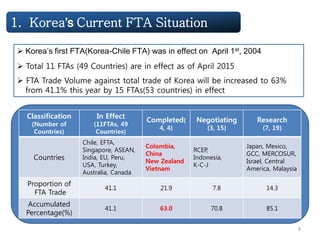
 Korea’s first FTA(Korea-Chile FTA) was in effect on April 1st, 2004
 Total 11 FTAs (49 Countries) are in effect as of April 2015
 FTA Trade Volume against total trade of Korea will be increased to 63%
from 41.1% this year by 15 FTAs(53 countries) in effect
1. Korea’s Current FTA Situation
Iceland, Norway, Switzerland,
Liechtenstein
Chile
Singapore
EFTA
ASEAN
KOREA
Indonesia, Laos,
Vietnam, Philippines,
Thailand, Cambodia,
Malaysia, Brunei,
Singapore, Myanmar
India
Peru
EU
K-Chile FTA
(Apr.2004)
K-Singapore]
(March 2006)
K-EFTA FTA
(Sept. 2006
K-ASEAN FTA
(June 2007)
K-India CEPA
(Jan. 2010)
K-EU FTA
(July 2011)
K-PERU FTA
(Aug. 2011)
K-USA FTA
(Mar. 2012)
USA
Turkey
2. Korea’s Current FTA Map
Australia
Canada
K-Turkey FTA
(May 2013)
K-Australia FTA
(Dec. 2014)
K-Canada FTA
(Jan. 2015)
China
Vietnam
Columbia
New Zealand
6
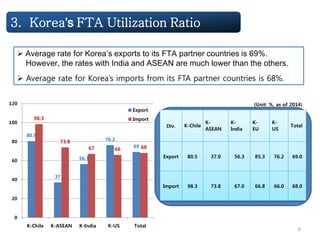
 Average rate for Korea’s exports to its FTA partner countries is 69%.
However, the rates with India and ASEAN are much lower than the others.
 Average rate for Korea’s imports from its FTA partner countries is 68%.
3. Korea’s FTA Utilization Ratio
Div. K-Chile
K-
ASEAN
K-
India
K-
EU
K-
US
Total
Export 80.5 37.0 56.3 85.3 76.2 69.0
Import 98.3 73.8 67.0 66.8 66.0 68.0
(Unit: %, as of 2014)
80.5
37
56.3
76.2
69
98.3
73.8
67 66 68
0
20
40
60
80
100
120
K-Chile K-ASEAN K-India K-US Total
Export
Import
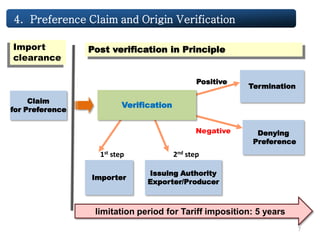
Claim
for Preference
Verification
Termination
Denying
Preference
Importer
Issuing Authority
Exporter/Producer
Negative
Post verification in PrincipleImport
clearance
1st step 2nd step
limitation period for Tariff imposition: 5 years
Positive
4. Preference Claim and Origin Verification
7
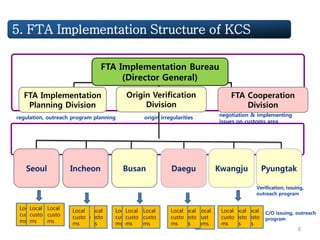
FTA Implementation Bureau
(Director General)
FTA Implementation
Planning Division
Origin Verification
Division
Daegu Kwangju PyungtakSeoul Incheon Busan
FTA Cooperation
Division
Local
custo
ms
Local
custo
ms
Local
custo
ms
Local
custo
ms
Local
custo
ms
Local
custo
ms
Local
cust
oms
Local
custo
ms
Local
custo
ms
Local
custo
ms
Local
custo
ms
Local
custo
ms
Local
custo
ms
Local
custo
ms
Local
custo
ms
regulation, outreach program planning origin irregularities negotiation & implementing
issues on customs area
Verification, issuing,
outreach program
C/O issuing, outreach
program
5. FTA Implementation Structure of KCS
8
II. Rules of Origin under FTA in Korea
9
Challenge1. Wholly Obtained Rule
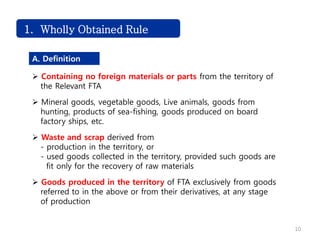
A. Definition
 Containing no foreign materials or parts from the territory of
the Relevant FTA
 Mineral goods, vegetable goods, Live animals, goods from
hunting, products of sea-fishing, goods produced on board
factory ships, etc.
 Waste and scrap derived from
- production in the territory, or
- used goods collected in the territory, provided such goods are
fit only for the recovery of raw materials
 Goods produced in the territory of FTA exclusively from goods
referred to in the above or from their derivatives, at any stage
of production
10
Challenge1. Wholly Obtained Rule
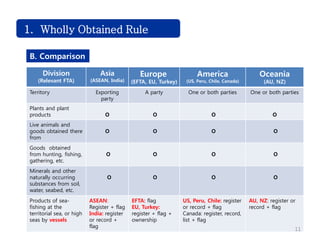
B. Comparison
Division
(Relevant FTA)
Asia
(ASEAN, India)
Europe
(EFTA, EU, Turkey)
America
(US, Peru, Chile, Canada)
Oceania
(AU, NZ)
Territory Exporting
party
A party One or both parties One or both parties
Plants and plant
products O O O O
Live animals and
goods obtained there
from
O O O O
Goods obtained
from hunting, fishing,
gathering, etc.
O O O O
Minerals and other
naturally occurring
substances from soil,
water, seabed, etc.
O O O O
Products of sea-
fishing at the
territorial sea, or high
seas by vessels
ASEAN:
Register + flag
India: register
or record +
flag
EFTA: flag
EU, Turkey:
register + flag +
ownership
US, Peru, Chile: register
or record + flag
Canada: register, record,
list + flag
AU, NZ: register or
record + flag
11
Challenge1. Wholly Obtained Rule
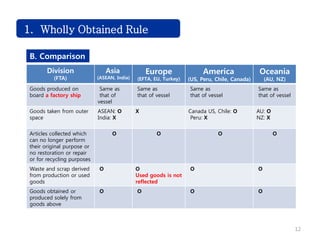
B. Comparison
Division
(FTA)
Asia
(ASEAN, India)
Europe
(EFTA, EU, Turkey)
America
(US, Peru, Chile, Canada)
Oceania
(AU, NZ)
Goods produced on
board a factory ship
Same as
that of
vessel
Same as
that of vessel
Same as
that of vessel
Same as
that of vessel
Goods taken from outer
space
ASEAN: O
India: X
X Canada US, Chile: O
Peru: X
AU: O
NZ: X
Articles collected which
can no longer perform
their original purpose or
no restoration or repair
or for recycling purposes
O O O O
Waste and scrap derived
from production or used
goods
O O
Used goods is not
reflected
O O
Goods obtained or
produced solely from
goods above
O O O O
12
Challenge1. Wholly Obtained Rule
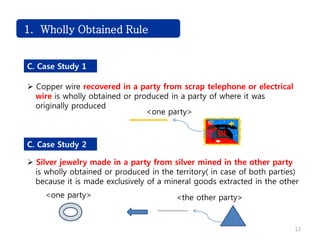
C. Case Study 1
 Copper wire recovered in a party from scrap telephone or electrical
wire is wholly obtained or produced in a party of where it was
originally produced
C. Case Study 2
 Silver jewelry made in a party from silver mined in the other party
is wholly obtained or produced in the territory( in case of both parties)
because it is made exclusively of a mineral goods extracted in the other
<one party>
<one party> <the other party>
13
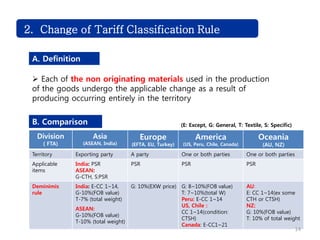
Challenge2. Change of Tariff Classification Rule
A. Definition
 Each of the non originating materials used in the production
of the goods undergo the applicable change as a result of
producing occurring entirely in the territory
B. Comparison
Division
( FTA)
Asia
(ASEAN, India)
Europe
(EFTA, EU, Turkey)
America
(US, Peru, Chile, Canada)
Oceania
(AU, NZ)
Territory Exporting party A party One or both parties One or both parties
Applicable
items
India: PSR
ASEAN:
G-CTH, S:PSR
PSR PSR PSR
Deminimis
rule
India: E-CC 1~14,
G-10%(FOB value)
T-7% (total weight)
ASEAN:
G-10%(FOB value)
T-10% (total weight)
G: 10%(EXW price) G: 8~10%(FOB value)
T: 7~10%(total W)
Peru: E-CC 1~14
US, Chile :
CC 1~14(condition:
CTSH)
Canada: E-CC1~21
AU:
E: CC 1~14(ex some
CTH or CTSH)
NZ:
G: 10%(FOB value)
T: 10% of total weight
(E: Except, G: General, T: Textile, S: Specific)
14
Challenge2. Change of Tariff Classification Rule
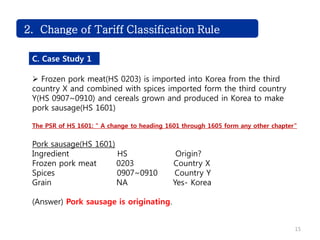
C. Case Study 1
 Frozen pork meat(HS 0203) is imported into Korea from the third
country X and combined with spices imported form the third country
Y(HS 0907~0910) and cereals grown and produced in Korea to make
pork sausage(HS 1601)
The PSR of HS 1601: “ A change to heading 1601 through 1605 form any other chapter”
Pork sausage(HS 1601)
Ingredient HS Origin?
Frozen pork meat 0203 Country X
Spices 0907~0910 Country Y
Grain NA Yes- Korea
(Answer) Pork sausage is originating.
15
Challenge2. Change of Tariff Classification Rule
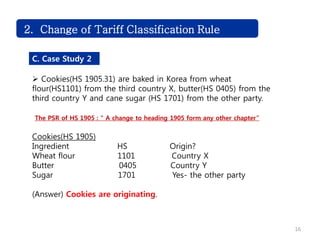
C. Case Study 2
 Cookies(HS 1905.31) are baked in Korea from wheat
flour(HS1101) from the third country X, butter(HS 0405) from the
third country Y and cane sugar (HS 1701) from the other party.
The PSR of HS 1905 : “ A change to heading 1905 form any other chapter”
Cookies(HS 1905)
Ingredient HS Origin?
Wheat flour 1101 Country X
Butter 0405 Country Y
Sugar 1701 Yes- the other party
(Answer) Cookies are originating.
16
Challenge
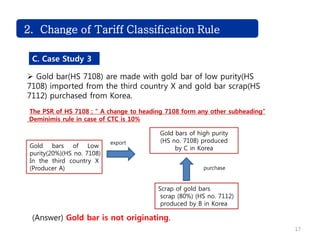
 Gold bar(HS 7108) are made with gold bar of low purity(HS
7108) imported from the third country X and gold bar scrap(HS
7112) purchased from Korea.
The PSR of HS 7108 : “ A change to heading 7108 form any other subheading”
Deminimis rule in case of CTC is 10%
2. Change of Tariff Classification Rule
C. Case Study 3
Gold bars of Low
purity(20%)(HS no. 7108)
In the third country X
(Producer A)
Scrap of gold bars
scrap (80%) (HS no. 7112)
produced by B in Korea
Gold bars of high purity
(HS no. 7108) produced
by C in Korea
(Answer) Gold bar is not originating.
export
purchase
17
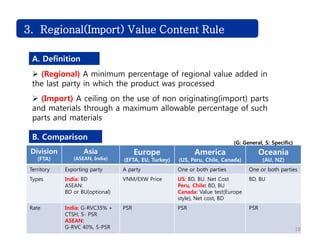
Challenge3. Regional(Import) Value Content Rule
A. Definition
B. Comparison
Division
(FTA)
Asia
(ASEAN, India)
Europe
(EFTA, EU, Turkey)
America
(US, Peru, Chile, Canada)
Oceania
(AU, NZ)
Territory Exporting party A party One or both parties One or both parties
Types India: BD
ASEAN:
BD or BU(optional)
VNM/EXW Price US: BD, BU. Net Cost
Peru, Chile: BD, BU
Canada: Value test(Europe
style), Net cost, BD
BD, BU
Rate India: G-RVC35% +
CTSH, S- PSR
ASEAN:
G-RVC 40%, S-PSR
PSR PSR PSR
(G: General, S: Specific)
 (Regional) A minimum percentage of regional value added in
the last party in which the product was processed
 (Import) A ceiling on the use of non originating(import) parts
and materials through a maximum allowable percentage of such
parts and materials
18
Challenge
C. Case Study
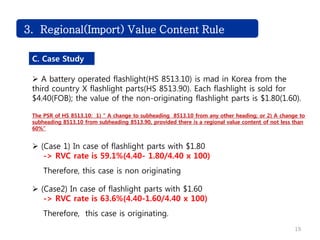
 A battery operated flashlight(HS 8513.10) is mad in Korea from the
third country X flashlight parts(HS 8513.90). Each flashlight is sold for
$4.40(FOB); the value of the non-originating flashlight parts is $1.80(1.60).
The PSR of HS 8513.10: 1) “ A change to subheading 8513.10 from any other heading; or 2) A change to
subheading 8513.10 from subheading 8513.90, provided there is a regional value content of not less than
60%”
 (Case 1) In case of flashlight parts with $1.80
-> RVC rate is 59.1%(4.40- 1.80/4.40 x 100)
Therefore, this case is non originating
 (Case2) In case of flashlight parts with $1.60
-> RVC rate is 63.6%(4.40-1.60/4.40 x 100)
Therefore, this case is originating.
3. Regional(Import) Value Content Rule
19
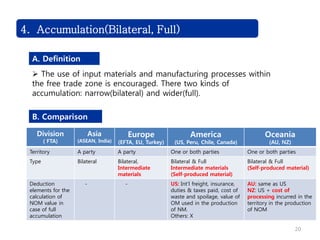
Challenge4. Accumulation(Bilateral, Full)
A. Definition
B. Comparison
Division
( FTA)
Asia
(ASEAN, India)
Europe
(EFTA, EU, Turkey)
America
(US, Peru, Chile, Canada)
Oceania
(AU, NZ)
Territory A party A party One or both parties One or both parties
Type Bilateral Bilateral,
Intermediate
materials
Bilateral & Full
Intermediate materials
(Self-produced material)
Bilateral & Full
(Self-produced material)
Deduction
elements for the
calculation of
NOM value in
case of full
accumulation
- - US: Int’l freight, insurance,
duties & taxes paid, cost of
waste and spoilage, value of
OM used in the production
of NM.
Others: X
AU: same as US
NZ: US + cost of
processing incurred in the
territory in the production
of NOM
 The use of input materials and manufacturing processes within
the free trade zone is encouraged. There two kinds of
accumulation: narrow(bilateral) and wider(full).
20
21
4. Accumulation(Bilateral, Full)
C. Case Study
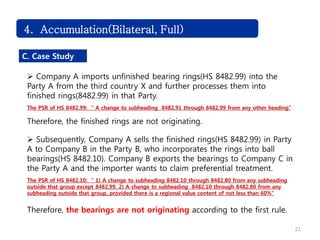
 Company A imports unfinished bearing rings(HS 8482.99) into the
Party A from the third country X and further processes them into
finished rings(8482.99) in that Party.
The PSR of HS 8482.99: “ A change to subheading 8482.91 through 8482.99 from any other heading”
Therefore, the finished rings are not originating.
 Subsequently, Company A sells the finished rings(HS 8482.99) in Party
A to Company B in the Party B, who incorporates the rings into ball
bearings(HS 8482.10). Company B exports the bearings to Company C in
the Party A and the importer wants to claim preferential treatment.
The PSR of HS 8482.10: “ 1) A change to subheading 8482.10 through 8482.80 from any subheading
outside that group except 8482.99, 2) A change to subheading 8482.10 through 8482.80 from any
subheading outside that group, provided there is a regional value content of not less than 60%”
Therefore, the bearings are not originating according to the first rule.
22
4. Accumulation(Bilateral, Full)
C. Case Study
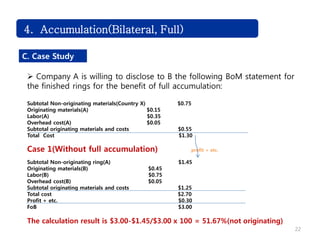
 Company A is willing to disclose to B the following BoM statement for
the finished rings for the benefit of full accumulation:
Subtotal Non-originating materials(Country X) $0.75
Originating materials(A) $0.15
Labor(A) $0.35
Overhead cost(A) $0.05
Subtotal originating materials and costs $0.55
Total Cost $1.30
Case 1(Without full accumulation) profit + etc.
Subtotal Non-originating ring(A) $1.45
Originating materials(B) $0.45
Labor(B) $0.75
Overhead cost(B) $0.05
Subtotal originating materials and costs $1.25
Total cost $2.70
Profit + etc. $0.30
FoB $3.00
The calculation result is $3.00-$1.45/$3.00 x 100 = 51.67%(not originating)
23
4. Accumulation(Bilateral, Full)
C. Case Study
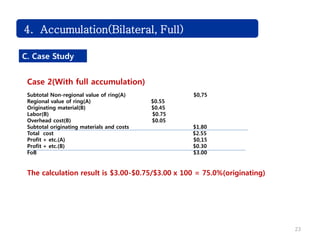
Case 2(With full accumulation)
Subtotal Non-regional value of ring(A) $0,75
Regional value of ring(A) $0.55
Originating material(B) $0.45
Labor(B) $0.75
Overhead cost(B) $0.05
Subtotal originating materials and costs $1.80
Total cost $2.55
Profit + etc.(A) $0,15
Profit + etc.(B) $0.30
FoB $3.00
The calculation result is $3.00-$0.75/$3.00 x 100 = 75.0%(originating)
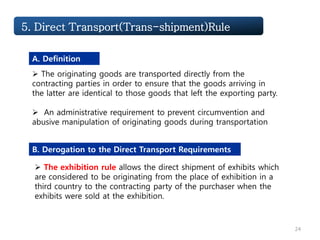
Challenge
A. Definition
B. Derogation to the Direct Transport Requirements
 The originating goods are transported directly from the
contracting parties in order to ensure that the goods arriving in
the latter are identical to those goods that left the exporting party.
 An administrative requirement to prevent circumvention and
abusive manipulation of originating goods during transportation
5. Direct Transport(Trans-shipment)Rule
 The exhibition rule allows the direct shipment of exhibits which
are considered to be originating from the place of exhibition in a
third country to the contracting party of the purchaser when the
exhibits were sold at the exhibition.
24
25
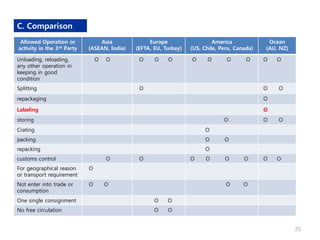
Allowed Operation or
activity in the 3rd Party
Asia
(ASEAN, India)
Europe
(EFTA, EU, Turkey)
America
(US, Chile, Peru, Canada)
Ocean
(AU, NZ)
Unloading, reloading,
any other operation in
keeping in good
condition
O O O O O O O O O O O
Splitting O O O
repackaging O
Labeling O
storing O O O
Crating O
packing O O
repacking O
customs control O O O O O O O O
For geographical reason
or transport requirement
O
Not enter into trade or
consumption
O O O O
One single consignment O O
No free circulation O O
C. Comparison
III. Origin Procedure under FTA in Korea
26
Challenge1. Origin Certification
Division
(FTA)
Asia
(ASEAN, India)
Europe
(EFTA, EU, Turkey)
America
(US, Peru, Canada, Chile)
Oceania
(AU, NZ)
Type Authority Exporter
* EU: approved
exporter
US: Exporter, Producer,
Importer
Peru: Authority or Exporter
Chile: Exporter
Canada: Exporter, Producer
AU: Authority, Exporter,
Producer
(KR: Exporter, Producer)
NZ: Exporter, Producer
Period of
Validity
1 year 1 year US: 4 years
Peru: 1 year
Chile, Canada: 2 years
2 years
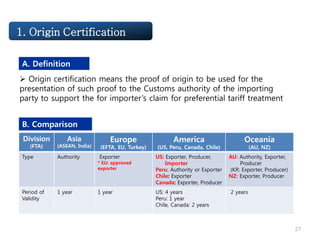
 Origin certification means the proof of origin to be used for the
presentation of such proof to the Customs authority of the importing
party to support the for importer’s claim for preferential tariff treatment
A. Definition
B. Comparison
27
Challenge2. Origin Verification
Division
(FTA)
Asia
(ASEAN, India)
Europe
(EFTA, EU, Turkey)
America
(US, Peru, Chile, Canada)
Oceania
(AU, NZ)
Type Indirect + Direct Indirect
(EU; Joint enquiry
EFTA, Turkey:
Observer)
US: Direct(Textile: Indirect)
Peru: Direct
Chile: Direct
Canada: Direct
Direct
Verification
Authority
Indirect: Issuing
Authority
Direct: Importing
customs
Exporting Customs Importing Customs
Textile(Exporting Customs)
Importing Customs
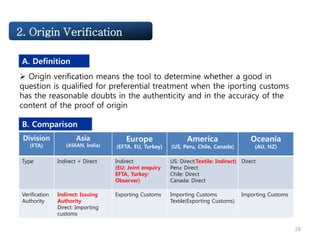
 Origin verification means the tool to determine whether a good in
question is qualified for preferential treatment when the iporting customs
has the reasonable doubts in the authenticity and in the accuracy of the
content of the proof of origin
A. Definition
B. Comparison
28
IV. Summary and Implication
29
30
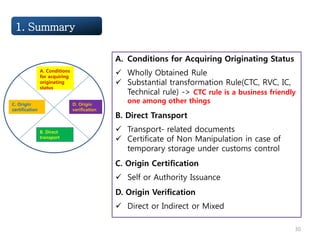
1. Summary
A. Conditions for Acquiring Originating Status
 Wholly Obtained Rule
 Substantial transformation Rule(CTC, RVC, IC,
Technical rule) -> CTC rule is a business friendly
one among other things
B. Direct Transport
 Transport- related documents
 Certificate of Non Manipulation in case of
temporary storage under customs control
C. Origin Certification
 Self or Authority Issuance
D. Origin Verification
 Direct or Indirect or Mixed
Condi
A. Conditions
for acquiring
originating
status
D. Origin
verification
C. Origin
certification
B. Direct
transport
31
2. Implications
Condi
A. Conditions
for acquiring
originating
status
D. Origin
verification
C. Origin
certification
B. Direct
transport
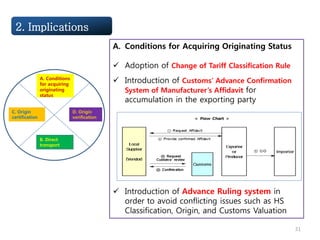
A. Conditions for Acquiring Originating Status
 Adoption of Change of Tariff Classification Rule
 Introduction of Customs’ Advance Confirmation
System of Manufacturer’s Affidavit for
accumulation in the exporting party
 Introduction of Advance Ruling system in
order to avoid conflicting issues such as HS
Classification, Origin, and Customs Valuation
32
2. Implications
Condi
A. Conditions
for acquiring
originating
status
D. Origin
verification
C. Origin
certification
B. Direct
transport
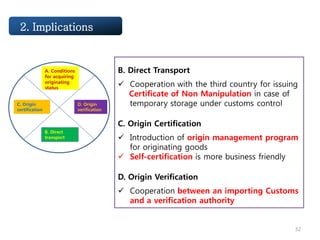
B. Direct Transport
 Cooperation with the third country for issuing
Certificate of Non Manipulation in case of
temporary storage under customs control
C. Origin Certification
 Introduction of origin management program
for originating goods
 Self-certification is more business friendly
D. Origin Verification
 Cooperation between an importing Customs
and a verification authority
KOREA CUSTOMS SERVICE
33
Contact Email address:
gyshim2000@gmail.com
KOREA CUSTOMS SERVICE
34

Policy of Free Trade Agreement in Korea.

  • 1.
    Rules of Origin inFTA Systems Gabby(Gabyoung) Shim Director, FTA Cooperation Division, Korea Customs Service and WCO Technical Trainer on ROO SNU GSIS Training Program on FTA Policy & Strategy April 29(Wed), 2015, Seoul National University, Korea
  • 2.
    Contents I. Korea’s FTAImplementation in Brief II. Rules of Origin under FTA in Korea III. Origin Procedure under FTA in Korea IV. Summary and Implication 2
  • 3.
    I. Korea’s FTAImplementation in Brief 3
  • 4.
    4 Classification (Number of Countries) In Effect (11FTAs,49 Countries) Completed( 4, 4) Negotiating (3, 15) Research (7, 19) Countries Chile, EFTA, Singapore, ASEAN, India, EU, Peru, USA, Turkey, Australia, Canada Colombia, China New Zealand Vietnam RCEP, Indonesia, K-C-J Japan, Mexico, GCC, MERCOSUR, Israel, Central America, Malaysia Proportion of FTA Trade 41.1 21.9 7.8 14.3 Accumulated Percentage(%) 41.1 63.0 70.8 85.1  Korea’s first FTA(Korea-Chile FTA) was in effect on April 1st, 2004  Total 11 FTAs (49 Countries) are in effect as of April 2015  FTA Trade Volume against total trade of Korea will be increased to 63% from 41.1% this year by 15 FTAs(53 countries) in effect 1. Korea’s Current FTA Situation
  • 5.
    Iceland, Norway, Switzerland, Liechtenstein Chile Singapore EFTA ASEAN KOREA Indonesia,Laos, Vietnam, Philippines, Thailand, Cambodia, Malaysia, Brunei, Singapore, Myanmar India Peru EU K-Chile FTA (Apr.2004) K-Singapore] (March 2006) K-EFTA FTA (Sept. 2006 K-ASEAN FTA (June 2007) K-India CEPA (Jan. 2010) K-EU FTA (July 2011) K-PERU FTA (Aug. 2011) K-USA FTA (Mar. 2012) USA Turkey 2. Korea’s Current FTA Map Australia Canada K-Turkey FTA (May 2013) K-Australia FTA (Dec. 2014) K-Canada FTA (Jan. 2015) China Vietnam Columbia New Zealand
  • 6.
    6  Average ratefor Korea’s exports to its FTA partner countries is 69%. However, the rates with India and ASEAN are much lower than the others.  Average rate for Korea’s imports from its FTA partner countries is 68%. 3. Korea’s FTA Utilization Ratio Div. K-Chile K- ASEAN K- India K- EU K- US Total Export 80.5 37.0 56.3 85.3 76.2 69.0 Import 98.3 73.8 67.0 66.8 66.0 68.0 (Unit: %, as of 2014) 80.5 37 56.3 76.2 69 98.3 73.8 67 66 68 0 20 40 60 80 100 120 K-Chile K-ASEAN K-India K-US Total Export Import
  • 7.
    Claim for Preference Verification Termination Denying Preference Importer Issuing Authority Exporter/Producer Negative Postverification in PrincipleImport clearance 1st step 2nd step limitation period for Tariff imposition: 5 years Positive 4. Preference Claim and Origin Verification 7
  • 8.
    FTA Implementation Bureau (DirectorGeneral) FTA Implementation Planning Division Origin Verification Division Daegu Kwangju PyungtakSeoul Incheon Busan FTA Cooperation Division Local custo ms Local custo ms Local custo ms Local custo ms Local custo ms Local custo ms Local cust oms Local custo ms Local custo ms Local custo ms Local custo ms Local custo ms Local custo ms Local custo ms Local custo ms regulation, outreach program planning origin irregularities negotiation & implementing issues on customs area Verification, issuing, outreach program C/O issuing, outreach program 5. FTA Implementation Structure of KCS 8
  • 9.
    II. Rules ofOrigin under FTA in Korea 9
  • 10.
    Challenge1. Wholly ObtainedRule A. Definition  Containing no foreign materials or parts from the territory of the Relevant FTA  Mineral goods, vegetable goods, Live animals, goods from hunting, products of sea-fishing, goods produced on board factory ships, etc.  Waste and scrap derived from - production in the territory, or - used goods collected in the territory, provided such goods are fit only for the recovery of raw materials  Goods produced in the territory of FTA exclusively from goods referred to in the above or from their derivatives, at any stage of production 10
  • 11.
    Challenge1. Wholly ObtainedRule B. Comparison Division (Relevant FTA) Asia (ASEAN, India) Europe (EFTA, EU, Turkey) America (US, Peru, Chile, Canada) Oceania (AU, NZ) Territory Exporting party A party One or both parties One or both parties Plants and plant products O O O O Live animals and goods obtained there from O O O O Goods obtained from hunting, fishing, gathering, etc. O O O O Minerals and other naturally occurring substances from soil, water, seabed, etc. O O O O Products of sea- fishing at the territorial sea, or high seas by vessels ASEAN: Register + flag India: register or record + flag EFTA: flag EU, Turkey: register + flag + ownership US, Peru, Chile: register or record + flag Canada: register, record, list + flag AU, NZ: register or record + flag 11
  • 12.
    Challenge1. Wholly ObtainedRule B. Comparison Division (FTA) Asia (ASEAN, India) Europe (EFTA, EU, Turkey) America (US, Peru, Chile, Canada) Oceania (AU, NZ) Goods produced on board a factory ship Same as that of vessel Same as that of vessel Same as that of vessel Same as that of vessel Goods taken from outer space ASEAN: O India: X X Canada US, Chile: O Peru: X AU: O NZ: X Articles collected which can no longer perform their original purpose or no restoration or repair or for recycling purposes O O O O Waste and scrap derived from production or used goods O O Used goods is not reflected O O Goods obtained or produced solely from goods above O O O O 12
  • 13.
    Challenge1. Wholly ObtainedRule C. Case Study 1  Copper wire recovered in a party from scrap telephone or electrical wire is wholly obtained or produced in a party of where it was originally produced C. Case Study 2  Silver jewelry made in a party from silver mined in the other party is wholly obtained or produced in the territory( in case of both parties) because it is made exclusively of a mineral goods extracted in the other <one party> <one party> <the other party> 13
  • 14.
    Challenge2. Change ofTariff Classification Rule A. Definition  Each of the non originating materials used in the production of the goods undergo the applicable change as a result of producing occurring entirely in the territory B. Comparison Division ( FTA) Asia (ASEAN, India) Europe (EFTA, EU, Turkey) America (US, Peru, Chile, Canada) Oceania (AU, NZ) Territory Exporting party A party One or both parties One or both parties Applicable items India: PSR ASEAN: G-CTH, S:PSR PSR PSR PSR Deminimis rule India: E-CC 1~14, G-10%(FOB value) T-7% (total weight) ASEAN: G-10%(FOB value) T-10% (total weight) G: 10%(EXW price) G: 8~10%(FOB value) T: 7~10%(total W) Peru: E-CC 1~14 US, Chile : CC 1~14(condition: CTSH) Canada: E-CC1~21 AU: E: CC 1~14(ex some CTH or CTSH) NZ: G: 10%(FOB value) T: 10% of total weight (E: Except, G: General, T: Textile, S: Specific) 14
  • 15.
    Challenge2. Change ofTariff Classification Rule C. Case Study 1  Frozen pork meat(HS 0203) is imported into Korea from the third country X and combined with spices imported form the third country Y(HS 0907~0910) and cereals grown and produced in Korea to make pork sausage(HS 1601) The PSR of HS 1601: “ A change to heading 1601 through 1605 form any other chapter” Pork sausage(HS 1601) Ingredient HS Origin? Frozen pork meat 0203 Country X Spices 0907~0910 Country Y Grain NA Yes- Korea (Answer) Pork sausage is originating. 15
  • 16.
    Challenge2. Change ofTariff Classification Rule C. Case Study 2  Cookies(HS 1905.31) are baked in Korea from wheat flour(HS1101) from the third country X, butter(HS 0405) from the third country Y and cane sugar (HS 1701) from the other party. The PSR of HS 1905 : “ A change to heading 1905 form any other chapter” Cookies(HS 1905) Ingredient HS Origin? Wheat flour 1101 Country X Butter 0405 Country Y Sugar 1701 Yes- the other party (Answer) Cookies are originating. 16
  • 17.
    Challenge  Gold bar(HS7108) are made with gold bar of low purity(HS 7108) imported from the third country X and gold bar scrap(HS 7112) purchased from Korea. The PSR of HS 7108 : “ A change to heading 7108 form any other subheading” Deminimis rule in case of CTC is 10% 2. Change of Tariff Classification Rule C. Case Study 3 Gold bars of Low purity(20%)(HS no. 7108) In the third country X (Producer A) Scrap of gold bars scrap (80%) (HS no. 7112) produced by B in Korea Gold bars of high purity (HS no. 7108) produced by C in Korea (Answer) Gold bar is not originating. export purchase 17
  • 18.
    Challenge3. Regional(Import) ValueContent Rule A. Definition B. Comparison Division (FTA) Asia (ASEAN, India) Europe (EFTA, EU, Turkey) America (US, Peru, Chile, Canada) Oceania (AU, NZ) Territory Exporting party A party One or both parties One or both parties Types India: BD ASEAN: BD or BU(optional) VNM/EXW Price US: BD, BU. Net Cost Peru, Chile: BD, BU Canada: Value test(Europe style), Net cost, BD BD, BU Rate India: G-RVC35% + CTSH, S- PSR ASEAN: G-RVC 40%, S-PSR PSR PSR PSR (G: General, S: Specific)  (Regional) A minimum percentage of regional value added in the last party in which the product was processed  (Import) A ceiling on the use of non originating(import) parts and materials through a maximum allowable percentage of such parts and materials 18
  • 19.
    Challenge C. Case Study A battery operated flashlight(HS 8513.10) is mad in Korea from the third country X flashlight parts(HS 8513.90). Each flashlight is sold for $4.40(FOB); the value of the non-originating flashlight parts is $1.80(1.60). The PSR of HS 8513.10: 1) “ A change to subheading 8513.10 from any other heading; or 2) A change to subheading 8513.10 from subheading 8513.90, provided there is a regional value content of not less than 60%”  (Case 1) In case of flashlight parts with $1.80 -> RVC rate is 59.1%(4.40- 1.80/4.40 x 100) Therefore, this case is non originating  (Case2) In case of flashlight parts with $1.60 -> RVC rate is 63.6%(4.40-1.60/4.40 x 100) Therefore, this case is originating. 3. Regional(Import) Value Content Rule 19
  • 20.
    Challenge4. Accumulation(Bilateral, Full) A.Definition B. Comparison Division ( FTA) Asia (ASEAN, India) Europe (EFTA, EU, Turkey) America (US, Peru, Chile, Canada) Oceania (AU, NZ) Territory A party A party One or both parties One or both parties Type Bilateral Bilateral, Intermediate materials Bilateral & Full Intermediate materials (Self-produced material) Bilateral & Full (Self-produced material) Deduction elements for the calculation of NOM value in case of full accumulation - - US: Int’l freight, insurance, duties & taxes paid, cost of waste and spoilage, value of OM used in the production of NM. Others: X AU: same as US NZ: US + cost of processing incurred in the territory in the production of NOM  The use of input materials and manufacturing processes within the free trade zone is encouraged. There two kinds of accumulation: narrow(bilateral) and wider(full). 20
  • 21.
    21 4. Accumulation(Bilateral, Full) C.Case Study  Company A imports unfinished bearing rings(HS 8482.99) into the Party A from the third country X and further processes them into finished rings(8482.99) in that Party. The PSR of HS 8482.99: “ A change to subheading 8482.91 through 8482.99 from any other heading” Therefore, the finished rings are not originating.  Subsequently, Company A sells the finished rings(HS 8482.99) in Party A to Company B in the Party B, who incorporates the rings into ball bearings(HS 8482.10). Company B exports the bearings to Company C in the Party A and the importer wants to claim preferential treatment. The PSR of HS 8482.10: “ 1) A change to subheading 8482.10 through 8482.80 from any subheading outside that group except 8482.99, 2) A change to subheading 8482.10 through 8482.80 from any subheading outside that group, provided there is a regional value content of not less than 60%” Therefore, the bearings are not originating according to the first rule.
  • 22.
    22 4. Accumulation(Bilateral, Full) C.Case Study  Company A is willing to disclose to B the following BoM statement for the finished rings for the benefit of full accumulation: Subtotal Non-originating materials(Country X) $0.75 Originating materials(A) $0.15 Labor(A) $0.35 Overhead cost(A) $0.05 Subtotal originating materials and costs $0.55 Total Cost $1.30 Case 1(Without full accumulation) profit + etc. Subtotal Non-originating ring(A) $1.45 Originating materials(B) $0.45 Labor(B) $0.75 Overhead cost(B) $0.05 Subtotal originating materials and costs $1.25 Total cost $2.70 Profit + etc. $0.30 FoB $3.00 The calculation result is $3.00-$1.45/$3.00 x 100 = 51.67%(not originating)
  • 23.
    23 4. Accumulation(Bilateral, Full) C.Case Study Case 2(With full accumulation) Subtotal Non-regional value of ring(A) $0,75 Regional value of ring(A) $0.55 Originating material(B) $0.45 Labor(B) $0.75 Overhead cost(B) $0.05 Subtotal originating materials and costs $1.80 Total cost $2.55 Profit + etc.(A) $0,15 Profit + etc.(B) $0.30 FoB $3.00 The calculation result is $3.00-$0.75/$3.00 x 100 = 75.0%(originating)
  • 24.
    Challenge A. Definition B. Derogationto the Direct Transport Requirements  The originating goods are transported directly from the contracting parties in order to ensure that the goods arriving in the latter are identical to those goods that left the exporting party.  An administrative requirement to prevent circumvention and abusive manipulation of originating goods during transportation 5. Direct Transport(Trans-shipment)Rule  The exhibition rule allows the direct shipment of exhibits which are considered to be originating from the place of exhibition in a third country to the contracting party of the purchaser when the exhibits were sold at the exhibition. 24
  • 25.
    25 Allowed Operation or activityin the 3rd Party Asia (ASEAN, India) Europe (EFTA, EU, Turkey) America (US, Chile, Peru, Canada) Ocean (AU, NZ) Unloading, reloading, any other operation in keeping in good condition O O O O O O O O O O O Splitting O O O repackaging O Labeling O storing O O O Crating O packing O O repacking O customs control O O O O O O O O For geographical reason or transport requirement O Not enter into trade or consumption O O O O One single consignment O O No free circulation O O C. Comparison
  • 26.
    III. Origin Procedureunder FTA in Korea 26
  • 27.
    Challenge1. Origin Certification Division (FTA) Asia (ASEAN,India) Europe (EFTA, EU, Turkey) America (US, Peru, Canada, Chile) Oceania (AU, NZ) Type Authority Exporter * EU: approved exporter US: Exporter, Producer, Importer Peru: Authority or Exporter Chile: Exporter Canada: Exporter, Producer AU: Authority, Exporter, Producer (KR: Exporter, Producer) NZ: Exporter, Producer Period of Validity 1 year 1 year US: 4 years Peru: 1 year Chile, Canada: 2 years 2 years  Origin certification means the proof of origin to be used for the presentation of such proof to the Customs authority of the importing party to support the for importer’s claim for preferential tariff treatment A. Definition B. Comparison 27
  • 28.
    Challenge2. Origin Verification Division (FTA) Asia (ASEAN,India) Europe (EFTA, EU, Turkey) America (US, Peru, Chile, Canada) Oceania (AU, NZ) Type Indirect + Direct Indirect (EU; Joint enquiry EFTA, Turkey: Observer) US: Direct(Textile: Indirect) Peru: Direct Chile: Direct Canada: Direct Direct Verification Authority Indirect: Issuing Authority Direct: Importing customs Exporting Customs Importing Customs Textile(Exporting Customs) Importing Customs  Origin verification means the tool to determine whether a good in question is qualified for preferential treatment when the iporting customs has the reasonable doubts in the authenticity and in the accuracy of the content of the proof of origin A. Definition B. Comparison 28
  • 29.
    IV. Summary andImplication 29
  • 30.
    30 1. Summary A. Conditionsfor Acquiring Originating Status  Wholly Obtained Rule  Substantial transformation Rule(CTC, RVC, IC, Technical rule) -> CTC rule is a business friendly one among other things B. Direct Transport  Transport- related documents  Certificate of Non Manipulation in case of temporary storage under customs control C. Origin Certification  Self or Authority Issuance D. Origin Verification  Direct or Indirect or Mixed Condi A. Conditions for acquiring originating status D. Origin verification C. Origin certification B. Direct transport
  • 31.
    31 2. Implications Condi A. Conditions foracquiring originating status D. Origin verification C. Origin certification B. Direct transport A. Conditions for Acquiring Originating Status  Adoption of Change of Tariff Classification Rule  Introduction of Customs’ Advance Confirmation System of Manufacturer’s Affidavit for accumulation in the exporting party  Introduction of Advance Ruling system in order to avoid conflicting issues such as HS Classification, Origin, and Customs Valuation
  • 32.
    32 2. Implications Condi A. Conditions foracquiring originating status D. Origin verification C. Origin certification B. Direct transport B. Direct Transport  Cooperation with the third country for issuing Certificate of Non Manipulation in case of temporary storage under customs control C. Origin Certification  Introduction of origin management program for originating goods  Self-certification is more business friendly D. Origin Verification  Cooperation between an importing Customs and a verification authority
  • 33.
    KOREA CUSTOMS SERVICE 33 ContactEmail address: gyshim2000@gmail.com
  • 34.