USMCA
Presented to the Saratoga
Prosperity Partnership
October 7, 2020
USMCA – What we see…
 A reset to a fair trade environment
 Integration of emerging technologies
 A counter to “non-market” practices
USMCA – Impact on commercial transport
Fasteraccess&entrybetweenmarkets
Lowertransactionalcostsforimporters,exporters&consumers
How?
• ContinueinvestmentsinrailinfrastructureacrosstheAmerica’s
• Focusedimprovementonbordercrossingfacilities(NY!)
• Chapter7(CustomsandTradefacilitation)
Expeditedrelease
Specialattentionto“expressshipments”
Singlewindowentryprocessing
USMCA updates the Criterion – but only by a bit.
In general, under the USMCA, a good is originating based on the following four Rules or Origin – assuming the good
satisfies all other applicable requirements. Preference criteria are as follows:
Criterion A: The good is wholly obtained or produced entirely in the territory of one or more of the USMCA countries, as
defined in Article 4.3 of the Agreement;
Criterion B: The good is produced entirely in the territory of one or more of the USMCA countries using non-originating
materials, provided the good satisfies all applicable requirements of product-specific rules of origin;
Criterion C: The good is produced entirely in the territory of one or more of the USMCA countries exclusively from
originating materials; or
Criterion D: The good is produced entirely in the territory of one or more of the USMCA countries. It is classified with its
materials, or satisfies the “unassembled goods” requirement, and meets a regional value content threshold of not less
than 60% if the transaction value method is used, or not less than 50% if the net cost method is used (not including RVC
for autos); except for goods in Chapter 61-63 of the HTSUS.
The De Minimus Change
• De Minimus under NAFTA was 7%. It’s now 10% under the USMCA. If the level of non-originating content is 10% or
less, it doesn’t render the good as non-originating as before even if the good fails to satisfy an applicable tariff shift or
RVC.
• A good will qualify as originating if the value of all non-originating materials used in its production that do not
undergo an applicable tariff shift doesn’t exceed 10% of the Transaction Value or the total cost of the good
(provided the good satisfies all other applicable origin requirements).
• A good that is otherwise subject to a RVC requirement will not be required to satisfy that requirement if the
value of all non-originating materials used in its production does not exceed 10% of the transaction value OR the
total cost of the good, provided the good satisfies all other applicable origin requirements.
• Most foods and agricultural products are ineligible for the de minimus exemptions, as with NAFTA.
RecoveredMaterialsProvision-
• A “recovered material” is defined in the USMCA as a form of a material that results from:
• The disassembly of a used good into individual parts, and
• The cleaning, inspecting, testing or other processing of those parts as necessary for improvement to sound working condition.
• A “recovered material” derived in the US/MX/CA will thus qualify as “originating” when it’s used in the production of, and incorporated into, a
“remanufactured good”. This is similar to other recovered materials provisions in other US FTA’s (US/AU FTA comes to mind).
• Accumulation – revised provision over NAFTA.
• A good is originating if it is produced in the US, Mexico or Canada by one or more producers, provided that it satisfies all applicable origin
requirements;
• An originating good or material that is produced in the US, Mexico or Canada is considered as originating in the territory of another
Party when it is used as a material in the production of a good there; and
• Production undertaken on a non-originating material in one or more of the Parties contributes to the originating status of the good,
regardless of whether that production was sufficient to confer originating status to the material itself.
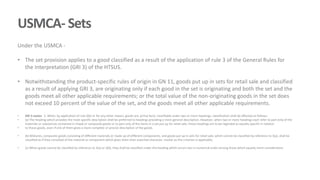
USMCA- Sets
Under the USMCA -
• The set provision applies to a good classified as a result of the application of rule 3 of the General Rules for
the Interpretation (GRI 3) of the HTSUS.
• Notwithstanding the product-specific rules of origin in GN 11, goods put up in sets for retail sale and classified
as a result of applying GRI 3, are originating only if each good in the set is originating and both the set and the
goods meet all other applicable requirements; or the total value of the non-originating goods in the set does
not exceed 10 percent of the value of the set, and the goods meet all other applicable requirements.
• GRI 3 states: 3. When, by application of rule 2(b) or for any other reason, goods are, prima facie, classifiable under two or more headings, classification shall be effected as follows:
• (a) The heading which provides the most specific description shall be preferred to headings providing a more general description. However, when two or more headings each refer to part only of the
materials or substances contained in mixed or composite goods or to part only of the items in a set put up for retail sale, those headings are to be regarded as equally specific in relation
• to those goods, even if one of them gives a more complete or precise description of the goods.
• (b) Mixtures, composite goods consisting of different materials or made up of different components, and goods put up in sets for retail sale, which cannot be classified by reference to 3(a), shall be
classified as if they consisted of the material or component which gives them their essential character, insofar as this criterion is applicable.
• (c) When goods cannot be classified by reference to 3(a) or 3(b), they shall be classified under the heading which occurs last in numerical order among those which equally merit consideration.
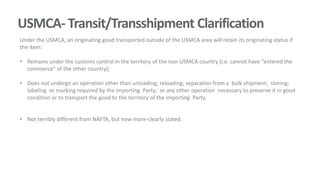
USMCA- Transit/Transshipment Clarification
Under the USMCA, an originating good transported outside of the USMCA area will retain its originating status if
the item:
• Remains under the customs control in the territory of the non-USMCA country (i.e. cannot have “entered the
commerce” of the other country);
• Does not undergo an operation other than unloading; reloading; separation from a bulk shipment; storing;
labeling or marking required by the importing Party; or any other operation necessary to preserve it in good
condition or to transport the good to the territory of the importing Party.
• Not terribly different from NAFTA, but now more-clearly stated.
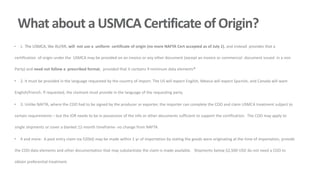
What about a USMCA Certificate of Origin?
• 1. The USMCA, like AU/KR, will not use a uniform certificate of origin (no more NAFTA Cert accepted as of July 1), and instead provides that a
certification of origin under the USMCA may be provided on an invoice or any other document (except an invoice or commercial document issued in a non
Party) and need not follow a prescribed format, provided that it contains 9 minimum data elements*
• 2. It must be provided in the language requested by the country of import. The US will expect English, Mexico will expect Spanish, and Canada will want
English/French. If requested, the claimant must provide in the language of the requesting party.
• 3. Unlike NAFTA, where the COO had to be signed by the producer or exporter, the importer can complete the COO and claim USMCA treatment subject to
certain requirements – but the IOR needs to be in possession of the info or other documents sufficient to support the certification. The COO may apply to
single shipments or cover a blanket 12-month timeframe- no change from NAFTA.
• 4 and more: A post entry claim via 520(d) may be made within 1 yr of importation by stating the goods were originating at the time of importation, provide
the COO data elements and other documentation that may substantiate the claim is made available. Shipments below $2,500 USD do not need a COO to
obtain preferential treatment.
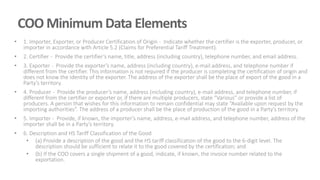
COO Minimum Data Elements
• 1. Importer, Exporter, or Producer Certification of Origin - Indicate whether the certifier is the exporter, producer, or
importer in accordance with Article 5.2 (Claims for Preferential Tariff Treatment).
• 2. Certifier - Provide the certifier’s name, title, address (including country), telephone number, and email address.
• 3. Exporter - Provide the exporter’s name, address (including country), e-mail address, and telephone number if
different from the certifier. This information is not required if the producer is completing the certification of origin and
does not know the identity of the exporter. The address of the exporter shall be the place of export of the good in a
Party’s territory.
• 4. Producer - Provide the producer’s name, address (including country), e-mail address, and telephone number, if
different from the certifier or exporter or, if there are multiple producers, state “Various” or provide a list of
producers. A person that wishes for this information to remain confidential may state “Available upon request by the
importing authorities”. The address of a producer shall be the place of production of the good in a Party’s territory.
• 5. Importer - Provide, if known, the importer’s name, address, e-mail address, and telephone number, address of the
importer shall be in a Party’s territory.
• 6. Description and HS Tariff Classification of the Good
• (a) Provide a description of the good and the HS tariff classification of the good to the 6-digit level. The
description should be sufficient to relate it to the good covered by the certification; and
• (b) If the COO covers a single shipment of a good, indicate, if known, the invoice number related to the
exportation.
COO-the final3DataElements -
• 7. Origin Criteria
Specify the origin criteria under which the good qualifies, as set out in Article 4.2
Originating Goods (A, B, C, or D)
• 8. Blanket Period
Include the period if the certification covers multiple shipments of identical goods for a specified
period of up to 12 months as set out in Article 5.2 (Claims for Preferential Tariff Treatment).
• 9. Authorized Signature and Date
The certification must be signed and dated by the certifier and accompanied by the following
statement:
“I certify that the goods described in this document qualify as originating and the
information contained in this document is true and accurate. I assume responsibility for
proving such representations and agree to maintain and present upon request or to make
available during a verification visit, documentation necessary to support this certification.”
Makinga ClaimforPreferentialTreatment
• An importer is required to have a valid certification of origin in its possession at the time the USMCA preference claim is made – no
change from NAFTA.
• If CBP requests the certification of origin and it is illegible, is defective on its face, or is incomplete, the importer will be granted a
period of not less than five working days to provide a copy of the corrected certification of origin.
• The certification may be submitted in English, Spanish, or French. If submitted to US Customs in Spanish or French, the English
translation should also be provided to CBP.
• A certification of origin is not required for: (1) a non-commercial importation of a good or (2) a commercial importation for which the
value of the originating goods does not exceed US $2,500, provided the importation does not form part of a series of importations
that may be considered to have been undertaken or arranged for purposes of evading U.S. laws, regulations, or procedures
governing claims for preferential treatment.
• If CBP determines that an importation described in this section is part of a series of importations carried out or planned for purposes
of evading compliance with preference requirements, the importer may be required to submit the certification of origin.
ProtestRights:
520(d) rules apply- no change from NAFTA.
You have one year from the date of import to file a 520(d) claim. No Post Summary Corrections are permitted.
What if CBP Denies a Claim Made for USMCA Duty Treatment?
Importers or other authorized parties may file a protest to contest a denial of preferential tariff treatment of a claim
made at entry pursuant to 19 USC 1514 within 180 days of liquidation. If approved, the goods will be eligible for
preferential treatment and CBP will refund the duties and MPF accordingly. If a protest relates to the analysis of the
Department of Labor relating to high-wage components of the labor value content requirements of a covered
vehicle, a protestant may not request accelerated disposition of the protest.
RecordkeepingConsiderations
Any importer who claims preferential tariff treatment under the Agreement for a good imported into the United States from a USMCA country must keep
the following documentation for a period of no less than five years from date of entry:
1. Records and supporting documentation related to the importation;
2. All records and supporting documents related to the origin of the good (including any certifications or copies thereof); and
3. Records and supporting documentation necessary to demonstrate compliance with the transit and transshipment provisions in Article 4.18 of the
Agreement.
Any exporter or producer who completes a USMCA certification of origin or provides a written representation for a good exported from the United States to
a USMCA country must keep all records and supporting documents related to the origin of the good (including the certification or copies thereof),
including records related to:
1. The purchase, cost, value, and shipping of, and payment for, the good or material;
2. The purchase, cost, value, and shipping of, and payment for, all materials, including indirect materials, used in the production of the good or material;
and
3. The production of the good in the form in which is exported or the production of the material in the form in which it was sold.
VERIFICATION:
CBP may initiate the verification to the importer or to the person who completed the certification of origin. If CBP initiates a verification to the exporter or
the producer, it will inform the importer of the initiation of the verification.
If CBP requests information from the importer and the importer does not provide sufficient information to demonstrate that the good is originating, and
the importer was not the certifier, CBP shall request information from the certifier (i.e., exporter or producer) before it may deny the claim for
preferential treatment.
Textiles-WearingApparel
Revised tariff shift rules have made only a few modifications from NAFTA. These rules allow manufacturers to use textile inputs not generally
available in North America (such as rayon fibers and visible lining fabric).
The USMCA modifies the chapter rules for goods classified in HTS chapters 61 and 62.
The USMCA increases the de minimis percentage of non-originating inputs allowed in qualifying goods from 7 to 10 percent (within the overall 10%
cap, the total weight of elastomeric content may not exceed 7%).
Other changes under the USMCA require that sewing thread, pocketing fabric, narrow elastic bands, and coated fabric used in the production of
apparel be made in North America in order for those products to be treated as originating (under the current NAFTA, these items can be sourced
from outside the region – USMCA ensures these secondary components originate within the region).
The USMCA reduces some TPLs for US imports from Canada and Mexico while substantially increasing TPLs for US exports to Canada of apparel and
other finished textile goods.
USMCA Definition: “textile or apparel good classified in HS subheading 4202.12, 4202.22, 4202.32, or 4202.92 (luggage, handbags and similar
articles with an outer surface of textile materials), heading 50.04 through 50.07, 51.04 through 51.13, 52.04 through 52.12, 53.03 through 53.11,
Chapter 54 through 63, heading 66.01 (umbrellas) or heading 70.19 (yarns and fabrics of glass fiber), subheading 9404.90 (articles of bedding and
similar furnishing), or heading 96.19 (babies diapers and other sanitary textile articles).”
TPL Defined: Tariff preference levels provide duty-free access for specified quantities of yarns, fabrics, apparel and made-up textile goods that do not meet the origin criteria (i.e.,
non-originating goods), but undergo significant processing in one or more Party countries. When imports exceed the established annual quantitative levels, the imported goods are
subject to most-favored nation (MFN) rates of duty. Imports under TPLs are exempt from merchandise processing fees.
More information
• Notable instructions for textile products:
• A yarn forward approach requires the yarn and intermediate fabric to originate in a party country and final cutting and sowing of the garment to occur
within a party country.
• Textile and other sets only qualify for the USMCA if every component in the set is originating, or if the entire set does not exceed 10% foreign value
content (i.e., the entire set meets de minimis).
• Specific rules are laid out for short supply goods, where textiles could still originate under the USMCA if the underlying yarn and fabrics cannot be timely
sourced in the Agreement's territory.
-----------------------------------------------------------------------------------------------------------------------------------------------------------------------------
The Merchandise Processing Fee (MPF) will continue to be waived when claiming preferential treatment when clearing a shipment; however,
the MPF will not be refunded in post importation claims, such as when the product was not declared as originating at the time of import.
• Importers will not be subject to penalties for an incorrect origin claim if they correct a declaration within 30 days of discovering the error;
however, they must pay any duties and MPF owed.
• NAFTA rulings will not apply to the USMCA – NAFTA duty deferral processes remain the same under USMCA
• How to Claim - July 1 2020: Dutiable tariff items eligible for preferential tariff treatment under the USMCA will indicate the SPI “S” or “S+” in
the “Special” subcolumn of the HTSUS. “S+” is designated for certain agricultural tariff rate quota (TRQs) goods, agricultural staging goods,
and textile tariff preference level (TPL) goods. SPI “S+” is used only when the HTSUS provides different preferential tariff treatment to each of
the USMCA countries. CargowiseOne has been updated to allow for this reporting. There is no more “CA” or “MX” shown in the HTSUS.
• USMCA preference may also be claimed on unconditionally free tariff items and is used to receive the exemption from Merchandise
Processing Fees (MPF), although the SPI “S” will not be listed in the “Special” subcolumn in the HTSUS for those items.
Q & A –
• What questions do you have?
• For more info:
• https://www.cbp.gov/trade/priority-issues/trade-agreements/free-trade-agreements/USMCA
• Uniform Regulations for Origin Procedures and Rules of Origin can be found at this url
Origin Procedures and Rules of Origin
For additional information:
• Tom Valentine, Vice President Transport, North America
• Contact: Tom.Valentine@mainfreightusa.com Phone: +1 518 573 8525
• Mark Neumann, Director of Customs / Compliance for Mainfreight, Inc.
• Contact: Mark.Neumann@mainfreightusa.com. Phone: +1 310 761 1511

USMCA - Mainfrieght slide deck

  • 1.
    USMCA Presented to theSaratoga Prosperity Partnership October 7, 2020
  • 2.
    USMCA – Whatwe see…  A reset to a fair trade environment  Integration of emerging technologies  A counter to “non-market” practices
  • 3.
    USMCA – Impacton commercial transport Fasteraccess&entrybetweenmarkets Lowertransactionalcostsforimporters,exporters&consumers How? • ContinueinvestmentsinrailinfrastructureacrosstheAmerica’s • Focusedimprovementonbordercrossingfacilities(NY!) • Chapter7(CustomsandTradefacilitation) Expeditedrelease Specialattentionto“expressshipments” Singlewindowentryprocessing
  • 4.
    USMCA updates theCriterion – but only by a bit. In general, under the USMCA, a good is originating based on the following four Rules or Origin – assuming the good satisfies all other applicable requirements. Preference criteria are as follows: Criterion A: The good is wholly obtained or produced entirely in the territory of one or more of the USMCA countries, as defined in Article 4.3 of the Agreement; Criterion B: The good is produced entirely in the territory of one or more of the USMCA countries using non-originating materials, provided the good satisfies all applicable requirements of product-specific rules of origin; Criterion C: The good is produced entirely in the territory of one or more of the USMCA countries exclusively from originating materials; or Criterion D: The good is produced entirely in the territory of one or more of the USMCA countries. It is classified with its materials, or satisfies the “unassembled goods” requirement, and meets a regional value content threshold of not less than 60% if the transaction value method is used, or not less than 50% if the net cost method is used (not including RVC for autos); except for goods in Chapter 61-63 of the HTSUS.
  • 5.
    The De MinimusChange • De Minimus under NAFTA was 7%. It’s now 10% under the USMCA. If the level of non-originating content is 10% or less, it doesn’t render the good as non-originating as before even if the good fails to satisfy an applicable tariff shift or RVC. • A good will qualify as originating if the value of all non-originating materials used in its production that do not undergo an applicable tariff shift doesn’t exceed 10% of the Transaction Value or the total cost of the good (provided the good satisfies all other applicable origin requirements). • A good that is otherwise subject to a RVC requirement will not be required to satisfy that requirement if the value of all non-originating materials used in its production does not exceed 10% of the transaction value OR the total cost of the good, provided the good satisfies all other applicable origin requirements. • Most foods and agricultural products are ineligible for the de minimus exemptions, as with NAFTA.
  • 6.
    RecoveredMaterialsProvision- • A “recoveredmaterial” is defined in the USMCA as a form of a material that results from: • The disassembly of a used good into individual parts, and • The cleaning, inspecting, testing or other processing of those parts as necessary for improvement to sound working condition. • A “recovered material” derived in the US/MX/CA will thus qualify as “originating” when it’s used in the production of, and incorporated into, a “remanufactured good”. This is similar to other recovered materials provisions in other US FTA’s (US/AU FTA comes to mind). • Accumulation – revised provision over NAFTA. • A good is originating if it is produced in the US, Mexico or Canada by one or more producers, provided that it satisfies all applicable origin requirements; • An originating good or material that is produced in the US, Mexico or Canada is considered as originating in the territory of another Party when it is used as a material in the production of a good there; and • Production undertaken on a non-originating material in one or more of the Parties contributes to the originating status of the good, regardless of whether that production was sufficient to confer originating status to the material itself.
  • 7.
    USMCA- Sets Under theUSMCA - • The set provision applies to a good classified as a result of the application of rule 3 of the General Rules for the Interpretation (GRI 3) of the HTSUS. • Notwithstanding the product-specific rules of origin in GN 11, goods put up in sets for retail sale and classified as a result of applying GRI 3, are originating only if each good in the set is originating and both the set and the goods meet all other applicable requirements; or the total value of the non-originating goods in the set does not exceed 10 percent of the value of the set, and the goods meet all other applicable requirements. • GRI 3 states: 3. When, by application of rule 2(b) or for any other reason, goods are, prima facie, classifiable under two or more headings, classification shall be effected as follows: • (a) The heading which provides the most specific description shall be preferred to headings providing a more general description. However, when two or more headings each refer to part only of the materials or substances contained in mixed or composite goods or to part only of the items in a set put up for retail sale, those headings are to be regarded as equally specific in relation • to those goods, even if one of them gives a more complete or precise description of the goods. • (b) Mixtures, composite goods consisting of different materials or made up of different components, and goods put up in sets for retail sale, which cannot be classified by reference to 3(a), shall be classified as if they consisted of the material or component which gives them their essential character, insofar as this criterion is applicable. • (c) When goods cannot be classified by reference to 3(a) or 3(b), they shall be classified under the heading which occurs last in numerical order among those which equally merit consideration.
  • 8.
    USMCA- Transit/Transshipment Clarification Underthe USMCA, an originating good transported outside of the USMCA area will retain its originating status if the item: • Remains under the customs control in the territory of the non-USMCA country (i.e. cannot have “entered the commerce” of the other country); • Does not undergo an operation other than unloading; reloading; separation from a bulk shipment; storing; labeling or marking required by the importing Party; or any other operation necessary to preserve it in good condition or to transport the good to the territory of the importing Party. • Not terribly different from NAFTA, but now more-clearly stated.
  • 9.
    What about aUSMCA Certificate of Origin? • 1. The USMCA, like AU/KR, will not use a uniform certificate of origin (no more NAFTA Cert accepted as of July 1), and instead provides that a certification of origin under the USMCA may be provided on an invoice or any other document (except an invoice or commercial document issued in a non Party) and need not follow a prescribed format, provided that it contains 9 minimum data elements* • 2. It must be provided in the language requested by the country of import. The US will expect English, Mexico will expect Spanish, and Canada will want English/French. If requested, the claimant must provide in the language of the requesting party. • 3. Unlike NAFTA, where the COO had to be signed by the producer or exporter, the importer can complete the COO and claim USMCA treatment subject to certain requirements – but the IOR needs to be in possession of the info or other documents sufficient to support the certification. The COO may apply to single shipments or cover a blanket 12-month timeframe- no change from NAFTA. • 4 and more: A post entry claim via 520(d) may be made within 1 yr of importation by stating the goods were originating at the time of importation, provide the COO data elements and other documentation that may substantiate the claim is made available. Shipments below $2,500 USD do not need a COO to obtain preferential treatment.
  • 10.
    COO Minimum DataElements • 1. Importer, Exporter, or Producer Certification of Origin - Indicate whether the certifier is the exporter, producer, or importer in accordance with Article 5.2 (Claims for Preferential Tariff Treatment). • 2. Certifier - Provide the certifier’s name, title, address (including country), telephone number, and email address. • 3. Exporter - Provide the exporter’s name, address (including country), e-mail address, and telephone number if different from the certifier. This information is not required if the producer is completing the certification of origin and does not know the identity of the exporter. The address of the exporter shall be the place of export of the good in a Party’s territory. • 4. Producer - Provide the producer’s name, address (including country), e-mail address, and telephone number, if different from the certifier or exporter or, if there are multiple producers, state “Various” or provide a list of producers. A person that wishes for this information to remain confidential may state “Available upon request by the importing authorities”. The address of a producer shall be the place of production of the good in a Party’s territory. • 5. Importer - Provide, if known, the importer’s name, address, e-mail address, and telephone number, address of the importer shall be in a Party’s territory. • 6. Description and HS Tariff Classification of the Good • (a) Provide a description of the good and the HS tariff classification of the good to the 6-digit level. The description should be sufficient to relate it to the good covered by the certification; and • (b) If the COO covers a single shipment of a good, indicate, if known, the invoice number related to the exportation.
  • 11.
    COO-the final3DataElements - •7. Origin Criteria Specify the origin criteria under which the good qualifies, as set out in Article 4.2 Originating Goods (A, B, C, or D) • 8. Blanket Period Include the period if the certification covers multiple shipments of identical goods for a specified period of up to 12 months as set out in Article 5.2 (Claims for Preferential Tariff Treatment). • 9. Authorized Signature and Date The certification must be signed and dated by the certifier and accompanied by the following statement: “I certify that the goods described in this document qualify as originating and the information contained in this document is true and accurate. I assume responsibility for proving such representations and agree to maintain and present upon request or to make available during a verification visit, documentation necessary to support this certification.”
  • 12.
    Makinga ClaimforPreferentialTreatment • Animporter is required to have a valid certification of origin in its possession at the time the USMCA preference claim is made – no change from NAFTA. • If CBP requests the certification of origin and it is illegible, is defective on its face, or is incomplete, the importer will be granted a period of not less than five working days to provide a copy of the corrected certification of origin. • The certification may be submitted in English, Spanish, or French. If submitted to US Customs in Spanish or French, the English translation should also be provided to CBP. • A certification of origin is not required for: (1) a non-commercial importation of a good or (2) a commercial importation for which the value of the originating goods does not exceed US $2,500, provided the importation does not form part of a series of importations that may be considered to have been undertaken or arranged for purposes of evading U.S. laws, regulations, or procedures governing claims for preferential treatment. • If CBP determines that an importation described in this section is part of a series of importations carried out or planned for purposes of evading compliance with preference requirements, the importer may be required to submit the certification of origin.
  • 13.
    ProtestRights: 520(d) rules apply-no change from NAFTA. You have one year from the date of import to file a 520(d) claim. No Post Summary Corrections are permitted. What if CBP Denies a Claim Made for USMCA Duty Treatment? Importers or other authorized parties may file a protest to contest a denial of preferential tariff treatment of a claim made at entry pursuant to 19 USC 1514 within 180 days of liquidation. If approved, the goods will be eligible for preferential treatment and CBP will refund the duties and MPF accordingly. If a protest relates to the analysis of the Department of Labor relating to high-wage components of the labor value content requirements of a covered vehicle, a protestant may not request accelerated disposition of the protest.
  • 14.
    RecordkeepingConsiderations Any importer whoclaims preferential tariff treatment under the Agreement for a good imported into the United States from a USMCA country must keep the following documentation for a period of no less than five years from date of entry: 1. Records and supporting documentation related to the importation; 2. All records and supporting documents related to the origin of the good (including any certifications or copies thereof); and 3. Records and supporting documentation necessary to demonstrate compliance with the transit and transshipment provisions in Article 4.18 of the Agreement. Any exporter or producer who completes a USMCA certification of origin or provides a written representation for a good exported from the United States to a USMCA country must keep all records and supporting documents related to the origin of the good (including the certification or copies thereof), including records related to: 1. The purchase, cost, value, and shipping of, and payment for, the good or material; 2. The purchase, cost, value, and shipping of, and payment for, all materials, including indirect materials, used in the production of the good or material; and 3. The production of the good in the form in which is exported or the production of the material in the form in which it was sold. VERIFICATION: CBP may initiate the verification to the importer or to the person who completed the certification of origin. If CBP initiates a verification to the exporter or the producer, it will inform the importer of the initiation of the verification. If CBP requests information from the importer and the importer does not provide sufficient information to demonstrate that the good is originating, and the importer was not the certifier, CBP shall request information from the certifier (i.e., exporter or producer) before it may deny the claim for preferential treatment.
  • 15.
    Textiles-WearingApparel Revised tariff shiftrules have made only a few modifications from NAFTA. These rules allow manufacturers to use textile inputs not generally available in North America (such as rayon fibers and visible lining fabric). The USMCA modifies the chapter rules for goods classified in HTS chapters 61 and 62. The USMCA increases the de minimis percentage of non-originating inputs allowed in qualifying goods from 7 to 10 percent (within the overall 10% cap, the total weight of elastomeric content may not exceed 7%). Other changes under the USMCA require that sewing thread, pocketing fabric, narrow elastic bands, and coated fabric used in the production of apparel be made in North America in order for those products to be treated as originating (under the current NAFTA, these items can be sourced from outside the region – USMCA ensures these secondary components originate within the region). The USMCA reduces some TPLs for US imports from Canada and Mexico while substantially increasing TPLs for US exports to Canada of apparel and other finished textile goods. USMCA Definition: “textile or apparel good classified in HS subheading 4202.12, 4202.22, 4202.32, or 4202.92 (luggage, handbags and similar articles with an outer surface of textile materials), heading 50.04 through 50.07, 51.04 through 51.13, 52.04 through 52.12, 53.03 through 53.11, Chapter 54 through 63, heading 66.01 (umbrellas) or heading 70.19 (yarns and fabrics of glass fiber), subheading 9404.90 (articles of bedding and similar furnishing), or heading 96.19 (babies diapers and other sanitary textile articles).” TPL Defined: Tariff preference levels provide duty-free access for specified quantities of yarns, fabrics, apparel and made-up textile goods that do not meet the origin criteria (i.e., non-originating goods), but undergo significant processing in one or more Party countries. When imports exceed the established annual quantitative levels, the imported goods are subject to most-favored nation (MFN) rates of duty. Imports under TPLs are exempt from merchandise processing fees.
  • 16.
    More information • Notableinstructions for textile products: • A yarn forward approach requires the yarn and intermediate fabric to originate in a party country and final cutting and sowing of the garment to occur within a party country. • Textile and other sets only qualify for the USMCA if every component in the set is originating, or if the entire set does not exceed 10% foreign value content (i.e., the entire set meets de minimis). • Specific rules are laid out for short supply goods, where textiles could still originate under the USMCA if the underlying yarn and fabrics cannot be timely sourced in the Agreement's territory. ----------------------------------------------------------------------------------------------------------------------------------------------------------------------------- The Merchandise Processing Fee (MPF) will continue to be waived when claiming preferential treatment when clearing a shipment; however, the MPF will not be refunded in post importation claims, such as when the product was not declared as originating at the time of import. • Importers will not be subject to penalties for an incorrect origin claim if they correct a declaration within 30 days of discovering the error; however, they must pay any duties and MPF owed. • NAFTA rulings will not apply to the USMCA – NAFTA duty deferral processes remain the same under USMCA • How to Claim - July 1 2020: Dutiable tariff items eligible for preferential tariff treatment under the USMCA will indicate the SPI “S” or “S+” in the “Special” subcolumn of the HTSUS. “S+” is designated for certain agricultural tariff rate quota (TRQs) goods, agricultural staging goods, and textile tariff preference level (TPL) goods. SPI “S+” is used only when the HTSUS provides different preferential tariff treatment to each of the USMCA countries. CargowiseOne has been updated to allow for this reporting. There is no more “CA” or “MX” shown in the HTSUS. • USMCA preference may also be claimed on unconditionally free tariff items and is used to receive the exemption from Merchandise Processing Fees (MPF), although the SPI “S” will not be listed in the “Special” subcolumn in the HTSUS for those items.
  • 17.
    Q & A– • What questions do you have? • For more info: • https://www.cbp.gov/trade/priority-issues/trade-agreements/free-trade-agreements/USMCA • Uniform Regulations for Origin Procedures and Rules of Origin can be found at this url Origin Procedures and Rules of Origin For additional information: • Tom Valentine, Vice President Transport, North America • Contact: Tom.Valentine@mainfreightusa.com Phone: +1 518 573 8525 • Mark Neumann, Director of Customs / Compliance for Mainfreight, Inc. • Contact: Mark.Neumann@mainfreightusa.com. Phone: +1 310 761 1511

Editor's Notes

  • #3 labor costs // agricultural tariffs // addressing trade imbalances SME’s // Digital platforms // Financial services // Environmental // Telecom & IP verticals currency manipulation // Anti-corruption // State-owned or controlled enterprises