Music: An Appreciation 7 th  brief Edition by Roger Kamien  2011 © McGraw-Hill Higher Education
Part 5, Chapter 3 The Art Song Composition for solo voice and piano Accompaniment integral part of the song Linked to vast amount of poetry in this period Composers interpreted poems,  translating mood, atmosphere and imagery into music Mood summed up at end with piano  postlude Forms Strophic form repeats music for each verse Through-composed—new music each verse Sometimes  modified strophic  form used The Song Cycle Group of songs unified in some manne Storyline or musical idea may link the songs
Franz Schubert Viennese composer (1797-1828) Prodigious output When 18 years old wrote 143 songs At 19 years wrote 179 works Included 2 symphonies, opera & mass Schubert’s Music Wrote over 600 songs Also symphonies, string quartets, other chamber music, sonatas, masses, operas, & piano works Including The  Unfinished Symphony : only 2 movements, not 4
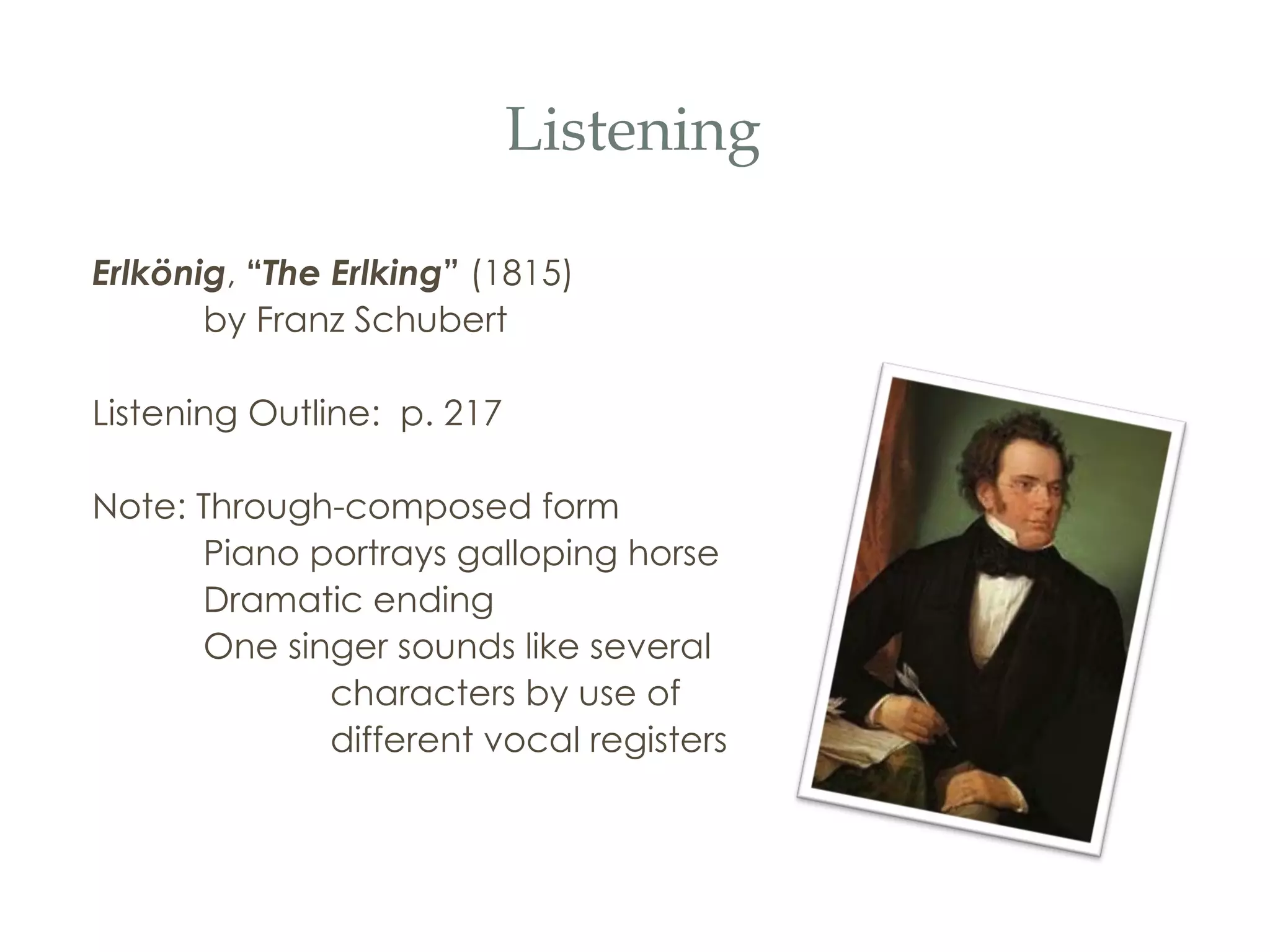
Listening Erlk ö nig ,  “ The Erlking ”  (1815) by Franz Schubert Listening Outline:  p. 217 Note: Through-composed form Piano portrays galloping horse Dramatic ending One singer sounds like several  characters by use of  different vocal registers
Robert Schumann German composer (1810-1856) Wanted to be piano virtuoso Married his piano teacher’s daughter, Clara Temperamentally unsuited for some of the musical positions he attempted Committed to asylum where he died Robert Schumann’s Music Wrote piano pieces, art songs, and later symphonies Piano pieces and art songs frequently in cycles
Listening Selected movements from  Carnaval   (1834) by Robert Schumann Listening Outline:  p. 221 Estrella Note:  Ternary form syncopation in B section Reconnaissance  (Reunion) Note:  Ternary form B section shifts from homophonic to polyphonic texture
Clara Wieck Schumann German composer (1819-1896) Leading concert pianist and female composer Married Robert Schumann Stopped composing after his death to focus on performing his works Friends with young Johannes Brahms Clara Schumann’s Music Stopped composing at age 36 Considered herself primarily a performer Wrote songs, piano pieces, a concerto
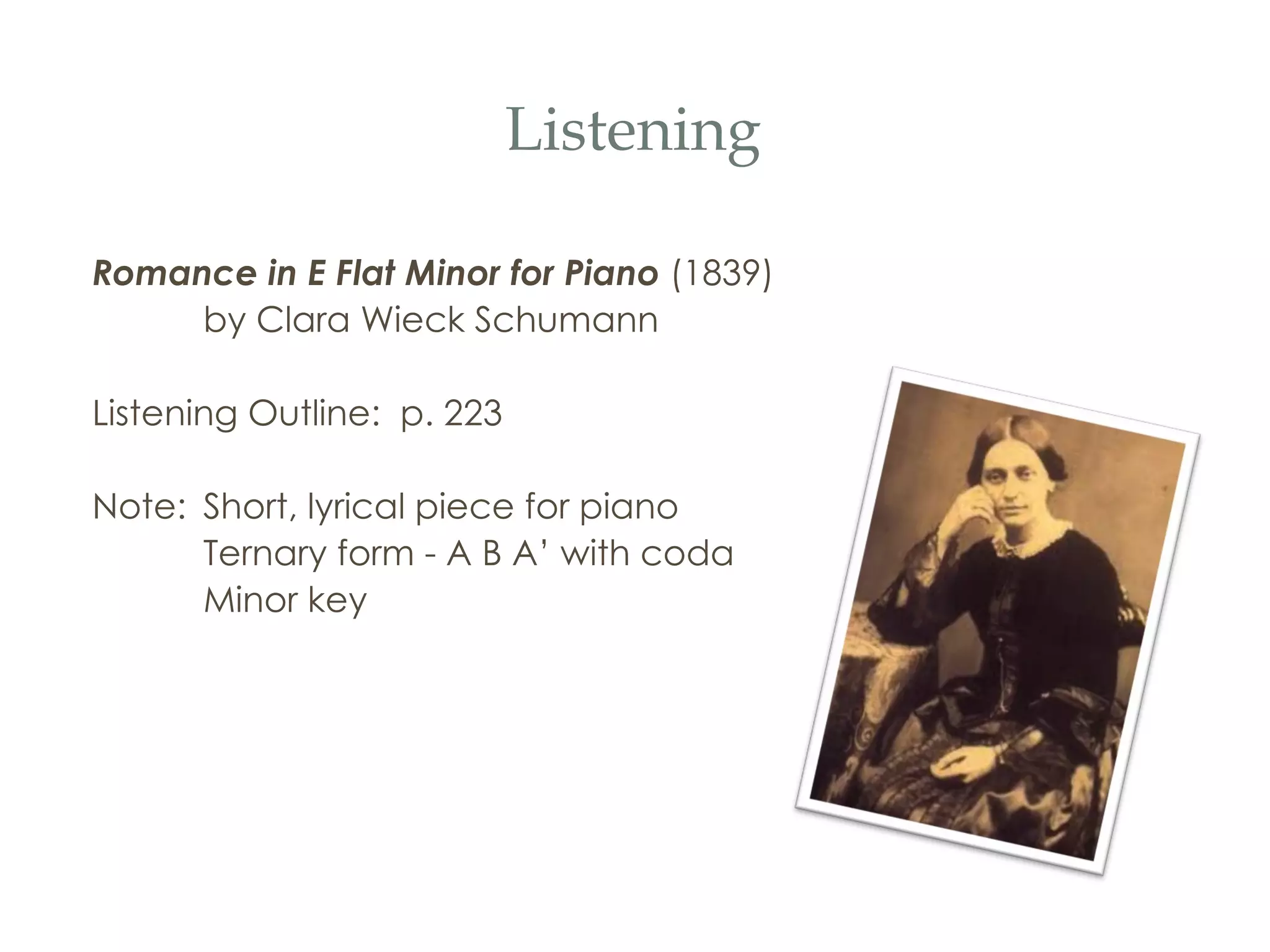
Listening Romance in E Flat Minor for Piano  (1839) by Clara Wieck Schumann Listening Outline:  p. 223 Note:  Short, lyrical piece for piano Ternary form - A B A’ with coda Minor key
Franz Liszt Hungarian composer (1811-1886) Virtuoso pianist, incredible performer and showman— ” rock star “ Touring concert pianist until age 36 Retired from touring & became court conductor and later took minor holy orders – Abb é Liszt Liszt’s Music Found new ways to exploit the piano , Extremely controversial Bombastic & vulgar, yet seen as the ideal direction for music Broke away from strict Classical forms Created  symphonic poem  ( tone poem )
Felix Mendelssohn German composer (1809-1847) Developed early Wrote symphonies, concertos, sonatas, and other works before being teenager Responsible for revival of Bach’s work Sister, Fanny, was also a composer Died of a stroke while touring Mendelssohn ’ s Music Somewhat more conservative Avoids emotional extremes Projects both elegance and balance
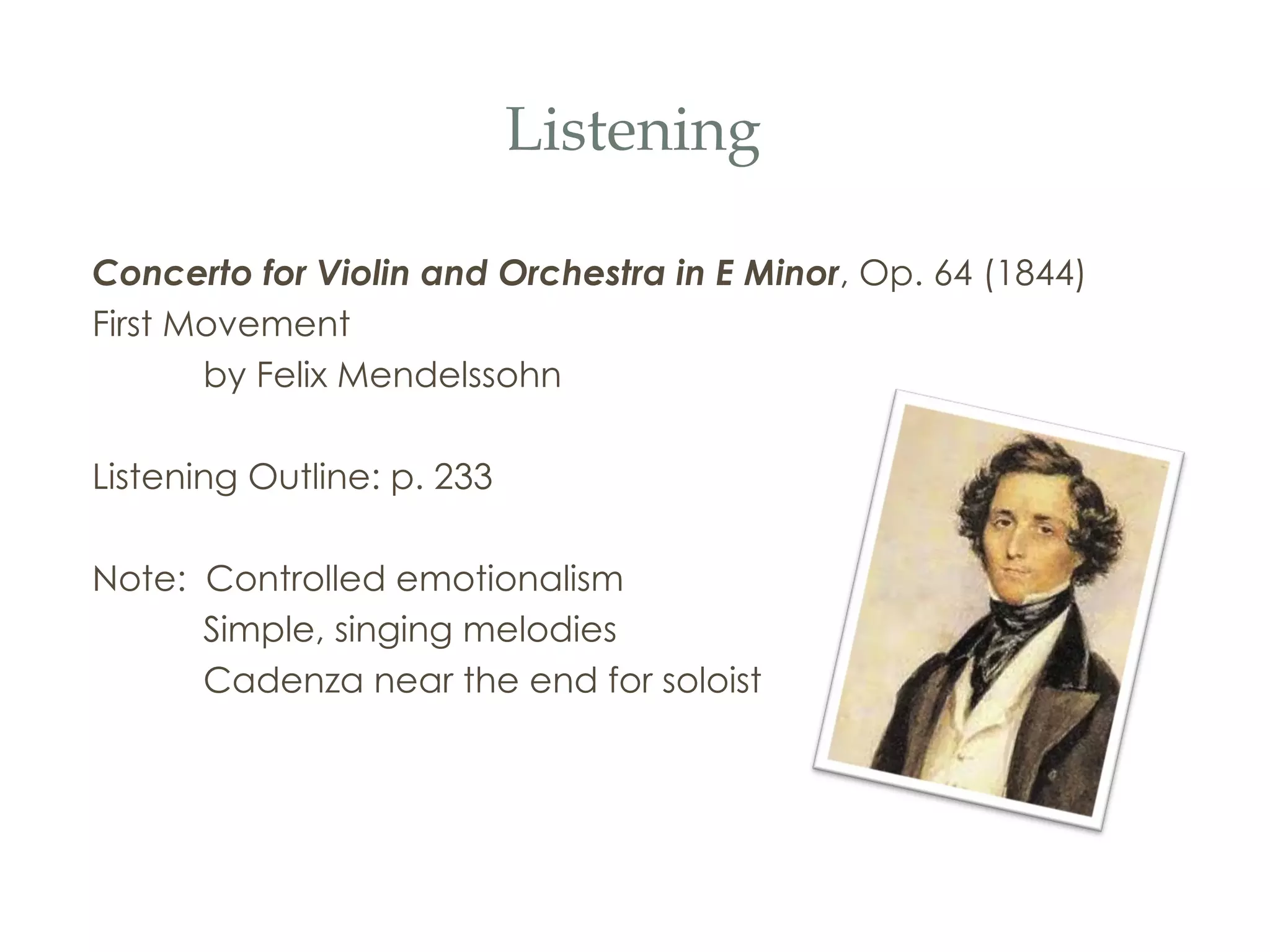
Listening Concerto for Violin and Orchestra in E Minor , Op. 64 (1844) First Movement by Felix Mendelssohn Listening Outline: p. 233 Note:  Controlled emotionalism Simple, singing melodies Cadenza near the end for soloist

Romanticartsong

  • 1.
    Music: An Appreciation7 th brief Edition by Roger Kamien 2011 © McGraw-Hill Higher Education
  • 2.
    Part 5, Chapter3 The Art Song Composition for solo voice and piano Accompaniment integral part of the song Linked to vast amount of poetry in this period Composers interpreted poems, translating mood, atmosphere and imagery into music Mood summed up at end with piano postlude Forms Strophic form repeats music for each verse Through-composed—new music each verse Sometimes modified strophic form used The Song Cycle Group of songs unified in some manne Storyline or musical idea may link the songs
  • 3.
    Franz Schubert Viennesecomposer (1797-1828) Prodigious output When 18 years old wrote 143 songs At 19 years wrote 179 works Included 2 symphonies, opera & mass Schubert’s Music Wrote over 600 songs Also symphonies, string quartets, other chamber music, sonatas, masses, operas, & piano works Including The Unfinished Symphony : only 2 movements, not 4
  • 4.
    Listening Erlk önig , “ The Erlking ” (1815) by Franz Schubert Listening Outline: p. 217 Note: Through-composed form Piano portrays galloping horse Dramatic ending One singer sounds like several characters by use of different vocal registers
  • 5.
    Robert Schumann Germancomposer (1810-1856) Wanted to be piano virtuoso Married his piano teacher’s daughter, Clara Temperamentally unsuited for some of the musical positions he attempted Committed to asylum where he died Robert Schumann’s Music Wrote piano pieces, art songs, and later symphonies Piano pieces and art songs frequently in cycles
  • 6.
    Listening Selected movementsfrom Carnaval (1834) by Robert Schumann Listening Outline: p. 221 Estrella Note: Ternary form syncopation in B section Reconnaissance (Reunion) Note: Ternary form B section shifts from homophonic to polyphonic texture
  • 7.
    Clara Wieck SchumannGerman composer (1819-1896) Leading concert pianist and female composer Married Robert Schumann Stopped composing after his death to focus on performing his works Friends with young Johannes Brahms Clara Schumann’s Music Stopped composing at age 36 Considered herself primarily a performer Wrote songs, piano pieces, a concerto
  • 8.
    Listening Romance inE Flat Minor for Piano (1839) by Clara Wieck Schumann Listening Outline: p. 223 Note: Short, lyrical piece for piano Ternary form - A B A’ with coda Minor key
  • 9.
    Franz Liszt Hungariancomposer (1811-1886) Virtuoso pianist, incredible performer and showman— ” rock star “ Touring concert pianist until age 36 Retired from touring & became court conductor and later took minor holy orders – Abb é Liszt Liszt’s Music Found new ways to exploit the piano , Extremely controversial Bombastic & vulgar, yet seen as the ideal direction for music Broke away from strict Classical forms Created symphonic poem ( tone poem )
  • 10.
    Felix Mendelssohn Germancomposer (1809-1847) Developed early Wrote symphonies, concertos, sonatas, and other works before being teenager Responsible for revival of Bach’s work Sister, Fanny, was also a composer Died of a stroke while touring Mendelssohn ’ s Music Somewhat more conservative Avoids emotional extremes Projects both elegance and balance
  • 11.
    Listening Concerto forViolin and Orchestra in E Minor , Op. 64 (1844) First Movement by Felix Mendelssohn Listening Outline: p. 233 Note: Controlled emotionalism Simple, singing melodies Cadenza near the end for soloist