Music: An Appreciation 7 th  Brief Edition by Roger Kamien  2011 © McGraw-Hill Higher Education Edited by Carolyn Ponce
Part 5, Chapters 10 & 11 Program Music Instrumental music associated with a story, poem, idea, or scene Usually performed with written explanation of the piece—a program Usually composed for piano or orchestra Common types of Program Music: Program symphony—multi-movement/orchestral Concert overture—modeled on opera overture Symphonic poem (or  tone poem )—1 movement, orchestral, flexible form Incidental music—for use before or during a play
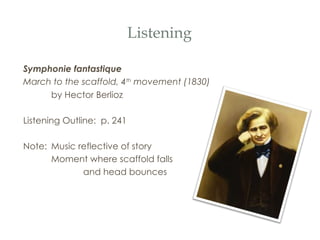
Hector Berlioz French composer (1803-1869) Won Prix de Rome award for  Symphonie fantastique Worked as music critic for financial support Pioneer in professional field of conducting Berlioz’s Music Unconventional, imaginative, innovative orchestrations Required huge resources Pioneered concept of  id ée fixe
Listening Symphonie fantastique   March to the scaffold, 4 th  movement (1830) by Hector Berlioz Listening Outline:  p. 241 Note:  Music reflective of story Moment where scaffold falls  and head bounces
Part 5, Chapters 12, 13, 14 & 15 Nationalism National identity grew during the Romantic Period Citizens, not mercenaries now fought wars Bonds of language, history & culture formed Led to unifications creating Germany and Italy Composers deliberately gave their works distinctive national identity Use of folksongs and folkdances Created original melodies with folk flavor Wrote operas and program music inspired by native history, legends, and landscapes Strongest impact in countries dominated by the music and composers of Germany, Austria, Italy and France
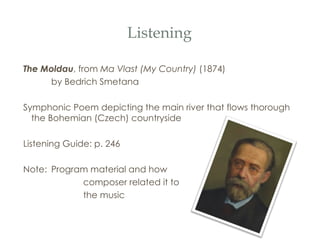
Listening The Moldau , from  Ma Vlast (My Country)  (1874) by Bedrich Smetana Symphonic Poem depicting the main river that flows thorough the Bohemian (Czech) countryside Listening Guide: p. 246 Note:  Program material and how  composer related it to  the music
Antonin Dvorak Czech composer (1841-1904) As teenager, played in orchestra under Smetana Became director of the National Conservatory of Music in New York Urged Americans to write nationalist music using the African-American spiritual Dvorak’s music Reflective of nationalism Used folktunes/spirituals
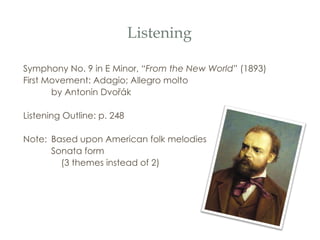
Listening Symphony No. 9 in E Minor, “ From the New World ”  (1893) First Movement: Adagio; Allegro molto by Antonin Dvo řá k Listening Outline: p. 248 Note:  Based upon American folk melodies Sonata form    (3 themes instead of 2)
Peter Ilyich Tchaikovsky Russian composer (1840-1893) Did not begin studying music until age 21 Married, divorced two weeks later Supported by benefactress (patron) They corresponded but never met Traveled Europe and United States Tchaikovsky ’ s Music Wrote ballets, symphonies, concerti, overtures, operas, and more Fused Russian folk music & European style
Johannes Brahms German composer (1833-1897) Son of a musician (father played bass) Studied music by day and had playing jobs by night Became close friends with the Schumanns Lived with Clara while Robert was in insane asylum Lifelong friends with Clara, but never romantically involved Brahms’s Music Studied earlier composers’ works in detail Especially Bach, Haydn, Mozart & Beethoven Considered somewhat conservative due to his use of classical forms Wrote in all traditional forms except opera
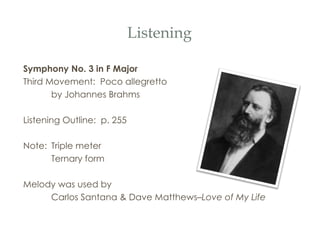
Listening Symphony No. 3 in F Major Third Movement:  Poco allegretto by Johannes Brahms Listening Outline:  p. 255 Note:  Triple meter Ternary form Melody was used by  Carlos Santana & Dave Matthews– Love of My Life

RomanticProgramandNationalism

  • 1.
    Music: An Appreciation7 th Brief Edition by Roger Kamien 2011 © McGraw-Hill Higher Education Edited by Carolyn Ponce
  • 2.
    Part 5, Chapters10 & 11 Program Music Instrumental music associated with a story, poem, idea, or scene Usually performed with written explanation of the piece—a program Usually composed for piano or orchestra Common types of Program Music: Program symphony—multi-movement/orchestral Concert overture—modeled on opera overture Symphonic poem (or tone poem )—1 movement, orchestral, flexible form Incidental music—for use before or during a play
  • 3.
    Hector Berlioz Frenchcomposer (1803-1869) Won Prix de Rome award for Symphonie fantastique Worked as music critic for financial support Pioneer in professional field of conducting Berlioz’s Music Unconventional, imaginative, innovative orchestrations Required huge resources Pioneered concept of id ée fixe
  • 4.
    Listening Symphonie fantastique March to the scaffold, 4 th movement (1830) by Hector Berlioz Listening Outline: p. 241 Note: Music reflective of story Moment where scaffold falls and head bounces
  • 5.
    Part 5, Chapters12, 13, 14 & 15 Nationalism National identity grew during the Romantic Period Citizens, not mercenaries now fought wars Bonds of language, history & culture formed Led to unifications creating Germany and Italy Composers deliberately gave their works distinctive national identity Use of folksongs and folkdances Created original melodies with folk flavor Wrote operas and program music inspired by native history, legends, and landscapes Strongest impact in countries dominated by the music and composers of Germany, Austria, Italy and France
  • 6.
    Listening The Moldau, from Ma Vlast (My Country) (1874) by Bedrich Smetana Symphonic Poem depicting the main river that flows thorough the Bohemian (Czech) countryside Listening Guide: p. 246 Note: Program material and how composer related it to the music
  • 7.
    Antonin Dvorak Czechcomposer (1841-1904) As teenager, played in orchestra under Smetana Became director of the National Conservatory of Music in New York Urged Americans to write nationalist music using the African-American spiritual Dvorak’s music Reflective of nationalism Used folktunes/spirituals
  • 8.
    Listening Symphony No.9 in E Minor, “ From the New World ” (1893) First Movement: Adagio; Allegro molto by Antonin Dvo řá k Listening Outline: p. 248 Note: Based upon American folk melodies Sonata form (3 themes instead of 2)
  • 9.
    Peter Ilyich TchaikovskyRussian composer (1840-1893) Did not begin studying music until age 21 Married, divorced two weeks later Supported by benefactress (patron) They corresponded but never met Traveled Europe and United States Tchaikovsky ’ s Music Wrote ballets, symphonies, concerti, overtures, operas, and more Fused Russian folk music & European style
  • 10.
    Johannes Brahms Germancomposer (1833-1897) Son of a musician (father played bass) Studied music by day and had playing jobs by night Became close friends with the Schumanns Lived with Clara while Robert was in insane asylum Lifelong friends with Clara, but never romantically involved Brahms’s Music Studied earlier composers’ works in detail Especially Bach, Haydn, Mozart & Beethoven Considered somewhat conservative due to his use of classical forms Wrote in all traditional forms except opera
  • 11.
    Listening Symphony No.3 in F Major Third Movement: Poco allegretto by Johannes Brahms Listening Outline: p. 255 Note: Triple meter Ternary form Melody was used by Carlos Santana & Dave Matthews– Love of My Life