By: Aldo Rojas 
Alejandro Melgar
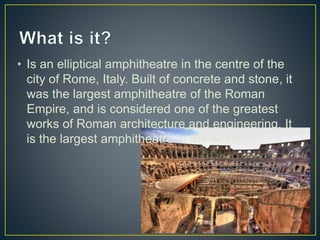
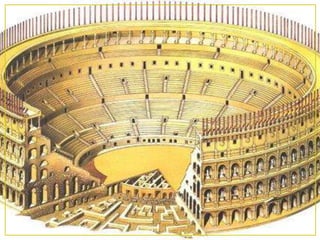
• Is an elliptical amphitheatre in the centre of the 
city of Rome, Italy. Built of concrete and stone, it 
was the largest amphitheatre of the Roman 
Empire, and is considered one of the greatest 
works of Roman architecture and engineering. It 
is the largest amphitheatre in the world.
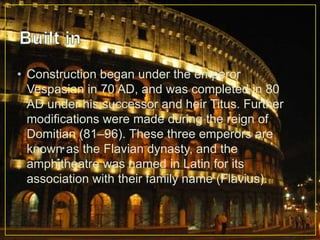
• Construction began under the emperor 
Vespasian in 70 AD, and was completed in 80 
AD under his successor and heir Titus. Further 
modifications were made during the reign of 
Domitian (81–96). These three emperors are 
known as the Flavian dynasty, and the 
amphitheatre was named in Latin for its 
association with their family name (Flavius).
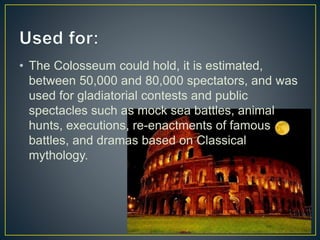
• The Colosseum could hold, it is estimated, 
between 50,000 and 80,000 spectators, and was 
used for gladiatorial contests and public 
spectacles such as mock sea battles, animal 
hunts, executions, re-enactments of famous 
battles, and dramas based on Classical 
mythology.
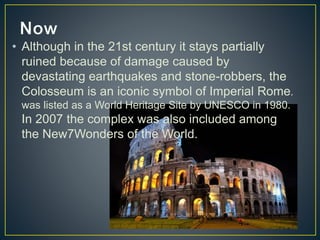
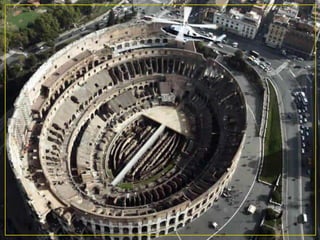
• Although in the 21st century it stays partially 
ruined because of damage caused by 
devastating earthquakes and stone-robbers, the 
Colosseum is an iconic symbol of Imperial Rome. 
was listed as a World Heritage Site by UNESCO in 1980. 
In 2007 the complex was also included among 
the New7Wonders of the World.
Roman colosseum
Roman colosseum
Roman colosseum

Roman colosseum

  • 1.
    By: Aldo Rojas Alejandro Melgar
  • 2.
    • Is anelliptical amphitheatre in the centre of the city of Rome, Italy. Built of concrete and stone, it was the largest amphitheatre of the Roman Empire, and is considered one of the greatest works of Roman architecture and engineering. It is the largest amphitheatre in the world.
  • 3.
    • Construction beganunder the emperor Vespasian in 70 AD, and was completed in 80 AD under his successor and heir Titus. Further modifications were made during the reign of Domitian (81–96). These three emperors are known as the Flavian dynasty, and the amphitheatre was named in Latin for its association with their family name (Flavius).
  • 4.
    • The Colosseumcould hold, it is estimated, between 50,000 and 80,000 spectators, and was used for gladiatorial contests and public spectacles such as mock sea battles, animal hunts, executions, re-enactments of famous battles, and dramas based on Classical mythology.
  • 5.
    • Although inthe 21st century it stays partially ruined because of damage caused by devastating earthquakes and stone-robbers, the Colosseum is an iconic symbol of Imperial Rome. was listed as a World Heritage Site by UNESCO in 1980. In 2007 the complex was also included among the New7Wonders of the World.