Rocks
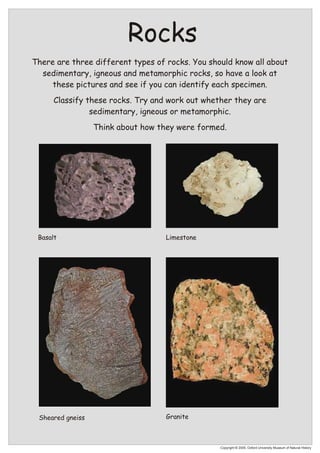
There are three different types of rocks. You should know all about
sedimentary, igneous and metamorphic rocks, so have a look at
these pictures and see if you can identify each specimen.
Classify these rocks. Try and work out whether they are
sedimentary, igneous or metamorphic.
Think about how they were formed.

Basalt

Limestone

Sheared gneiss

Granite

Copyright © 2005, Oxford University Museum of Natural History
Sandstone

Marble

Pitchstone

Chalk

Slate

Lava

Copyright © 2005, Oxford University Museum of Natural History
Conglomerate

Garnet amphibolite

Gabbro

Marble

Granite

Gritstone

Copyright © 2005, Oxford University Museum of Natural History
Faulted gneiss

Clay (top), mudstone (bottom)

Identifying rocks
If you are stuck and cannot decide whether a rock is sedimentary,
igneous or metamorphic here are some clues.
Sedimentary rocks are made up of grains of sediment that have
been weathered from a pre-existing rock or mineral. The grains can
be big or small, they are often rounded, and are cemented together
in a matrix. Sedimentary rocks may be layered and may also contain
fossils.
Igneous rocks often form from volcanic activity. They are made up
of interlocking crystals that form when molten rock cools. The
crystals can be big (if the rock formed underground), or small (if it
formed from lava that was extruded from a volcano). Igneous rocks
rarely contain fossils and they are not layered, but may contain gas
bubbles.
Metamorphic rocks form when a pre-existing rock is subjected to
heat and/or pressure. They may show evidence of re-crystallisation.

Copyright © 2005, Oxford University Museum of Natural History

Rocks

  • 1.
    Rocks There are threedifferent types of rocks. You should know all about sedimentary, igneous and metamorphic rocks, so have a look at these pictures and see if you can identify each specimen. Classify these rocks. Try and work out whether they are sedimentary, igneous or metamorphic. Think about how they were formed. Basalt Limestone Sheared gneiss Granite Copyright © 2005, Oxford University Museum of Natural History
  • 2.
    Sandstone Marble Pitchstone Chalk Slate Lava Copyright © 2005,Oxford University Museum of Natural History
  • 3.
  • 4.
    Faulted gneiss Clay (top),mudstone (bottom) Identifying rocks If you are stuck and cannot decide whether a rock is sedimentary, igneous or metamorphic here are some clues. Sedimentary rocks are made up of grains of sediment that have been weathered from a pre-existing rock or mineral. The grains can be big or small, they are often rounded, and are cemented together in a matrix. Sedimentary rocks may be layered and may also contain fossils. Igneous rocks often form from volcanic activity. They are made up of interlocking crystals that form when molten rock cools. The crystals can be big (if the rock formed underground), or small (if it formed from lava that was extruded from a volcano). Igneous rocks rarely contain fossils and they are not layered, but may contain gas bubbles. Metamorphic rocks form when a pre-existing rock is subjected to heat and/or pressure. They may show evidence of re-crystallisation. Copyright © 2005, Oxford University Museum of Natural History