ROCKS
Rocks ----SYLLABUS
 Difference between minerals and rocks,
 Types of rocks:
 Igneous,
 Sedimentary,
 Metamorphic,
 Their characteristics
 Formation.
Introduction
Rocks can be defined as aggregate of minerals .
They are mixture of various minerals in different proportions.
It may hard or soft.
Minerals
Solid inorganic substance occurring naturally.
Having a definite chemical composition and physical
A rock having a large proportion of a single mineral is called
ore of the mineral.
Difference between rocks and minerals
Earth is made up of rocks and minerals
Earth’s outer layer made up of solid rock that is why it is called Lithosphere.
ROCKS MINERALS
Aggregate of minerals Solid inorganic substance occurring naturally.
No definite chemical composition Definite chemical composition.
Minerals are organized to form rocks Elements (pure substance )are organized to form
compounds
3 main types- Igneous, Sedimentary, Metamorphic
ISM
4main groups
Silicates Carbonates, Sulphides ,Metallic Minerals----SCSM
Basalt, granite, sand stone, slate et Iron, silicon, magnesium, nickel etc
Characteristics of Igneous Rocks
They are hard, massive and compact.
They are formed by solidification of molten magma.
The size of rocks depends upon the rate of cooling of lava or magma.
They are granular and crystalline.
They do not have layers.
These rocks are not easily weathered because there are no pores so
water cannot easily enter.
They are found mostly in volcanic regions.
formation
Igneous--- Formation
Comes from the Latin word ignis which means fire.
Igneous rocks form when magma (molten rock) cools and
crystallizes.
Due to high temperature in the interior of the earth the rocks
are in a molten state.
This molten material is called as Magma.
Magma is ejected from the interior of the earth to the surface
through the volcanic activity.
Since they were the first rocks to be formed so igneous rocks
are also called the primary rocks.
Characteristics-Sedimentary rocks
Sedimentary rocks are found in layers. So they are known as stratified
rocks.
They have plant and animal remains.so they may contain fossils.
They have pores in which water can easily enter.
They do not have any type of crystals.
These rocks are prone to weathering because they are soft.
These hold all reserves of coal, oil and natural gas.
They constitute above 75% of the surface of the earth.
Sedimentary rocks – Formation
 Sedimentary rocks are formed through consolidification of accumulated
 Sediments deposited on huge depressions like sea or lake.
weathering of pre-existing rocks
 Igneous rocks are exposed on the surface of the earth, they are broken down, (sediments) due to
temperature, water, wind etc
Transport of the weathering products
 Carried away by the rivers , glaciers and ocean waves.
Deposition of the material
 Weathering materials (sediments) deposited in the rivers ,seas, lakes over a long period
Cementation of the sediment to form rock.
 and get cemented together and formed as sedimentary rocks
They are called Secondary rocks because they are formed by the solidification of original igneous rocks,
sedimentary or metamorphic parent rocks.
Lithification: the process that turns loose sediments into rocks.
Characteristics of metamorphic rocks
 Very hard and more compact than their original form.
Eg: marble is harder than from limestone.
 Are formed due to change in texture and composition of the pre-existing rocks.
 Most of them are impermeable.-they do not allow water to percolate through
them.
 They do not have fossils – during formation they destroy fossils.
 New minerals are formed during the processes of metamorphism.
Metamorphic rocks-- Formation
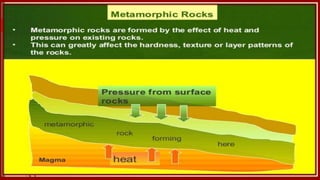
 Formed by the effect of the heat and pressure on existing rocks.
 Original rock is transformed in a process is called metamorphism.
 The original rock can be either igneous or sedimentary or old metamorphic.
 The original rock change in its physical and chemical composition.
 The original rocks are metamorphosed to produce new rocks. Limestone into marble,
shale to slate , coal into graphite.
 Causes for change 1. High temperature 2. Pressure at great depth.
 Metamorphism can be two types:
1.Contact or thermal due to heat or temperature. It involves solidification and
crystallization.
2. Regional or dynamic metamorphism. Is a result of excessive pressure and reluctant
heat caused earth movement.
Rocks
Rocks

Rocks

  • 1.
  • 2.
    Rocks ----SYLLABUS  Differencebetween minerals and rocks,  Types of rocks:  Igneous,  Sedimentary,  Metamorphic,  Their characteristics  Formation.
  • 3.
    Introduction Rocks can bedefined as aggregate of minerals . They are mixture of various minerals in different proportions. It may hard or soft. Minerals Solid inorganic substance occurring naturally. Having a definite chemical composition and physical A rock having a large proportion of a single mineral is called ore of the mineral.
  • 4.
    Difference between rocksand minerals Earth is made up of rocks and minerals Earth’s outer layer made up of solid rock that is why it is called Lithosphere. ROCKS MINERALS Aggregate of minerals Solid inorganic substance occurring naturally. No definite chemical composition Definite chemical composition. Minerals are organized to form rocks Elements (pure substance )are organized to form compounds 3 main types- Igneous, Sedimentary, Metamorphic ISM 4main groups Silicates Carbonates, Sulphides ,Metallic Minerals----SCSM Basalt, granite, sand stone, slate et Iron, silicon, magnesium, nickel etc
  • 5.
    Characteristics of IgneousRocks They are hard, massive and compact. They are formed by solidification of molten magma. The size of rocks depends upon the rate of cooling of lava or magma. They are granular and crystalline. They do not have layers. These rocks are not easily weathered because there are no pores so water cannot easily enter. They are found mostly in volcanic regions.
  • 6.
  • 7.
    Igneous--- Formation Comes fromthe Latin word ignis which means fire. Igneous rocks form when magma (molten rock) cools and crystallizes. Due to high temperature in the interior of the earth the rocks are in a molten state. This molten material is called as Magma. Magma is ejected from the interior of the earth to the surface through the volcanic activity. Since they were the first rocks to be formed so igneous rocks are also called the primary rocks.
  • 8.
    Characteristics-Sedimentary rocks Sedimentary rocksare found in layers. So they are known as stratified rocks. They have plant and animal remains.so they may contain fossils. They have pores in which water can easily enter. They do not have any type of crystals. These rocks are prone to weathering because they are soft. These hold all reserves of coal, oil and natural gas. They constitute above 75% of the surface of the earth.
  • 9.
    Sedimentary rocks –Formation  Sedimentary rocks are formed through consolidification of accumulated  Sediments deposited on huge depressions like sea or lake. weathering of pre-existing rocks  Igneous rocks are exposed on the surface of the earth, they are broken down, (sediments) due to temperature, water, wind etc Transport of the weathering products  Carried away by the rivers , glaciers and ocean waves. Deposition of the material  Weathering materials (sediments) deposited in the rivers ,seas, lakes over a long period Cementation of the sediment to form rock.  and get cemented together and formed as sedimentary rocks They are called Secondary rocks because they are formed by the solidification of original igneous rocks, sedimentary or metamorphic parent rocks. Lithification: the process that turns loose sediments into rocks.
  • 11.
    Characteristics of metamorphicrocks  Very hard and more compact than their original form. Eg: marble is harder than from limestone.  Are formed due to change in texture and composition of the pre-existing rocks.  Most of them are impermeable.-they do not allow water to percolate through them.  They do not have fossils – during formation they destroy fossils.  New minerals are formed during the processes of metamorphism.
  • 12.
    Metamorphic rocks-- Formation Formed by the effect of the heat and pressure on existing rocks.  Original rock is transformed in a process is called metamorphism.  The original rock can be either igneous or sedimentary or old metamorphic.  The original rock change in its physical and chemical composition.  The original rocks are metamorphosed to produce new rocks. Limestone into marble, shale to slate , coal into graphite.  Causes for change 1. High temperature 2. Pressure at great depth.  Metamorphism can be two types: 1.Contact or thermal due to heat or temperature. It involves solidification and crystallization. 2. Regional or dynamic metamorphism. Is a result of excessive pressure and reluctant heat caused earth movement.