Rock Record created by  TeachPower.net This lesson is a preview of a full complete lesson and contains animation, sounds, video, and pictures that SlideShare.net does not show.  To preview this lesson as it was originally intended please go to  http://teachpower.net , click on the  Lesson PowerPoints  tab at the top, and scroll down until you see the name of this lesson in the appropriate category.
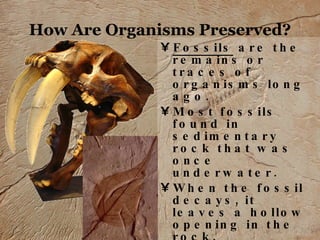
How Are Organisms Preserved? Fossils  are the remains or traces of organisms long ago. Most fossils found in sedimentary rock that was once underwater. When the fossil decays, it leaves a hollow opening in the rock. Hollow opening –  mold Cast  forms when sand or mud fill up the mold and harden.
Alternative Ways to Form Fossils Ice Organism dies and covered by snow or ice. Tar Animals fell into these pits of tar that is pools of oil and sediment bubbling to the surface. Amber Insects were commonly trapped in the sticky tree sap flowing down the tree. The tree sap would dry and harden and eventually turn to stone, perfectly preserving the insect.
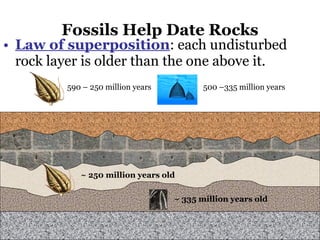
Fossils Help Date Rocks Law of superposition : each undisturbed rock layer is older than the one above it. 590 – 250 million years 500 –335 million years ~ 250 million years old ~ 335 million years old
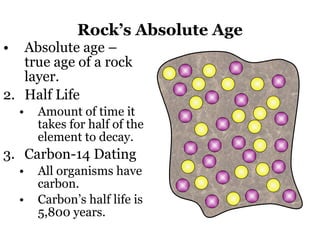
Rock’s Absolute Age Absolute age – true age of a rock layer. Half Life Amount of time it takes for half of the element to decay. Carbon-14 Dating All organisms have carbon. Carbon’s half life is 5,800 years.
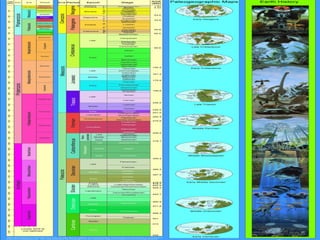
Geologic Time Scale Geologic time scale  outlines the major divisions of Earth’s history.
Trip Thru Geologic Time Quarternary Tertiary Cretaceous Jurrasic Triasic Permian Carboniferous Devonian Silurian Orodivician Cambrian PRECAMBRIAN CENOZOIC ERA MESOZOIC ERA PALEOZOIC ERA

Rock record

  • 1.
    Rock Record createdby TeachPower.net This lesson is a preview of a full complete lesson and contains animation, sounds, video, and pictures that SlideShare.net does not show. To preview this lesson as it was originally intended please go to http://teachpower.net , click on the Lesson PowerPoints tab at the top, and scroll down until you see the name of this lesson in the appropriate category.
  • 2.
    How Are OrganismsPreserved? Fossils are the remains or traces of organisms long ago. Most fossils found in sedimentary rock that was once underwater. When the fossil decays, it leaves a hollow opening in the rock. Hollow opening – mold Cast forms when sand or mud fill up the mold and harden.
  • 3.
    Alternative Ways toForm Fossils Ice Organism dies and covered by snow or ice. Tar Animals fell into these pits of tar that is pools of oil and sediment bubbling to the surface. Amber Insects were commonly trapped in the sticky tree sap flowing down the tree. The tree sap would dry and harden and eventually turn to stone, perfectly preserving the insect.
  • 4.
    Fossils Help DateRocks Law of superposition : each undisturbed rock layer is older than the one above it. 590 – 250 million years 500 –335 million years ~ 250 million years old ~ 335 million years old
  • 5.
    Rock’s Absolute AgeAbsolute age – true age of a rock layer. Half Life Amount of time it takes for half of the element to decay. Carbon-14 Dating All organisms have carbon. Carbon’s half life is 5,800 years.
  • 6.
    Geologic Time ScaleGeologic time scale outlines the major divisions of Earth’s history.
  • 7.
    Trip Thru GeologicTime Quarternary Tertiary Cretaceous Jurrasic Triasic Permian Carboniferous Devonian Silurian Orodivician Cambrian PRECAMBRIAN CENOZOIC ERA MESOZOIC ERA PALEOZOIC ERA