GE Foundation
Developing Futures™
In Education
Testimonials
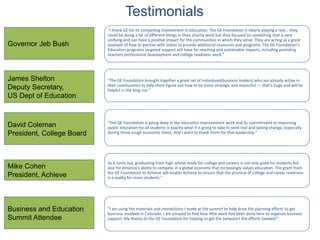
“I thank GE for its compelling involvement in education. The GE Foundation is clearly playing a role… they
could be doing a lot of different things in their charity work but they focused on something that is very
unifying and can have a positive impact for the communities in which they serve. They are acting as a great
example of how to partner with states to provide additional resources and programs. The GE Foundation’s
Education programs targeted support will have far reaching and sustainable impacts, including providing
teachers professional development and college readiness work.”
“The GE Foundation brought together a great set of individuals(business leaders) who are already active in
their communities to help them figure out how to be more strategic and impactful — that’s huge and will be
helpful in the long run.”
“The GE Foundation is going deep in the education improvement work and its commitment to improving
public education for all students is exactly what it is going to take to seed real and lasting change, especially
during these tough economic times. And I want to thank them for that leadership.”
As it turns out, graduating from high school ready for college and careers is not only good for students but
also for America's ability to compete in a global economy that increasingly values education. The grant from
the GE Foundation to Achieve will enable Achieve to ensure that the promise of college and career readiness
is a reality for more students.”
“I am using the materials and connections I made at the summit to help drive the planning efforts to get
business involved in Colorado. I am amazed to find how little work had been done here to organize business
support. My thanks to the GE Foundation for helping us get the jumpstart the efforts needed!”
Governor Jeb Bush
James Shelton
Deputy Secretary,
US Dept of Education
David Coleman
President, College Board
Mike Cohen
President, Achieve
Business and Education
Summit Attendee
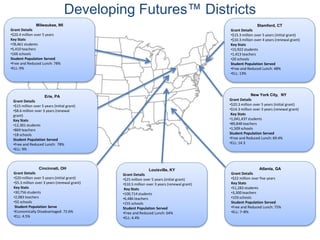
New York City, NY
Grant Details
•$20.3 million over 5 years (initial grant)
•$14.3 million over 3 years (renewal grant)
Key Stats
•1,041,437 students
•89,848 teachers
•1,509 schools
Student Population Served
•Free and Reduced Lunch: 69.4%
•ELL: 14.3
Cincinnati, OH
Grant Details
•$20 million over 5 years (initial grant)
•$5.3 million over 3 years (renewal grant)
Key Stats
•30,756 students
•2,083 teachers
•55 schools
Student Population Serve
•Economically Disadvantaged: 72.6%
•ELL: 4.5%
Atlanta, GA
Grant Details
•$22 million over five years
Key Stats
•51,283 students
•3,300 teachers
•103 schools
Student Population Served
•Free and Reduced Lunch: 75%
•ELL: 7–8%
Stamford, CT
Grant Details
•$15.3 million over 5 years (initial grant)
•$10.3 million over 4 years (renewal grant)
Key Stats
•15,922 students
•1,413 teachers
•20 schools
Student Population Served
•Free and Reduced Lunch: 48%
•ELL: 13%
Milwaukee, WI
Grant Details
•$20.4 million over 5 years
Key Stats
•78,461 students
•5,410 teachers
•166 schools
Student Population Served
•Free and Reduced Lunch: 78%
•ELL: 9%
Erie, PA
Grant Details
•$15 million over 5 years (initial grant)
•$8.6 million over 3 years (renewal
grant)
Key Stats
•12,301 students
•869 teachers
•18 schools
Student Population Served
•Free and Reduced Lunch: 78%
•ELL: 9%
Louisville, KY
Grant Details
•$25 million over 5 years (initial grant)
•$10.5 million over 3 years (renewal grant)
Key Stats
•100,714 students
•6,486 teachers
•155 schools
Student Population Served
•Free and Reduced Lunch: 64%
•ELL: 4.4%
Developing Futures™ Districts
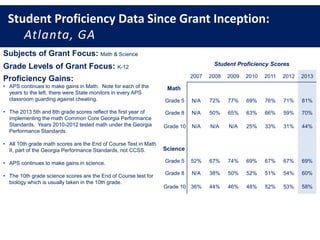
Student Proficiency Data Since Grant Inception:
Atlanta, GA
Subjects of Grant Focus: Math & Science
Grade Levels of Grant Focus: K-12
Proficiency Gains:
• APS continues to make gains in Math. Note for each of the
years to the left, there were State monitors in every APS
classroom guarding against cheating.
• The 2013 5th and 8th grade scores reflect the first year of
implementing the math Common Core Georgia Performance
Standards. Years 2010-2012 tested math under the Georgia
Performance Standards.
• All 10th grade math scores are the End of Course Test in Math
II, part of the Georgia Performance Standards, not CCSS.
• APS continues to make gains in science.
• The 10th grade science scores are the End of Course test for
biology which is usually taken in the 10th grade.
Student Proficiency Scores
2007 2008 2009 2010 2011 2012 2013
Math
Grade 5 N/A 72% 77% 69% 76% 71% 81%
Grade 8 N/A 50% 65% 63% 66% 59% 70%
Grade 10 N/A N/A N/A 25% 33% 31% 44%
Science
Grade 5 52% 67% 74% 69% 67% 67% 69%
Grade 8 N/A 38% 50% 52% 51% 54% 60%
Grade 10 36% 44% 46% 48% 52% 53% 58%
Student Proficiency Data Since Grant Inception:
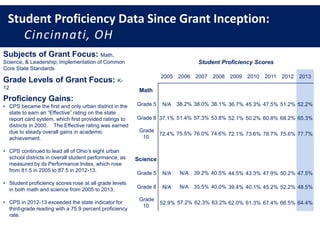
Cincinnati, OH
Student Proficiency Scores
2005 2006 2007 2008 2009 2010 2011 2012 2013
Math
Grade 5 N/A 38.2% 38.0% 38.1% 36.7% 45.3% 47.5% 51.2% 52.2%
Grade 8 37.1% 51.4% 57.3% 53.8% 52.1% 50.2% 60.8% 68.2% 65.3%
Grade
10
72.4% 75.5% 76.0% 74.6% 72.1% 73.6% 78.7% 75.6% 77.7%
Science
Grade 5 N/A N/A 39.2% 40.5% 44.5% 43.3% 47.9% 50.2% 47.5%
Grade 8 N/A N/A 35.5% 40.0% 39.4% 40.1% 45.2% 52.2% 48.5%
Grade
10
52.9% 57.2% 62.3% 63.2% 62.0% 61.3% 67.4% 66.5% 64.4%
Subjects of Grant Focus: Math,
Science, & Leadership; Implementation of Common
Core State Standards
Grade Levels of Grant Focus: K-
12
Proficiency Gains:
• CPS became the first and only urban district in the
state to earn an “Effective” rating on the state
report card system, which first provided ratings to
districts in 2000. The Effective rating was earned
due to steady overall gains in academic
achievement.
• CPS continued to lead all of Ohio’s eight urban
school districts in overall student performance, as
measured by its Performance Index, which rose
from 81.5 in 2005 to 87.5 in 2012-13.
• Student proficiency scores rose at all grade levels
in both math and science from 2005 to 2013.
• CPS in 2012-13 exceeded the state indicator for
third-grade reading with a 75.9 percent proficiency
rate.
Student Proficiency Data Since Grant Inception:
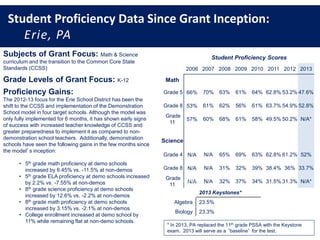
Erie, PA
Subjects of Grant Focus: Math & Science
curriculum and the transition to the Common Core State
Standards (CCSS)
Grade Levels of Grant Focus: K-12
Proficiency Gains:
The 2012-13 focus for the Erie School District has been the
shift to the CCSS and implementation of the Demonstration
School model in four target schools. Although the model was
only fully implemented for 6 months, it has shown early signs
of success with increased teacher knowledge of CCSS and
greater preparedness to implement it as compared to non-
demonstration school teachers. Additionally, demonstration
schools have seen the following gains in the few months since
the model’s inception:
• 5th grade math proficiency at demo schools
increased by 6.45% vs. -11.5% at non-demos
• 5th grade ELA proficiency at demo schools increased
by 2.2% vs. -7.55% at non-demos
• 8th grade science proficiency at demo schools
increased by 12.6% vs. -2.2% at non-demos
• 8th grade math proficiency at demo schools
increased by 3.15% vs. -2.1% at non-demos
• College enrollment increased at demo school by
11% while remaining flat at non-demo schools.
Student Proficiency Scores
2006 2007 2008 2009 2010 2011 2012 2013
Math
Grade 5 66% 70% 63% 61% 64% 62.8% 53.2% 47.6%
Grade 8 53% 61% 62% 56% 61% 63.7% 54.9% 52.8%
Grade
11
57% 60% 68% 61% 58% 49.5% 50.2% N/A*
Science
Grade 4 N/A N/A 65% 69% 63% 62.8% 61.2% 52%
Grade 8 N/A N/A 31% 32% 39% 38.4% 36% 33.7%
Grade
11
N/A N/A 32% 37% 34% 31.5% 31.3% N/A*
2013 Keystones*
Algebra 23.5%
Biology 23.3%
* In 2013, PA replaced the 11th grade PSSA with the Keystone
exam. 2013 will serve as a ‘baseline’ for the test.
Student Proficiency Data Since Grant Inception:
Louisville, KY
Subjects of Grant Focus: Math & Science
Grade Levels of Grant Focus: K-12
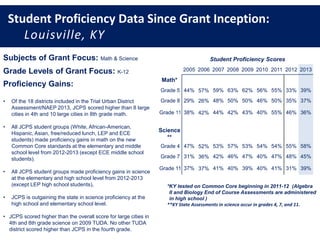
Proficiency Gains:
• Of the 18 districts included in the Trial Urban District
Assessment/NAEP 2013, JCPS scored higher than 8 large
cities in 4th and 10 large cities in 8th grade math.
• All JCPS student groups (White, African-American,
Hispanic, Asian, free/reduced lunch, LEP and ECE
students) made proficiency gains in math on the new
Common Core standards at the elementary and middle
school level from 2012-2013 (except ECE middle school
students).
• All JCPS student groups made proficiency gains in science
at the elementary and high school level from 2012-2013
(except LEP high school students),
• JCPS is outgaining the state in science proficiency at the
high school and elementary school level.
• JCPS scored higher than the overall score for large cities in
4th and 8th grade science on 2009 TUDA. No other TUDA
district scored higher than JCPS in the fourth grade.
*KY tested on Common Core beginning in 2011-12 (Algebra
II and Biology End of Course Assessments are administered
in high school )
**KY State Assessments in science occur in grades 4, 7, and 11.
Student Proficiency Scores
2005 2006 2007 2008 2009 2010 2011 2012 2013
Math*
Grade 5 44% 57% 59% 63% 62% 56% 55% 33% 39%
Grade 8 29% 26% 48% 50% 50% 46% 50% 35% 37%
Grade 11 38% 42% 44% 42% 43% 40% 55% 46% 36%
Science
**
Grade 4 47% 52% 53% 57% 53% 54% 54% 55% 58%
Grade 7 31% 36% 42% 46% 47% 40% 47% 48% 45%
Grade 11 37% 37% 41% 40% 39% 40% 41% 31% 39%
Milwaukee Public Schools – GE Foundation Grant
MAP®* Assessment Data – Comparison
GEF Schools to District 2012 & 2013
Reading Value-added* Math Value-added**
0%
10%
20%
30%
40%
50%
60%
70%
80%
90%
100%
0%
10%
20%
30%
40%
50%
60%
70%
80%
90%
100%
Above
Average
Value
Added
Average
Value
Added
Below
Average
Value
Added
Student Proficiency Data Since Grant Inception:
Milwaukee, WI
Subjects of 2012- Now Grant
Focus: Common Core Implementation – 10 Schools
Grade Levels of Grant Focus: K- 5/K-8
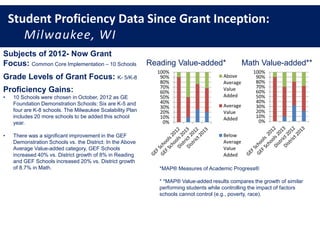
Proficiency Gains:
• 10 Schools were chosen in October, 2012 as GE
Foundation Demonstration Schools: Six are K-5 and
four are K-8 schools. The Milwaukee Scalability Plan
includes 20 more schools to be added this school
year.
• There was a significant improvement in the GEF
Demonstration Schools vs. the District: In the Above
Average Value-added category, GEF Schools
increased 40% vs. District growth of 8% in Reading
and GEF Schools increased 20% vs. District growth
of 8.7% in Math. *MAP® Measures of Academic Progress®
* *MAP® Value-added results compares the growth of similar
performing students while controlling the impact of factors
schools cannot control (e.g., poverty, race).
Student Proficiency Data Since Grant Inception:
Milwaukee, WI
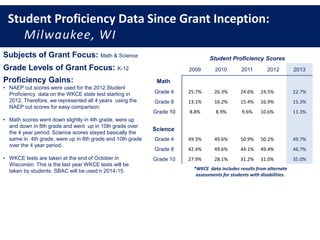
Subjects of Grant Focus: Math & Science
Grade Levels of Grant Focus: K-12
Proficiency Gains:
• NAEP cut scores were used for the 2012 Student
Proficiency data on the WKCE state test starting in
2012. Therefore, we represented all 4 years using the
NAEP cut scores for easy comparison.
• Math scores went down slightly in 4th grade, were up
and down in 8th grade and went up in 10th grade over
the 4 year period. Science scores stayed basically the
same in 4th grade, were up in 8th grade and 10th grade
over the 4 year period.
• WKCE tests are taken at the end of October in
Wisconsin. This is the last year WKCE tests will be
taken by students. SBAC will be used n 2014-15. *WKCE data includes results from alternate
assessments for students with disabilities.
Student Proficiency Scores
2009 2010 2011 2012 2013
Math
Grade 4 25.7% 26.3% 24.6% 24.5% 22.7%
Grade 8 13.1% 16.2% 15.4% 16.9% 15.3%
Grade 10 8.8% 8.9% 9.6% 10.6% 11.3%
Science
Grade 4 49.3% 49.6% 50.9% 50.2% 49.7%
Grade 8 42.4% 49.6% 44.1% 49.4% 46.7%
Grade 10 27.9% 28.1% 31.2% 31.0% 35.0%
Student Proficiency Data Since Grant Inception:
New York City, NY
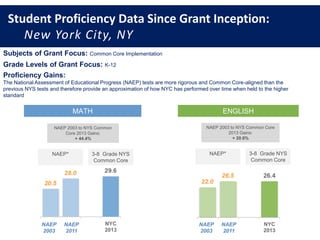
Subjects of Grant Focus: Common Core Implementation
Grade Levels of Grant Focus: K-12
Proficiency Gains:
MATH ENGLISH
NAEP*
The National Assessment of Educational Progress (NAEP) tests are more rigorous and Common Core-aligned than the
previous NYS tests and therefore provide an approximation of how NYC has performed over time when held to the higher
standard
3-8 Grade NYS
Common Core
NAEP 2003 to NYS Common
Core 2013 Gains:
+ 44.4%
NAEP* 3-8 Grade NYS
Common Core
NAEP 2003 to NYS Common Core
2013 Gains:
+ 20.0%
NAEP
2003
NAEP
2011
NAEP
2003
NAEP
2011
Student Proficiency Data Since Grant Inception:
Stamford, CT
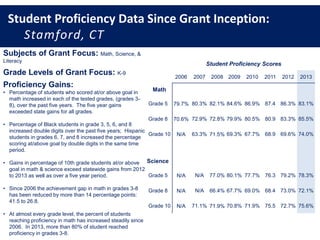
Student Proficiency Scores
2006 2007 2008 2009 2010 2011 2012 2013
Math
Grade 5 79.7% 80.3% 82.1% 84.6% 86.9% 87.4 86.3% 83.1%
Grade 8 70.6% 72.9% 72.8% 79.9% 80.5% 80.9 83.3% 85.5%
Grade 10 N/A 63.3% 71.5% 69.3% 67.7% 68.9 69.6% 74.0%
Science
Grade 5 N/A N/A 77.0% 80.1% 77.7% 76.3 79.2% 78.3%
Grade 8 N/A N/A 66.4% 67.7% 69.0% 68.4 73.0% 72.1%
Grade 10 N/A 71.1% 71.9% 70.8% 71.9% 75.5 72.7% 75.6%
Subjects of Grant Focus: Math, Science, &
Literacy
Grade Levels of Grant Focus: K-9
Proficiency Gains:
• Percentage of students who scored at/or above goal in
math increased in each of the tested grades, (grades 3-
8), over the past five years. The five year gains
exceeded state gains for all grades.
• Percentage of Black students in grade 3, 5, 6, and 8
increased double digits over the past five years; Hispanic
students in grades 6, 7, and 8 increased the percentage
scoring at/above goal by double digits in the same time
period.
• Gains in percentage of 10th grade students at/or above
goal in math & science exceed statewide gains from 2012
to 2013 as well as over a five year period.
• Since 2006 the achievement gap in math in grades 3-8
has been reduced by more than 14 percentage points:
41.5 to 26.8.
• At almost every grade level, the percent of students
reaching proficiency in math has increased steadily since
2006. In 2013, more than 80% of student reached
proficiency in grades 3-8.

DevFuturesWork_JCPS

  • 1.
  • 2.
    Testimonials “I thank GEfor its compelling involvement in education. The GE Foundation is clearly playing a role… they could be doing a lot of different things in their charity work but they focused on something that is very unifying and can have a positive impact for the communities in which they serve. They are acting as a great example of how to partner with states to provide additional resources and programs. The GE Foundation’s Education programs targeted support will have far reaching and sustainable impacts, including providing teachers professional development and college readiness work.” “The GE Foundation brought together a great set of individuals(business leaders) who are already active in their communities to help them figure out how to be more strategic and impactful — that’s huge and will be helpful in the long run.” “The GE Foundation is going deep in the education improvement work and its commitment to improving public education for all students is exactly what it is going to take to seed real and lasting change, especially during these tough economic times. And I want to thank them for that leadership.” As it turns out, graduating from high school ready for college and careers is not only good for students but also for America's ability to compete in a global economy that increasingly values education. The grant from the GE Foundation to Achieve will enable Achieve to ensure that the promise of college and career readiness is a reality for more students.” “I am using the materials and connections I made at the summit to help drive the planning efforts to get business involved in Colorado. I am amazed to find how little work had been done here to organize business support. My thanks to the GE Foundation for helping us get the jumpstart the efforts needed!” Governor Jeb Bush James Shelton Deputy Secretary, US Dept of Education David Coleman President, College Board Mike Cohen President, Achieve Business and Education Summit Attendee
  • 3.
    New York City,NY Grant Details •$20.3 million over 5 years (initial grant) •$14.3 million over 3 years (renewal grant) Key Stats •1,041,437 students •89,848 teachers •1,509 schools Student Population Served •Free and Reduced Lunch: 69.4% •ELL: 14.3 Cincinnati, OH Grant Details •$20 million over 5 years (initial grant) •$5.3 million over 3 years (renewal grant) Key Stats •30,756 students •2,083 teachers •55 schools Student Population Serve •Economically Disadvantaged: 72.6% •ELL: 4.5% Atlanta, GA Grant Details •$22 million over five years Key Stats •51,283 students •3,300 teachers •103 schools Student Population Served •Free and Reduced Lunch: 75% •ELL: 7–8% Stamford, CT Grant Details •$15.3 million over 5 years (initial grant) •$10.3 million over 4 years (renewal grant) Key Stats •15,922 students •1,413 teachers •20 schools Student Population Served •Free and Reduced Lunch: 48% •ELL: 13% Milwaukee, WI Grant Details •$20.4 million over 5 years Key Stats •78,461 students •5,410 teachers •166 schools Student Population Served •Free and Reduced Lunch: 78% •ELL: 9% Erie, PA Grant Details •$15 million over 5 years (initial grant) •$8.6 million over 3 years (renewal grant) Key Stats •12,301 students •869 teachers •18 schools Student Population Served •Free and Reduced Lunch: 78% •ELL: 9% Louisville, KY Grant Details •$25 million over 5 years (initial grant) •$10.5 million over 3 years (renewal grant) Key Stats •100,714 students •6,486 teachers •155 schools Student Population Served •Free and Reduced Lunch: 64% •ELL: 4.4% Developing Futures™ Districts
  • 4.
    Student Proficiency DataSince Grant Inception: Atlanta, GA Subjects of Grant Focus: Math & Science Grade Levels of Grant Focus: K-12 Proficiency Gains: • APS continues to make gains in Math. Note for each of the years to the left, there were State monitors in every APS classroom guarding against cheating. • The 2013 5th and 8th grade scores reflect the first year of implementing the math Common Core Georgia Performance Standards. Years 2010-2012 tested math under the Georgia Performance Standards. • All 10th grade math scores are the End of Course Test in Math II, part of the Georgia Performance Standards, not CCSS. • APS continues to make gains in science. • The 10th grade science scores are the End of Course test for biology which is usually taken in the 10th grade. Student Proficiency Scores 2007 2008 2009 2010 2011 2012 2013 Math Grade 5 N/A 72% 77% 69% 76% 71% 81% Grade 8 N/A 50% 65% 63% 66% 59% 70% Grade 10 N/A N/A N/A 25% 33% 31% 44% Science Grade 5 52% 67% 74% 69% 67% 67% 69% Grade 8 N/A 38% 50% 52% 51% 54% 60% Grade 10 36% 44% 46% 48% 52% 53% 58%
  • 5.
    Student Proficiency DataSince Grant Inception: Cincinnati, OH Student Proficiency Scores 2005 2006 2007 2008 2009 2010 2011 2012 2013 Math Grade 5 N/A 38.2% 38.0% 38.1% 36.7% 45.3% 47.5% 51.2% 52.2% Grade 8 37.1% 51.4% 57.3% 53.8% 52.1% 50.2% 60.8% 68.2% 65.3% Grade 10 72.4% 75.5% 76.0% 74.6% 72.1% 73.6% 78.7% 75.6% 77.7% Science Grade 5 N/A N/A 39.2% 40.5% 44.5% 43.3% 47.9% 50.2% 47.5% Grade 8 N/A N/A 35.5% 40.0% 39.4% 40.1% 45.2% 52.2% 48.5% Grade 10 52.9% 57.2% 62.3% 63.2% 62.0% 61.3% 67.4% 66.5% 64.4% Subjects of Grant Focus: Math, Science, & Leadership; Implementation of Common Core State Standards Grade Levels of Grant Focus: K- 12 Proficiency Gains: • CPS became the first and only urban district in the state to earn an “Effective” rating on the state report card system, which first provided ratings to districts in 2000. The Effective rating was earned due to steady overall gains in academic achievement. • CPS continued to lead all of Ohio’s eight urban school districts in overall student performance, as measured by its Performance Index, which rose from 81.5 in 2005 to 87.5 in 2012-13. • Student proficiency scores rose at all grade levels in both math and science from 2005 to 2013. • CPS in 2012-13 exceeded the state indicator for third-grade reading with a 75.9 percent proficiency rate.
  • 6.
    Student Proficiency DataSince Grant Inception: Erie, PA Subjects of Grant Focus: Math & Science curriculum and the transition to the Common Core State Standards (CCSS) Grade Levels of Grant Focus: K-12 Proficiency Gains: The 2012-13 focus for the Erie School District has been the shift to the CCSS and implementation of the Demonstration School model in four target schools. Although the model was only fully implemented for 6 months, it has shown early signs of success with increased teacher knowledge of CCSS and greater preparedness to implement it as compared to non- demonstration school teachers. Additionally, demonstration schools have seen the following gains in the few months since the model’s inception: • 5th grade math proficiency at demo schools increased by 6.45% vs. -11.5% at non-demos • 5th grade ELA proficiency at demo schools increased by 2.2% vs. -7.55% at non-demos • 8th grade science proficiency at demo schools increased by 12.6% vs. -2.2% at non-demos • 8th grade math proficiency at demo schools increased by 3.15% vs. -2.1% at non-demos • College enrollment increased at demo school by 11% while remaining flat at non-demo schools. Student Proficiency Scores 2006 2007 2008 2009 2010 2011 2012 2013 Math Grade 5 66% 70% 63% 61% 64% 62.8% 53.2% 47.6% Grade 8 53% 61% 62% 56% 61% 63.7% 54.9% 52.8% Grade 11 57% 60% 68% 61% 58% 49.5% 50.2% N/A* Science Grade 4 N/A N/A 65% 69% 63% 62.8% 61.2% 52% Grade 8 N/A N/A 31% 32% 39% 38.4% 36% 33.7% Grade 11 N/A N/A 32% 37% 34% 31.5% 31.3% N/A* 2013 Keystones* Algebra 23.5% Biology 23.3% * In 2013, PA replaced the 11th grade PSSA with the Keystone exam. 2013 will serve as a ‘baseline’ for the test.
  • 7.
    Student Proficiency DataSince Grant Inception: Louisville, KY Subjects of Grant Focus: Math & Science Grade Levels of Grant Focus: K-12 Proficiency Gains: • Of the 18 districts included in the Trial Urban District Assessment/NAEP 2013, JCPS scored higher than 8 large cities in 4th and 10 large cities in 8th grade math. • All JCPS student groups (White, African-American, Hispanic, Asian, free/reduced lunch, LEP and ECE students) made proficiency gains in math on the new Common Core standards at the elementary and middle school level from 2012-2013 (except ECE middle school students). • All JCPS student groups made proficiency gains in science at the elementary and high school level from 2012-2013 (except LEP high school students), • JCPS is outgaining the state in science proficiency at the high school and elementary school level. • JCPS scored higher than the overall score for large cities in 4th and 8th grade science on 2009 TUDA. No other TUDA district scored higher than JCPS in the fourth grade. *KY tested on Common Core beginning in 2011-12 (Algebra II and Biology End of Course Assessments are administered in high school ) **KY State Assessments in science occur in grades 4, 7, and 11. Student Proficiency Scores 2005 2006 2007 2008 2009 2010 2011 2012 2013 Math* Grade 5 44% 57% 59% 63% 62% 56% 55% 33% 39% Grade 8 29% 26% 48% 50% 50% 46% 50% 35% 37% Grade 11 38% 42% 44% 42% 43% 40% 55% 46% 36% Science ** Grade 4 47% 52% 53% 57% 53% 54% 54% 55% 58% Grade 7 31% 36% 42% 46% 47% 40% 47% 48% 45% Grade 11 37% 37% 41% 40% 39% 40% 41% 31% 39%
  • 8.
    Milwaukee Public Schools– GE Foundation Grant MAP®* Assessment Data – Comparison GEF Schools to District 2012 & 2013 Reading Value-added* Math Value-added** 0% 10% 20% 30% 40% 50% 60% 70% 80% 90% 100% 0% 10% 20% 30% 40% 50% 60% 70% 80% 90% 100% Above Average Value Added Average Value Added Below Average Value Added Student Proficiency Data Since Grant Inception: Milwaukee, WI Subjects of 2012- Now Grant Focus: Common Core Implementation – 10 Schools Grade Levels of Grant Focus: K- 5/K-8 Proficiency Gains: • 10 Schools were chosen in October, 2012 as GE Foundation Demonstration Schools: Six are K-5 and four are K-8 schools. The Milwaukee Scalability Plan includes 20 more schools to be added this school year. • There was a significant improvement in the GEF Demonstration Schools vs. the District: In the Above Average Value-added category, GEF Schools increased 40% vs. District growth of 8% in Reading and GEF Schools increased 20% vs. District growth of 8.7% in Math. *MAP® Measures of Academic Progress® * *MAP® Value-added results compares the growth of similar performing students while controlling the impact of factors schools cannot control (e.g., poverty, race).
  • 9.
    Student Proficiency DataSince Grant Inception: Milwaukee, WI Subjects of Grant Focus: Math & Science Grade Levels of Grant Focus: K-12 Proficiency Gains: • NAEP cut scores were used for the 2012 Student Proficiency data on the WKCE state test starting in 2012. Therefore, we represented all 4 years using the NAEP cut scores for easy comparison. • Math scores went down slightly in 4th grade, were up and down in 8th grade and went up in 10th grade over the 4 year period. Science scores stayed basically the same in 4th grade, were up in 8th grade and 10th grade over the 4 year period. • WKCE tests are taken at the end of October in Wisconsin. This is the last year WKCE tests will be taken by students. SBAC will be used n 2014-15. *WKCE data includes results from alternate assessments for students with disabilities. Student Proficiency Scores 2009 2010 2011 2012 2013 Math Grade 4 25.7% 26.3% 24.6% 24.5% 22.7% Grade 8 13.1% 16.2% 15.4% 16.9% 15.3% Grade 10 8.8% 8.9% 9.6% 10.6% 11.3% Science Grade 4 49.3% 49.6% 50.9% 50.2% 49.7% Grade 8 42.4% 49.6% 44.1% 49.4% 46.7% Grade 10 27.9% 28.1% 31.2% 31.0% 35.0%
  • 10.
    Student Proficiency DataSince Grant Inception: New York City, NY Subjects of Grant Focus: Common Core Implementation Grade Levels of Grant Focus: K-12 Proficiency Gains: MATH ENGLISH NAEP* The National Assessment of Educational Progress (NAEP) tests are more rigorous and Common Core-aligned than the previous NYS tests and therefore provide an approximation of how NYC has performed over time when held to the higher standard 3-8 Grade NYS Common Core NAEP 2003 to NYS Common Core 2013 Gains: + 44.4% NAEP* 3-8 Grade NYS Common Core NAEP 2003 to NYS Common Core 2013 Gains: + 20.0% NAEP 2003 NAEP 2011 NAEP 2003 NAEP 2011
  • 11.
    Student Proficiency DataSince Grant Inception: Stamford, CT Student Proficiency Scores 2006 2007 2008 2009 2010 2011 2012 2013 Math Grade 5 79.7% 80.3% 82.1% 84.6% 86.9% 87.4 86.3% 83.1% Grade 8 70.6% 72.9% 72.8% 79.9% 80.5% 80.9 83.3% 85.5% Grade 10 N/A 63.3% 71.5% 69.3% 67.7% 68.9 69.6% 74.0% Science Grade 5 N/A N/A 77.0% 80.1% 77.7% 76.3 79.2% 78.3% Grade 8 N/A N/A 66.4% 67.7% 69.0% 68.4 73.0% 72.1% Grade 10 N/A 71.1% 71.9% 70.8% 71.9% 75.5 72.7% 75.6% Subjects of Grant Focus: Math, Science, & Literacy Grade Levels of Grant Focus: K-9 Proficiency Gains: • Percentage of students who scored at/or above goal in math increased in each of the tested grades, (grades 3- 8), over the past five years. The five year gains exceeded state gains for all grades. • Percentage of Black students in grade 3, 5, 6, and 8 increased double digits over the past five years; Hispanic students in grades 6, 7, and 8 increased the percentage scoring at/above goal by double digits in the same time period. • Gains in percentage of 10th grade students at/or above goal in math & science exceed statewide gains from 2012 to 2013 as well as over a five year period. • Since 2006 the achievement gap in math in grades 3-8 has been reduced by more than 14 percentage points: 41.5 to 26.8. • At almost every grade level, the percent of students reaching proficiency in math has increased steadily since 2006. In 2013, more than 80% of student reached proficiency in grades 3-8.

Editor's Notes

  • #5 Delete – or move to the back as “reserve slides” in case Deb really interested
  • #6 Delete – or move to the back as “reserve slides” in case Deb really interested
  • #7 Delete – or move to the back as “reserve slides” in case Deb really interested
  • #8 Delete – or move to the back as “reserve slides” in case Deb really interested
  • #9 Delete – or move to the back as “reserve slides” in case Deb really interested Strong growth areas: Mathematics: 80% of the schools RIT* scores increased in Kindergarten (K5) 75% of the K-8 RIT scores increased in Grade 7** Reading: 60% of the schools RIT scores increased in Grade 3 90% of the schools RIT scores increased in Grade 5 100% of the schools RIT scores increased in Grade 7 ** 75% of the schools RIT scores increased in Grade 8 ** * “RIT stands for Rasch Unit. It is a unit of measure that uses individual item difficulty values to estimate student achievement. RIT scores create an equal interval scale. Equal interval means that the difference between scores is the same regardless of whether a student is at the top, middle or bottom and regardless of grade level.” (courtesy of the NWEA website) ** 4 of the 10 GEF Demonstration Schools are K-8 schools
  • #10 Delete – or move to the back as “reserve slides” in case Deb really interested
  • #11 Delete – or move to the back as “reserve slides” in case Deb really interested
  • #12 Delete – or move to the back as “reserve slides” in case Deb really interested