Robots that see likeRobots that see like
humanshumans
Real Time Stereo Vision With ZED Camera
on Nvidia Jetson TX1
Walter Lucetti
myzhar@robot-home.it
Summary
21/05/2016Officine Robotiche 2016
2
WalterLucetti–myzhar@robot-home.it
Live Demo
Conclusions
Introduction
Stereo “Binocular” Vision
Robotic Stereo Vision
“Simplified” Stereo Vision
Pin Hole Camera model
Stereo Vision camera model
Stereo Vision process
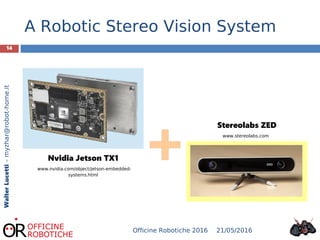
A Robotic Stereo Vision System
Nvidia Jetson TX1
Stereolabs ZED camera
Stereolabs ZED SDK
Stereolabs ZED engine
Simple Code example
Introduction3
Introduction
4
WalterLucetti–myzhar@robot-home.it
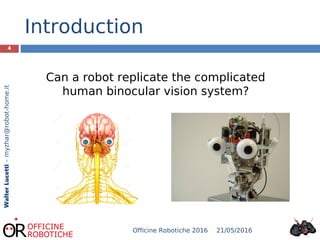
Can a robot replicate the complicated
human binocular vision system?
21/05/2016Officine Robotiche 2016
Stereo “Binocular” Vision
5
[from Wikipedia: Binocular vision]
Vision made with TWO “EYES”
It gives a “creature” a spare eye in case one is damaged
It gives a wider field of view
It can give stereopsis in which binocular disparity (or
parallax) provided by the two eyes' different positions on
the head gives precise depth perception
It allows a creature to see more of, or all of, an object
behind an obstacle
It gives binocular summation in which the ability to detect
faint objects is enhanced
WalterLucetti–myzhar@robot-home.it
21/05/2016Officine Robotiche 2016
Robotic Stereo Vision
6
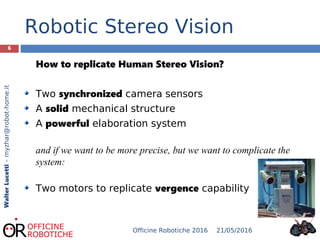
How to replicate Human Stereo Vision?
Two synchronized camera sensors
A solid mechanical structure
A powerful elaboration system
and if we want to be more precise, but we want to complicate the
system:
Two motors to replicate vergence capability
WalterLucetti–myzhar@robot-home.it
21/05/2016Officine Robotiche 2016
“Simplified” Stereo Vision7
“Simplified” Stereo Vision
8
WalterLucetti–myzhar@robot-home.it
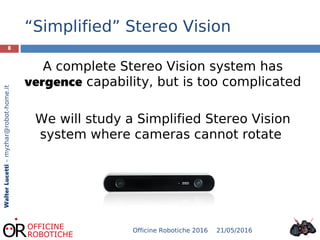
A complete Stereo Vision system has
vergence capability, but is too complicated
We will study a Simplified Stereo Vision
system where cameras cannot rotate
21/05/2016Officine Robotiche 2016
9
WalterLucetti–myzhar@robot-home.it
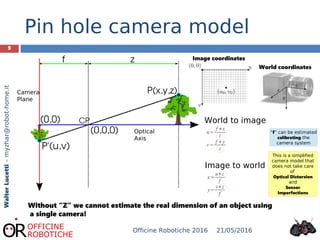
Pin hole camera model
Camera
Plane
Optical
Axis
Image coordinates
World coordinates
World to image
Image to world
Without “Z” we cannot estimate the real dimension of an object using
a single camera!
“f” can be estimated
calibrating the
camera system
This is a simplified
camera model that
does not take care
of
Optical Distorsion
and
Sensor
Imperfections
21/05/2016Officine Robotiche 2016
u=
f ∗x
z
v=
f ∗y
z
x=
u∗z
f
y=
v∗z
f
10
WalterLucetti–myzhar@robot-home.it
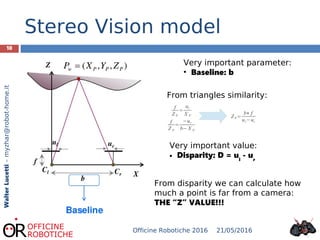
Stereo Vision model
Very important parameter:
●
Baseline: b
From triangles similarity:
Very important value:
● Disparity: D = ul
- ur
From disparity we can calculate how
much a point is far from a camera:
THE “Z” VALUE!!!
21/05/2016Officine Robotiche 2016
f
Z P
=
ul
X P
f
Z P
=
−ur
b−X P
ZP=
b∗ f
ul−ur
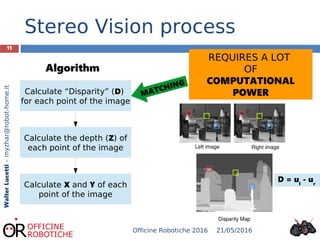
Calculate “Disparity” (D)
for each point of the image
11
WalterLucetti–myzhar@robot-home.it
Stereo Vision process
Calculate the depth (Z) of
each point of the image
Calculate X and Y of each
point of the image
Algorithm
MATCHING
REQUIRES A LOT
OF
COMPUTATIONAL
POWER
D = ul
- ur
21/05/2016Officine Robotiche 2016
12
WalterLucetti–myzhar@robot-home.it
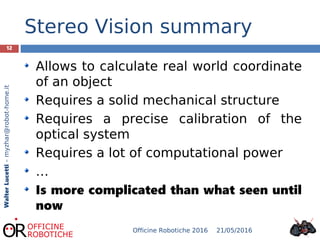
Stereo Vision summary
Allows to calculate real world coordinate
of an object
Requires a solid mechanical structure
Requires a precise calibration of the
optical system
Requires a lot of computational power
…
Is more complicated than what seen until
now
21/05/2016Officine Robotiche 2016
A Robotic Stereo Vision system13
14
WalterLucetti–myzhar@robot-home.it
A Robotic Stereo Vision System
Nvidia Jetson TX1
www.nvidia.com/object/jetson-embedded-
systems.html
Stereolabs ZED
www.stereolabs.com
21/05/2016Officine Robotiche 2016
15
WalterLucetti–myzhar@robot-home.it
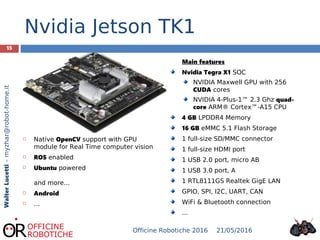
Nvidia Jetson TK1
Main features
Nvidia Tegra X1 SOC
NVIDIA Maxwell GPU with 256
CUDA cores
NVIDIA 4-Plus-1™ 2.3 Ghz quad-
core ARM® Cortex™-A15 CPU
4 GB LPDDR4 Memory
16 GB eMMC 5.1 Flash Storage
1 full-size SD/MMC connector
1 full-size HDMI port
1 USB 2.0 port, micro AB
1 USB 3.0 port, A
1 RTL8111GS Realtek GigE LAN
GPIO, SPI, I2C, UART, CAN
WiFi & Bluetooth connection
...
 Native OpenCV support with GPU
module for Real Time computer vision
 ROS enabled
 Ubuntu powered
and more...
 Android
 ...
21/05/2016Officine Robotiche 2016
16
WalterLucetti–myzhar@robot-home.it
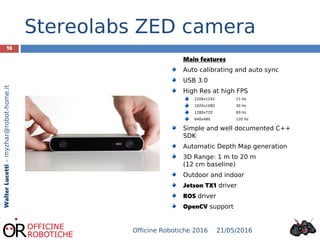
Stereolabs ZED camera
Main features
Auto calibrating and auto sync
USB 3.0
High Res at high FPS
2208x1242 15 Hz
1920x1080 30 Hz
1280x720 60 Hz
640x480 120 Hz
Simple and well documented C++
SDK
Automatic Depth Map generation
3D Range: 1 m to 20 m
(12 cm baseline)
Outdoor and indoor
Jetson TX1 driver
ROS driver
OpenCV support
21/05/2016Officine Robotiche 2016
17
WalterLucetti–myzhar@robot-home.it
Stereolabs ZED SDK
C++ Classes and APIs for Linux and Windows
2 main classes and 5 support classes
Main classes:
Camera: the main class to use the ZED camera
Mat: the class to store image data in GPU and CPU memory
spaces
Support classes:
CamParameters: calibration params for the two sensors
StereoParameters: calibration params for stereo processing
resolution: dimensions of the images
float3Struct: 3D point
uchar3Struct: RGB pixel
Current version:
0.9.3-beta for Linux and Windows, 0.9.3-alpha for Jetson TX1
21/05/2016Officine Robotiche 2016
18
WalterLucetti–myzhar@robot-home.it
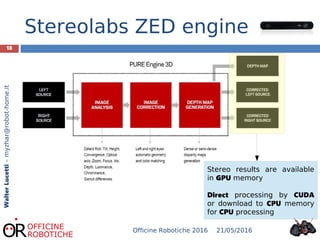
Stereolabs ZED engine
Stereo results are available
in GPU memory
Direct processing by CUDA
or download to CPU memory
for CPU processing
21/05/2016Officine Robotiche 2016
19
WalterLucetti–myzhar@robot-home.it
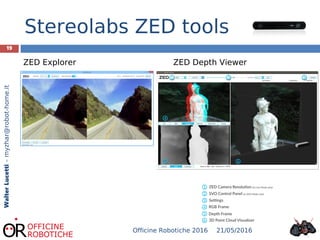
Stereolabs ZED tools
ZED Explorer ZED Depth Viewer
21/05/2016Officine Robotiche 2016
20
WalterLucetti–myzhar@robot-home.it
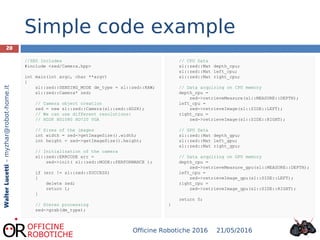
Simple code example
//ZED Includes
#include <zed/Camera.hpp>
int main(int argc, char **argv)
{
sl::zed::SENSING_MODE dm_type = sl::zed::RAW;
sl::zed::Camera* zed;
// Camera object creation
zed = new sl::zed::Camera(sl::zed::HD2K);
// We can use different resolutions:
// HD2K HD1080 HD720 VGA
// Sizes of the images
int width = zed->getImageSize().width;
int height = zed->getImageSize().height;
// Initialization of the camera
sl::zed::ERRCODE err =
zed->init( sl::zed::MODE::PERFORMANCE );
if (err != sl::zed::SUCCESS)
{
delete zed;
return 1;
}
// Stereo processing
zed->grab(dm_type);
// CPU Data
sl::zed::Mat depth_cpu;
sl::zed::Mat left_cpu;
sl::zed::Mat right_cpu;
// Data acquiring on CPU memory
depth_cpu =
zed->retrieveMeasure(sl::MEASURE::DEPTH);
left_cpu =
zed->retrieveImage(sl::SIDE::LEFT);
right_cpu =
zed->retrieveImage(sl::SIDE::RIGHT);
// GPU Data
sl::zed::Mat depth_gpu;
sl::zed::Mat left_gpu;
sl::zed::Mat right_gpu;
// Data acquiring on GPU memory
depth_cpu =
zed->retrieveMeasure_gpu(sl::MEASURE::DEPTH);
left_cpu =
zed->retrieveImage_gpu(sl::SIDE::LEFT);
right_cpu =
zed->retrieveImage_gpu(sl::SIDE::RIGHT);
return 0;
}
21/05/2016Officine Robotiche 2016
Live demo21
Conclusions22
23
WalterLucetti–myzhar@robot-home.it
Conclusions
With Stereo Vision
A robot can see obstacles
A robot can measure obstacles
A robot can localize obstacles
Stereo Vision requires
a lot of mathematical elaborations
a lot of computational power
a solid mechanical structure
so
Nvidia Jetson TX1 with Stereolabs ZED
is a really amazing solution for Robotic Stereo Vision!
21/05/2016Officine Robotiche 2016
The End!
OR
THANK YOU FOR YOUR
ATTENTION!
Walter Lucetti
http://myzharbot.robot-home.it
GitHub
@myzhar
Youtube
Myzhar
Twitter
@myzhar
Facebook
robothome
24
21/05/2016Officine Robotiche 2016

Robots that see like humans

  • 1.
    Robots that seelikeRobots that see like humanshumans Real Time Stereo Vision With ZED Camera on Nvidia Jetson TX1 Walter Lucetti myzhar@robot-home.it
  • 2.
    Summary 21/05/2016Officine Robotiche 2016 2 WalterLucetti–myzhar@robot-home.it LiveDemo Conclusions Introduction Stereo “Binocular” Vision Robotic Stereo Vision “Simplified” Stereo Vision Pin Hole Camera model Stereo Vision camera model Stereo Vision process A Robotic Stereo Vision System Nvidia Jetson TX1 Stereolabs ZED camera Stereolabs ZED SDK Stereolabs ZED engine Simple Code example
  • 3.
  • 4.
    Introduction 4 WalterLucetti–myzhar@robot-home.it Can a robotreplicate the complicated human binocular vision system? 21/05/2016Officine Robotiche 2016
  • 5.
    Stereo “Binocular” Vision 5 [fromWikipedia: Binocular vision] Vision made with TWO “EYES” It gives a “creature” a spare eye in case one is damaged It gives a wider field of view It can give stereopsis in which binocular disparity (or parallax) provided by the two eyes' different positions on the head gives precise depth perception It allows a creature to see more of, or all of, an object behind an obstacle It gives binocular summation in which the ability to detect faint objects is enhanced WalterLucetti–myzhar@robot-home.it 21/05/2016Officine Robotiche 2016
  • 6.
    Robotic Stereo Vision 6 Howto replicate Human Stereo Vision? Two synchronized camera sensors A solid mechanical structure A powerful elaboration system and if we want to be more precise, but we want to complicate the system: Two motors to replicate vergence capability WalterLucetti–myzhar@robot-home.it 21/05/2016Officine Robotiche 2016
  • 7.
  • 8.
    “Simplified” Stereo Vision 8 WalterLucetti–myzhar@robot-home.it Acomplete Stereo Vision system has vergence capability, but is too complicated We will study a Simplified Stereo Vision system where cameras cannot rotate 21/05/2016Officine Robotiche 2016
  • 9.
    9 WalterLucetti–myzhar@robot-home.it Pin hole cameramodel Camera Plane Optical Axis Image coordinates World coordinates World to image Image to world Without “Z” we cannot estimate the real dimension of an object using a single camera! “f” can be estimated calibrating the camera system This is a simplified camera model that does not take care of Optical Distorsion and Sensor Imperfections 21/05/2016Officine Robotiche 2016 u= f ∗x z v= f ∗y z x= u∗z f y= v∗z f
  • 10.
    10 WalterLucetti–myzhar@robot-home.it Stereo Vision model Veryimportant parameter: ● Baseline: b From triangles similarity: Very important value: ● Disparity: D = ul - ur From disparity we can calculate how much a point is far from a camera: THE “Z” VALUE!!! 21/05/2016Officine Robotiche 2016 f Z P = ul X P f Z P = −ur b−X P ZP= b∗ f ul−ur
  • 11.
    Calculate “Disparity” (D) foreach point of the image 11 WalterLucetti–myzhar@robot-home.it Stereo Vision process Calculate the depth (Z) of each point of the image Calculate X and Y of each point of the image Algorithm MATCHING REQUIRES A LOT OF COMPUTATIONAL POWER D = ul - ur 21/05/2016Officine Robotiche 2016
  • 12.
    12 WalterLucetti–myzhar@robot-home.it Stereo Vision summary Allowsto calculate real world coordinate of an object Requires a solid mechanical structure Requires a precise calibration of the optical system Requires a lot of computational power … Is more complicated than what seen until now 21/05/2016Officine Robotiche 2016
  • 13.
    A Robotic StereoVision system13
  • 14.
    14 WalterLucetti–myzhar@robot-home.it A Robotic StereoVision System Nvidia Jetson TX1 www.nvidia.com/object/jetson-embedded- systems.html Stereolabs ZED www.stereolabs.com 21/05/2016Officine Robotiche 2016
  • 15.
    15 WalterLucetti–myzhar@robot-home.it Nvidia Jetson TK1 Mainfeatures Nvidia Tegra X1 SOC NVIDIA Maxwell GPU with 256 CUDA cores NVIDIA 4-Plus-1™ 2.3 Ghz quad- core ARM® Cortex™-A15 CPU 4 GB LPDDR4 Memory 16 GB eMMC 5.1 Flash Storage 1 full-size SD/MMC connector 1 full-size HDMI port 1 USB 2.0 port, micro AB 1 USB 3.0 port, A 1 RTL8111GS Realtek GigE LAN GPIO, SPI, I2C, UART, CAN WiFi & Bluetooth connection ...  Native OpenCV support with GPU module for Real Time computer vision  ROS enabled  Ubuntu powered and more...  Android  ... 21/05/2016Officine Robotiche 2016
  • 16.
    16 WalterLucetti–myzhar@robot-home.it Stereolabs ZED camera Mainfeatures Auto calibrating and auto sync USB 3.0 High Res at high FPS 2208x1242 15 Hz 1920x1080 30 Hz 1280x720 60 Hz 640x480 120 Hz Simple and well documented C++ SDK Automatic Depth Map generation 3D Range: 1 m to 20 m (12 cm baseline) Outdoor and indoor Jetson TX1 driver ROS driver OpenCV support 21/05/2016Officine Robotiche 2016
  • 17.
    17 WalterLucetti–myzhar@robot-home.it Stereolabs ZED SDK C++Classes and APIs for Linux and Windows 2 main classes and 5 support classes Main classes: Camera: the main class to use the ZED camera Mat: the class to store image data in GPU and CPU memory spaces Support classes: CamParameters: calibration params for the two sensors StereoParameters: calibration params for stereo processing resolution: dimensions of the images float3Struct: 3D point uchar3Struct: RGB pixel Current version: 0.9.3-beta for Linux and Windows, 0.9.3-alpha for Jetson TX1 21/05/2016Officine Robotiche 2016
  • 18.
    18 WalterLucetti–myzhar@robot-home.it Stereolabs ZED engine Stereoresults are available in GPU memory Direct processing by CUDA or download to CPU memory for CPU processing 21/05/2016Officine Robotiche 2016
  • 19.
    19 WalterLucetti–myzhar@robot-home.it Stereolabs ZED tools ZEDExplorer ZED Depth Viewer 21/05/2016Officine Robotiche 2016
  • 20.
    20 WalterLucetti–myzhar@robot-home.it Simple code example //ZEDIncludes #include <zed/Camera.hpp> int main(int argc, char **argv) { sl::zed::SENSING_MODE dm_type = sl::zed::RAW; sl::zed::Camera* zed; // Camera object creation zed = new sl::zed::Camera(sl::zed::HD2K); // We can use different resolutions: // HD2K HD1080 HD720 VGA // Sizes of the images int width = zed->getImageSize().width; int height = zed->getImageSize().height; // Initialization of the camera sl::zed::ERRCODE err = zed->init( sl::zed::MODE::PERFORMANCE ); if (err != sl::zed::SUCCESS) { delete zed; return 1; } // Stereo processing zed->grab(dm_type); // CPU Data sl::zed::Mat depth_cpu; sl::zed::Mat left_cpu; sl::zed::Mat right_cpu; // Data acquiring on CPU memory depth_cpu = zed->retrieveMeasure(sl::MEASURE::DEPTH); left_cpu = zed->retrieveImage(sl::SIDE::LEFT); right_cpu = zed->retrieveImage(sl::SIDE::RIGHT); // GPU Data sl::zed::Mat depth_gpu; sl::zed::Mat left_gpu; sl::zed::Mat right_gpu; // Data acquiring on GPU memory depth_cpu = zed->retrieveMeasure_gpu(sl::MEASURE::DEPTH); left_cpu = zed->retrieveImage_gpu(sl::SIDE::LEFT); right_cpu = zed->retrieveImage_gpu(sl::SIDE::RIGHT); return 0; } 21/05/2016Officine Robotiche 2016
  • 21.
  • 22.
  • 23.
    23 WalterLucetti–myzhar@robot-home.it Conclusions With Stereo Vision Arobot can see obstacles A robot can measure obstacles A robot can localize obstacles Stereo Vision requires a lot of mathematical elaborations a lot of computational power a solid mechanical structure so Nvidia Jetson TX1 with Stereolabs ZED is a really amazing solution for Robotic Stereo Vision! 21/05/2016Officine Robotiche 2016
  • 24.
    The End! OR THANK YOUFOR YOUR ATTENTION! Walter Lucetti http://myzharbot.robot-home.it GitHub @myzhar Youtube Myzhar Twitter @myzhar Facebook robothome 24 21/05/2016Officine Robotiche 2016