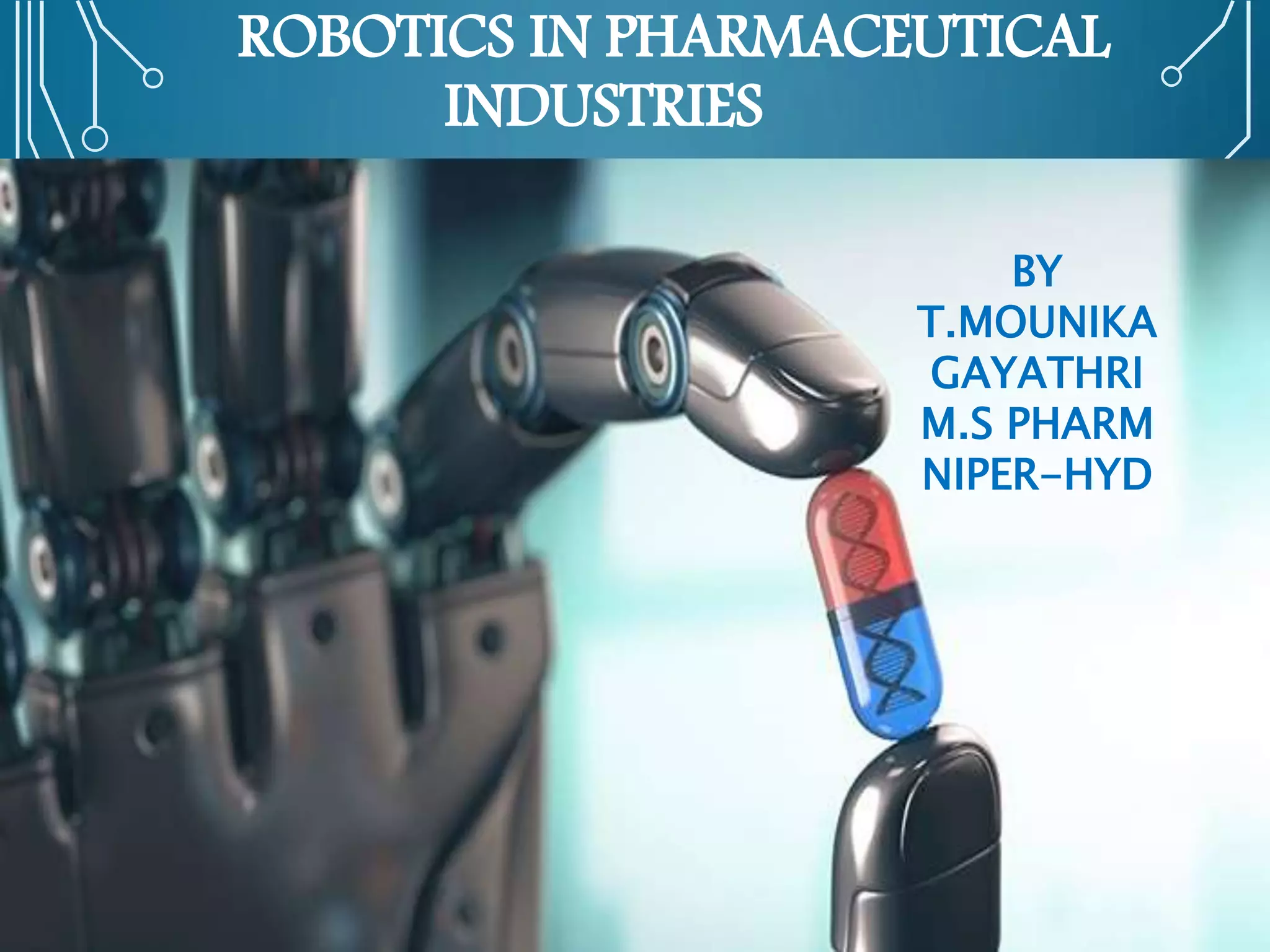
ROBOTICS IN PHARMACEUTICAL
INDUSTRIES
BY
T.MOUNIKA
GAYATHRI
M.S PHARM
NIPER-HYD
CONTENTS
• INTRODUCTION
• WHY TO USE OF ROBOTS IN AREAS OF PHARMACY
• TYPES OF ROBOTS
• DETERMINING THE TYPE OF ROBOT NEEDED
• BENEFITS
• CHALLENGES
• CONCLUSION
2
INTRODUCTION
• The international standard
organization gives a definition of
robot in ISO 8373: ‘’ An
automatically controlled,
reprogrammable, multipurpose,
manipulator programmable in
three or more axes, which may be
either fixed in place or mobile for
use in industrial automation and
applications.
3
WHY TO USE ROBOTS IN
PHARMACEUTICAL INDUSTRIES?
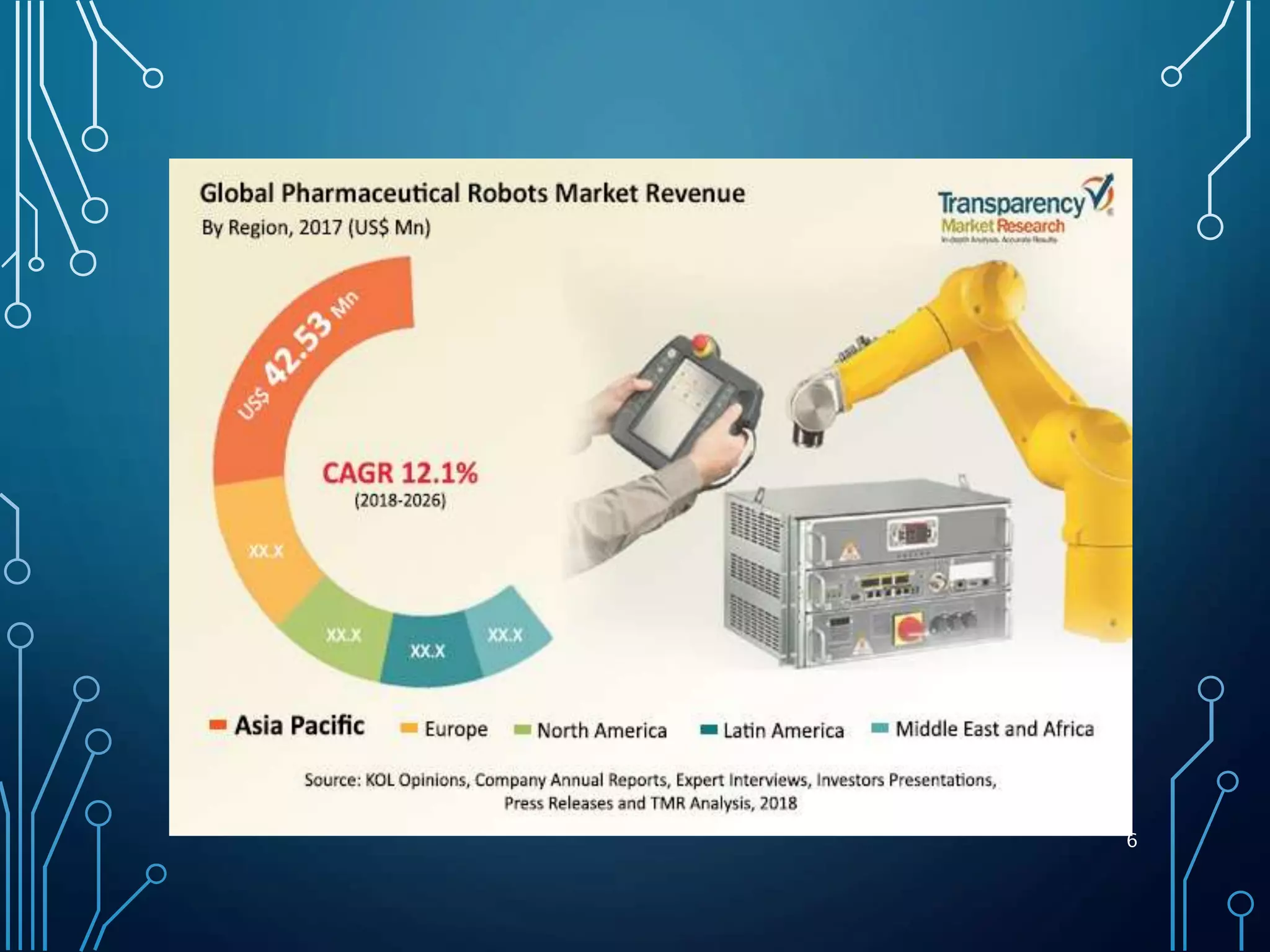
• As demand for new drugs and medicines grows,
pharmaceutical companies are continuously looking for new
ways to increase productivity, leading to an increased
automated equipment and robotics.
• Due to the great potential for the use of robots in the
pharmaceutical industries, they are gradually injecting more
robotic systems into their operations.
• In the world of pharmaceuticals, there is a vital role for robots
to play in the complicated processes of research and
development, production, and packaging.
1
CURRENTLY USING INDUSTRIES
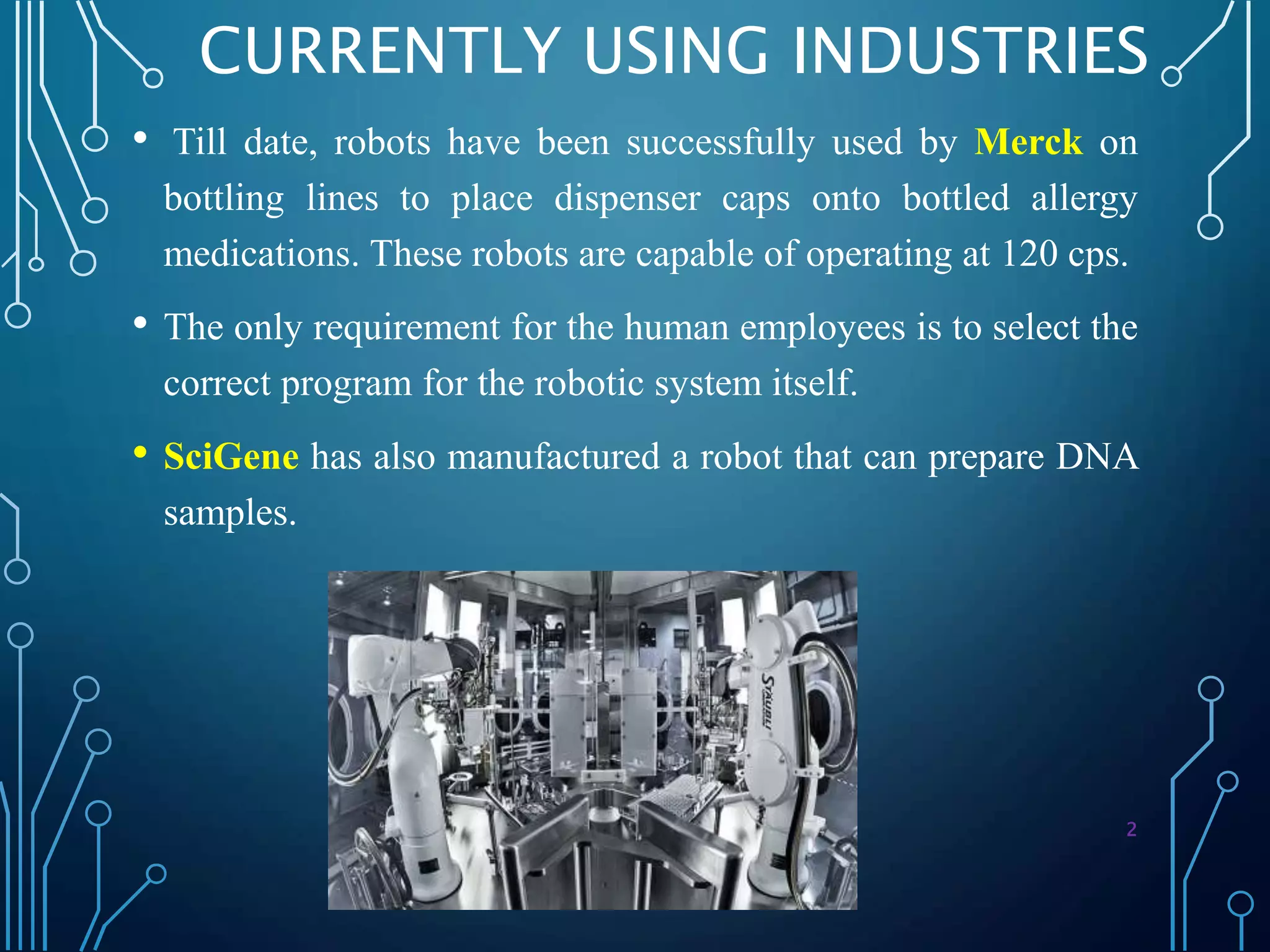
• Till date, robots have been successfully used by Merck on
bottling lines to place dispenser caps onto bottled allergy
medications. These robots are capable of operating at 120 cps.
• The only requirement for the human employees is to select the
correct program for the robotic system itself.
• SciGene has also manufactured a robot that can prepare DNA
samples.
2
6
TYPES OF ROBOTS
• Cartesian robots, moves up and down in a vertical plane, low
cost
• SCARA robots (selective compliance articulated robot arm) ,
move freely but in a single geometrical plane
• Articulated robots, can move in horizontal and vertical planes
7
TYPE OF ROBOT NEEDED
• Based on
• Required type and size of end-of-arm tooling
• Cycle time
• Repeatability
• Reach
• Payload capacity
• Environment in which the robot will be operating (if
essential) 8
IN WHICH AREAS OF PHARMACY
WE CAN USE ROBOTS?
• In Packaging and processing
Can erase labour-intensive tasks
Can produce large quantities of a
product in a short space of time.
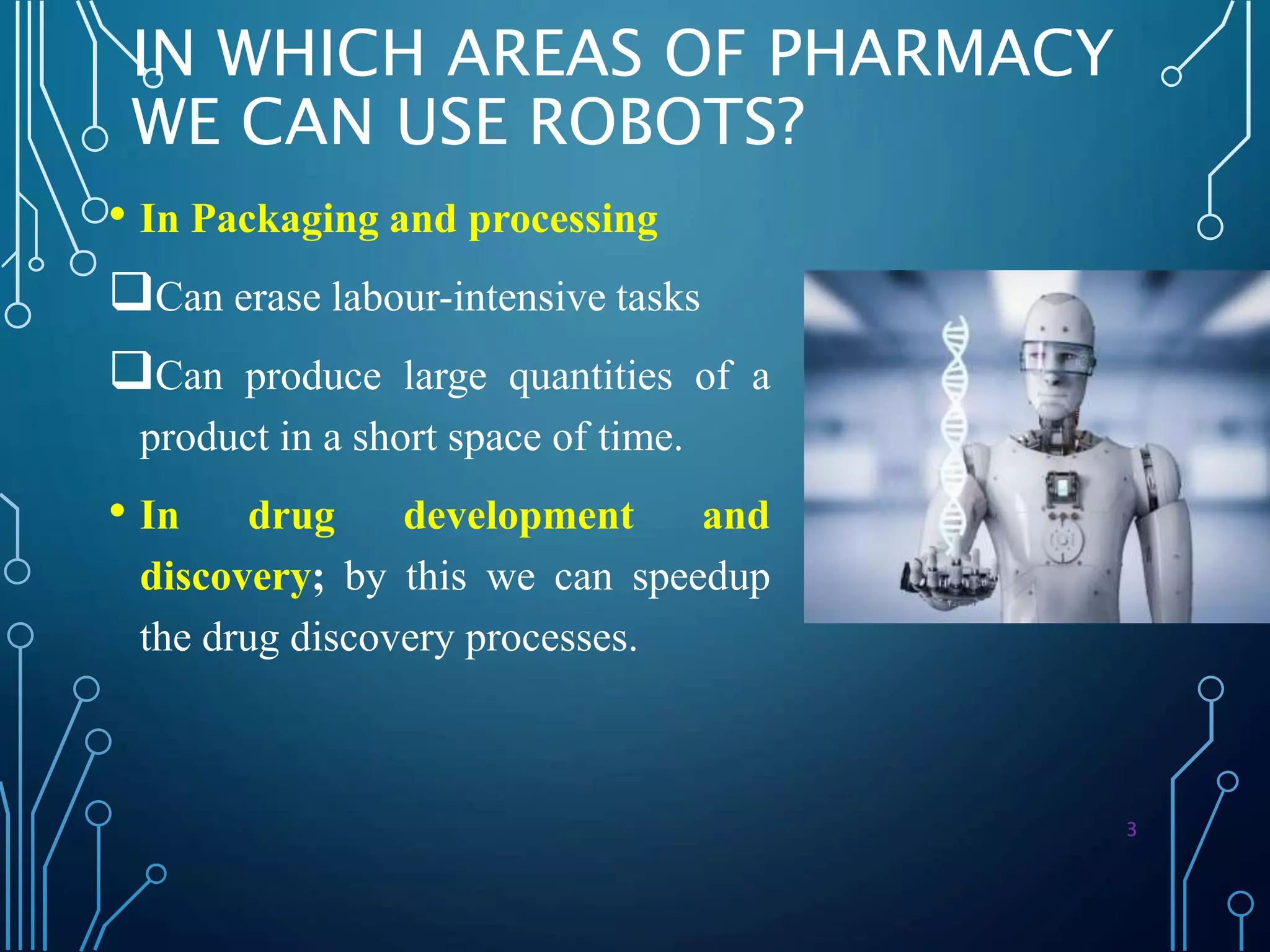
• In drug development and
discovery; by this we can speedup
the drug discovery processes.
3
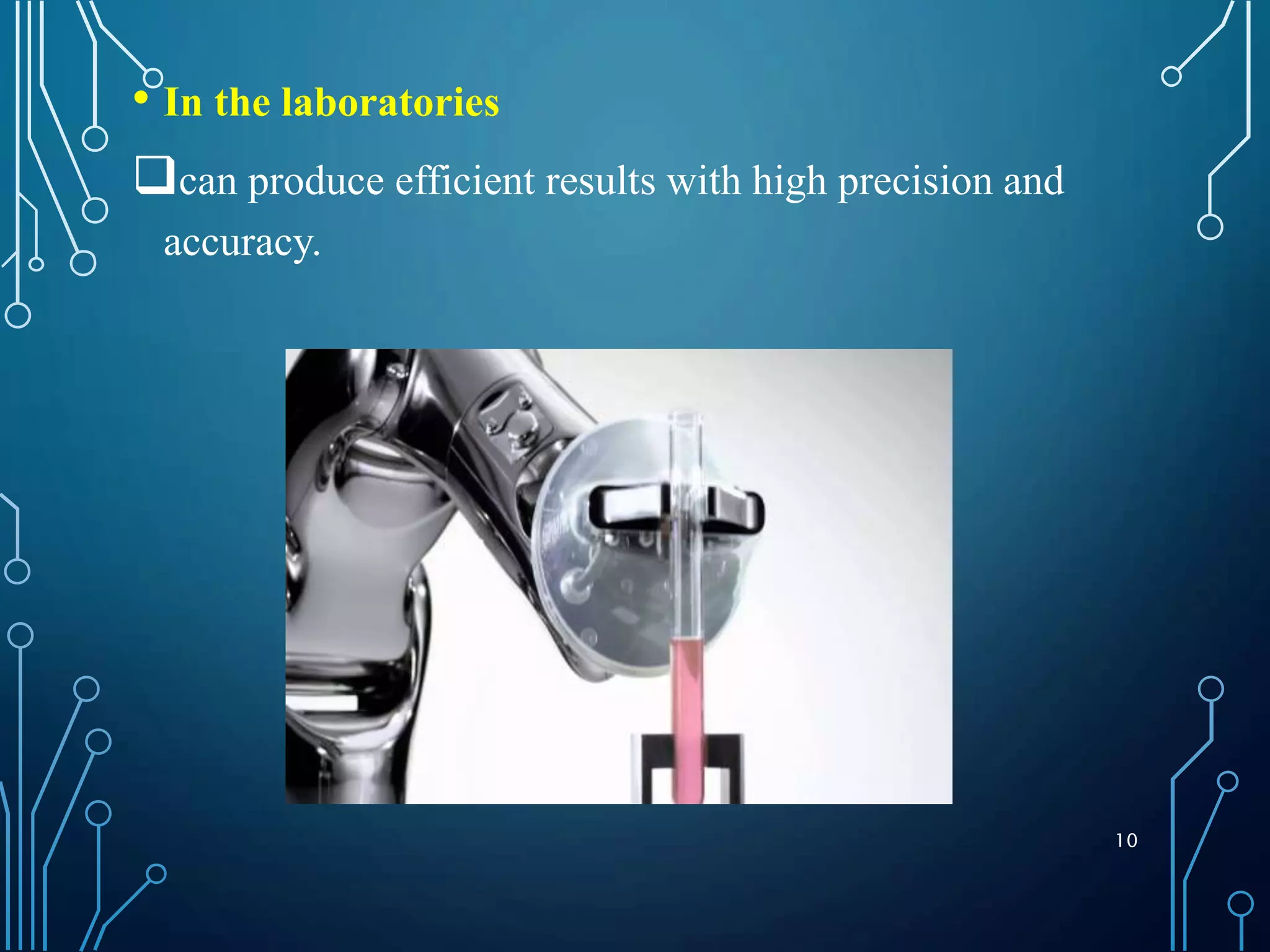
• In the laboratories
can produce efficient results with high precision and
accuracy.
10
• To detect the Fraudulent medications
could also be useful in assisting pharmacies and drug
companies in the identification of counterfeit
medications.
11
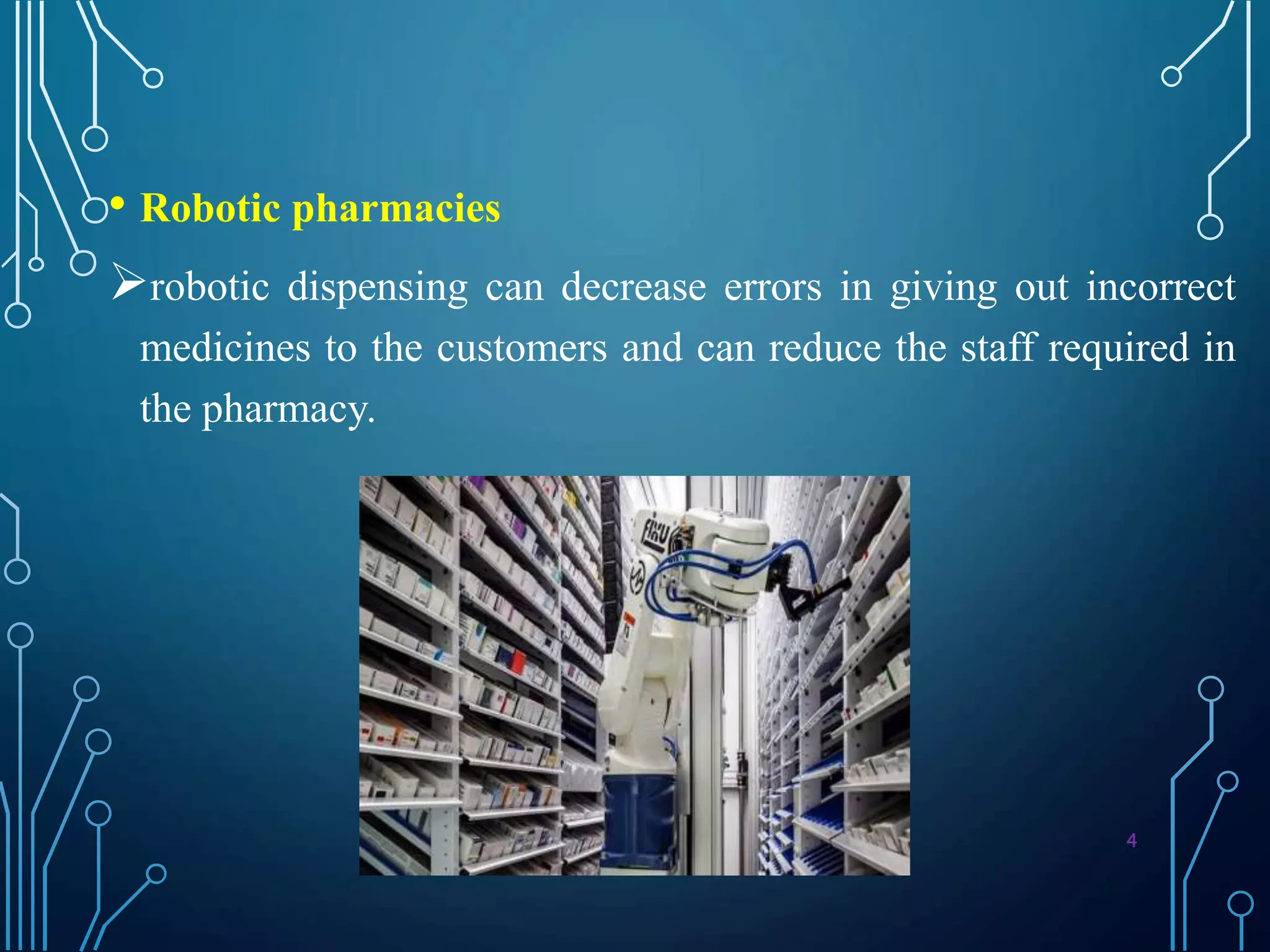
• Robotic pharmacies
robotic dispensing can decrease errors in giving out incorrect
medicines to the customers and can reduce the staff required in
the pharmacy.
4
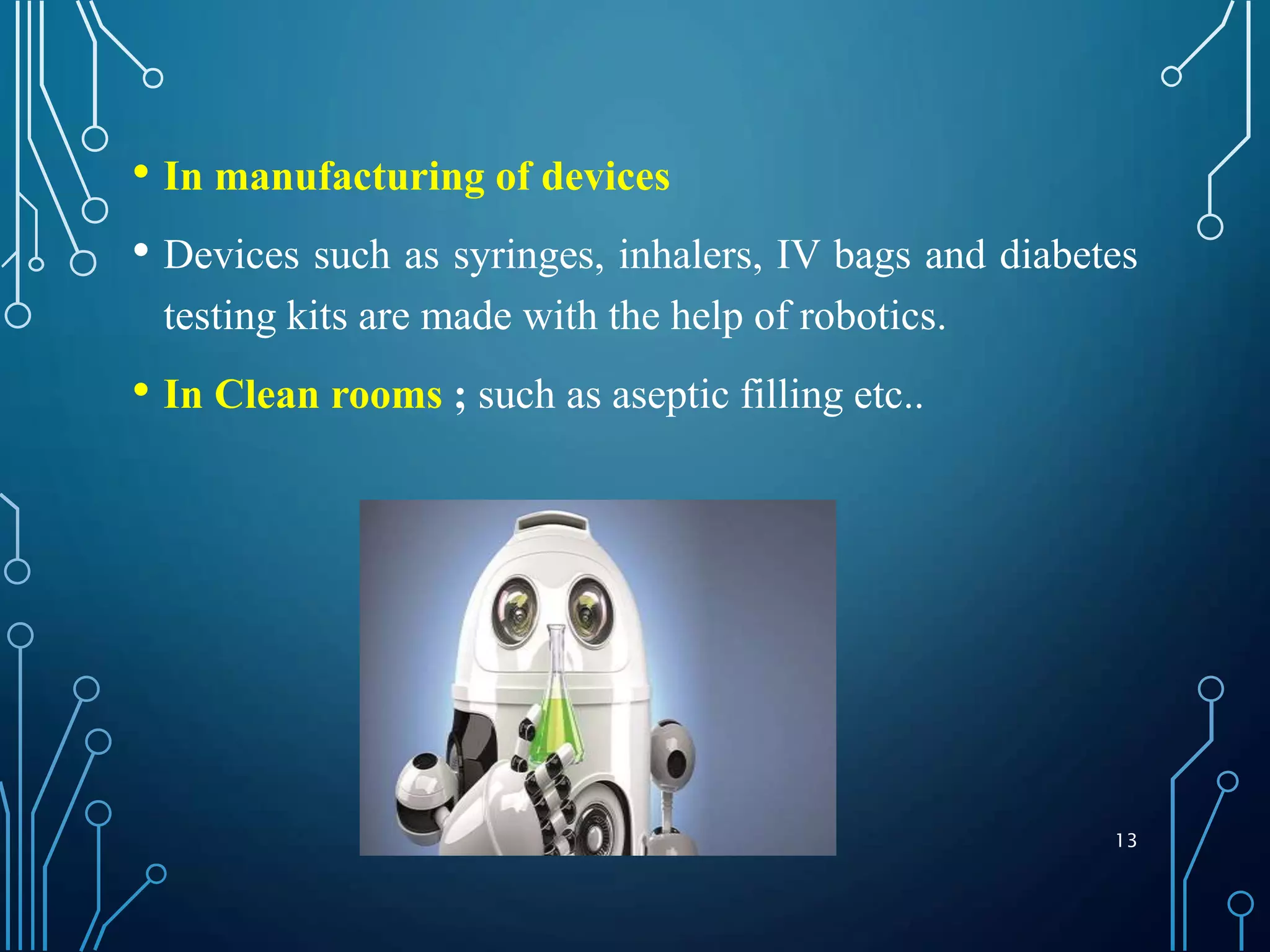
• In manufacturing of devices
• Devices such as syringes, inhalers, IV bags and diabetes
testing kits are made with the help of robotics.
• In Clean rooms ; such as aseptic filling etc..
13
BENEFITS BEHIND THE USE OF
ROBOTS
• Accuracy
• Tirelessness, perform a 96 man-hour project in 10 hours
• Reliability, can work 24x7
• Return on investment (ROI): with the increase in quality and
application speed, there are the benefits of increased
production possibilities.
• Speed, work efficiently, without wasting movement or time.
• Work continuously in any environment
5
• Production
• Safety: Robots increase workplace safety, so they no
longer have to perform dangerous applications in
hazardous settings.
 A single robot can perform the functions of numerous
pieces of equipment and therefore reduce the amount of
space necessary to build a factory.
• Reduced chances of contamination: Removing people
from the screening process reduces the potential for
contamination.
6
CHALLENGES
 Expense: There is high initial cost of purchasing and using
robots.
 fears:They pose any threat or danger to society, fears.
 Robotic systems are too complicated to use and require
complex programming.
 Expertise: Employees will require training in programming
and interacting with the new robotic equipment. This
normally takes time and financial output.
 Return on investment (ROI): Incorporating industrial
robots does not guarantee results. Without planning,
companies can have difficulty achieving their goals.
8
CONCLUSION
• The changes and benefits robots that could provide the
pharmaceutical industry are seemingly endless.
• From creating vast savings to increasing efficiency and
safety it is the robots' speed, precision, reliability and
flexibility that make them such valuable tools.
• Pharmaceutical industries are intently seeking ways to
reduce their expenses, increase their efficiency, and make
high quality products. Robots can help companies
achieve these ends by providing speed, precision,
repetability, and flexibility.
10
Robotics in pharmaceutical industries

Robotics in pharmaceutical industries

  • 1.
  • 2.
    CONTENTS • INTRODUCTION • WHYTO USE OF ROBOTS IN AREAS OF PHARMACY • TYPES OF ROBOTS • DETERMINING THE TYPE OF ROBOT NEEDED • BENEFITS • CHALLENGES • CONCLUSION 2
  • 3.
    INTRODUCTION • The internationalstandard organization gives a definition of robot in ISO 8373: ‘’ An automatically controlled, reprogrammable, multipurpose, manipulator programmable in three or more axes, which may be either fixed in place or mobile for use in industrial automation and applications. 3
  • 4.
    WHY TO USEROBOTS IN PHARMACEUTICAL INDUSTRIES? • As demand for new drugs and medicines grows, pharmaceutical companies are continuously looking for new ways to increase productivity, leading to an increased automated equipment and robotics. • Due to the great potential for the use of robots in the pharmaceutical industries, they are gradually injecting more robotic systems into their operations. • In the world of pharmaceuticals, there is a vital role for robots to play in the complicated processes of research and development, production, and packaging. 1
  • 5.
    CURRENTLY USING INDUSTRIES •Till date, robots have been successfully used by Merck on bottling lines to place dispenser caps onto bottled allergy medications. These robots are capable of operating at 120 cps. • The only requirement for the human employees is to select the correct program for the robotic system itself. • SciGene has also manufactured a robot that can prepare DNA samples. 2
  • 6.
  • 7.
    TYPES OF ROBOTS •Cartesian robots, moves up and down in a vertical plane, low cost • SCARA robots (selective compliance articulated robot arm) , move freely but in a single geometrical plane • Articulated robots, can move in horizontal and vertical planes 7
  • 8.
    TYPE OF ROBOTNEEDED • Based on • Required type and size of end-of-arm tooling • Cycle time • Repeatability • Reach • Payload capacity • Environment in which the robot will be operating (if essential) 8
  • 9.
    IN WHICH AREASOF PHARMACY WE CAN USE ROBOTS? • In Packaging and processing Can erase labour-intensive tasks Can produce large quantities of a product in a short space of time. • In drug development and discovery; by this we can speedup the drug discovery processes. 3
  • 10.
    • In thelaboratories can produce efficient results with high precision and accuracy. 10
  • 11.
    • To detectthe Fraudulent medications could also be useful in assisting pharmacies and drug companies in the identification of counterfeit medications. 11
  • 12.
    • Robotic pharmacies roboticdispensing can decrease errors in giving out incorrect medicines to the customers and can reduce the staff required in the pharmacy. 4
  • 13.
    • In manufacturingof devices • Devices such as syringes, inhalers, IV bags and diabetes testing kits are made with the help of robotics. • In Clean rooms ; such as aseptic filling etc.. 13
  • 14.
    BENEFITS BEHIND THEUSE OF ROBOTS • Accuracy • Tirelessness, perform a 96 man-hour project in 10 hours • Reliability, can work 24x7 • Return on investment (ROI): with the increase in quality and application speed, there are the benefits of increased production possibilities. • Speed, work efficiently, without wasting movement or time. • Work continuously in any environment 5
  • 15.
    • Production • Safety:Robots increase workplace safety, so they no longer have to perform dangerous applications in hazardous settings.  A single robot can perform the functions of numerous pieces of equipment and therefore reduce the amount of space necessary to build a factory. • Reduced chances of contamination: Removing people from the screening process reduces the potential for contamination. 6
  • 16.
    CHALLENGES  Expense: Thereis high initial cost of purchasing and using robots.  fears:They pose any threat or danger to society, fears.  Robotic systems are too complicated to use and require complex programming.  Expertise: Employees will require training in programming and interacting with the new robotic equipment. This normally takes time and financial output.  Return on investment (ROI): Incorporating industrial robots does not guarantee results. Without planning, companies can have difficulty achieving their goals. 8
  • 17.
    CONCLUSION • The changesand benefits robots that could provide the pharmaceutical industry are seemingly endless. • From creating vast savings to increasing efficiency and safety it is the robots' speed, precision, reliability and flexibility that make them such valuable tools. • Pharmaceutical industries are intently seeking ways to reduce their expenses, increase their efficiency, and make high quality products. Robots can help companies achieve these ends by providing speed, precision, repetability, and flexibility. 10