Robot Programming - 1
Methods of Robot Programming
1. Leadthrough Programming
2. Textual robot languages
Leadthrough Programming methods:
1.Powered Leadthrough
2. Manual Leadthrough
Methods of defining positions in
space
1. Joint movements
2. x-y-z coordinate motions (also called
world coordinates)
3. Tool coordinate motions
Robot Languages
For ease of control of motions of
robots having different structures and
geometrical capabilities.
Classification
1. First generation language
* Provides off-line programming in
combination with the programming through robot
pendant teaching.
(E.g) VAL
* Branching, IP/OP interfacing and commands
leading to a sequence of movements of arm and
body, and opening and closing of the end –
effectors are possible.
* ON/OFF binary signals
Classification
2. Second Generation Language
* They are structured Programming languages performing
complex tasks.
* Complex motions can be generated.
* Handle both analog and digital signals besides the binary
signals.
* Force, torque, slip and other sensors can be incorporated on
the joints, wrist of gripper fingers.
* (E.g) VAL II, AML, RAIL, MCL, etc.,
* Today’s programming languages with all features including
knowledge- based programs some decision- making programs can be
kept in the robot’s memory to find some means of getting out of the
manufacturing.
* They have better interacting facilities with other computers.
Data processing, file management and keeping all the records of the
events happening in the work-cell can be done more efficiently.
3. World modeling and task – oriented object level language
* TIGHTEN THE NUT –Voice Control
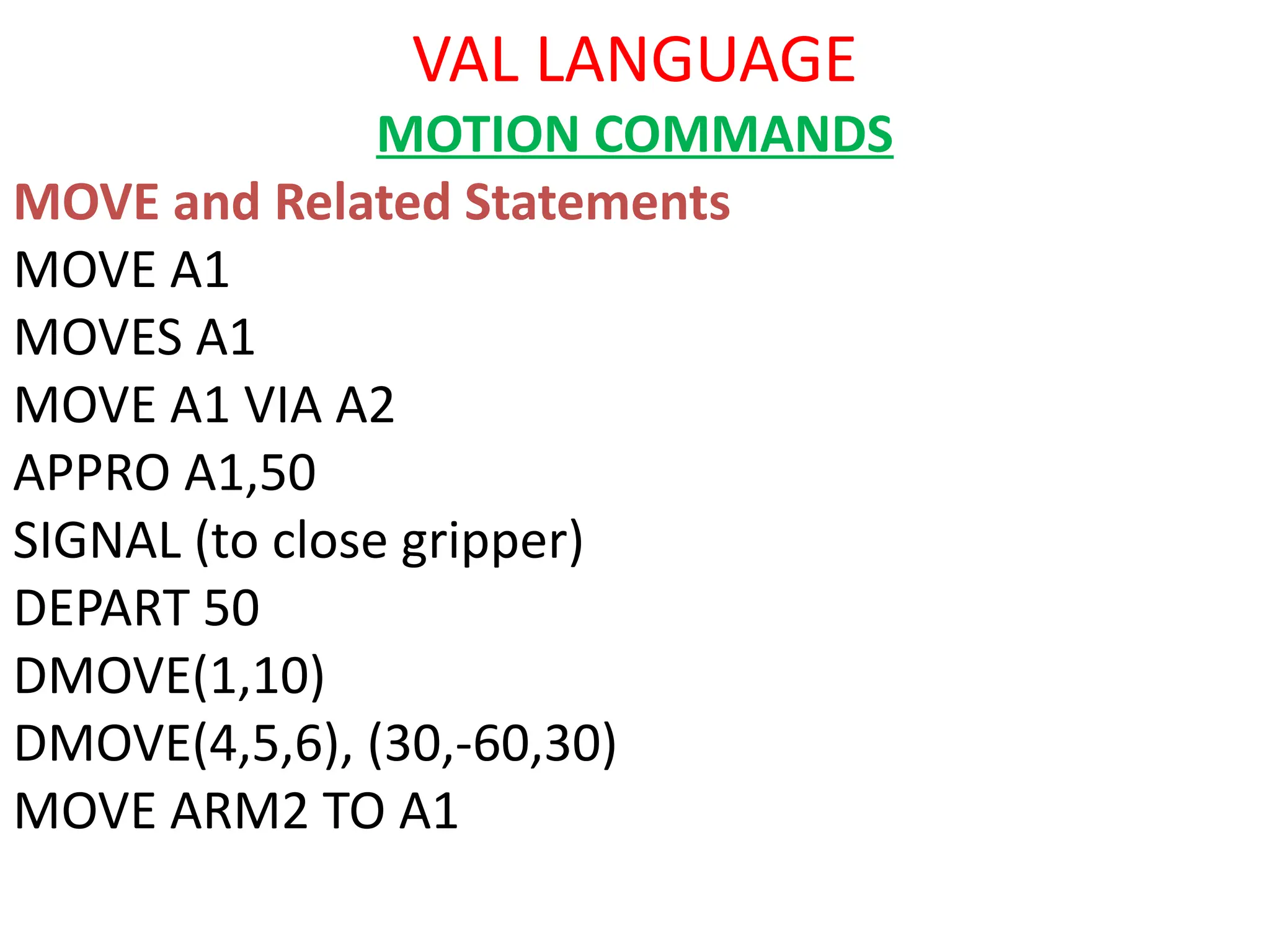
VAL LANGUAGE
MOTION COMMANDS
MOVE and Related Statements
MOVE A1
MOVES A1
MOVE A1 VIA A2
APPRO A1,50
SIGNAL (to close gripper)
DEPART 50
DMOVE(1,10)
DMOVE(4,5,6), (30,-60,30)
MOVE ARM2 TO A1
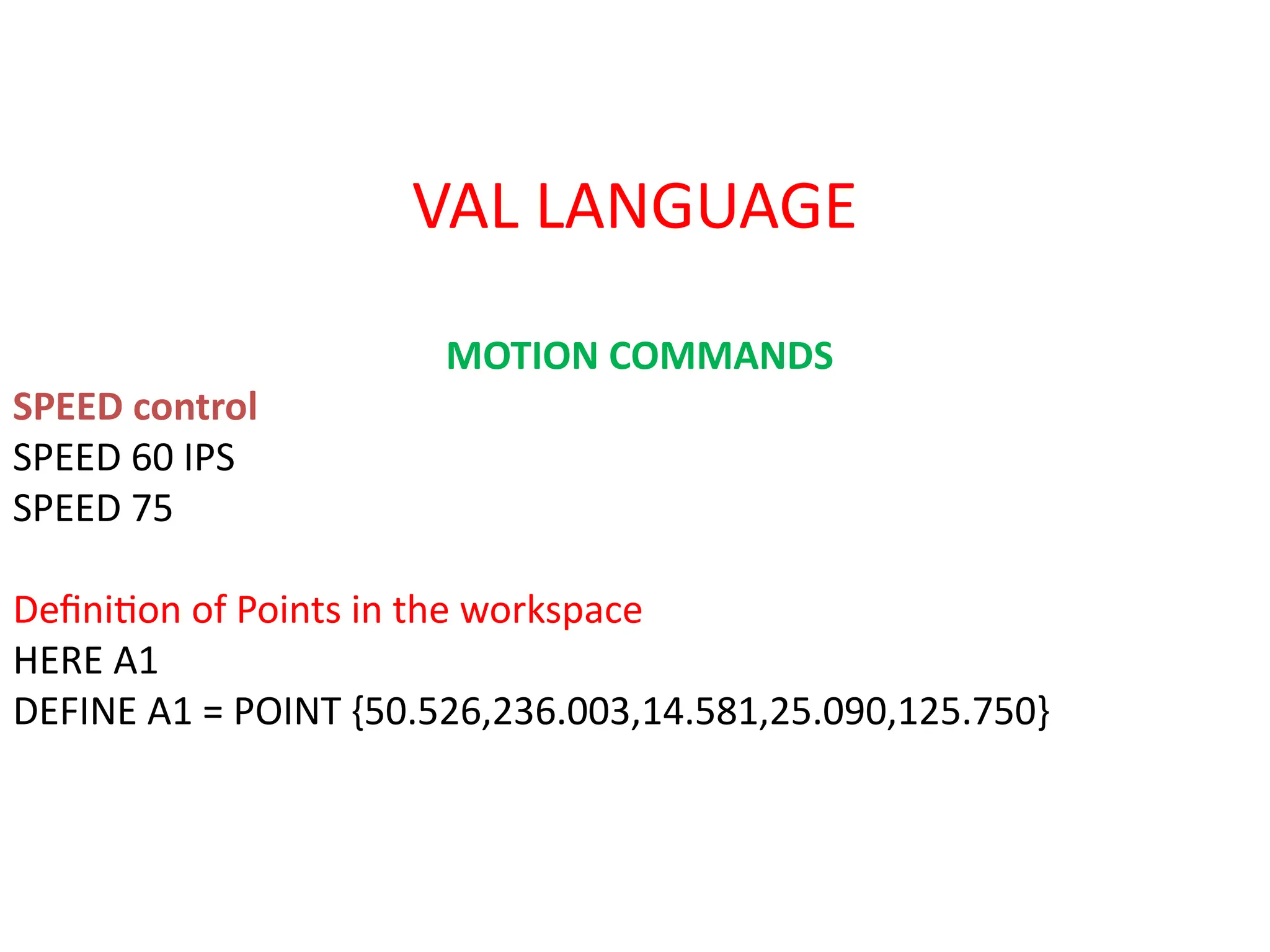
VAL LANGUAGE
MOTION COMMANDS
SPEED control
SPEED 60 IPS
SPEED 75
Definition of Points in the workspace
HERE A1
DEFINE A1 = POINT {50.526,236.003,14.581,25.090,125.750}
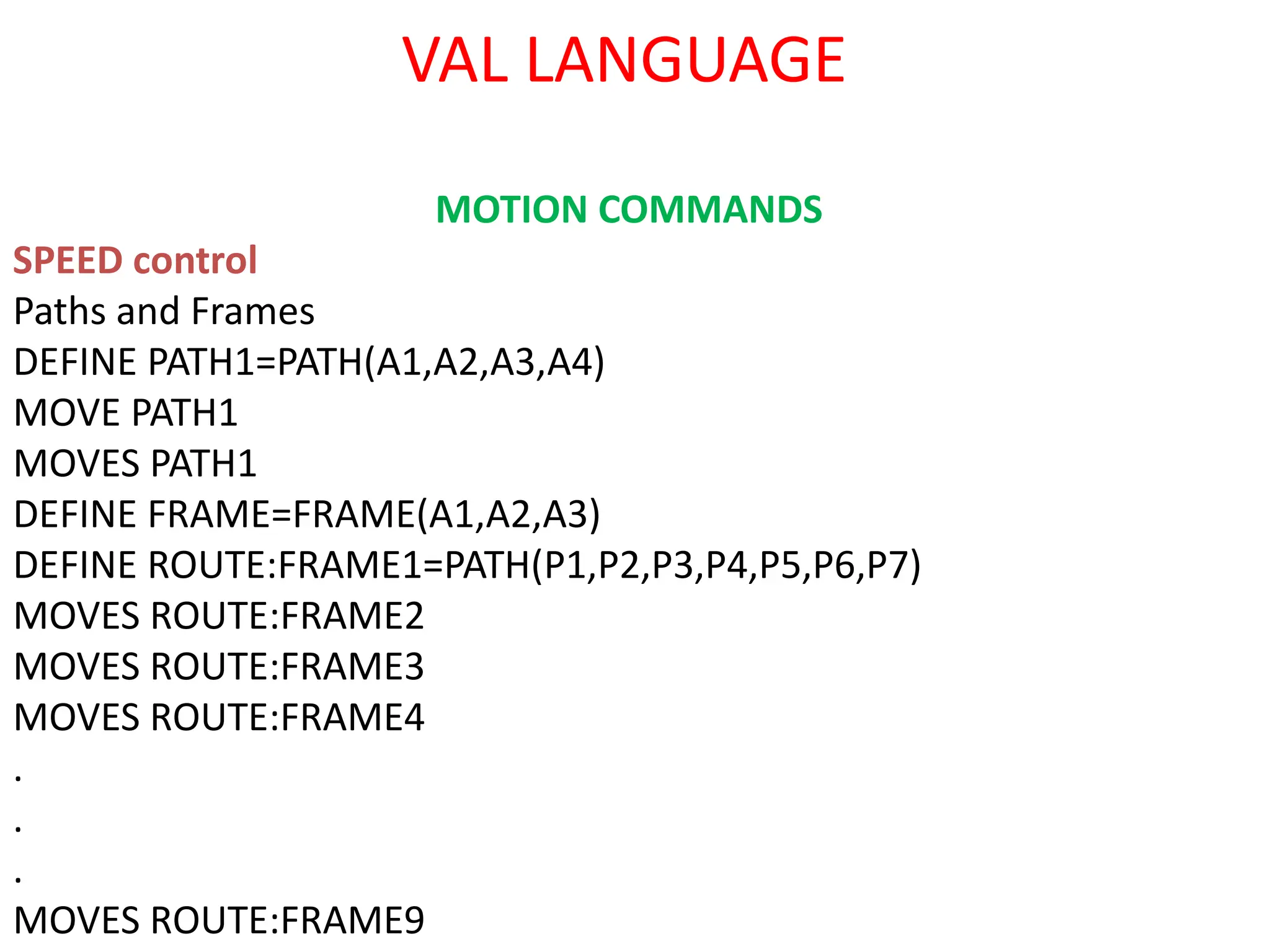
VAL LANGUAGE
MOTION COMMANDS
SPEED control
Paths and Frames
DEFINE PATH1=PATH(A1,A2,A3,A4)
MOVE PATH1
MOVES PATH1
DEFINE FRAME=FRAME(A1,A2,A3)
DEFINE ROUTE:FRAME1=PATH(P1,P2,P3,P4,P5,P6,P7)
MOVES ROUTE:FRAME2
MOVES ROUTE:FRAME3
MOVES ROUTE:FRAME4
.
.
.
MOVES ROUTE:FRAME9
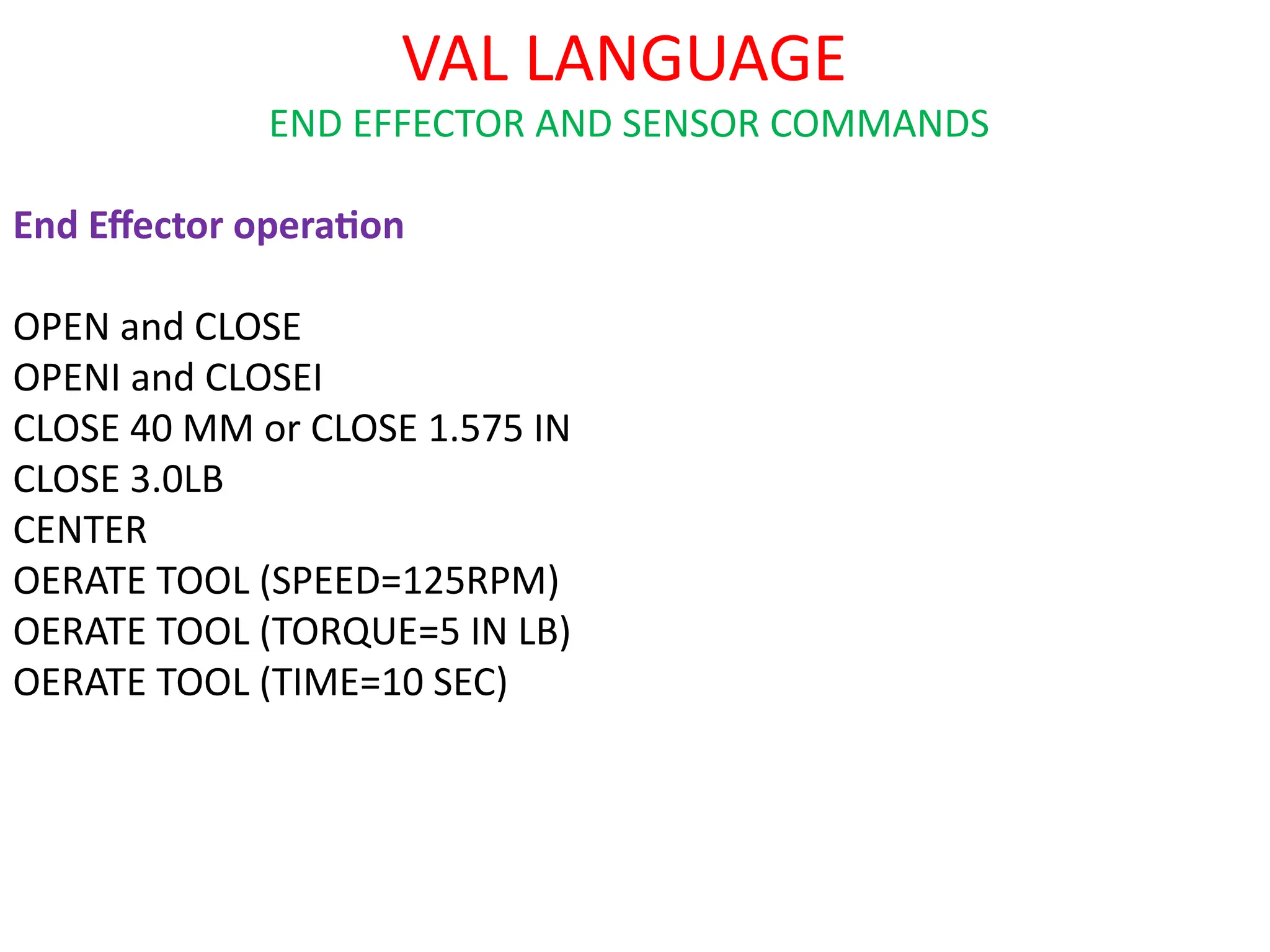
VAL LANGUAGE
END EFFECTOR AND SENSOR COMMANDS
End Effector operation
OPEN and CLOSE
OPENI and CLOSEI
CLOSE 40 MM or CLOSE 1.575 IN
CLOSE 3.0LB
CENTER
OERATE TOOL (SPEED=125RPM)
OERATE TOOL (TORQUE=5 IN LB)
OERATE TOOL (TIME=10 SEC)
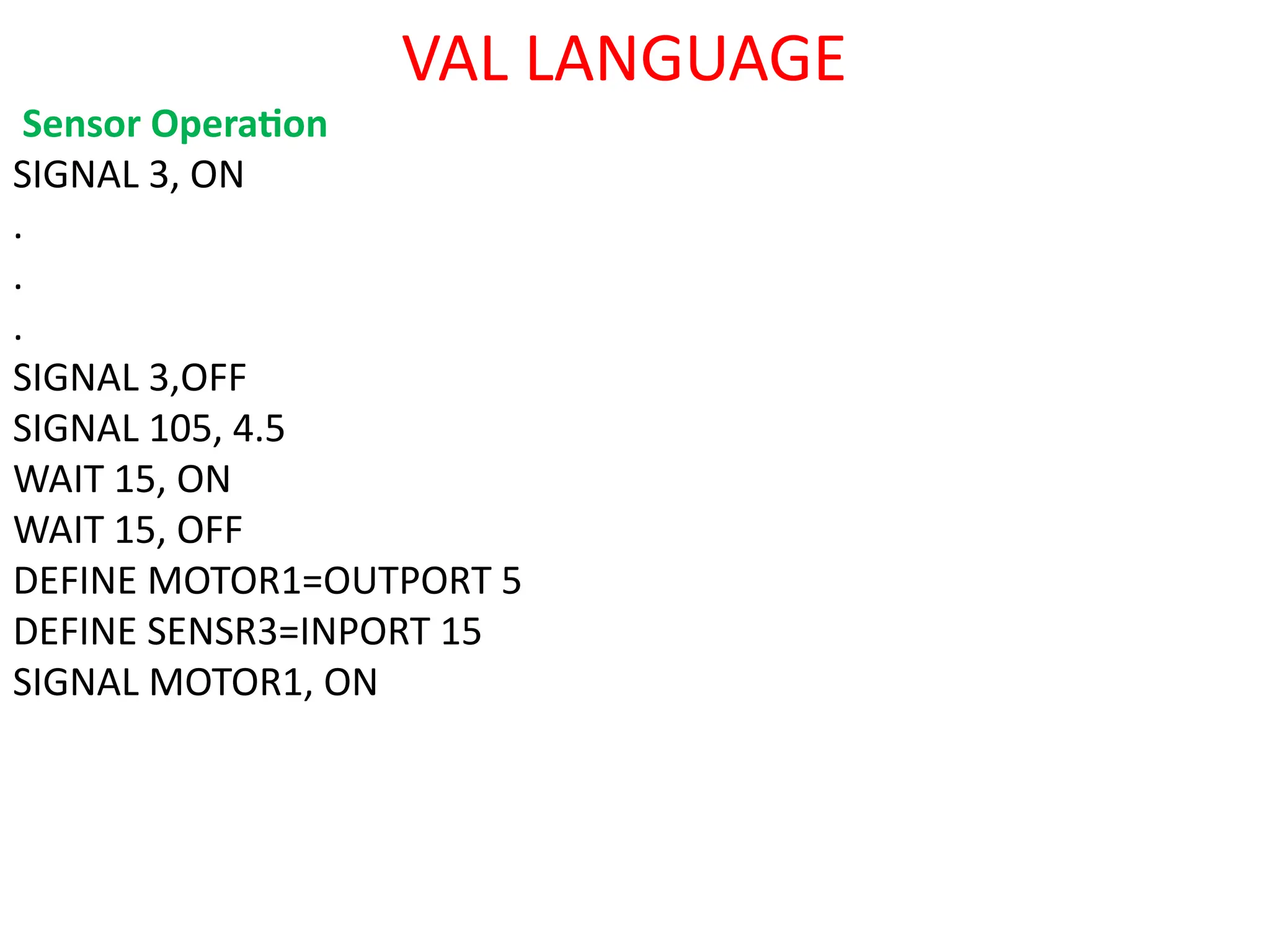
VAL LANGUAGE
Sensor Operation
SIGNAL 3, ON
.
.
.
SIGNAL 3,OFF
SIGNAL 105, 4.5
WAIT 15, ON
WAIT 15, OFF
DEFINE MOTOR1=OUTPORT 5
DEFINE SENSR3=INPORT 15
SIGNAL MOTOR1, ON
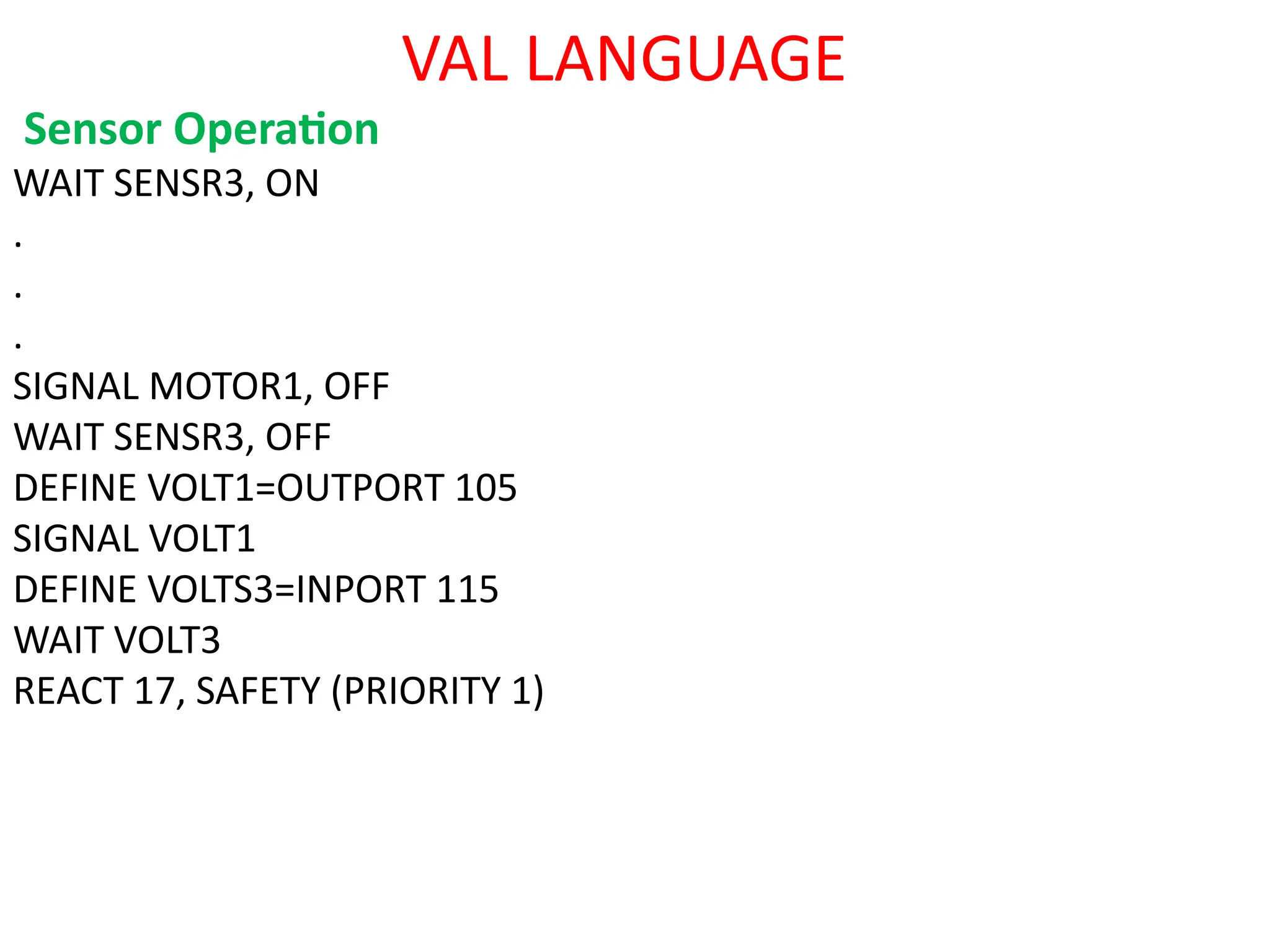
VAL LANGUAGE
Sensor Operation
WAIT SENSR3, ON
.
.
.
SIGNAL MOTOR1, OFF
WAIT SENSR3, OFF
DEFINE VOLT1=OUTPORT 105
SIGNAL VOLT1
DEFINE VOLTS3=INPORT 115
WAIT VOLT3
REACT 17, SAFETY (PRIORITY 1)
Robot manipulator Programming & its languages - 2.pptx

  • 1.
  • 2.
    Methods of RobotProgramming 1. Leadthrough Programming 2. Textual robot languages Leadthrough Programming methods: 1.Powered Leadthrough 2. Manual Leadthrough
  • 3.
    Methods of definingpositions in space 1. Joint movements 2. x-y-z coordinate motions (also called world coordinates) 3. Tool coordinate motions
  • 4.
    Robot Languages For easeof control of motions of robots having different structures and geometrical capabilities.
  • 5.
    Classification 1. First generationlanguage * Provides off-line programming in combination with the programming through robot pendant teaching. (E.g) VAL * Branching, IP/OP interfacing and commands leading to a sequence of movements of arm and body, and opening and closing of the end – effectors are possible. * ON/OFF binary signals
  • 6.
    Classification 2. Second GenerationLanguage * They are structured Programming languages performing complex tasks. * Complex motions can be generated. * Handle both analog and digital signals besides the binary signals. * Force, torque, slip and other sensors can be incorporated on the joints, wrist of gripper fingers. * (E.g) VAL II, AML, RAIL, MCL, etc., * Today’s programming languages with all features including knowledge- based programs some decision- making programs can be kept in the robot’s memory to find some means of getting out of the manufacturing. * They have better interacting facilities with other computers. Data processing, file management and keeping all the records of the events happening in the work-cell can be done more efficiently. 3. World modeling and task – oriented object level language * TIGHTEN THE NUT –Voice Control
  • 7.
    VAL LANGUAGE MOTION COMMANDS MOVEand Related Statements MOVE A1 MOVES A1 MOVE A1 VIA A2 APPRO A1,50 SIGNAL (to close gripper) DEPART 50 DMOVE(1,10) DMOVE(4,5,6), (30,-60,30) MOVE ARM2 TO A1
  • 8.
    VAL LANGUAGE MOTION COMMANDS SPEEDcontrol SPEED 60 IPS SPEED 75 Definition of Points in the workspace HERE A1 DEFINE A1 = POINT {50.526,236.003,14.581,25.090,125.750}
  • 9.
    VAL LANGUAGE MOTION COMMANDS SPEEDcontrol Paths and Frames DEFINE PATH1=PATH(A1,A2,A3,A4) MOVE PATH1 MOVES PATH1 DEFINE FRAME=FRAME(A1,A2,A3) DEFINE ROUTE:FRAME1=PATH(P1,P2,P3,P4,P5,P6,P7) MOVES ROUTE:FRAME2 MOVES ROUTE:FRAME3 MOVES ROUTE:FRAME4 . . . MOVES ROUTE:FRAME9
  • 10.
    VAL LANGUAGE END EFFECTORAND SENSOR COMMANDS End Effector operation OPEN and CLOSE OPENI and CLOSEI CLOSE 40 MM or CLOSE 1.575 IN CLOSE 3.0LB CENTER OERATE TOOL (SPEED=125RPM) OERATE TOOL (TORQUE=5 IN LB) OERATE TOOL (TIME=10 SEC)
  • 11.
    VAL LANGUAGE Sensor Operation SIGNAL3, ON . . . SIGNAL 3,OFF SIGNAL 105, 4.5 WAIT 15, ON WAIT 15, OFF DEFINE MOTOR1=OUTPORT 5 DEFINE SENSR3=INPORT 15 SIGNAL MOTOR1, ON
  • 12.
    VAL LANGUAGE Sensor Operation WAITSENSR3, ON . . . SIGNAL MOTOR1, OFF WAIT SENSR3, OFF DEFINE VOLT1=OUTPORT 105 SIGNAL VOLT1 DEFINE VOLTS3=INPORT 115 WAIT VOLT3 REACT 17, SAFETY (PRIORITY 1)