The story of the changing space of
reading and writing in 2014
ETEC 540
July 2014
Using quotes from:
Writing Space: The computer, hypertext and the history of
writing.
By J.D Bolter
Once upon a time there was
something called Writing.
 “Writing is a medium of communication that
represents language through the inscription of
signs and symbols. In most languages, writing
is a complement to speech or spoken
language” (Wikipedia, 2014)
And it had a BFF called Reading
 Reading is a complex cognitive process of
decoding symbols in order to construct or
derive meaning. It is a means of language
acquisition, of communication and of sharing
information and ideas.
 (Wikipedia, 2014)
Together they mutated
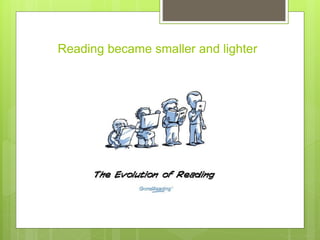
Reading became smaller and lighter
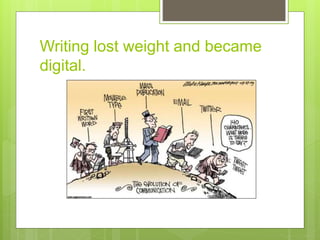
Writing lost weight and became
digital.
Writing did not like the changes
 “The principal idea of each generation would
no longer write itself with the same material
and in the same way..”
 “The distinction between lasting texts and
pragmatic communication has broken down,
and all kinds of communication are being
digitized. ”
Reading, thought the changes
were good.
 “Digital technology seems to reduce the
distance between author and reader by
turning the reader into an author herself”
They fought over who was more
important.
 “Printing did displace handwriting, in the
sense that the printed book became the most
highly valued form of writing.”
 “Today we are living in the late age of print.
Word processing, databases, e-mail, the
World Wide Web, and computer graphics are
displacing printed communication for various
purposes”
Writing was worried.
 “it has now become clear that we can use the
computer to provide a writing surface with
conventions different from those of print”
 “Electronic writing is mechanical and precise like
printing, organic and evolutionary like handwriting,
visually eclectic like hieroglyphics and picture
writing. On the other hand, electronic writing is
fluid and dynamic to a greater degree than
previous technologies.”
Reading was happy.
 “Tensions between monumentality and
changeability and between the tendency to
magnify the author and to empower the
reader have already become part of our
current economy of writing.”
 “Machines have diminished dramatically in
size and in price during the past 40 years, and
computer screens are becoming more
readable. ”
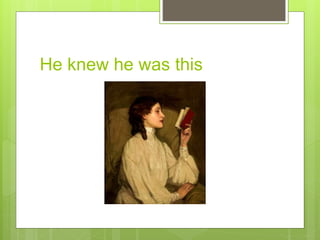
He knew he was this
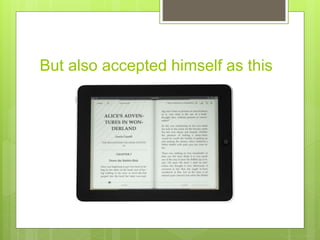
But also accepted himself as this
Reading realized he had to
help Writing. He realized they
could not live without each
other.
Reading tried to convince Writing
that change was good
 “Most writers have enthusiastically accepted
the word processor precisely because it does
not challenge their conventional notion of
writing. The word processor is an aid for
making perfect printed copy: the goal is still
ink on paper.”
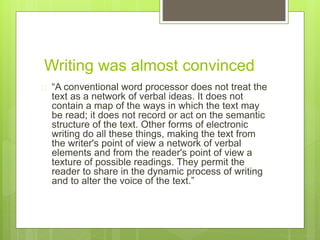
Writing was almost convinced
 “A conventional word processor does not treat the
text as a network of verbal ideas. It does not
contain a map of the ways in which the text may
be read; it does not record or act on the semantic
structure of the text. Other forms of electronic
writing do all these things, making the text from
the writer's point of view a network of verbal
elements and from the reader's point of view a
texture of possible readings. They permit the
reader to share in the dynamic process of writing
and to alter the voice of the text.”
She was reassured that
 “Every text, no matter how rigid its
hierarchical organization, must after all work
though associations of sound as well as
ideas. Even if a writer begins with and
remains faithful to an outline, the result is
always a network of verbal elements.”
She thought about
 “ If all texts can ultimately be regarded as
networks of verbal elements, digital
technology makes it much easier to record
and present these networks to writers and
readers.”
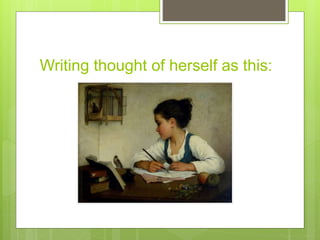
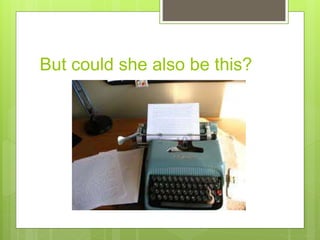
Writing thought of herself as this:
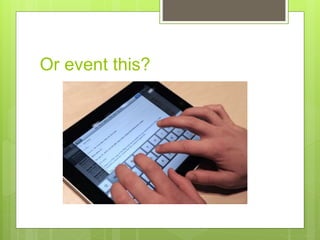
But could she also be this?
Or event this?
She heard Reading say
 “Multimedia on the Internet is helping to
redefine the relationship of word and image, a
process of redefinition that had already been
going on in our culture's writing space for
decades.”
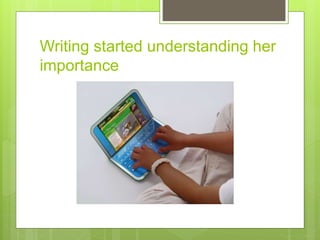
Writing started understanding her
importance
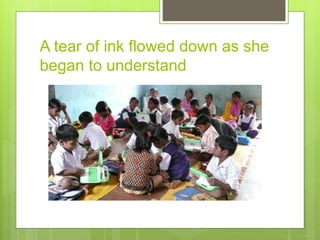
A tear of ink flowed down as she
began to understand
They came to a conclusion.
Neither was more important,
Reading and writing had evolved
together. They needed each
other.
 “In this late age of print, the two technologies,
print and electronic writing, still need each
other.”
 “It seems increasingly natural to represent all
sorts of information as hypertext on the World
Wide Web.”
 “Electronic hypertext is not the end of print; it
is instead the remediation of print.”
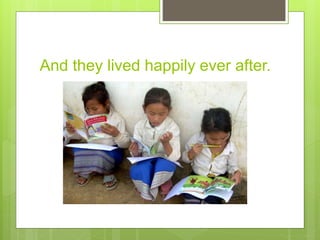
And they lived happily ever after.
References:
 1)Evolution of reading, [photograph] retrieved July 9th from:
 https://homoeconomicusnet.wordpress.com/tag/humour/
 2)Writing heals and keeps me sane, [photograph] retrieved July 9th from:
 https://www.flickr.com/photos/mrsdkrebs/7989674100/in/photolist-db2aKJ-8dJBzB-6qNWzU-8Jkhjr-5meDVG-
xLUqy-4xMRLU-88TxSz-7YnRkk-8swpRx-4zoES-9nnJjC-6h2jvE-6wd9Mw-6ajgze-dUScov-aJPNLn-4kKXC-
8Z5eVC-9wShWM-BMFkL-7sMRfW-4wLVYi-8amXGb-cC4YY9-7S5Acj-xKiwV-4mkBjq-7Fro46-2BzZNk-
4mMuQE-6jQV5n-9Ag4Wp-bJ8WHP-dTtNxZ-61jMvt-5XhpBb-7Fro7M-akcukh-aaHDon-bDMEYH-6EMdga-
iLXoqB-7gHBwx-daQimU-7JM9oz-563tay-aaDf8Q-7SP2FQ-9E6BKR
 3)Writing is my hobby, [photograph] retrieved July 9th from:
 https://www.flickr.com/photos/danoff/3427826247/in/photolist-6dUvjx-aaFzdh-bo3m2z-nRppGA-9eKvZr-
4X7zeZ-fsA5BG-9ZT7mD-2WUKDW-4p1s5k-g7h9EG-HvN2R-i4a5Sr-cUBc6q-ynRUT-7CUriE-Cvsam-cFssXu-
9YwFk-pv63t-6ifpBT-NQYHJ-nNoKHj-5FDznX-dGwfTC-4x7jUo-iW7afq-7Fvho1-5WLNWm-5iJp6M-7NcEL3-
aXdewF-fjJZQT-d7diQf-db2aKJ-8dJBzB-6qNWzU-8Jkhjr-5meDVG-xLUqy-4xMRLU-88TxSz-7YnRkk-8swpRx-
4zoES-9nnJjC-6h2jvE-6wd9Mw-6ajgze-dUScov/
 4)Evolution of communication, [photograph] retrieved July 9th from:
 http://www.ritholtz.com/blog/2009/04/evolution-of-writing/
 5)Writing, [photograph] retrieved July 9th from:
 http://en.wikipedia.org/wiki/Writing
 6)Rowne, Henriette- A girl Writing. [photograph] retrieved July 9th from:
 http://commons.wikimedia.org/wiki/File:Browne,_Henriette_-_A_Girl_Writing;_The_Pet_Goldfinch_-
_Google_Art_Project.jpg
 7)Typerwriter, [photograph] retrieved July 9th from:
 http://www.minascreativeexpressions.com/2013_10_01_archive.html
References continued:
 8)Virtual Keyboard, [photograph] retrieved July 9th from:
 http://en.wikipedia.org/wiki/Virtual_keyboard
 9)Miss Auras, [photograph] retrieved July 9th from:
 http://en.wikipedia.org/wiki/Reading_(process)
 10)Ipad generation 1, [photograph] retrieved July 9th from:
 http://en.wikipedia.org/wiki/IPad
 11)One Laptop pew child, [photograph] retrieved July 9th from:
 http://en.wikipedia.org/wiki/One_Laptop_per_Child
 12)OLPC_Khairat_Collaborating. [photograph] retrieved July 9th from:
 http://commons.wikimedia.org/wiki/File:OLPC_Khairat_Collaborating.JPG
 13)Lao School Girls, [photograph] retrieved July 9th from:
 http://en.wikipedia.org/wiki/Literacy

 14) Bolter, J.D (1991). Writing Space: The computer, hypertext and the history of writing. Hillsdale,
NJ: Lawrence Erlbaum Associates.
 15) Wikimedia Foundation. (2014, July 7). Reading (process). Retrieved July 9th from Wikipedia:
http://en.wikipedia.org/wiki/Reading_(process)
 16) Wikimedia Foundation. (2014, June 11). Writing. Retrieved July 9th from Wikipedia:
http://en.wikipedia.org/wiki/Writing

Rip Mix Feed- ETEC 540

  • 1.
    The story ofthe changing space of reading and writing in 2014 ETEC 540 July 2014 Using quotes from: Writing Space: The computer, hypertext and the history of writing. By J.D Bolter
  • 2.
    Once upon atime there was something called Writing.  “Writing is a medium of communication that represents language through the inscription of signs and symbols. In most languages, writing is a complement to speech or spoken language” (Wikipedia, 2014)
  • 3.
    And it hada BFF called Reading  Reading is a complex cognitive process of decoding symbols in order to construct or derive meaning. It is a means of language acquisition, of communication and of sharing information and ideas.  (Wikipedia, 2014)
  • 4.
  • 5.
  • 6.
    Writing lost weightand became digital.
  • 7.
    Writing did notlike the changes  “The principal idea of each generation would no longer write itself with the same material and in the same way..”  “The distinction between lasting texts and pragmatic communication has broken down, and all kinds of communication are being digitized. ”
  • 8.
    Reading, thought thechanges were good.  “Digital technology seems to reduce the distance between author and reader by turning the reader into an author herself”
  • 9.
    They fought overwho was more important.  “Printing did displace handwriting, in the sense that the printed book became the most highly valued form of writing.”  “Today we are living in the late age of print. Word processing, databases, e-mail, the World Wide Web, and computer graphics are displacing printed communication for various purposes”
  • 10.
    Writing was worried. “it has now become clear that we can use the computer to provide a writing surface with conventions different from those of print”  “Electronic writing is mechanical and precise like printing, organic and evolutionary like handwriting, visually eclectic like hieroglyphics and picture writing. On the other hand, electronic writing is fluid and dynamic to a greater degree than previous technologies.”
  • 11.
    Reading was happy. “Tensions between monumentality and changeability and between the tendency to magnify the author and to empower the reader have already become part of our current economy of writing.”  “Machines have diminished dramatically in size and in price during the past 40 years, and computer screens are becoming more readable. ”
  • 12.
    He knew hewas this
  • 13.
    But also acceptedhimself as this
  • 14.
    Reading realized hehad to help Writing. He realized they could not live without each other.
  • 15.
    Reading tried toconvince Writing that change was good  “Most writers have enthusiastically accepted the word processor precisely because it does not challenge their conventional notion of writing. The word processor is an aid for making perfect printed copy: the goal is still ink on paper.”
  • 16.
    Writing was almostconvinced  “A conventional word processor does not treat the text as a network of verbal ideas. It does not contain a map of the ways in which the text may be read; it does not record or act on the semantic structure of the text. Other forms of electronic writing do all these things, making the text from the writer's point of view a network of verbal elements and from the reader's point of view a texture of possible readings. They permit the reader to share in the dynamic process of writing and to alter the voice of the text.”
  • 17.
    She was reassuredthat  “Every text, no matter how rigid its hierarchical organization, must after all work though associations of sound as well as ideas. Even if a writer begins with and remains faithful to an outline, the result is always a network of verbal elements.”
  • 18.
    She thought about “ If all texts can ultimately be regarded as networks of verbal elements, digital technology makes it much easier to record and present these networks to writers and readers.”
  • 19.
    Writing thought ofherself as this:
  • 20.
    But could shealso be this?
  • 21.
  • 22.
    She heard Readingsay  “Multimedia on the Internet is helping to redefine the relationship of word and image, a process of redefinition that had already been going on in our culture's writing space for decades.”
  • 23.
  • 24.
    A tear ofink flowed down as she began to understand
  • 25.
    They came toa conclusion. Neither was more important, Reading and writing had evolved together. They needed each other.
  • 26.
     “In thislate age of print, the two technologies, print and electronic writing, still need each other.”  “It seems increasingly natural to represent all sorts of information as hypertext on the World Wide Web.”  “Electronic hypertext is not the end of print; it is instead the remediation of print.”
  • 27.
    And they livedhappily ever after.
  • 28.
    References:  1)Evolution ofreading, [photograph] retrieved July 9th from:  https://homoeconomicusnet.wordpress.com/tag/humour/  2)Writing heals and keeps me sane, [photograph] retrieved July 9th from:  https://www.flickr.com/photos/mrsdkrebs/7989674100/in/photolist-db2aKJ-8dJBzB-6qNWzU-8Jkhjr-5meDVG- xLUqy-4xMRLU-88TxSz-7YnRkk-8swpRx-4zoES-9nnJjC-6h2jvE-6wd9Mw-6ajgze-dUScov-aJPNLn-4kKXC- 8Z5eVC-9wShWM-BMFkL-7sMRfW-4wLVYi-8amXGb-cC4YY9-7S5Acj-xKiwV-4mkBjq-7Fro46-2BzZNk- 4mMuQE-6jQV5n-9Ag4Wp-bJ8WHP-dTtNxZ-61jMvt-5XhpBb-7Fro7M-akcukh-aaHDon-bDMEYH-6EMdga- iLXoqB-7gHBwx-daQimU-7JM9oz-563tay-aaDf8Q-7SP2FQ-9E6BKR  3)Writing is my hobby, [photograph] retrieved July 9th from:  https://www.flickr.com/photos/danoff/3427826247/in/photolist-6dUvjx-aaFzdh-bo3m2z-nRppGA-9eKvZr- 4X7zeZ-fsA5BG-9ZT7mD-2WUKDW-4p1s5k-g7h9EG-HvN2R-i4a5Sr-cUBc6q-ynRUT-7CUriE-Cvsam-cFssXu- 9YwFk-pv63t-6ifpBT-NQYHJ-nNoKHj-5FDznX-dGwfTC-4x7jUo-iW7afq-7Fvho1-5WLNWm-5iJp6M-7NcEL3- aXdewF-fjJZQT-d7diQf-db2aKJ-8dJBzB-6qNWzU-8Jkhjr-5meDVG-xLUqy-4xMRLU-88TxSz-7YnRkk-8swpRx- 4zoES-9nnJjC-6h2jvE-6wd9Mw-6ajgze-dUScov/  4)Evolution of communication, [photograph] retrieved July 9th from:  http://www.ritholtz.com/blog/2009/04/evolution-of-writing/  5)Writing, [photograph] retrieved July 9th from:  http://en.wikipedia.org/wiki/Writing  6)Rowne, Henriette- A girl Writing. [photograph] retrieved July 9th from:  http://commons.wikimedia.org/wiki/File:Browne,_Henriette_-_A_Girl_Writing;_The_Pet_Goldfinch_- _Google_Art_Project.jpg  7)Typerwriter, [photograph] retrieved July 9th from:  http://www.minascreativeexpressions.com/2013_10_01_archive.html
  • 29.
    References continued:  8)VirtualKeyboard, [photograph] retrieved July 9th from:  http://en.wikipedia.org/wiki/Virtual_keyboard  9)Miss Auras, [photograph] retrieved July 9th from:  http://en.wikipedia.org/wiki/Reading_(process)  10)Ipad generation 1, [photograph] retrieved July 9th from:  http://en.wikipedia.org/wiki/IPad  11)One Laptop pew child, [photograph] retrieved July 9th from:  http://en.wikipedia.org/wiki/One_Laptop_per_Child  12)OLPC_Khairat_Collaborating. [photograph] retrieved July 9th from:  http://commons.wikimedia.org/wiki/File:OLPC_Khairat_Collaborating.JPG  13)Lao School Girls, [photograph] retrieved July 9th from:  http://en.wikipedia.org/wiki/Literacy   14) Bolter, J.D (1991). Writing Space: The computer, hypertext and the history of writing. Hillsdale, NJ: Lawrence Erlbaum Associates.  15) Wikimedia Foundation. (2014, July 7). Reading (process). Retrieved July 9th from Wikipedia: http://en.wikipedia.org/wiki/Reading_(process)  16) Wikimedia Foundation. (2014, June 11). Writing. Retrieved July 9th from Wikipedia: http://en.wikipedia.org/wiki/Writing